



Answering the question upfront to ground us in the same language.
By definition, a full life encompasses more than a good life; one who has lived more fully can categorically say that they have seen & felt more, irrespective of what those things may be. An easy example is speaking multiple languages. That breadth allows your experiences to exist on a fuller continuum. If I can only laugh at jokes told in English, for instance, I will hypothetically laugh less than a person who can understand jokes in two or more languages (all things being equal). I’d opt for a life of more laughter. Feels like a universal aspiration.
A good life may feel subjectively better than a full life, but it can’t (again, by definition) be more complete than a full life. And elders on their last leg seem to always remind us that, when your time comes, fullness is what you’ll be thankful you experienced.
But we’ve always been an ears-half-open sort of species. Hard of hearing, as Jamaicans would say. For whatever reason, we need to see it for ourselves to believe it.
True?

Further grounding.
We are all traceable consequences of what came before us. Some call it history (read: I call it that). Others vary their talk track to prevent dissonance. Not mad at you for your choices.
We are also the cumulative of our experiences. The grand sum of the only guidepost that matters: exposure. Or, as Brené Brown highlighted in Atlas of the Heart: Mapping Meaningful Connection and the Language of Human Experience –
“The limits of my language mean the limits of my world.” – Ludwig Wittgenstein
Because how can you know if you don’t know? How can you enjoy or seek out that which you can’t even see? Rude answer is – you can’t.
Bob Marley, ever one to be introspective in his days, evoked and verbalized this timeless notion best: “Who Feels It (Knows It).”
So I ask – are you after a good life or a full life?
Range.
“We were poor, but we had love. And the fun we had was real fun, because it was all built on love.” – Dapper Dan, Made in Harlem: A Memoir
Anyone who grew up without, anyone who has borne the heavy brunt of economic volatility, even if their innocent child brain could not decipher that cloud, knows that the presence (or absence) of love made a huge difference. I do not mean poor in the completely inescapable sense, since poor-poor is whale weight heavy and chronic. That bind doesn’t allow for fun when everyone is hanging on by a thread. This is not what I mean.
The ‘getting by, but we’ll be alright’ described by Dapper Dan – what I’m referring to – is far from a contradiction. Dapper Dan’s portrayal is a fiercely aggressive (I prefer the word “honest”) world to live in, yes. One that strips people down to their naked selves and forces you to be who you are, truly. But also, since economic preconditions aren’t social acceptance prerequisites in that world, the love that is passed around tends to be more honest. Everything, for that matter, tends to be (or at least feel) more real.
“Living simply makes loving simple.” – bell hooks, all about love: new visions
For perspective on the other side of that coin:
“Indeed, the rich and the rest have very differently constructed social networks: rich networks are broad (national and even international) but shallow and cater to “a mobile, even migratory” or “cosmopolitan” self, while working- and middle-class networks are narrow but deep and cater to a “rooted self.” Even activities as basic as cooking and conversation now divide the rich and the rest. Elites cook novel foods to impress people whom they would like “to know better,” often for purposes of professional networking; the middle class, by contrast, cooks familiar food to share with family and long-standing friends. And the rich tend toward formal and polite conversational habits, while the rest are proudly straightforward and direct.” – Daniel Markovits, The Meritocracy Trap: How America’s Foundational Myth Feeds Inequality, Dismantles the Middle Class, and Devours the Elite
Wouldn’t we all be happier if everything were “proudly straightforward and direct,” or is that a pipe dream?
As I’ve coursed through a few universes and seen how different tribes live (note: this is how I prefer to describe humans across countries & socio-economic classes), I’ve grown increasingly thankful for the personal range – exposure & experiences – I’ve developed. And I don’t mean experienced the way a 3-day vacation leaves an intentional person wanting. I mean experienced in a ‘I was in it-in it’ sort of way.
And across every single tribe, there are more constants & similarities than differences. A primary sticking point is that we are full of shit, which I mean in the most loving way possible. We’ve inherited worlds that we do our darndest to make sense of, often with a finite toolkit. For many of us, a limited range will only allow us to deal with what we can perceive/see, which can drive a person crazy when they know that something is more detailed than they have language to describe.
Those with the most range interrogate their inheritance fiercely (read: are open-minded), which is a fancy way of saying they care more about knowing than defaulting. We’d do really well as a human species to practice the mantra of ‘I see you in me’ as opposed to allowing our intersubjective realities (things that exist only because we talk about them) to siphon us off into specific tribes.
A little personal range brain dump to keep things exciting:
Of the Bronx, not enough to just say I was born there. I was an outside child (shout out to my Uptown massive).
Another shout out to my Albanians and Kosovars (who I used to kick ball with) for teaching me how to play poker and chess. Forgive me, I’ve forgotten how to do both.
There is no greater teacher than the soil and the mountains. They don’t confuse you about what’s what. Big up the best-balanced youth a child could ask for, given my time spent in St. Elizabeth, Jamaica.
I believe investment banking & private equity are the best introductory roles a person can start in; I can also admit that I don’t have the introductory experience across other industries to opine in those directions. But see, I am in the rum space now = ), which will come as a surprise to absolutely no one.
Texas, I miss you from time to time.
Kingston (Jamaica), I miss you more.
Wadi Shab in Oman is still one of the most beautiful things I’ve ever seen; I’m sure some of those sites in Madeira could’ve topped it. I didn’t get around to scaling the island in the limited time there.
To the French man in Nice who translated my request for a pour of neat rum to ‘pure,’ I won’t ever forget that…or you and your wife’s Brazilian food, my goodness.
I’d put Grenada up against a lot of countries in terms of beauty (and hilliness).
My core point is that range is a blessing. It is the only thing that carries you from point A to Z. Range is your way of sense-making. The idea that ‘you don’t know what you don’t know’ is particularly true for those with less experience & exposure. Range anchors where and how you can exist. Some friends can slum it. Other friends need a 5-star hotel. Some friends can be thrown in any room. Other friends can only exist in certain rooms. Some friends are antisocial. And I don’t hang with those friends. I’m kidding.
For someone who has climbed to the top (whatever that may mean to you) from the bottom, the idea of starting over from zero is far less scary because that person has the range to understand that everything will be just fine; it may not be ideal, but there are worse things in the world. This sentiment most often comes from people who have walked that walk:
“I make sure I always prepare for the reality that I might have to start all over.” – Dapper Dan, Made in Harlem: A Memoir
Vary your palate, good and bad, even if it feels contradictory/that you’re inviting pain and friction into your life. Because when it’s time to face yourself, the only person you won’t ever outrun, that range will be your compass. For me, variation is a healthy reminder that things will literally be okay, EVERY SINGLE TIME.
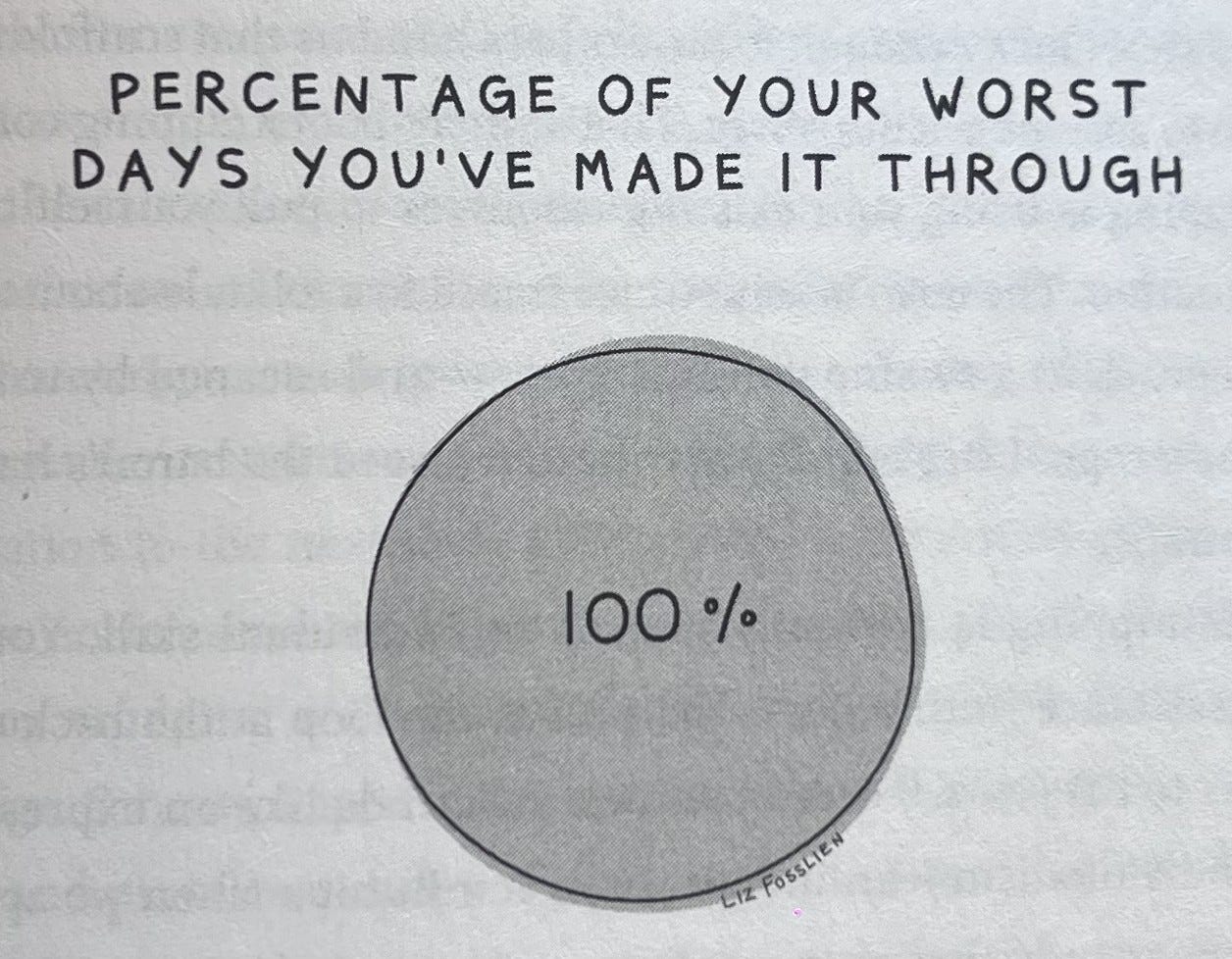
I’d go so far as to argue that your range dictates the type of life you’ve lived to date, though it says nothing of what is to come. Humans are malleable like that.
Ignoring the extremes for a second, the narrower your bounded range (by design or decisions), the more you’ve lived a good life and not a full one. And the older I get, the more I begin to believe that a full life is best, even if it doesn’t have the bells and whistles of the perceived good life. Didn’t I say that all the old folks on their way out usually tell us this?
So I ask again – are you after a good life or a full life?
The forest.
“Most people today rarely step outside their comfort zones. We are living progressively sheltered, sterile, temperature-controlled, overfed, underchallenged, safety-netted lives. And it’s limiting the degree to which we experience our “one wild and precious life,” as poet Mary Oliver put it.” – Michael Easter, The Comfort Crisis: Embrace Discomfort to Reclaim Your Wild, Happy, Healthy Self
“…as we experience fewer problems, we don’t become more satisfied. We just lower our threshold for what we consider a problem. We end up with the same number of troubles. Except our new problems are progressively more hollow…no matter how good we can have it relative to the grand sweep of humanity. We are always moving the goalpost. There is, quite literally, a scientific basis for first-world problems.” – Michael Easter, The Comfort Crisis: Embrace Discomfort to Reclaim Your Wild, Happy, Healthy Self
Life. You only get one chance to go through the forest. And in this proverbial forest, freedom of movement is guaranteed. Let’s assume no jaguars or other animals to remind us that we are, strength-wise, a supremely inferior species. Laughably so.
Some will carve out a portion of the forest, let’s call it “Z-land,” the homogenous section. The good life is a reality in Z-land – let’s accept that. Someone from another part of the forest may be dissatisfied with their section and pursue residence in Z-land. Once they arrive, they’ll feel temporarily fulfilled that they finally made it. That latter person has gone from A to Z. And now, assuming full acceptance in Z-land, A-lander is firmly rooted in a bounded life, typically an unsavory meal for someone who has experienced and knows that the joy is in the journey. Those born in and only know Z-land may inquire about what things are like back in the A to Y sections of the forest. Z-lander doesn’t know what they don’t know because the good life has kept them bound in the sparkly, uneventful side of the forest. But hey, life is good - right?
“Upward-oriented people, in contrast, moved in more homogenous social and family circles, had experienced less class mobility, and espoused more conservative politics (relatively speaking).” – Rachel Sherman, Uneasy Street: The Anxieties of Affluence
Outside of that clear priming with the quote, I’ll be presumptuous and surmise that your brain largely defaulted to a rags-to-riches story in the context of the forest; arguably, the most apt think-track for our purposes. But I’d say it applies to everything. Reading only one kind of book vs. all kinds (I’m a bit guilty in that regard). Listening to one type of music and never feeling the jolt of good feeling that comes from all kinds of music. Have you ever listened to a great South African soulful house track? To that end, I want to give another big shout out to my Albanians for introducing me to this song at a young age, when I was strictly in Hip Hop & Dancehall mode (for the most part) –
Note: some of the best artists we have are dear fans of music you wouldn’t immediately associate them with. Case in point, Method Man:
Scale as much of the forest as you reasonably can. There are all sorts of phrases and adages about ‘greener grass’ and ‘watering where you are.’ I only advise you to pursue range without anchoring yourself in hopes and dreams of what you expect something to be like. Your chances of ending up disappointed decrease dramatically. It must be incredibly defeating to, as many do, chase something your entire life only to find out that it’s not a ‘bed of roses.’
Or, as many people who go from rags to riches feel about the riches side of things, it ain’t all it’s cracked up to be from an interpersonal standpoint. Which I can understand, given that there is the very real cloud hovering above: there would be no relationship if there were no economic and social status anchoring the contact. In that way, it’s a thin connection. Or it can be. There is no judgment in that statement. Tribes operate differently, and if you want to be a part of that tribe, people tend to play by those rules. That’s just the way it is, I suppose.
There’s a heady middle-ground that can feel complicated for the range-r (I just made that up, but I like it):
“My people be projects or jail, never Harvard or Yale.” – Nas, Book of Rhymes
Philosophically speaking, I don’t think any of the above has to be that way, so long as you’re grounded in who you are. Being grounded is one of the fastest tracks to accepting people from all walks of life. I thank NYC and Jamaica for making me completely full of myself (in my youth), which then served as the tool(s) I rely on to knock down invisible wall(s) between I and another person. All within reason, of course. Let’s not get carried away.
All to say, journey through the forest and back. You’ll be thankful for the variety along the way. Hell, you’ll have more to speak about. Those typically are the most interesting people. You can’t invent, engineer, or shortcut the knowledge that accumulates from seeing, feeling, and knowing as much as possible. Go and see what…I don’t know…R-land looks like in that proverbial A to Z forest.
For those who are more ‘how can I apply this’ inclined, here are some analogous ways to think about the information –
“…breadth of training predicts breadth of transfer. That is, the more contexts in which something is learned, the more the learner creates abstract models, and the less they rely on any particular example. Learners become better at applying their knowledge to a situation they’ve never seen before, which is the essence of creativity.” – David Epstein, Range: Why Generalists Triumph In A Specialized World
“Learning deeply means learning slowly.” – David Epstein, Range: Why Generalists Triumph In A Specialized World
Go for it.
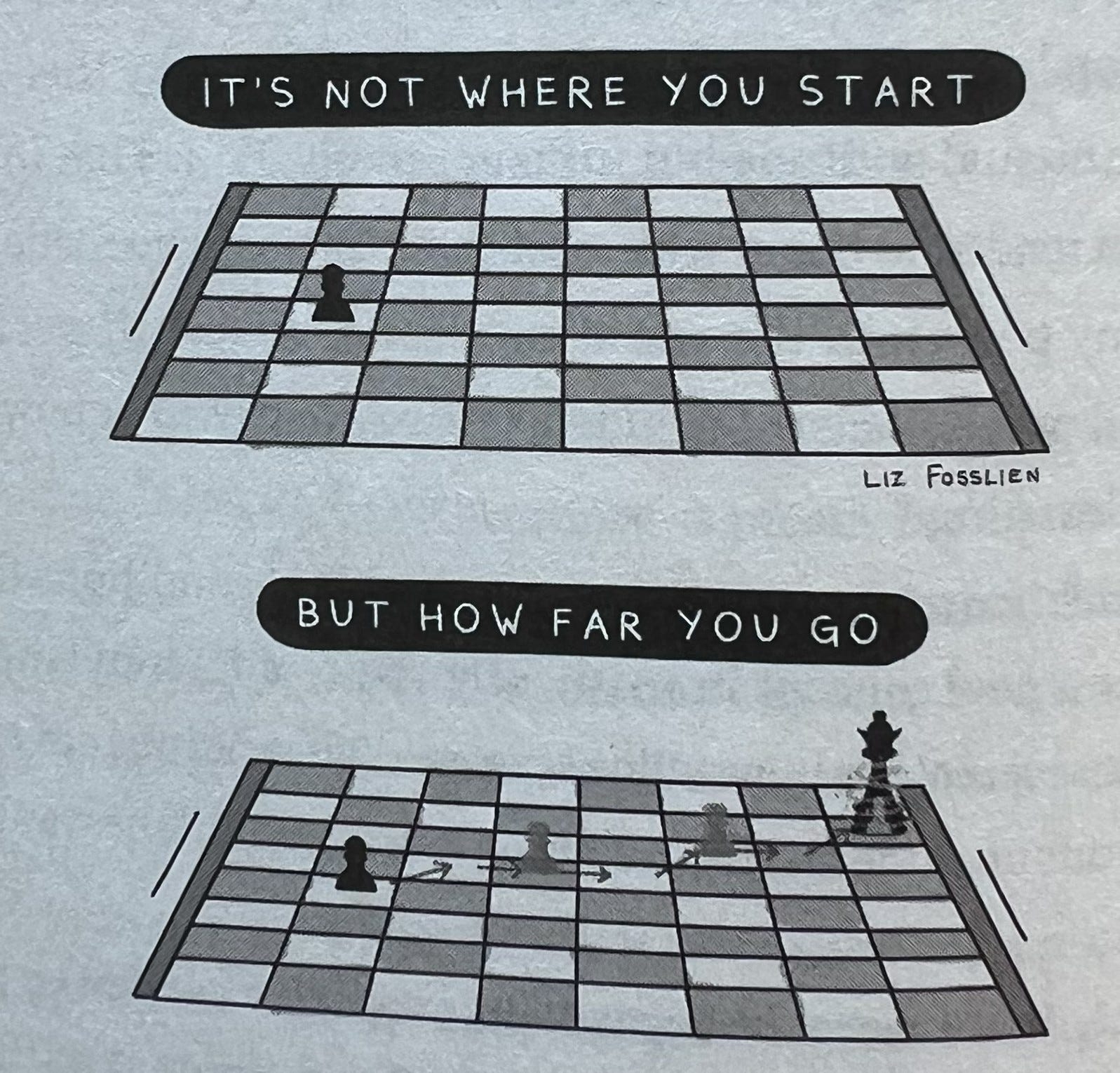
“The true measure of your potential is not the height of the peak you’ve reached, but how far you’ve climbed to get there.” – Adam Grant’s Hidden Potential: The Science of Achieving Greater Things
“Becoming a creature of discomfort can unlock hidden potential in many different types of learning. Summoning the nerve to face discomfort is a character skill—an especially important form of determination. It takes three kinds of courage: to abandon your tried-and-true methods, to put yourself in the ring before you feel ready, and to make more mistakes than others make attempts. The best way to accelerate growth is to embrace, seek, and amplify discomfort.” – Adam Grant’s Hidden Potential: The Science of Achieving Greater Things
Go, but look back if you need to. Whenever I chat with friends about decisions, I make sure to remind myself that we will largely conclude if a decision was good or bad in hindsight. Maybe even on our deathbeds, if we’re lucky. In that respect, life proves that the here and now, the experience received along the way, is where you’ll locate the maximum amount of memories and knowledge.
“There’s only an eternal present, and you can only experience the now.” – Fumio Sasaki, Goodbye, Things: The New Japanese Minimalism
“There’s really no tomorrow, and no next week to look forward to. Once tomorrow comes, it’s going to be today.” – Fumio Sasaki, Goodbye, Things: The New Japanese Minimalism
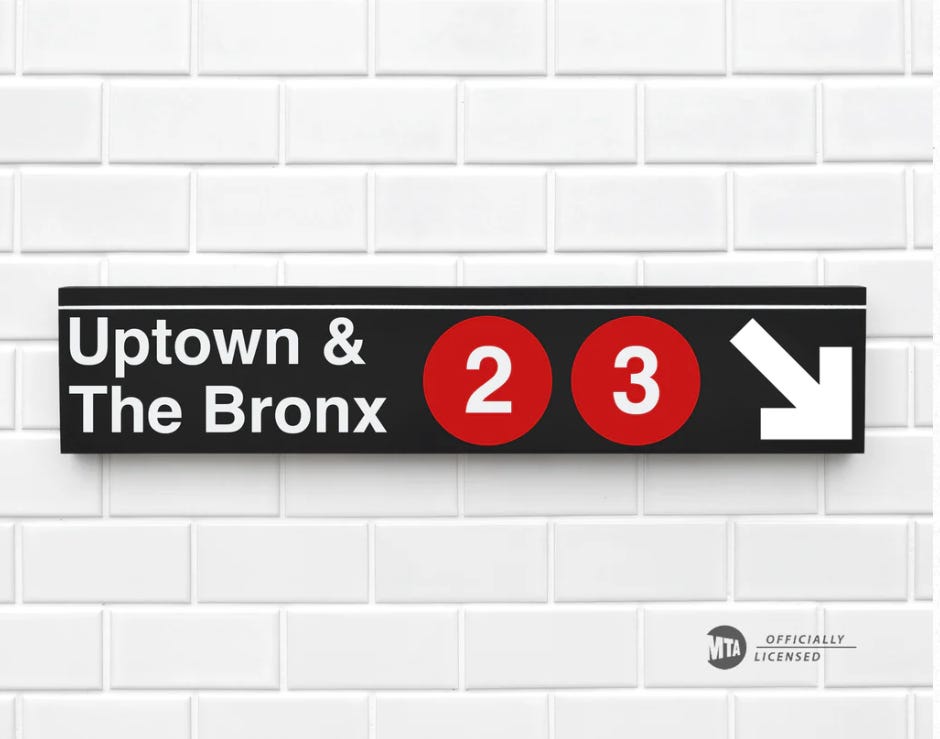
In a world that increasingly advocates for flat (similar) experiences, stepping off the line and showcasing a bit of variation can feel like you’re not playing nice with the times. I want to be clear: I do not believe this in the least. If there’s one thing my NYC upbringing taught me, and something that I will continue to practice until I turn skeleton, is that when you are on a train, and you don’t know what direction it’s going in, you get the hell off that train. Simple!
Anyone who knows the precarity of riding the train into unknown territory will understand this intuitively. Get your bearings; you may even get back on the same train and find that nothing changed. But at least that decision was yours.
“…my lonely is mine. Now your lonely is somebody else’s. Made by somebody else and handed to you. Ain’t that something? A secondhand lonely.” – Toni Morrison, Sula
That thing called retrospect. I believe it must be engaged often and with intention, so as not to lose sight of what is tangibly meaningful; life will pull you in all directions. Retrospect can be the proverbial CITGO sign at Boston University: a landmark that will always be your guidepost to get you home. As you can tell, this city kid has a thing about home base, guideposts, and taking heed of the signage. Shout out to my fellow BU terriers. I understand that the CITGO reference is hyper-specific.
Range fills out the compass by giving you the tools to assess. It allows you to determine if you’ve seen, felt, heard, or can distinguish whatever is going on in the present. Now I’ll close with a hard truth that serves as a seemingly immutable defense to everything I’ve discussed: that’s not how things work across most tribes. There’s a deep psychosis that comes with confined living. Economic and social reinforcements rationalize homogeneity. A self-reinforcing feedback loop denoting ‘this is the pinnacle.’ In the same wheelhouse, you have confined living driven mainly by anxieties toward outsiders, whoever they may be. People inherit fears about invisible ghosts. But can you imagine being fearful of someone you would probably enjoy being around if you just had a conversation with them? Whoa, I’m grateful to not be in that scenario, fighting with my mind, while my mind has Lennox Lewis gloves on.
No judgment on my end, someone else’s battle to fight. I’ll close with this: seek out novelty, change, and anything that will nurture your range. If that isn’t motivating enough, think back to when you were a little kid. Remember how slow time moved? How everything felt new, and many moments felt indescribably precious? There’s scientific reason for that:
“Psychologist William James…1890 work, The Principles of Psychology: “The same space of time seems shorter as we grow older…In youth we may have an absolutely new experience, subjective or objective, every hour of the day. Apprehension is vivid, retentiveness strong, and our recollections of that time, like those of a time spent in rapid and interesting travel, are of something intricate, multitudinous, and long-drawn-out. But as each passing year converts some of this experience into automatic routine that we hardly note at all, the days and the weeks smooth themselves out in recollection to contentless units, and the years grow hollow and collapse.” – Michael Easter, The Comfort Crisis: Embrace Discomfort to Reclaim Your Wild, Happy, Healthy Self
Trade in all that comfort and extend your life – psychologically – vs. living out the good life, dying a “hollow and collaps[ing]” death. I’ve heard it has implications for aging and dementia/Alzheimer’s; a naturally deteriorating brain combats this freefall with cognitively new challenge & activity, rather than living in complacency & mastery. Put simply – range extension:
“The only true voyage of discovery, the only fountain of Eternal Youth, would be not to visit strange lands but to possess other eyes, to behold the universe through the eyes of another, of a hundred others, to behold the hundred universes that each of them beholds, that each of them is.” – Marcel Proust
My thoughts on this are evolving and loose. However, I hope you received something concrete in the jumble.
The question remains – a good life or a full life?
Your brain may be screaming, “BOTH!”
Cheers to that.
Just remember,
in all that you do, please, don’t ever stop reading.

P.S. – don’t do anything extreme, all within reason, please.
ST. E THE BEST PARISH!!! (That was probably the least important part of this, but it had to be said lmao). This was truly magnificent. Range is something that opens you up in a way that you could never ever get from any other experience. And sometimes it comes simply from a hello and being open to connecting, before you even have to do any leaps to try to explore on your own. It means so much to me that the life I’ve experienced has taken me on a journey that could have closed me off, but trying to open the doors and finding new centers have saved me time and time again. I feel like they’re portals to pieces of you that you would’ve never known otherwise. And then you get to use those pieces as anchors when you need them — even in the smallest ways. Sometimes they’re not tangible and only live in your memories and that’s just enough to keep on going. It’s like when James Baldwin said you think you’re alone in your experiences until you read and see people have been living pieces of your life since the beginning of time and now you’re connected to anyone who has ever lived. (That’s not what he said that was my interpretation lmao) Anyways! I’m chatting now, so cheers to a good/full life and to the overall sentiment of, “it’s gonna be alright”.
That's a good question, I don't have an answer to just yet, but I guess it depends on what someone defines as a "fully lived life", and what that entails. Perhaps a bit of deep introspection, through experiences and connections over time helps you to arrive to that conclusion.