


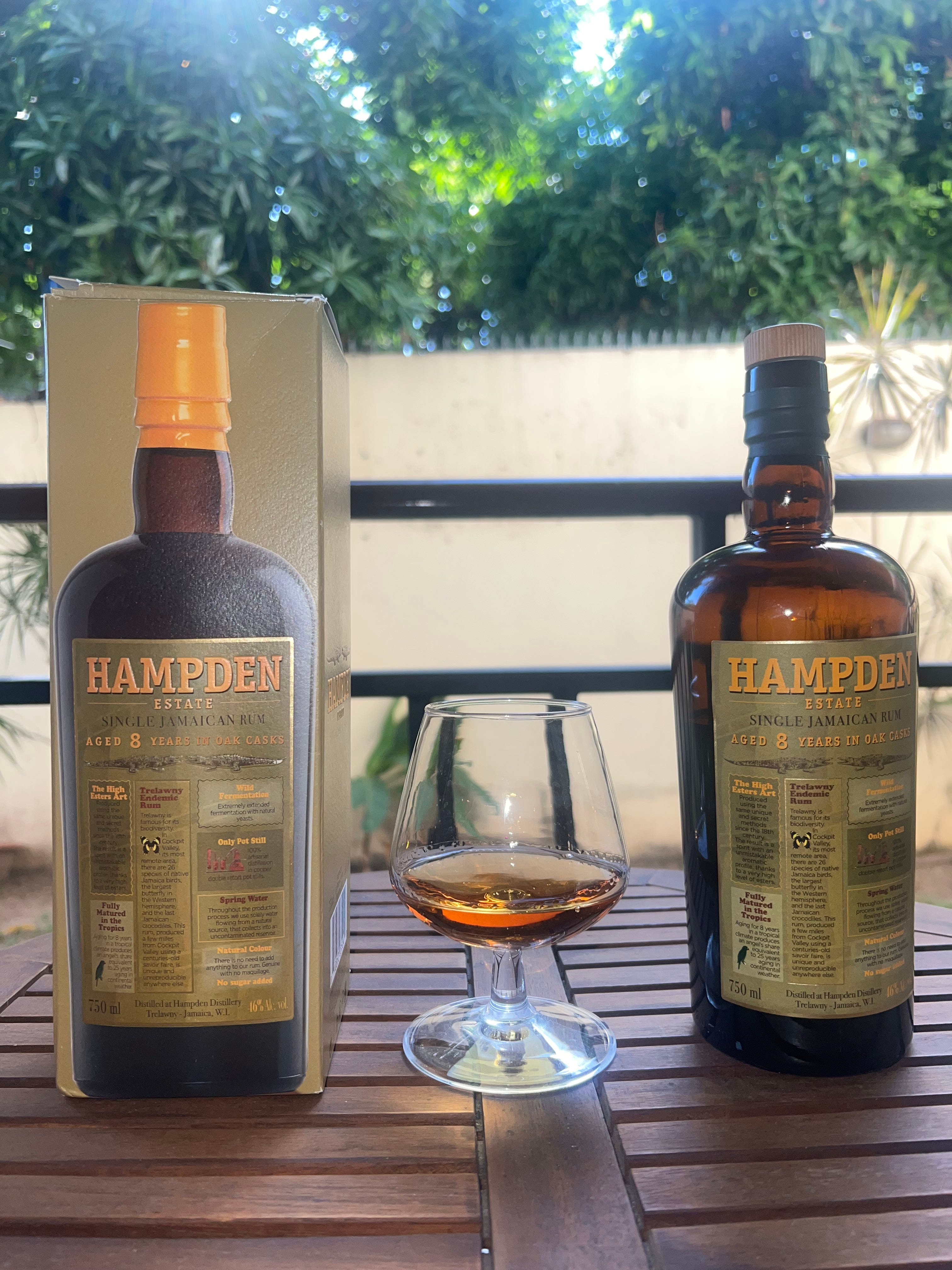
Sipping tips: When you pick this up, I implore you to chew your food before swallowing. Most spirits taste harsh if you down it immediately (taking shots or drinking it like it’s juice): you’re blasting your palette and taste buds with high-proof alcohol. Take a small swig, let the liquid sit in your mouth, and hug every crevice for 4-5 seconds (open the taste buds). Down it. You’ll pick up all the flavors and truly know what the beverage tastes like. Once you do that 1-2 times, your palette is ready. Drink away neatly.
And to my NY’ers, I am sorry for all the wild language.
Remember my piece on Appleton’s Signature and 8-year products? I would advise you to do a side-by-side of Appleton’s and Hampden’s 8s, so that you can go, “Okay, I see what you mean.” CALL ME AND LET ME KNOW WHERE THIS TASTING IS HAPPENING. If not, no biggie.
Part A – Nothing but the feels.
Do you remember being a child and smelling a marker top, or something with a similar intoxicating equivalence? Those items with warning signs for children plastered in red ink, yet little ones found them smelly-ly addictive? Normal yutes, not laundry pod chewers. That same level of ‘I can’t stop smelling this’ is what it’s like to inhale Hampden’s 8-year liquid in the glass; I suppose this has its own warning signs (e.g., alcohol and pregnancy), but that’s beside the point.
On the sniff, a very light candied apple. The vast majority of the whiff is roasted overripe pineapple and banana. Feels like a pineapple is literally being slow roasted in front of your nose…but in liquid form. The rum smells like a green apple was soaked in alcohol and stuffed into a pineapple, and the combo was left to roast…a little sweet, minty, menthol-y vibe (not in a bad way).
If you have an Appleton 8 sip, which is lovely…swig a little water…take a second…and then have a Hampden 8 sip, you’re going to think to yourself – “what a difference.” And for people who are completely new to this type of rum-style, you’re going to also think to yourself, in the best way possible, “what in the world did I just taste,” as you proceed to take another sip. “What in the world did I just taste” is a result of the Congeners, or esters (a type of congener), developed during the fermentation-forward-ness of Hampden’s rum-making process, which we’ll touch on gently in Part B. For now, just know that (that) taste is a result of a commonly practiced cultural hallmark of Jamaican rum-wash creation, which strongly contributes to that bonanza of taste (overripe fruit).
Note: if that all sounded like goo-goo-gah-gah, check out the following pieces that I wrote to make some of the gibber make sense –

The wild fermentation process is the key to the unique aromatic profile of Hampden Estate rum thanks to a very high level of esters. It follows ancestral techniques from the 18th century, only using the native, ambient yeasts present at the distillery. – Hampden Estate [repasting from the What is Rum 3/3 article, fitting]
If there was ever a go-to sipper, ol’ reliable, ol’ faithful, Hampden 8 would be it (for me). Great balance of challenge, depth, and interest-ing. The taste profile is complex, but somehow familiar. You can taste the uniqueness relative to other rums, though the overripe fruit taste brings you back to center. I think non-sippers who are not primed with info beforehand may feel it has a medicinal-alcohol taste. And to that, Worthy Park would say, “Hold my…rum.” Note: read “medicinally” as taste-good-in-rum-world description vs. eww-medicine description.
Part B – Historical Distillery visit, technical.
← Distillery →
Note: As mentioned in my review of Unsilencing Slavery: Telling Truths About Rose Hall Plantation, Jamaica and Rum Fire (Hampden product), I think it’s worth touching on the history of the brand (and ownership/family) when I get around to writing about one of the Great House liquids. For now, my visit to the distillery.
Labor Day – September 2, 2024
The day I did the drive from Kingston to Trelawny to go and visit Hampden Distillery.
The day, or right around the timeframe, when I decided to begin my rum-collecting journey.
The day I listened to the first episodes of the Podcask and the Rumcast and thought…well, those two groups of people couldn’t be more different.
The day I figured out that St. Elizabeth driving is rough, but Trelawny, and specifically getting to Hampden Distillery, is some of the fiercest potholes I’ve ever braved in my life. Shout out to that head-knocking former vehicle of mine, the Suzuki Vitara, you did well on them roads.
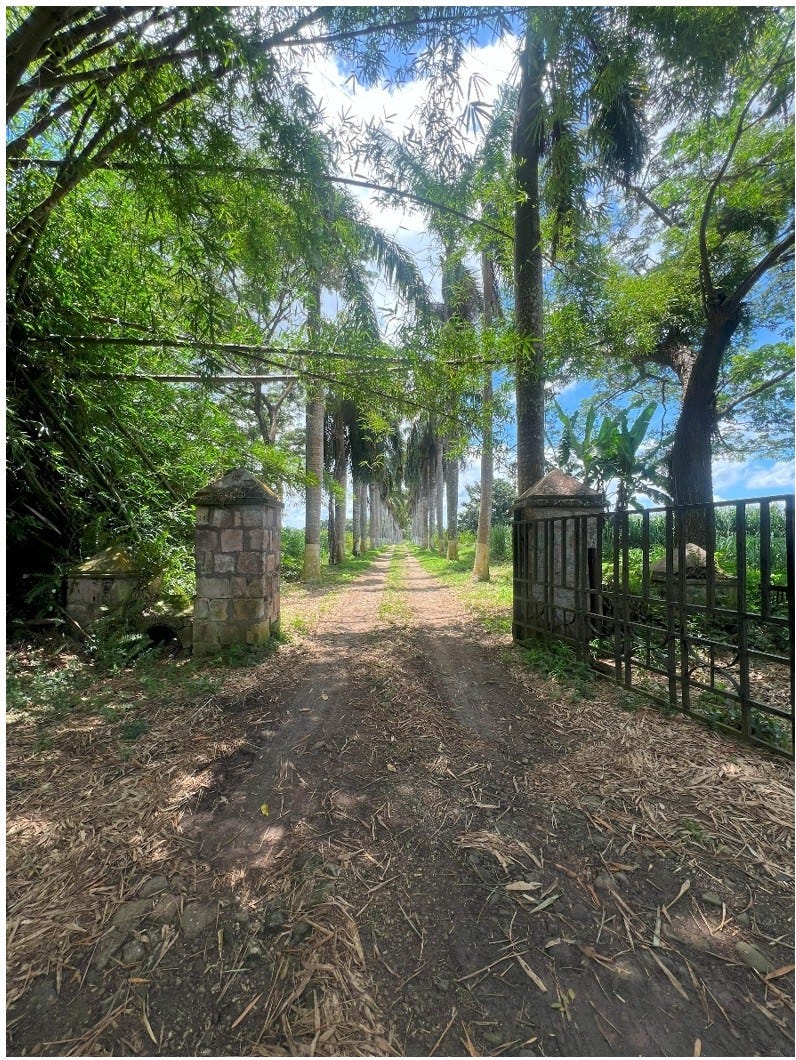
Driving into the distillery, down the long path of trees coating the side of the dirt road, was a sight.
At some point, after mucho driving, I arrived.
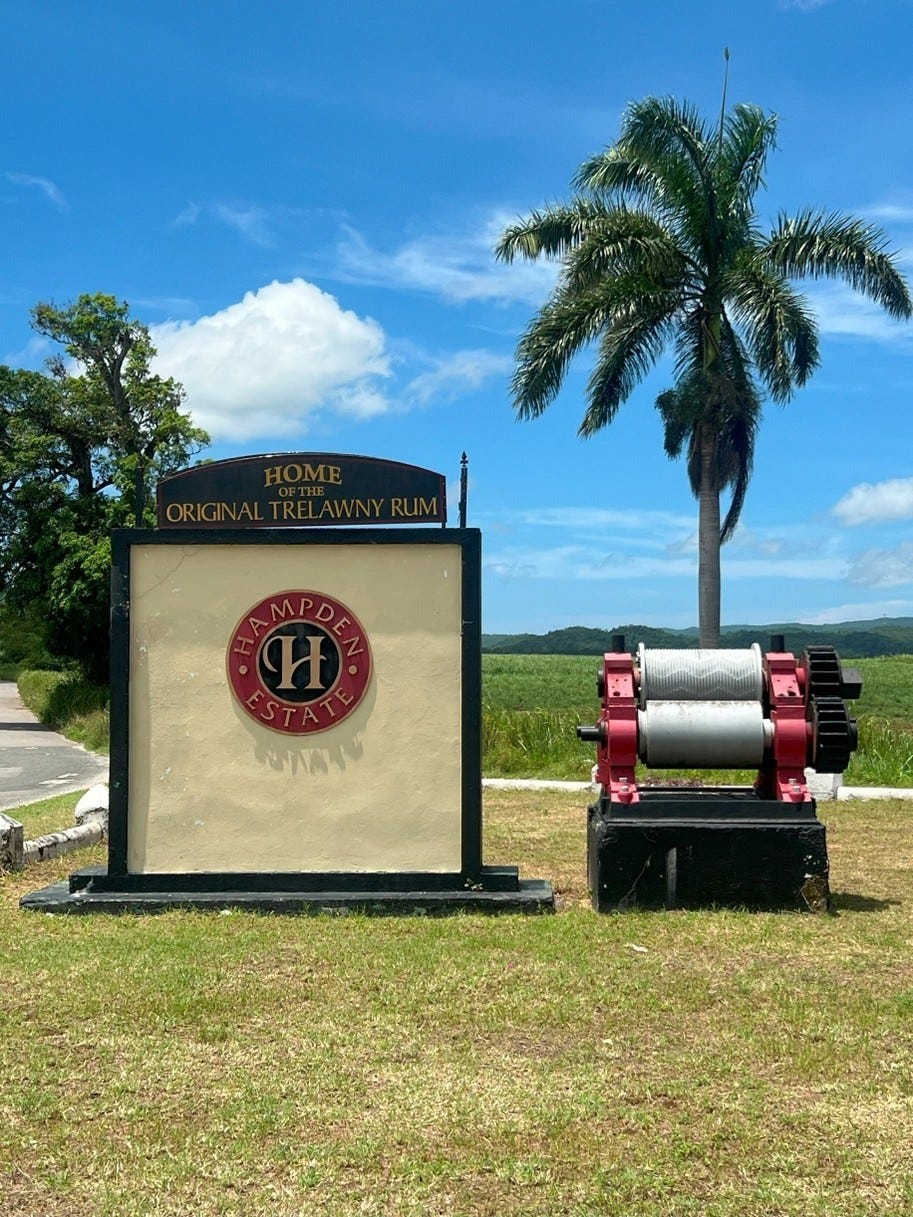
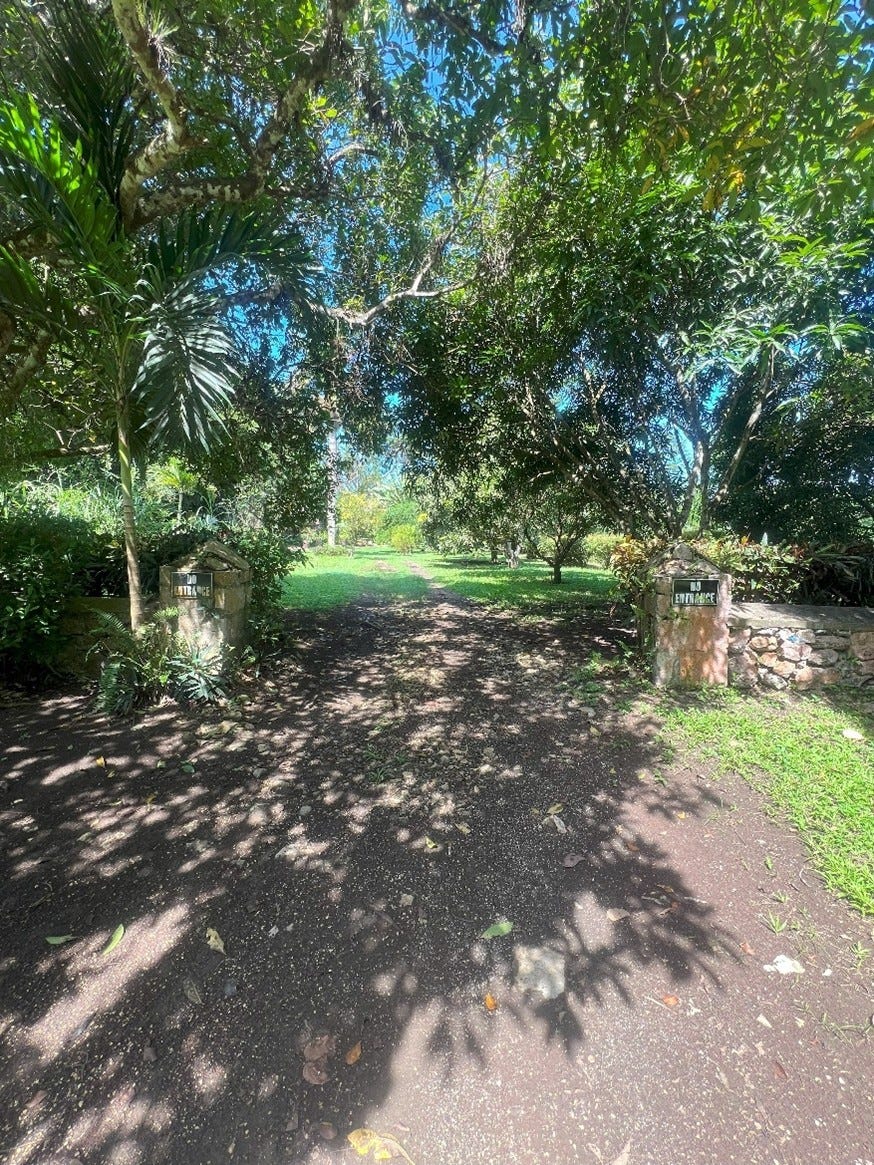
We’re going to do a bit of a fly-by because any one detail of the tour could be a technical deep dive in and of itself (e.g., discussing their use of dunder, cane juice, etc.). My goal here is for you to get a gist of the soul of the place, not just the chemistry and hardware. The most interesting thing to come out of the tour for me, which will come as zero surprise if you’ve got a glimpse into my writings, was my tour guide telling me the following (paraphrase):
→ It is said that the first set of Hampden plantation owners (mid-18th century to the first few decades of the 19th century) were much kinder to the people they enslaved compared to other Jamaican slaveowners. I can’t recall if it was the Stirlings or the Lawsons/Farquharsons, but I’d have to assume the latter since they obtained ownership in 1827, which lines up with the timeframe of the Baptist War/Christmas Rebellion of 1832 (source). Nonetheless, the kindness of the plantation owners supposedly spared Hampden from being burned to the ground during the war.
Note: That sounds ridiculous to anyone in the 21st century, but it could have been a “rational” consideration for people living in their bubbles at that time.
→ The tour guide also felt that it was true because they didn’t feel “that feeling” when visiting other grounds in the country…that feeling you can’t put into words, but you have an inclination that what happened on those other plantations was of the worst examples of plantation brutality. As if the soil held the record.
If you put your history cap on, this is not completely off the rails. The difference, for enslaved people who plotted to turn plantations upside down one day, in determining whose farm gets torched vs. not, could have, in some instances, boiled down to who treated people with the most severity vs. not. That is an incredibly low bar, to our sensibilities, because of how ferocious and violent the worst of the worst plantation owners were, but I won’t dismiss this as a far-fetched paradigm for those times. I’m giving the history its just due.
Remember our friend Vincent Brown? The author of Tacky’s Revolt? He provides an example that validates the above, which gives us one (academic) example to substantiate the tour guide’s word of mouth, passed-down story —
Slaveholders generally believed that that most important social cleavage during a slave revolt between black and white, but distinguishing friend from foe was always more complicated. The rebels had spared the overseer of Trinity estate, Abraham Fletcher, who had a good reputation among the enslaved, allowing him to flee the plantation unmolested. On the other side, they did not hesitate to slay fellow slaves who failed to join them or impeded the uprising. – Vincent Brown
Friendly reminder that stories not written down, passed from generation to generation, and retained by word of mouth, can be categorically legitimate. Don’t let the dressings of academia be the only source of legitimacy you take seriously. It all comes together nicely when you appreciate the continuum.
Back to the tour…
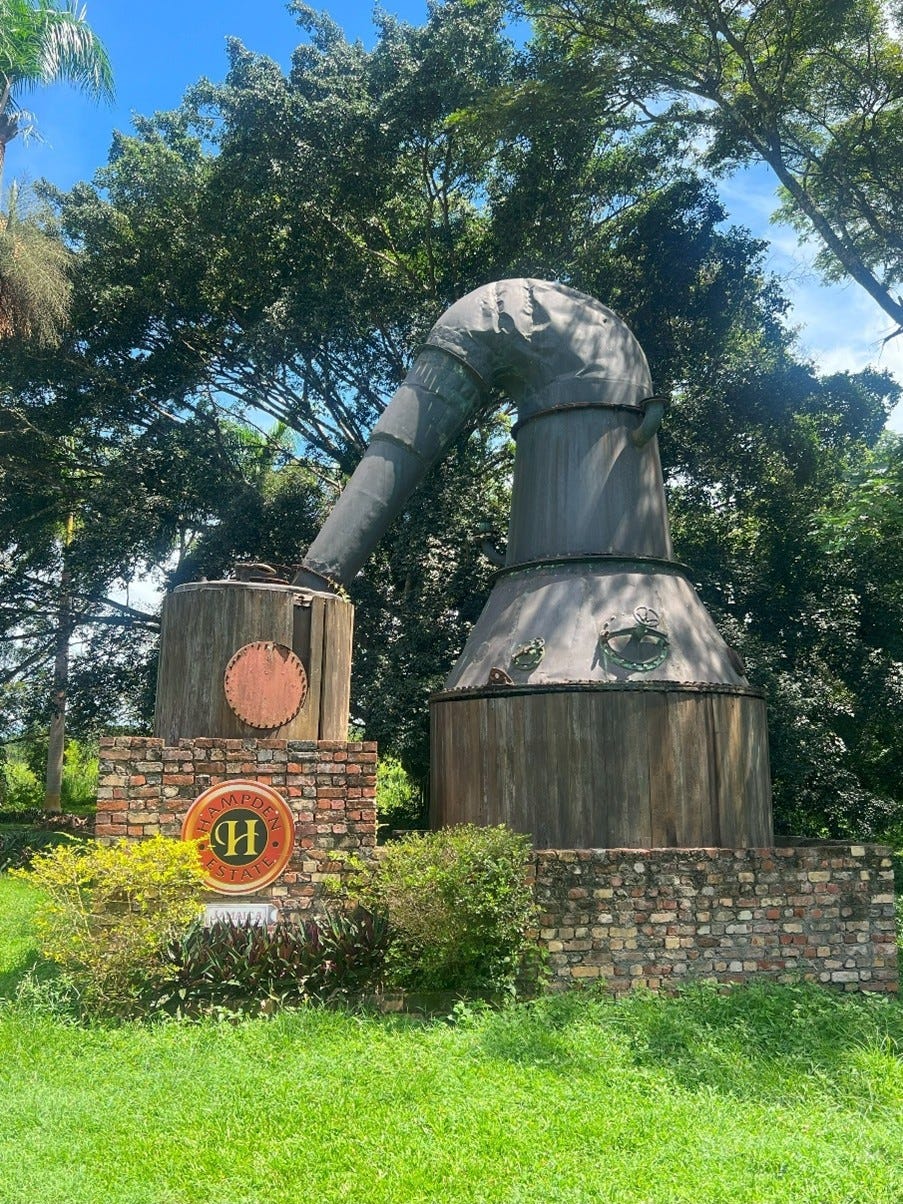
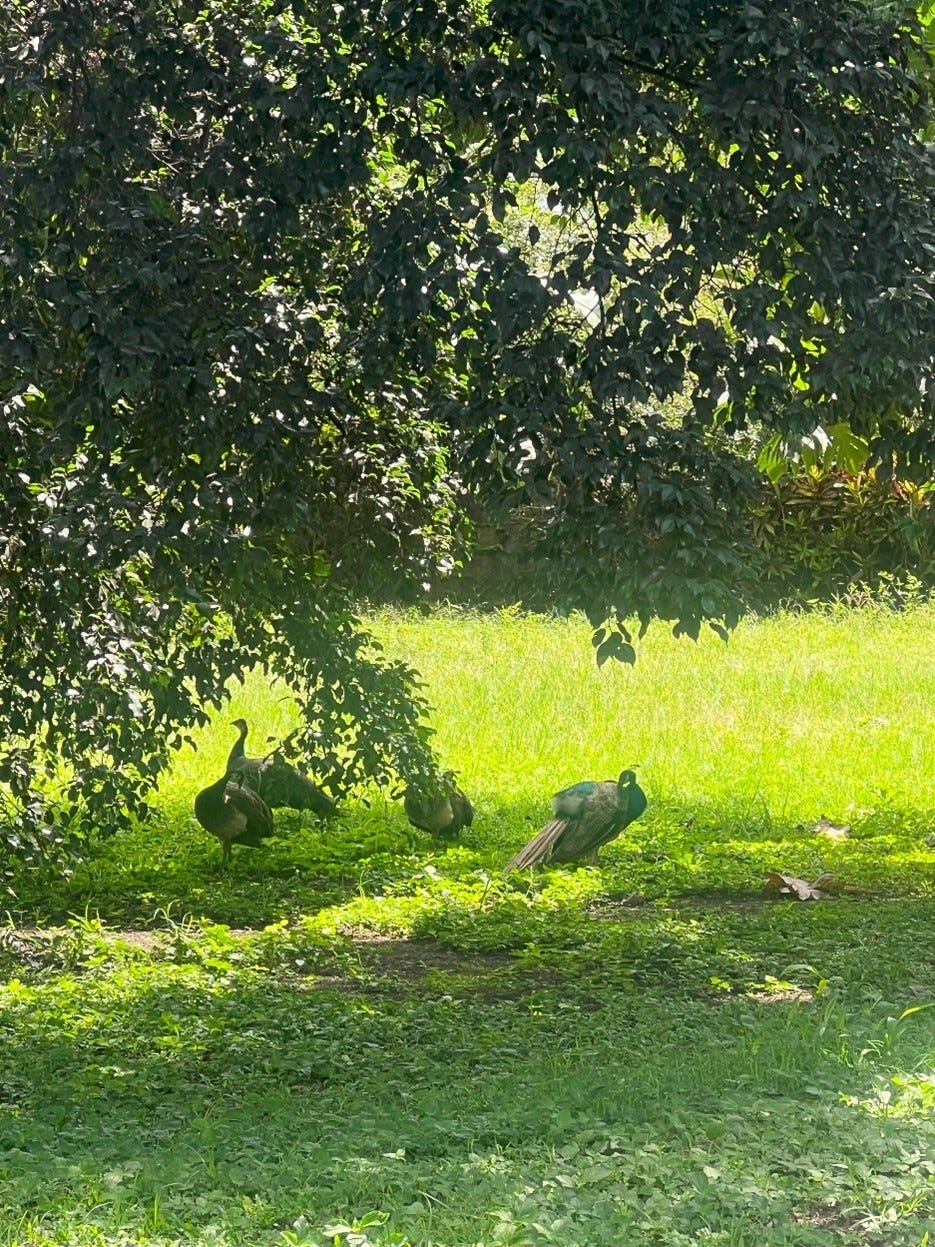
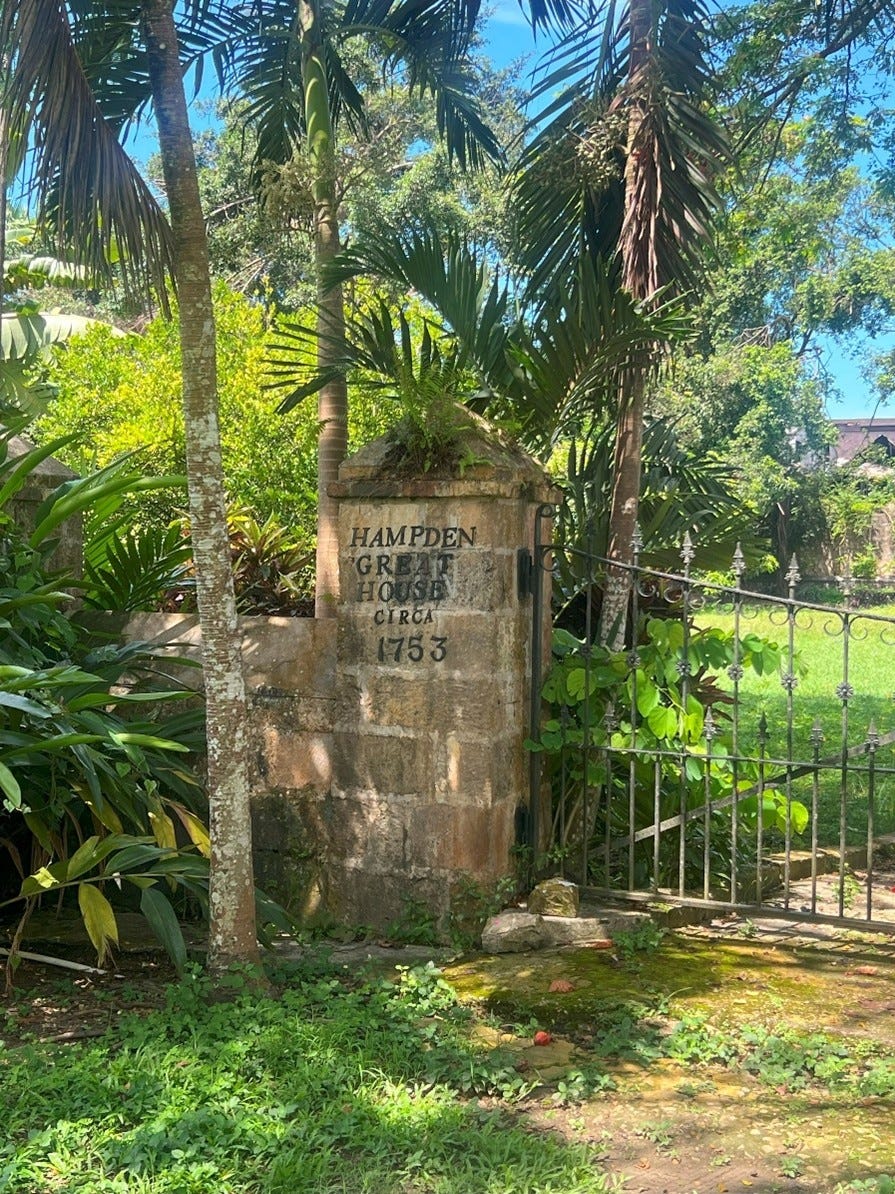
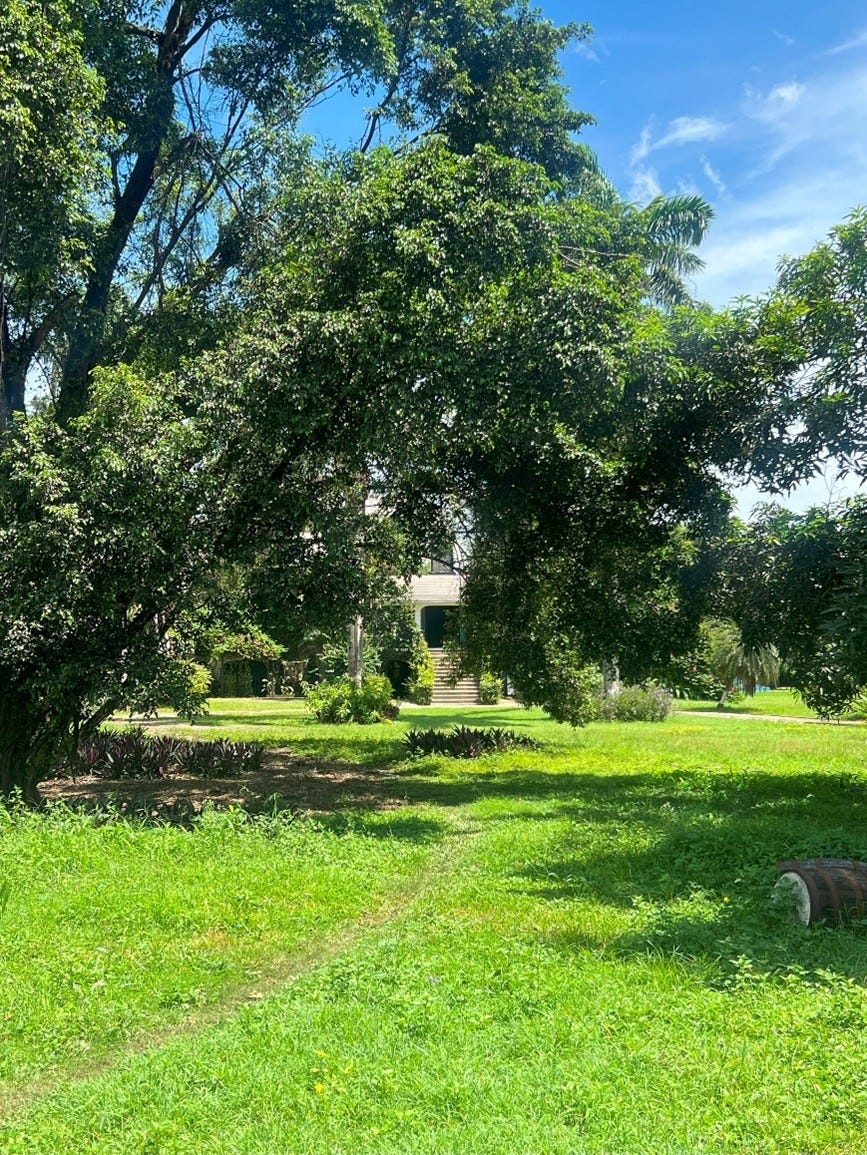
I took in the grounds, the old hardware/still that was now being used as decoration out front, the birds you’ll only find in certain parts of Jamaica, and the Great House. There was a sense of rustic awe about it all that is easier to visualize than to explain.
Eventually, my tour guide leads me to the door that leads up to where the magic happens, where the rum is made…but in true Jamaican fashion, it took a while for someone to come open up the gate for us. The mosquitoes didn’t mind the delay.
There was one room/factory behind this door where I was not allowed to take pictures or videos, and that is the place where the fermentation happens. It’s a hot and smelly enclosure. But any rum drinker who gets a whiff of that room would conclude that the pungency is directly what contributes to the liquid tasting so unique. Your brain, therefore, rewires and says, “Okay, doesn’t smell too bad.” Otherwise, I got to see all the magic and hallmarks of the place: the pot stills, the rum going from A to B, the barrels, etc.
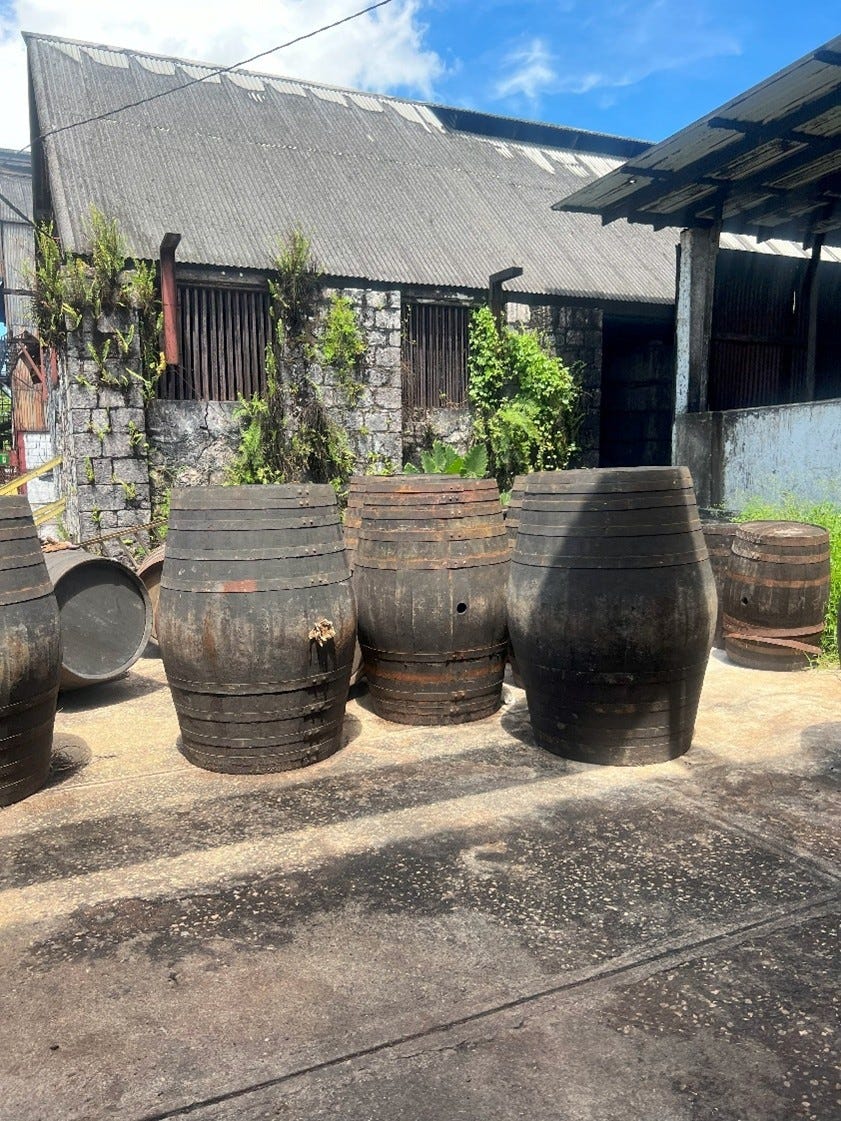
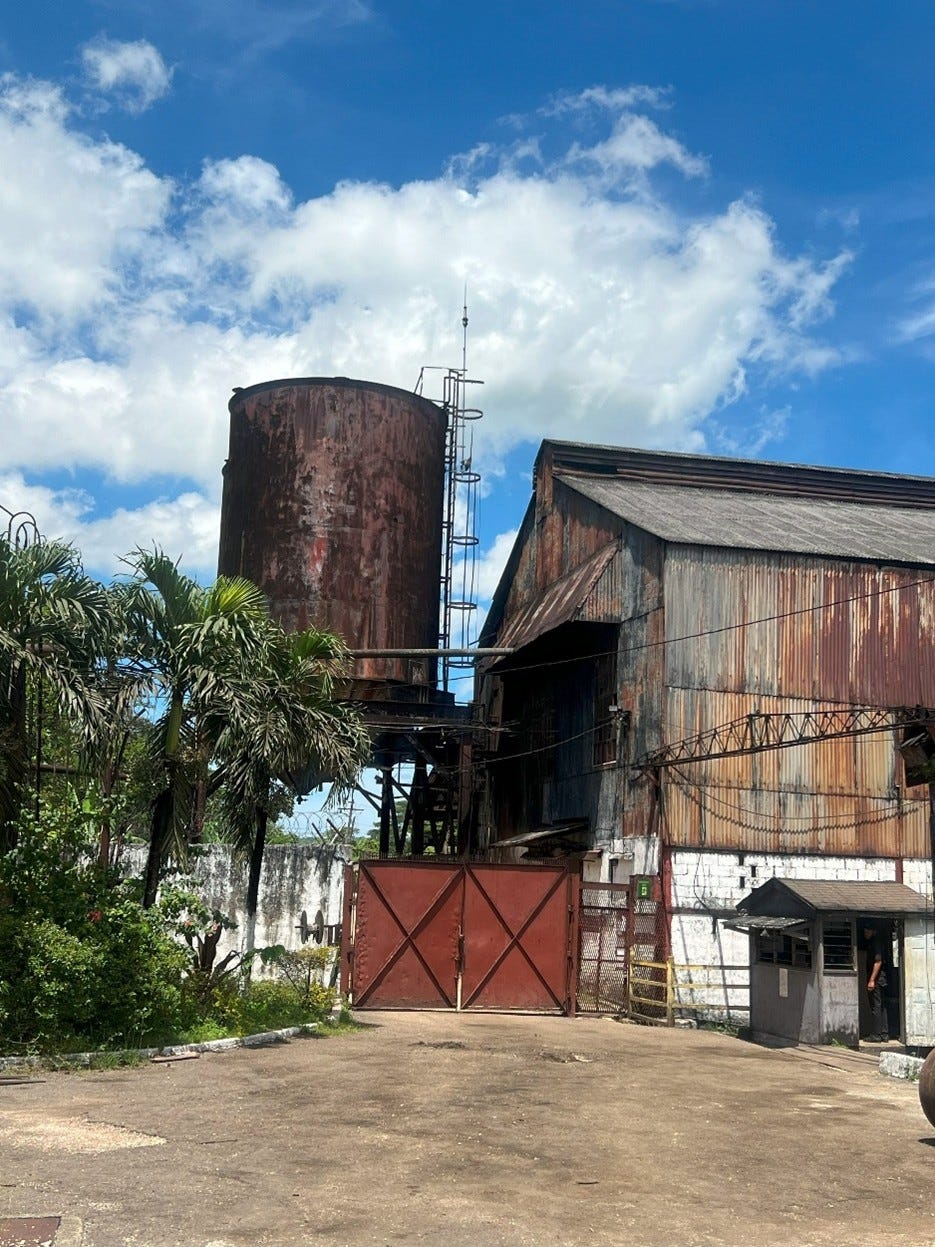
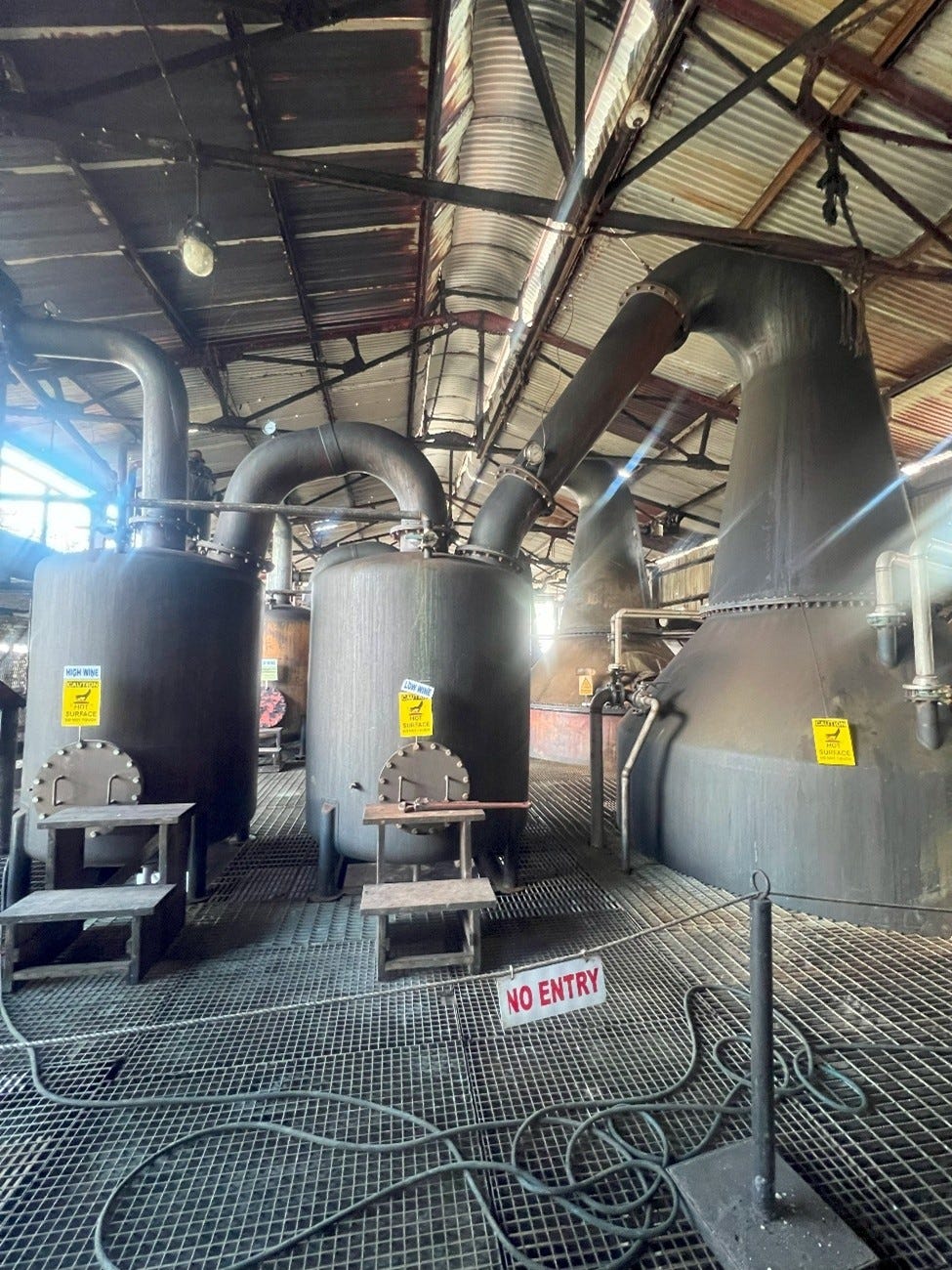
Giving myself a pat on the back. I am horrible at capturing moments because I tend to get lost in said moments. Having to scratch my brain and recall is a bit romantic. But this time around, I had to record what I saw at Hampden. There’s no way to convey it all with just words. Wouldn’t be enough.
The distillery isn’t easy to get to. But if you find the opportunity to visit one day, you should go (obviously, I highly recommend). Let’s get into a little bit of the technical and revert back to the point of the article anyway, the 8-year.
← Technical →
There’s not a whole lot of digging you have to do to be aware of – I didn’t say understand – the chemistry, hardware, nod to historical methods, etc. that coalesce to create this liquid. Why? Because they literally write everything down…for nerds, discerning drinkers, spirit/rum enthusiasts, and anyone else who wants to know exactly what is in the bottle, how it got to be, etc. Tiny, tiny fraction of drinkers, if we’re being fair, but a powerfully vocal and passionate community. Hampden, for Italian reasons that aren’t pertinent to this article, has become hyper-aware of these things and, therefore, gives you every ounce of detail.
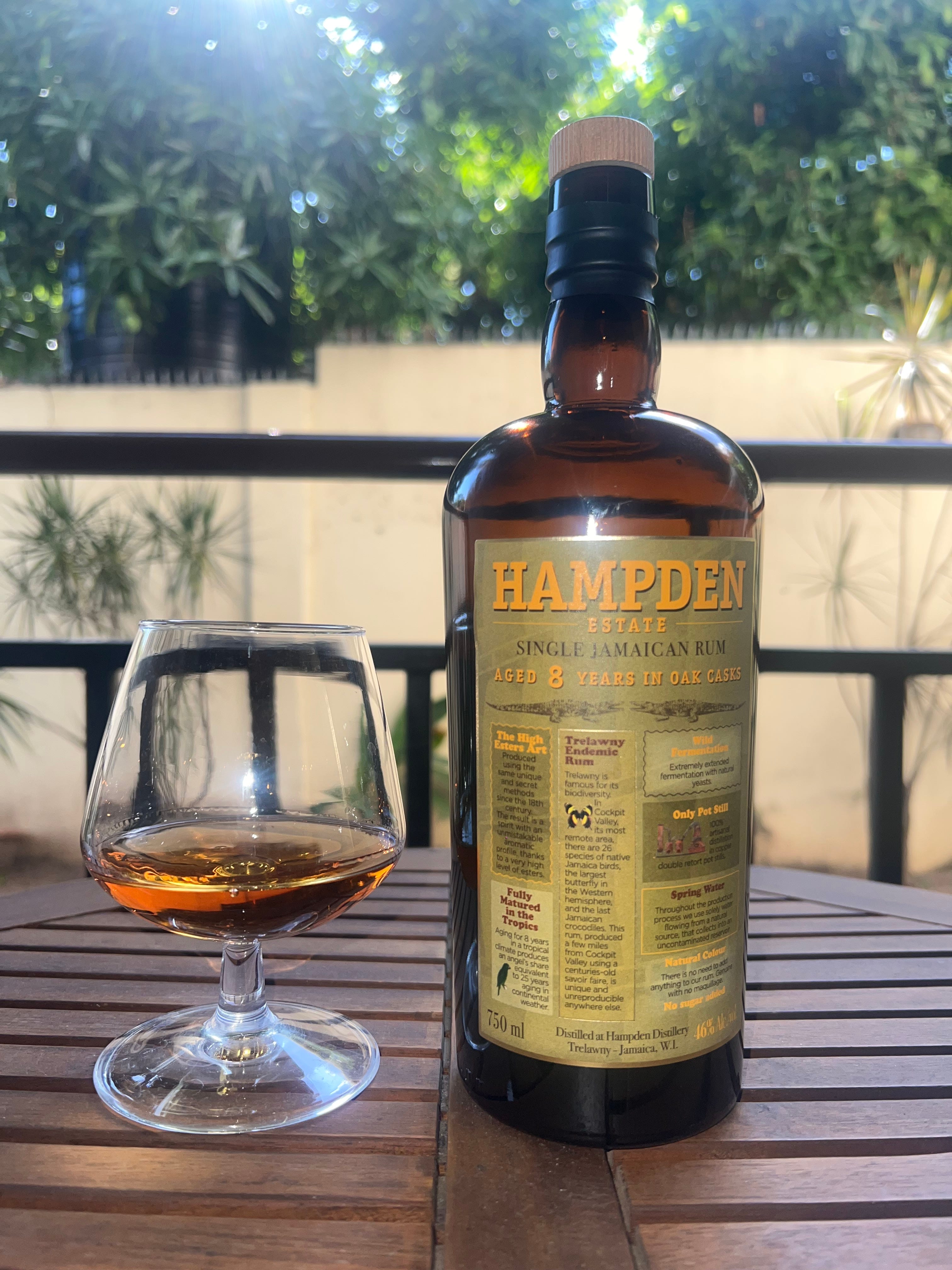
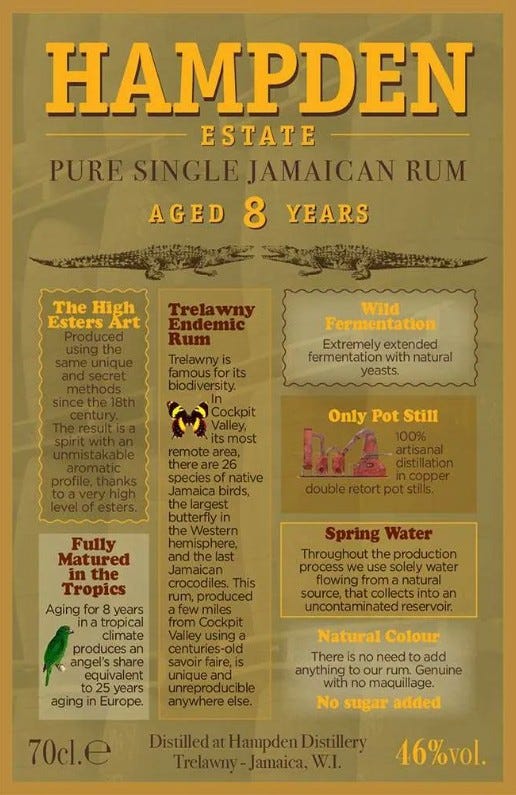
Layman’s terms (from left to right):
The High Esters Art: We have a production method that reportedly dates back to the 1700s; that unique aroma and taste is a direct result of the production method, the chemistry term for those things you taste is called Esters.
Fully Matured in the Tropics: Hot in Jamaica. Liquid in the barrels expands more because of the tropical climate. And although we lose more liquid faster than a barrel aging in a varied climate in Europe (typically colder), the liquid hugging the barrel for more time in the tropics results in the rum’s flavors developing faster than it would if the rum was aging in Scotland (which is the example Jamaican rum makers always use…which I’m sure you can tell I find a little weird).
Trelawny Endemic Rum: Unique part of Jamaica, from a biodiversity standpoint, and that ties into why this rum will stand out from others.
Wild Fermentation: Wild bacteria, or native/ambient yeast, in the uniqueness of our Trelawny environment, are what eat the sugars in the rum-wash and convert it to alcohol. No commercial or cultured yeast. All wild, natural, and native to the environment.
Only Pot Still: We make rum using the OG, artisan, slow-cook hardware (note: that big piece of machinery you saw earlier).
Spring Water: Similar to the Wild Fermentation, they have a unique water source they use…water will also inevitably contribute to the uniqueness of the rum, as it is a core ingredient for everything to come together. Note: contrast this with Appleton, who uses limestone-filtered water. Well, I don’t know, to be honest, because Hampden notes that the “[l]imestone soil makes this water some of the purest in the world.” Is that because the vast majority of Jamaica’s water source is limestone-filtered? This is getting out of my wheelhouse, so let’s stop there.
Natural Colour: No caramel or anything added to make the color what it is. All natural. I looked up the word maquillage, which means “makeup; cosmetics,” in case you were wondering.
No Sugar Added: This is for non-premium rum people who stereotype rum as sweet, easy to drink, etc. There is no sugar added to the rum. In fact, there is nothing added to the rum.
If you want another snapshot of this, I’d recommend checking out The Five Pillars section of their website. But if you really want to begin understanding the chemistry and components (outside of the water, native yeast, etc.) that allow Hampden to be what it is, I would recommend checking out Rum Wonk’s pieces on esters, organic compounds, volatile substances, etc.
Esters, Volatile Compounds, and Congeners - What's the Difference?
A 40% ABV (80 proof) rum contains 40% ethanol, around 59 percent water, and one percent or less of other organic compounds…Water contributes no flavor to a rum, and ethanol contributes very little. Thus, nearly all of a rum’s flavor comes from a very small portion of its organic compounds.
When it comes to rum, esters get special attention from enthusiasts. Esters provide sweet fruity aromas like apple, banana, and pineapple, as well as scents like coconut, honey, and chocolate. There are hundreds of different ester types, each formed from a unique combination of alcohol and acid molecules.”
…congeners [of which esters are a type of congener] are substances other than ethanol produced during fermentation…For over a century, Jamaican rum producers and blenders have used ester levels to define different tiers of flavor/quality known as marks, aka marques.
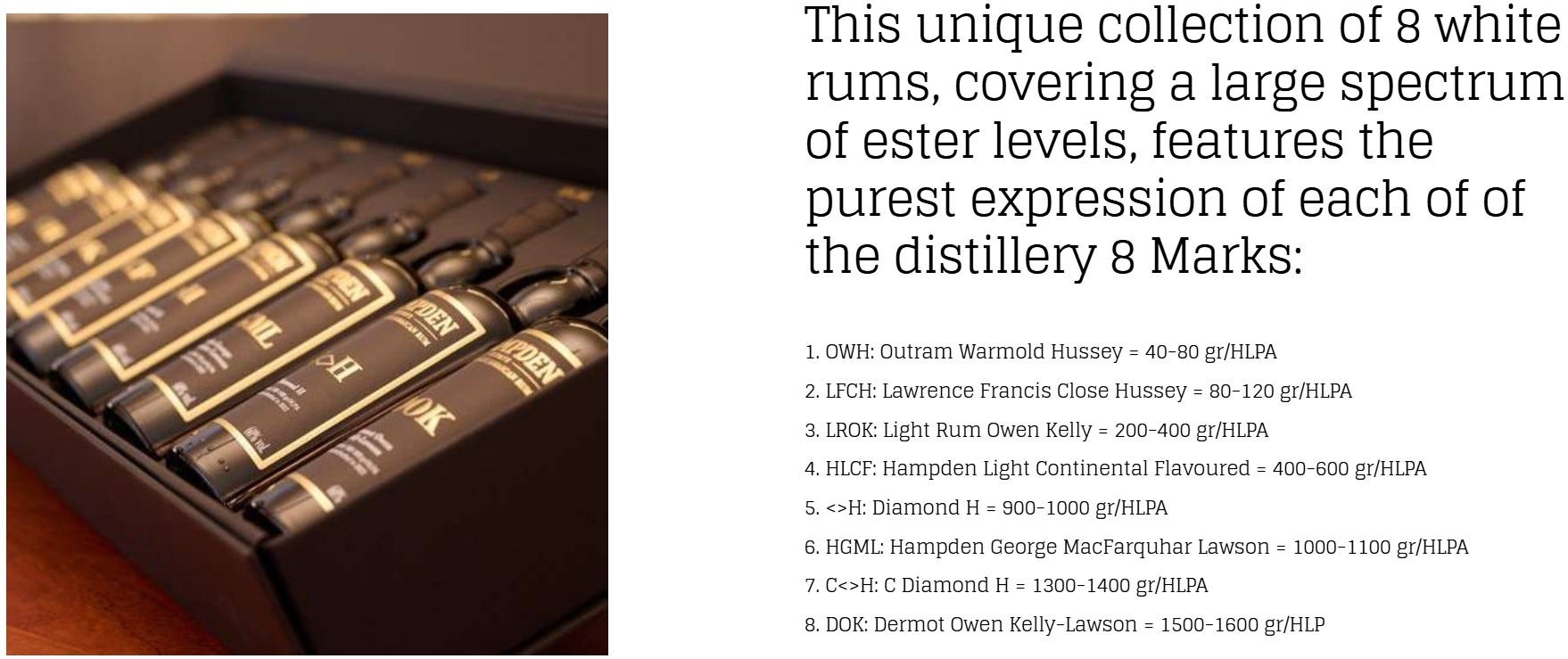
To quickly tie this back to the Hampden 8: that liquid is from their lowest-ester mark, or OWH. They have an 8 mark collection that, if you are not a discerning rum/spirit drinker, and maybe even if you are, I am fairly certain you will find to be a not-so-pleasant experience. But I don’t know, buy it and try, so that when you take the first few sips, start coughing, you’ll reach out and say, “Please take this from me,” to which I will respond in the affirmative.
The product and collection I am referencing –
But as aptly noted in another article, It's Not All About Esters When It Comes to Rum.
Jamaica’s rums, redolent of overripe banana, pineapple, and solvent notes, are most frequently called “high-ester,” but true high-ester rums are also made in locales like Martinique, Barbados, Guyana, and Reunion Island.
“Somewhere along the line, “high-ester” and “highly flavored” became synonymous in the minds of many enthusiasts…Rum gets its aromas and flavor from hundreds of different molecules known as volatile organic compounds, abbreviated as VOC.
Fortunately, Jamaica’s rum makers are adept at creating other types of esters, including ethyl butyrate, which smells of pineapple, and the previously noted isomyl acetate, which smells of banana. These esters are a minuscule fraction of the total esters present in a rum but play an outsized role when it comes to flavor.
A rum’s ester level is always lower than its VOC level, as esters are just one component of the VOC measurement. To use a musical analogy, an ester value is how loud the bass player is, while the VOC value is the volume of the entire band.
And a major shout out to our scientists for plain-Englishing this out for us.
All of the above goes right back to the main point.
The rum tastes great. All the science, work, and luck of geographic stroke that goes into the beverage reminds me precisely why you can’t replicate it. I’m sure Hampden would say it more succinctly: flavors that are uniquely Jamaican, uniquely Trelawny, uniquely them. It’s dynamic, and this is only one mark’s representation vs. blends (we’ll get to that one day).
Hampden 8’s finish is lengthy, the taste profile lingers on your tongue for a while, and even if you take good breaks between sips, the flavor never quite vanishes. I like that. Again, a solid go-to that will sneak up on you. So, sip easily. For cocktail lovers, this would take your drink up a couple notches if you could balance all the flavors with the spirit. I’m sure whatever results will likely be spirit-forward, the rum feels weighty in that way.
Till next time.
The last time I was at Astor Wine & Spirits back in the town, I saw someone racking their brain on whether they should buy the Hampden 8 or another rum. I went up to them and nudged them in Hampden’s direction because I know it does not disappoint. I did my good rum deed for the year.
Cheers and #rumresponsibly
