



Sipping tips: When you pick these up, I implore you to chew your food before swallowing. Most spirits taste harsh if you down them immediately (shots): you’re blasting your palette and taste buds with high-proof alcohol. Take a small swig, let the liquid sit in your mouth, and hug every crevice for 4-5 seconds (open the taste buds). Down it. You’ll pick up all the flavors and truly know what the beverage tastes like. Once you do that 1-2 times, your palette is ready. Drink away. And to my NY’ers, I am sorry for all that wild language.
In my last article, I covered a piece of history connecting colonial Louisiana rum drinkers to Martinique. The former was the importer, the latter was the producer & exporter. I feel compelled to share more details on rum & Martinique. The island has a storied history with the beverage, given colonial France’s impetus to squash liquor production in its colonies to prevent any direct competition with French wine and brandy. That is, of course, until Mother Nature forced the French hand to turn elsewhere when wine production was no longer viable, notwithstanding the pre-existing gains from rum production/molasses exports realized in its holdings. Enough of that. A quick historical peek into Martinique & rum (and sugar, of course) –
On Martinique six [sugar] refineries were at work in 1688…
The remaining molasses, 839,000 gallons, the islanders converted into rum at the standard French West Indian rate of 103 gallons of molasses per 100 gallons of rum. Martinique distilled 914,000 gallons of rum in 1770.
French North America before the war [American Revolution] had been a major importer of Martinique’s rum.
All of the above are from John J. McCusker’s Rum and the American Revolution: The Rum Trade and the Balance of Payments of the Thirteen Continental Colonies (Volume 1).
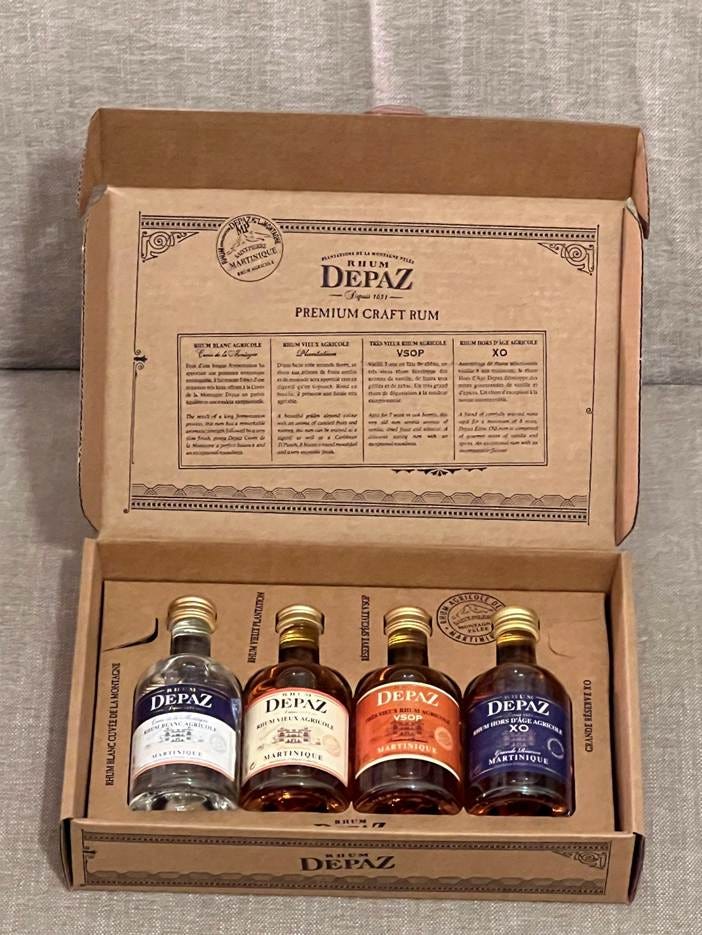
Before I continue down the history & context lane(s), let’s talk about the Depaz liquids pictured in the cover image.
4-way Martinican street.
I secured the sample pack in Paris, France, which is where the eponymous rum brand’s founder, Victor Depaz, passed away in 1960. More on the senior Depaz later. Below is coverage of each expression in age order vs. taste preference.
Unaged Rhum Blanc Agricole: Cuvée de la Montagne.
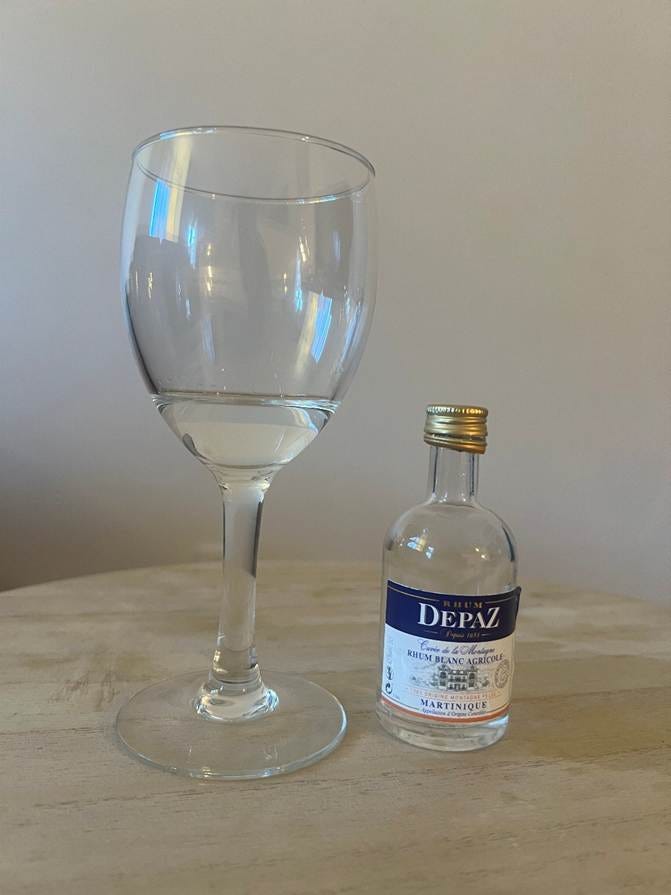
Having visited Grasse, France, before securing the rums put me in a perfume-oriented mindset. I do not doubt that this influenced my initial thoughts surrounding the standard grassy aroma characteristic of cane juice r(h)ums from Martinique. The nose is elegant with just enough grass not to throw you in the deep end. I wonder what a perfumer would think about its addition to an aromatic composition. Overall, the Cuvée de la Montagne has a beautiful nose. I’d hand this rum to someone who needs a softer (but still very tasty) intro to Martinique liquids. Fruity and floral-y, but temperate on the palate. Would be akin to trying a Le Rocher first before Vaval or Sajous (Clairins). The slight spiciness on the finish is preceded by a floral flush—balance. While I don’t pick this up (on the pre-distillation side of things), the producer notes a fermentation and “slow reduction in fractions” period lasting up to 60 days. My non-technical brain interprets that the 60 days comprises more of the latter than the former, since Depaz typically engages short fermentation (48 hours or so). But I am not 100% sure. At 45% ABV, and something many would consider a candidate firstly for a Ti’ Punch cocktail, I would recommend giving it a try (pure). It’s a very pleasant, albeit vegetal, sipping experience. Par for the Martinican course.
Lightly Aged Rhum Agricole: (Plantation) Vieux.
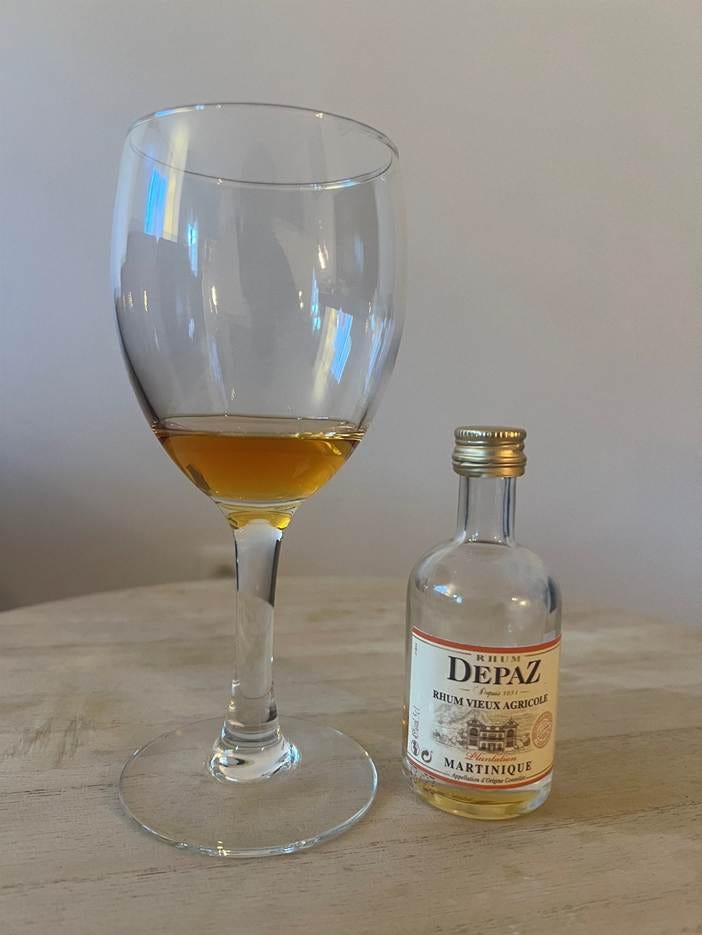
Still on a scent high: the Vieux placed me squarely in candle land. Kick all those garbage pumpkin and gingerbread candles out of here and put the Vieux aroma in their place. The nose has a soft chocolate and caramel scent. But be careful: what you smell is not what you will taste. Of all the rums I’ve had thus far, this one is high on the bait and switch. Not necessarily a bad thing. Only that it distorts the primal instinct of a human’s survival tick: what we smell is what we expect to taste, lest it be some sort of poison trick. The chocolate and butter-y caramel nose vanishes, and the cane juice comes roaring back. What the brain concludes between smell and taste is: good bitter. The green apple on the palate comes through a ton. This expression is okay. I would reach for the unaged over the Vieux.
Medium Aged Rhum Agricole: Réserve Spéciale VSOP.
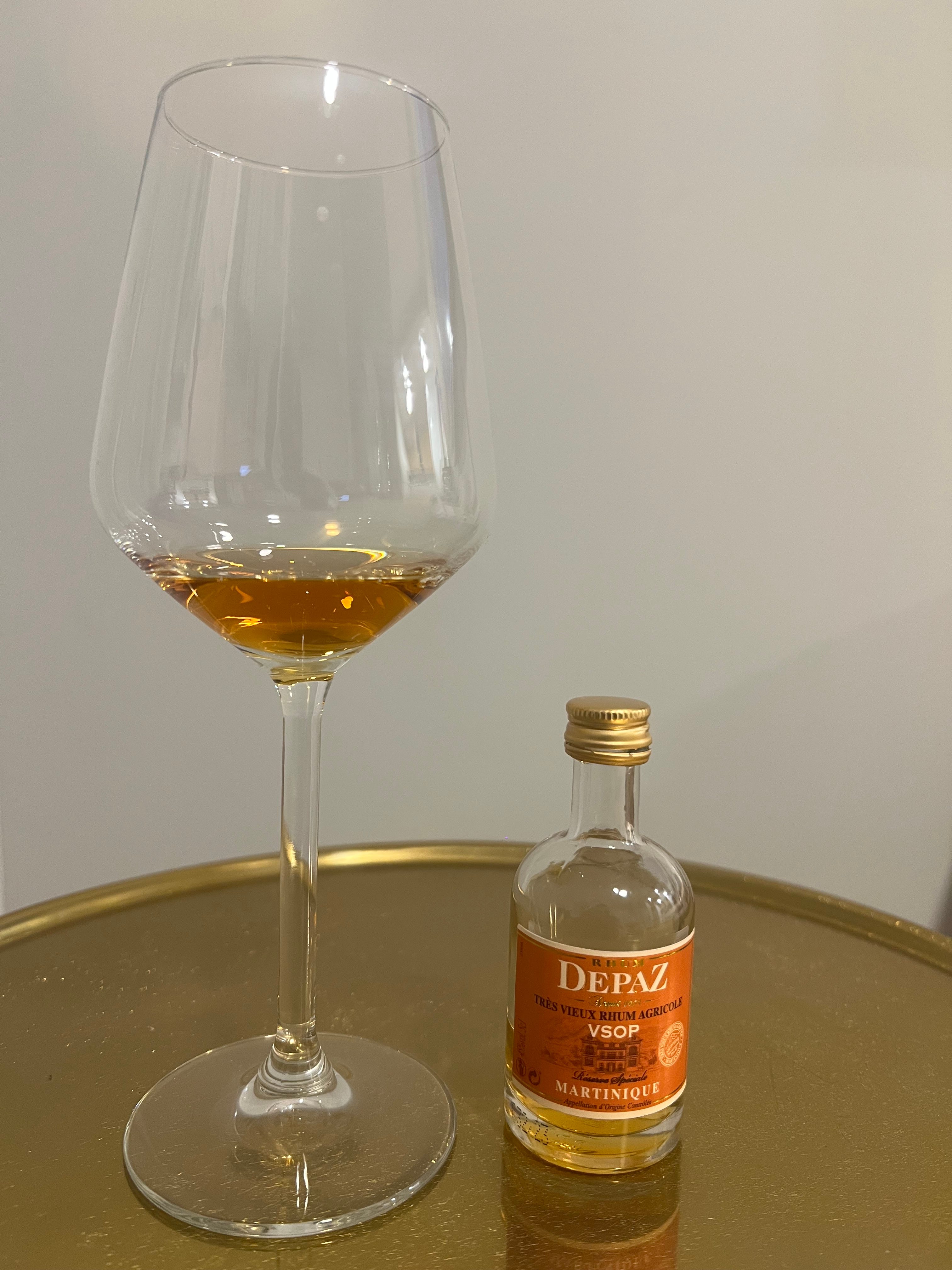
This is it for me. VSOP cane juice liquids are my sweet spot. The character rains through the entire journey. The oak doesn’t take over too much. There’s a spicy finish to let you know that the distillate and oak are playing well together. I was so in tune with the rum that I forgot to take a single note. I just remember an orange peel aroma, which brings me back to Appleton 8, and a finish reminiscent of Rhum Bologne’s VSOP. This is all from memory, so take it with a grain of sugar. Here’s what the producer says –
Aroma
Chocolate, toasted dried fruits, tobacco, and licorice (initially)
Follows up with hints of prune, vanilla, and soft aok
Palate
Rounded, prune notes, and soft oak
Long, slightly spicy finish
And finally…
Slightly Longer Aged Rhum Agricole: Grande Réserve XO.
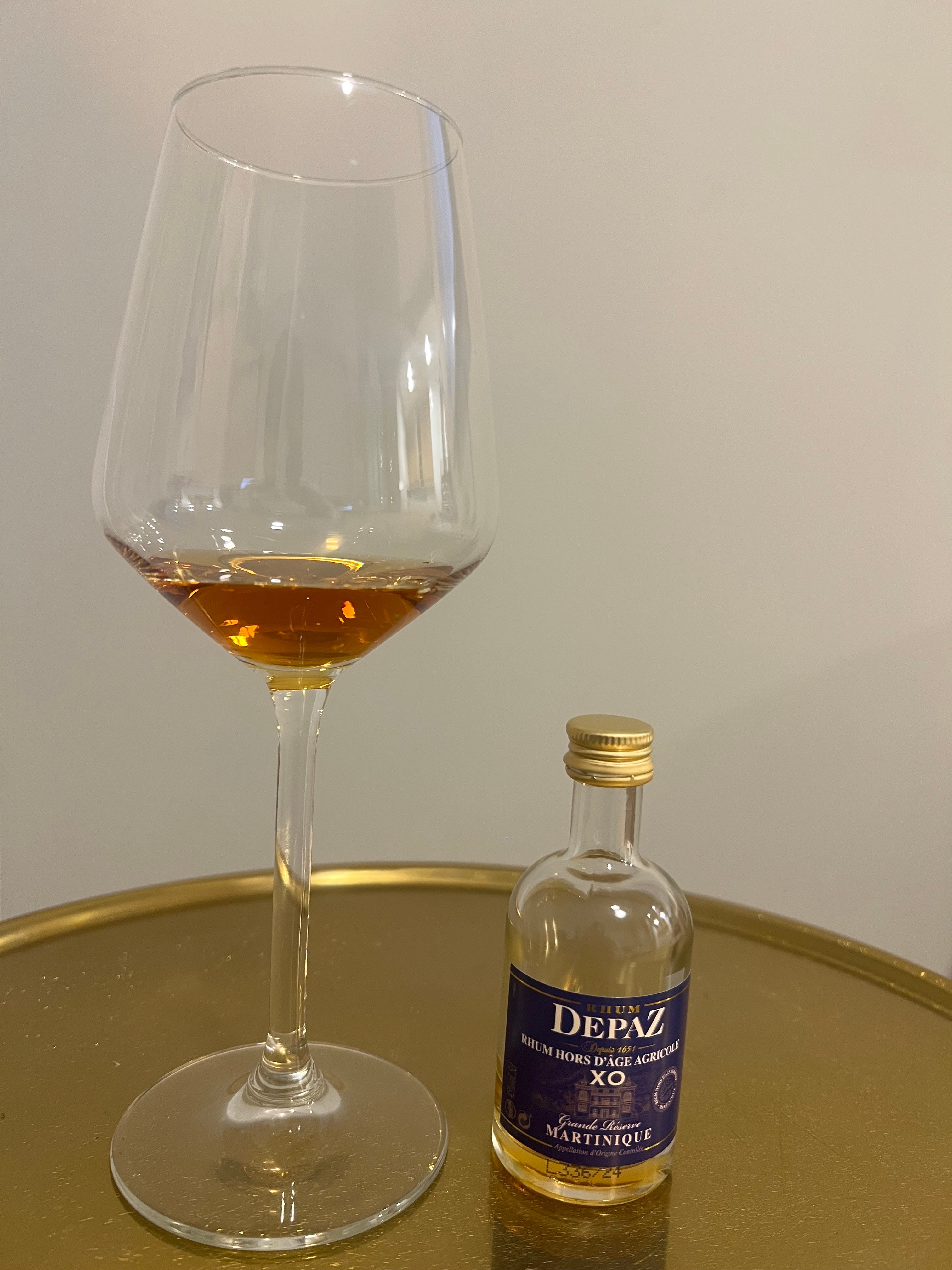
A lot more wood influences the aroma. If you are into spirits that extract a majority of their composition from oak, then this will sit well with you. For me, and I think this is a fairly common theme among rum-people, that much oak influence can take the joy out of experiencing the bright, vegetal characteristics of cane juice r(h)ums. It’s not entirely far off from the VSOP in flavor, but the VSOP sings on the tastebuds a bit more vibrantly than the XO. I’d recommend this for sipping sessions with friends who enjoy decently aged liquids outside the rum category and would like to introduce them to something that balances vibrancy with oak. Those notes of vanilla rain through in the XO.
Overall, the unaged and VSOP are the ones I’d reach for first. The commonality flowing through all four expressions, aside from the 45% ABV, is that the source material (cane & juice) comes from the “foot of Mount Pelée” (volcanic soil). In an age of mass substitutes, these terroir distinctions, what I lovingly refer to as “sense of place,” are important, insofar as the characteristic(s) truly distinguish the r(h)um(s), and do not serve as mere marketing tactic. Before we sign off, let’s dial the clock back a bit to discuss some of the brand’s history, as well as social dynamics in Martinique.
The patriarch and family behind the brand.
The birthplace of the Depaz brand, the La Montagne homestead, was originally a farm founded in 1651 by Jacques Duparquet, the first governor of the island. Clinging to the majestic flanks of the Mount Pelée in the north of the island, these fertile but dangerous soils tell the amazing story of one man, Victor Depaz, and his extraordinary destiny. – Depaz
May 8th, 1902 – the volcano erupted, wiping out the town. Depaz was in Bordeaux, France, studying during the event. And as the story is told, he felt compelled to return to his birthplace in 1917 to start a new distillery.
In 1922, Depaz rums won their first medal in Marseille…During the 1950s, Victor Depaz’s sons took over from their father. André and Raoul Depaz modernized the sugar cane production and improved the distillery that became known as the Depaz distillery. Still today, the sun-soaked sugar canes, the volcanic soils and the purest of waters contribute to the exceptional taste of Depaz rums, certified AOC Rum of Martinique. – Depaz
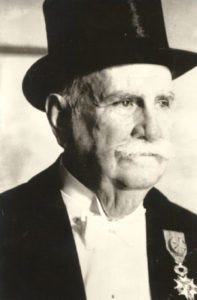
Other sites note Victor Depaz, the Industrialist, as being a Béké. Békés, or what some would simply call Creoles, are White Martinicans (or Martiniquais) who are the direct descendants of colonists – former slaveowners/plantation owners. These Creoles operate at the top of the socio-economic ladder and are seemingly an insular bunch. Modern-day example –
In Cap-Est, the location of residence favored by the Creole whites of Martinique, beautiful villas overlook the turquoise water, their high walls protecting their owners from the curious and jealous. From the cul-de-sacs traveled by no one, except those who have business being there, all the way up to this spur, the area is called “Békéland” by the islanders. Here, during the general strike, they hid themselves, even more than usually. Police patrols have been reinforced. – Béatrice Gurrey, Békés: A Matter of Inheritance
“The béké boy who ‘messed around’ with a black woman was ostracized by others,” recalls Roger de Jaham. That’s a rule that still persists among some families. Family trees have endlessly intersected since the beginning of the colonization. – Béatrice Gurrey, Békés: A Matter of Inheritance
A little context to further heighten the palate. It’s good to have a somewhat full understanding of a thing’s origin and inheritance.
Till next time.
Only right that I talk about Louisiana juice next time around, right? Done.
Cheers and #rumresponsibly

At some point with aged rums they take on characteristics & flavours more associated with barrel aging - often similar to those found in whiskey who use the same ex-bourbon barrels - & loose the freshness & joy of unaged rum.
That tipping point obviously varies between individuals & possibly also rum brands.
I always like to start with the unaged variety myself.
They’re a more honest expression of the raw ingredients & distillers craft.