



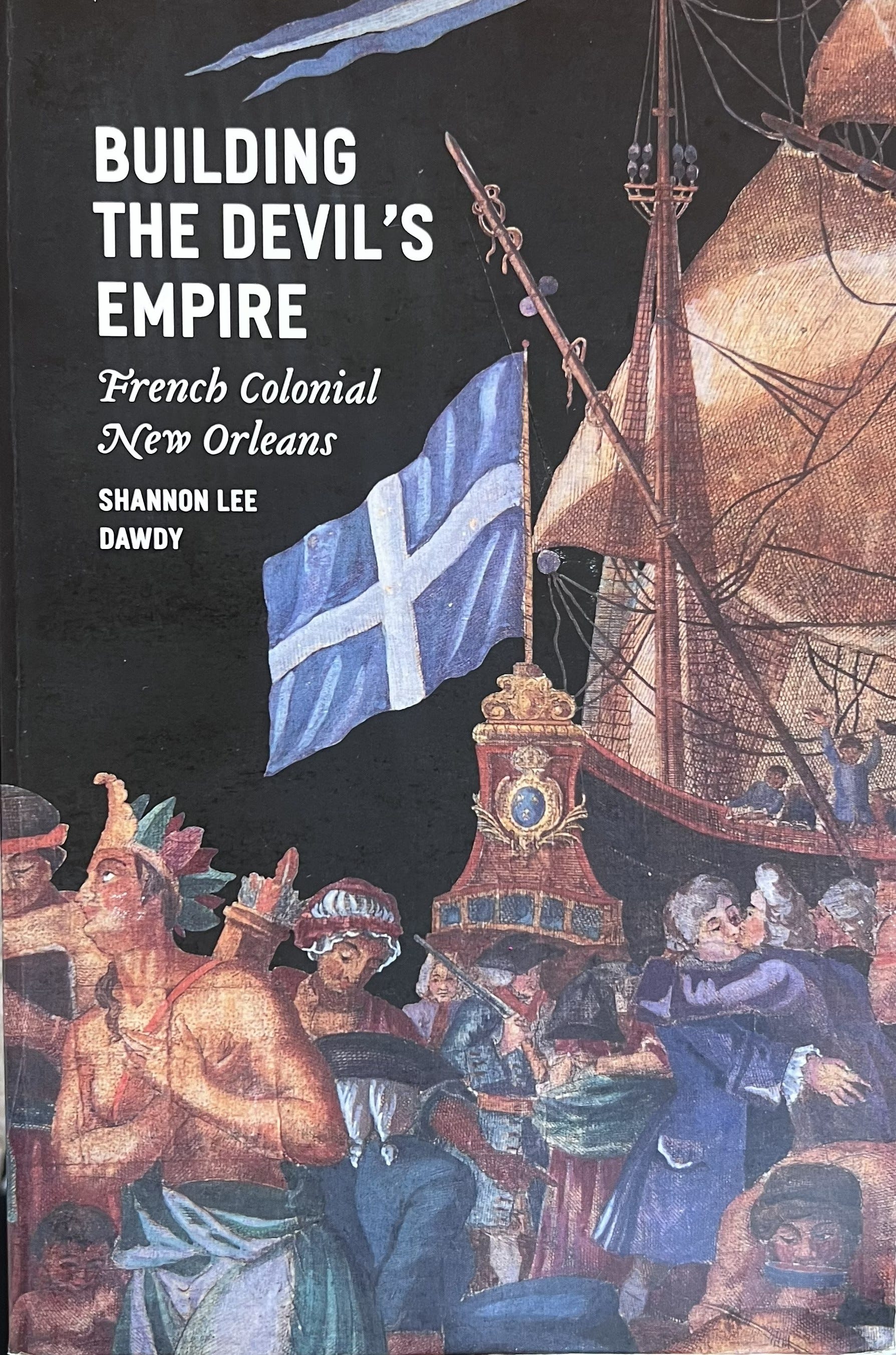
Building the Devil’s Empire – strong title – is easily one of the best books I have read on colonial Louisiana (and New Orleans specifically, since the author’s core focus is the Big Easy). Shannon Lee Dawdy does a world-class job augmenting popular perspectives on New Orleans while simultaneously redirecting you to places of fulsome critical analysis; you walk away from this book with a deep sense of gratitude for the knowledge imparted.
The author tackles colonialism’s history & tentacles via the (highly specific) New Orleans experience, which I believe helps us better grasp colonialism’s adaptations. From the pen-woman herself –
New Orleans contributes to our understanding of colonialism in a particularly historical way, and in a more global way. The town was launched at a critical juncture in the early eighteenth century when ministers were taking a new, scholarly approach to refine strategies of rule and expand the power of the state. New Orleans was in many ways an Enlightenment experiment in which recognized tools of modern colonialism (urban planning, census-taking, natural histories, ethnographies, mapping, new criminalities, and the control of subordinates through sentiment) were under development. Such experiments in social engineering and Enlightened absolutism often failed, but the lessons derived from the famous failure of New Orleans [and] the Mississippi Bubble informed later colonial efforts in the nineteenth century and early twentieth centuries.
The Mississippi Bubble? That’s our boy John Law! We’ll come back to that in a bit. I must warn that Dawdy’s book, for the non-habitual history readers among us, will feel very dense in the way that many history books do. However, Building the Devil’s Empire will not read as ‘dry’ because the author’s perspectives are so damn refreshing. It will take some time to get from cover to cover. But I wouldn’t write about the book if I did not believe it to be worth the time. All this talk of Dawdy – fire last name (Jamaican side of my brain speaking) – so let’s give the author the floor before we jump in.
“Ah weh yu get da new Clarks deh Dawdy?” Why did my brain go there? I do not know. It won’t turn off, so be it.
Dr. Shannon Lee ’the Clarks’ Dawdy (Shannon Lee Dawdy)
Alright, I’ll stop. First things first, the author’s accolades:
Anthropologist
Archaeologist
Those two things = you’re in for a treat when they share perspectives on history!
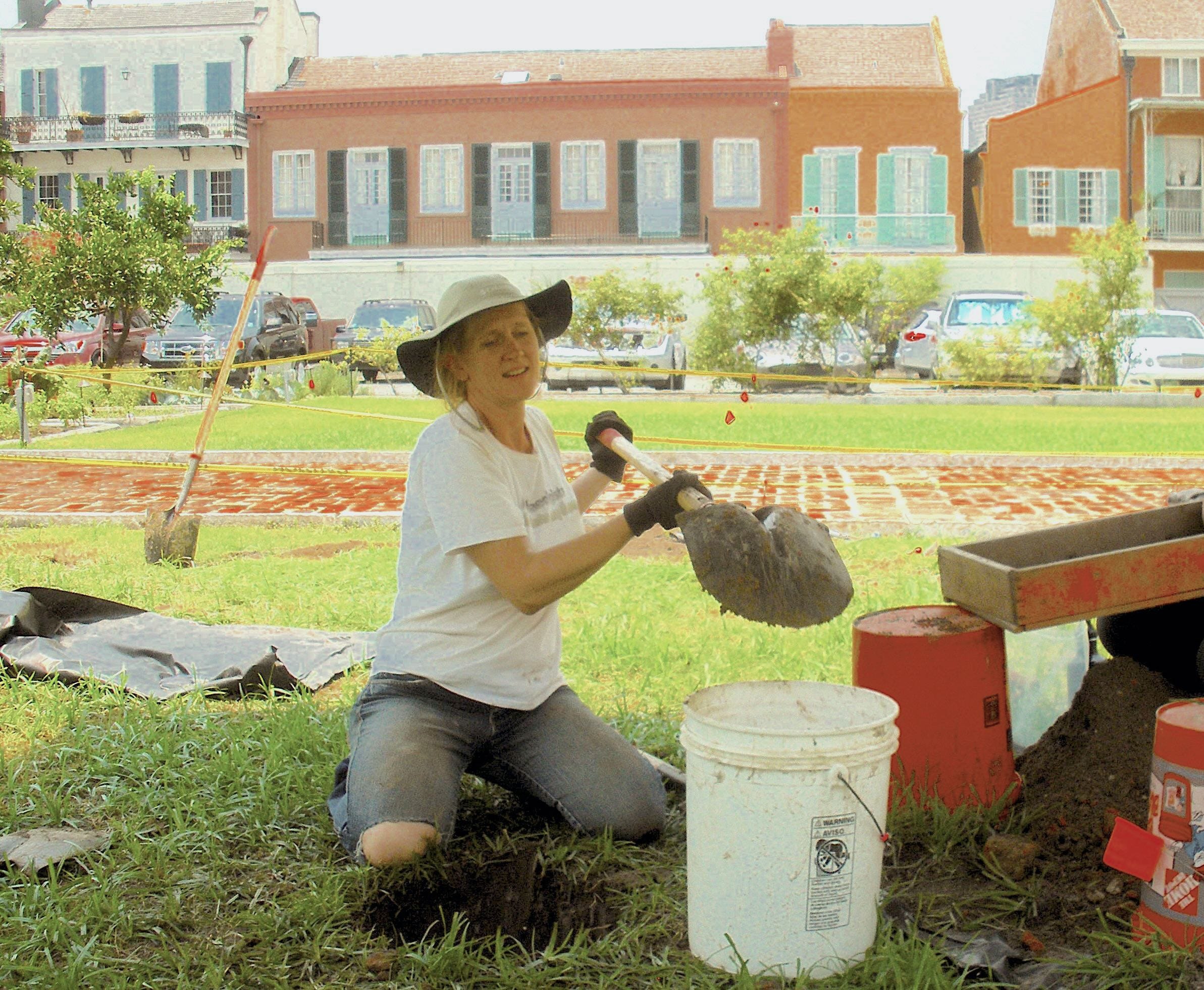
Professor Emerita at the University of Chicago
Independent writer, researcher, and director of the Future Café Network
Topics of her writing include death, disaster, food, colonialism and the history of capitalism.
The highly condensed CV aside, what most struck me about the author’s background was how Hurricane Katrina reoriented her life and perspective, as disasters tend to do. Flirtations with mortality are, to put it lightly, life-changing in the best and worst of ways. Optimistically, it urges one to see, live, and embrace chances more ruthlessly. Those who no longer have the opportunity would probably have urged you to do the same on their behalf. For Dawdy –
My strong emotional reaction to the disaster made me realize how attached I had become to New Orleans, not simply because I have been an on-again, off-again resident for thirteen years, but because I identified with the city. In my imagination, it had a personality I had come to know, love, even emulate. This is a risky admission for a researcher to make. I think Katrina has emboldened me to take more risks.
Dawdy first moved to New Orleans in 1994. She’s remained struck by how decidedly French much of the city has remained, despite this aspect of its history being least preserved, and, at this juncture, the shortest stint in its New World tale. But a base that hasn’t been ruthlessly targeted for extermination (often) serves as an unshakeable foundation, so it’s a little less surprising to me. In the same way that New Orleans has retained its specific strains of African compared to other towns.
The primary sources Dawdy used for this work are:
→ Louisiana Superior Council Records
→ Louisiana administrative correspondences of the French National Archives Colonial Section (C13 series, in particular)
→ Other letters/correspondence between Louisiana and France
→ Various historical mémories (this is French for memoirs, not memories) and maps
A major thank-you to the author for layering in French throughout the book and translating where necessary. For a summary of the author’s perspective –
…I am most interested in how New Orleans informs us more generally about the nature of colonialism—how colonies are established, how they are ruled, how they produce new societies, and how these societies are organized.
In other words, Dawdy’s focus is not a “linear, event-centered history.” She is more concerned with daily lives and understanding colonialism in full.

Paving the New Orleans road (pre-drive).
Before we discuss what this book entails and the approach the author took, I want to ground you in Louisiana’s & New Orleans’ gradual shift from an Old World (Native) territory to a New World (French) colony, with more emphasis on the latter given the context of the book. From 1682 to 1718 –
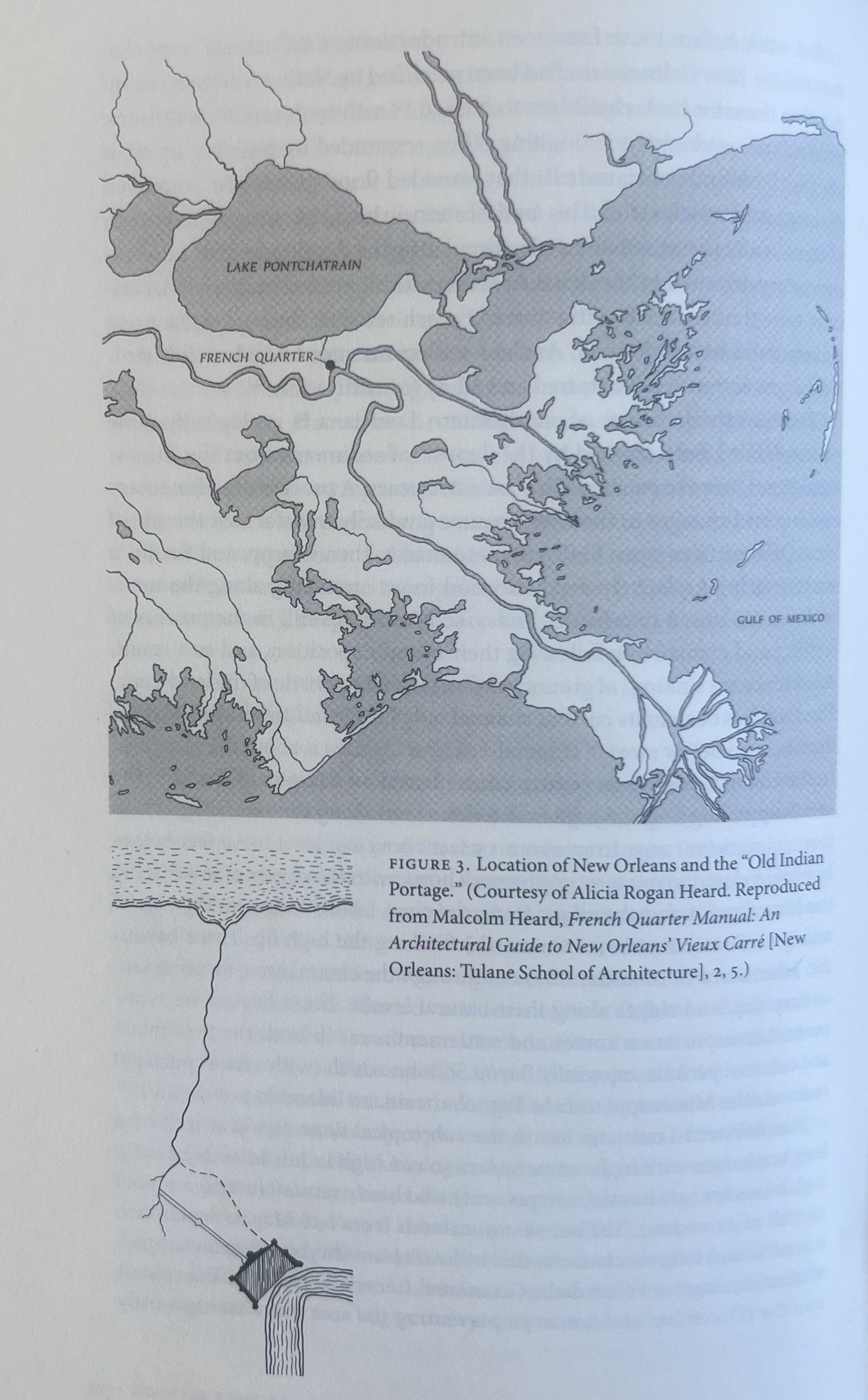
The French explorer Robert Cavalier de La Salle and his party passed through the site [that] would become New Orleans in 1682, in France’s first bid to claim the lower Mississippi Valley. Other explorers and coureurs de bois likely visited the site between that time and Iberville’s visit in 1699. In that year the real colonization of Louisiana began. Within a few years, a handful of Canadian and French settlers established themselves at an Indian village along Bayou St. Jean (present-day St. John) a mile or two inland from the future colonial town. The holdings were confirmed by concessions in 1708. By 1715 French administrators recognized that a post located near the Indian portage would be a valuable asset. In 1717 the Company ordered that not only a post, but a “principal town” should be built on the site recommended by Bienville…Toward the end of March 1718, Governor Bienville ceremonially cut the first cane at the chosen site for New Orleans. The city was christened with convict labor…thirty out of forty men sent to clear the dense canebrake were French convicts. Within a year, a handful of buildings had been erected.
And thus began the journey of what French nun/missionary, Marie Hachard, dubbed “[t]he devil here possesses a large empire.” Dawdy’s frameworks for unpacking French-founded New Orleans (1718 – 1768) are:
Ethnography &
Nature of colonialism (“…certain undercurrents of colonialism became mainstream in New Orleans, and thus remain more visible for study.”)
On #2, she pays keen attention to unpacking rogue colonialism, where the inhabitants manage the frontier conditions “in their own self-interest.” Ultimately, this style led to colonialism’s downfall because it “create[ed] conditions that foster not only cultures of resistance, but also circuits of seditious power and contraband flow.” In short, when Europeans-turned-Creole got a bite of the economic/political independence apple, they wanted the full fruit. We see this time and time again. Can’t put the lid back on the proverbial candy jar once the kid gets a taste. But New Orleans is unique in many ways when stacked against other colonies that had a consistent influx of people, be they enslaved, indentured, wealthy, etc. In other words, when you do not have that consistent stream, your “native born” seemingly take on a much different stride to defining themselves and how they view the territory they are in. More importantly, it allows us to see the transitions from one generation to the next much clearer since the denizens and their offspring vary little from one handover to the next –
The utilization of creole as the dominant designation for native New Orleanians dates at least to the 1740s. Virtually abandoned by France in 1731, Louisiana saw no significant new immigration from Europe or Africa until the beginning of Spanish rule thirty-five years later. As a result, the city presents an unusually clear picture of the generational transition from colonial to creole society.
For clarity:
→ The “founder generation” is considered the folks in New Orleans/Louisiana from 1699–1736
→ In the “abandonment era,” 1730s – 1760s, we have the firmly “creole generation,” before Louis XV secretly handed off Louisiana to his cousin, King Carlos III of Spain, post-Seven Years’ War loss.
Some very seismic cultural & socio-political waves governed these decades listed above:
The French colonized New Orleans during the height of their “Enlightenment absolutism,” which served as a guidepost on “social control,” colonial experimentation, and what was deemed a successful campaign vs. not (i.e., “metropolitan neglect” stems from the French crown viewing this colonial experiment as a failure).
The French three-tier system & prevailing social construct were firmly in play: clergy (#1), nobility (#2), everyone else (#3). All three are expected to have full and absolute deference to the king (absolutism).
Where are we? A New World French colony emerges in 1699, in which Pierre LeMoyne d’Iberville, who brought with him “French soldiers, Caribbean buccaneers, and Canadian coureurs de bois,” settles in. Over the next ~15 years, the colony became a small outpost led by Iberville’s little brother, Jean-Baptiste LeMoyne de Bienville (“father of Louisiana”). Remember the Scottish flag and John Law? Well, Law had the influence and status to convince the French Crown to let him experiment with “centralizing and tying together national banking operations, the royal treasury, and the colonial companies” for the new territory. Long story short, this led to the “Mississippi Bubble” in 1720, and eleven years later, the colony returned to the crown’s administrative control (i.e., after the Company of the Indies took over in the interim). Some of this was referenced in my Studies on Black Colonial Louisiana piece.
Yet, despite all of this, “New Orleans [was viewed] as the center of the colony’s social, economic, and intellectual life,” hence its christening as the capital in 1722. There was also a geo-economic practicality behind this capital status, given that New Orleans was the primary port/commercial locus. This central-locus benefit typically induces citizens to believe that they’re culturally superior, on account of figuratively (and literally) speaking more languages given their interactions with the Atlantic community.
To put a nice (long) bow on the form and consequence that New Orleans’ colonialism took, the author encourages us to decenter the metropole –
Colonialism was as much a creation of rogues and independent agents as it was the project of imperial states. It was actually rare for those at the center of state power (such as a monarch and his close advisers, high-level ministers, or powerful legislators) to take initiative in launching colonial projects, and even rarer for them to pay close attention to how the projects were managed. “Colonial power” has become too abstracted and too overstated, in my view. Although colonialism, particularly in the Americas, is characterized by unfathomable depths of genocide and dehumanizing slavery, this brutality has too often been attributed to a nearly faceless state power located in Europe. In fact, these acts were perpetrated on the ground by local militias, slaveowners, and colonial administrators often acting on their own initiative and in pursuit of their own interests—in short, by private citizens and rogue politicians.
If you don’t know what comes next, prepare for a sharp turn off the Louisiana road, and into the cane fields (sort of).
Rum.
Just when I thought Hall’s work, Africans in Colonial Louisiana, was my earliest peek into rum imbibing in 18th-century Louisiana, here comes Dawdy with the gems! And the story goes (circa 1720s Louisiana, emphasis mine in the quote):
→ There is a historian & writer, Dumont, who was “well educated and politically well connected, but of uncertain nobility and little wealth.” These distinctions, given the three tiers, are of high social importance.
→ The author discusses his manuscripts, life, and how he eventually engaged with the revered home beverage (“Bordeaux wine”), while also engaging in the New World liquids (rum).
…He eats a good meal of salad and curdled milk, then drinks “at least” two bottles of Bordeaux wine and smokes three or four pipes of tobacco while taking large gulps of the local crude rum called eau de vie. After vomiting violently for two days, he finds his body [purged] of its illness…
eau de vie, to the modern-day eyes, reads as unaged fruit brandy. But we must remember that certain terms served as catch-all categorizations rather than the clear/clean distinctions we use today. So, eau de vie = unaged (“local crude”) rum is not out of left field (historically speaking). Point here is: the man drank excessively, in part because alcohol as remedy for illness was still popular in those days. And he surely did not discriminate between the low-proof (wine) and high-proof (rum) goods.
Next, we’ll get a glimpse of an early catalog of goods desired by the Louisiana colonists. The original sources of these items ranged from the French Caribbean colonies, Europe, and trade with Indigenous peoples. The below quote is from “the Company period,” so this must mean all references are pre-1731, when the colony was returned to the French king (emphasis mine) –
Louisiana consumers desired the sugar, coffee, flour, cloth, tools, liquor, Indian trade items, and household sundries available in island markets. Some of these items were local products, such as sugar, coffee, and rum, while others were European imports.
Smuggling, pirate & privateer activity was par for the course in those days, though one of the three activities gets far more attention – in a Hollywood sort of manner – than the others. Nonetheless, we see how this illegal/illicit activity encouraged the flow of alcohol to Louisianans in the early 1700s (emphasis mine)
A pirate and smuggler named Béranger described how he helped settlers survive by running a corsair between Martinique and the Gulf coast in the early years, preying upon New England ships when not docked at Tortuga, the legendary port of the Caribbean underworld. He provided Louisianans with wine, eau de vie (brandy or crude rum), flour, and dry goods plundered from New England ships in exchange for Native American slaves and lumber.
Note: see, eau de vie could be either brandy or rum. But since the “Caribbean underworld” and “New England” were involved, there is a high likelihood rum was in the mix.
For a firm example of rum in Louisiana via import from Martinique (circa 1740s), Dawdy cites one Jacques de Meyère. Meyère, a shipowner & smuggler based in Martinique, who also had a second home in New Orleans, gets caught up in a legal tussle with other smugglers surrounding prices paid for goods and other disagreements (emphasis mine) –
De Meyère had also allegedly attempted to cover his debts by “overcharging” local smugglers Michel F. Gerald (alias Fitzgerald) and Jacques Lorrain dit Tarascon. They had purchased beer, rum, cloth, syrup, and soap they intended to sell at the Pensacola post in Spanish Florida. Governor Bienville supported Gerald in his suit against de Meyère. De Meyère countered that Gerald had tried to “extort” a price break by causing unnecessary delays while piloting Le Chevallière to port.
When I stumbled upon the above, it Dawdy dawned on me that, in my quest to unearth all that is Louisiana & Rum, much will be left unfound because “wine, liquors, and cloth” were some of the most highly sought commodities on the smuggling/black market. And the smuggling/black market is where recordkeeping went to die, lest those items were confiscated and thereafter reported to authorities. But the author masterfully allows our imagination to put those pieces of the puzzle together –
Runaways, in particular, found peddling smuggled goods a viable employment. By supplying their contacts with clothing items, liquor, and small luxuries difficult to get in rural areas, runaways played a key role in the distribution system to plantations that tied the internal economy of slaves to international smuggling rings.
To substantiate Dawdy’s quote, I’ll recall a ‘for instance’ from Africans in Colonial Louisiana (circa 1779 or 1794, emphasis mine) –
There were distinctive patterns of crime at the post. Crimes committed by slaves usually involved theft of food and clothing. Free black women were sometimes accused of being involved in provoking thefts and receiving stolen goods. Nanette, a free négresse living at the house of the English commissioner Boukguard, was accused of stealing cloth from him and selling it to two male slaves in exchange for eight bottles of tafia and four barrels of corn.
My final-ish example, before I make a very strong conclusion, is from court proceedings that took place between the 20th of February and the 21st of March 1744. An enslaved person admits to drinking cane spirit in a tavern, which stoked the fears surrounding “negro” drinking and how that would result in an enslaved person losing “his senses.” In other words, it was believed that enslaved persons were no longer prone to “the necessity of submission” while intoxicated (sentiments of “Attorney General Lafrénière” in 1763). Back to the court proceedings/charges (drinking & stealing) –
…criminal trials…Alexandre, a thirty-four-year-old Senegalese slave, admitted to drinking rum at Dusigne’s tavern with his friend Jupiter, but not to passing off stolen merchandise.
These sentiments were layered into the fabric of social control and stereotypes foisted upon certain groups (emphasis mine) –
…Governor d’Abbadie wrote a letter to France saying, “Immoderate consumption of tafia [crude rum] has turned all the people into brutes.”
And this is when I had a…

In almost every single case where I come across the word “tafia,” it is usually followed up with some descriptor to emphasize its (1) lack of exportability (undesirable for trade in the (Trans)Atlantic market), (2) crude nature, and (3) proximity to those of the lower classes. All to say, rum (or rhum en français) is rarely described in those same manners (at least not in the same frequency). The plain and unfortunate truth is that a good’s perceived value is often divorced from its actual, artisanal production quality (inputs and outputs), and judged more by the people who embrace and/or can afford it. In-group / out-group behavior.
The ‘what is luxury vs. mass’ goal post shifts over time. Case in point: what we think of as rum punch today was once considered a luxury in the 18th century, because only a select few could afford the ingredients to blend rum with fruits and spices. Today: the commoner’s cocktail.
So, my conclusion is as follows: in many instances, “tafia,” “Guildive,” and any other form of “crude [colonial] rum” were spoken of in pejorative ways because they posed a threat to the social order. In the French New Orleans scenario, there was no chance that those at the top, increasingly the creole generation, wanted any symbiosis between the following groups:
French prisoners & soldiers
Native Americans (free/enslaved)
Blacks (free/enslaved)
Poor Frenchmen and women
“Forçat” (forced exile or convict labor)
“Engage” (indentured servants)
Literally anyone in that #3 category
Collectively, “les petits,” or the “little people.” Gatherings of les petits across taverns where rum was widely available had a specific ‘what could come of this’ ghost lurking in the background for those at the top. Hence, we see “tafia” (and related terms) often discussed negatively. It’s more symbolic than anything to do with the beverage’s actual quality. I’ll need to continue picking up the breadcrumbs on this, but it holds water –
Social and economic exchanges in the cabarets and taverns of New Orleans continued to blur intended divisions of class and color…policies appear to have had negligible effects. The Superior Council issued redundant ordinances in 1725, 1746, 1751, and 1763 attempting to control the number of taverns and discourage the mixing of slaves, soldiers, and free people in these establishments…Some establishments were owned by free people of color, who offered a place for slaves to meet in the city.
Maybe future clampdowns on tafia/rum consumption & production were because they served as the fuel lubricating the social car of the petit gens. Another way to sow disintegration among the classes. To be determined. What does not need any further determining, as far as I’m concerned, is that rum was part and parcel of the colonial drinking environment of 1700s Louisiana. And I am here to never let you forget that, cheers.
Back on Dawdy’s New Orleans road. First stop: European expectations, Louisiana realities.
“Les petits” are led by the example of “les grands” and “les grands” have no power to repress the unruliness of “les petits” since they take part in the same disorders. This entire colony is a veritable Babylon.” – Father Le Marie on Louisiana, 1717
As you can see, the French missionaries rarely had pleasant things to say about New Orleans. It is through Le Marie’s lens that Dawdy takes us on the journey of those early days surrounding people, culture, expectations, behaviors, and all the other qualities that go under the ethnography bucket. But remember, humans are storytelling, fallible machines, so we must – as Dawdy does – take good care to peek between the gaps to reveal as full a story as possible. Which is to say: “disorder” was viewed in a very particular way by the standard of (1) “eighteenth-century modes of thought” and (2) the “Enlightenment absolutism” of the “ancien régime” (French crown and its adherents). It is largely through the “les grands” echo chamber that we get perspectives on the “order/disorder thread” Dawdy discusses. Or, as Marie Louise Pratt described the echo chamber: communicators wrote with “imperial eyes.” We must consider this when drawing conclusions –
…disconnect between metropolitan expectations and local developments in French Louisiana, or to a particularly inept effort to install colonial power.
It is probably impossible to establish any agreement on criteria for measuring “orderliness.”
A favorable (for the colonists) local development that deviated from the crown’s “blueprint” was “the famous LeMoyne brothers (Sieur d’Iberville and Bienville)” becoming “quite successful” in short order of setting up shop in the territory. All in all, what would have looked chaotic to some was probably viewed as favorable by others. It’s just that the chaos was overly emphasized, like a baby crying when it doesn’t get its way (bad example, but I’m not changing it!).
Separately, proof that New Orleans was not entirely void of intellectualism, which is a popular trope –
The size and content of private colonial libraries proves that spending thirty years in a remote outpost did not prevent colonials from continuing their education, nor imbibing the most current thinking in the metropole. Estate inventories of major Louisiana concessions taken between 1729 and 1769 list collections of books and pamphlets numbering from 36 to 300.
In 1713 alone, over 700 official letters passed between France and its American colonies, while the parallel British correspondence averaged just 52 per year.
You don’t usually think uncontrollable territory and rich “epistolary” exchange; it’s also important to add that letter-writing was the primary means of communication for every facet of life: business exchanges, favor requests, updates (administrative tool), and, most importantly, proving to your fellow humans that you were participating in the higher intellectual cultural practices of the time. Practically speaking, (1) many were homesick and wrote back to their Old World (Europe), and (2) the constant war between colonial powers, which caused “variation in ship arrivals,” urged many to communicate as often as they could.
Ultimately, the French did not heed the lesson that every action has an equal or greater reaction, which is reflected in the letters of the day. Dawdy analyzing a colonist’s exchange showcases this epistolary cause-and-effect (i.e., natural environment → lowest on the three-tier shipped to the territory) –
Vallette shows us that already in 1720 two theories were forming to explain Louisiana’s failure. The first held that it could be blamed on a particularly inhospitable province of Nature where flooding, disease, and heat sabotaged efforts to build a respectable community. The second claimed that the colony represented a moral failure in the part of the French themselves—the blame falling not only on loose women in Louisiana, but also on the men who sent them there. How could France expect an orderly colony when it was peopled with criminal rejects from the home country? Vallette was not the last to express concern about the moral quality of Louisiana’s immigrants, and its women in particular.
Yet still, Dawdy provides us with further fuel to combat the long-standing myth about the supposed “anti-intellectualism of colonial New Orleans.” She notes that Louisiana’s literacy rate was comparable to that of France and other Catholic communities. And when you dig into the data further, some unanticipated truths reveal themselves –
Thomas Ingersoll found in a sample of slave baptism records from the 1730s that 84.4 percent of male and 57.8 percent of female sponsors (godparents) could sign their names. In another sample, it was found that 42 percent of the colony’s soldiers between 1727 and 1730 could sign their name and 7 percent had received some sort of higher education. About the same percentage (40 percent) could sign their names to the oaths of allegiance required by the new Spanish king in 1769.
We’re jumping ahead a bit (timeline-wise), but it’s all relevant –
On average, creole New Orleanians [“generation of 1760–62”] were twice as literate as their parents or grandparents and much more likely to sign their names than contemporary in France.
And for women, in particular, this was even more the case –
Emily Clark credits the Ursulines for the unusually high literacy rate of New Orleans creole women by the 1760s.
Ultimately, the author wants us to recognize that the poor self-image projected onto New Orleans is in part due to the metropolitan failure to realize its “blueprint,” as opposed to something inherently wrong with the colony itself. Dawdy encourages us “to free our understanding of New Orleans from this flat duality so that we can better see ethnographic complexities on the ground.” More honestly, the circumstances in early colonial Louisiana are split down the middle, a sort of metaphor for most things –
It was simultaneously ordered and disorderly.
Second stop: figuring out where everything goes.
Bienville and Company of the Indies had the “proprietary charter for the development of the colony.” In 1721, French military engineer, Adrien de Pauger, was charged with designing/overseeing execution of the city. Rules of the (three-tier) road said that those of higher stripes received the best assets –
Concessionaires, company officials, and military officers received the best and the largest lots, situated on the high ground next to the river. This was not a free-for-all land grab of a frontier town.
Homes that conflicted with the plan (i.e., built before execution) were often torn down, much to the frustration of the existing colonists. We get a clear sense of where this New Orleans backwater reputation comes from: the French had a way they desired for things to look and feel, all else was criticized, especially if it involved petits gens –
“The inhabitants, sailors, Indians, and slave run around freely, inside as well as beyond the town. They meet in a multitude of negro cabarets frequented by slaves who have fled their plantations either due to laziness or want, and who survive by trading stolen goods. They meet in the thick and intruding woods that border the town almost all around. The woods trap humidity and provide a good cover for smuggling.” — French visitor’s remarks on New Orleans, circa 1750s
For the French, control of the space/territory meant control of people, politics, and economics. Which is a difficult thing to do in a heterogeneous society where people from various walks of life have their own concepts of space & existing –
…African societies had been building large towns in the interior of the continent for over 3,000 years. The late [pre]colonial period seems to have been a time of urban growth, particularly in the kingdoms of Mali, Niger, and Benin.
Be that as it may, the French went ahead with the intentions –
With its Place d’Armes overlooked by St. Louis Church, its rigid symmetry, and its segregated spaces, the original plan for New Orleans actually resembles Spanish colonial cities much more than it does old French towns of the eighteenth century.
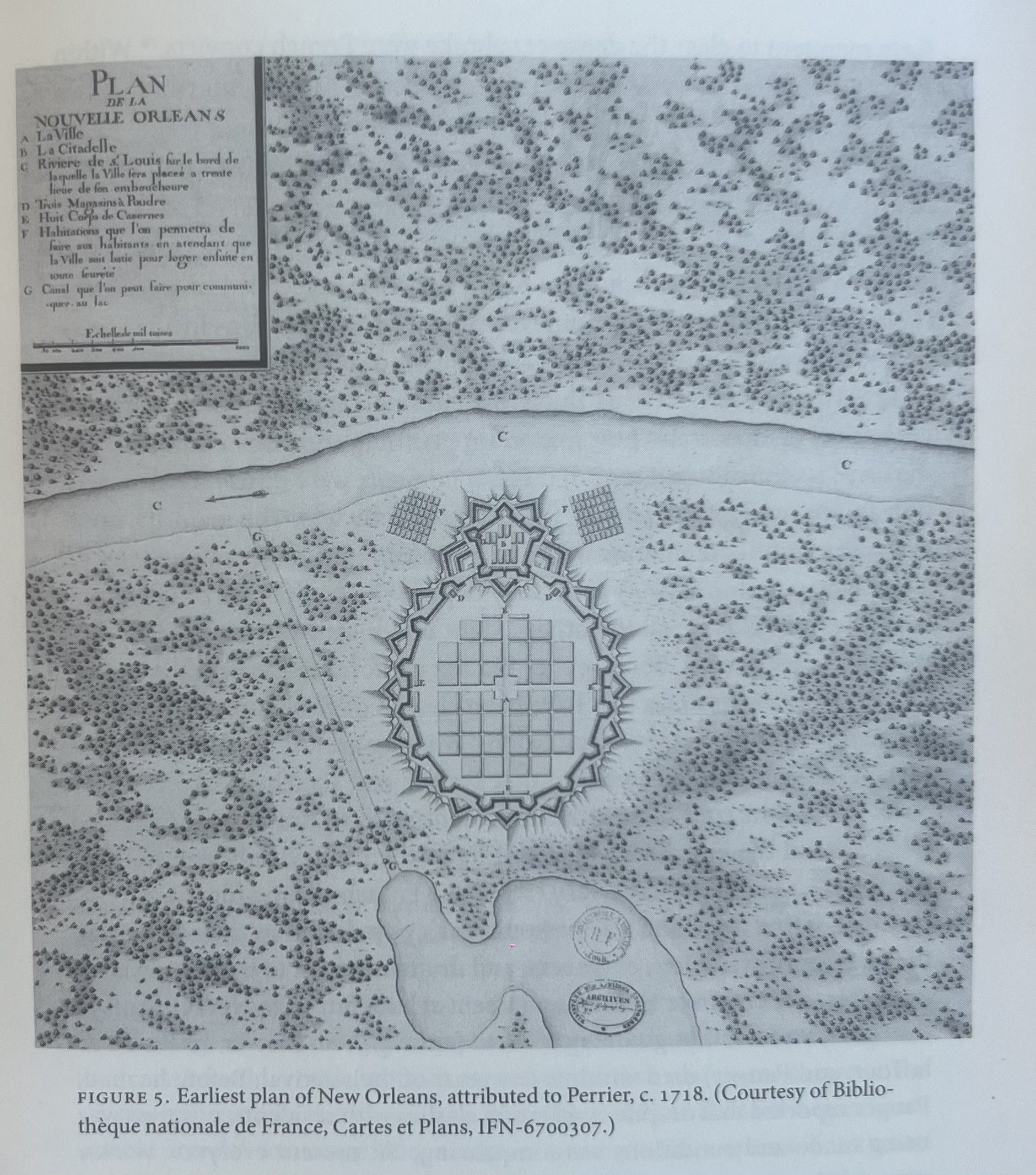
The colonists (most likely those directly from France, not the ones who came over from Canada) did their darndest to recreate Paris in New Orleans, “la cité idéale.” Some of these desired city attributes were: well-lit, properly surveilled, no abandoned buildings, encourage freshwater circulation, among other things.
One of those “other things” was enforcing continuity between its port cities (Le Havre, Brest, Lorient, and New Orleans/La Balize), mainly to maintain an efficient flow of goods and capital. But New Orleans is unlike France (to say the least). The French did not encounter fresh terrain when colonizing Louisiana. Also, the Spanish had been there 150 years prior, so there was some exchange between the native population and the Spanish. Even so, the Native Americans had altered the terrain to suit their needs (e.g., using clamshells to build mounds that protected against flooding, improved drainage, and soil enrichment). These areas already settled by the Natives became more attractive to the French because the land was better and easier to inhabit. As mentioned in Africans in Colonial Louisiana, the assistance of the Indigenous is an all too important part of the French colonization formula that must not go underreported –
Although engineers drawing up plans in France may have reduced Native Americans to features of the natural landscape, the Canadians who first explored Louisiana did not depict the country as uninhabited, wild land. The foundation story of New Orleans credits Iberville’s Native American guide as playing a key role during an exploratory trip in 1699.
The French underestimated what fortifying a city at “the edge of a swamp” would entail. The “hurricane on 11 September 1722” surely put the pep in their step. Ironically, this became an opportunity for the French engineers charged with building the city. To the engineers, the hurricane was seen as fortuitous (i.e., an excuse to knock down buildings erected outside of/before the implementation of their plans). Their cause was only further encouraged by diseases such as “cholera, dysentery, malaria, and yellow fever” that ravaged the colonists throughout the 1700s.
By 1722, Bienville enforced the engineering of levees to protect against future disasters –
By the middle of the French period, the city was walled in from the river and the streets were scored with an intricate grid of ditches and canals crossed by little footbridges at intersections.
Although a large influx of slaves entered the colony between 1719 and 1731, for the first several years those in the New Orleans area were put to work building levees, herding cattle, hunting, and tending gardens. Their labor tasks differed little from those of the idle soldiers in the city or the majority of free colonists who were forced to experiment with agricultural diversity to ensure their own survival.
It seems that most goods were imported as the town fortified itself/French colonists learned the lay of the land. Subsistence farming (e.g., “livestock and food crops”) did sustain, while in tandem attempts to cultivate “tobacco and sugar” largely failed (latter more so than the former). The imbalances kept the colonists in a hand-to-mouth state since procuring “provisions from Europe” (i.e., trading goods) was not a guarantee when the French Caribbean islands were more mature.
As the city approached a decade of organic development outside the military engineers’ control (mid-1730s), the representatives of the crown must have realized that they had not accounted for the large enslaved population that eventually inhabited the city. They did not design with this development in mind. The emerging creole population (French European descent) began doing away with self-sufficiency plots in place of slave quarters –
A new, local model of urbanity arose that mimicked the plantation landscape…the parallels to Mauritius…are stunning.
In short, the creole generation began to embrace New Orleans for their own concept of survival and living (irrespective of the “ancien régime”) —
Rather than being a European metropolis of aristocratic gardens, New Orleans became a more African place, its gardens given over to slave quarters. Rather than serving as a major port for transatlantic trade, it became a hub for an intercolonial black market that defied mercantilist controls.
And that “BACKWATER ENTREPÔT” is what we will discuss next.
Third stop: get out the car and hit the waters.
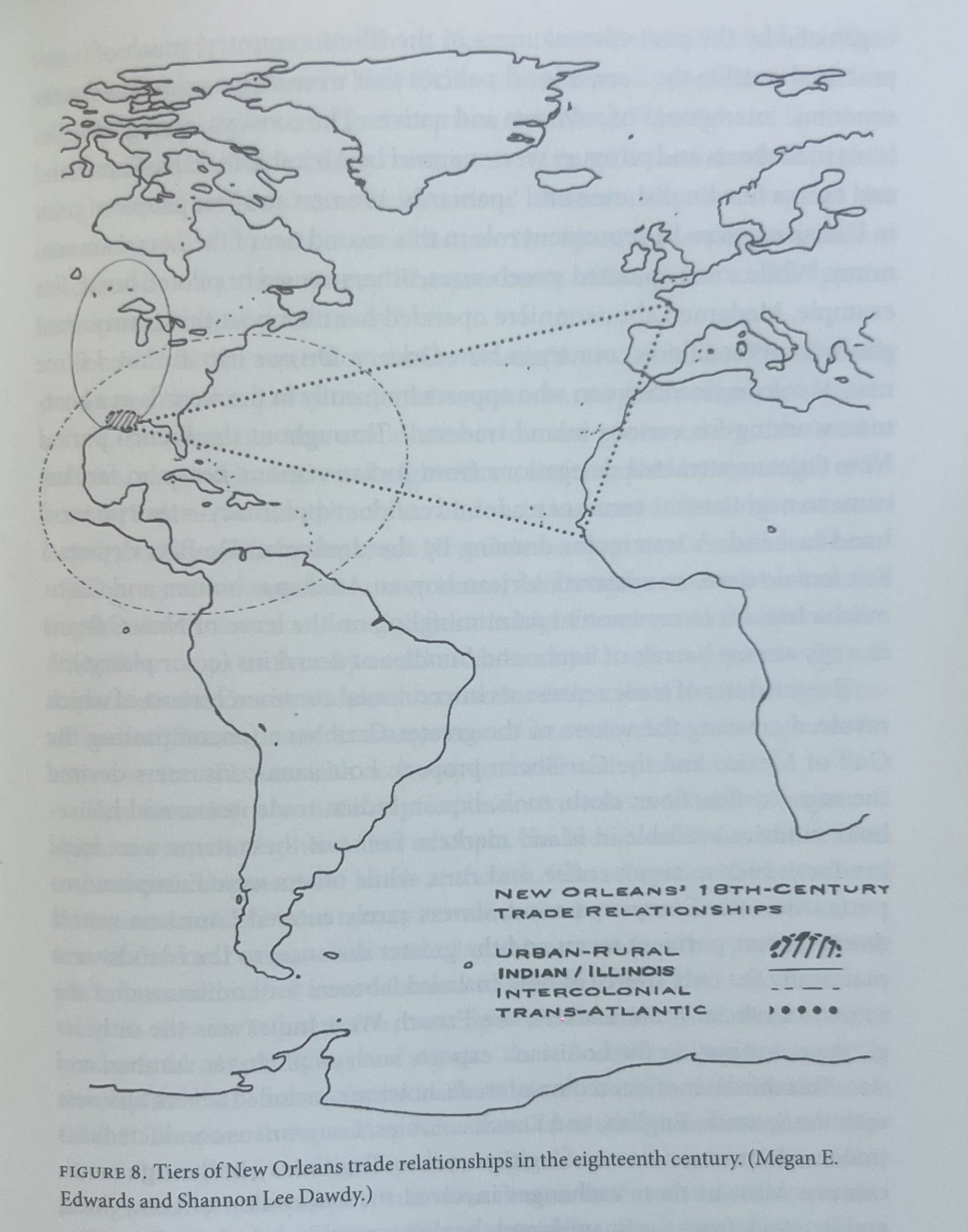
Given French abandonment of their perceived failed colony, along with other survival/frontier constraints, many in New Orleans turned away from the typical Atlantic (Caribbean-Europe) trading schema and looked inward for alternate routes. This included trading with Native Americans, as well as going up & down the Mississippi River, and around the greater Caribbean. Where there are constraints, people find a way –
The circuit linked tiny New Orleans to the major ports of Veracruz, Havana, and Cap François, as well as to sister cities such as St. Pierre, Martinique, and smuggling coasts such as Cartagena.
Smuggling was a rampant (though common) reality of the “Mississippi-Caribbean World.” A new style of mercantilism. Gone were the days (1712 – 1731) of being forced to patronize the Company of the Indies’s stores, where goods were sold at “preset prices.” The Company’s “exclusive control over all imports and exports” unintentionally engineered a society where people learned to create economies – smuggling, secondary exchanges – beyond the monopoly. This sustained even when the Company flipped control back to the French crown, despite the strict licensing requirements imposed. The bucked system I am referring to –
All native exports, from tobacco and indigo to deerskins, had to be sold, commissioned, and/or shipped via the Company. After the crown took the colony back from the Company in 1731, independent French merchants gained the right to trade in Louisiana, but only if they operated out of a French port authorized for that destination, and only if they obtained a proper license.
We are talking about the commercial hub of the territory, which does not account for the economies and market practices developed throughout the entire state. Many came from other parts to peddle goods/extra provisions from plantations, which created another (organic) market mechanism out of the crown’s control –
In 1739, a free woman of color named Isabelle came to town to buy fifteen herd of cattle for her ranch and tar factory on the north shore of Lake Pontchartrain.
The very important secondary market, many thousands of miles across “Illinois farm country” and the rest of North America, allowed the colonists to trade in “pelts and deerskins…arms, metal tools, beads, vermilion (valued as body paints), cloth, and liquor that had value in Native American markets.” Everything was on the table: wine, sugar, flour, hams, and bison tongues. Dawdy reminds us that this was not necessarily illicit activity; these commercial exchanges just existed outside the established political/colonial preset boundaries. Women and people of color played a significant role in this part of the economy, from “inn” & “storehouse” operators to boat managers along this stretch of trading terrain.
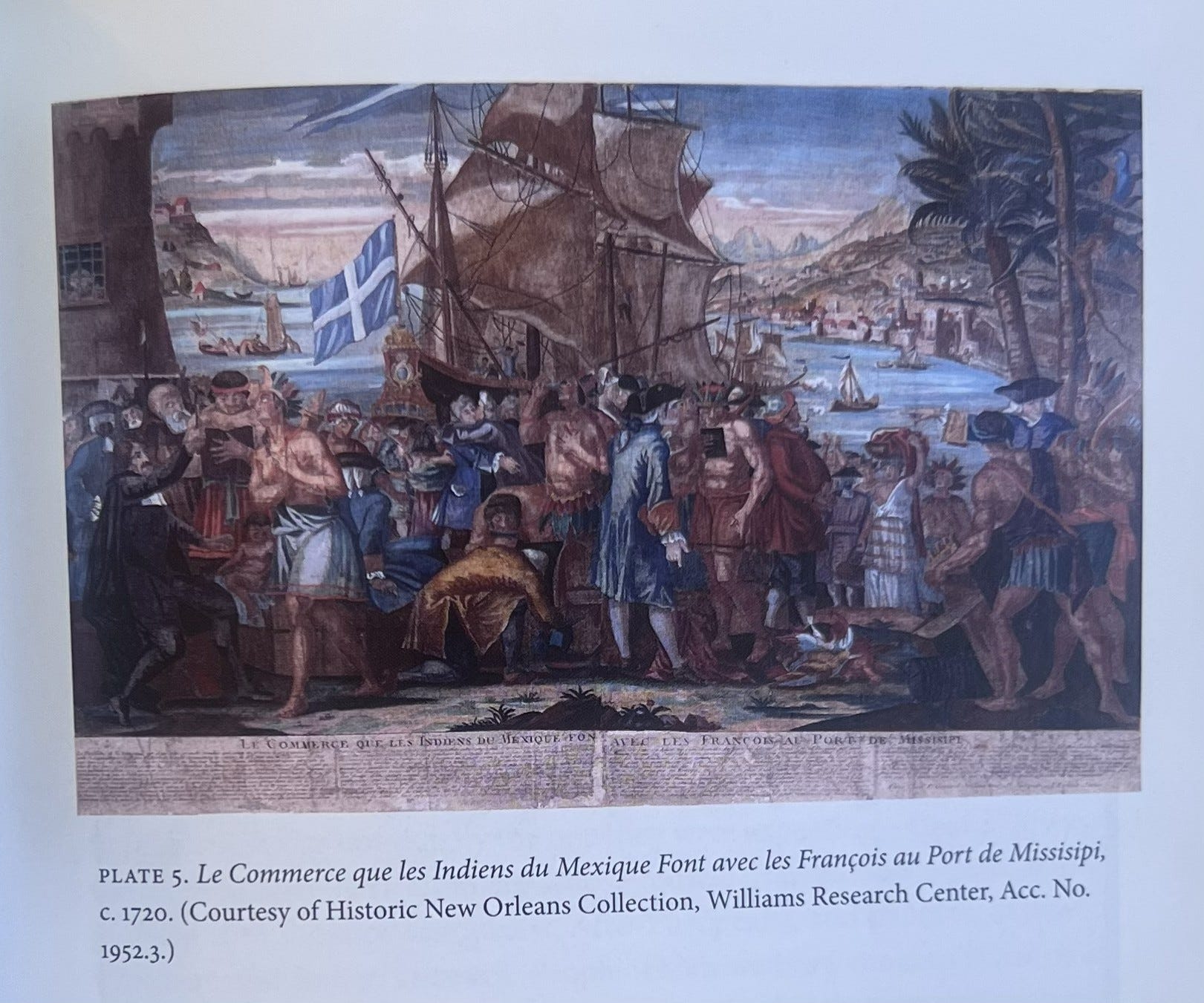
The third tier of trade was inter-colonial commerce: the greater Caribbean and the Gulf of Mexico. This third tier often took the form of sanctioned (contraband) activity among arch-enemies: French <> Spanish <> British. However, the illegal “stuff” was helped along by many payoffs and turning of the blind eye –
“The proximity of Louisiana to the Spanish Indies assures us of good trade.” – Pirate Jean Béranger (1720s)
…St. Pierre in Martinique and Portobello on the Panamanian isthmus…two of the most active smuggling entrepôts in the world.
Over half of the recorded voyages (51 percent) involve foreign (and usually banned) Spanish, British, or Dutch colonial ports. Most shipping connections of New Orleans in the greater Caribbean were with other secondary ports and small coastal transfer points. Many of these, such as Cartagena, Portobello, and Jamaica, were notorious smuggling harbors. – From the Superior Council Records regarding “secondary ports” and New Orleans trade (1735 – 1763)
The heads of Louisiana, Bienville and Iberville, had a sharp reputation for smuggling/profiteering on the crown’s dime. But much of this history, for obvious reasons, went undocumented, and is therefore “understated in the historical literature.” The complicity of higher officials follows along similar lines, so “regulatory record[s]” are also sparse. However, in the “[n]otarial documents,” people often had goods they weren’t supposed to, which is evidence in and of itself that smuggling was rampant. In other words, how is it possible that someone was able to secure Jamaican rum in Louisiana when French colonies were forbidden from trading with the lads? Most investigations by the Superior Council “led them to the top of the colonial power structure,” meaning the investigation was dead on arrival. The creole generation was firming up their own impenetrable hierarchy –
Criminals or not, international traders and merchant-planters became the most powerful group in New Orleans from the 1730s to the 1760s through their influence over the Superior Council and their political alignment with Louisiana’s pragmatic governors.
We gotta give it up to Dawdy for using civil cases, depositions, and other records to triangulate the extent of smuggling in New Orleans.
These structures only operated because of coordination and complicity. New Orleans is not the only ‘bad child’ in the underground economy of the time. State-sponsored smuggling was par for the course across Louisiana’s “sister cities” –
The governor of Martinique wrote to Louisiana Governor Kerlérec in 1759 that cartel ships “are today our only means of subsistence…[it is] important that we encourage them.”
Healthy reminder that, regardless of what the law says, people will typically do what is “socially acceptable and pragmatically necessary.” And in the case of ‘get it how you live,’ market participants responded accordingly. What’s beautiful about this slice of New Orleans history is that, depending on whose side of the story you listen to, you’ll end up drawing different conclusions. Naturally, therefore, you should grease every spoke on the wheel. As told by the French, New Orleans was an “economic backwater [that] failed to return any significant profits to the metropole.” As told by the boots on Louisiana soil, however, success was manufactured where there was no clear path – along the Mississippi, across the broader Caribbean, and throughout the rest of the Americas (especially Mexico). The success yielded from ignoring the Mother Country’s constraints must have emboldened the colonists –
In French Louisiana one can easily imagine that in addition to its survival value, smuggling represented ideological resistance to the imperial impositions of mercantilism and chattel slavery. This romantic version of the story idealizes free trade and informal economics as revolution from below.
Jumping forward – to Spanish-controlled Louisiana – we can see why a tightening of the ‘how things operate around here’ belt (i.e., imposition of structure & formalities to secure complicity) would have been anathema to those who built the proverbial glove to fit their hand. It’s worth taking a closer look at those characters who were of this mindset –

Fourth stop: back on the road that the creole paved.
Dawdy emphasizes the “social organization” that took hold among the people now considered the early “creole elite.” This hierarchy was “foreign to metropolitan design” when compared to the rigidness of European feudalism, where birth & status dictated your lineage’s social standing. What took hold in New Orleans by the 1730s or so was a “new type of social order.” I would say that it mirrored European feudalism in rhythm, but, like everything else in the territory, was refitted to make sense for the citizens and environment.
By the second creole generation, one could characterize New Orleans as a society with four basic social strata: large slaveholders and merchants, small slaveholders, non-slaveholders, and slaves. Mobility into the top tier had become circumscribed by marriage and inheritance, but considerable fluidity remained among the other social classes. Individuals could transform themselves from slaves to small slaveholders and, under legal duress, back again.
This social operation, a far cry from the caste system under the English/American colonies, aligns with Gwendolyn Midlo Hall’s notion that race and judgment, while likely practical approximations at the time, were not hard-and-fast rules about how things operated. All, of course, within reason since we’re talking about societies that mainly depended on Africans for slave labor. Dawdy affirms: social demarcations between citizens of the 1750s were largely rooted in “slavery and trading wealth.”
Part of the issue in New Orleans was that there were too many classifications for those at the bottom of the socio-economic pyramid. Legal statuses ranged from “free French subject, freeborn person of color, affranchit (freedman), engagé (indentured servant), soldier, forçat (forced exile or convict labor), and slave.” Add gender into the mix, and you’re in over your head trying to count the sub-classifications. So, when the colonial orders could not fully segregate people, as seen in the many drinking establishments of New Orleans, “the elite began to segregate themselves.”
…the rise of the creole oligarchy in New Orleans was accompanied by blancification (or whitening) through endogamy and marriage alliances with the few new French officers who arrived in the colony after the 1730s. The work of defining who was a grand eventually evolved into defining who was “white.” In other words, the elite racialized themselves. Racialization reflected the development of elite endogamy and oligarchy at least as much as it reflected the development of color-coded slavery.
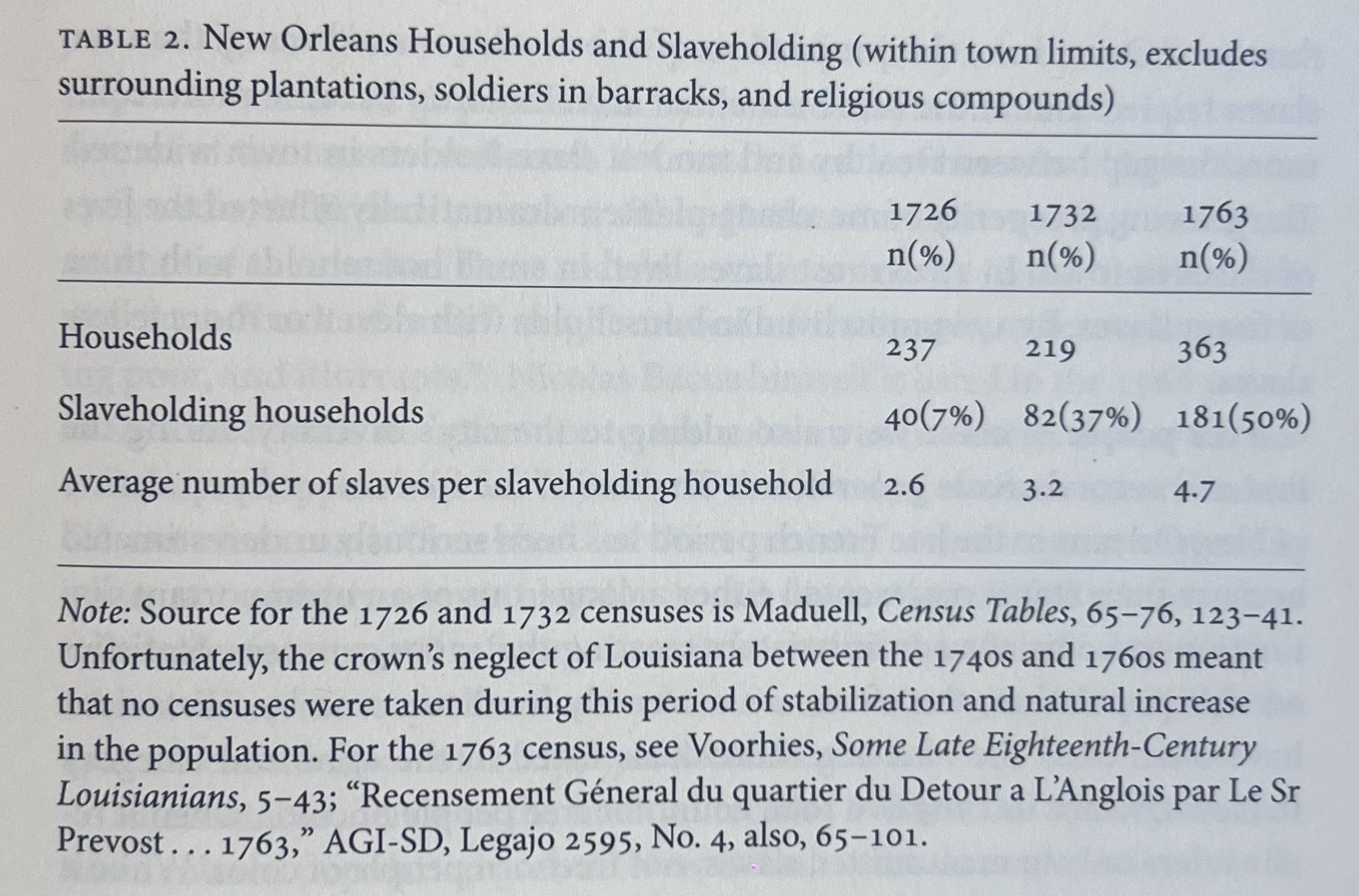
And though they siphoned off into their own social universe, the source of the group’s wealth was largely sustained by the form & shape that slavery took on in and around the city –
Planners had not anticipated the rapid growth of urban slavery, nor the unregulated movement of free people of color, runaways, and hired slaves into town. After the 1730s, as Louisiana’s creole population came of age, New Orleans became a multicolored place, both in neighborhoods and within individual households. The census of 1763 shows the evolution of a creole society in the second and third generations and its own categories of classification…this time the ranks of the free were also finely divided.
That fine division referenced, Affranchit (“the freed”), was further broken down into négres, négresses, négrillons, and négrittes. Free or not, skilled Black labor became critical to the city's growth. Artisans were probably most sought-after, followed by a legion of craftsmen. And then there were edge cases –
In the 1720s Raphael Bernard, who called himself a “negre libre,” sued several Euro-Louisianans to collect on debts they owed him.
Note: Dawdy does a rigorous job detailing census, which categories of free persons of color were emphasized vs. not, among a host of other analyses that I am going to bypass. I recommend tearing into those details when you pick up this book.
The takeaway: New Orleans had tended toward a posture of “insubordination” against the metropole in forming their own understandings of social structure, though I believe these structures had a base in feudalism (ultimately). Wealthy planters/merchants enjoyed the developing “creole system, which tied status to slaveholding and commercial wealth rather than to claims of nobility that few could plausibly defend.” Poor Whites and enslaved people enjoyed “greater mobility” than they otherwise would (had they been elsewhere).
Fifth stop: the hand of the law stopped the vehicle.
Law as written is rarely an adequate instrument of power, and the ambitions of individual agents are frequently at odds with their own class interests.
Which is to say: the creole elite went off script. In the earliest periods, the focus was controlling “the colony’s unruly petit gens in the interests of the king.” In the first creole generation (1730s on), those in control went above the king’s head and started calling the shots; the Superior Council became far more concerned with controlling the enslaved via enforcement of the Code Noir. For background on the Superior Council –
From 1699 to 1712 Louisiana was ruled singlehandedly by a military governor. With the takeover of Crozat’s company in 1712, the king issued letters patent establishing a Superior Council with responsibility for the colony’s civil affairs of finance, administration, and justice. After 1722 New Orleans became the seat of the Superior Council.
Dawdy shows how “law, discipline, and political power” had a specific set of colors in the New Orleans territory. In many respects, NOLA became the chaos (“theater of violence”) and “judicial center,” since crimes committed far away in Louisiana’s “backcountry” would also be settled in the city. I will throw you for a quick loop, but one that showcases Louisiana falling dead last in the French’s list of preferred territories –
Technically, Louisiana’s government operated under Québec, but in reality, very little correspondence occurred between the two governments.
Given the creole elite’s tightening grip on how the society functioned, it is worth zooming in on specific actions they took to secure control. Much of this was done via modifications to the Code Noir. First things first, no lawyers –
The second intentional modification made by metropolitan planners was to legislate lawyers out of the colony. In doing so, they hoped to curtail civil suits and challenges to political authority.
Second things second, some key tenets they modified out – based on what was in the Saint Domingue Code Noir (late 1600s) – were: a) Black & White marriage (concubinage illegal even if both parties baptized), b) manumission needed a reason with full backing of the Superior Council, and c) free people aiding maroons could “be remitted to slavery.” I suppose the one positive in a sea of negatives was the following –
Masters were prohibited from directly administering any of the more severe corporal punishments.
This was also under the jurisdiction of the Superior Council. But given those stipulations, you see many enslaved people in Louisiana, probably more so than other slave territories, sue & win for compensation or freedom under claims of extreme punishment. All of this was a far cry from where things began in the precarious colony –
In the charter generation, the black-on-white penal strategy [e.g., Louis Congo] served to level the colony’s petits gens at the same time that it attempted to cut a divide between two of the most dangerous elements of the lower orders—enslaved Africans and Frenchmen serving in the colony under their own degrees of servitude (forçat, engagé, soldier)…French forçats arrived with a legal status similar to that of black and Indian slaves, and were themselves known by the same term, esclave. Many had originally been exiled to the colony as a cheap alternative to Africans.
After 1737, there don’t seem to be any further signs of a “Negro executioner,” which means that the creole generation’s articulation and exacting of race/white superiority was firming itself up. And when you make & enforce the rules, there are predictable outcomes, regardless of what the letter of the law says –
Instead of the state intervening in the relationship between slave and master, as intended in many parts of the Code Noir, in the creole generation local government handed over the means of force to slaveowners as a private matter. Of course, the government officials responsible for this move were themselves major slaveowners.
It should come as no surprise that the Code Noir’s clauses were selectively applied. Generally speaking, it is difficult to locate a society where equal distribution of justice under law is a reality; the further back we go, the more true this tends to be. Importantly, however, we must account for the fact that Louisiana’s environment made requests of the people in ways different from those in other places. Example (also addressed in Africans in Colonial Louisiana) –
Louisianans declined to enforce many of the code’s articles, such as the ban on slaves carrying guns or weapons, or the ban on concubinage.
Primal behavior.
While Dawdy provides some solid understandings around the crimes of the day (e.g., “verbal violence”), who committed what crimes, and the psychosis a society must be under to treat enslaved drinking & marronage as a higher crime than actual violence, I think it is fairly predictable to conclude how crime, justice, and punishment were dictated in this era. Moreover, one can only wonder what the Superior Council deemed unworthy of reporting (e.g., “conflict between lower class French men and enslaved women”), which only results in a reader having to treat this topic as a rabbit hole to explore if they see fit. Nonetheless, the author sharing as much detail as possible helps remind us that what’s said & unsaid need to be weighed just as equally.
Sixth stop: who the hell let the Spanish in the car?
To go from French rule (hands off) to “Spanish Catholic imperialism,” as you can imagine, was too heavy a transition for the second creole generation. But given the outcome of the Seven Years’ War (France lost) & Treaty of Paris (1763), this transfer of colony from Louisiana to Spain was beyond their control.
The colonists did their best to put up strong resistance (initially): issued manifestos decrying Spanish rule → revolted → sent the first governor on his way –
…both les petits and les grands revolted and forced the “tyrannous” Ulloa back onto his ship, bound for Havana.
The Revolt of 1768 was made up of “three different sociopolitical interest groups” (~1,000 strong):
Elite merchant-planters (Superior Council);
Yeoman farmers (mainly German-speaking & crypto-Protestant upriver from New Orleans); and
petit gens (artisans, soldiers, laborers, and small-business owners)
The Spanish, determined to get things under control, sent in “bloody O’Reilly,” who forcefully put down the tumult (and yes, Alejandro O’Reilly was an Irish-born, Spanish officer) –
Louisiana’s days of rogue colonialism ended when the heirs of its “founding father,” the aging Bienville, faced the firing squad. Among those known in popular memory as the “martyrs of 1769” were his second cousin Lafrénière and grand-nephew Jean Baptiste de Nolan dit Bienville (nicknamed after his famous uncle).
Fair to say that 1769 marks the official transfer of control to the Spanish. Dawdy, talented as all hell in the ‘astute analysis game,’ unpacks why O’Reilly ultimately targeted the top of the socio-economic pyramid for executions, and why the petit gens would “simply move on” if they did not approve of Spanish imposition –
This is one of the major paradoxes we must add to our understanding of “the many-headed hydra,” as Linebaugh and Rediker term the maritime working class. The same mobility that made nationalist loyalty weak among sailors, traders, and tavern-goers (and thus made them prone to revolt) meant that they were rarely invested enough in any particular place to carry through with full-scale revolution. Revolution requires the collaboration of a group rooted to the land—be they large property owners or enslaved peasants working provision plots.
We will not go any further down this road, because the Spanish are now the owners of the car. What made me go with car-themed sections? Completely random choice that I decided to stick with. And since you made it this far, thank you for coming along for the drive. Let’s park.
Engine off, where are we?
Colonialism dependent on chattel slavery is bound to produce a disjointed picture, and anyone who claims to tell it in a coherent way is selling you garbage juice. The French tried to create “[a] peaceful, orderly slave society,” whatever that means, and failed; plainly, the premise was ill-suited. But, as we saw, New Orleans was wrapped up in the French Enlightenment’s objectives and ideals. All of the above urges us to take a step back when analyzing the history. In other words –
Désorde was a pervasive preoccupation of Enlightenment France, a term applied to so many aspects of daily life and public culture that it becomes difficult to have faith in its specificity.
“[D]isorder” could have been anything. A reflection of the tension between “colonizer and colonized,” or “colony and metropole,” or “creole and newcomer.” Disorder was also me figuring out how to distill this fantastically dense book down from the lovingly provided 300+ pages. I’ll leave you with a sentiment from the author that I found apt (to say the least) –
It is time to do away with the heroes-and-villains model of historical explanation and social analysis. It distorts our understanding of the working and reworking of power, disabling us with naïveté and making it even more difficult to control our political fates. For one thing, the colonial situation strips down the pretensions of legality and legitimacy to show how fragile and murky these categories are. What was technically criminal according to metropolitan law was socially acceptable according to local custom.
Bon voyage! I just like saying that, has nothing to do with the car theme.
Just remember,
in all that you do, please, don’t ever stop reading.

i felt the work it took to connect those dots, javaun..and now that i’ve sat with this piece a second time, i can name what reading you actually feels like. it’s a walking history-and-culture tour led by someone who knows where the real bodies are buried // books open, rum poured, real ground under our feet. i’m waiting on the next tour. 🤎
the rum thread is what got me, javaun. you found the part of a dense book that still breathes “tafia” talked about with contempt because of who was drinking it and what those gatherings threatened, while the same logic gets called something respectable when the people at the top hold it. value assigned by who can afford the thing. that logic outlived the period by centuries. and the “rogue colonialism” frame…brutality as local self-interest by militias, slaveowners, administrators…reorganizes how most people are taught all of this. 🤎