
If you’ve done the quintessential tourist trip to Montego Bay, I’m sure at some point you heard about the spooky tours at Rose Hall Plantation featuring the ghost of Annie Palmer (“White Witch of Rose Hall”). Reportedly, the plantation gets 100,000+ visitors yearly.
She salta dan Annie Palmer di white witch – Vybz Kartel x No Milkshake
The irony of Kartel’s actual last name being Palmer stands out to me more than anything else as a testament to the permanent spillovers of plantation societies in the “New World.”
Getting off track, back to it…
…A nagging thought while reading Unsilencing Slavery: I wonder how the author felt constantly coming across her name in the Rose Hall Journal (example below) –
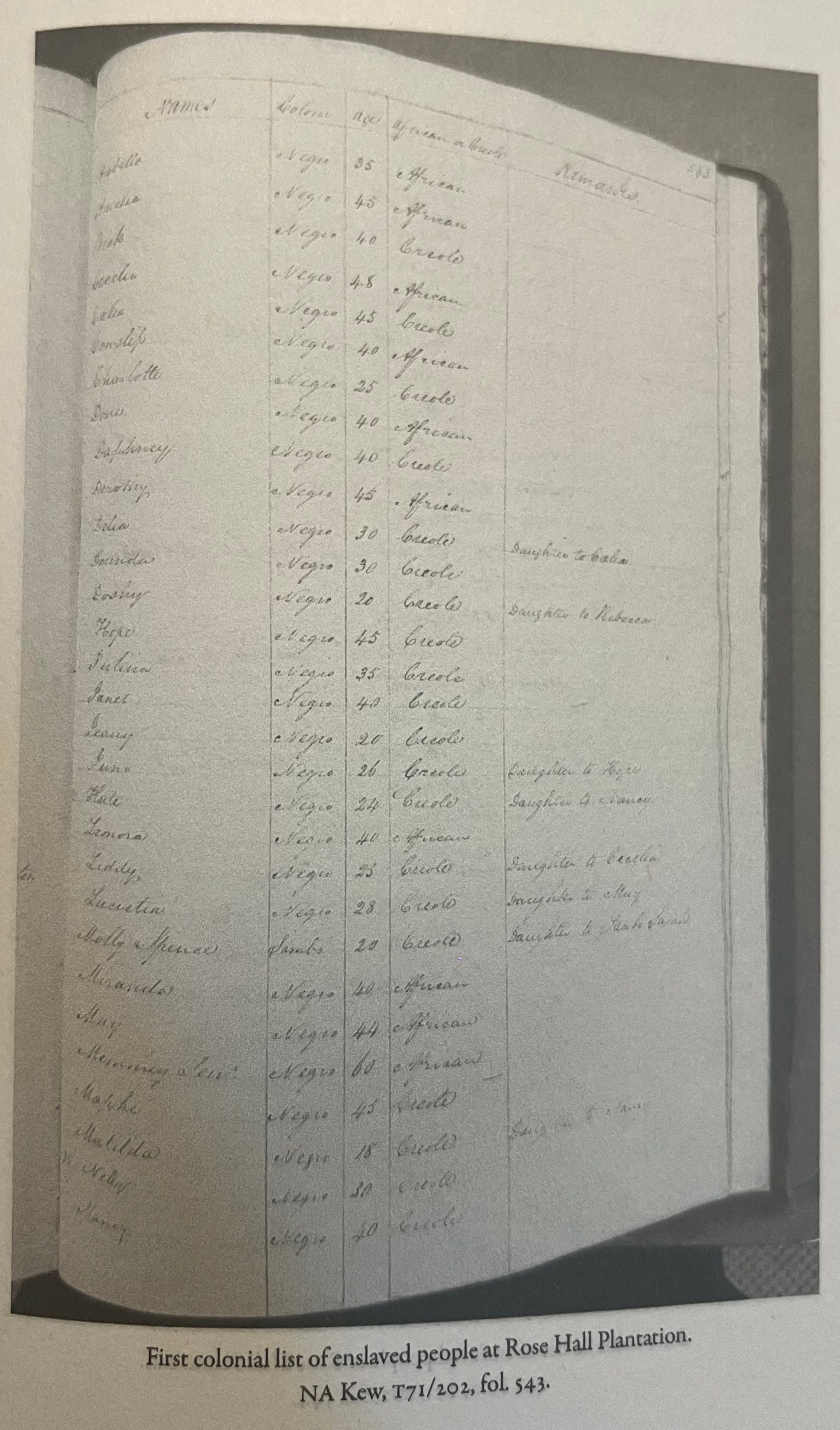
…and Celia…listed as forty-five years old in the 1817 slave register.
Naylor addresses this at the end of the book (Epilogue) –
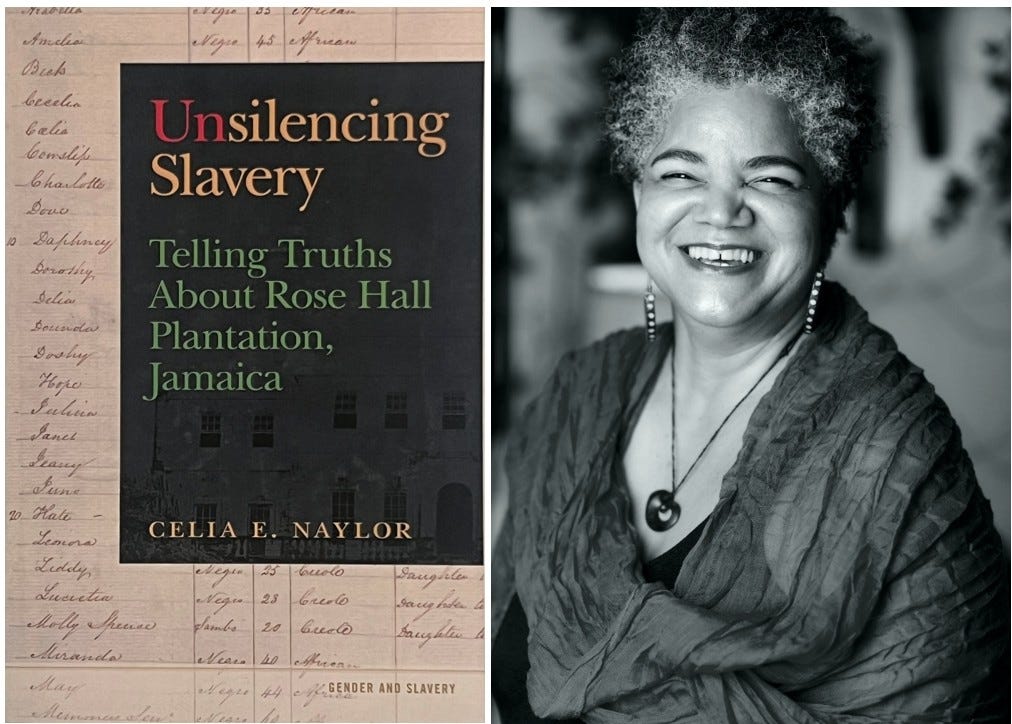
When I first reviewed the actual names of enslaved people the 1817 slave register for Rose Hall Plantation, I stopped and stared at the names of two particular women…Cecelia (African born) and then Celia (Creole)…It took a long time for me to move on to the names below their names. Although not directly and biologically related to any of the enslaved people at Rose Hall (as far as I know), I had not expected in reading the names of enslaved people at Rose Hall to see my own name…my feelings and thoughts were bound up in a recognition, a reverence for these names.
Now, the Kartel lyric and Naylor quotes above are from wildly different universes, maybe. They’ll converge later, I promise, though I do not recommend you listen to No Milkshake if expletives of the highest, and I mean HIGHEST, degree are not your thing.
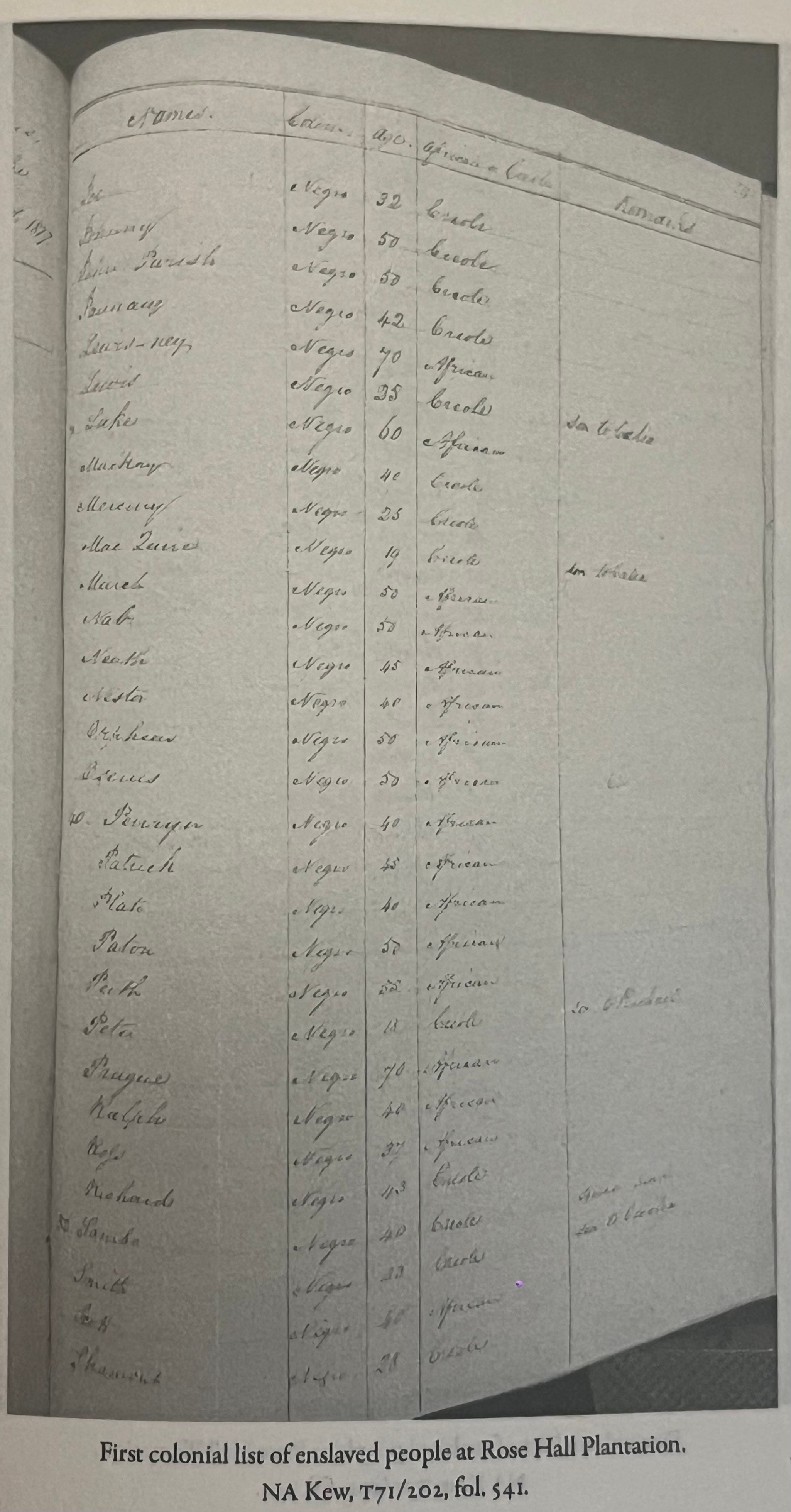
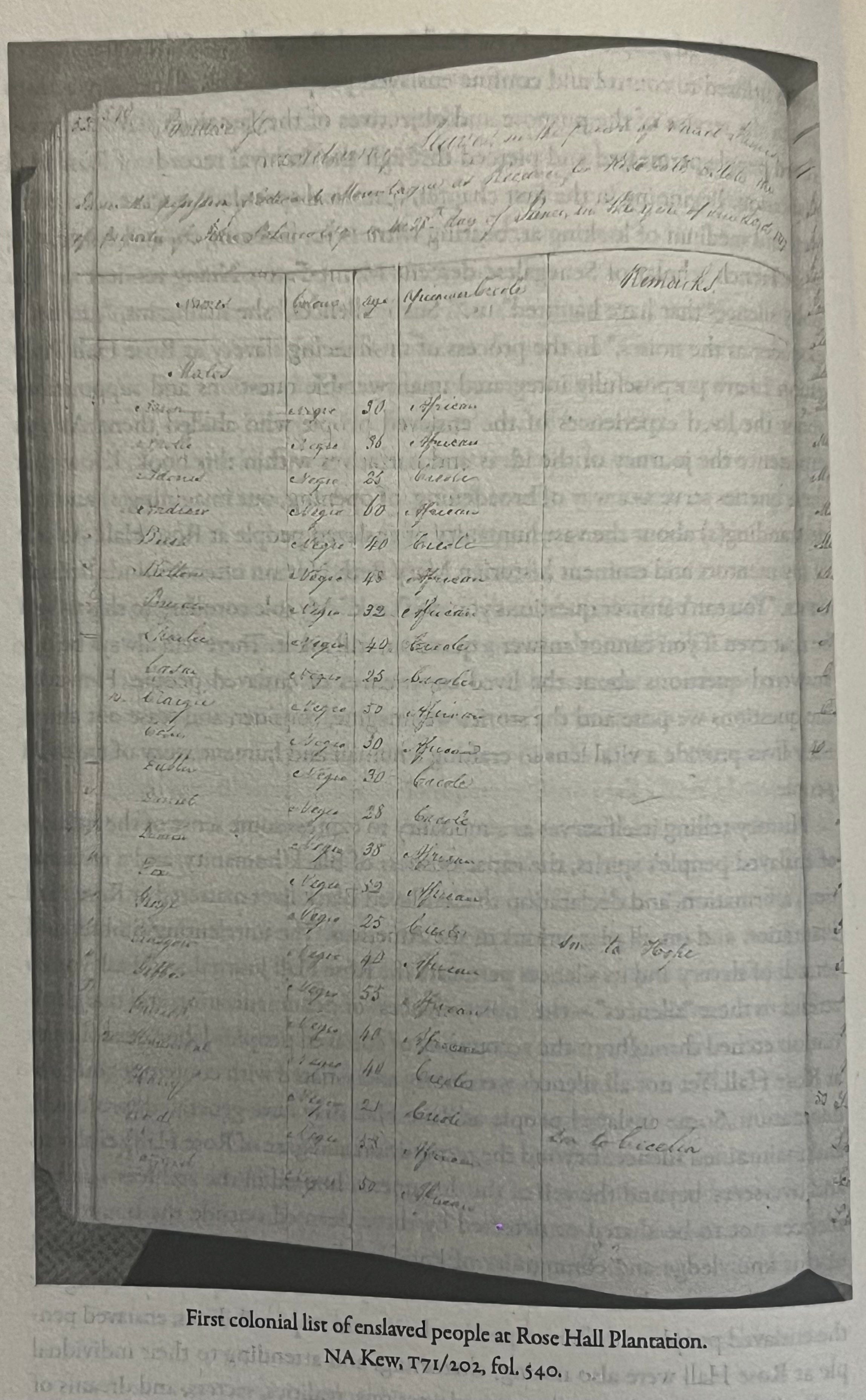
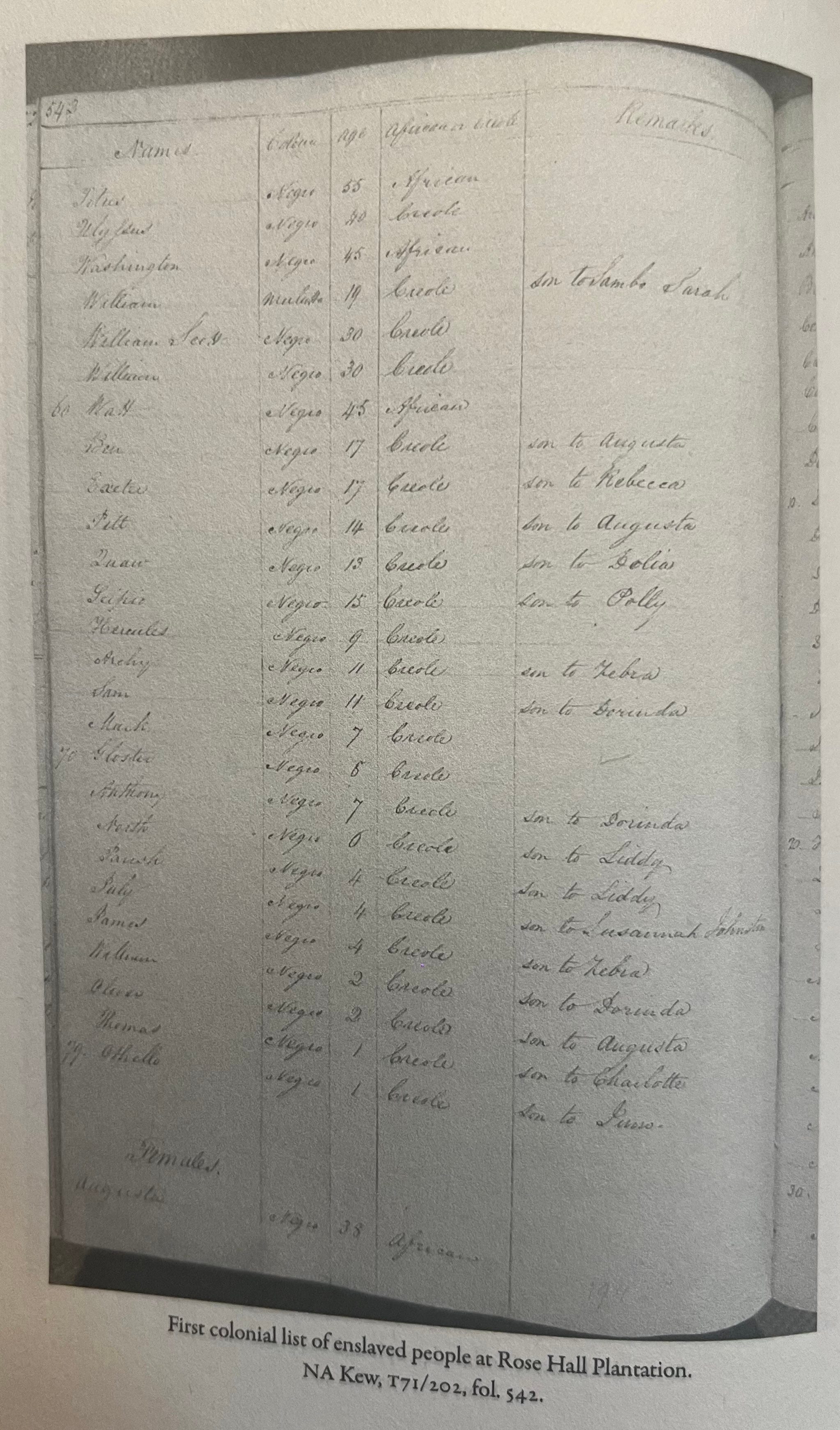
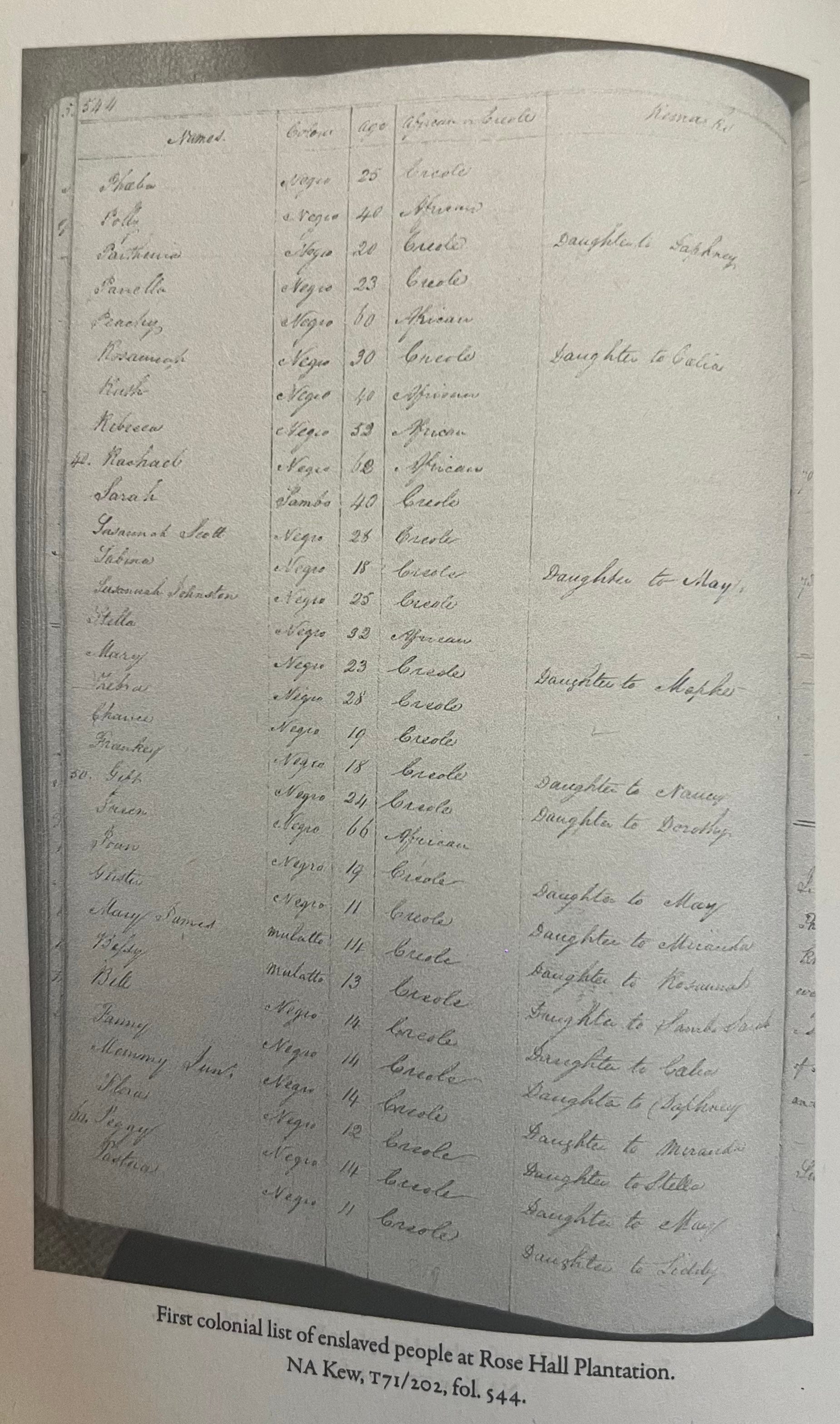
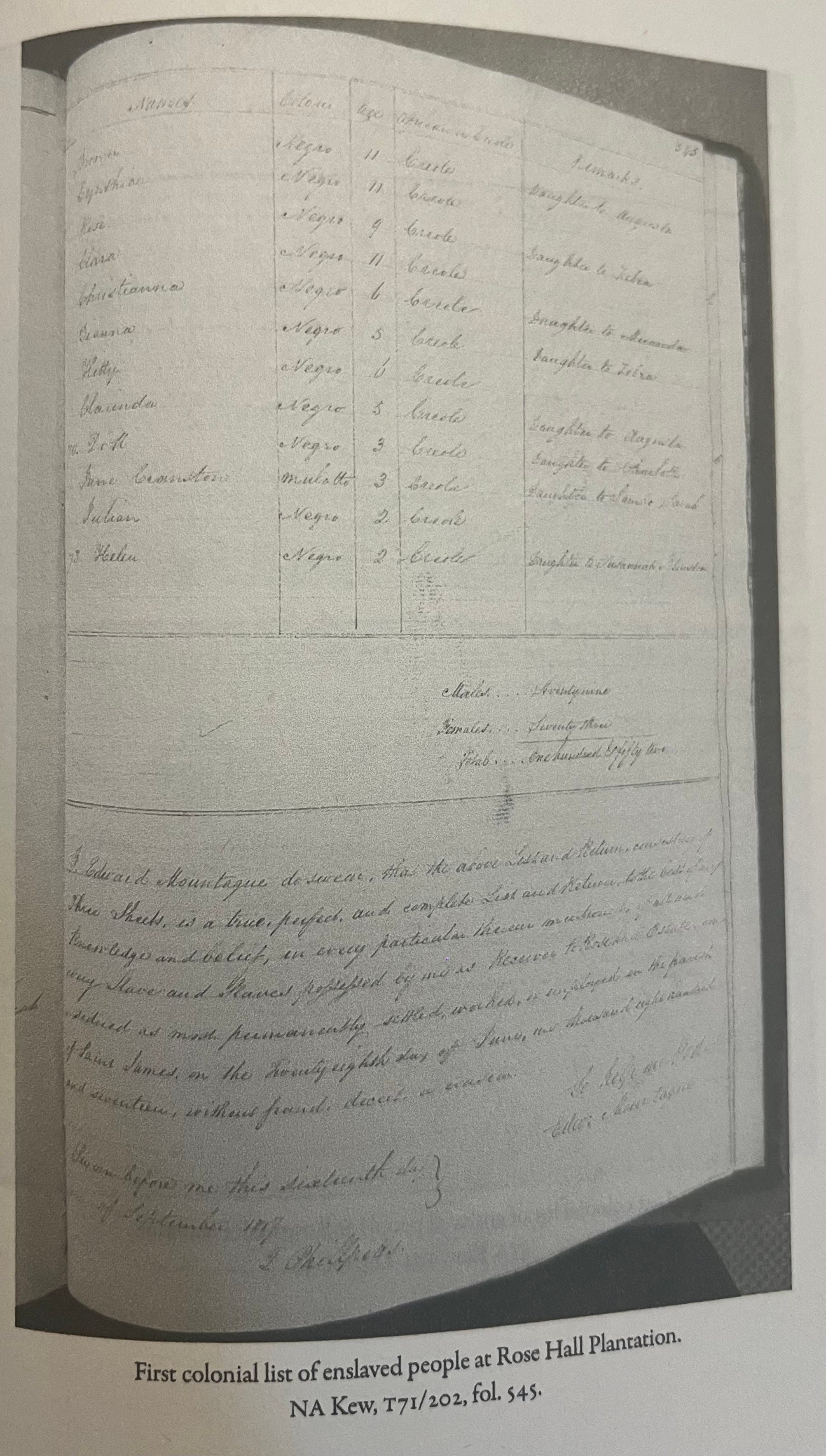
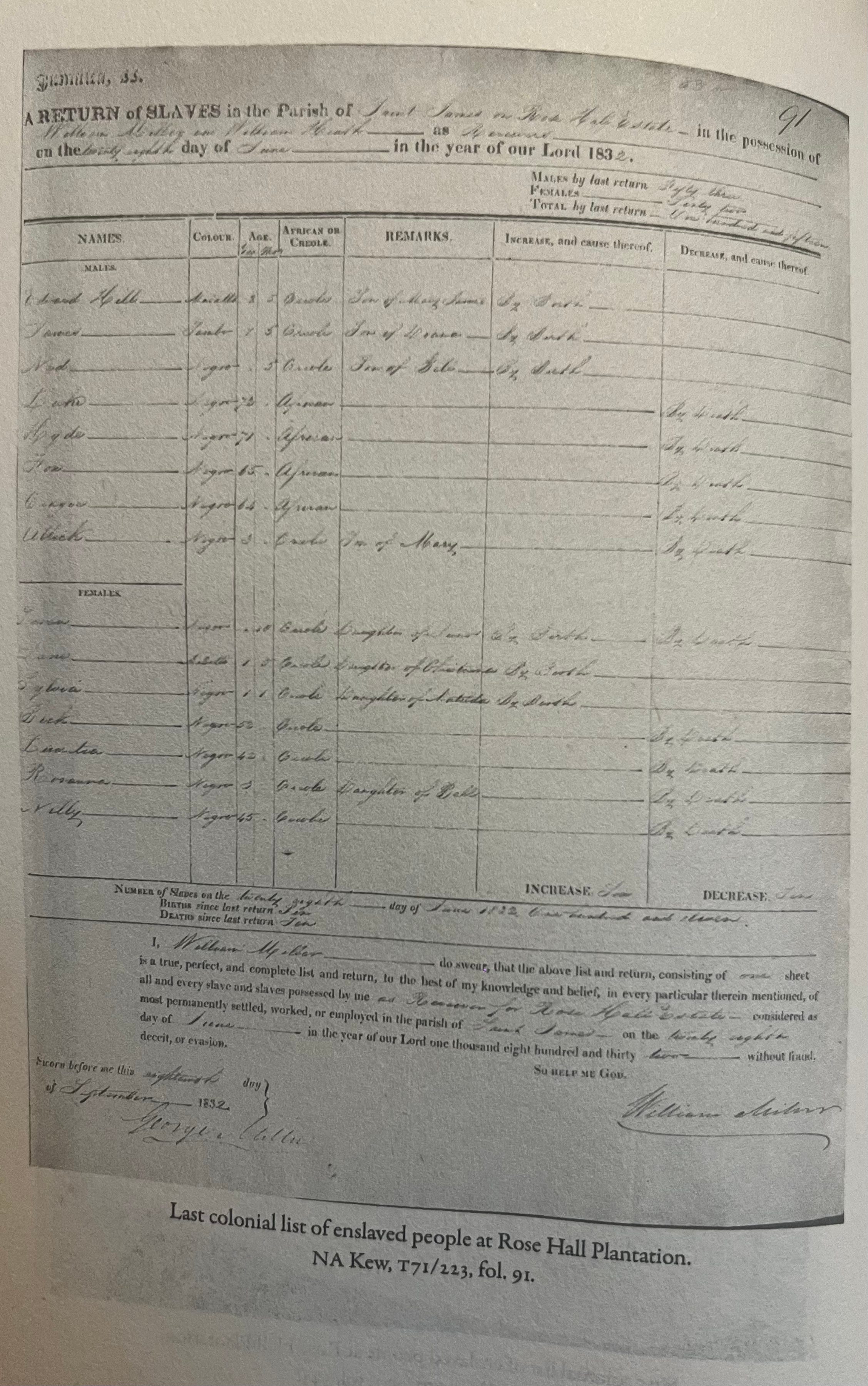
Note: At the end of the piece, I’ll provide the pictures (Exhibit) of the full list of enslaved people’s names and information in the Rose Hall Journal, unless an image or two would be very topical for what I’m discussing. If I am not mistaken, the author listed every enslaved woman (for sure) and man (I think) in the Rose Hall Journal. The names and information are fairly difficult to ascertain because the ink/images are faint. However, it is worth perusing given how important those kinds of primary historical sources are.
True to form, I must talk about the author.
Professor Naylor.
I have a lot more to share about this writer’s life because Naylor provides a nice walk-through of various stages of her journey.
A fun fact to connect some dots –
Due to the timing of when I left Durham, I did not meet Vincent Brown until much later, but I include him here as part of that extraordinary graduate student community at Duke, to which I am deeply indebted.
If you said to yourself, “where have I seen that name before?” You’re not going crazy. I did a two-part review (one, two) of his book, Tacky’s Revolt: The Story of an Atlantic Slave War. Isn’t that great? Something in the Duke history department’s water to attract top academics like this!
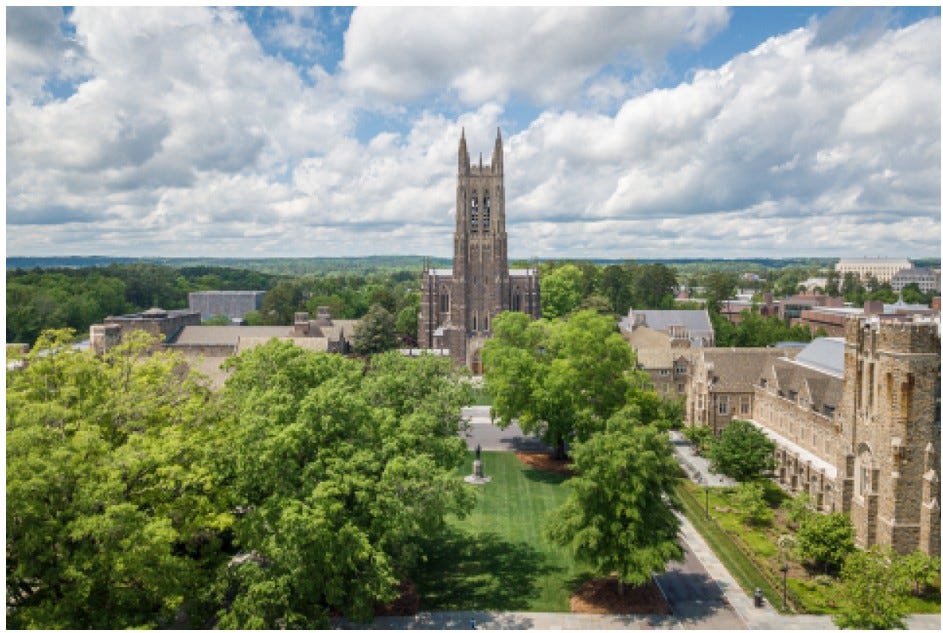
So, we know that Naylor went to Duke for her doctorate. But there is lots of schooling in between undergrad and PhD. Let’s start at the 13th grade. Naylor completed her undergrad at Cornell, where she learned from notable figures such as Henry Louis Gates Jr. Her graduate studies were done at UCLA.
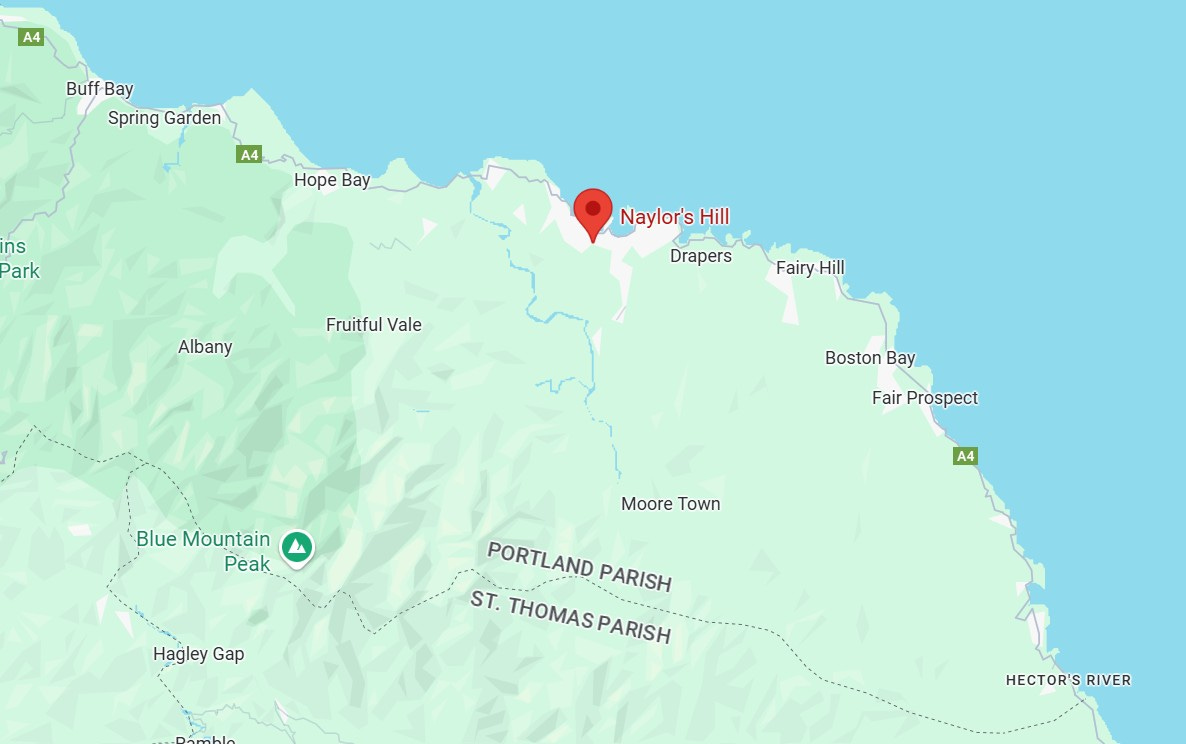
Doctor Naylor writing this work is deeply personal as she was born in Jamaica with her “family’s roots in Portland and the site of Naylor’s Hill.” Despite the family roots, she grew up mainly in Kingston before leaving the island at age 10.
Her reflection on Jamaica’s meaning to her –
I have tried, but I simply cannot fully explain the healing vibes of Jamaica for me…was always rejuvenating to my mind, body, and spirit.
Thank you, professor, for giving me a reason to showcase a good chune –
Fast-forward: Professor Naylor currently teaches in the Africana studies and history departments at Barnard College and Columbia University. Naturally, she resides in Jamaica’s 15th parish, the town of all towns, birthplace of yours truly, city of the vibes, el holy grail, New York City. The 16th and 17th parishes are London and Toronto, respectively. I really hope that you understand this geography chat is satirical.
Scapegoat for the author’s writing this book.
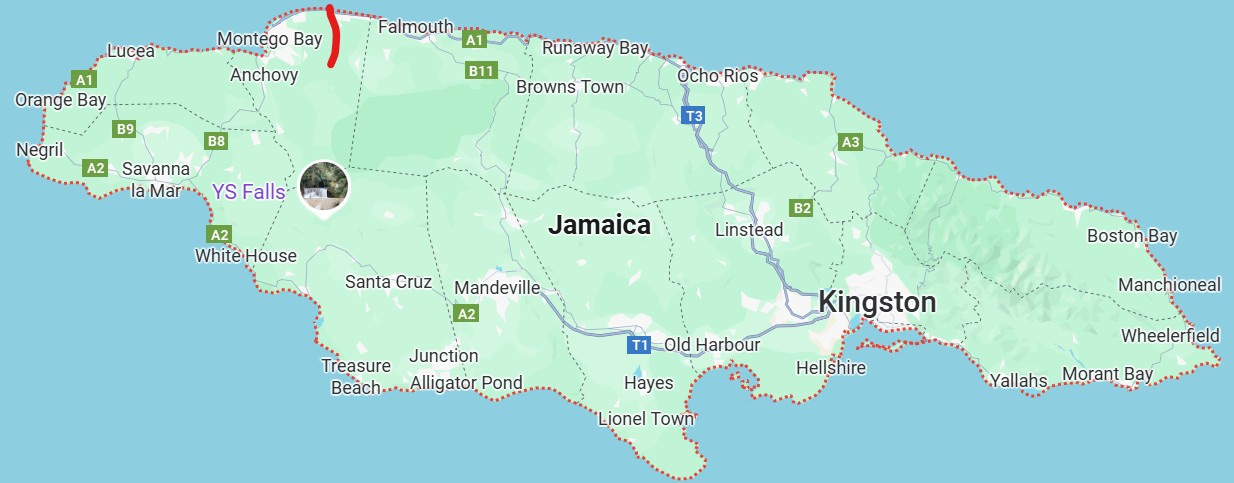
Remember, she grew up in Jamaica. However, she had never been to the Rose Hall Plantation. My guess, like most things in life, is that the reasons are rooted in everyday practicality. Portland and Kingston are on the east of the island. Montego Bay is far west, just before Negril…impractical for many eastern-side residents.
It was in 2013, the year I crossed the burning sands, that Naylor and her daughter, Ayanbi, both had their first tours of Rose Hall while on a visit to Jamaica. Naturally, as any keen-eyed historian would operate, Naylor was “haunted by the silences of the tour.” She was disturbed at how the tour was made to be a sort of pleasurable experience in the form of murder tactics, ghost stories, and sex scandals by way of Annie Palmer. I wonder how much of her time spent at Duke (North Carolina/the south) influenced some of the haunting silences she references. In other words, did time spent in a region notorious for plantations drop conscious/subconscious reminders about visiting Rose Hall one day? Scratching a familiar and hometown itch vs. the vastness of the American South.
As Ayanbi and I followed the tour guide, moving from one room to the next, I became increasingly incensed by how much the tour focused almost entirely on Annie Palmer and her malevolent actions as the White Witch of Rose Hall…the most pressing feeling that lingered for me was the disturbing absence of any essential information about slavery or the lives of enslaved people at Rose Hall Plantation.
From what I’ve gathered from southern friends and acquaintances, plantation tours, in the form of field trips, are pretty commonplace. We went to the zoo back in the Bronx. I don’t know, that feels a little more appropriate for children. For some Jamaican youth, a major field trip to Rose Hall Plantation is commonplace. Which may be analogous to my southern countrymates and their penchant for field trips to plantations.
Following the mother-daughter tour of Rose Hall, she felt a resolve to highlight the enslaved people’s experiences in the decades leading up to the abolition of slavery in Jamaica. Her daughter provided the necessary nudge for moomsy to write this book. Thanks, Ayanbi.
To construct the book, the author spent a lot of time doing research at the Jamaica Archives and Records Department (JARD) in Spanish Town, the OG capital of Jamaica, because the island was a Spanish colony before Jamaica took it from them in 1665. Can you imagine if the man dem spoke Spanish? Nope. All love. Naylor also did a good deal of research at the National Archives in Kew Gardens, England, as well as the University College London Library.
You know that I can’t jump into the book without sharing a personal connection.
As an appreciator of deep and rich details of history, visiting the Rose Hall Plantation/Great House fell to the lowest level on my ‘to do one day’ list. Why? Because my quick (re)search on what those tours covered left me assured that the visit would be more fiction than non; A way of telling a fun story that would gel well with the overall themes of tourism on the island. An economic greaser.
However, because I knew that I would read this book and have to be on that side of the island at some point…I figured, why not?
I don’t have much in the way of notes or memories of the tour, other than thinking it was outrageously humorous for anyone to believe that what was being showcased was remotely accurate relative to the events that took place in the Great House/on the Plantation. Especially – and this I later found out – with the tours largely mirroring a piece of fiction work, Herbert G. de Lisser’s 1929 novel, The White Witch of Rosehall.
Author reinforcement –
All other details about Annie Palmer described in de Lisser’s novel and the tours are entirely fictional, including (but not limited to) the information about Annie Palmer’s and her parents’ connections and time spent in Haiti; Annie Palmer being raised by a “voodoo priestess” in Haiti; Annie Palmer’s marriage to three Englishmen; her murdering these three husbands; and her being killed by a previously enslaved man named Takoo during a slave revolt, the Baptist War / Christmas Rebellion of 1831–1832.
The presentation of the “history” of slavery at Rose Hall becomes a theatrical farce…“amnesiac blow” dominated by the…legend of the White Witch of Rose Hall.
What’s crazier is that the crux of the entire tour reflects the details in the first quote. Literally, the entire tour is centered around those points. Despite it all, what the tour did for me was energize the anticipation I had pent up for Naylor’s book. Mission unintentionally accomplished.
With that, let’s jump into the real-real.
For this book, the author did as Dionne Brand said.
[Sat] in the room with history.
For some historical grounding –
→ 1807: Abolition of the Slave Trade Act in Great Britain (note: not the abolition of slavery, but the abolition of the “legal” trade)
→ Increased pressure from abolitionists to enact a bill requiring registration of enslaved people, presumably to prevent illegal trafficking of Africans to the Caribbean
→ 1812: Registration requirements enacted in Trinidad
→ 1816–1817: Same for Jamaica
→ 1816 – 1832: There is a triennial basis for the recordings (focus here is on Jamaica)
Always remember, this was about economics and control (i.e., why this form of registration was passed). Much to the chagrin, I suppose, of the abolitionists, the registrations became a practical tool for what I just mentioned:
Increased natural births on plantations as a way for manageable/predictable population tracking and, therefore, projecting growth of plantations
Tax breaks offered to those who achieved the best results via accurate plantation management tracking/record keeping
And on and on in this realm
And as it relates specifically to Rose Hall –
The first slave register for Rose Hall was completed the year before John Rose Palmer’s arrival. This 1817 slave register lists 79 enslaved males and 73 enslaved females at Rose Hall…Unlike a significant number of absentee slave owners who resided in England…John Rose Palmer chose to live at Rose Hall between 1818 and the time of his death in 1827…
One important thing to note regarding the slave registrars: when highlighting children/birth, there is no mention of fathers. Why? Because partus sequitur ventrum, or “that which is brought forth follows the womb [belly].” Or, more simply, “offspring follows belly.” Given that the Europeans-turned-Jamaicans followed closely the law of their Old World, it would’ve been a natural carryover to follow the happenings of primogeniture. However, and unsurprisingly, inheritance passing from father to son would’ve been against the slaveowners’ excessive libidinous, so they instead forcibly procreated with the enslaved and denoted the child as “offsprings [who followed] belly.” By doing so, the assets/lineage of the enslaver was protected from their acts. A twisted form of clemency that divorced slaveowners’ possessions from their acts.
Let’s leap into the archives.
Who’s who?
You may not have any sense of what it means to confront silences in the archives…to see what is there and what is not.
Naylor goes the holistic route by giving a voice to the unstated, the uninterpreted, and most certainly, the least-covered aspects of the slave registrar (Rose Hall Journal). Giving a voice to the voiceless, so to speak.
Among the enslaved, there are people born in Africa and the Americas at Rose Hall. All were undoubtedly assigned specific work tasks, “which revolved around the harvesting of sugarcane for its profitable by-products [i.e., sugar and rum],” and was further segmented by gender, age, technical capabilities, etc.
Both the form and content of the Rose Hall Journal embody the denigration, devaluation, and disposability of enslaved people—the format of the journal, the organization of duties and responsibilities on this plantation arranged by rows and columns, and the brevity, placement, and marginalization of notes regarding the births and deaths of enslaved people.
The Journal’s entries begin on Monday, March 17, 1817, and end on Saturday, November 10, 1832. Given the structure and volatility of plantation societies at the time, there were inevitable alterations in both the ownership and structure of the journal during that 15-year period. A change in penmanship is a detail that Naylor takes very seriously, which she highlights between 1829 to 1832 (i.e., change in overseer given the journal record’s differences).
These are the types of notations/descriptions made in the journal:
“Distribution of Negroes”
Saturdays (no work) were described as “Negroes Day,” “Negroes Taking Day,” or “Negroes in their Grounds” (i.e., cultivating their provision grounds’ plots for their own nourishment, which really was a cost-saving and efficiency strategy of the planters vs. some form of generous deed)
Sundays, no work
Males generally listed first before females, with “colour” as the foremost identifier
Negro: African and/or Creole parentage (not racially mixed); Creole in this context means born in Jamaica
Mulatto: one negro parent, one white
Quadroon: one mulatto parent, one white
Sambo: one negro parent, one mulatto
Quick personal detour to showcase that Louisiana can’t ever beat the “Caribbean” allegations. When I was in NOLA, I had an Uber driver who I was doing some solid back-and-forth with on everything from music, his visit to NYC in the 90s, and New Orleans’s history. Funnily enough, he mentioned the term Quadroon, which I thought squarely showcased the psyche of a people whose lives were/are governed by the allusion of phenotypically-driven social constructs (that have very real consequences on people’s daily lives, if I’m being practical). If you said Quadroon to the average, I don’t know, Bostonian, they would probably think you’re looking for a venue of some kind they’ve never heard of before. My read of this is that the strongest colonial powers of the 19th century largely swam in the same classification pool, though special attention should be paid to the French and Spanish since they were particular lovers of these terms. Therefore, what happened in New Orleans should not come as a surprise. Detour over, back to it.
Annual disbursement and allocation of clothing, which was done once a year (requirement of the Consolidated Slave Law of 1788); One strong caveat: no shoes are included in the allocation, “as shoes were not deemed by enslavers as necessities for enslaved people at Rose Hall and other plantations across the Americas.”
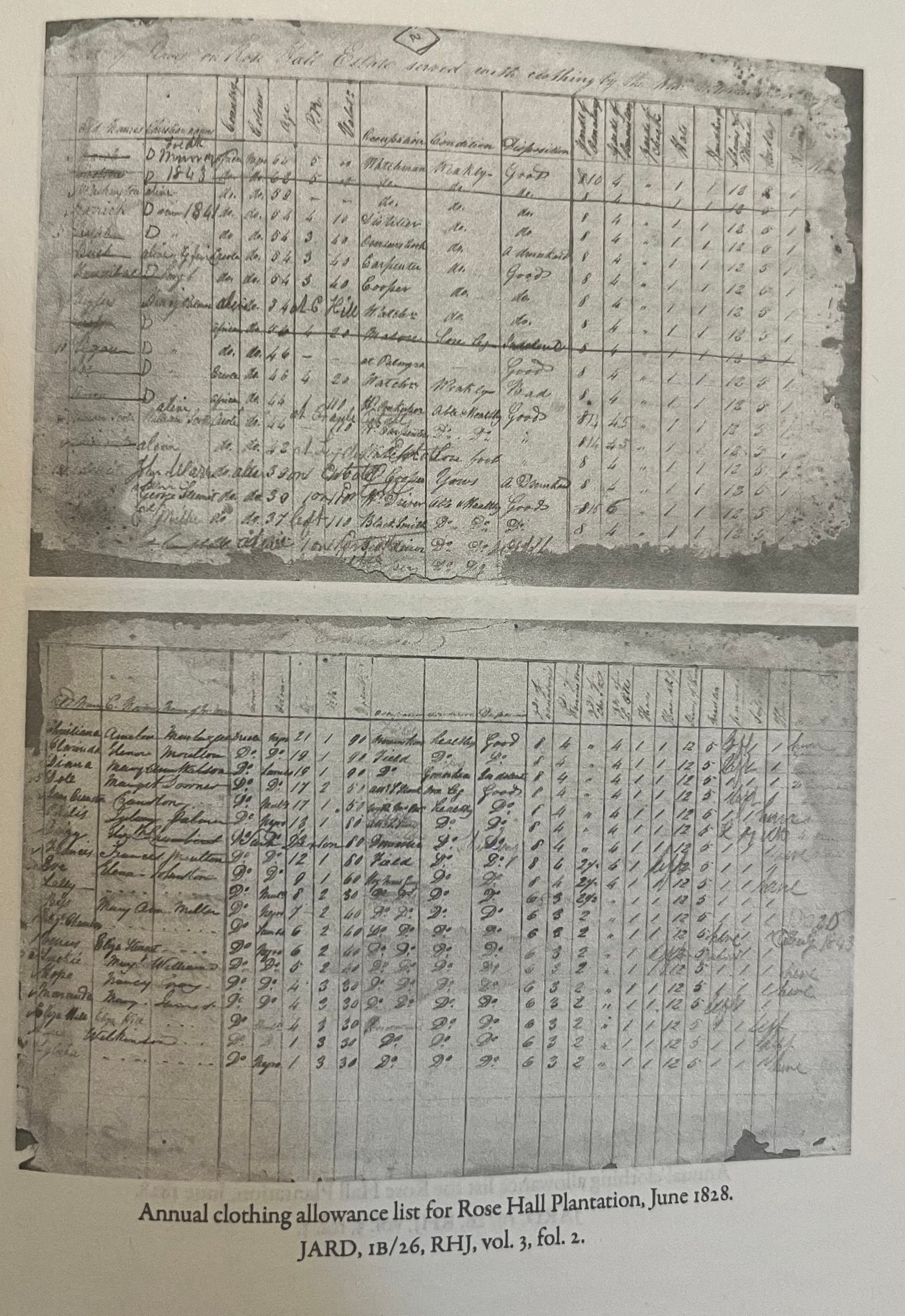
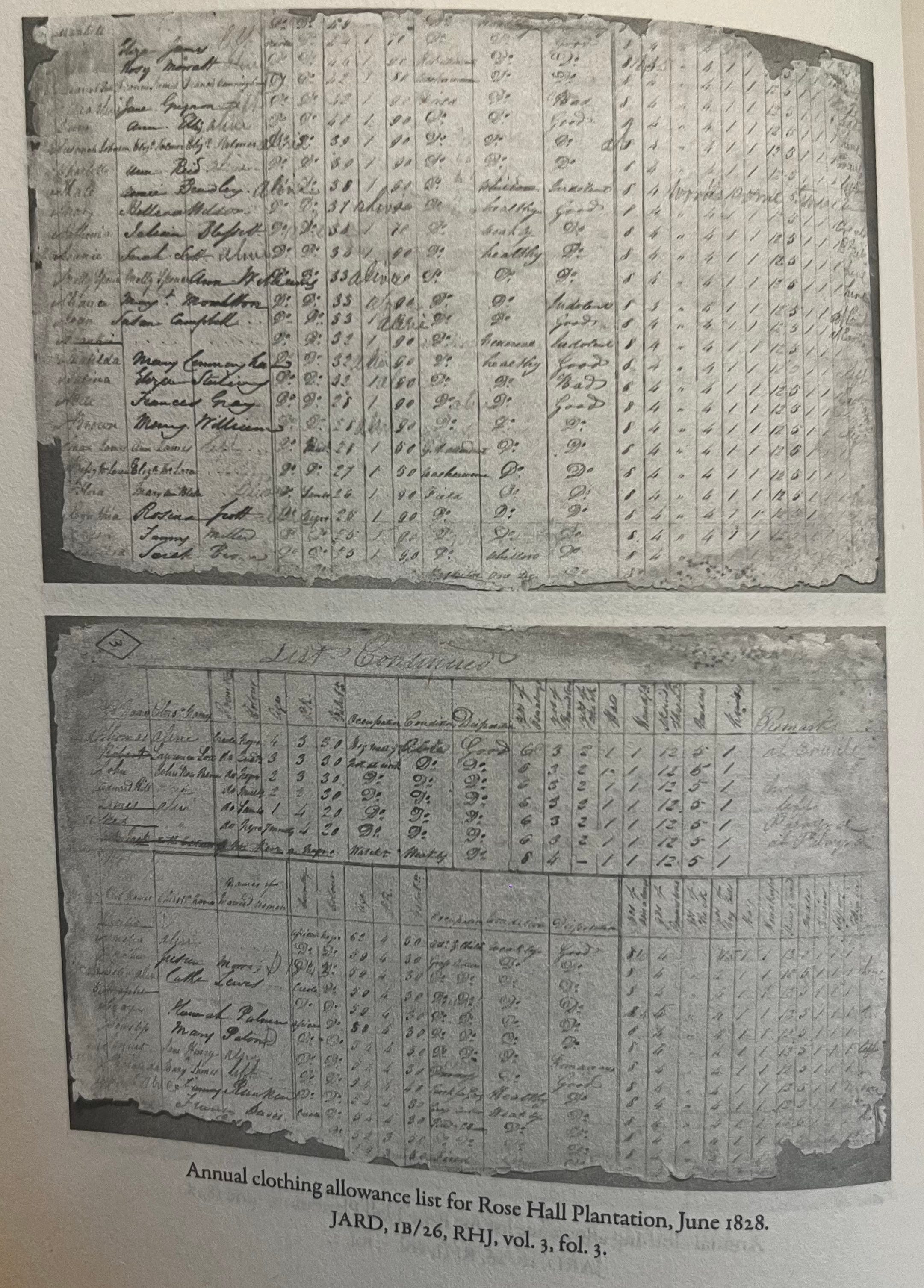
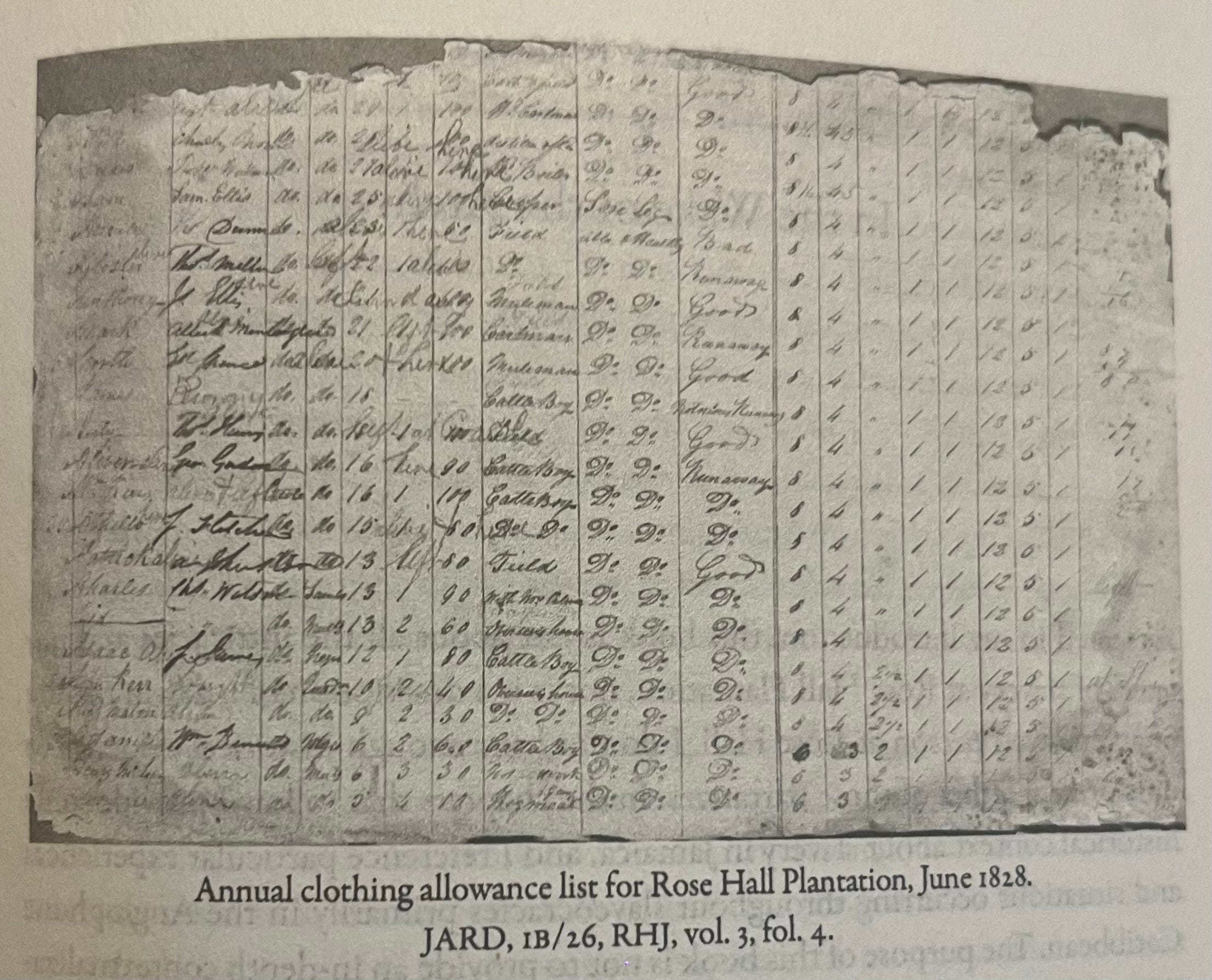
Work roles (e.g., Celia was a “grasscutter”)
“Christian names” (or given names)
Health and prime ratings (denoted “P/R”) from 1 to 5
“Valuation” of each slave in pounds/colonial currency
“Disposition[s]” such as good, drunkard, indolent, runaway, “notorious runaway,” etc.
Now, just because records existed doesn’t necessarily mean that all the Ts were crossed and i’s were dotted.
The detailed and meticulous nature of this Rose Hall ledger, with specifics about duties and the number of laboring bodies associated with these responsibilities, also belies some of the overseers’ actual mathematical skills…From the very first page of the Rose Hall Journal, the simple addition involved in totaling the numbers in a given column is at times inconsistent and inaccurate.
But I think this also showcases the required competency levels of the people given overseer positions. Their forcefulness, the ability to keep order and exert violence as they saw fit, anything to ultimately ladder up to successful crop years, was going to take precedence over arithmetic capabilities. At least that’s my interpretation.
A final note on the African x Creole split at Rose Hall –
…eldest enslaved people at Rose Hall were Africans who were born in the 1740s and 1750s, lived into their sixties and seventies, and died before the abolition of slavery. Of the 152 enslaved people recorded at Rose Hall at the end of June 1817, the eldest two were seventy-year-old African-born men named Prague and Lewis-ney (listed also as Jemmy).
As alluded to earlier in the piece, Naylor pays very special attention to the women on the plantation. That is where we will go next.
Machinations of slavery, mechanical childbearing, and capitalism’s fruits.
Given the brutal physical realities of enslavement, life spans were significantly shorter, while the ever-increasing demands of plantation labor, as well as global demands for the outputs (e.g., sugar), continued to grow. As such, women, and more often than not, young girls, became the physical outlets exploited for more labor hands. It was a system of complete seesaw, mentally and physically, whereby enslaved women were critically important (for plantations’ economic outcomes) and simultaneously relegated to the social bottom (given their status as (Black) women). This became even more of a reality when the legal trade was abolished by the British, and plantation owners became reliant on “organic” population growth vs. replacing and refilling.
…valued for their productive and reproductive labor solely in the service of the slavocracy while they were systematically and unequivocally devalued due to their supposedly inferior and innate racial and gendered classifications.
After England’s abolition of its involvement in the legal slave trade in 1807, the economic value of enslaved girls and women rose due to their potential reproductive capabilities. At Rose Hall, the records reflect the certainty of interracial sex between enslaved women and white men.
Naylor notes that many young enslaved girls were classified under “womanhood” and “motherhood” capable as early as ten years old. The earlier you can make attempts to legally classify a girl as ready for motherhood, the earlier the plantation owners were able to justify impregnating them to produce (what they could have only viewed as) future field hands. This is not to suggest outlier scenarios of actual romantic affection; these are human beings we’re discussing. But it is far more likely that maintenance of the plantation system, and its economic future, were top of mind for plantation owners under the system of partus sequitur ventrem. Friendly reminder that fathers of children were not identified in the Rose Hall Journal. While there was likely forced and organic procreation that took place among the enslaved (men and women), the omission of fathers was mainly to protect plantation owners from having to note themselves as fathers of the children they would ultimately enslave anyway. A level of removal that feels incomprehensible until you realize that people do funny things when money is on the line.
It should be easy to understand that healthy and continuous procreation could never be a constant under this type of regime. Therefore, there were lots of “gynecological resistance” acts to disrupt or completely eliminate the childbearing practice, be it medical, herbal, or other practices that prevent forced reproduction. Even with children that were brought to term, many passed early given the unhealthy conditions –
The 1826 slave register notes that the baby girl Lydie, daughter of Jane Cranston, died at seven days…Jane is listed as a three-year-old mulatto in the 1817 slave register, and she would have been between the ages of nine and twelve when she gave birth to Lydie/Leddie sometime between late 1823 and early 1826.
“…between the ages of nine and twelve when she gave birth…”
Many also ran away for a brief period of time (*), with the intent of returning, and this was referred to as petit marronage. It seems, however, that most wanted to run away permanently, grande marronage. (*) The preceding sentences may read odd to people schooled in American plantation histories, where running away was categorically not tolerated. In smaller societies (islands in particular), some cases of running away may have been tolerated and not met with immediate violence since the places are so small anyway.
→ Example A: Creole Doshey was labeled the most notorious runaway (at least 16 times)
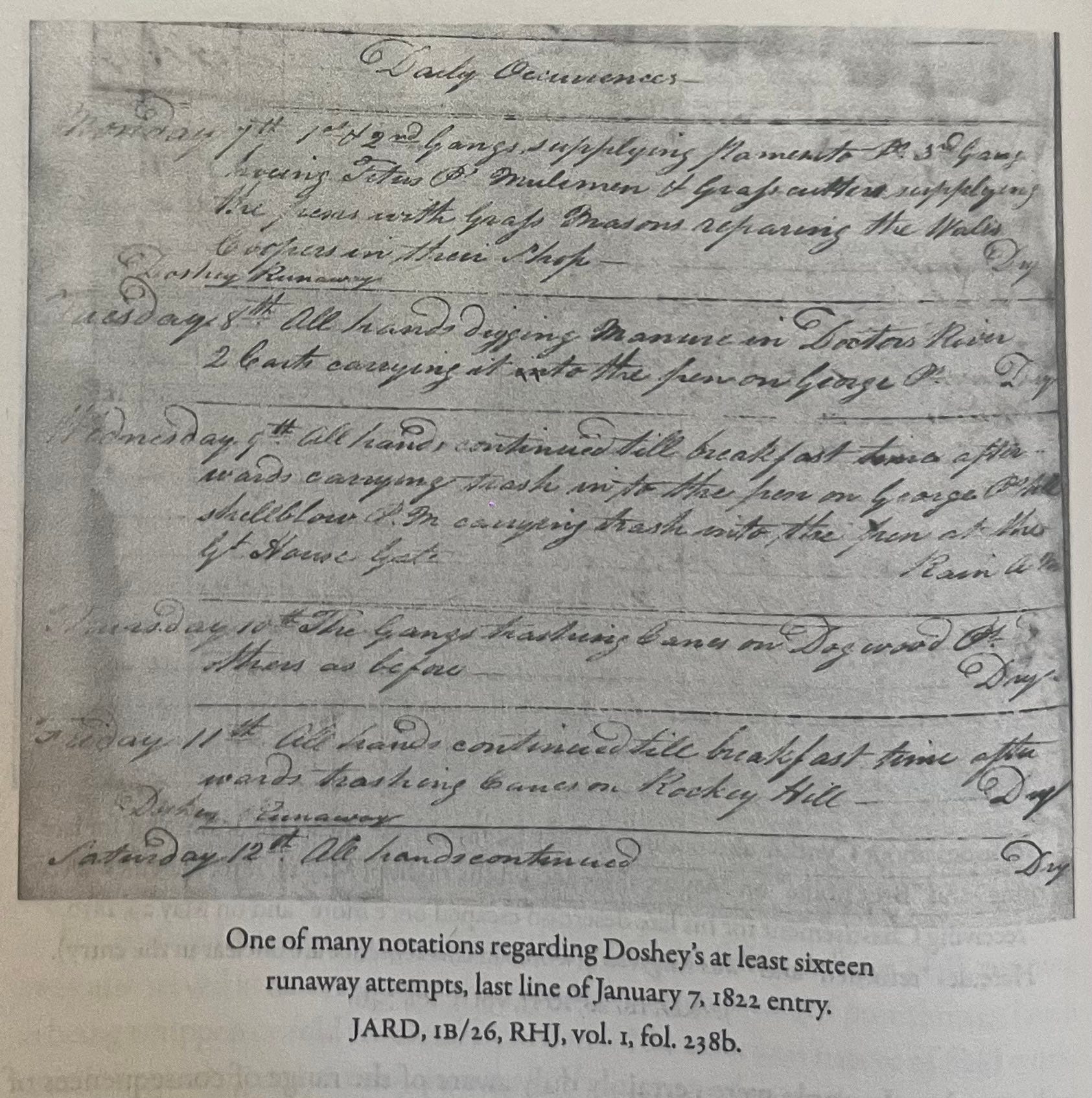
→ Example B: Hercules was not classified as a notorious runaway, but he tried the most times between 1817 and 1833 (at least 26 times)
I’ve not come across many instances in American plantation history where an enslaved person would’ve been able to run away anywhere remotely close to 26 times.
I suppose morality figured in here at some point. In 1816, the Jamaican Assembly addressed the sexual abuse of enslaved girls under the age of ten by instituting a law –
…punishable by death…the rape of enslaved girls under the age of ten was so prevalent that the Assembly enacted a law to prohibit it; it was also another indication that there was no consideration of childhood or girlhood on Jamaica’s estates before the creation of the law.
But I’d conclude that this law was very loosely enforced because, as we just witnessed, a (nine to twelve-year-old) girl had given birth within 10 years of the passage of the act. Feels more reactionary. In other words, back to regular scheduled programming when the now-ness of the law wore off.
If your brain is telling you that this is a sad and ugly stripe of history, you must wonder what isn’t written down and recorded. Take a moment…
…on to the “gangs” and sugarcane plantation labor operations.
But first, a poem, Cane Gang –
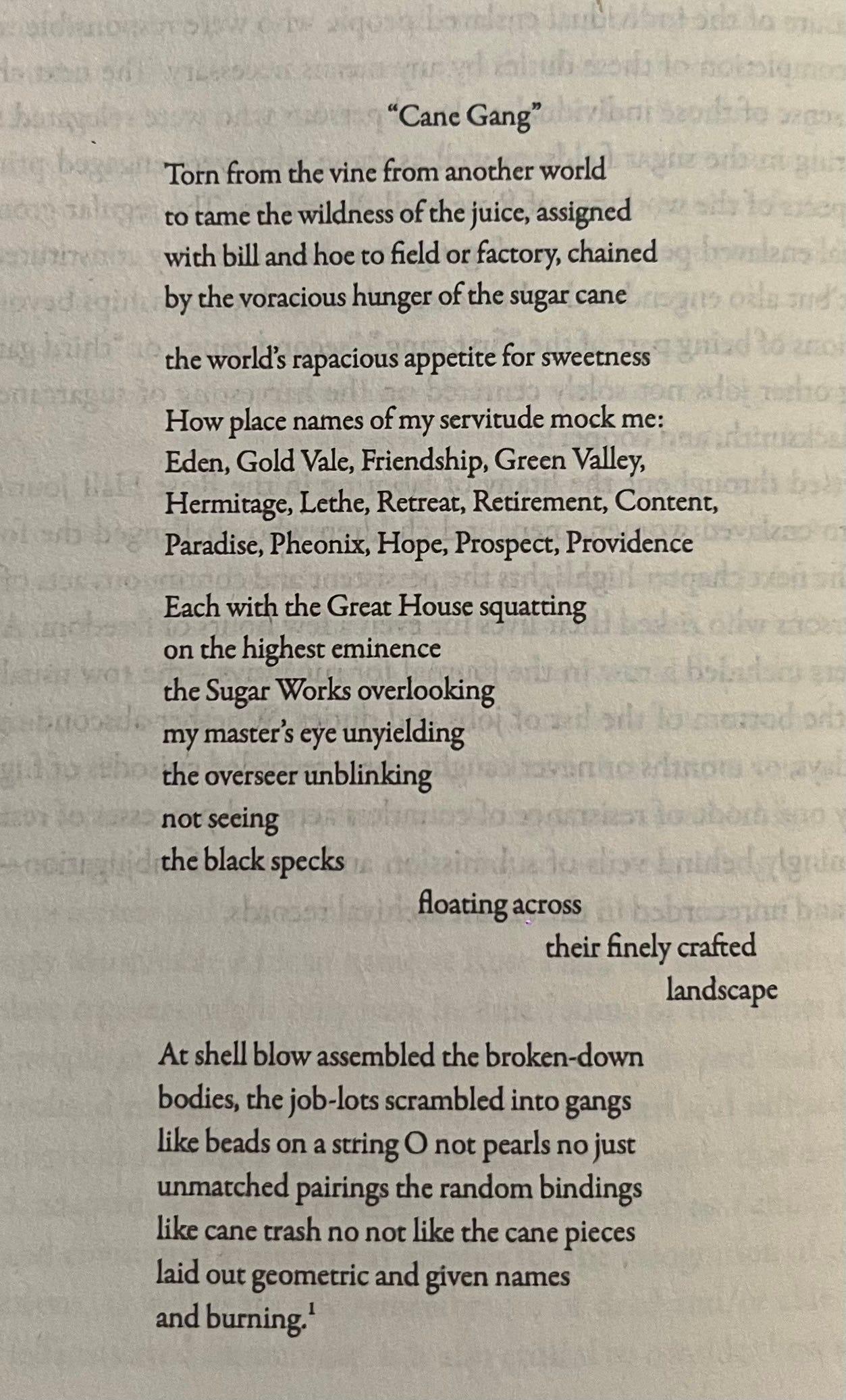
The maintenance of the journal, the (attempts at) precision to know how many hands, who had the capacity to do what work, and how this would all ladder up to effective cane crop seasons, was meticulously executed. Plantation org charts, if you will.
During the busy season of harvesting and processing sugarcane, where the element of time was critical after cutting the cane (i.e., juice spoils quickly, so you have to get it to the mill/boiling houses asap), many of the enslaved people at Rose Hall worked well into the night.
For a full view of the yearly operations –
The grueling processes on sugar plantations involved every possible woman, man, and child being charged with specific duties related to the sowing, tending, harvesting of sugarcane, followed by extracting, boiling, and processing the juice for the production of sugar and rum. Beginning in June, the first and second gangs worked on preparing sections at Rose Hall for planting…From January to May (the harvesting and sugar and rum-making season), enslaved field workers focused on cutting the sugarcane, and, once cut, it was taken promptly for the processing stages in the mill house, boiling house, and still house…May and into June saw cleaning and clearing sections for planting, as well as the height of transporting wagonloads of sugar (in hogsheads and tierces) and rum (in puncheons and gallons) from Rose Hall to the Montego Bay wharf for exportation to English cities such as London and Bristol.
And here’s where the “gangs” come into play:
Per Naylor, mainly men were tasked with sugar and rum production processes, while women were forced to be field workers (I feel these lines, for field work, were blurred OFTEN); Nonetheless, in the Rose Hall Journal, 4 of 51 men were noted as solely field workers
At the age of 15/16, enslaved children joined the first gang (field work), unless selected to work as domestics or craftsmen/tradesmen
“Till Shell Blow,” which is the name of a chapter in the book, refers to an actual shell blown by an overseer, or another person responsible for labor coordination, signaling the gangs to switch from one activity to another. The governing sound.
Escape, across the continuum of vanish to petit marronage, was certainly a constant in a society that tried to extract every ounce of physical from the enslaved. Between 1817 and 1832, “[a]lmost 25 percent of the total enslaved population were identified as running away from Rose Hall at least once during this time period.”
And if you ever go on the tour, there will be a dungeon featured in the Great House. This dungeon was formerly the jail cells that many were relegated to for infractions such as running away.
Note: Naylor covers, very briefly, “The Christmas Rebellion / Baptist War of 1831 — 1832 And The Aftermath Of Abolition,” which I won’t talk too much about here. The reason: I made a well-intentioned attempt at reading through these histories chronologically and read a book about this pivotal moment in Jamaica’s history. The book was not that great, but it’s appropriate to wait until I write about it vs. covering it here. A key takeaway for now is that on August 28, 1833, the Slavery Abolition Act, which abolished slavery throughout British colonies, received royal assent and went into effect on August 1, 1834. August 1st is now a public holiday in Jamaica, known as Emancipation Day. This wasn’t the case until the 1990s, so it’s fairly recent (implementation) history. Today, August 6th, is Independence Day.
The journal does not reveal any specific information about what transpired at Rose Hall during this slave rebellion. The last extant entry for 1833 is for the week of December 19 (ending with Christmas Eve). There are no journal entries for January 1832.
Quickly revisiting Herbert G. de Lisser’s The White Witch of Rosehall.
de Lisser (1878–1944) was a journalist, author, and editor of the Gleaner, a prominent newspaper publication in Jamaica. Naylor takes you through a detailed summary of his book, which forms the crux of what the tour of Rose Hall Great House/Plantation is based on (“The fictional perspective, storyline, and context in de Lisser’s novel represent the source of the contemporary Rose Hall tours.”). I don’t really have the desire to muddy vigorous, historical analysis with de Lisser’s sensationalized storytelling, but I also don’t want to ignore a very key puzzle piece in all of this. So, I’ll give you a preview of the types of things littered throughout the book.
Annie Palmer cannot be blamed for her devilish and seductive ways; rather, it is Jamaica and all of its Blackness that permeate, corrupt, and poison her and all of her white, womanly sensibilities. – de Lisser
There is a level of ‘what is this’ and ‘there’s no way’ that permeates historical narratives being wholly based on fiction. Feels particularly out of bounds. But then again, humans are storytelling machines. Myth-making monsters. It all fits.
Rose Hall ownership.
In the late 1950s, John [W.] Rollins Sr., a former lieutenant governor of Delaware, entrepreneur, and philanthropist, purchased the Rose Hall property (7,000 acres). At that time, the house was uninhabited for 100+ years.
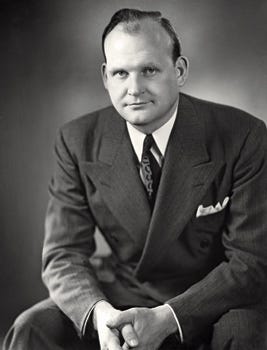
In the 60s, $2 — $3 million was reportedly invested to rehab the Great House to “its former glory,” and that renovation was completed in ’71. Concurrently (70s), the Rollins family constructed major hotels across Montego Bay. Naylor paints this picture of ownership and development to showcase why the Rose Hall tours are constructed in the manner that they are. Part of a larger tourism expansion scheme that need not be interrupted by non-fiction.
Moreover, the way things are today fuels the livelihood for the many Jamaicans who are employed by the company running the show –
The Rose Hall Great House tour guides are not volunteers. There are no unpaid workers at Rose Hall. Staff members are also not contract laborers; instead, they are full time employees of Rose Hall Developments, Ltd., and they are paid in accordance with the labor laws of Jamaica. Tour guides receive health insurance, group life insurance, maternity leave, and pension benefits. They also receive free lunch, overtime, shopping vouchers, uniforms, paid vacations (between two and four weeks per year), and up to ten sick days per year.
The spoils, predictably so, go to the largest purse…
“…the Rose Hall Great House is not a museum.”
The author notes –
…no slavery statue or monument, no matter how exquisite, elaborate, or enormous, will ever be a sufficient memorial for generations upon generations of enslaved people of African descent who lived and labored for centuries throughout the Americas.
To that end, Naylor created a digital archive that does a fantastic job chronicling everything covered in her book. I highly recommend browsing through –
I believe that Naylor’s parents would have been incredibly proud of her for writing this book. They passed during its production, but she notes that her storytelling, appreciation for history & traditions stem directly from their imparting on her these principles early on.
To my father, Cecil Anthony Naylor (1927–2017), a storyteller’s storyteller who enjoyed hearing the stories in the musical notes of a jazz standard as much as he relished telling the stories of the old days in Jamaica.
To my mother, Fay Patricia Naylor, née Hornett (1929–2020), who listened to all of my father’s stories and continued to tell her own stories about the past and present as a keeper of our family’s history, traditions, and aspects of Jamaican culture.
Before we go, indulge me and a strong shot of this rum.
Naylor notes that her family has ties that connect them to Liverpool, England. But not only that, they are connected to a family name that stuck out to me like a sore thumb. I mean a real sore thumb (boldened).
Throughout the decades, my mother, Fay Patricia Naylor, was one of our family’s vital sources for old stories about the Hornett, Adams, and Hussey families…On my mother’s maternal side, her mother, Una Adams Hornett, was the daughter of Margaret Louise Hussey Adams and Joseph James Adams.
My mother remembered her grandmother Margaret Hussey Adams Samuel’s telling stories about her (white) father, referred to as Richard (though possibly called by the name William) Hussey. Richard/William Hussey’s father was a landowner and enslaver in St. Andrew…One of the stories passed down about Richard/William Hussey was that an enslaved playmate accidentally put something in his eye while they were in the midst of playing, and as a result Richard/William Hussey became blind in one eye.Rum connoisseurs will know exactly where am I going from here.
Rum connoisseurs will know exactly where I am going from here.
Today, the Hussey family owns a very famous rum brand called Hampden Estate.
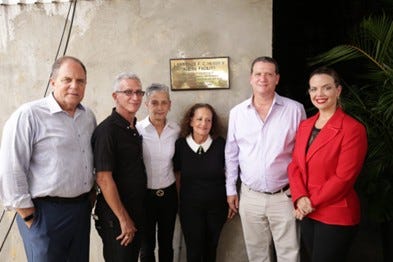
One of their most sought-after product lines is their Great House series (released annually). The picture of that Great House on their bottles is not just a picture; The house still stands prominently on the estate.
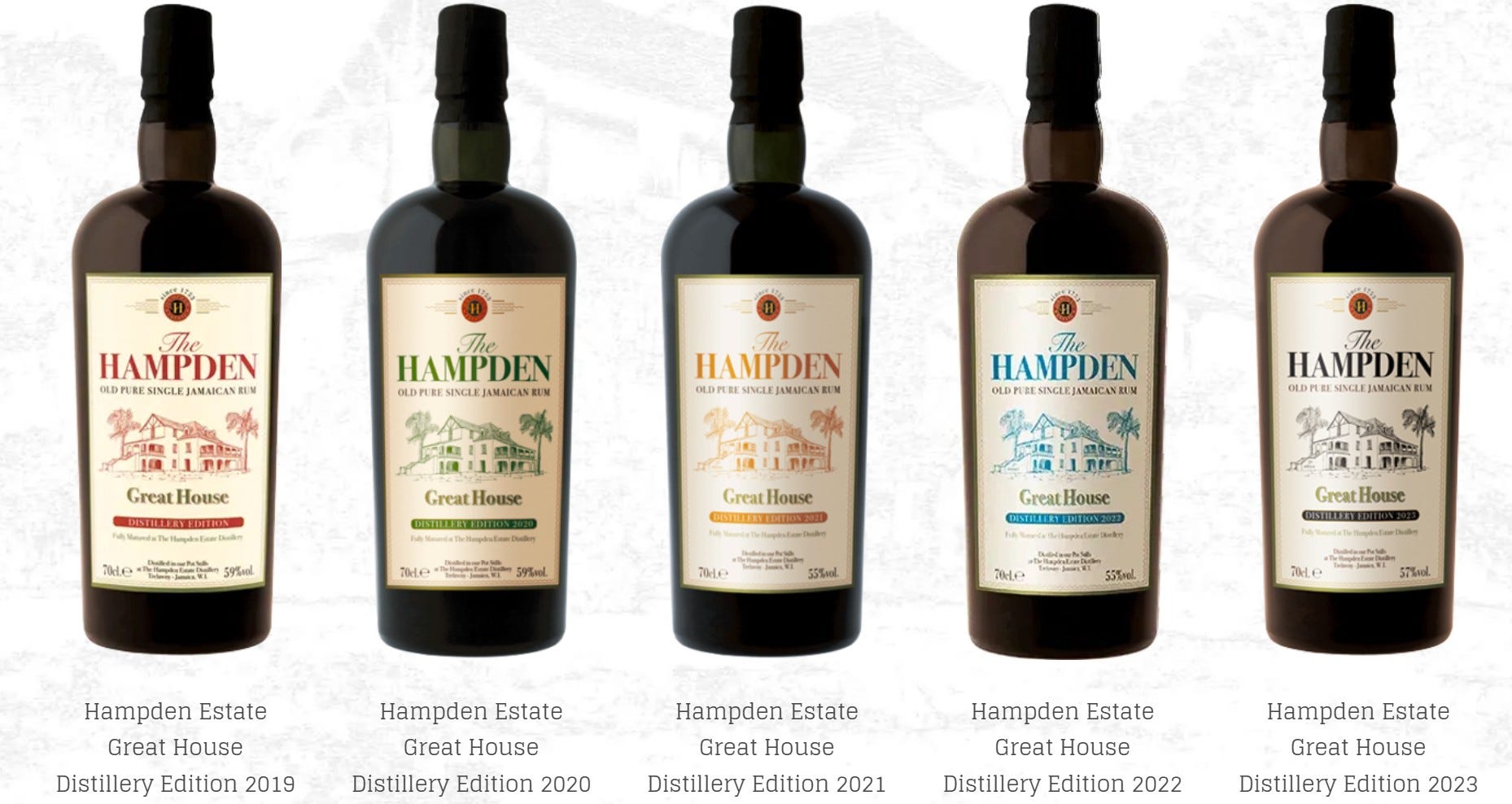
Unpacking the terminology Great House vis-à-vis this product line, and its larger implications, is not something I’ll do in this piece. Deserves a write-up of its own, though I’m sure you can generate obvious conclusions based on what the Rose Hall Great House stood for. Binary conclusions, for most things in life, won’t ever lead you down the path of critical analysis and educated conclusions. It’s never just this or that, even if natives of places where the term Great House is used say, “it’s not a big deal to us.”
Frankly, that’s another way of them saying (without saying explicitly, and sometimes without knowing outright) that their societies are too worrisome in other (survival) areas for them to be caught up in the Great House and/or Plantation terminologies. It lives in the same universe of analysis as the answers to ‘why would Jamaicans work for Rose Hall?’ Well, do you see what they offer in terms of employment and benefits? I can promise you that survival over feelings, or survival over historical consequences, is a much more likely default for people in Jamaica. Hollow agenda in the short term to wrestle with the term Great House, not because it doesn’t matter, but because it can’t matter right now, relative to everything else to worry about.
All of the above is notwithstanding the politics around whose voices and complaints are given airtime. Those potent dynamics around whose voices get heard relative to their standing in society. You care less about things when you have evidence that suggests it won’t change your life in a material way (for some). On the other hand, I can almost assure you that if others outside of Jamaica started going after the Great House line because of its historical realities, then average Jamaicans would feel compelled and politically empowered to get on that bandwagon. But if not, doing so would feel pointless…relative to other things on the list of everyday concerns. This is the reality vs. “it’s not a big deal to us the way it is to Americans.”
Beef up the way you think about these things. It’s way more robust and involved than if not A, then B. As Baldwin noted, you can’t just accept the birthright and not the inheritance (paraphrase). Anything rooted in history deserves a long line of conversation, a hearty peeking around corners and crevices, to get to as full a conclusion as possible (or set of conclusions). If you have an agenda when discussing these topics, then touché (i.e., the Hussey family would likely advocate focusing on the product, story, heritage, etc. vs. the negatives of Great Houses); Humans typically advocate behind their motives, it’s fairly routine, particularly so when their wallets are depending on it.
Sidetracked (ish), back to the main point.
I have no evidence to confirm/deny if there is a connection between the Hampden family and the author, though the name Hussey is specific, and the background (“landowner and enslaver”) would get us closer to concluding the lineage ties. If Naylor confirms that this is family lineage and gives me permission to share this information, I will. Until then, I’ll have to leave us with that cliffhanger.
My analytical itch was STRONG when I made that connection. Gotta love history. Or at least I do.
Peace.

Exhibit – “First Colonial List of enslaved people at Rose Hall Plantation”