


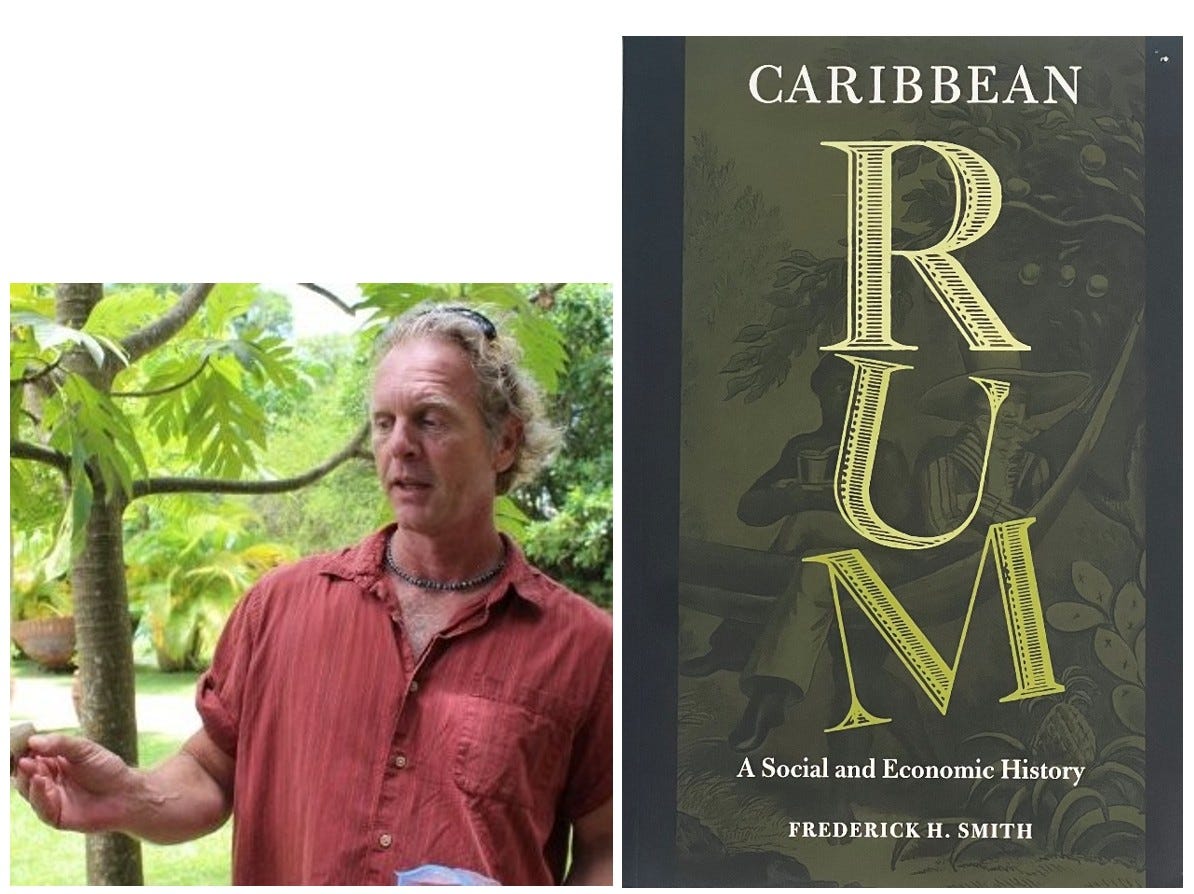
Easily one of the most untraceable professors on the net.
I’ll give you a dollar if you find another picture of him. Smith seems like more of a ‘one with nature’ kind of guy. Respect. But given this first-world dilemma, I can’t provide a witty bio of the man outside of what’s on the back of the book:
Frederick H. Smith, assistant professor of anthropology at the College of William and Mary, is the author of The Archaeology of Alcohol and Drinking.
…the end. Well played, Smith, well played.
If you’ve read my other rum pieces and book reviews, then you’re not going crazy.
You’ve seen Caribbean Rum featured throughout. The book is referenced in:
The book may be featured in subsequent reviews, given it provides solid context of the region’s history with rum. The text is well-researched and satisfies the interdisciplinary palette (archaeology, ethnography, etc.). The only thing I would add to the title is “Political.” Because "Politics" defines the order of "Social" and usually supports the initiatives of "Economics" (in most societies). It’s a triangle relationship that you’re hard-pressed to talk about the development of one without including the other two.
Caribbean Rum was published in 2005 as part of his research and fieldwork in the 90s. If any of this information feels outdated, then…that’s quite normal since we are now 20 years ahead =)
How did I arrive at this book?
Less exciting than some of my other reads: Sat down toward the end of 2024, after I decided that 2025 would be dedicated to reading about rum’s history, and found this book throughout my 2-hour or so Google search stint.
What is more exciting: Smith’s journey to writing this book.
As an anthropologist/historian, Smith explored the vestiges of Bajan plantation/rum records (primarily, so expect a Barbados-narrative-bent, notwithstanding many mentions of Martinique and a few other former/current French-controlled island nations).
His run-in with a specific – unbeknownst to him – rum historical site was providential:
—> Summer 1996 x Barbados: Working alongside Dr. Karl Watson (Uni of West Indies, Cave Hill), the pair was doing archaeological field work
—> July 13, 1986: Dr. KW reported that construction workers in Pierhead unearthed skeletal remains (humans). It was determined that the graveyard was the final resting place – whatever that may mean – of Bridgetown‘s slave population. They began packaging the skeletons for proper storage at the Uni of West Indies
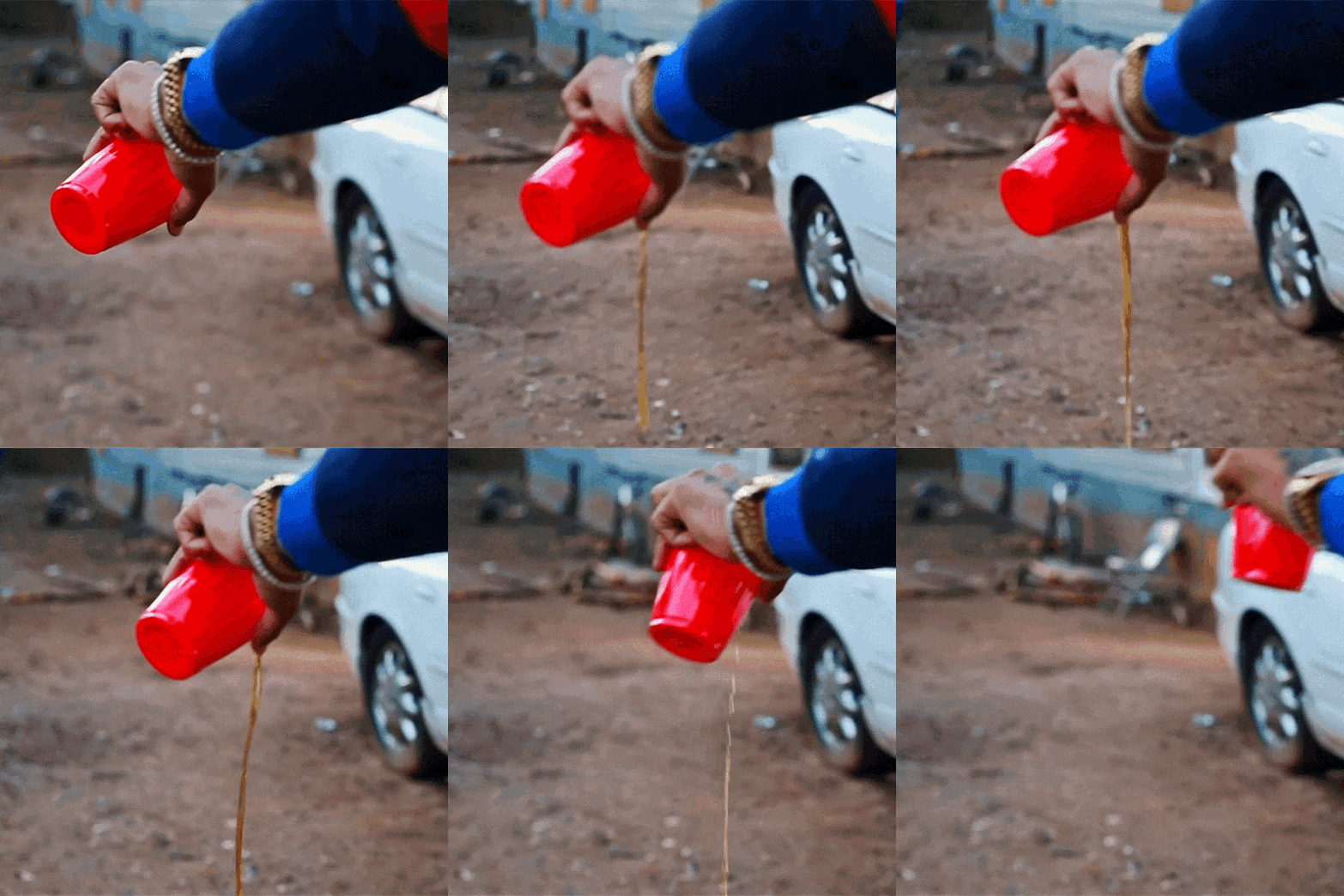
…someone in the crowd shouted that we needed to pour libations to those buried at the site, and within minutes a bottle of rum was produced for that purpose. The rum was poured on the ground and the pouring was punctuated by requests that the duppies “rest in peace” and “leave us alone.”
Pouring one out for the dead, as you’ll come to understand, is a deeply ancestral practice. Just in case some of you were wondering why it felt necessary to do that without having the words to describe why. And for others that read the above and are wondering what in the world am I talking about, just keep reading.
It was this event, Smith says, that served as the central turning point in his desire to focus on Caribbean rum and its historical path. I give Smith credit for exploring the crevices of this history vs. only offering up the more simplistic historical tropes. Example: he describes levels of drunkenness in the Caribbean over the centuries, noting that it was not simply access to the beverage that encouraged over-consumption. Other factors – epidemic, disease, natural disasters, domestic and international conflicts – ultimately laddered up to confronting anxiety, which many used rum as the panacea to abet. Humanizes things a bit.
I almost put the book down – thought I wouldn’t return to it – in the first chapter.
Not really. I have a quirk when it comes to reading: if I start a book, no matter what, I have to finish it. I’ll struggle through a text even if I don’t like it. Want to give the author their respect for spending considerable time writing the work. So, I don’t really have any books lying around that I haven’t read, a library full of ‘Imma get to those.’ Getting sidetracked. Why did I almost put this down?
Because he called molasses “waste products” (that’s my emotional response, I get it) and said that rum was produced in the early 1600s by “European and African colonist.” Nothing wasteful about the product used to make the luxurious beverage, and wtf is plabor what in the world is an “African colonist” in the context of “New World” colonialism?
But I continued because…I always do…and told myself that the following 250+ pages wouldn’t be littered with these missteps…and I was right-ish.
Note: Finish the book even if you don’t like it, you’ll pick something up along the way.

In the Introduction of the book, Smith pointed out two important distinctions to level-set before jumping into the history:
Compared to sugar, which was exported early and widely, rum had a sort of second-class citizen status. Because of this reputation, “rum consumption was concentrated among poor classes. Soldiers, seamen, Indians, poor whites, and slaves.”
Rum was not an inevitable creation since many early producers/plantation owners ignored the by-products in favor of trading the money-product (sugar). Practicality over exploration. But the expanding knowledge of alcohol distillation (and advances in the technology), coupled with the growing demand for alcohol domestically (islands), firstly, and then Europe/outside world, secondly, spurred the emergence of Caribbean rum
For more coverage on the history of distilling technologies, booze (beer, wine, spirits), and how they became widespread, check out my first-half review of A History of the World in 6 Glasses.
The early colonists needed their booze, come hell or high tides.
The Europeans and Africans who settled the Caribbean came from societies with strong traditions of alcohol use…
You see why I almost put the book down? I’m 100% certain the author isn’t dense and was paying homage to the reality that there is no prosperous new world without forced captive/labor contribution. The formalization and “development” of much of the Caribbean/North America does not occur without African labor. Okay, shout out to my Africans who settled the Caribbean. Toeing the line, let’s move on.
The ’strong traditions of alcohol use’ piece is critically important to understand the development of booze consumption in the Caribbean. I don’t think there’s any shock around Europeans having deep-rooted ties to alcohol (again, see my first 6 Glasses review for more of the historical arc, it will surprise you). So, the early colonists sought to replicate their drinking habits in this new (to them) land. Problem is: old world beverages were too expensive – distance/shipping costs, raw materials (i.e., popular grains), etc. – so they had to make do with what was available.
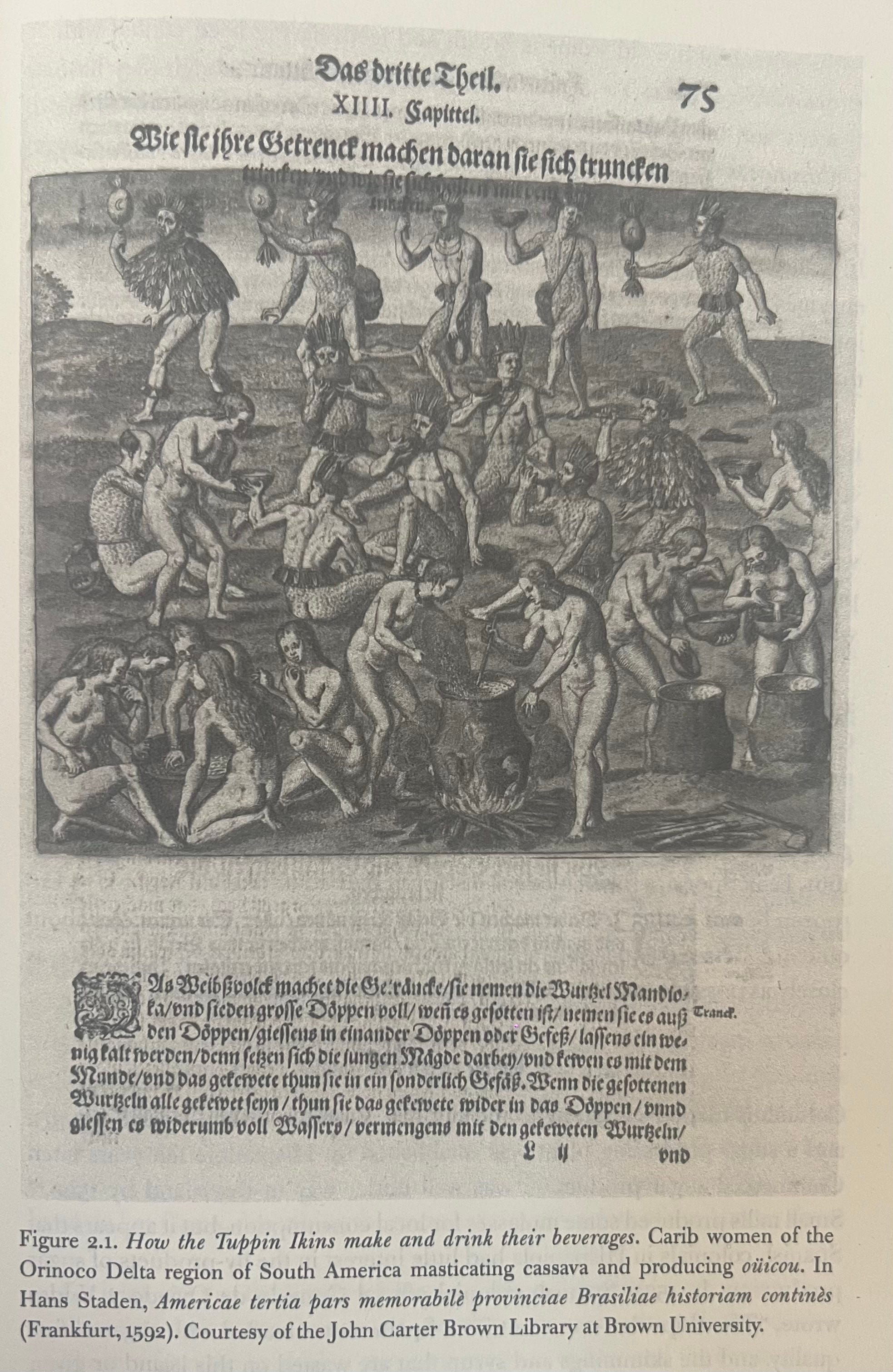
In 1627, a Barbadian expeditionary voyage went up the Essequibo River, into what is today Guyana, and returned with sweet potatoes and 32 Caribs, who knew how to produce a fermented alcoholic drink from them. Colonists eventually became skilled at the art of making mobbie…
Both sweet potato and cassava-based drinks were commonplace among the Caribs (Indigenous Natives of the Lesser Antilles and the Orinoco Delta regions of mainland South America). The most popular cassava beverage was oüicou (Francophone) or parranow/perino (Barbados). It’s not that sugarcane wasn’t present. The Spanish introduced cane to the Americas in the late 1400s. As a reminder, the early colonists only saw sugar as the most essential export/product for some time. So, mobbie and oüicou/parranow had to satiate them until they played around with more booze creations.
These same colonists – yearning for that liquid – fermented other local plants into low ABV alcohol: pineapple wine was a big hit; plantains (that’s disgusting); bananas; plums; oranges; limes (bro, what?!); wild grapes, the fruit of the tamarind tree, and the apple of the mahogany. The Europeans judged the taste quality of the beverages against what they remembered their old-world booze to be like, further reinforcing that they did everything possible to recreate what they left behind. The hallmark example of immigration: replicating what you left behind to provide a sense of familiarity and comfort in new lands.
And here come rum’s precursors, not that fermented plantain bev stuff.
My read on Smith’s analysis of 1500s Americas and enslaved Africans' consumption of rum precursor(s) is that it was still new, uncommon, and undesirable (i.e. because it was consumed by the enslaved and white indentured servants). For instance, in 1550, Spanish Dominican friar Bartolomé de Las Casas, when talking about the routine death of Africans at the sugar mills/plantations, described the drinks that the enslaved consumed as “beverages they drink made from the sugarcane.” Therefore, It would follow that whether it be leftover scraps or their drink of “choice,” enslaved Africans probably had the first go at defining rum’s character. Qualitative explanations abounded because there was still no word for rum.
African slaves may have played a key role in the manufacture of these fermented rum prototypes.…they, rather than the Europeans, may have conducted some of the initial experiments with fermented varieties of sugarcane juice in the Caribbean.
Distilled rum was universally consumed in the Caribbean, but in the seventeenth century, its use seems to have been especially concentrated among slaves, servants, and Caribs.
You would have a very hard time convincing me that the people who did the actual labor aren’t to be throned with the manual invention of things, especially during a period when leisure and idleness were a sign of wealth. If you believe that you learn by doing, then you understand what I’m talking about. Whether or not credited, I think it’s logical to conclude that 1) if the enslaved were relegated to the labor of sugarcane (and especially the waste that “planters” didn’t want to deal with) —> 2) and they did the work of turning those by-products to beverage —> 3) then they are most likely the authors of the beverage. No? Am I missing something? The hard truth is that the spoils go to those in charge, the coordinators of labor, the patenters and lawmarkers, if you will. That’s how it goes. And I’d argue that today's maximum economic spoils also go to those who are efficient coordinators of the best/most productive labor. These things aren’t accidents, I’ll give you some comedy to make the point –
And now, rum – make some noise.
…evidence indicates the British island of Barbados and the French island of Martinique were the cradles, if not the birthplaces, of Caribbean rum.
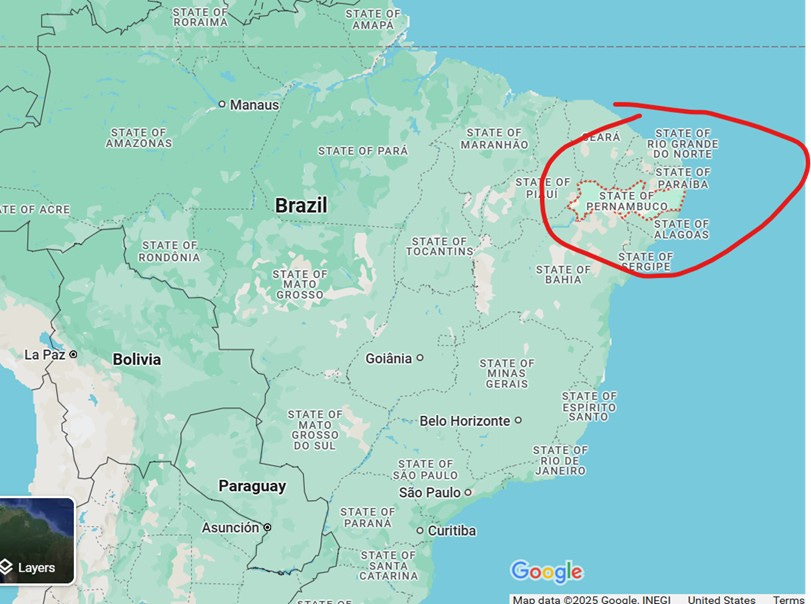
Big statement. BIG BIG STATEMENT. I address this a bit in my What is Rum – Part B (History) article, so I won’t dive too deep again. Javaun, focus on the book. So, the British “settled” Barbados in 1627, and the French “settled” Martinique in 1635. They initially began with cash crops: cotton, indigo, and tobacco. But later turned to sugar planting because it was more effective (read: $). James Holdip and James Drax are cited as the planters (read: they didn’t do the planting) who brought sugarcane and knowledge of how to produce to Barbados from the Dutch-controlled region of Pernambuco in the early 40s (i.e., the Dutch ousted the Portuguese from sugarcane growing areas of Brazil in the 1630s…temporarily). When the Portuguese took Pernambuco back in the 1640s and 1650s, many Dutch refugees fled to Barbados and Martinique. They may have brought with them enslaved laborers who had knowledge of sugarcane cultivation and distillation. These things follow predictable trends: I noted in my 6 Glasses (Part 1) review that French refugees fled Haiti post-Revolution, bringing enslaved people to Cuba (who had knowledge of rum-making).
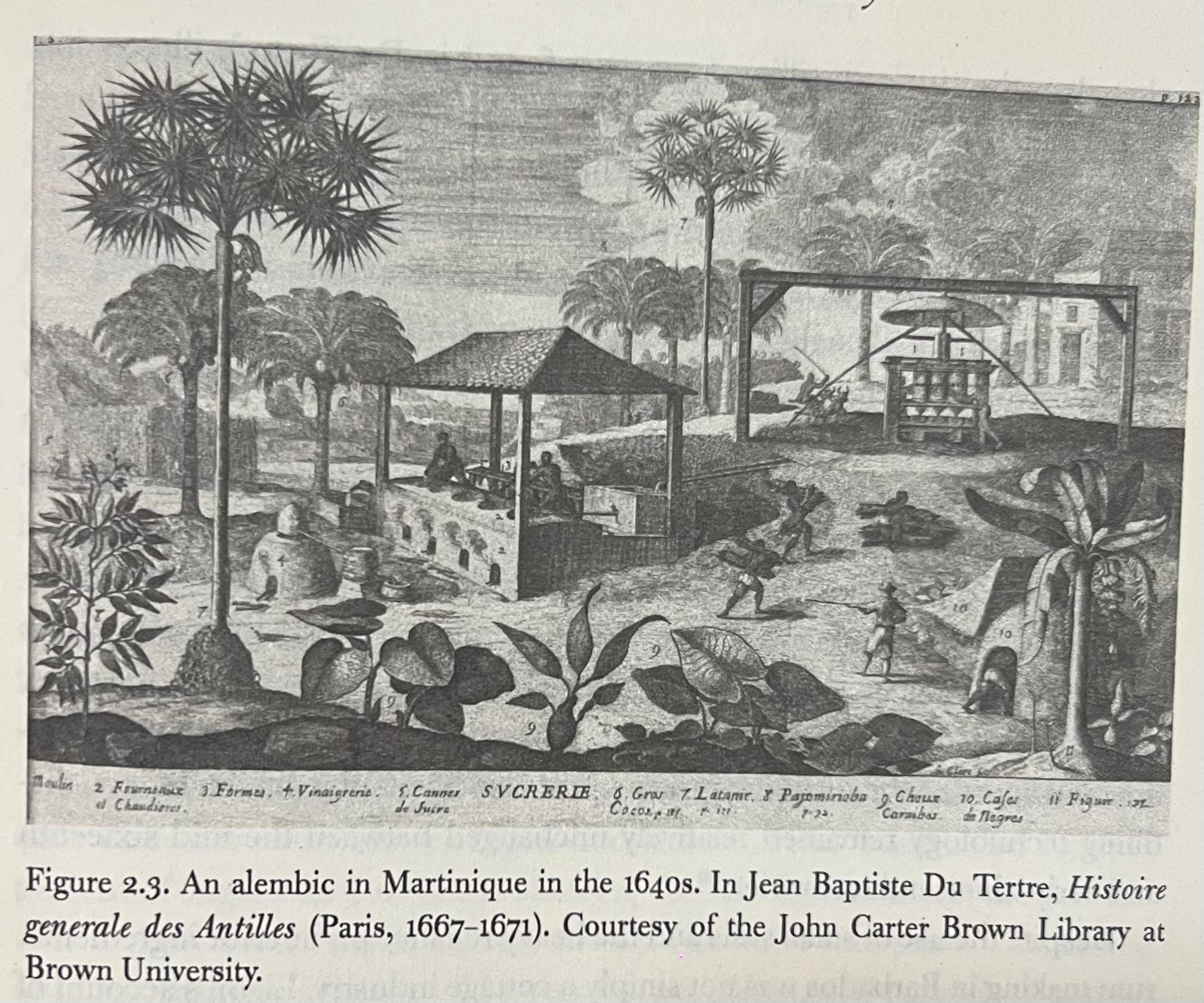
The spent and exhausted canes and also the stimming [from the boiling process] are not unstable, because the skimmings of the second and third cauldrons, and everything that spills over in the stirring on to the cauldron platform run into a cistern where it is kept to make eau de vie. – Jean Baptiste Du Tertre (1640s x Martinique)
Few notes:
Eau de vie is commonly used to refer to colorless brandy but was likely used as a catch-all term back then since beverages from cane are not the same as beverages from distilled wine/grapes.
Full-scale sugarcane plantations were present in South America (pre-1640s). Any distillation taking place, if it were happening then, in Barbados and Martinique, would’ve been small given their reliance on imported sugarcane/raw materials. The Portuguese/Brazilians would’ve been one of the core parties helping to fill this gap.
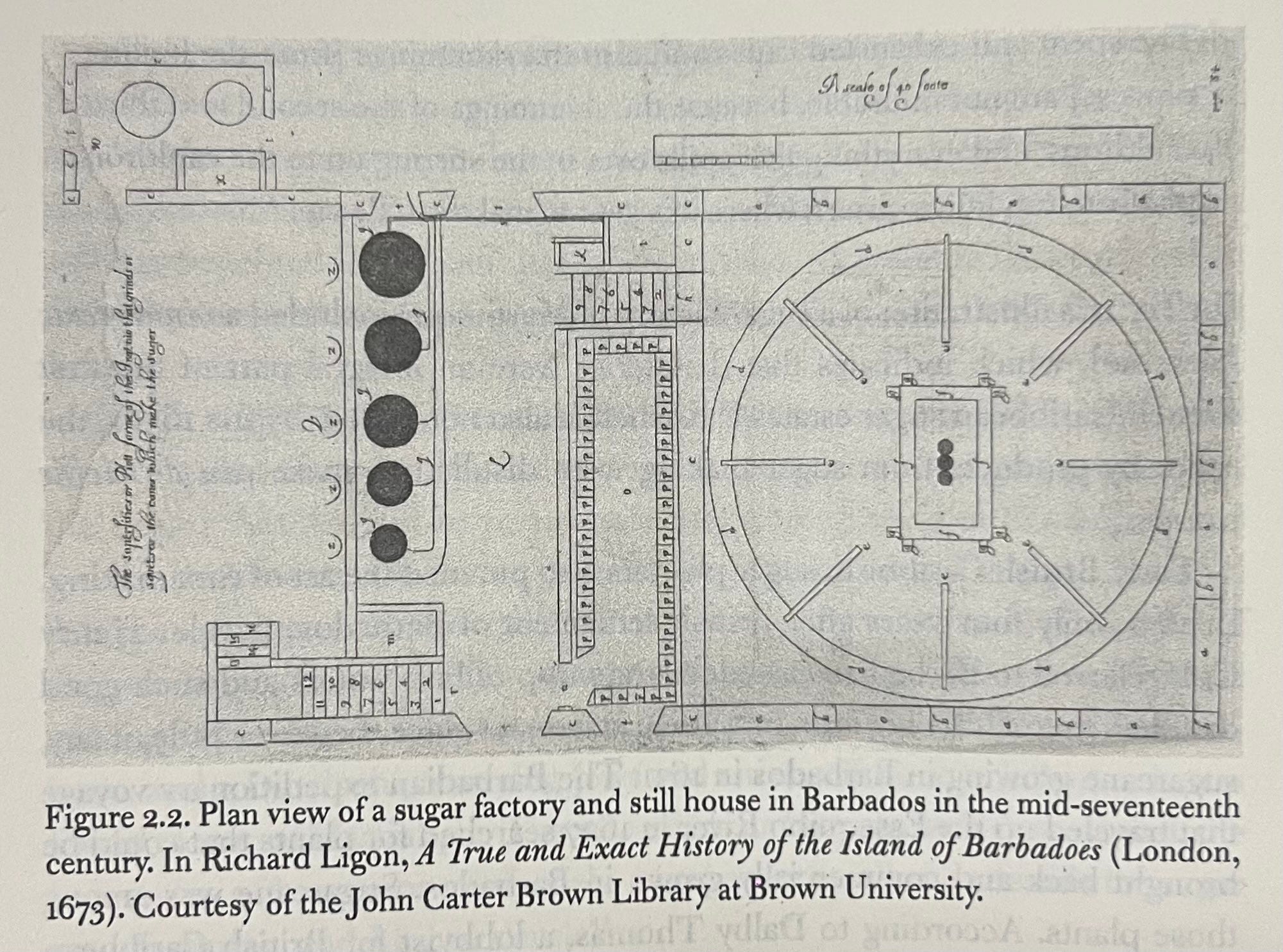
However, by the 1650s, “rum making in Barbados was well under way, and it was common for large sugar plantations to have still houses.”
But we still don’t have an answer for who called it rum first and why. In 1647, we have a reference to Colonel Thomas Modiford (Cornwall Bigga Ford), who later became the governor one of the wickedest crime fighters of Jamaica, referring to the drink as “the skimming of sugar, which is infinitely strong, but not very pleasant in taste.”
bUt nOt vErY pLeaSNt iN taStE…SHUT UP! To be fair, he was probably 100% correct; the crude forms of rum produced back then were likely terrible. Case in point: Giles Sylvester, an early resident of Barbados (1651), described the beverage as “made of Suggar cones distilled a hot hellish and terrible liquor.” People back then spelled things however they pleased. Richard Ligon, aka Mr. Full Of Himself (titled his book A True and Exact History of the Island of Barbados), initially referred to the drink as “Kill-Devil.” I think he heard that from an indentured servant or enslaved person and said, “Oh, that’s good, let me call it that too.” But I have no way to prove that. Intuition. In the French islands, they used the phrase eau de vie de cannes (later guildiverie, the French rendition of “Kill-Devil.”)
The earliest document to specifically use the term rum is a plantation deed recorded in Barbados in 1650, which identified Three Houses estate in St. Philip parish as having “four large mastics cisterns for liquor for Rum.” The name rum originated in the British Caribbean in the seventeenth century and derived from the English word rumbullion…Rumbullion was a word commonly used in Devonshire, England, to mean “a great tumult,” and it was probably meant to convey the volatile effects of excessive rum consumption on early colonists. Its origin reflects the large number of West Country English who settled Barbados in the early seventeenth century. By the early 1650s, rumbullion was shortened to rum…French and Spanish Caribbean adopted rum as the term for a distilled sugar-cane based alcohol, translating it to rhum and ron respectively.
I just looked up “West Country English,” which broadly characterizes South West England: Cornwall, Devon, Dorset, Somerset, Wiltshire, Bristol, and Gloucestershire. I know I was joking about CORNWALL Bigga Ford, but DEVON house ice cream is a staple in Kingston, JA. Look, I’m going off the rails here, but these naming conventions/legacies are connected. CAN A WEST COUNTRY ENGLISH PERSON COME AND TALK SOME SENSE INTO US ABOUT THE HISTORICAL CONTEXT? I KNOW THE ENGLISH DRINK A LOT, BUT DO SOUTH WEST ENGLANDERS HAVE A PARTICULAR REPUTATION? IDK WHY I AM STILL TYPING IN CAPS. Okay, back to rumbullion…lads…ok, my bad.

Sorry, one more thing – I just looked up South West England, and they’re closer to the water/edge of the island-nation (YES, UK IS AN ISLAND). So, it was likely logistically easier for them and their existing connections to waterway trading/activities that they made their bones by engaging in imperialistic expeditions. FOR REAL, BACK TO RUMBULLION.
Rum (not sugar) ain’t blown up yet, still a LAB. Sugar is international though!
Many of the still houses (for rum making) remained small for some time because the big bucks were still in exporting sugar to England. Distinct rum-making profiles began to develop in the mid-17th century. Smith notes that as early as the 1640s, Barbadian distillers double-distilled their rum and made distinctions about specific qualities of the liquid that resulted. So, when you hear chatter of Bajan rum having roots in excellent quality, much of it stems back to the 1600s. It ain’t just alcohol.
French planters also profited and ran sharp operations during this period, albeit at a scale presumably lower than the Bajans because the metropolitan spirits (wine, brandy, etc.) couldn’t face too much competition. It still remains very likely that, throughout the 1600s, rum remained a drink of the lowest on the social ladder, notwithstanding what was exported: “In the French Caribbean, Rochefort reported…sucrose-rich skimmings from the others could be used to make a drink for servants and slaves.”
French Caribbean sugar planters also profited from rum, more commonly known as tafia and guildive. In the late seventeenth century, Labat considered a vinaigrerie an essential part of a Martinican sugar factory, and a sugar plantations was expected to have one slave as a distiller. Labat estimated that a large sugar plantation of 750 acres would produce 238,000 pounds of sugar and 60 barrels of rum, about [~4,4K] gallons, in a 45-week crop cycle. According to Labat, 10 percent of the rum was allocated to the plantation’s 120 slaves to supplement their diet and reduce plantation costs. The remaining 54 barrels were sold bringing 3,000 francs.
Rum “geeks,” it is time to shatter your hearts. Labat is referencing Jean Baptiste Labat (Père Labat), the eponymous rum that many of you rave about (I’ve never had it, but heard good things). Your boy was a missionary, explorer, engineer, and fiercely strategic enslaver. That’s how these things often go

Vinaigrerie refers to alembics (pot stills for distilling rum), which further refers to the “Old World” term from Louis XII’s 1514 decree allowing vinegar-makers in France to distill wine into Brandy (reminder that immigrants always try to recreate/re-do/reference what they left behind in some variety)
Rum was allocated to slaves to supplement their diets because plantation owners fed and clothed those they controlled, so they always opted for the cheapest sources (to their knowledge), of which rum they believed helped to keep people full for longer (hence, “reduce plantation costs”). Rest of rum they sold off.
Isn’t history fascinating =) ?
In mid-1600s Barbados, there were about 350 sugar cane plantations of the total 844 plantations on the island. They move quick. Barabados is small, 844?! But they only exported “10 to 15 percent of its rum,” consumption largely remained local. Some of this is explained by alcohol as a (falsely believed) good way to balance body temperature when ill, which would have been a constant source plaguing the newcomers (i.e., acclimating to new land, mosquitoes tearing you up, facing the unfamiliarity and diseases of that land, etc.). Europeans, in particular, brought with them “Old World” fears about tainted drinking water, which was commonplace in their heritage lands. Consumption of alcohol was (falsely believed) to be a healthier alternative to drinking unfamiliar waters. Lastly, since it would take doctors another 300+ years to gain status as real medical professionals, the plantation MDs often resorted to “one…dram cup of the Spirit [rum]” since it was believed “that [it was the] present cure” for the enslaved who fell ill. All in all, local rum consumption was the reality for most of the 1600s. Export of rum – driven by European AND NORTH AMERICAN (i.e., USA) demand – resulted in an uptick as the century came to a close.
In the late 17th century/early 18th century, “[t]he majority of the 600,000 gallons of Barbados rum went to North America, particularly the Chesapeake and New England.” Not just the final product, molasses as well since there were a ton of distilleries in that Northeast pocket: “New Englanders took it upon themselves to turn almost all of that molasses into rum.”
Emmanuel Downing of Salem, Massachusetts, may have been distilling rum from imported Caribbean molasses as early as 1648, and a commercial run distillery was operating in Rhode Island in 1684.
These seemingly minute details are why I’ve said – in prior articles – that Rum consumption and America dates back centuries.
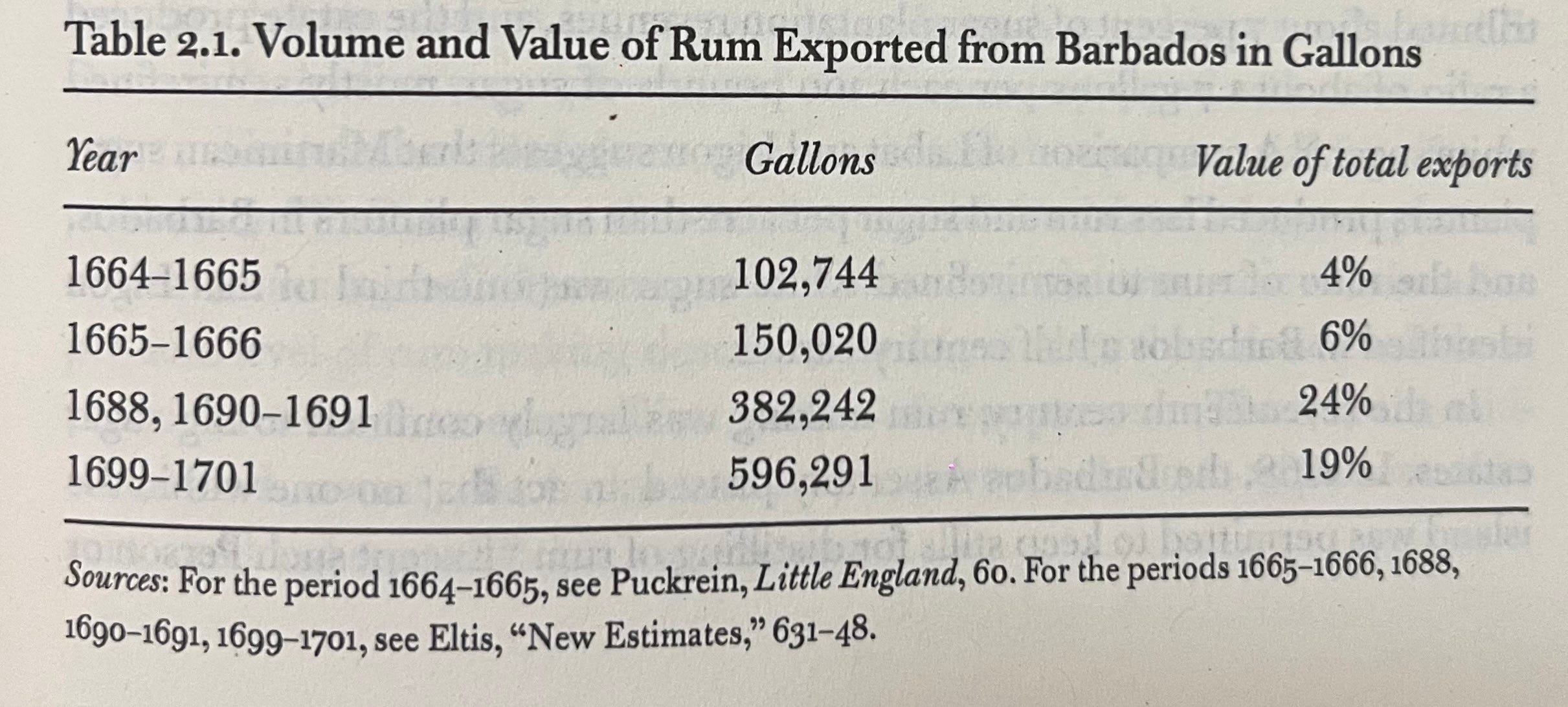
Once the export market got a taste, there was no slowing it down…at least not for some time.
By the end of the seventeenth century, merchants and traders throughout parts of Africa, Europe, and North and South America began to accept Caribbean rum in exchange for much-needed plantation labor, provisions, and supplies.
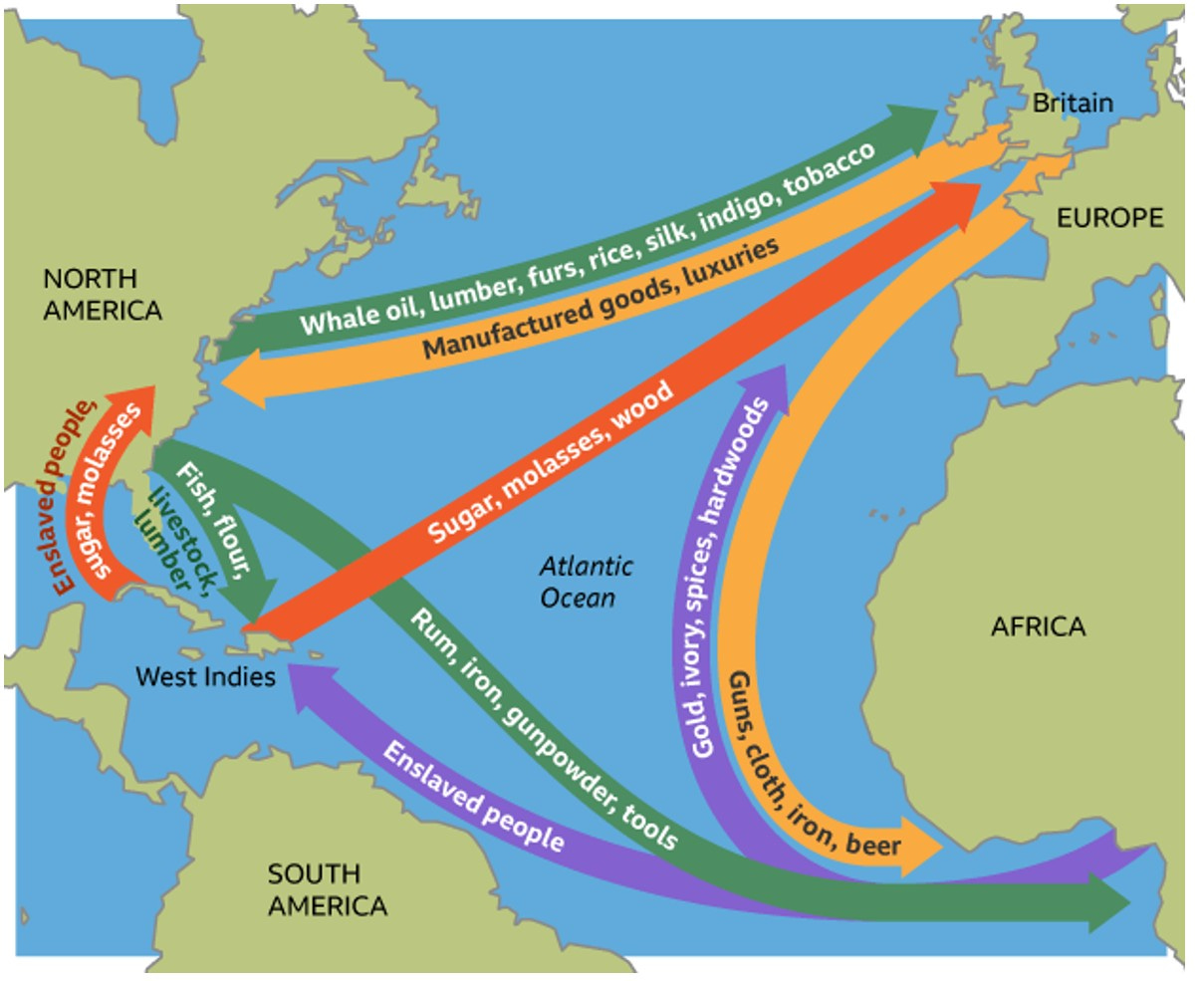
The dark reality (Triangle Trade) was such that (1) Caribbean rum produced by enslaved labor in the colonies was (2) traded for more enslaved labor, and other goods, on the coast of Africa (or likely with other slaveholding territories nearby), and (3) the captured men, women, and children further produced more output for trade, and on and on. This linked the Caribbean/modern-day U.S. —> Europe —> West Coast of Africa (primarily) in an unfortunate way. I simplified it, of course. One can’t truly explain this fully and do it justice. Here's an image to show how involved it was –
Interestingly, a lot of Barbados rum also went to North Carolina. Note: these seemingly random accounts are what I mean by rum “trade” was also practically executed (distance-wise).
In 1682, Thomas Ashe writing about conditions in the newly settled North Carolina colony wrote, “The Commodities of the Country as yet proper for England are furs and Cedar: For Berbadoes, Jamaica and the Caribbee Islands, Provisions, Pitch, Tarr and Clapboard, for which they have in Exchange Sugar, Rumm, Melsses and Ginger, etc.” The rum trade between Barbados and the Carolinas reflects strong ties that developed as a result of the great number of [Barbadians] who migrated to the Carolinas in the seventeenth century.
Told you, spelled things however they pleased. Berbadoes. Rumm (this is fine). But Melsses is crazy. My brain wheels are turning: I’ve always thought that the Gullah-Geechee accents I’ve heard (Carolinas) sound heavily Bajan. And while my Bajan friend, The Loyalist (who I referenced in my What is Rum Series (Part A), is supposed to be doing this research/writing for me to confirm my suspicions…we’ll just have to let my mind draw those connections without firm proof. I’ll come back to this one day, let me continue reviewing this book in the meantime.

I’m not CRAZY!
C’mon now, you know I have to call out Francois and Francisco.
Before Louisiana became a U.S. state (1812), the French ensured that, through their mercantilist policy of exclusif, French Caribbean trade only took place between their territories, France, and its holdings in Canada and Louisiana. Note to reader: “Empires” always turn away from these policies eventually because isolationism tends to lead to bad capitalism (i.e., relying solely on self-sufficiency hasn’t proven to work in a capitalistic world)
French Canadians had lumber, fish, tar, and provisions that were much needed on Caribbean sugar plantations. In order to stimulate trade and facilitate a self-contained empire, Colbert’s policies reduced import duties on rum entering French Canadian port[s]. As early as 1685, French Caribbean rum made its way to the northern French colonies.
However, I’m sure a lot of illicit activity occurred because many New Englanders smuggled in French territories’ molasses for their own rum production. When people want to make their bones ($), and you place restrictions on them, they’ll find ways around it to make more bones.
Similarly, for the Spanish domain –
In the seventeenth century, the Spanish American colonies were another primary destination for Caribbean rum. The high taxes imposed on imported Spanish wine and brandy, the unpredictability of wine shipments, and the fact that Spanish wine occasionally went bad on a long sea voyages to the Americas, [led] to experiments with alternative alcoholic beverages.
The experiments = rum = aguardiente de caña. Sugar production in Spanish colonies remained a sad state of affairs for a while, which constrained the blossoming of their rum production. Part of it was self-inflicted because of the preference/bias to the mother-country spirits of wine, etc.
By the end of the seventeenth century, Spanish and Spanish colonial officials were sufficiently concerned about the negative social and economic impact of rum that on June 8, 1693, the Crown instituted a comprehensive prohibition against rum making in the Spanish colonies. Although the ban stifled the growth of Spanish Caribbean rum making, the frequent reiteration of the ban in the following century suggests the prohibition on distilling was often evaded.
Again, when people want to make their bones, they’ll evade your restrictions. And you know who will help them with those evasions? Jamaicans.
Jamaican traders also purchased cattle in Cuba with smuggled rum.

This may sound crazy, but we haven’t exited the 1600s yet – let’s do so now.
How do you think “they” entered the new century? With optimism? You think the French and Spanish let up a bit and let their sugar-colonies’ rum flourish? Maybe they gained ground on the English. Maybe not. Actually, not at all.
…eighteenth century…British Caribbean planters developed an especially sophisticated rum industry, and pulled away from their French and Spanish rivals. Barbados and Jamaica, spurred by huge North American and metropolitan markets, emerged as the leading rum-making colonies.
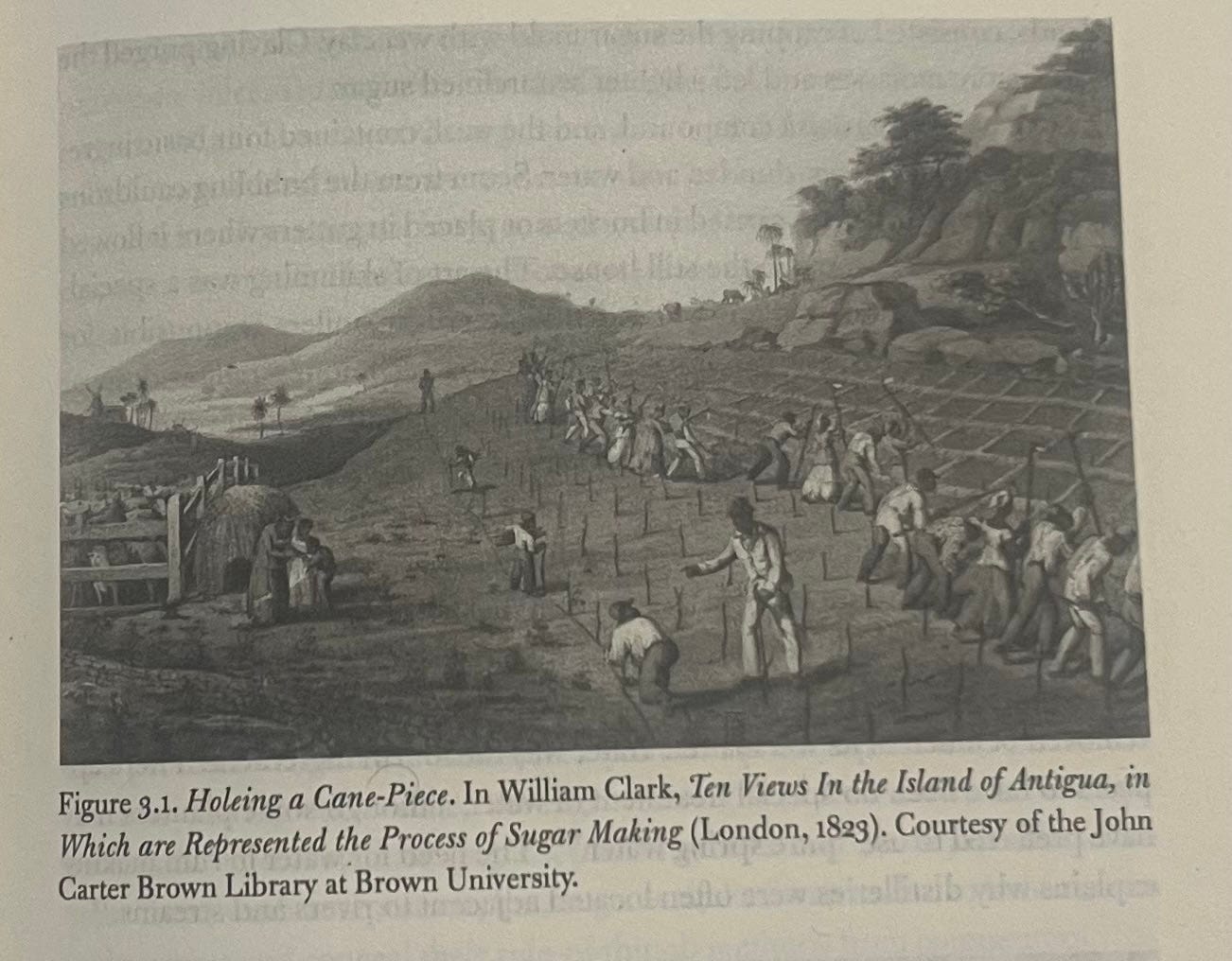
During those times, rum lacked standardization and quality control (much like most things those days), but the potential economic gains staring down the plantation owners forced them to get their s*** together. They were also dealing with a delicate crop (cane), one whose juice spoiled quickly. Transportation to mills (remember, donkey and horse days) was another component of the ‘get it together’ motivations, ultimately laddering up to not wanting to lose out on mula. Care and attention to the process (cane to bottle) began in earnest –
I see no just Reason why [a] Still-House should be making Rum in the wet season of the Year, but when no good fermentation can be expected or made equal to the Months between January and August. – William Belgrove (Barbados Sugar Planter)
Talk such as “the average 100-gallon wash in the British Windward Islands contained equal parts scum, dunder, and water,” became more common (among particular plantation owners/rum producers) across the islands. But, Smith notes, this was especially the case in Jamaica and Barbados.
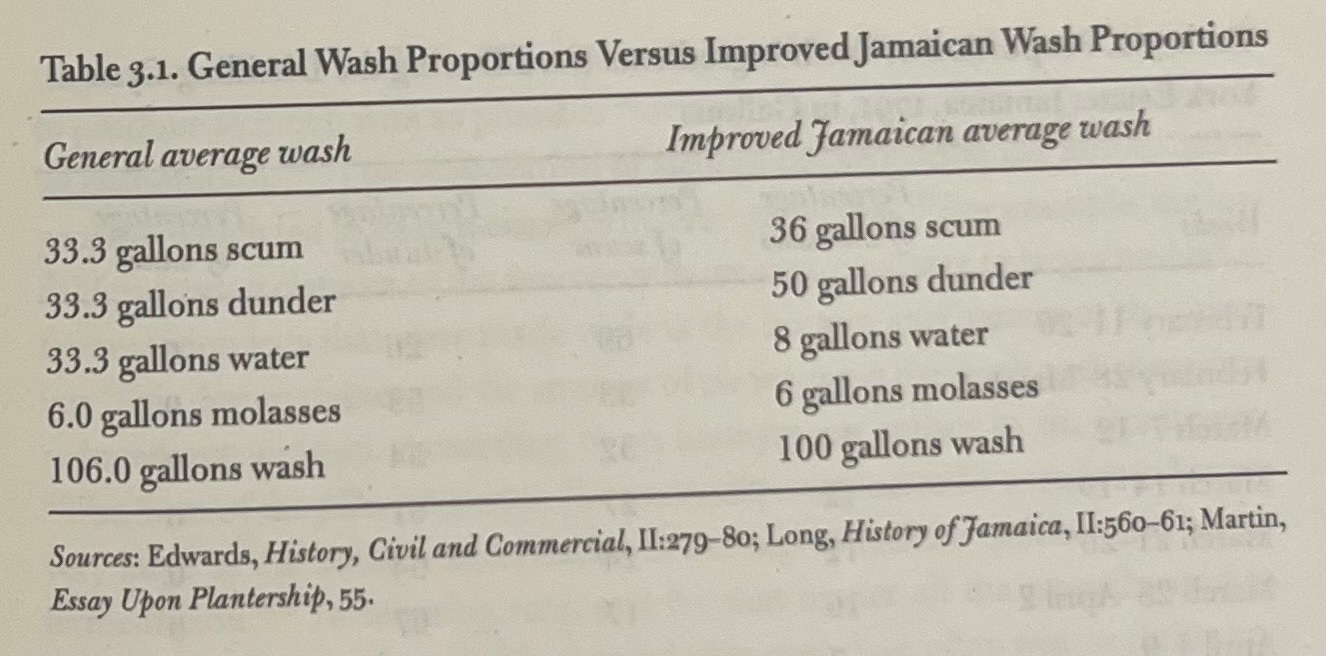
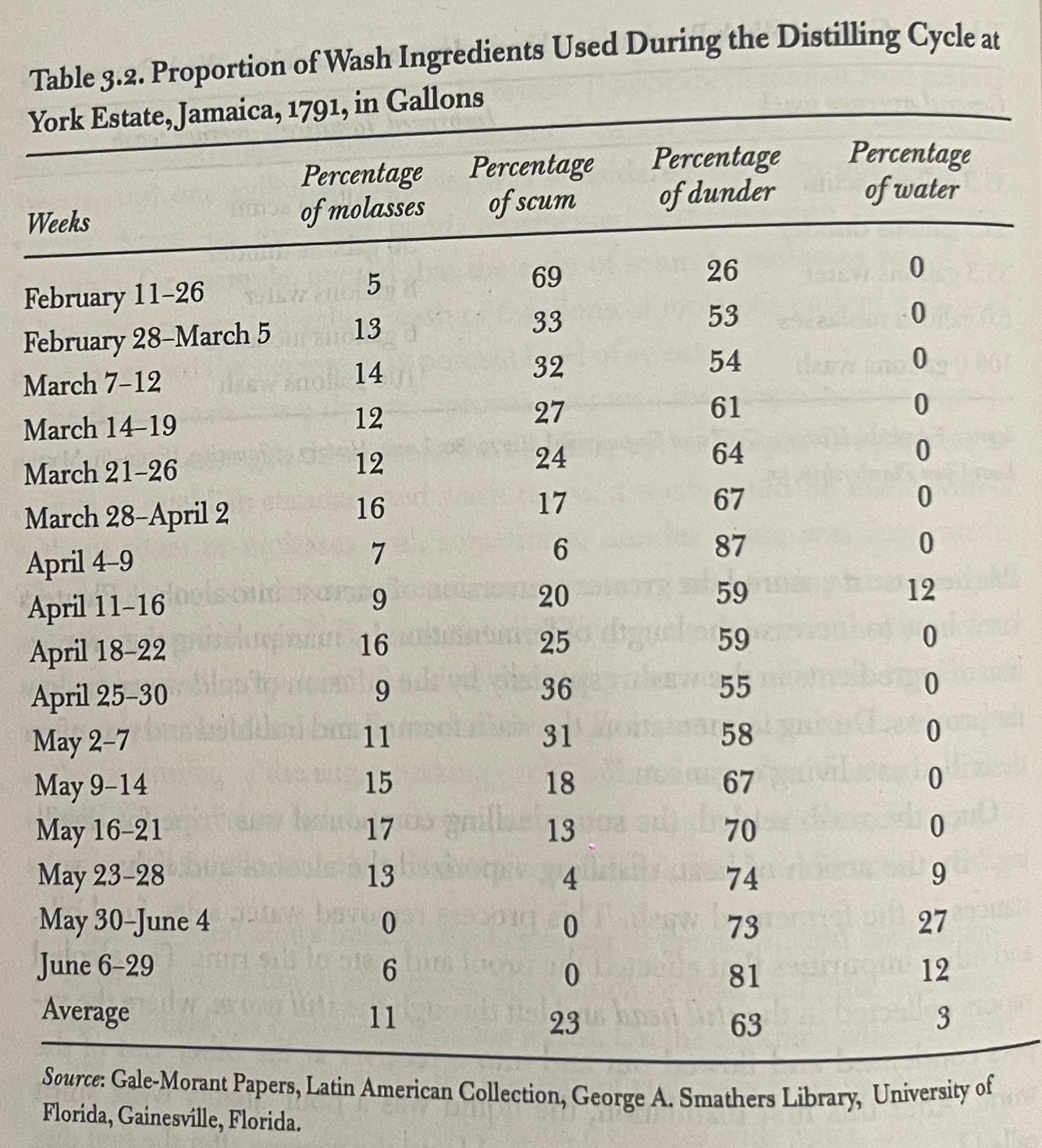
I think I’d be overselling you, however, on the intelligence of the Caribbean rum producers in the 1700s if I didn’t also emphasize that some things were done because they were more profitable. For instance, the fact that Londoners had a preference for “a fiery spirit” that “is of a much higher proof” likely resulted in Jamaican producers (in particular) pumping out high-proof rums that could be adulterated or consumed on their own. If your customer says 5 more of the higher proof, you…produce 5 more of them. And suddenly, you’re known for overproof rums. Now, I’m not saying that’s a 1-for-1 connection. But I am saying that it may have something to do with it =)
And now, Jamaicans are well-known for being the overproof dons. Rum with a bite (note: you have many rums that have higher ABVs than Jamaicans, but still pack less character in the flavor and ‘what’s going on with this rum’ thing that happens when you taste it). But, sometimes, oftentimes, I’d argue – this stuff is done for purposes of practicality.
The practice of raising proof was a rational economic strategy. It allowed the planter to increase the amount of alcohol shipped without increasing shipping costs. A puncheon of 120–130 proof rum contained 10–15 percent more absolute alcohol than a puncheon of proof rum, but the shipping costs and spaced used were the same.
And that, folks, is called economies of scale!
Quick nerd-out detour for the rum “geeks” (Jamaican vs. Bajan Production).
Jamaicans distilled the wash, took the low wine, and re-distilled it separately to produce a hot spirit with high alcohol content. The Barbadian distillers ran off a single wash, and that resulting low wine was returned to the following wash compound. The entire batch was then re-distilled to produce a cool-proof spirit.
This could also signal that Jamaicans were far more in tune with trying to understand the palette and desire of the mass market taster in England, whereas the Barbadians were more focused on producing what would be considered a luxury rum (I may be giving them too much credit again). Not to mention that North America (remember New England, North Carolina, etc.) was still the primary destination for Barbadian rum, which the Bajans exchanged for plantation supplies, such as barrel staves, provisions, and livestock.
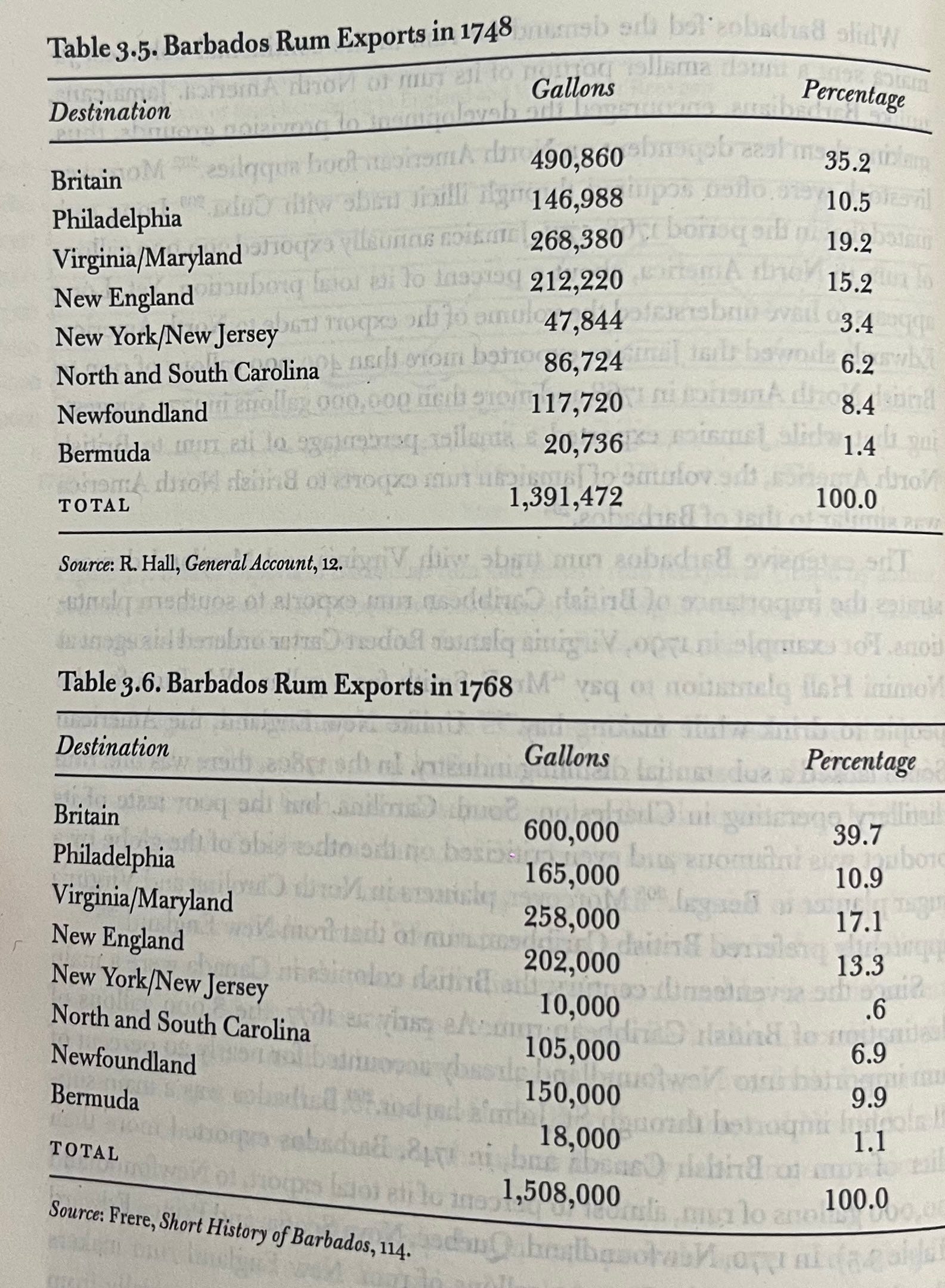
For example, in 1790, Virginia planter Robert Carter ordered his agent at Nomini Hall plantation to pay “Mr. F. Smith for 8 gallns. W.I. Rum for the people to drink while making hay.” Unlike New England, the American South lacked a substantial distilling industry. In the 1780-s, there was one rum distillery operating in Charleston, South Carolina, but the poor taste of its product was infamous…
I didn’t have to include that last sentence. I did it to be childish to my fellow countrymates in the South…for no reason other than…I don’t have one. Cheers.
It’s not entirely accurate to say that Bajan rum was always produced to be of a low proof and low concentration (similar to cane juice-only rums not always being a hallmark of places like Martinique, they were molasses-only for a large part of their rum timeline). In the early years – 17th century into the 18th century – the Bajan rum industry did produce higher-proof rums via separate distillation of wine.
…Barbadian planters were so concerned with the strength of their rum that the Barbados assembly passed an act in 1670 that fined planters [100 pounds] for producing rum that would not catch fire. This probably refers to the old practice of gauging the strength of spirits by mixing them with gunpowder. Gunpowder, steeped in a spirit that contained more than 50% alcohol will ignite.

Rum begins to, at full(er) force, leak across the Atlantic and disrupt Francois and Francisco beverages.
French and Spanish wine = Francois and Francisco beverages (if unclear). Brandy, too. But the only Brandy we acknowledge is Miss Norwood. Take it away…
I would like to get to know if I could be…the kind of rum that you could be down for! Alright, where was I?
In the Spanish Caribbean, colonial officials outlawed rum making and forced Spanish Caribbean rum makers underground. French Caribbean rum makers fared somewhat better. Although France prohibited rum from entering metropolitan ports, French Caribbean makers continued their seventeenth century pattern of supplying markets at the margins of the Atlantic world…British Caribbean rum making flourished…
The Spanish fought hard to ensure that wine and brandy imported from the Canary Islands and Spain (+ Peru) were the crown's primary continental and colonial exports. The primary factor impacting and inhibiting the growth of Spanish Caribbean rum was the lack of a metropolitan market. Hamstringing yourself over some wine and distilled wine…wickedness. But again – when people want to make their bones, they will: Cubans exported rum and molasses heavily throughout the 1700s, but especially toward the end of the 1700s (filling the void after trade was disrupted because of the American Revolution). Talked a bit about this in the Havana Club Especial review last week, so I’ll leave it there for now. And the details on rum and the American Revolution (Molasses Act, Sugar Act, American Revenue Act, Seven Years’ War, etc.) are covered in the 6 Glasses (Part One) review, so I won’t dive too deep into that either. All very interesting history, though, so have a read when you can.
GOTTA MAKE YOUR BONES, AND AMERICANS WANTED THEIR RUM TO DRINK –
Although the exclusif prohibited trade with foreigners, the British continental colonies were an important destination for French Caribbean goods. This illicit trade highlights the vigor of the barter economy in the Americas. In the seventeenth century, New Englanders purchased cheap French Caribbean molasses at French, Dutch, Danish, and British American ports, which they carried home and used for their own rum industries.
Smith draws out an important analysis vis-à-vis the British and warfare with the Spanish/French: brief intermission of the British controlling enemy territories or having some trading/port influence meant that the free-wheeling knowledge (and equipment) for rum-making extended to some of those territories (Cuba, Haiti, Martinique, etc.). Interesting. And I guess not all too surprising since the British were all-in, undoubtedly (it seems), on rum –
The notion of the superiority of Brandy to Rum…has done mischief to our West-Indian colonies; and been injurious to our balance of trade, and political interest, by augmenting the consumption of a foreign commodity, purchased for money of our rivals, to the exclusion of one produced in our own dominions, and supplied in exchange for our manufactures and domestic products. – British Caribbean Interests
…as early as 1690, Dalby Thomas, an advocate for British Caribbean sugar planters, wrote, [Rum is] wholesomer for the Body [than brandy], which is observed by the long living of those in the Collonies that are great Drinkers of Rum, which the Spirits we make of Mellasses, and the short living of those that are great Drinkers of Brandy in those parts.
“Mellasses.” People say the darndest things when reinforcing narratives to support their cause, but that’s how it goes. Pocket protection by any means necessary, but they also likely believed these things at this time.
The British weren’t playing about patronage for their interests. Importing from France and southern Europe is/was easier logistically. But the British said – “nope, send yee rum on yonder” or whatever –
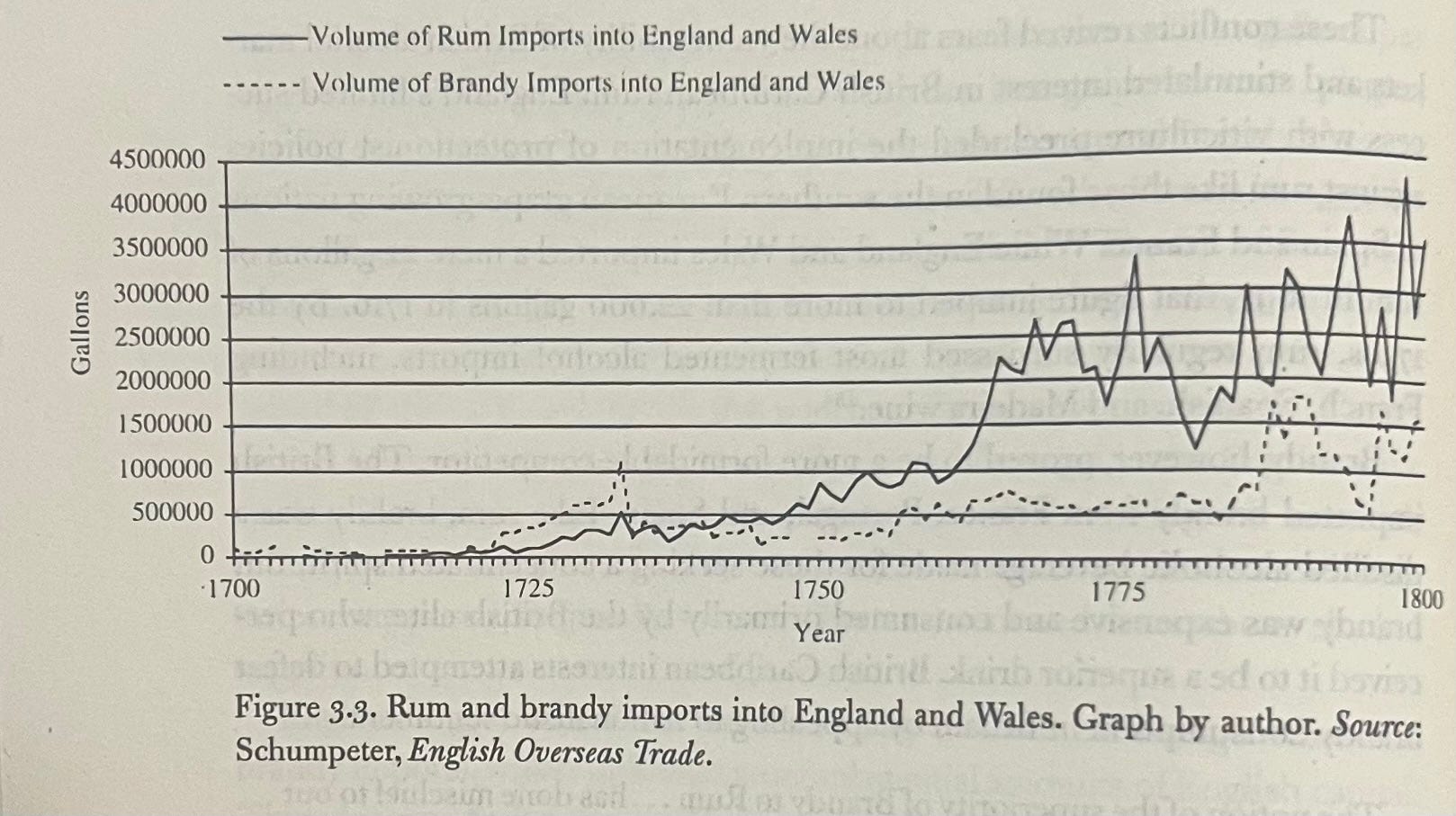
In 1719, British imports of rum surpassed those of brandy for the first time. After 1741, rum imports regularly exceeded those of brandy for the rest of the century.
Rum, the liquid lubricant, is central to the British imperial strategy.
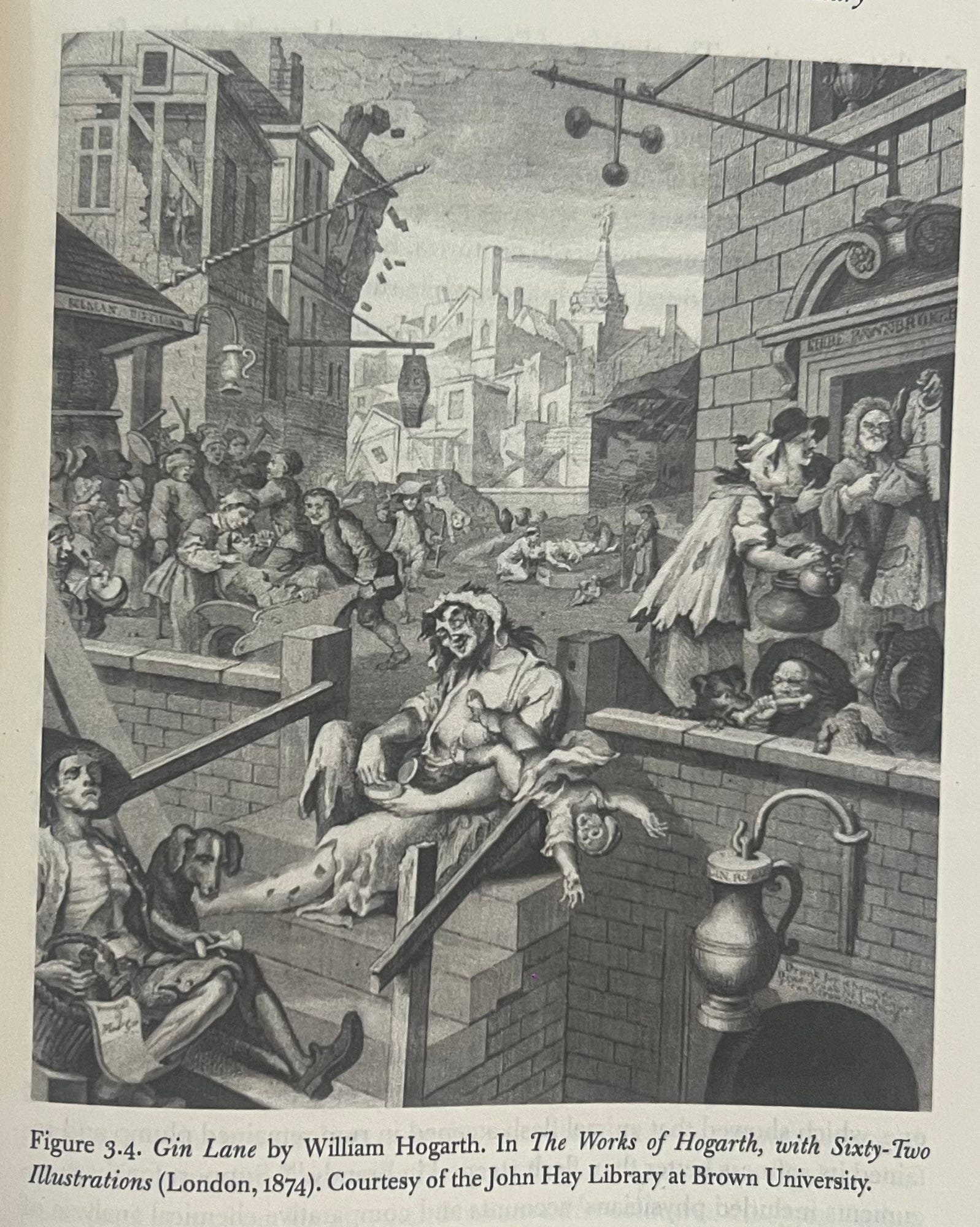
It “helped” that Gin drinking (late 1600s/early 1700s) was seen as a social and public crisis in England. Parliament passed a series of Gin Acts to curtail its consumption/distribution starting in the 1720s. A lot of British attributed high mortality and low fertility rates in the 18th century to excessive gin drinking. The Caribbean planters stepped in and said, “Drink rum, it’s healthier” (not an actual quote, but I’m sure they said that in some variation: yee Gin shall not…lol, alright, I’ll stop).
But the Caribbean planters also had a fundamental need to protect their economic interests (plantations/sugar/rum), so they firmly integrated themselves into the British crown’s pinwheel of colonial control. Rum rationing in the British army and navy (gallons of rum distributed per month) was supported by those British Caribbean rum interests who needed to secure a stable market for their exports. In other words, send them boys rum. If there are slave uprisings/wars, please come save us, and we’ll keep giving you rum. Sounds a little satirical, but that’s the logic distilled down. Because at the end of the day, the British crown was successful if its colonies were stable.
Planters stored rum for traveling troops, especially during times of civil unrest. During Tacky’s slave rebellion in Jamaica in 1760, Thomas Thistlewood, the manager of Egypt plantation, broke open casks of stored rum made on his plantation…
Fun fact, I read Vincent Brown x Tacky’s Revolt: The Story of an Atlantic Slave War right after reading Caribbean Rum. He provides a more thorough deep dive into who Thomas Thistlewood was. Review on that coming soon =)
You know what? Let’s leave it there for now. We’ll get into Part 2 next week, where I’ll start with details that I intentionally raced through but are critical to how all of this comes together: Africans, Europeans trading with African empires, African drinking habits in the Caribbean, etc.
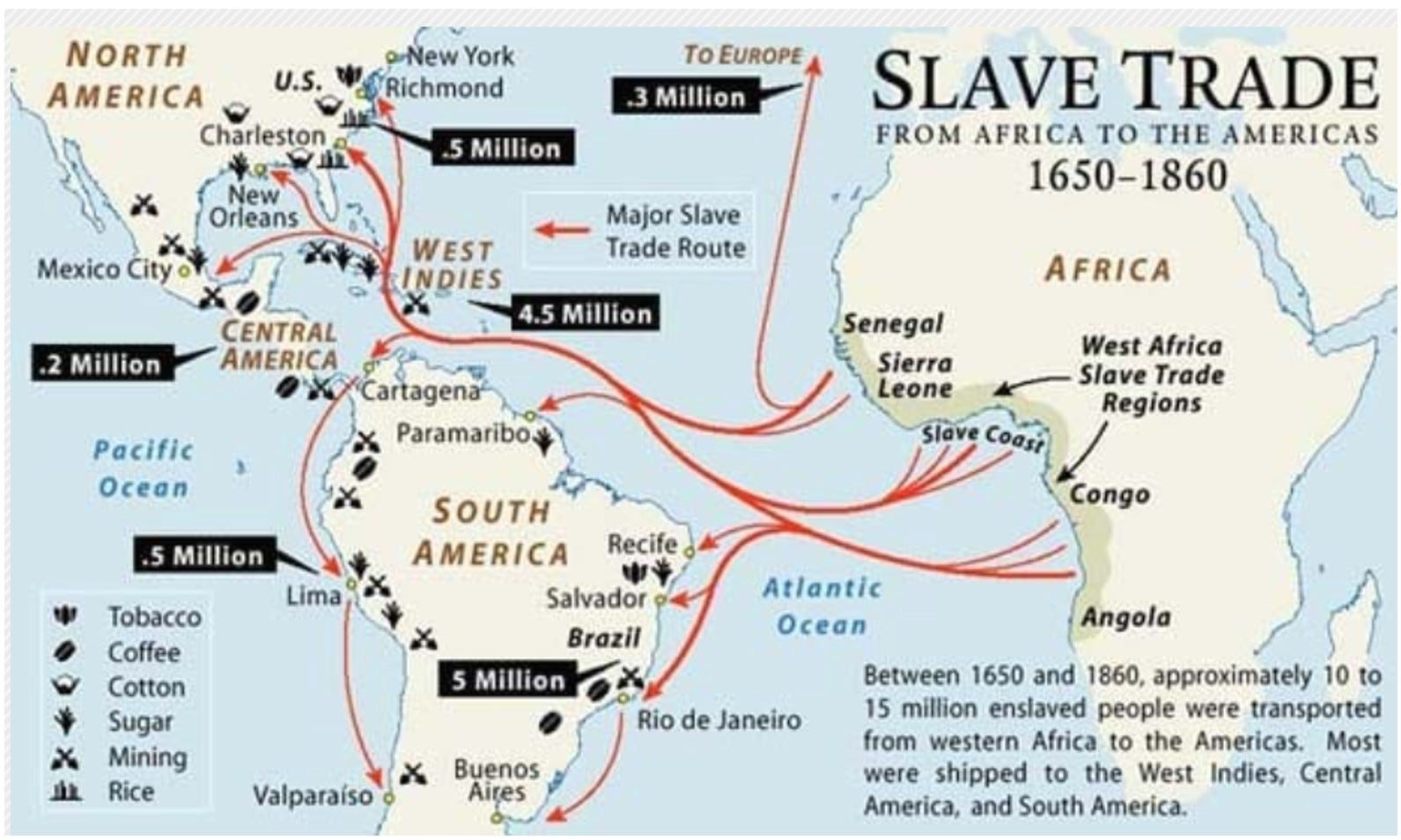
Part of the reason why Brazil – today – has the largest population of African-descent outside of the continent of Africa (highest proportion of Africans were captured and taken there)
This entire piece could’ve been just on Brazil and their cane-spirit history, gargantuan amount of reading/learnings there
I dropped this map for you to take in the magnitude of this centuries-long slave trade, which completely redefined the places and spaces where you now have people of African descent outside of the African continent (but there as well, to be fair)
Their “Old World” drinking habits are one of the many food + bev legacies they “brought” with them (we’ll get into it)
For now, cheers to everything we’ve learned.
And remember,
in all that you do, please, don’t ever stop reading.
