


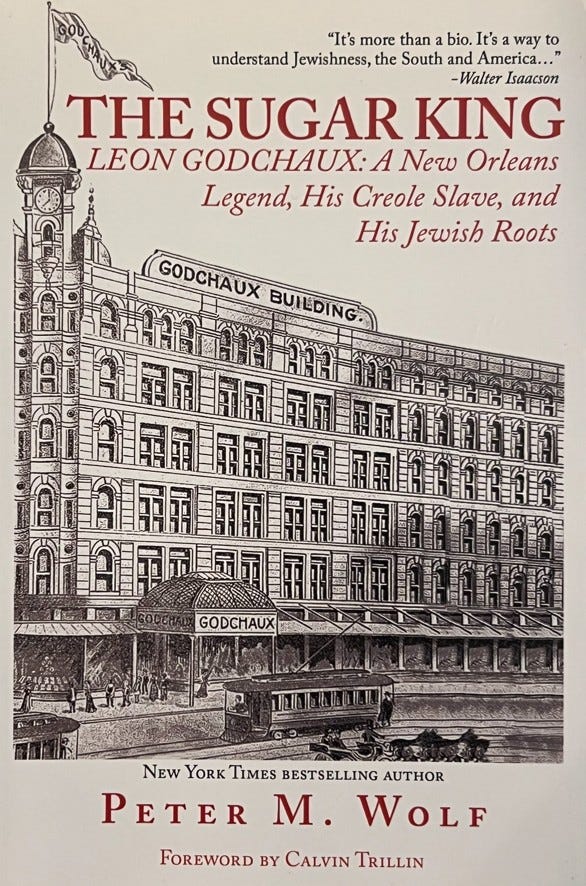
We are now venturing into my favorite territory to explore American rum: Louisiana. And though we will not get to rum precisely (i.e., no mention of the spirit in this book), the raw material (sugar) and learning about a leading character in Louisiana’s historical business figures still whet the appetite for learning. I read this book before ever visiting Louisiana. Which means I was significantly lacking familiarity with the state and its jewel city, New Orleans (before May 2025 at least).
The smell of the air. The twang of the people. The food & beverage scene. The variety of musicality & raw talent. And the uncanny resemblance – in touch & flavor – to the Caribbean, I’d eventually come to appreciate once I felt the soil/driven across the state. From Cajun country to Creole towns, my five senses were being toyed with in all kinds of ways.
I read The Sugar King, understanding that all the nuances, subtleties, and references a native Louisianian would spot immediately would escape me. Down to the pronunciation of towns & cities. Long way of saying I went into this book with an eagerness to match my open-mindedness. After all, I’m chasing the liquid (rum). Whatever gets me there, or close enough, will have to suffice.
Wolf.
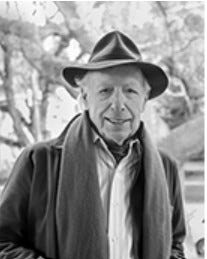
Peter M. Wolf, a child of New Orleans, was born on December 6, 1935. His education is varied, across institutions/coasts, though he eventually touched concrete in the greatest city of them all: “Metairie Park Country Day School, Phillips Exeter Academy, Yale University (BA), Tulane University (MA), [and] New York University (Ph.D).” Wolf also spent time in the military (“Air National Guard”).
I appreciate the author’s background. He flexed a multitude of intellectual, creative, and passionate muscles by testing the extremes (stereotypically speaking); a retired investment advisor isn’t typically a “School of Architecture” adjunct professor, a former Fulbright Fellow, or someone who dabbles in fine arts and design. Again, stereotypically speaking.
From the litany of books he’s written on topics like urban planning, land use/development, and much more, I suppose I am not all too surprised that Wolf would have taken an interest in Godchaux’s journey to the Big Easy, how the city developed through Godchaux’s life, and the ramifications this had on Wolf’s hometown.
As I coursed through Wolf’s bio, I couldn’t help but realize (this was pre-diving into the book), the man is writing about his elder (emphasis is mine) –
Roots: Father’s family (Godchaux, Weis, Wolf): first descendents came to New Orleans from Alsace [France] in 1830s.
More concretely, the author’s dad is Albert Jacob Wolf (1881–1968), who married Leon Godchaux’s first grandchild, Carrie Godchaux, in 1906.
I will admit, my skeptical antennas went up when I unearthed the connection. It is atypical, especially for folks of the older generations, to paint their ancestors in any negative light, even if that is the honest thing to do. I understand. But, as I do with any book/author, I gave it a fair chance.
The flip side is worth acknowledgment as well: Wolf writes more passionately than someone else likely would have (about Godchaux), given Leon is his elder. Understandably, Wolf takes personal family misfortunes, which shine in the words he puts down on paper. More than anything else, a thank you to Wolf for giving us a peek into your family’s history; you didn’t owe anyone that favor.
Many thanks to my boy for grabbing this book for me while in New Orleans. The Sugar King undoubtedly adds to the breadth of work that helps the world to understand Louisiana’s/New Orleans’ social & commercial development over time.
Note: the source of the information above is the author’s website.
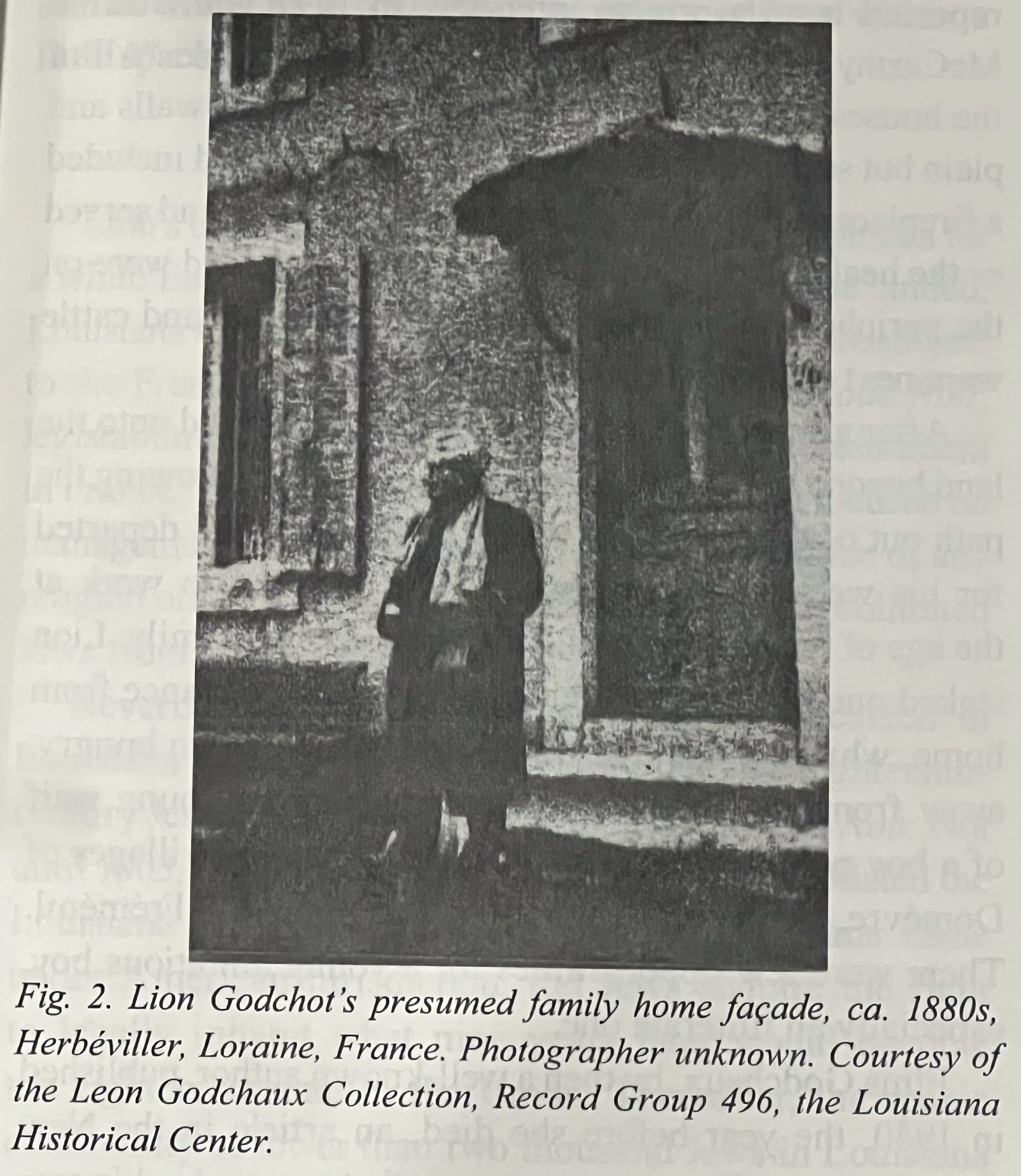
Who is (was) Lion Godchot?
He was my great-great grandfather.
A man from Herbéviller (northeastern), France, who grew up without means. His poor economic status only worsened when his father, “Paul Godchot, the village butcher, died when Lion was seven years old.” It seems as if Lion did his best to be additive to the family, serving as an “itinerant peddler selling yarn and scraps to nearby villages.”
The “white European Jew” with “almost no money” was, as we all are, a product of his generation. With that, his aspirations would have been of the time, constrained by the perceived universe of possibilities. One of which was: go to New Orleans for a better life. A not uncommon aspiration for those who had heard of their countrymen going off to current/former French territories and making a better life. That discourse must have been even more intimate in the smaller Jewish community Lion inhabited, one can assume.
In the 1840s, steamship agents stationed throughout Alsace-Lorraine were in business to sell cheap, belowdecks passage on the busy seaway from Le Havre to New Orleans. Targeted customers were would-be immigrants, many of them young, discontent, and ambitious Jews from poor families—families that had long clustered near the Rhine on the western edge of the former Holy Roman Empire.
More personally, Lion’s grandson, Walter Jr., surmised that his grandfather left France because there was not enough food for his family to share, and that his landing in New Orleans could have been because “it was the only ship he could find.” Now that is some good historical storytelling. Plain, boring, and practical.
Arriving in polyglot land.
Godchot’s journey aboard the Indus lasted 4 months. He arrived in the port of New Orleans on February 20, 1837. By this point, Louisiana was no longer a French territory, though the French influence remained strong. The Louisiana Purchase (France → America) took place in 1803. Statehood granted 9 years later. 13-year-old Lion may have viewed the American ownership favorably, given that freedom of religion under Catholic France was an uncertainty –
Thirty-four years before he landed, Louisiana was still a French territory: residents were subject to the French legislative act of 1724 called Le Code Noir, legislation that reflected pervasive anti-Semitic sentiment in France. Though the legislation was primarily focused on management of enslaved blacks, it forbade any practice of any religion other than Catholicism and specifically prohibited Jews from living in Louisiana.
Lion arrived to a small Jewish community in Louisiana (low thousands). But still of importance, as the safety of his (religious) community was surely the bigger draw to New Orleans than the residual benefits of being French. The Cajun community’s migration to Louisiana is an example/testament to that unfortunate reality of colonial France and its ramifications. Lion’s community, or what it was to become (rather) –
By the early twentieth century, some 7,500 Jews inhabited Louisiana, two thirds living in New Orleans, which by then had become home to the largest Jewish population in the South.
To be fair, it is also worth noting the practicality of Lion’s decision to go to New Orleans: people still spoke French in Louisiana. The timeline for making a better life for yourself tends to be faster if you arrive in a foreign land where you are already familiar with the tongue. Moreover, it seems that there was a consistent transit line going from France to New Orleans, so it would have been cheap(est) to get there from French ports. The economics of New Orleans, even if the teenage Godchot was not intimately familiar, would have had a buzz and attraction that would have been difficult to ignore if you were eager/determined –
The port of New Orleans, crucial to Lion’s eventual success, was the fourth most active in the world, eclipsed only by those of London, Liverpool, and New York.
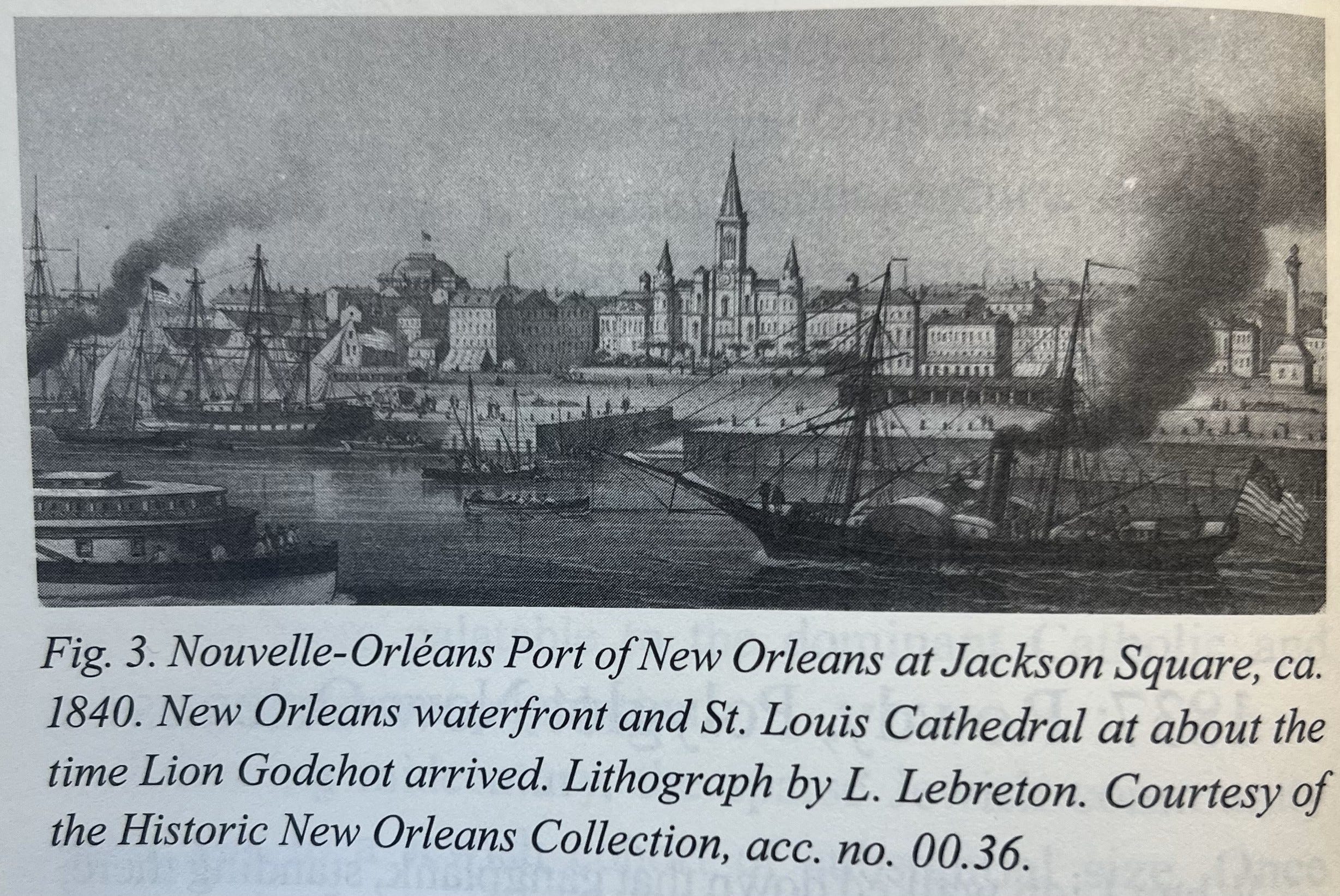
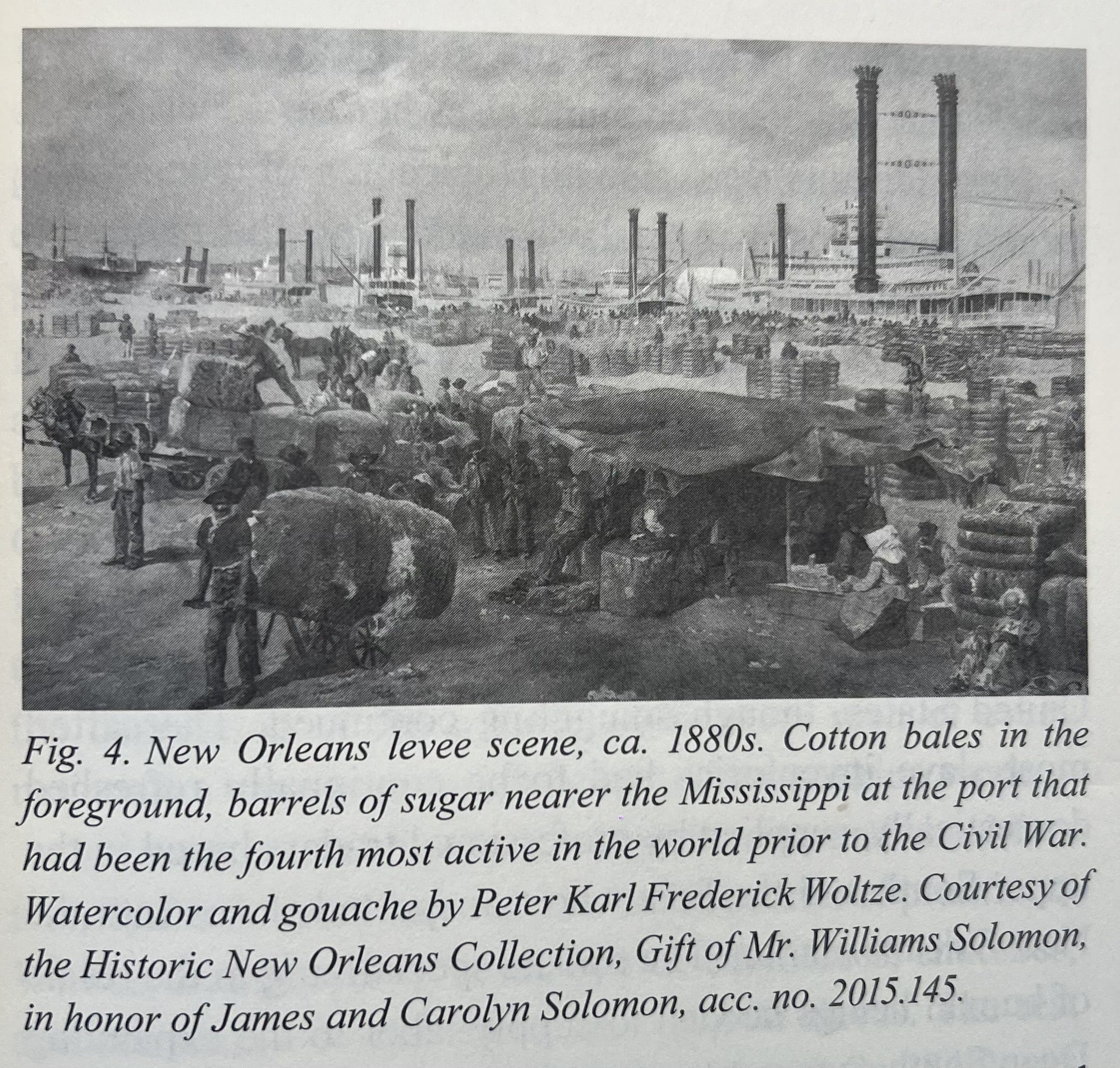
When Lion arrived, New Orleans was the most heterogenous city in the country. It teemed with denizens of every background, religion, and nationality—African, French, German, Spanish, Caribbean, and Native American. Long-standing ethnic and economic diversity had created an environment of religious and social tolerance for free people that was not to be found elsewhere in America.
“for free people” is a very important distinction here because New Orleans was also an epicenter of one of the largest slave markets in the nation.
The 20,000 or so free people of color, or gens de couleur libres, would fit into what Wolf is referring to around social tolerance. All is/was relative, of course. Not very straightforward to modern-day sensibilities, either –
New Orleans was home to more than a quarter of all the freemen and -women of color in the nation. Some were slave owners.
How the teenager fared.
Now, you must be asking yourself, “What in the world is a thirteen-year-old boy doing by himself in New Orleans in the late 1830s?” A city with a sub-tropical climate where diseases like yellow fever claimed the lives of roughly 2,000 people the year Lion arrived. What is he doing there?!
The answer: looking for Mr. Leopold Jonas. Originally from Lorraine, Jonas was a Jewish immigrant and wholesale merchant. Lion was probably acquainted with his family back in France. Jonas would have been a default mentorship option for Lion, who was in desperate need of acclimating sooner rather than later. It is suggested that Jonas encouraged Lion Godchot to change the spelling of his name to Leon Godchaux, “so that he would fit in with the dominant French community.” Note: I will use the latter spelling going forward. Wolf also suggests that Jonas taught him a bit of English.
Two critical points regarding Jonas and Godchaux –
Jonas taught him how to peddle goods, though Leon had some experience back in his Old World, and informed him of which countryside routes were best for selling his wares.
Jonas provided him with the most critical help of all: CREAM. Or as the French say, d’argent (MONEY!).
On point #2, we can understand that the prospect of help in this new land would also have been a driving factor behind Godchaux’s decision to choose New Orleans rather than somewhere else. And with the d’argent in hand, Godchaux had some fuel in his tank to begin enterprising.
If I recall correctly, the funds and goods – mirrors, combs, small household items, etc. – were mostly borrowed. But it seems Leon did well on his first runs and was able to repay Jonas. According to Walter Godchaux Jr. (Leon’s same grandson referenced earlier) –
He asked Mr. Jonas to send his profit to his mother in France…this established his credit. He got another pack and prospered and later was able to buy a mule and wagon.
With the mule and wagon, Godchaux was able to increase his territorial reach (countryside/places people weren’t willing to trek to). This, of course, expanded his clientele: plantation owners, small farmers, free Blacks, and enslaved people. You did not read that incorrectly: many plantation societies allowed enslaved people minimal participation in the economy within specified bounds, as a means of providing (1) an illusion of semi-independence, and (2) a means to reduce the amount of money/effort the plantation owner had to expend to provide resources to the enslaved.
Godchaux trudged along, making do –
For three years, Leon traveled the mud-caked tracks between the various plantations…living hand to mouth and at night spreading his breeding in barns and sheds…
Lion concentrated his territory in St. John the Baptist and St. James parishes, strung along the Mississippi, some 30 miles north of New Orleans. He was providing a critical service for this period of time –
In the rural South, especially before the Civil War, peddling created fertile opportunity because the population (White, Black, and everyone in between) was spread far apart and because transportation options were severely limited….Peddlers thrived in south Louisiana because they performed an essential service fulfilling a specialized need—goods delivered by door-to-door service…
Apparently, Godchaux would ask plantation owners for permission to visit slave quarters once he had completed displaying his new wares and delivering goods. In fact, one of Leon’s regular stops was at the plantation property owned by Jean-Baptiste Tassin and his wife, Clarisse. While he was likely making good money from the Tassins, there was also Thérèse, an enslaved woman who was spared field labor because –
Her job was to be clean, rested, and available whenever the master, exercising his droit de seigneur, sent for her.
What is droit de seigneur you ask? I asked the same thing, so this is for both of us –
…a feudal right said to have existed in medieval Europe giving the lord to whom it belonged the right to sleep the first night with the bride of any one of his vassals. – Brittanica
Fancy French way of saying sexual ownership. Same practice in every colonial society. This was merely the Francophone characterization. All the same exploitation in the end. Thérèse’s other job was caring for her son, Joachim, who was 8 years younger than Leon (14). Joachim was a six-year-old, light-complexioned child, which means –
[he] was surely the unacknowledged bastard son of Jean-Baptiste.
Wolf says that Godchaux developed a big-brother affection for Joachim and a platonic one for Thérèse. My spidey man senses are telling me that pubescent Leon had more than just a platonic affection for Thérèse, but how would I know, right? All of these characters are vitally important to the story. Stay tuned.
As it relates to Godchaux’s commercial prospects, the important takeaway is that he was honing his scope – relationships and territories. Exposure to rural life in Louisiana allowed him to be in proximity to sugarcane plantations, where “he became acquainted with storekeepers and the local laborers—both free and enslaved and some of them plantation overseers and their bosses to whom he sold goods.”
Moving on up.
True to form, Godchaux saved his coins and put them into the professionalization of his peddling. In 1840, at 16 years old, Leon opened a modest brick & mortar (general store) 40 miles northwest of New Orleans in a town called Convent.
But Godchaux was one to maximize his circumstances, so he still traveled/peddled part-time, despite the fixed base. Leon had good reason to make his rounds, given that “[h]e felt at home with Thérèse.” Wolf argues that it may have been “possible that Leon began a clandestine intimate relationship with his attractive friend.”

Back to the store. In a very forward-thinking manner, Leon used the operation as a warehouse as well, which helped him establish a wider consumer base (i.e., deeper inventory of stuff to sell since he had the room for it). Staying the course, Godchaux continued traveling from settlement to settlement, expanding his personal contacts, making friends with the up-and-coming children of plantation owners, merchants, local government representatives, tax collectors, notaries, sheriffs, etc. According to Wolf, these people would become vitally important to Leon later in life. What the modern-day corporate world dubs “growing up in the business (industry) together.”
Gotta hop over to the center of it all.
New Orleans, that is.
“It was the cosmopolitan city in the South…”
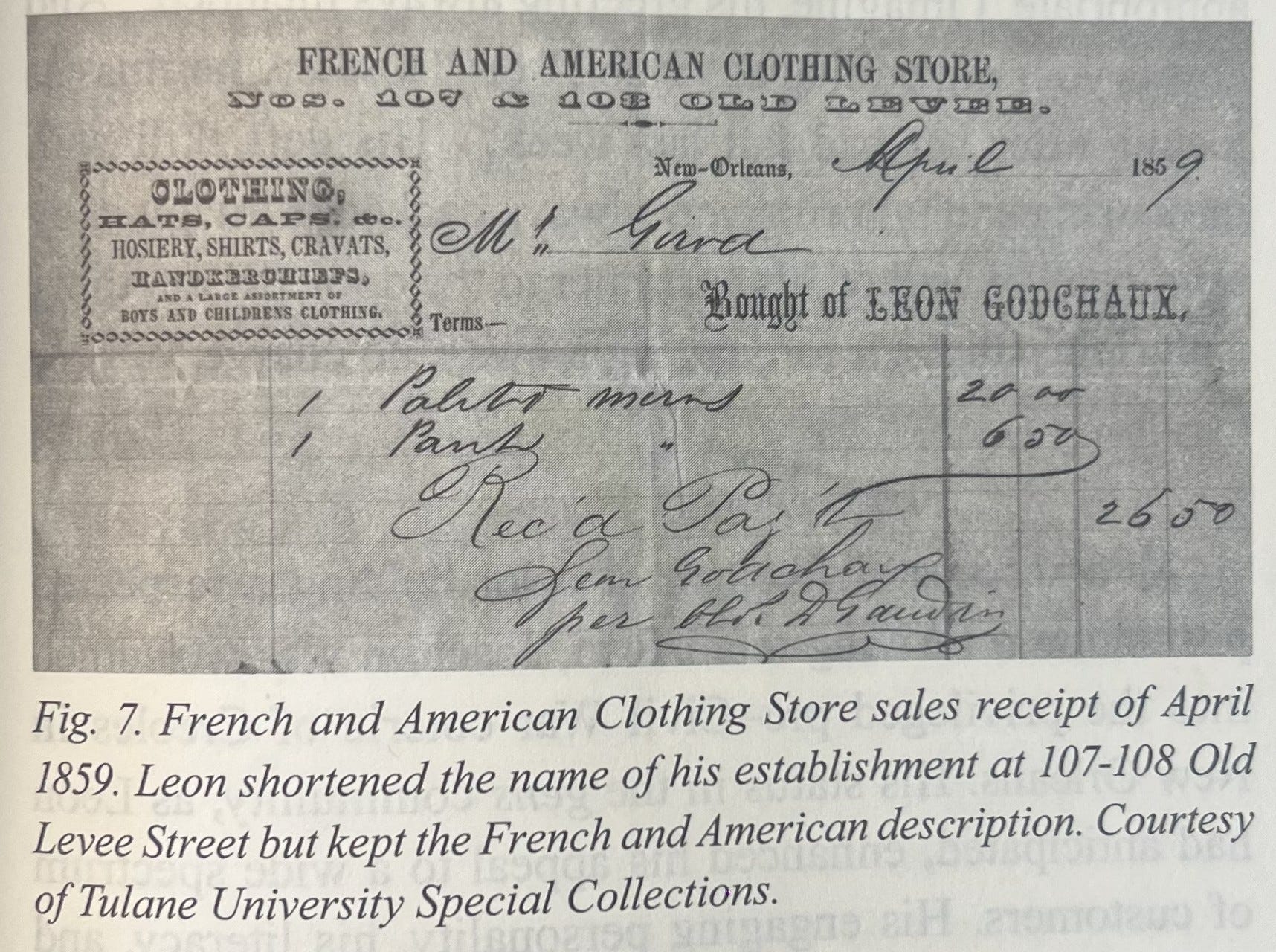
1844. A long recession was wrapping up. Real estate prices were depressed. A young Leon made a move he undoubtedly anticipated, but needed the market to shapeshift to his favor to execute. What exactly was his next move? Well, he got himself into a 2nd retail operation, leaping into the clothing business. His store was aptly named the French and American Clothing Store, reflecting “that both languages were routine” in and around New Orleans –
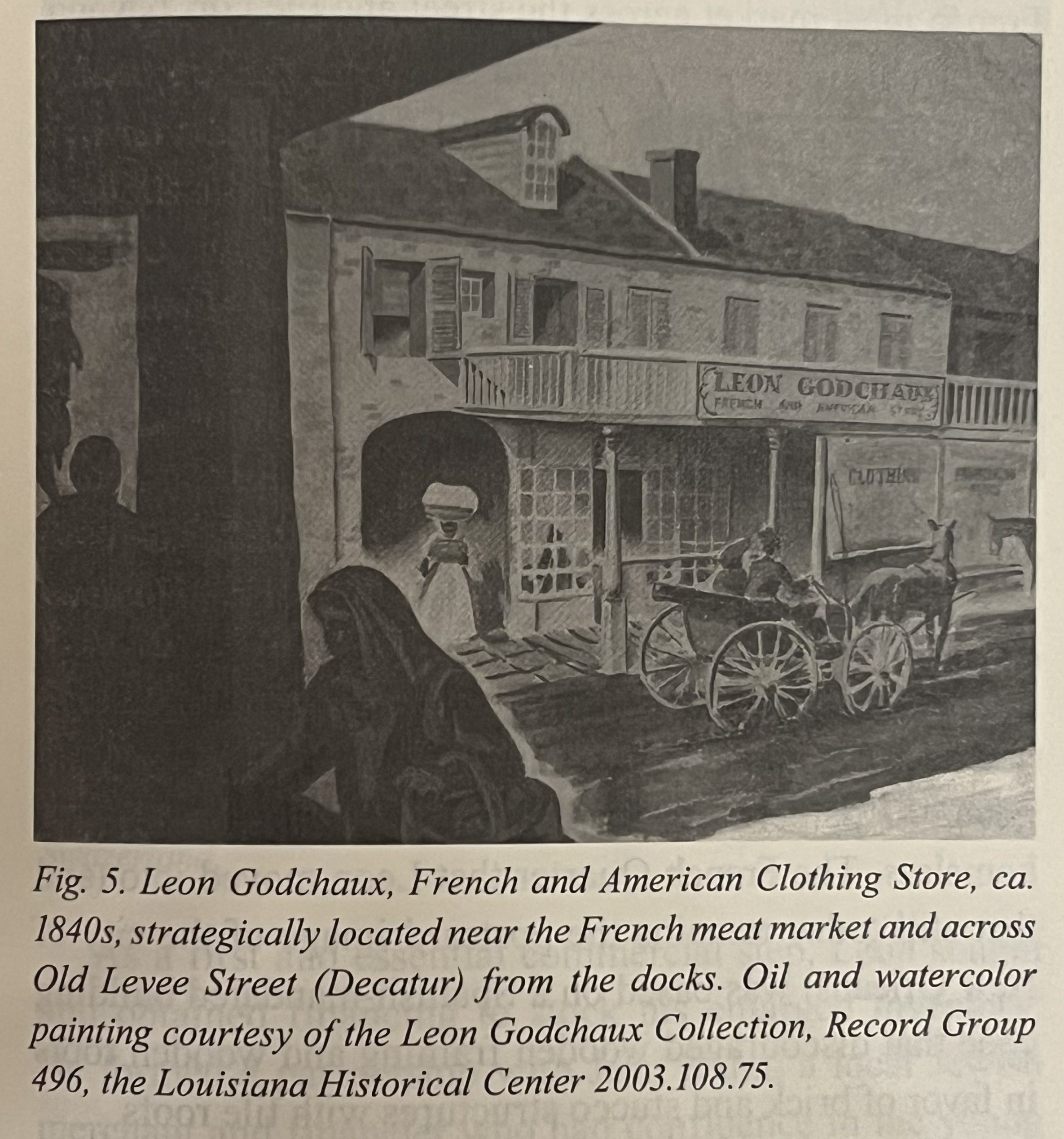
There was a lot of competition in the New Orleans clothing game. Everything from retail and wholesale merchants, many of whom were first-generation Jewish; in total, approximately 250 established Jewish businesses were operating in the town, half of them selling general merchandise, clothing, or dry goods. Godchaux had a community and examples to pull from.
What helped New Orleans maintain its economic reality as the commercial hub of the South was the steamboat innovation, which expedited the movement of goods to and from (e.g., the time from New Orleans to St. Louis was reduced from three months to 10 days).
Leon leased a store/location between the vibrant port of New Orleans and the densely populated French Quarter, which, at that time, was a combined retail and residential hub. He started out offering just men’s and boys’ clothing, focusing on a niche to gain competitive advantage/differentiate himself as a specialty clothier. To get a proper start, Godchaux found himself another Leopold Jonas –
As a first and essential commercial step, Leon sought and obtained financing to stock his enlarged inventory. He formed a perversion with Jean Hahn, a local Jewish merchant and financier who had confidence in the young man.
Hahn, a silent partner, handed him $3K. The money served not only to increase inventory, but also to open another clothing store. Leon continued to succeed, so he opened more stores. Godchaux sourced a lot of goods from the East Coast, NY(C) in particular. He began to also develop a contact rolodex of financiers/merchants from the east, as well as abroad.
In 1845, as business continued on the up-and-up, Leon brought his older brother, Mayer, over from France to join his operation. As a result of the newly blossomed family partnership, Leon renamed the company “Godchaux Frères.”
Explaining “His Creole Slave” in the title of the book.
Remember the plantation owned by Jean-Baptiste and Marie Clarisse “Russel” Tassin? The one where Joachim and his mother, Thérèse, were enslaved? Well, on November 3, 1849, that estate went on the auction block. As you probably guessed, Leon and Mayer made their way up to the plantation with the sole intention (per Wolf) to “claim the mixed-race eighteen-year-old slave known in the list of family assets simply as “Joachim.””
The brothers went to the St. John the Baptist Parish Office of notary, Charles Boudousquié, to present proof of the $1.7K funds available to purchase “the Creole mulatto aged about eighteen named Joachim.” Who provided the brothers with 100% of the money (loan) to finance the purchase? Hahn did.
Throughout the book, Wolf paints his great-great-grandfather as someone who detested slavery. Entirely. And without question. Wolf supposes that the conversation between Joachim and Leon, when Joachim was released to the brothers, was that Godchaux needed Joachim never to divulge his slave status to anyone, and that Leon would ensure Joachim was taken care of. To me, it felt a bit odd, then, to note “His Creole Slave” in the title of the book. That aside, this moral narrative feels a bit too…convenient.
The likelihood of someone coming from France, adapting to the ways of the South/Louisiana, especially in an attempt to build wealth, and be of the times, was less likely not to hold (or learn) discriminatory racial beliefs. Buying into the lucrative (but harsh) discriminatory mentality of the time was more likely to yield Godchaux wealth, unfortunately. The degree to which, that’s obviously something I can’t ever put a finger on. But if we are to take Wolf and his family at their word, then we have to believe that Godchaux held a completely clean resume on the topic of race/slavery.
A book I read about 3 months after The Sugar King called Reconstruction in the Cane Fields: From Slavery to Free Labor in Louisiana’s Sugar Parishes, 1862—1880, spoke to some of this skepticism I carried while reading Wolf’s book (emphasis mine) –
…Leon Godchaux typified southerners who had not owned slaves or plantations before the war…Godchaux, founder of the future sugar conglomerate, immigrated to New Orleans from France in the 1830s and became a merchant. He purchased his first plantation in 1862 and by century’s end owned twelve plantations that comprised more than thirty thousand acres. The upheaval of war gave men like…Godchaux, who possessed the talent and business acumen to succeed, entry into the planter class, something that had been denied them during the late antebellum period. As products of slave society, they undoubtedly harbored racial prejudices consistent with their backgrounds. Nonetheless, in addition to possessing the necessary financial resources they were also unhampered by the experience of having commanded slaves. – John C. Rodrigue
Two things can be true. Godchaux was unlikely to be blindly feudalistic in his mindset, especially given his socio-economic & religious background in France. But given the circumstance change (socio-economically) for Leon in Louisiana, it’s likely that his mentality shapeshifted as well. Remember, this is the Louisiana we’re talking about –
Before the end of the antebellum period…New Orleans became the largest slave market in America.
The slave market at Esplanade and Moreau, according to Erin Greenwald, an authority on New Orleans slave markets, was “a slave pen, with a showroom, like an auto dealership, and a yard where enslaved people would sleep, exercise and cook. These pens were basically jails. And the eating-well and physical activity was all so that the traders could sell their property—humans—at the highest possible profit.” The slave market business in New Orleans had swelled as the century [18th] matured.
All of the above aside, Wolf reminds us that Joachim was still a businessman, and commercial priorities remained top of mind. Part of the strategy for acquiring Joachim was so that he could attract the “affluent free Black and mixed-race customer base in New Orleans, a base that was still significant at around 10,000 residents, down from some 20,000 a decade earlier.” The reduction was caused by many fleeing the oppressive South to Mexico, the Caribbean, and up North. This would turn out to be a great investment for Leon: the “purported freeman of color” did well with that clientele once he began working for Godchaux in late 1849.
Pre-Civil War.
Leon Godchaux meets Justine Lamm, who is also from Lorraine, not too far from Herbéviller. She must have felt like home to Leon. Despite Rodrigue’s assertion that Godchaux did not own “slaves or plantations before the war,” Wolf shows that they purchased an enslaved person dedicated to house duties on February 19, 1851, three months before he and Lamm’s wedding; The pair would engage in a similar human purchase once Lamm became pregnant.
In legal proceedings before a notary, recorded in French, he purchased from Lucien and Augustine Arceneaux “une négress nomineé Francoise ageé d’environ cinquante” (a Negress about fifty years old called Francoise).”
On May 24, 1851, the pair married. One strategic, non-romantic benefit the author believes Justine provided to Leon was her ability to read, which made up for his (now) famed illiteracy.
Increasingly, Leon’s New York business interests/connections occupied his time and attention. And for good reason –
…in the 1850s, close to sixty thousand people were at work in the industry.
In addition to building his book of contacts and business, he began shielding his assets via NY enterprises. He had “funds on deposit in New York exchanged for silver and gold,” diversifying his assets. Wolf paints this in all too prescient way, given the gravity of what’s going to unfold in the next decade.
Regardless, Leon continued to ride out the retail wave, braving epidemics (yellow fever) and other economic hazards. In the late 1850s, he started a wholesale operation alongside his retail services. And at the end of 1857, he leased a string of five stores (instead of buying); Wolf claims that Leon remained cautious because of “the real possibility of a terrible war.”
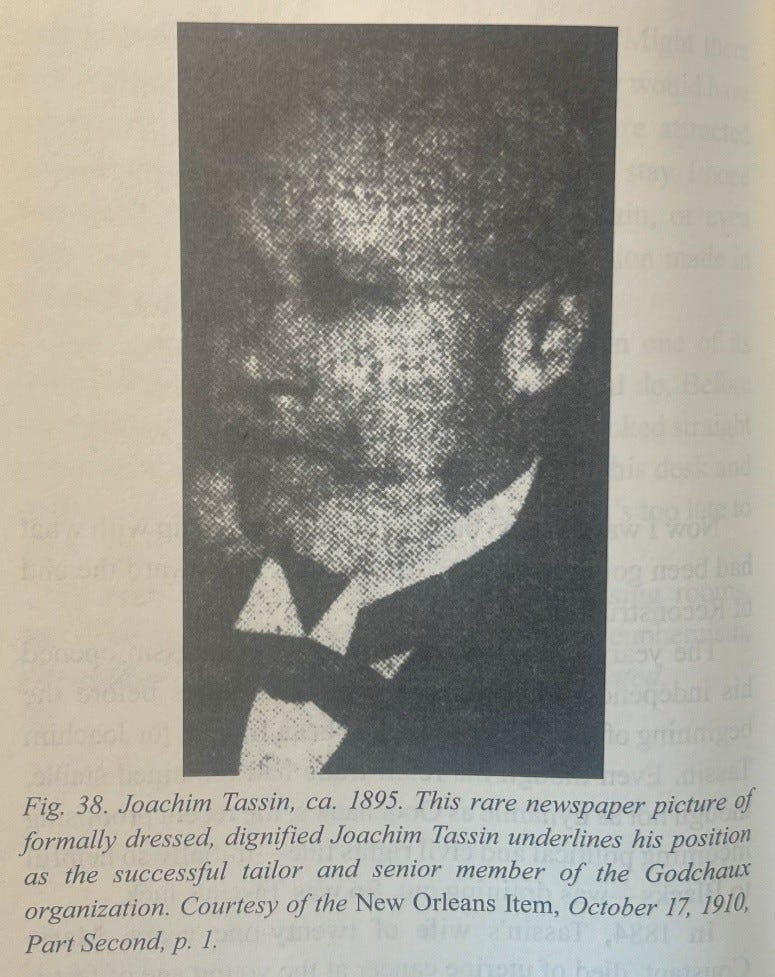
In this expansionary period, Leon grew to depend on Joachim Tassin, who rose to become a master tailor, star salesman, final voice on business matters, surrogate manager, etc. This was strategically beneficial for Godchaux’s expansion of his customer base because Tassin was accepted into the free Creole community as a member of the talented and successful free Black people of New Orleans.
Man, scratch that. Where is Thérèse?!

Well, I suppose that detail is no longer relevant because Leon is a married man.
Christmas, 1959. Leon takes the family to New York. He also exchanges most of his liquid funds into gold (i.e., out of New Orleans’ institutions). I suppose the prescient feeling holds some merit, or this was required of him if he were to maintain good standing in the New York business community. He set up shop at 171 Duane Street to replicate his work/living arrangements. Today’s Tribeca is where Leon opened his manufacturing operation, a business move that had been on his mind for some time.
He adjusted operations accordingly:
→ The New Orleans arm was dedicated to the wholesale and retail of clothing (named after Mayer).
→ The New York side of the business was dedicated to the manufacturing of clothing and named after Leon.
The brothers made this announcement to their New Orleans customers to assure them that things would continue as usual, despite their expanding operations. Enter a new era – M. GODCHAUX, FRERE & CO. (Louisiana) / L. GODCHAUX, FRERE & CO. (New York).
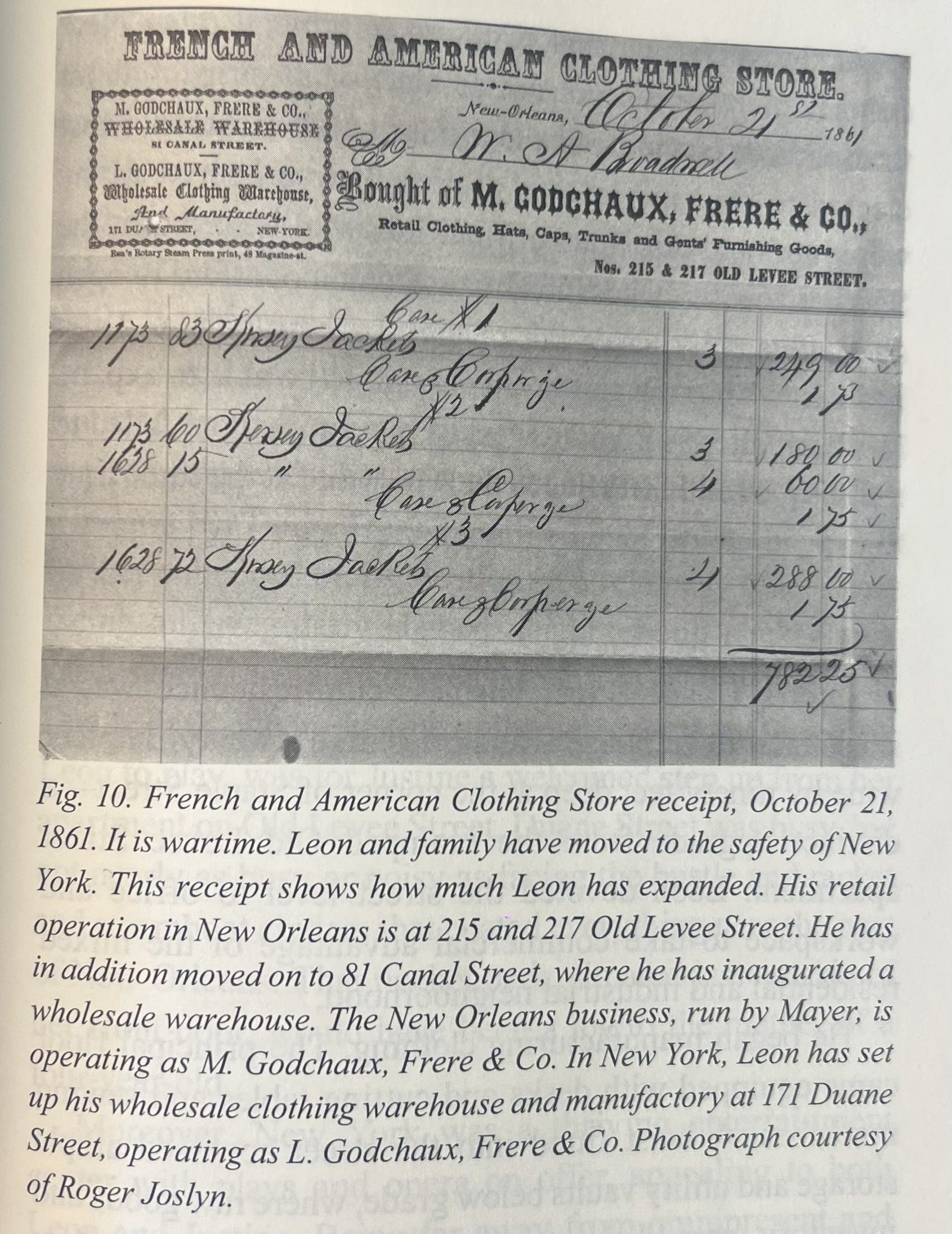
Someone always wins in tough times.
Spearheaded by Thomas Overton, a staunch secessionist governor, Louisiana voted for removal from the union — to join the confederacy — on January 26, 1861. Fast forward to the Battle of New Orleans on April 18, 1862: the city was captured without a fight. The white flag was hoisted –
On May 1, 1862, to escape destruction, the city sensibly acceded to occupation without military engagement.
We’ll engage the Civil War and Louisiana in more detail in later book reviews.
Eventually, Leon brought his family back from New York to New Orleans.
During the first half of 1862, while national turbulence prevailed, the Leon Godchaux family got reestablished in New Orleans and Leon severed his New York operations.
Ever the astute find-a-deal kind of guy, Leon, with Mayer’s oversight, purchased a building at 81 Canal Street, establishing (what would today be called) a fulfillment center. He was able to purchase the real estate because of depressed (“giveaway”), war-level prices. He continued down his real estate buying spree, acquiring two more buildings on Canal Street.
Godchaux also brought back a Singer sewing machine with him from the East Coast. Mayer eventually left the business to pursue real estate full-time, which is probably why Leon was able to find such good deals in the first place. And Mayer did well at his new venture. Not Leon, though. He was locked in. No more East Coast hugging. No more direct brother involvement. Just a man and his retail aspirations, for now.
Notably, however, Leon and Mayer made a speculative bet in 46,000 pounds of raw cotton (out in Woodville and Summit, Mississippi) at ten cents per pound. They were banking that, at the end of the war, prices would boost back up to 45 cents per pound (or higher). I would suggest that this bet was less speculative, especially for someone like Leon, because he was deep in the clothing business and knew a thing or two about cotton/material pricing anyhow. To be fair, the question marks were really around what would come of southern societies after the war.
What’s Joachim up to you ask? He marries another f.p.c. (Free Person of Color), Marie-Madeleine-Elene Coustat, on Aug 12, 1863.
We know the outcome of the Civil War. But what about Leon, his expanding family, and his enterprise in the post-Antebellum South?
I’ll tell you.
Prosperity continues, for Leon at least.
Leon’s financial prudence – rebalancing his wealth into gold/silver and not having any Confederate currency – served him well by the end of the Civil War; he was wealthy in a “profoundly devalued world.” So, what does he do with this wealth? Buys more real estate. This time, a family home on Esplanade Avenue, the stomping grounds of the French and Creole elite (St. Charles Avenue was characterized as the domain of the Anglo elite).
The home purchased in 1865 –
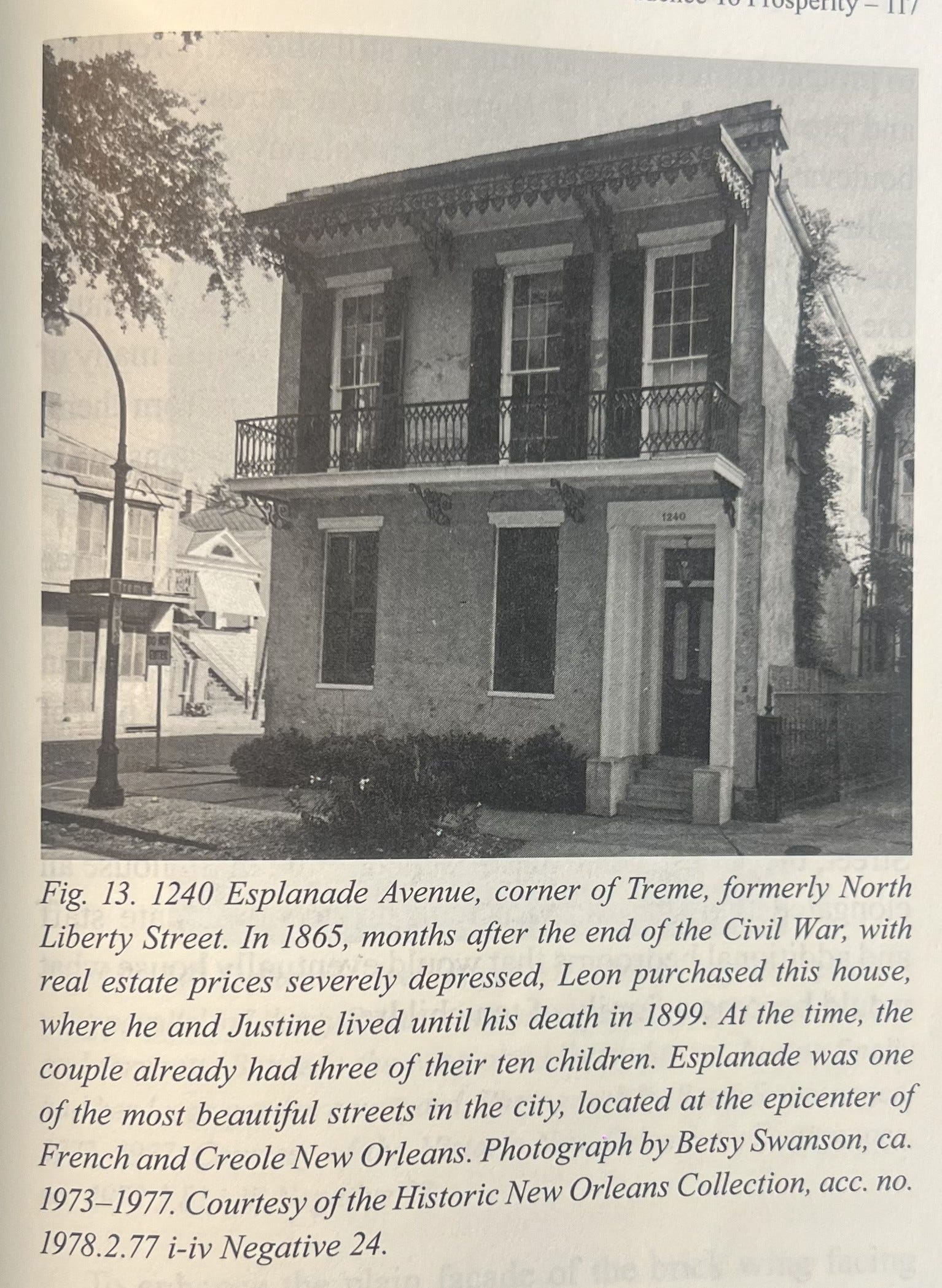
Leon and Justine lived at 1240 Esplanade for 34 years (until Leon’s death). If you’ve been reading this and wondering why the book is titled The Sugar King, rather than, I don’t know, The Retail King, that would be a valid concern. I mean, he did go on to have “the first general clothing-manufacturing enterprise based in New Orleans.” Affectionately known as the Leon Godchaux Clothing Company. But let’s march on over to cane land.
Pre-Civil War, sugar production levels had reached all-time highs (1861). But “marketing and distribution of refined sugar” became “practically impossible” once the North “blockade[d] the mouth of the Mississippi [River].” Many farmers, sitting on worthless land, and lenders, sitting on worthless credit (collateral, land, and other assets denominated in Confederate currency), needed some form of bailout. Apparently, many of these families were people Leon had peddled goods to two decades earlier (the children of plantation owners, etc.). Here is an example of Leon providing credit to a Creole family to prevent them from going into complete financial distress –
Leon spared Sophie Boudousquié the ignominy of foreclosure and bankruptcy. On May 28, 1866, along with a fifty-fifty partner, Francois Valcour Labarre, a member of a distinguished Creole family, Leon bought the…mortgage plus twelve other smaller mortgages that Sophie Boudousquié had outstanding. This refinancing amounted to a consolidation of notes owed to Godchaux and Labarre and others.
Wolf says that Sophie probably approached Leon pre-war to ask for help, and he would’ve denied assisting because her family’s enterprise depended on slave labor. However, after the emancipation, she would’ve approached him again at which point Godchaux would have said, “[y]es…now I can.”

Sophie was unable to manage the credit, and on “June 1, 1869, Leon purchased Reserve [Plantation],” hoisting Godchaux into the sugar business. One of his first orders of business was to completely mechanize the “backbreaking operation” that was still in place – hand-cut, manual loading into carts, pulling cane to the boiling house by mule – since the 1700s. Part of this improvement was the adoption of Norbert Rillieux’s transformational invention in sugar refining (“the multiple effect evaporator”).
Leon was not only operating with good cash flow (from his retail business and now the sugar business), but he was also competing with people who were financially reeling from the Civil War’s consequences. Simply put, those former/existing plantation owners could not compete. The new Northern entrants, now that’s a different story (and for a different piece altogether). More cane plantation prosperity for Leon meant more ‘good problems to have,’ but conundrums that ultimately needed solving –
The factory at Reserve was so efficient that it was capable of handling more cane than grown on the place. Leon was suddenly able to process cane grown at nearby plantations.
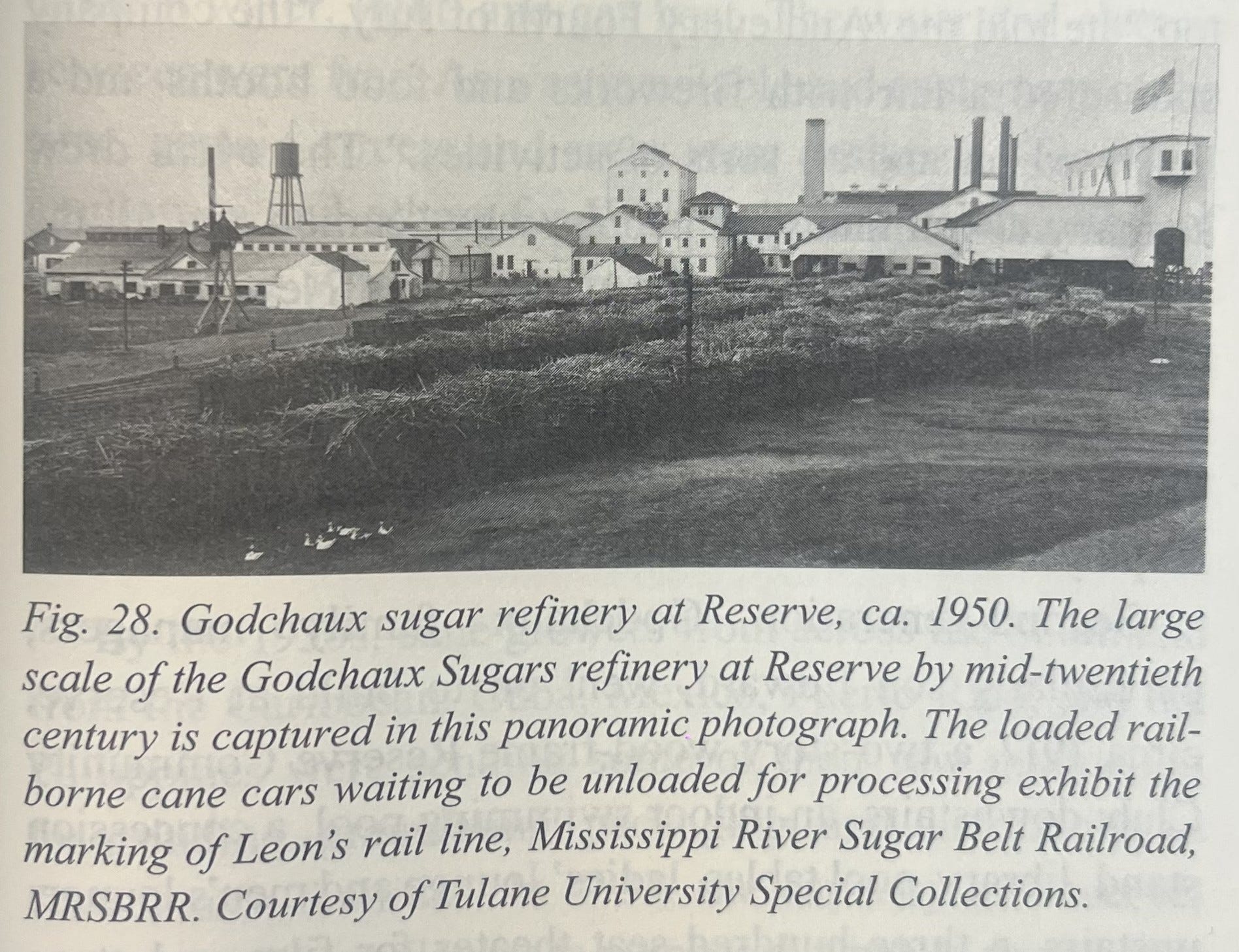
So, what did he do? Began acquiring as many properties as possible near existing holdings. And with that, Leon became central to a process of cane cultivation familiar to those in Louisiana: the centralized factory (sugar mill) where individual farmers bring their cane for processing into sugar.
…Godchaux created the centralized factory whereby one efficient mill would service the cane production of several plantations rather than…each individual plantation undertaking its own manufacturing.
Note: I don’t know if Godchaux “created the centralized factory,” or popularized it. Here’s a view of where things stand today: American Sugar Cane League x Raw Sugar Factories. If you want a good show to watch that touches on the sugar factory centralization dynamic, watch this –
Godchaux’s operation eventually transitioned into end-state packaging of the refined sugar, ready for retail and wholesale distribution. He was having so much success that he closed sugar mills on his other plantations near Reserve, while expanding cane-growing capacity. Ultimately, he consolidated all 14 of his plantations into 3 manufacturing districts (again, centralization).
The plantations he owned were Reserve, Star, Diamond, LaPlace, LaBranche, Belle Pointe, New Era, Cornland, Elm Hall, Utopia, Upper Ten, Mary, Madewood, Foley, and Greater Raceland. All fourteen properties comprised 72,000 acres (10,000 of which were sugarcane fields). That’s an immense amount of acreage.
Safe to say, the man didn’t slow down. No reason to cut this momentum and clear advantage –
In St. James Parish alone, between 1875 and 1881, Leon bought land in nineteen separate transactions.
His land in the countryside was composed of deep nutritious soil deposited over the ages by the river floods. He bought what later-day agronomists would call class 1 agricultural soils, the most productive and rarest cropland in America.
Wolf understandably lobs some high praise over to his great-great-grandfather for his stature and reputation in the history of Louisiana’s sugar industry –
Leon Godchaux is universally credited with transforming what had been, worldwide, an antiquated and piecemeal industry saddled with disorganization, decentralization, and primitive refining methods. He pioneered the transformation of sugar processing into an agricultural-industrial hybrid…The age-old way that sugar had been produced—a separate sugarhouse on every plantation, each separate and discrete in all its processes and equipment—was on the way out by the time Leon Godchaux retired.
But we must remember, sugar cane is a crop that bends man to its whims, not the other way around. That is to say, Leon operated a business that was oppressively labor-intensive for those in its employ. Hard labor can be honest, to be clear, really all depends on who is running the show –
“As they work an overseer watches them, and a timekeeper goes along beside them and sees that every man and every woman is at work. The wages are very low. They get from 60 cents to $1 a day, according to their skill and are boarded on the plantation. They sleep in cabins, several of them lying on the floor and getting their rest as best they can. The hours are from daylight until dark, and there are few stops.” Frank G. Carpenter on Leon Godchaux’s sugar plantations, Los Angeles Times, x 1896
Eventually, a man’s time must come to an end.
“The Duke of Clothing” was also The Sugar King. What a life. He had worked hard and cemented himself, brick by brick, and eventually cane seed by cane seed (or takeover by takeover, however you want to look at it). He augmented the cane business through his children’s academic/professional training by expanding rail access for his operations. This expansion helped with the continued shipment of the finished sugar. But also, he was feeding himself in the process –
…a whole new set of customers could transport cane conveniently and cheaply to the Godchaux mills.
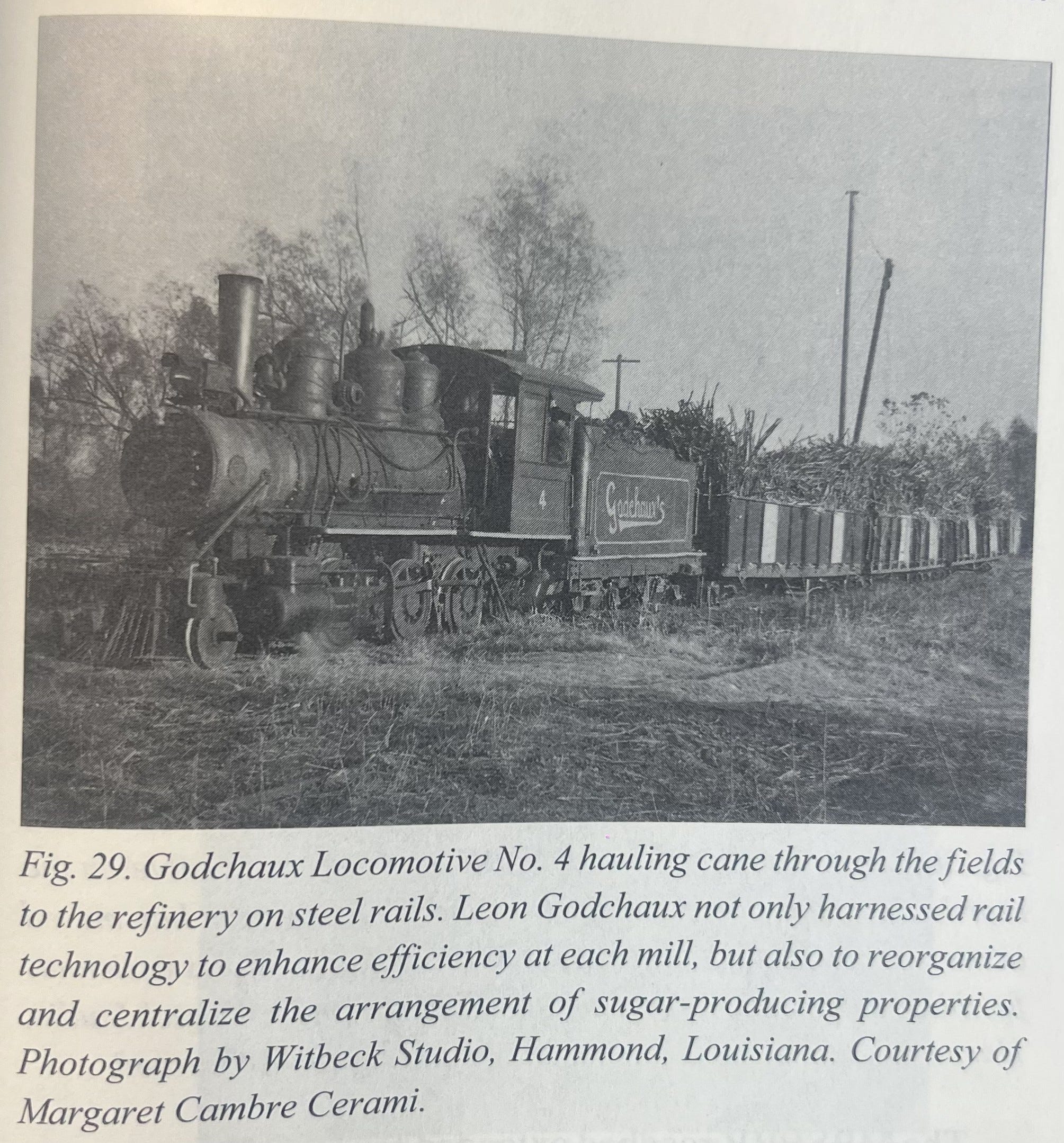
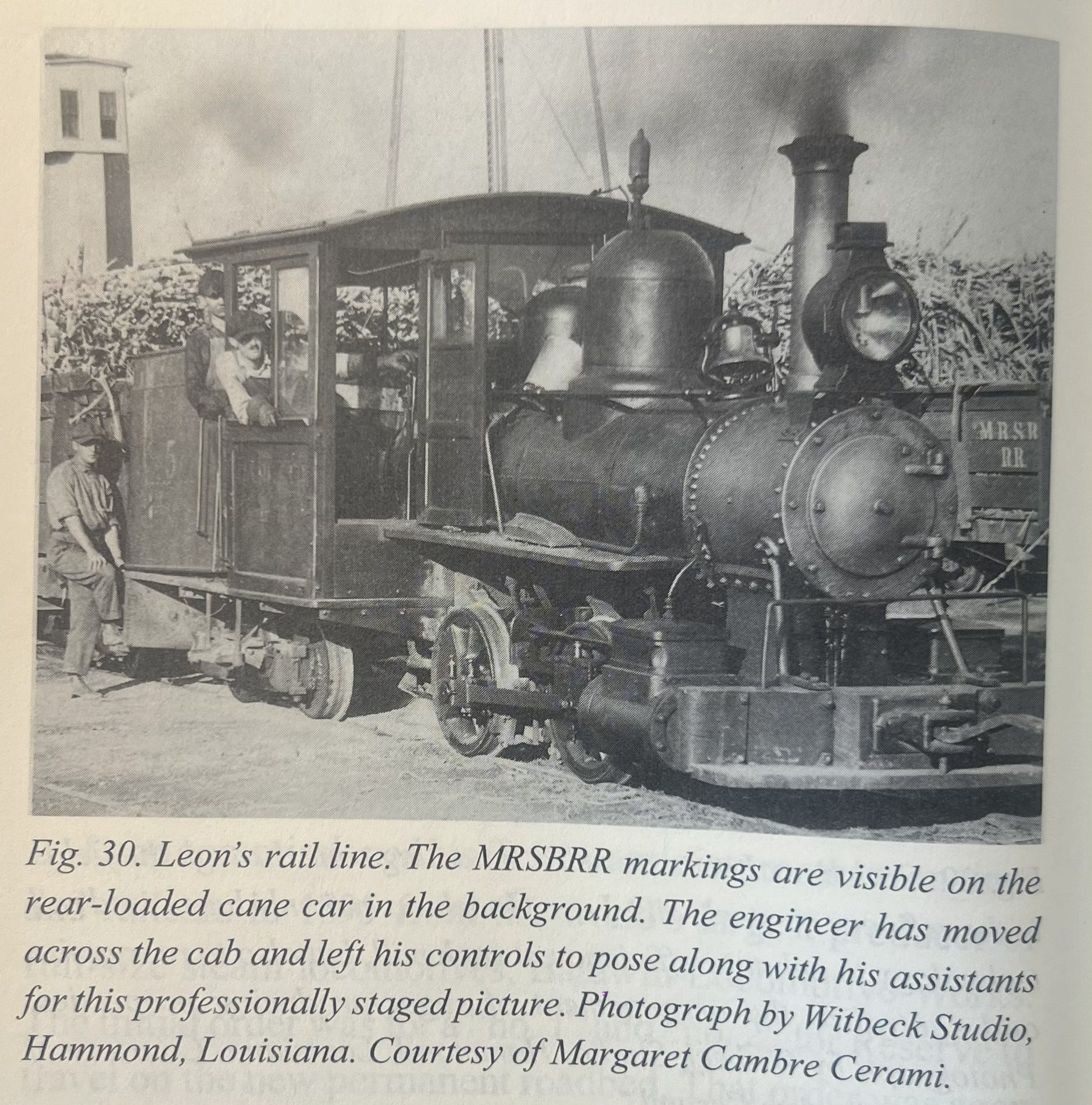
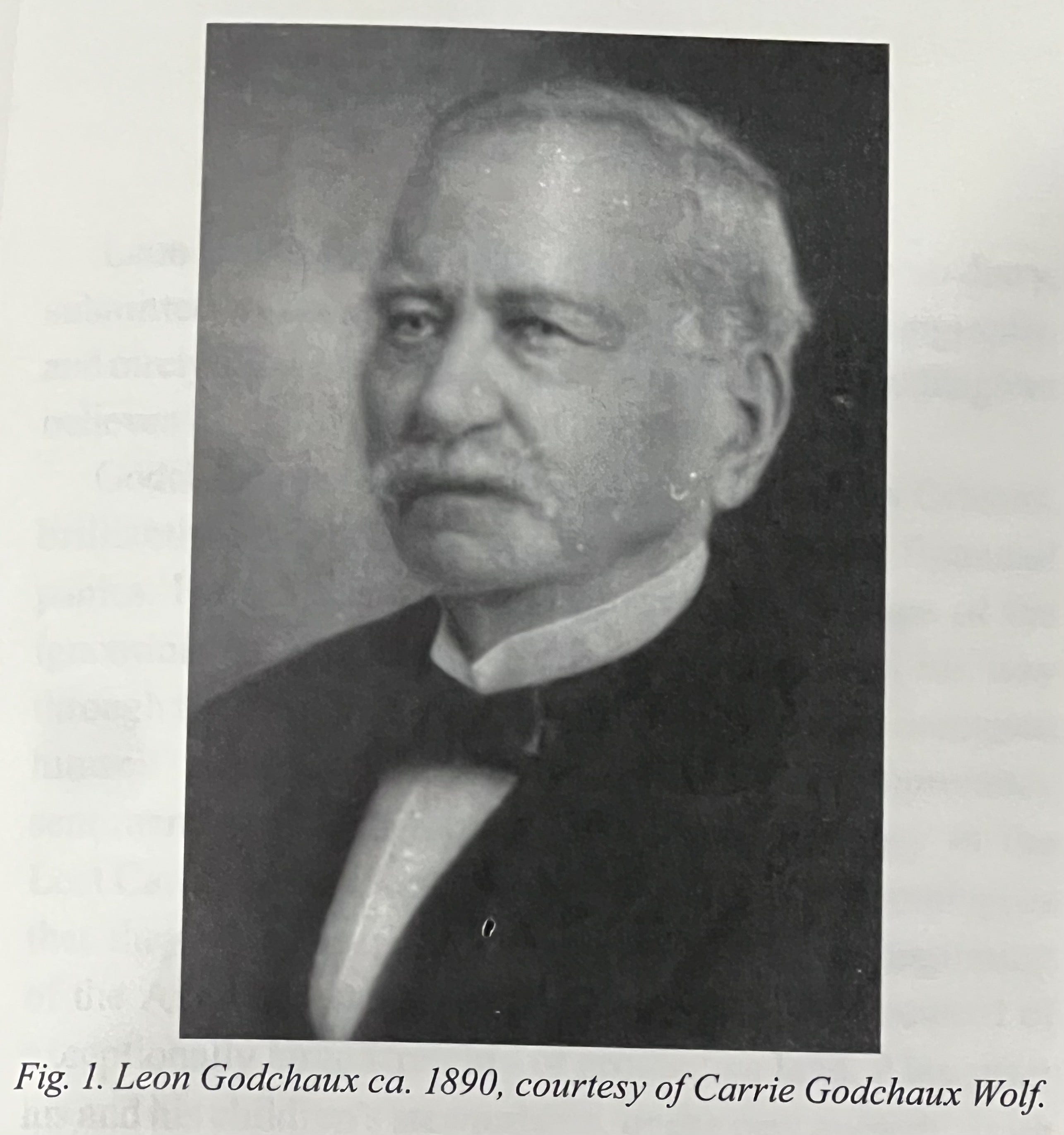
As age and time took over, as they are guaranteed to do, Leon ensured that his sons were trained and that business know-how was passed. His daughters were largely excluded from the ‘you will run the business when I’m gone’ conversations. However, they received “equal shares in his financial legacy. That is how it was—then.” Godchaux, firmly wealthy as we approach the 20th century, also leaned into charity/philanthropy. Unfortunately, Leon would not see the 1900s: he passed away at the age of 75, on May 17, 1899, in his home.
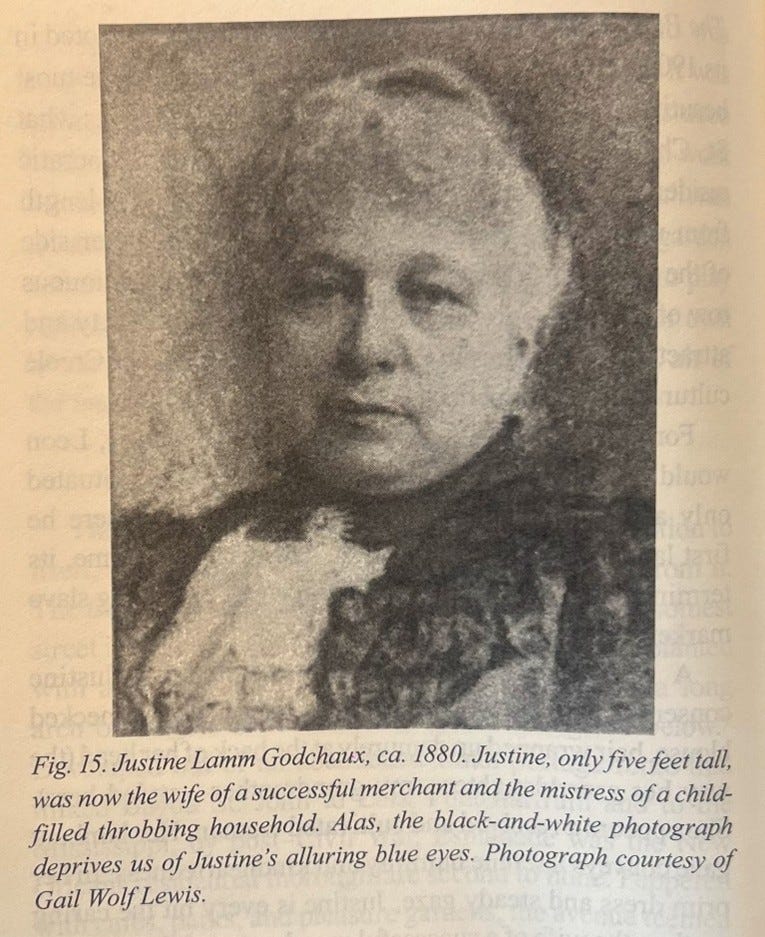
His beloved, Justine, died in 1906 and was buried next to him. Their passing represented “the end of the first generation of the Leon Godchaux family in New Orleans.”
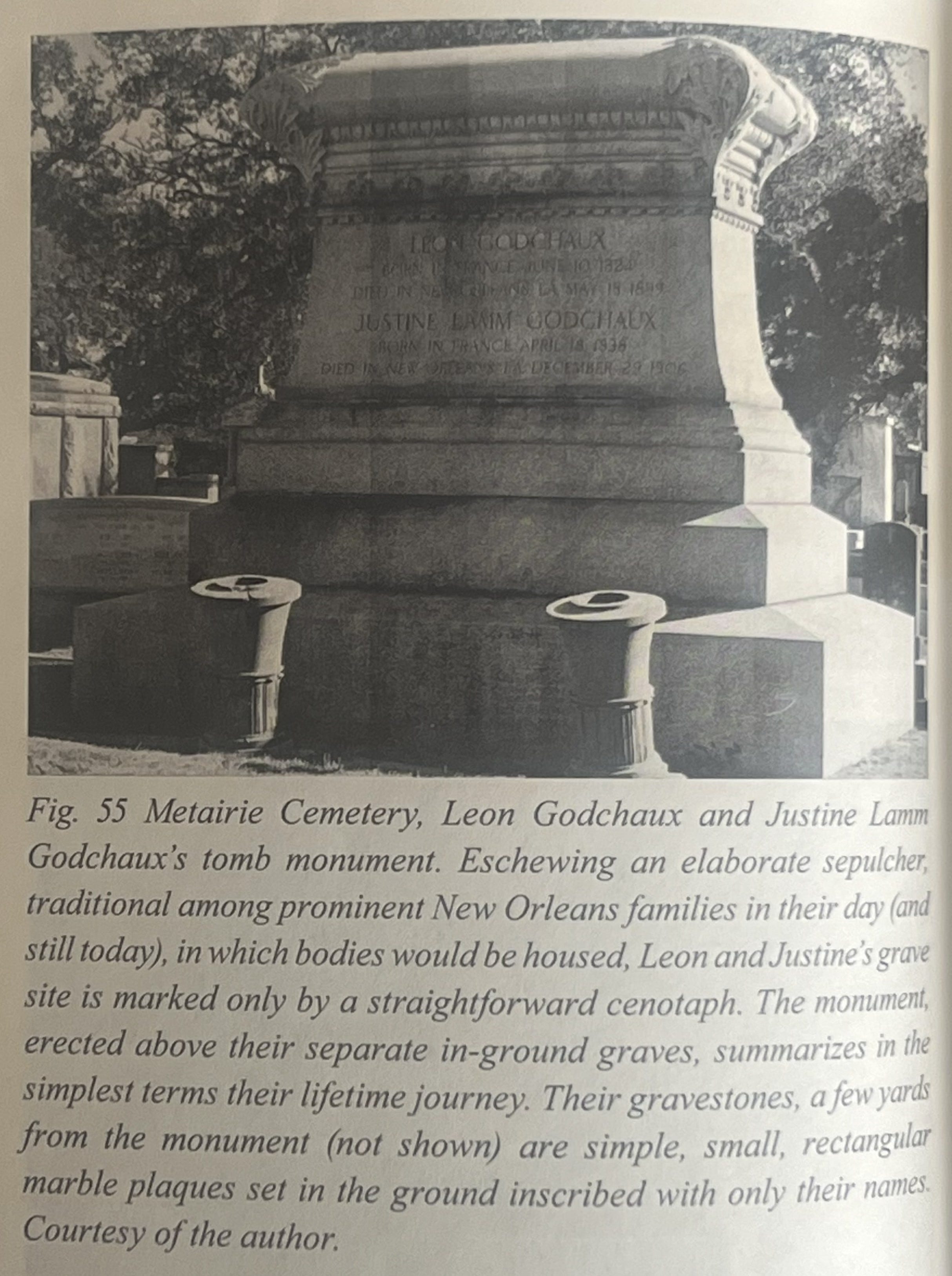
Au revoir.
I usually take us to the end of the text, but I think it’s worth leaving you wanting. In other words, go grab yourself a copy of the book. Some juicy tidbits I’ve left out of this piece (a preview):
Joachim Tassin broke off from Leon (amicably, apparently) to open his own store, which unfortunately succumbed to “a disastrous fire” in August 1865; Tassin was welcomed back to work with Leon at Godchaux’s continued growing retail enterprise.
The Godchaux store became a full-service department store (men, women, and children), though they eventually shut down the manufacturing division; 1940, the store celebrated its 100th anniversary.
The business went bankrupt in the late 1980s.
A business saga familiar to those in family enterprises that grow to a certain size, and surpass a specific number of generations (i.e., who controls what, who deserves what, etc.).
I’ll say this, Wolf, understandably, is not pleased with how this all played out –
Leon’s notorious humility combined with his third-and fourth-generation successor’s inability, have left nothing except the Godchaux-Reserve House as a tangible vestige of Leon Godchaux’s vast and multifarious achievements. Within a hundred years of Leon’s death, his retail stores, his clothing manufacturing operation, his extensive country properties, and the sugar refiners are no longer. Like a whiff of the sweet scent of night-blooming jasmine upon the morning breeze, they are gone.
Kudos to the author for the undertaking.
There you have it.