



This, like a prior rum article, is a two-for-one and will be more condensed compared to previous releases. I know, I know – you really enjoy reading those 20 – 30-minute pieces, right?

We will stick to the timeline by picking up from Reconstruction in the Cane Fields. Still Louisiana, but this time, and I’m not much of a betting man, I’m willing to wager that we are venturing into new historical territories for most. At least it was to me. If you are from Louisiana, then you may already be familiar with what I will cover. On to diving deeper into a region of the country, and world for that matter, that truly is “a place unto itself.”
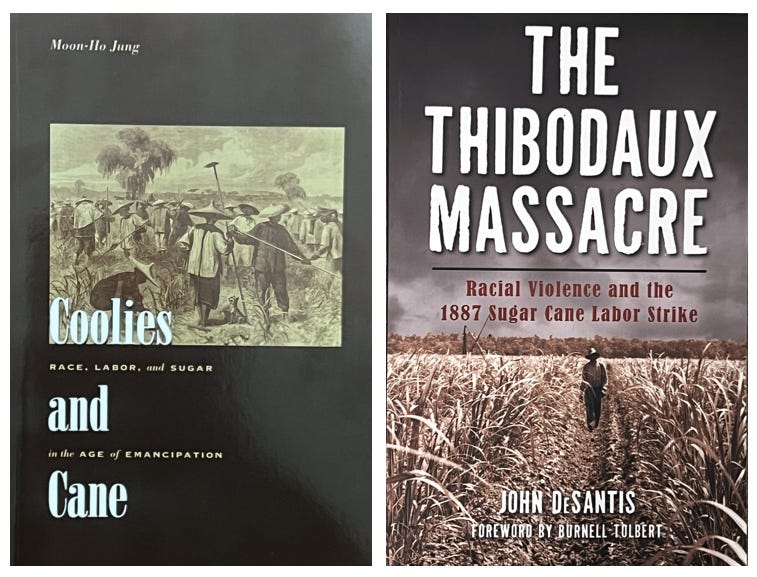
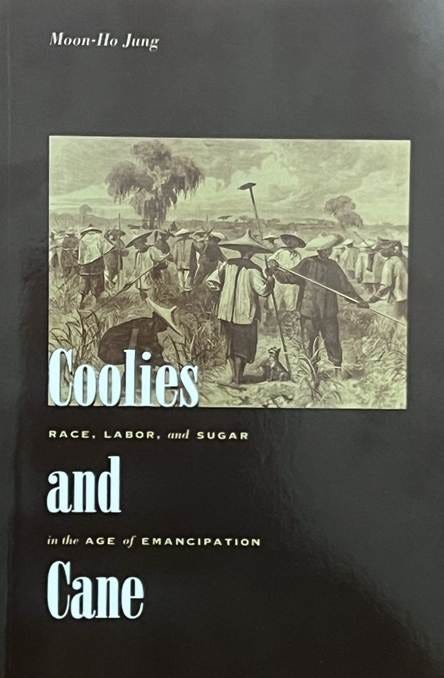
Coolies and Cane: Race, Labor, and Sugar in the Age of Emancipation.
In my last piece, I touched on the importation of Chinese labor following Emancipation ever so slightly. And while that is a natural place to pick up from, I’m urged, for personal reasons, to start with the etymology of the word “coolie[s].”
Cultural detour (still relevant).
Everyone in the Caribbean (English-speaking in particular) knows the word “coolie.” My side – Jamaicans – volley the word around in everyday speech quite loosely and amicably. From describing (i) an actual person of East Indian heritage, (ii) the texture of someone’s hair, or even (iii) a riddim, Jamaicans generally view the word in a harmless, playful, descriptive manner, or some combination of the above. Note: this is an overgeneralization + you will die on a tall hill trying to get Jamaicans to use “appropriate” terms to describe people, places, and things. On (iii), I wasn’t joking. One of the hardest riddims to come out of Jamaica is literally called “Coolie Dance Riddim” –
Etymologically, however, the word has a much more layered history (emphasis mine) –
“As they prepared the rigging, I heard the ship’s men call us “coolies” from the Tamil word kuli – the payments made to the poorest of us for manual work in India.” – Shanti (a main character in Joanne Joseph’s Children of Sugarcane)
Amazing (historical) novel that I read at the end of 2025, covering Indian indentured labor on plantations in British-controlled Port Natal/Durban, South Africa, in the 19th century. Quick clarification: “kuli” refers to the payments, not the laborer themselves (i.e., it would be akin to referring to a group of people as “minimum wage”).
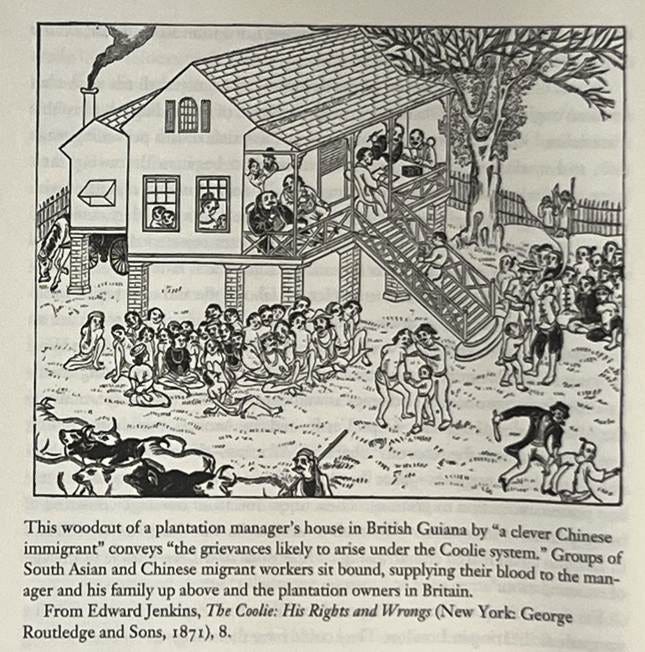
And with that, let’s hop over to our friends in the Lesser Antilles and broader CARICOM region. I know that if I am around friends who are of Guyanese or Trinidadian heritage, islands with significantly higher Indo-Caribbean populations (e.g., Guyana’s Indo-heritage is nearly half the population, and probably more if we include mixed-heritage Guyanese), the word “coolie” does not go over well. In short, it’s a very charged slur, which we can understand why, given the history underpinning the word’s usage.
But also, what actually took place. Memories of groups such as the “Gladstone coolies,” Indians who faced the worst of conditions in modern-day Guyana, many of whom died or elected to return to India, linger in the soil and memory of the people. The word weighs significantly on the psyche of a people when this is the history to contend with. Note: “Gladstone” is the last name of the British plantation owner who brought the Indians to British-controlled “Guiana.”
With that personal story, mini history lesson, and socio-cultural context in mind, let’s end the detour here.
Back to Coolies and Cane.
The “coolies” that Moon-Ho Jung is concerned with are Chinese laborers who were “imported” to southern Louisiana following Emancipation – the plantation owners’ attempt to solve what they deemed was a labor problem. Sinners make a bit more sense now? Showcasing Chinese people with thick southern/Louisiana accents is historically accurate, if you were curious.
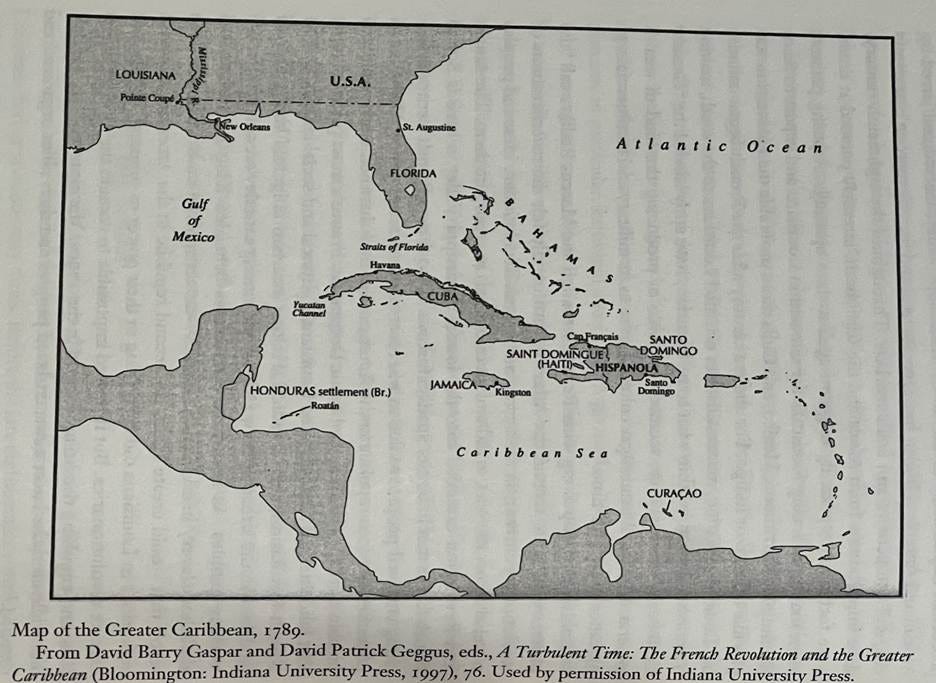
This importation of labor was, yet again, another page taken right out of the Caribbean (i.e., fellow sugarcane countries’) playbook. However, Louisianians did not have to look to Trinidad or Guyana. Cuba was notorious for their Chinese labor importation: 1847 – 1874, almost 125,000 Chinese people landed in Cuba for work, showcasing slavery and indentured labor working side by side on the island. In many cases, Chinese labor would leave Cuba after a stretch of work for higher wage prospects in the Pelican State. In truth, this was a strategically competitive move on the part of Louisiana planters, who pursued every outlet to reduce Cuba’s importance on the world’s sugar stage. Louisiana planters offered $15 to $18 per month compared to 4 pesos per month offered by the Cubans. As you can imagine, many Chinese jumped at the opportunity –
A New Orleans newspaper soon announced that “a dozen fullblooded Coolies” had arrived from Cuba, under contract to work in Louisiana.
“There seems to be a rage at this time for speculating in Chinese…the trade, which gives enormous profits, is engaging the attention of the first commercial houses and largest capitalists of this city…Chinese are coming in fast; and…these laborers are, on some plantations, treated no better and even worse than negro slaves…For my part, I assure you that I regret very much to see vessels under our flag engaged in such a traffic.” — U.S. consul in Havana, 1855
In Louisiana, the “Chinese cooly contract system” was viewed crudely and directly as a business, despite the human costs, not much different than the previous trade in people of African descent –
…the remaining 150 or so slaves left the plantation…Within eight years, Boston investors would purchase [Laurent Millaudon’s] estate for merely $175,000 and recruit more than 140 Chinese migrant laborers.
John S. Thrasher, a resident of Cuba and Louisiana and a leading filibuster before the war, argued in the summer of 1865 that the “advantages of Coolie contract labor” had “been abundantly demonstrated in Cuba” and ought to initiate “a combined effort” by “our responsible planters” to invest in a similar project.
There were labor recruiting firms, such as the “Arkansas River Valley Immigration Company,” and shipping entities like the “Oriental Steamship Company,” who did the legwork of finding/importing laborers on behalf of the plantation owners. There were also major meetings & conferences geared toward the Chinese labor question, such as the June 30, 1869, meeting of the “Memphis Chamber of Commerce.” Despite the significant costs and subsequent failures associated with experimenting in the Chinese labor trade, the planters pressed on. They were determined to prove to the formerly enslaved that they could be replaced, and that their newfound political empowerment would fall apart without consistent income –
“Some happy medium may be struck, and the only medium between forced and voluntary labor, is that offered by the introduction of Orientals.” – New York Times (19th Century)
“…the Coolie competition will bring the niggers to their senses.” – John Burnside to Edward J. Gay
Unsurprisingly, primarily the elite planters (e.g., Edward J. Gay) could afford to absorb the losses associated with hiring the “runners” sourcing the Chinese labor. In the long run, the Chinese would follow the same patterns as previous laborers of all stripes: overworked, mistreated, and discontented, they would initiate strikes or take more extreme measures, such as deserting plantations entirely. The plantation owners desired as close a return to chattel slavery as possible by using this new immigrant element, which they believed would challenge the Black population’s place in society. The planter’s aspirations did not bear fruit –
The bitter interracial rivalry imagined by coolie promoters never took root in Louisiana.
We can add this labor-substitution scheme to the tall pile of failures during the Reconstruction Era. The last thing to note is that many rallied against the importation of Chinese labor and, really, against anything they felt was pro-planter policy, given the tension between North and South following the war. Ultimately, anti-Chinese labor advocates indicated that it was an affront to America to behave like the West Indians to resolve labor issues. This was not the industrial, free-market representation of American business that the anti-Chinese labor side believed in.
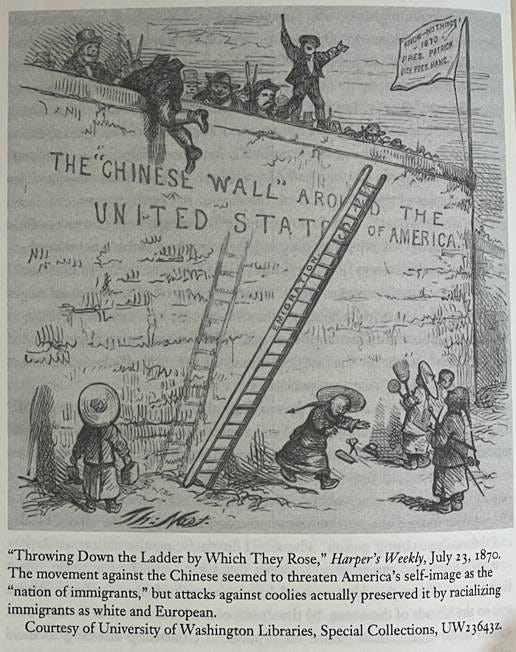
So, ultimately, who were America’s “coolies” and what did they mean for the nation?
They [coolies] remained an enigma, a cultural figure identified with the past (slavery) and increasingly with the future (industrial capitalism and free trade). Were they slaves or immigrants, black or white, an asset or a deficit to America’s progress? In an industrializing and expanding nation trying to recover from a devastating war, they were all those things and much more.
Culturally and socially, the term “coolie”, not being remotely relevant to the modern-day American reality, speech, and psyche, is telling. Before we flip the page to another book & chapter, the author, Moon-Ho Jung –

“I learned to think critically and engage politically—this is, I woke up and grew up—at Cornell University.
P.S. – Below is an interesting article highlighting the development of the Japanese population in Brazil. Today, the largest diaspora of Japanese is in the South American nation. Although the author does not point directly to “cooliesm” as an industry and prevailing outlet, it does not require too much brainpower to realize that the Brazilians’ reach for Asia’s sons (primarily) was of the same flavor as the Louisianians –

Author: Cailian Savage
…in 1888, Brazil became the last country in the Americas to abolish slavery. Good news for humanity, very bad news for the coffee and sugar barons, who suddenly had to start paying their workers.
Simply moving on from these industries, especially coffee, was not feasible: Brazil produced ~75% of the world’s coffee, and coffee made up half of Brazil’s exports. But few of the former slaves had any desire to stay on the plantations, so where would you find the workers?
Like many countries in the Americas, Brazilian elites responded to the end of slavery by pursuing a goal of “racial whitening”, i.e importing large numbers of Europeans to “dilute” the black population.
Struggling to recruit Europeans in the desired numbers, Brazilian elites turned instead to Japan.
The Thibodaux Massacre: Racial Violence and the 1887 Sugar Cane Labor Strike.
Almost every book on Louisiana I’ve come across that explores cane country in the 19th century makes a cursory mention of the Thibodaux Massacre. Some do indeed call it a massacre. Some call it a war. Others call it an uprising. Each label nudges me squarely into an author’s mindset. What feels somewhat clear to me regarding the historical tragedy is that, for locals, the events of 1887 may be something that people are hush-hush about.
The terror instilled from the time of the strike, as well as the decades and centuries before, is still evidenced through the loud sound of silence.
I don’t have personal, confirmatory evidence of this; just my suspicion given the gravity of the event. Most would say that this slice of history is very specific. You would be well within your rights to ask me how I even landed here. Well, here’s how.
Queen Sugar.
A main character of the show, Nova Bordelon, after discovering bones on the family land, emotionally recalls and verbalizes that the discovery is linked to the Thibodaux Massacre. I watched this in 2024 (maybe early 2025 at the latest), so I cannot recall the season/episode or much of the details beyond what I outlined. There are a lot of seasons & episodes, each worth watching (to be clear).
As someone interested in history, and increasingly Louisiana’s, Nova’s new-to-me highlight stuck. Voilà, a book was thereafter procured because I had to make sense of what was clearly a deeply painful connection of dots for the fictitious Bordelon family.
Back to The Thibodaux Massacre.
Interestingly, the “incident” was never investigated. It was an “ancillary inquiry” by Jack Conrad, a formerly enslaved person and veteran of the U.S. Colored Troops (Civil War), that opened the floodgates to detailed accounts of what happened in 1887. Before we leap ahead, let’s rewind the clock to the year 1887 –
Bleeding from his chest and right arm, Jack Conrad squeezed himself under the simple wood-frame house on St. Michael Street as members of the mob, maybe fifty strong, kept on firing, clouding the air with acrid smoke. “I am innocent!” the fifty-three-year-old veteran called out, protesting that he had nothing to do with the strike of sugar laborers, nominally the cause of the violence. He pressed his chest against the cold ground and felt hot blood pooling beneath him. Another ball ripped through Conrad’s flesh, and he pushed his face against the earth and weeds. – November 23, 1887, 7:00am
Conrad ended up playing dead. Jack’s wounds became the aforementioned “ancillary inquiry,” leading us to what happened that day in 1887.
In 1890, Congress passed a law that allowed Civil War veterans to file for pensions if they could not work, even if their injuries were not related to the war so long as they came about through no fault of the veteran…The Conrad files confirmed the killing and wounding of innocent people on the basis of race in an atmosphere poisoned by concepts of white superiority and panic fed by rumors, as well as a resulting breakdown of law and humanity.
Let’s explore what led to the events described above.
The author does a good job of providing historical context/grounding – the expansiveness of the cane country, the original inhabitants of the state, conflict in early Louisiana societies, the Civil War, Reconstruction, etc. – in the decades preceding 1887. Grounding the reader in this context is helpful for sensemaking of the events leading up to the month-long strike of Black sugarcane workers (pre-massacre).
Any Union intervention in the South was, understandably, met with animosity by the White population, notwithstanding the very overt military occupation during Reconstruction, which ended about 1877 (i.e., withdrawal of federal troops after the Compromise). So, when Northern labor unions grew influential among southern Louisiana’s labor force, you can imagine how it was received by those who identified with the “cult of the lost cause.” A particularly popular labor union in the late 1870s was the Knights of Labor (KOL), whose membership swelled to over 80,000 by 1884. In cane country, one of the KOL’s primary initiatives was advocating for wage increases ($0.65/day to $1.25/day for day workers off plantation grounds, or $1.00/day for those living on the plantation grounds).
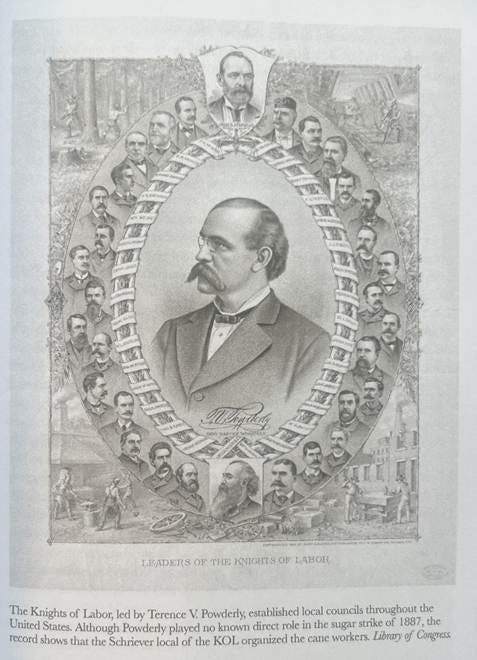
It is worth noting here that Conrad did not support the KOL because he was an engineer, did not toil in the fields, and therefore earned higher wages. Additionally, as a family man, he seemed much more risk-averse than the many single men who made up the union’s ranks.
I did not go on the strike. None of the mechanics went on the strike. – Conrad
But it was believed that his youngest son, Grant, was a field hand and member of the KOL. This likely came back to haunt the entire family.
“…these negroes felt unusually important because of their organization called the Knights of Labor, of which they were members.” – Daily Picayune, “The Knights and the Laborers” (October 29, 1887)
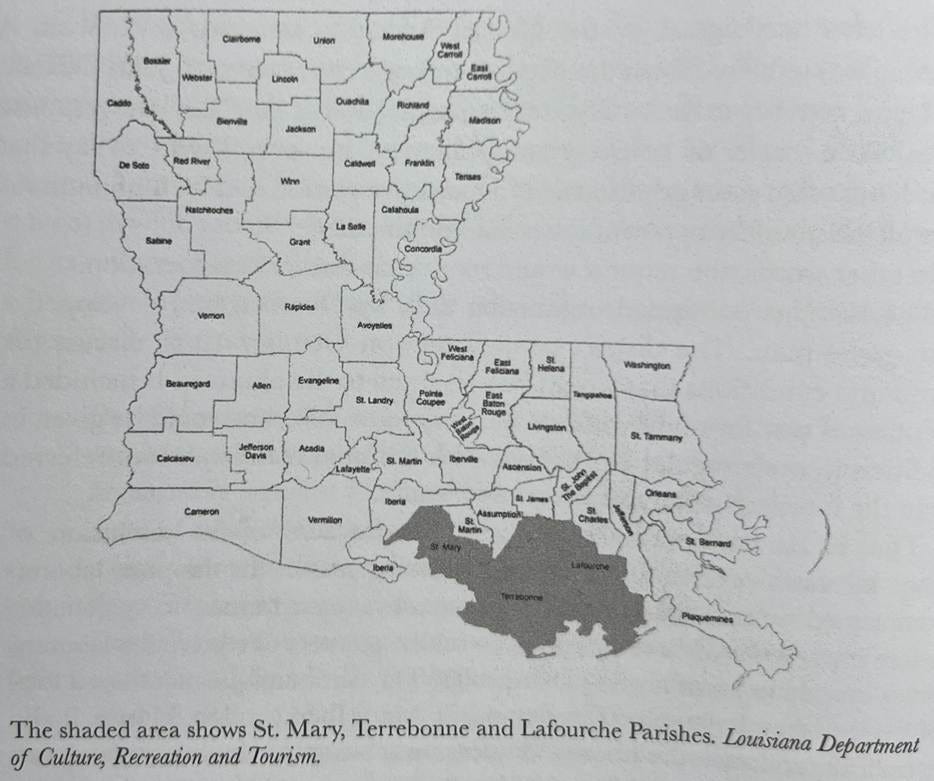
Once negotiations over wages revealed that neither side would walk away satisfied, the “Terrebonne Strike” ensued. Many Black workers simply refused to work, leaving plantations stranded. As this timeframe is the height of grinding season, a critical juncture for the cane-to-mill process, state authorities, planters, and their allies saw this Strike as particularly dangerous to a state whose sugarcane production had not rebounded to pre-Civil War levels. Planters felt that their plantations were “in the hands of a mob of strikers,” and that circumstances had become increasingly violent.
Sugar planters refused to increase wages as a means of calming down the strike(s), given the depressed conditions of the cane industry at large. Instead, they would act “by force” to maintain (what they would have considered) decent and law-abiding conditions. They called on all citizens, “regardless of race or color,” to help in “carrying out the plain behests of the written law of the land.”
And, by order of the state’s Executive Department, they were supported –
“The Terrebonne Strike has unnecessarily assumed a shape that is considered dangerous to life and property, and in order to support the civil authorities in their efforts to preserve peace, the Governor has upon an urgent requested, ordered that a detachment of troops be sent to the parish…deemed necessary to prevent serious troubles.”
Many Confederate Civil War veterans, and those sympathetic or directly a part of The Knights of the White Camellia, were sent by railcar to Thibodaux to quell the strikes.
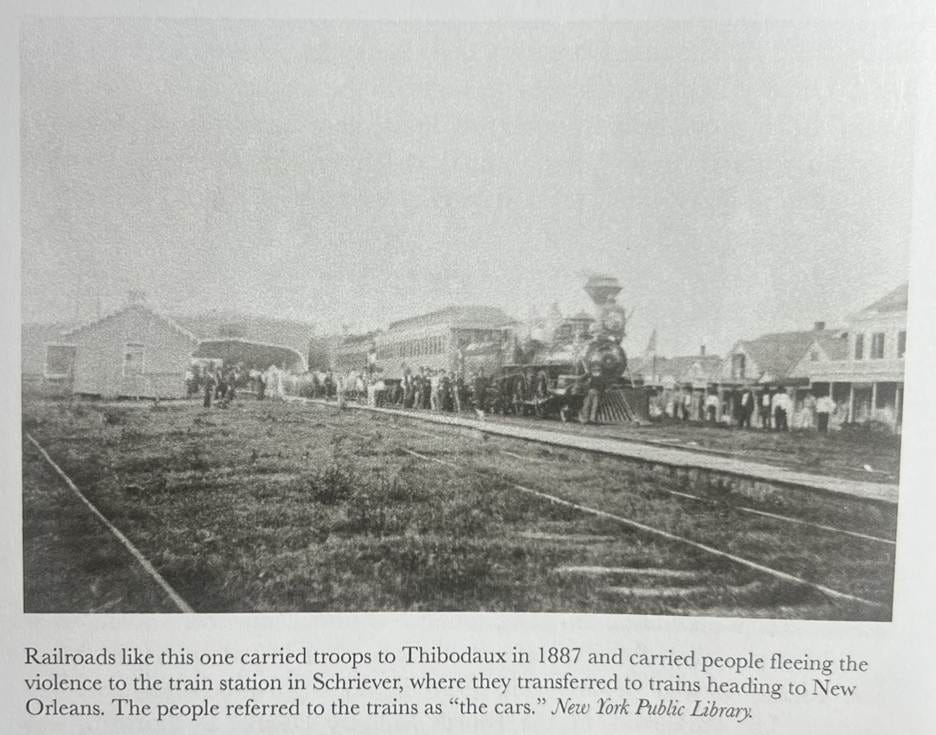
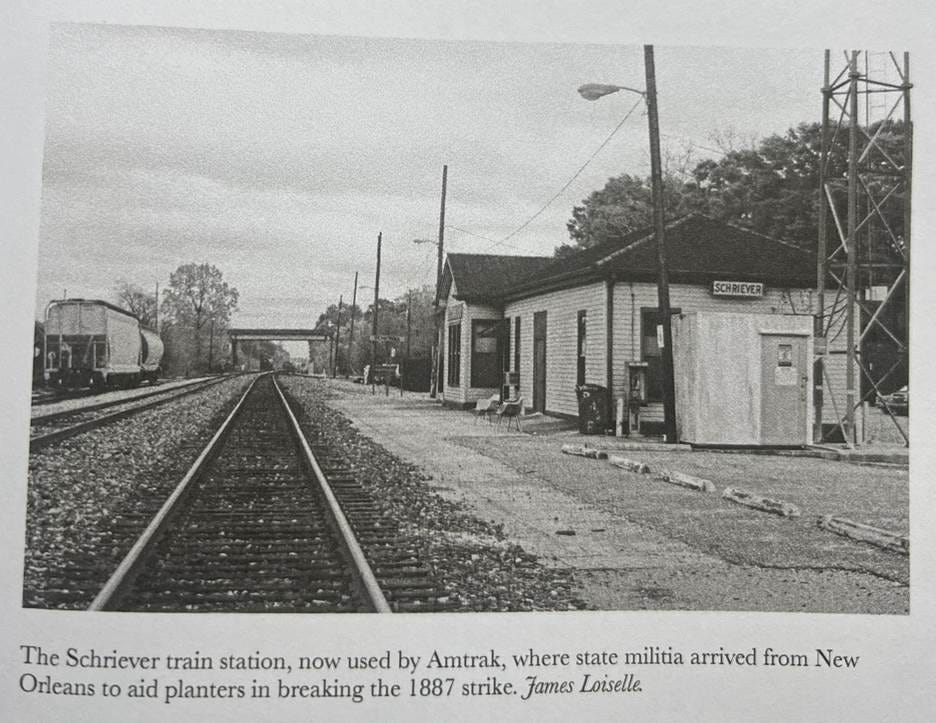
In another instance of tearing a page out of the Caribbean playbook –
…Planter’s Association would provide food, as well as quarters, for the troops.
Note: it was common for West Indian plantation owners to provide rum, food, and other resources to the soldiers and navies of the “Mother Country” when they arrived to squash slave wars/rebellions, or maintain whatever standard of order they sought to preserve.
Things continued to remain tense –
“Serious trouble is then expected all over the country as the negroes generally are stubborn and disposed to stand their ground.” – Picayune, November 2, 1887
On that same November day in 1887 –
Hundreds of men and no fewer than a half dozen artillery pieces were stationed at a variety of points in Terrebonne and Lafourche.
Lots of arrests and beatings followed. Rangers reportedly fired “between thirty to one hundred shots.” St. Mary Parish planter and politician, Don Caffery, was at the shooting site and said that he “saw no negroes fire.” However, this seemed to eventually shift –
The overseer at Rienzi Plantation had been shot in the face, though not severely injured. Four white workers on the Ridgefield Plantation were shot at, though not hit. In the actual homes of Thibodaux’s sugar elite, domestic workers—primarily women—muttered threats, causing fear among the wives of planters and politicians. There were rumors of murders that never occurred.
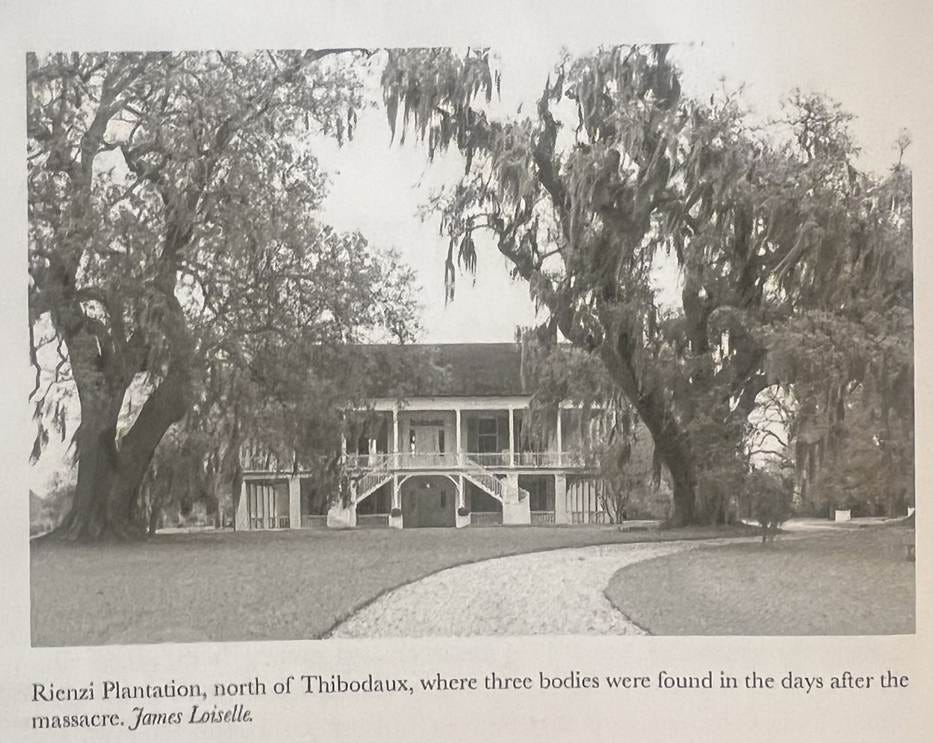
What happened at Rienzi, coupled with what seemed like unsubstantiated hysteria by the publications of the time, was enough to make White citizens feel that a Black uprising was imminent, that “assassins” were on the loose. There was a general sense among the White population that it was time to prepare for another war. An example of this was them shutting off entry/exit for Black citizens of Thibodaux. The author notes that no historical records substantiate Black citizens feeling the same way, though publications portrayed them as feeling that way.
On November 23, 1887, a group of watchmen (White) was having a discussion when a shot rang out, and one of them was hit. Word made its way around town, and we can predict what happened from there –
“And this opened the Ball.” – Mary Pugh
It was commonly reported that only 8 people were killed. The author estimates that the more accurate range is between 30 and 60. Many of those who escaped fled into the woods, an act not unfamiliar to the formerly enslaved, who did the same during the Civil War.
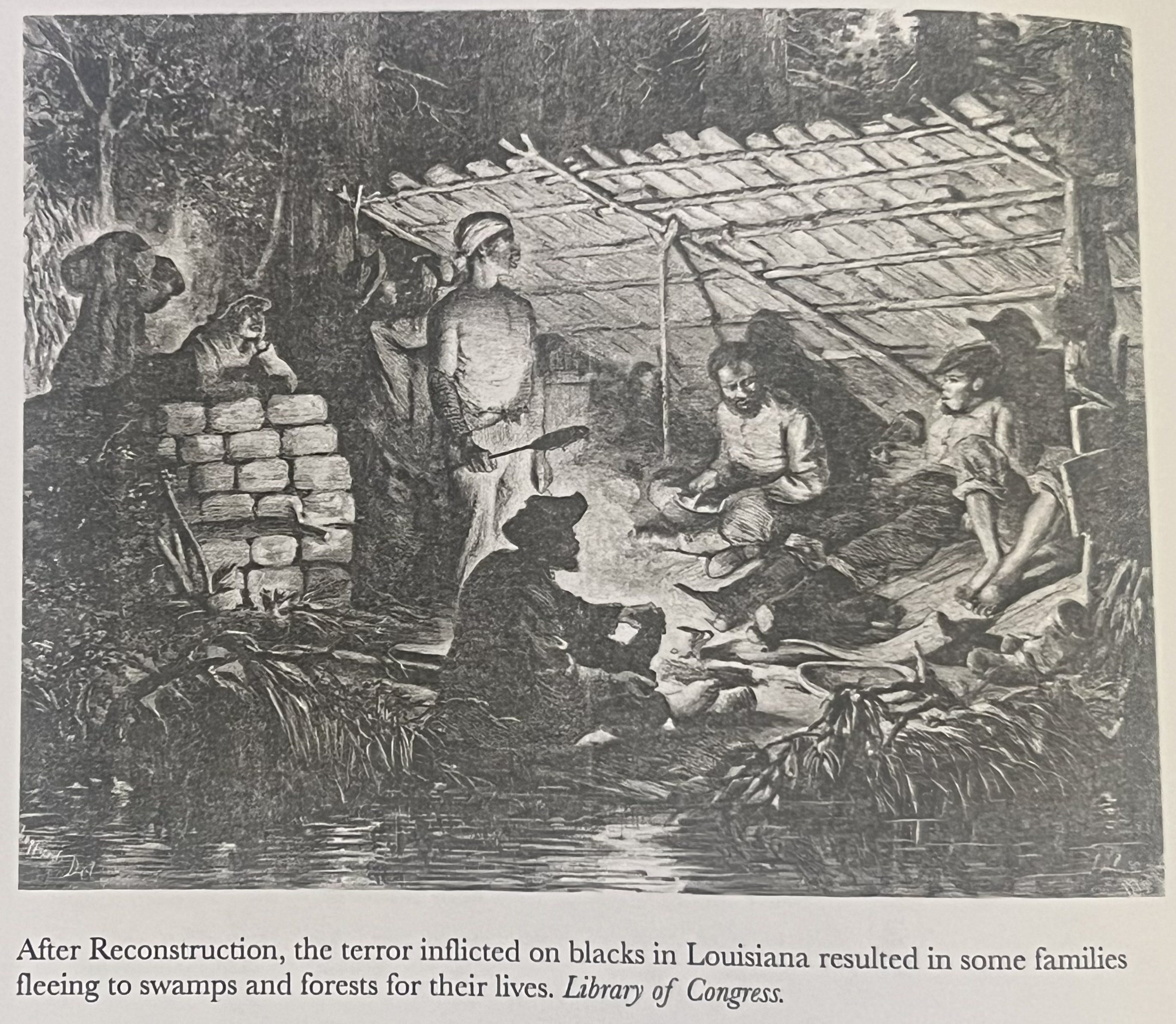
Let’s close by revisiting the statements of the Conrad family, filed from Jack's veteran’s pension application in 1893, as well as those on the other side of the narrative –
(Conrads)
“I think there were about 50 or 60 men in the crowd, which was comprised entirely of white citizens who lived in and around Thibodaux. Jack, his son Grant and his brother-in-law Marcelin were told to line up, and they began to run.” – Clarisse Conrad (Jack’s daughter)
“I heard my uncle [Marcelin] tell them he wasn’t in it.” – Clarisse Conrad
“And they said “get back you son-of-a-bitch” and shot him down and killed him. My brother was back of the house and got behind a barrel and the white men got behind the house and shot him dead. My father crawled under the house and they shot him under the house. He fell on his face when they shot him. After he fell on his face I heard them say “he is dead now” and “let us go”…I know that my father was unarmed when the white men came and called him out.” – Clarisse Conrad
(The other side)
“…he had exhausted every means within reason to bring the negro to a sense of his real condition; that he had advised him time and again to be aware of and avoid those who would plunge him into difficulties with which he was wholly unable to cope; that he would afford him the largest protection with respect both to life and property; but that when the shot…was fired there was nothing further left for him to do so save that of assisting the good citizens in the preservation of law and order.” – Judge Beattie’s sentiments recorded in the Times Democrat
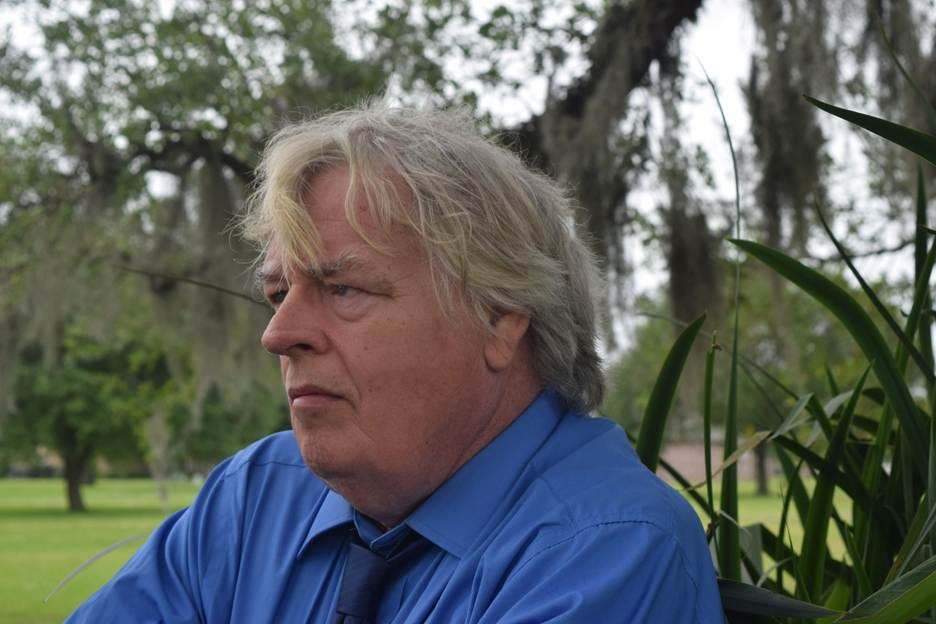
This very tucked-away piece of history was covered by John DeSantis –
Thanks for continuing to walk down the Louisiana lane with me. Still, no rum. I’ll live.
Just remember,
in all that you do, please, don’t ever stop reading.
