



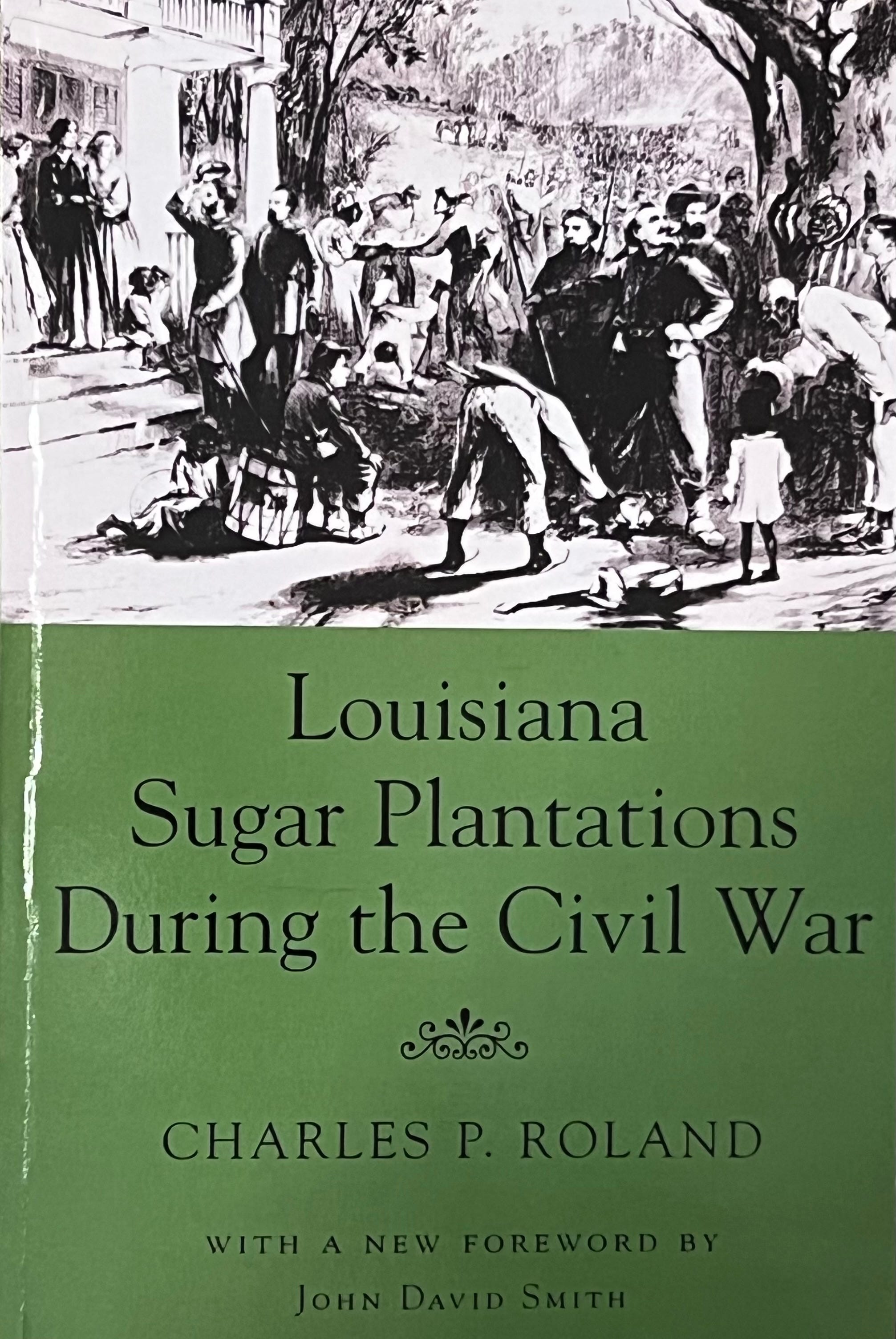
My last piece covered Richard Follett’s The Sugar Masters: Planters and Slaves in Louisiana’s Cane World, 1820–1860. His work analyzed Louisiana’s cane world & plantations right before the Civil War. It is only appropriate that we thread the historical needle by picking up where Follett left off.
Poetically, Charles P. Roland, the author of Louisiana Sugar Plantations During the Civil War, and Follett use the same map to showcase the major cane regions of the state –
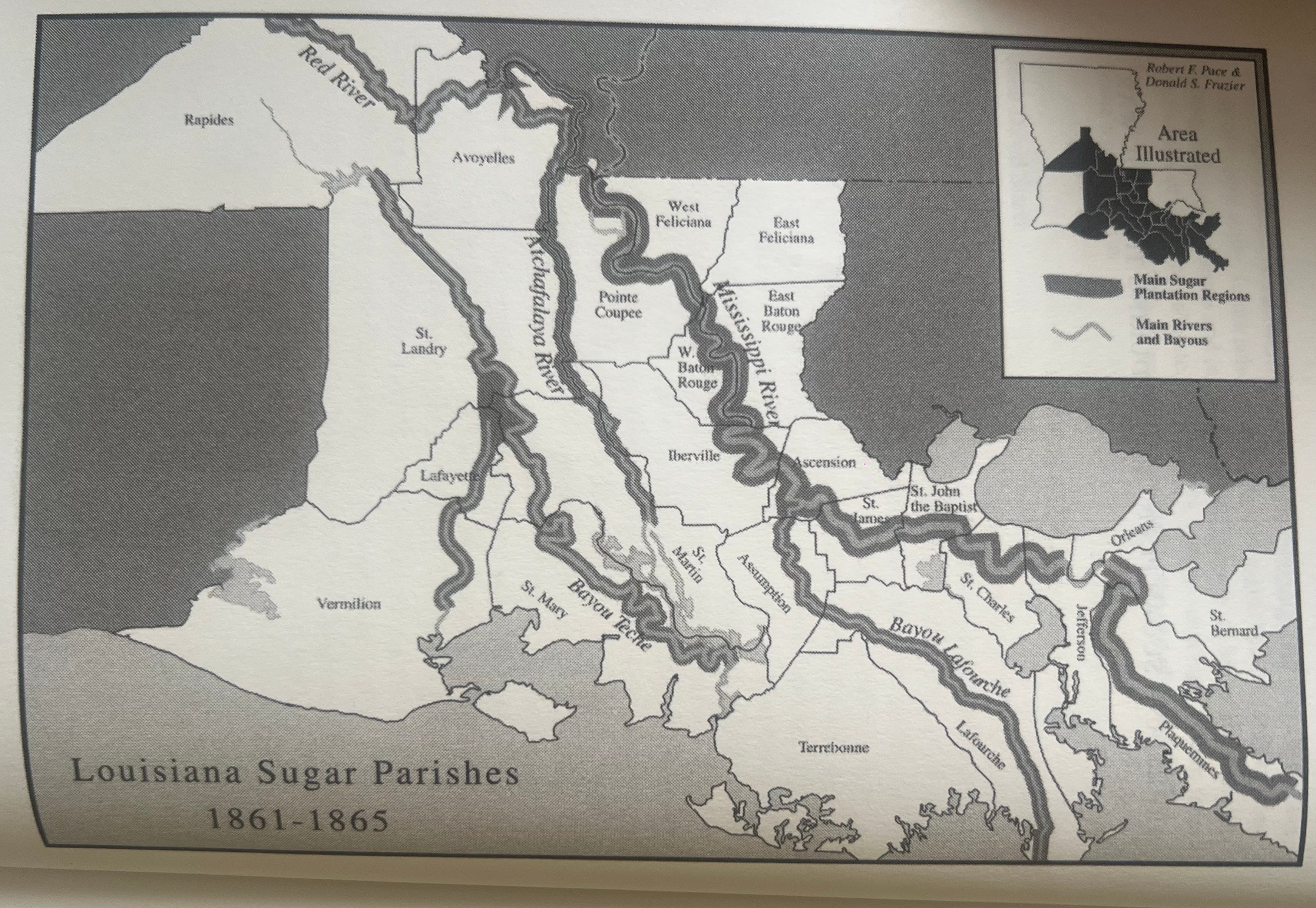
However, a sharp eye notices that the authors edited the map’s date range to align with their respective scopes (i.e., 1820 – 1860 for Follett and 1861 – 1865 for Roland). In short, same map, different years. I wonder if Follett came across Roland’s work at all. He must have –
Louisiana Sugar Plantations During the Civil War (1957)
Follett’s work (2005).
A significant departure from Follett is Roland’s more affectionate tone toward the foregone Louisiana plantation society. As a product of his generation and era, he uses language that reflects this affection without requiring further interpretation. Personally, this is one of my favorite aspects of history: you gain a better understanding of time, place, and people from the verbiage. Alright, I’ll get on with it. Roland’s sentiments –
Cane planters lived full lives. They strove with a measure of success to build a graceful society on a foundation of sugar cane and Negro slavery…They were men of sound wit who tempered their lives with vigorous play, set the pace for the area in which they lived, and made the plantation ideal supreme.
A peek into Roland’s mind upfront, as it will be necessary for sensemaking.
John David Smith, a Professor of American History at the University of North Carolina at Charlotte, nudges us to contextualize the history (and author) in the time Roland wrote the book, which people generally find difficult to do because of the understandable shock value of people and circumstances pre-dating them by a material number of decades/centuries. From the foreword –
In contrast to Roland’s approach in the 1950s, scholars now take much greater heed of the perspective of those enslaved, view emancipation as “progress,” and write of the good that came from slavery’s demise. – Smith
Frankly, Roland was of a time when he probably would have responded to Smith with, “Nope, said what I said.”
Who knows. What I do know is that we need to talk a bit about the author.
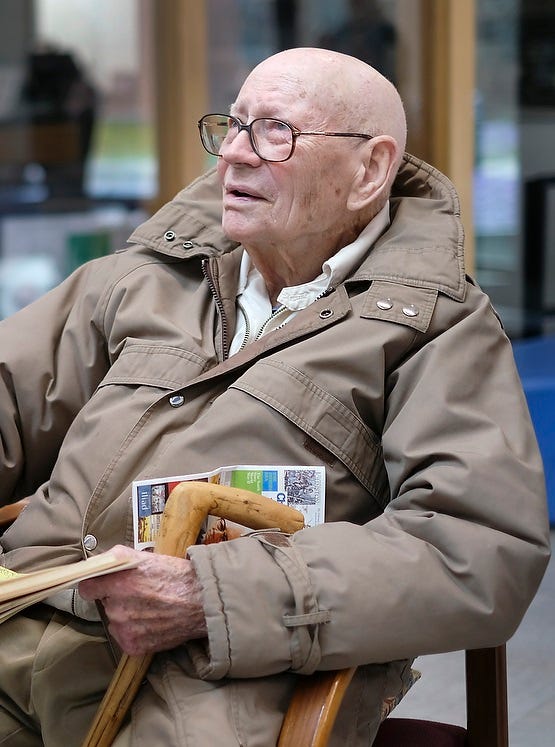
Charles Pierce Roland.
A son of the South: Roland was born on April 8, 1918, in Maury City, Tennessee.

And with a 2025 population of 594 people (let’s assume it was similar 100+ years ago), the Roland name carries weight there –
Charles P. Roland, historian of the Civil War and the American South, was born in Maury City in 1918. His father, Clifford Paul Roland, was a schoolteacher in Maury City. Maury City is located at the intersection of State Route 88 and State Route 189, northwest of Jackson and southeast of Dyersburg. – the town’s official website
He died at the age of 104 on April 12, 2022. A long life.
There is a detailed dedication (“In Memoriam”) to Roland written on the AHA’s site that I will pull bits and pieces from –
Undergrad completed at Vanderbilt University (a son of Tennessee through and through) in 1938.
Combat officer in World War II (99th Infantry Division); he received a Purple Heart and Bronze Star.
Master’s completed in 1948 and PhD in 1951, both at Louisiana State University.
Taught for 36 years: Tulane University (1952 – 70) and the University of Kentucky (1970 – 88).
He’s received a ton of awards & distinctions for his professorship/research.
In closing –
Perhaps the most enduring quality of Roland’s impressive oeuvre is its breadth and depth. Few scholars have written as authoritatively about several American eras (two centuries in fact) and have offered as sweeping and incisive commentaries about past and contemporary history. Roland’s range as a scholar is remarkable; so too his graceful, powerful, and terse prose.
Roland will be remembered for his substantial corpus of scholarship on the Civil War and his native South. Years of study, reflection, and “real world” experience convinced him that history “is a vital sustaining force in society.” He found solace in the contradictions, paradoxes, and subtleties of the past. Roland believed, as he titled his final book in 2007, that History Teaches Us to Hope.
Roland, thank you for the rum references.
Ironically, Roland’s work led me to Louisiana rum before anyone else’s. To be clear, I would not necessarily trust Roland’s depth of knowledge on Louisiana rum history; his references are apathetic at best and largely ring of stereotypes (e.g., the use of “crude” and “fiery” to describe rum is a historically easy place to go). All that aside, I appreciated the honest references to the liquid versus a complete overlook/sidestep, which is what I’ve found happens most in discussions of Louisiana cane spirit history. I am absolutely sure this was not Roland’s intent, but it served my purpose. Walk with me.
An example of economic alternatives plantation owners pursued once in the throes of the War –
Lacking a market for their sugar, planters racked their brains for ways to gain a profit on the blockaded produce. One Rapides Parish landowner had the ingenuity to dispose of his crop by converting it into rum. In March of 1863 he sold a large quantity of this homemade beverage for $17,000. Stored in Alexandria he had another 100 barrels of the fiery liquid, estimated to be worth $40,000.
Roland describing illicit production of rum –
Another sugar [producer] was disquieted upon finding that one of his Negroes was diverting sugar from what the planter felt was its true mission; the resourceful black had rigged a still on the plantation and was turning out rum.
Roland’s language aside, my brain immediately took me to two places: 1) Rigging together a still at that time, and for an enslaved person (in particular) would have been considered a highly technical/skilled trait; 2) Where are the ancestors of the “resourceful black,” I wonder if there’s ancestral knowledge of rum-making just sitting out there in Louisiana somewhere.
(and finally)
The author showcases an odd demonstration of what I’ll call “dancing amidst danger.” Despite the Civil War raging on, balls/dances between women and Confederate soldiers still carried on gaily –
The soldiers and ladies danced and romped in the parlor to the handle of an untuned piano. After hours of exaggerated hilarity they sat down to the resourceful hostess’ dinner of ham and roast turkey. Dessert consisted of cornmeal pound cake and eggnog, a beverage sharpened with a generous portion of “crude and fiery rum” made from plantation molasses. The girls did not appreciate this throat-burning delicacy, but the soldiers drank freely…According to one account, the plantation had never seen a merrier day. The party ended as abruptly as a bugle call, thrown into consternation by the appearance of an enemy gunboat on the river.
Though I will never agree with anyone who believes that a plantation society functioning on chattel slavery is a “graceful civilization,” I must acknowledge that it is Roland’s work that reassured me of Louisiana’s heritage with rum. I will continue to investigate further. Please send recommendations/people to speak to.
Allow me to return us to the book’s purpose: to understand how Louisiana’s plantation society fell apart. A glimpse –
War brought the Louisiana sugar industry to the brink of extinction. The closest estimates of the value of sugar property in 1861 ran to almost $200,000,000; four years later, with slaves freed, sugarhouses ruined or [severely] damaged, livestock confiscated, and land prices vastly depreciated, the industry was worth hardly more than one eighth of that figure.
Setting the scene: Cane Country
A romantic view of Cane Country, Louisiana –
A favored and colorful part of the Old South was the Louisiana sugar country. This area was a labyrinthine river land of ample cane plantations interspersed with narrow sugar farms, of white-columned mansions contrasting with humble dwellings, of tall-chimneyed sugarhouses in juxtaposition with primitive mule-drawn cane mills, of Anglo-American planters among Creole proprietors, of Irish and “Cajun” laborers in the midst of a multitude of Negro slaves, and of affluent and graceful living in the presence of rural simplicity and back-breaking soil.
I have no idea why he put the folded bunny ears around “Cajun,” intriguing.
New Orleans was the main port for the sugar territories. Planters sold their wares at the market(s) there, and ocean vessels took on cargo for distribution to Atlantic coastal communities. NOLA had banks and merchants that provided money for the economy of the lower Mississippi Valley. Cane country planters flocked to the city to purchase Yankee-produced machinery and supplies and “to bid for Virginia and Carolina Negroes at the slave markets.”
South of Baton Rouge, the capital city, sugarcane was plentiful, despite a few cotton plantations along the riverbank. Roland notes that sugar was first granulated at a profitable scale in Louisiana in 1795; cane was introduced to Louisiana earlier in the century. Roland’s reference is to indicate when cane became of consequence to the state’s valuation. All to say, when Louisiana became a territory of the US in the early 19th century, this sugarcane profile and production helped to satiate a growing (and large) domestic market for the produce.
Levees were erected to prevent the heavy flows of the Mississippi River from destroying cane country. A necessary engineering project for the inhabitants if they wanted to compete against West Indian sugar, which had been in the game long before Louisiana. The Creole and Anglo planters initially had a wedge, though I imagine the profit potentials of sugar forced their hands into mutualism.
The planter’s home, romantically pictured by Roland –
In approaching by steamboat a typical sugar plantation, on first saw “the house,” the master’s dwelling. It was an institution of the Southern scene glorified in literature and lore, and even today venerated in its dilapidation. Set well back from the levee, with lines softened by a column façade, the white structure dominated its surroundings and lent and impressive elegance to the countryside…it was and yet remains the highest symbol of the grandeur of the ante-bellum sugar civilization.
Behind the owner’s home was typically the “slave quarters.” The sugar house/mill (i.e., where the technically-inclined produced the white stuff) was usually constructed at a convenient point between where the cane was transported from the fields and where the hogsheads of product were brought to the pier to sail downriver. All of this was positioned in a way that aligns with the author’s assertion that the planter was the ‘Monarch of all he surveyed,’ a “seventeenth-century lord in his great hall.” What Follett would have dubbed the “fantasy” of “patriarchal sway.”
The planter’s wife had duties stereotypically associated with the Antebellum era: mother, hostess, and tutor to the household’s enslaved people. The hostess would have helped the planters throw sugarhouse parties/balls, the pinnacle of social life in the bayou. However, then as now, “New Orleans was the entertainment Mecca of lower Louisiana, and many sugar planters kept town houses in the city for the season of opera and balls.” Incredibly, Roland hints that (initially) the planters were unlikely to embrace religion and Christian values in that magnanimous way that is often historically portrayed. The sense of being Kings of their circumstance was potent –
In the lives of many cane proprietors [religion] was not a compelling force, for perhaps they were more nearly able to achieve a “heaven on earth” than was the general run of mankind.
Another ‘look at it from this perspective’ point that Roland makes that I found to be honest, for lack of a better word, is the assertion that most people played along with chattel slavery because they were of their time and not necessarily intelligent enough to think about an alternative. It’s probably the one theme that is true for the majority of humans at any given point in time. Alas, Roland notes that most enslavers also likely condemned the peculiar institution, “but felt that they were not responsible for it, could do nothing about it, and must make the best of it.” A stark contrast to historians who claim that many considered the institution to be good for all. My read is that both mindsets were pervasive at the time and probably fed each other. All told, chattel slavery was the fundamental fuel keeping the Old South’s engine going, that much we know.
Plantation life and those who bore the brunt of it.
The conditions of life for those who endured on Louisiana plantations were so harsh that the state became an epithet for a doomed existence. So much so that those enslaved in the upper southern regions of the country were threatened with being sent to cane country. Ironically enough, those enslaved in Louisiana were threatened with being sent to Cuba. An ecosystem and industry, both economic and psychological.
To massage the larger-than-life image the planters had of themselves, they became the judge and executioner for all things in existence on the plantations. Everything from settling disputes among the enslaved to approving marriages and finalizing punishments. On beatings, it was not uncommon for a plantation owner to require his presence before an overseer used the whip. To be clear, wanton brutality was routine. However, Roland asserts that there was a supposed “gentlemanly manner” that punishments were to be meted out by.
All in all, regimentation was the utmost priority –
Slave organization has been compared with that of an army. The master was the commander, and the overseer his lieutenant. From the overseer the chain of command ran through first and second drivers, who performed the functions of sergeants, to the command hands—the private soldiers of the slave company. The plantation bell was to the Negroes what the bugle is to the troops. It was rung in the morning by the first driver as the quarter’s reveille; meals were announced by its rolling; and at night it sounded taps to send the laborers to their cabins.
Drivers were typically enslaved Black people who exercised (were given) disciplinary powers over others, which served to maintain a calculated amount of disarray. Enough to sometimes turn the attention away from the plantation owner. The overseer surveillance was so pervasive that they completed bed checks daily/nightly, and administered/approved passes for leaving and coming onto the plantation (applied to both “resident” and “nonresident Negroes”). Skilled laborers – Black and White – were also present on plantations (i.e., carpenters, masons, engineers, mechanics, etc.). I wonder if the “resourceful black” who began churning out rum was someone close to the hardware, so it was easy for them to distill the juice. As you can imagine, I won’t let this thought go.
Roland’s colorful language regarding the enslaved and their state on the plantation was crudely honest in asserting that, no matter the façade of pleasures they eked out, they were still in the lowest rung of the social ladder. His language would understandably be considered patronizing & dehumanizing –
Slaves enjoyed amusements consistent with their low place in the social scale. Sundays were usually days of rest, except in the grinding season, while on plantations where religion was encouraged, worship services offered an avenue and social expression…The year’s social high light for the slaves was a rousing sugar-house dinner and ball at the end of the grinding period. These diversions, scattered at intervals among periods of grueling toil, were water in the desert to the fun-loving Negroes and did much to buoy up their spirits.
To leave or to stay?
January 23, 1861 – the Louisiana legislature’s scheduled meeting date of the state convention to decide if they will secede and join the other pro-slavery states. You must all know how this story goes. If not, then here are some quotes –
“Well done Mobilians … well done Louisiana …” – A. Franklin Pugh, Louisiana planter
“All honor to the men, who had the courage to this first step, to prosperity which will be as permanent as earthly things may be.” – Pugh
Roland on Louisiana’s decision to secede –
Louisiana sugar cultivators led the movement that carried the state into secession. Thirteen of the twenty-three parishes of the cane land were represented in the secession convention in January by immediate secessionist delegates. Among this number were the great sugar parishes of Iberville, St. Mary, Plaquemines, St. Bernard, St. Martin, and St. Charles.
Not all were so sure. You had “[c]ooperative secessionists” who sought a middle ground, likely out of fear of the unknown. Ultimately, however, those middle-grounders believed that the slaveholding states should withdraw together and form a Southern Union.
The one thing that all secessionists seemed to agree upon was that Lincoln’s ascension represented the elevation of a “Black Republican,” which, to me, feels like semi-coded language for what those in favor of plantation societies feared most: the manifestation of Haiti’s (Black Republic) outcome on their shores. More directly, however, the terminology in the southern psychology represented the Republican Party’s support for a pro-Black cause (note: Democrats and the secessionist South go hand-in-hand at this time). Put differently, progress forBlack people was considered detrimental for the South.
From the horse’s mouth, a Southern prayer –
“This Day is set a part by presedent Jefferson Davis for fasting and praying owing to the Deplorable condition ower Southern country is In My prayer Sincerely to God is that Every Black Republican in the Hole combined whorl Either man women o chile that is opposed to negro slavery as it existed in the Southern confederacy shall be trubled with pestilences & calamitys of all kinds & drag out the Balance of there existence in misry & degradation with Scarsely food & rayment enughf to keep sole & body to geather and O God I pray the to Direct a bullet or a bayonet to pirce the hart of every northern Soldier that invades southern Soil…My honest convicksion is that Every man women & chile that has gave aid to the abolishionist are fit subjects for Hell…Amen…” – [An] Overseer on Magnolia Plantation
The conviction of a people lay in one direction only: gather arms and fight to protect the peculiar institution. Substantial sums of money were raised for militias and cavalry units across various parishes (e.g., the Bayou Goula Guards). In the closing months of 1861 & early 1862, a decent number of sugar growers and their sons joined the Confederate army. Many of them presumably saw little action, as Louisiana was far from the main battle zones in Virginia and Kentucky.
But what’s going on back on the plantations?
→ 1860: anxiety among the planters skyrocketed as “political excitement heightened”; there was a steep drop in land values.
The sugarcane industry operated on borrowed funds, which largely came from the capital markets – bankers, merchants, and financiers – of New Orleans.
→ 1861: talks of secession and war did not affect the 1861 acreage/production, as we know this was a banner year for Louisiana cane, mainly because the cane was in the ground before the fighting began. In total, 459,410 hogsheads of sugar were produced, marking the highest output up to that point; the greatest in the history of the industry up to that point.
Notably, many plantation owners behaved as usual because they fundamentally believed in the South’s ability to win the War. Slowly but surely, the pendulum swung in the other direction once the Union blockade was in place. Shipments from the sugar parishes to the North ground to a halt. The Federal Navy soon took control of the Gulf of Mexico, tightening any movement and trade potential around the Mississippi River. Visuals for it to make a bit more sense –
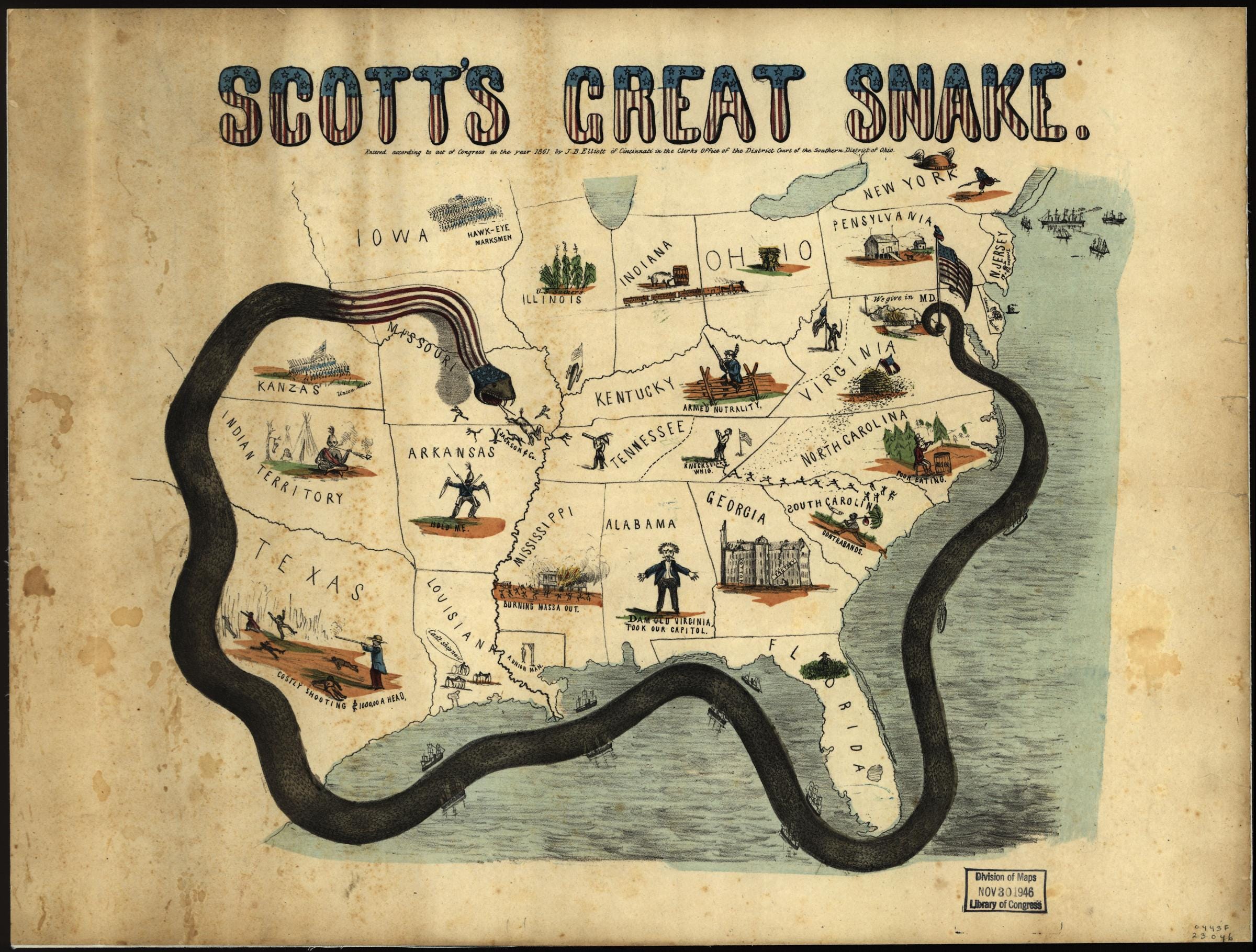
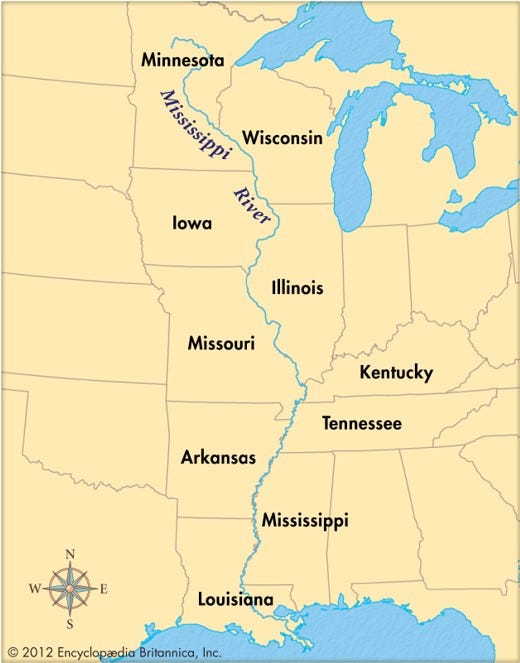
Rail could have served as an alternative, but the Confederate rail system was at capacity (troops and supplies were the priority). As the plantation owners became more fearful of the inevitable, cane operations took a further hit as many overseers were sent off to war (shortage of enforcers). A necessary evil in the planters’ eyes, I suppose.
Contributions to the war effort, in some capacity, seemed inevitable. Planters probably began to believe that the war’s consequences would fall on their doorsteps. You would assume that the War was their sole focus. In fact, it was not: they were desperately holding on to their way of life, too. In other words, they remained committed to enforcing control & surveillance over the enslaved during the conflict. I suppose that fighting the war and maintaining the status quo were part of the same goal they set out to defend. The paranoia was so palpable that the Louisiana soldiers implemented internal punishments for anyone who did not enforce their purported racial dominance. For instance, “in 1862 [, they] passed an act subjecting to a fine of ten dollars or twenty-four hours’ imprisonment any eligible citizen who failed to take his assigned place on patrol.” But, as Roland notes, the anxiety plantation owners felt may have been unfounded (at least initially), since the Union war effort primarily targeted New Orleans, the state’s economic engine. In 1861 to early 1862 –
Distant war changed but did not crush the rich social life of the bayou land.
Geographically speaking –
Louisiana felt secure from invasion of land, for she was located behind a tier of states that spread from Virginia to Arkansas…These border states absorbed the thrusts of the Union army for many months, sheltering the lower South from assault.
Violent disruption of the status quo.
“As there is great scarcity of meat in the country, every planter I believe is trying to get a good supply of molasses.” – Letter from a Bayou Lafourche plantation owner to another plantation owner, October 1861
…in desperation they turned to molasses as a substitute…consumption of this by-product vastly increased throughout the South during 1862.
In April 1862, New Orleans fell, doing away with the notion that the war would be short and in the South’s favor. Sugar planters made last-ditch (covert) efforts to move and sell their goods. Some fled with the people they considered their property. Texas became a popular destination for those escaping their sugar plantations. Those fleeing appear to be a minority since the Union army cut off major transportation arteries. As you can imagine, especially for those who remained, the invasion by the Yankees was not well received.
“We are no welcome tourists, at least not to the white inhabitants…But to the negroes we evidently appear as friends and redeemers.” – A Union soldier
Again, Roland makes clear that he believes what was taking place was “the destruction of a graceful civilization.” He offers conciliation by reminding us that Confederate soldiers also erred and took advantage when the opportunity presented itself. However, I would assume that Roland believed these were minor misdeeds relative to what the “Negroes” and Yankees did.
Union pillaging –
Federal troops stripped Louisiana plantations of an untold amount of property by foraging and looting.
Plantation furniture and fixtures were handsome booty to Northern men and officers alike. In September of 1862 all of the silver was stolen from Bradish Johnson’s plantation on the Mississippi below New Orleans.
Both –
…elegant mansions abandoned by owners and pillaged by Negroes and men of both armies.
Confederate pillaging (friendly fire, if you will) –
“The brigade of Genl. Alfred (Mouton) is still encamped on my plantation, devastating my property; robbing & plundering me & my negro cabins…” – William T. Palfrey
“Our troops have stripped me, by robbery, of nearly every resource for living from day to day, & what is in reserve for me from the common enemy, is yet to be ascertained. [From] a condition of ease comfort and abundance, I am suddenly reduced to one of hardship, want & privation.” – Palfrey
The author reports that “poor whites” flooded plantations, taking what they never had access to. In the Spring of 1863, a Bayou Teche planter found that his house “had been broken up & robed by the…rogues who [had] long infested this neighborhood—and everything taken off…which could be moved.”
The Union soldiers carried on with their supposed “noble crusade to stamp out human bondage.” Acts of Congress – August 3, 1861, and July 12, 1862 – supported the soldiers’ efforts by legalizing “confiscation of property employed in aid of the rebellion.” Union General (Butler) manned the vehicle behind these Acts. Everything was taken: mules, racehorses, guns, food, you name it. Losses in equipment, as calculated by an “eminent contemporary student of the sugar industry,” were estimated at $70 million.
War left the cane country stricken, for the “winds of destruction” had blown from friend and foe alike.
Union control and the fallout of the plantation’s belly.
General Butler’s sequestration order of November 9, 1962, permitted landowners who were peaceful and who took the oath of allegiance to the United States, to remain and work their plantations.
Undoubtedly, some planters were genuine Unionists, while others wore the mask to protect their assets. The catch-22 to the sequestration order was that it effectively allowed sugarcane plantation slavery to continue as-is. Or as Roland puts it, oath-taking ended up being an “invaluable service in keeping the Negroes reasonably well in line on the plantations.”
It seems that most planters were too incensed to recognize this paradigm, as the presence of the Federals was already too much to bear. It disrupted their lifestyle and the world they believed would endure in perpetuity, notwithstanding their general allegiance to state and region. Practically, all things – disputes, arrangements, etc. – were now to be approved by Union provost Marshals, which only further aggravated a group who were previously at the top of the socio-economic chain.
Even though some plantations remained in operation, many were abandoned. Contrary to popular belief, many of the enslaved, knowing no other life for centuries, willingly remained loyal to their plantation owners. Let’s deal, however, with the masses that fled –
During the summer of 1862 the Negroes of parishes below New Orleans grew increasingly restive. Owners were unable to maintain discipline among workers because of the nearness of protecting Federal troops—an advantage not lost on the blacks. Large gangs of plantation Negroes wandered almost at will into New Orleans and the Union army camps, seeking freedom, excitement, and escape from toil.
Roland labeled this mass exodus a “dark tidal wave” sweeping over New Orleans. Those who deserted the farms often set up camps (“shanty villages”) in and around Union army posts. It wasn’t all pretty once the enslaved were across Union lines. Many White Northerners held deep-seated beliefs that, irrespective of the War, Black people were still at the bottom of the social caste. As such, they interacted with them in this way –
…penniless wanderers depended upon Federal soldiers for food. Invading troops often looked to the fugitives for entertainment, and the result was a debauch of the blacks. The availability and complaisance of slave women to Northern soldiers brought on a frolic of miscegenation.
The notion that the “[p]lanters” were “disgust[ed] at the behavior of invading stalwarts with their laborers” is a bit one-sided and narrowly conveyed, given that droit de seigneu was fundamentally part and parcel of Louisiana plantation society. As noted in the Follet piece –
“The young masters were criminally intimate with the negro girls; it was their custom…practice of copulation was so frequent…” — J.B. (Jean Baptiste) Roudanez
Nonetheless, without hands to work the plantations, cane farms inevitably fell apart. In addition to seed cane shortages, climate catastrophes, of which Louisiana was no stranger to (then and now), and disease ran amok. Levees burst open (lacking the forced and free labor to fortify them as was done in the past), whooping cough, malaria, & typhoid fever decimated certain areas. Some threw an economic hail mary by trying their hand at cotton cultivation. This turn in economic hand did not bear fruit, as the climate of lower Louisiana was not conducive to cotton growth (hence the historical focus on sugar). But desperate times, right?
This dance ended when desperation led those with cold economic minds to turn to available funds, irrespective of their source. With New Orleans’ capital on hold, Louisiana plantation looked to Northerners who were hoping to “find quick fortune in the cane fields.” Which seemed much more viable with land/asset prices at rock bottom levels.
Leading plantations and forming partnerships, frequently with Northerners, lightened the onerous burdens of wartime planting.
In fact, many Louisiana fortunes were amassed by Northern companies and transplants after the Civil War. And since we’re on the topic, let’s understand what a post-slave Louisiana society looked like. Wage laborers, or what Roland called “Indolent Negroes,” were the new reality in a society and culture entirely unfamiliar with that structure.
Freedom?
The supreme social and economic result of war in the cane country was the freeing of the area’s 139,000 Negro slaves, an action that transformed a great mass of black humanity from chattels into citizens.
“Freeing” should be interpreted loosely. General Butler, now responsible for thousands of enslaved people fleeing across his lines, had to figure out what to do with them. Butler did not advise “declar[ing] the blacks free,” though he could not “re-enslave them.” Instead, he concocted a plan “to hire as many as possible to planters who remained on their estates.” One. He also employed many of the enslaved as “government agents and lessees who operated abandoned plantations,” among other roles. Two. Wage levels were established for workers who worked 10 hours per day for 26 days per month. Hardly imaginable by today’s standards. A look at what was to be provided by those now employing wage laborers –
The new wage scale provided that mechanics, sugar makers, and drivers receive three dollars a month, male field hands two dollars, and female field hands, house servants, and nurses one dollar. In addition to these wages, sugar producers were to furnish food, lodging, and medical care for the workers, and support for the dependents. If the cane growers and laborers agreed, one twentieth of the profit from the year’s crop could be paid to the hands in lieu of monthly wages. Two great differences between this system and slavery were that the Negroes could now contract to work for planters of their choice, and discipline was administered by Federal provost marshals rather than by owners.
The new wage workers held a bargaining chip previously unthinkable: they could choose who to work for. As a result, planters cautioned overseers against violent discipline (and harsh language) out of fear that the new profile workers would desert immediately.
Needless to say, hysteria among plantation owners remained high because they could not maintain strict cooperation and discipline in this new environment. Sugar production continued to fall, even with the latest wage dynamic, which only further infuriated them. Southerners pleading to federal authorities to force Blacks to work became a common occurrence.
“The wish of the negro is now the white man’s law.” A man had as well be in [purgatory] as attempt to work a sugar plantation, under existing circumstances.” – William J. Minor, plantation owner
Formalized freedom was on the horizon, which would only further put a rift in whatever new plans the plantation owners were formulating. On January 1, 1863, Lincoln issued “his” Emancipation Proclamation, setting free the enslaved in rebellious states. Notably, Lincoln “exempted from this action various parts of the South already under Federal control, including thirteen of the lower sugar parishes.” What does this mean?
The Proclamation freed zero people in “loyal Louisiana—that is, occupied Louisiana—and Lincoln had no power actually to set free anyone in Confederate Louisiana.” Roland had very specific feelings about the circumstance, labeling those who wanted to remain enslaved “intelligent” and possessing “insight to remain docile.” In his words –
When asked why they did not take this opportunity to go free, an intelligent slave replied: “I see no use of us going and getting ourselves into trouble. It so be it we are to get free, we get it anyhow…. we think it betterer to stay home on the plantation, and get our food and our clothes…But, if we run away, and go to New Orleans, like dem crazy niggers, where is we?” This Negro possessed the insight to remain docile and continue being provided with the necessities of life while the whites decimated themselves in a contest to decide his future.
The confusion about ‘free or not’ ended when Louisiana’s Constitutional Convention declared all to be free in the state later that year (September 1863). Sugar production would take considerable time to recover as the state adjusted to its new normal. The 1864—1865 crop yielded a paltry 10,000 hogsheads of sugar (reminder that 1861 yielded 459,410), which Roland squarely blames on “the inefficiencies of free Negro labor in its trial stage.” Or, more crassly –
For a people fresh out of bondage to spend a season in the wilderness of irresponsibility and unrest was not without precedent, even in the Old Testament. Nor could the unschooled and inexperienced blacks know that freedom meant freedom to work, not freedom from work.
Louisiana plantation owners were “[b]red in this conviction” that slave labor was the only way to obtain maximum value from their farms. The potential in the “new order” would take some time to sink in. But sink in, it eventually did.
As Roland aptly notes, there was still a fixed caste system in place that both Northerners and Southerners could agree on, even if the schema appeared modified from place to place –
Bitterness over defeat and military occupation robbed cultivators of the insight to perceive that Union officials in large measure shared their own views and role of the Negro, which were that at least for the present he should remain a laborer and not become a landowner.
Freedom in name only, not in practice.
Where do we go from here?
By 1865, there were less than 200 sugar plantations (out of 1,291) still in operation. Those who remained likely fell in the “nominal Unionists” or “pseudo-Unionists” buckets. In other words, dedication to their economic “self-interest” & “[s]elf-preservation” was the utmost priority. It didn’t matter that William J. Minor’s sons were in the Confederate Army. He “reverted to Unionism” once he saw the Yankee tidal wave coming his way.
“I foresaw (or thought I did) the terrible woes that would result from. it & opposed it most strenuously.” – William J. Minor
Of those 200 remaining, many probably did whatever they absolutely could to satisfy the Union side. To make clear that they were oath-takers –
Plantations belonging to Unionists frequently were the setting for dances and parties attended by Federal officers.
Unsurprisingly, the author is steadfast in his belief that “Old Abe” [Lincoln] robbed White Louisianians of their respectable/admirable way of life –
War blighted the colorful social life of many families in the sugar land. Plantation daughters were lonely after planters’ sons marched away to the armies, while wartime shortages greatly reduced the sumptuousness of balls and dinners. Casualty lists from the fighting front shattered many homes and brushed away all thoughts of gaiety.
But Roland also concluded that all was not lost. Gradually, life reverted to a pseudo-pre-Antebellum scenario in which the majority of laborers in the cane fields were Black. The incorporation of wage labor probably satisfied the North’s desire for optics more than substance. Or, as Charles Nordhoff (Northerner who traveled to the South) put it in 1875 –
“Here was a clear indication of a meeting of Southern and Northern minds as to the role of the Negro in the New South.”
Most labor was now contracted monthly, and many laborers continued to live in the planters’ cabins, which were effectively postwar slave quarters. Sharecropping did not become as popular in Louisiana as it was in the cotton South because sugar production (machinery in particular) was much more expensive, leaving less economic room for negotiation beyond the new reality.
Foreclosures of sugarcane lands were rampant, so many old faces of the Parishes went out of business. These failures are what invited many of the merchants, bankers, and speculators from the North. But as we saw with Leon Godchaux, some in the South were also able to take advantage of low asset & land prices. In short, the speculators won in the long run –
One student of the post-war Louisiana agricultural pattern estimates that after 1870 at least half of the planters were either of Northern birth or were backed by Northern money.
Being a son of the South, I can’t imagine that Roland was pleased with another Northern “invasion,” this time in the form of speculative/aggressive capital. What we know for sure is that the old way of life was legally no more. What was to come? Let Roland tell it –
Ultimately the cane industry regained its economic strength, but the soul was gone from the old sugar civilization. Great numbers of plantations after the war belonged to Northern entrepreneurs and to banks and corporations…while emancipation of the slaves reduced the sugar growers’ old sense of patriarchal omnipotence.
Today three landmarks of the ante-bellum sugar plantations remain: the broad, canal-gridded cane fields; occasional sugarhouses, infinitely more elaborate than of old; and the great, proud mansions—ghosts along the waters.
I finished reading this book on June 20, 2025. Approximately one month earlier, the Nottoway Plantation, “billed as the largest antebellum home still standing in the American South,” burned to the ground (source). The “proud mansion” was no more. I will leave you with that information for you to do your own musing, which I hope is a robust exercise now that you have deep historical context.
I am very happy that I read this book. Beyond all the learnings I outlined – you know where I’m going – the one specific to my core interest (unbeknownst to Roland, I’m sure) was that rum and Louisiana share a deep heritage. I knew this deep in my soul (based on common sense and historical dots connecting)! Even if mentioned in offhand ways, the aha moment far surpassed anything else. I hope you walk away from this piece a bit more informed.
Happy (almost) New Year’s. Have a fantastic 2026.
Just remember,
in all that you do, please, don’t ever stop reading.