



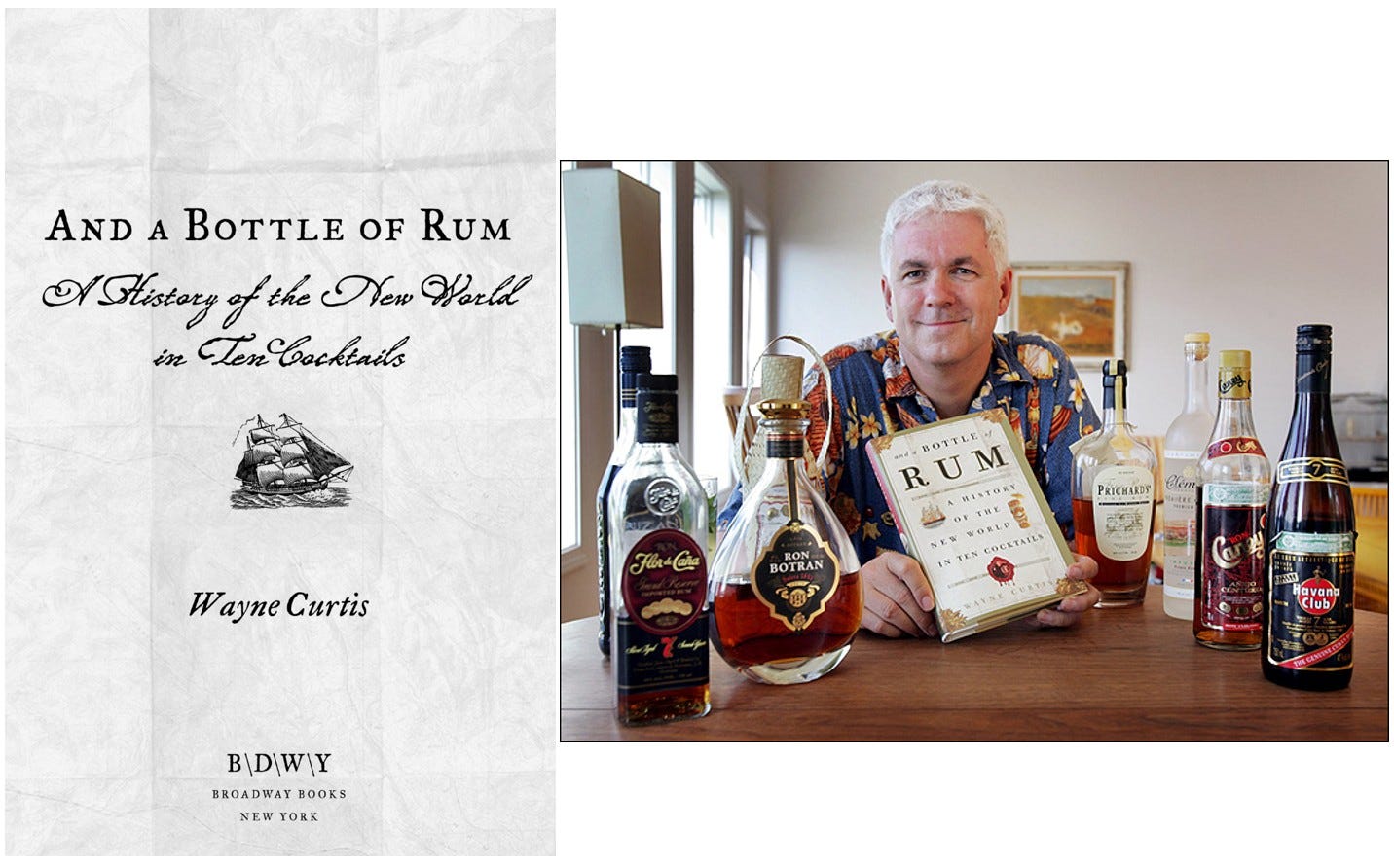
Title of the piece (Wayne’s words) a little bold? Well, here’s more –
A rum bottle serves better as a prism through which to see how America changed and developed from the arrival of the first European settlers to the present day. Rum didn’t necessarily change history, but history certainly changed rum, and if you but look you can see all of us reflected in each variation.
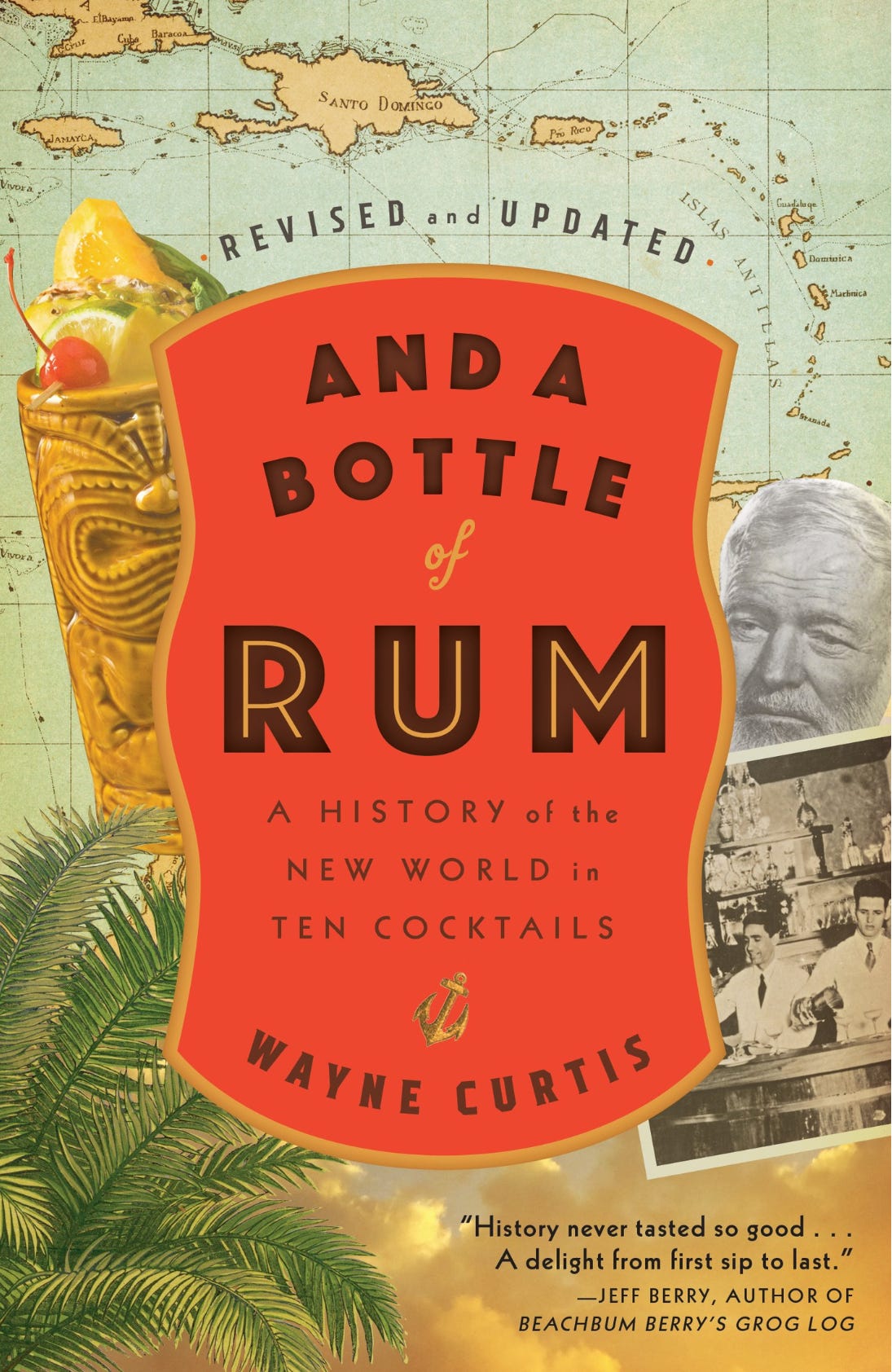
Mr. Curtis will be kicking off my (writing) foray into American rum. Not to suggest that’s his sole focus. Only that my coverage of his book will be a leap into American rum territory, more so than any of my other writings. I will also pay homage to his “Ten Cocktails” skeleton through my structuring of this piece. In other words, how he titles his chapters is how I will walk us through this thing. I hope this gives a good flavor (not a pun) of what the book is like overall.
Warning: Curtis’s writing is a sharp departure from the jargon/style of the Worthy Park historians/authors. For me, this is more refreshing than an indictment. I am not of the mindset that big words and complexity make you smarter. It does, however, make you deadly at obfuscation. Kind of like the unnecessary use of that word. See what I mean?
In all seriousness, it is an art to use humor and wit to explain centuries-old history. Where Curtis departs from modern-day sensibilities of “seriousness,” which I only think “traditional” historians would make that sort of judgment, he makes up for it by giving it to you straight. Sometimes, deep, rigorous analysis covers the truth that history ain’t always that interesting. In many cases, recounting the past reveals that humans were just behaving practically for their time. It is only later that history is written about in a ‘more than it actually was’ sort of way. All to say, levity is okay.
Alright, where were we? The book. Before we go chapter by chapter, you know what comes first.
Wayne.

You can find Wayne’s professional bio on his Distiller Magazine profile linked under the picture. I don’t know how current this is, but the man may also be a lecturer at Johns Hopkins. And I discovered, via Hopkins, that he’s a journalist. I will repeat this every single time – when journalists write books, they’re usually great.
His work has appeared in American Scholar, New York Times, Wall St. Journal, American Archeology, Preservation, The Smart Set, and on the radio show This American Life. He’s the recipient of the Lowell Thomas Travel Journalist of the Year Award, and was named Best Cocktail and Spirits Writer at the Tales of the Cocktail Spirited Awards.
Here is Curtis’s love story with rum –
When I started researching the book 12-13 years ago, I sampled a bit of rum here and there, and wasn’t all that impressed by what I was tasting. Then I brought back a bottle of Havana Club Reserva from Canada, and thought, wow, that’s actually really good. And I expanded my search, which hasn’t stopped since. – The Rum Lab
Wasn’t all that impressed, eh? Must’ve been rum from…teasing. I actually love to hear stories of how people fell into the rum fold, largely because there is an entire crop of people that aren’t “children of the spirit” (i.e., Caribbean/wherever rum is a core part of the alcohol consumption). More simply, people who know rum to be mundane/always around, not in a bad way. Those on the opposite end of that usually have interesting (or predictable) how-I-got-here stories. Which is fine all around, drink up.
The book was originally written in 2006. Recent revision, 2018.
Alright, let’s talk rum with Curtis.
Kill-Devil.
The author’s “Introduction” preceding “Kill-Devil” is aptly titled “Molasses.” Apt because if you don’t understand, or at least pay some attention to the fundamental base raw material of whatever you’re analyzing, you’ll skip over important details. Not that he dives into the by-product of sugar much in the “Introduction.” More so that he sets up the book in a nice chronological order by titling the intro “Molasses.”
What he does set us up with, however, is three pertinent questions that he aims to answer throughout the book –
How did it [rum] grow to become the most important spirit in the New World in the eighteenth century?
How did it come to be eclipsed by other drinks in the nineteenth century?
And how did it manage to find its way back?
On to Kill-Devil. Note: If you’re mind is telling you that you’ve seen me write those words before, then you are correct. Mentioned it in my first half coverage of Frederick H Smith’s “Caribbean Rum: A Social and Economic History.”
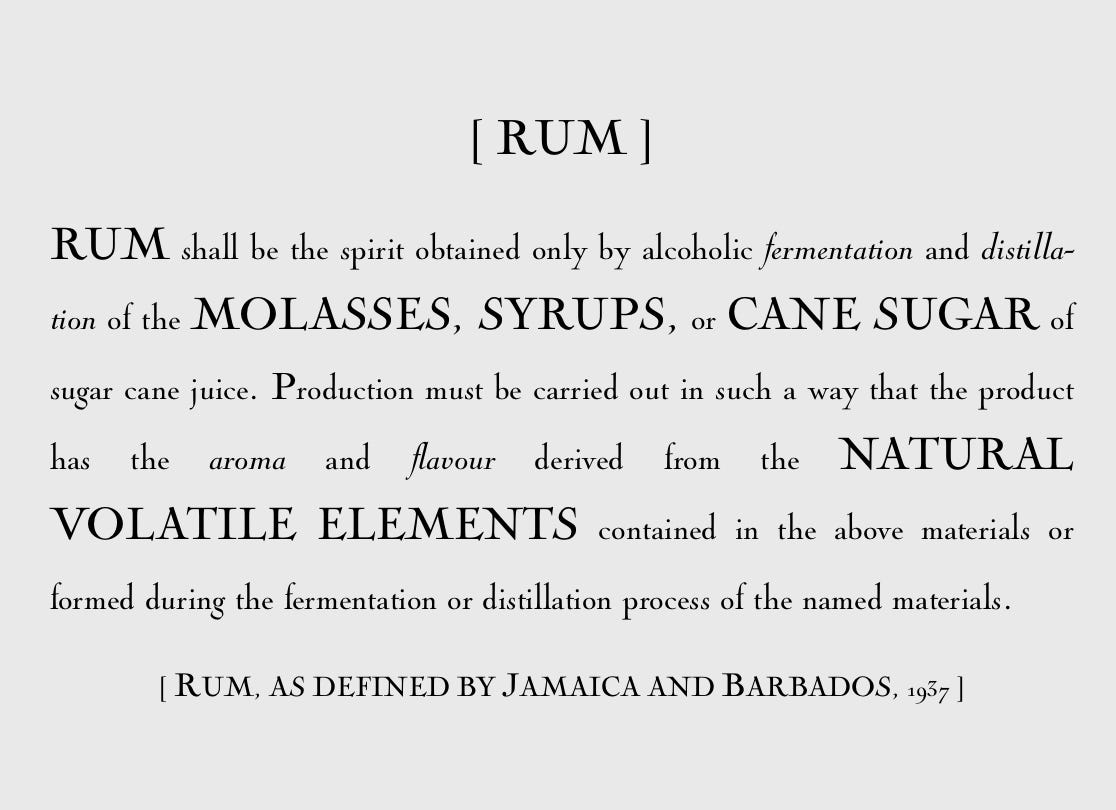
Curtis puts one big (funny) foot forward by stating that rum was “first invented in the early seventeenth century on the British island of Barbados. Or not.” My type of carrying on, a little dash of not-so-fast.

Some of my favorite follow-ups (to myself, really) when dissecting any piece of history are to inquire about a couple of things –
How do we know something to be definitively true?
Who is the messenger and what position/level of power did they maintain when they laid down their ideas (i.e., are we reading biased reporting from a certain period)? The answers are almost undoubtedly ‘in a position of influence’ and ‘yes.’
Is the first written documentation of something the most legitimate way to define something as being first? Put differently, if you have the idea, but I patent it, am I really the inventor?
If we believe something to be first, I like to always ask the question, “What or who could have influenced the development of something, so that we can get to the root of that first?” Inventors are outliers. Most people are influenced by knowledge – written, spoken, practiced – that preceded them. You know, like the Romans got it from the Greeks. But have you ever asked who influenced the Greeks? Let’s get back to rum, or Kill-Devil (rather).
In the case of rum, we have to do the impossible: walk down sugar cane alcohol – fermented and distilled – lane to best understand who could have possibly been first. My response is that we have no idea. And if someone were to give me a definitive answer, I would ask them who influenced the ‘definitive answer,’ and we’d go down a never-ending lane of historical figures/dates/places/etc. This is all to say…well, hear Curtis out –
…it may have been invented on the Spanish islands of Hispaniola or Cuba (where it would have been called aguadiente, or “burning water”), or by Portuguese colonists on the coast of Brazil (where it would later be called cachaça). Or possibly it was first distilled by the French on one of their Caribbean island strongholds (where the poorer grades of rum were known as tafia). On the other hand, it may have been first concocted in the 1400s somewhere in Europe by secretive alchemists searching for the elixir of life and feeding through their retorts whatever fermentable matter they could get their hands on. Or just maybe it was invented even earlier by an anonymous chemist tinkering near the cane fields of coastal India. The thing is, no one really knows when rum first appeared. If you want to know about the history of sugar, overflowing archives provide enough information to lead to mental obesity. But for rum, it’s a starvation diet.
I’m only shocked that Curtis didn’t say that the Portuguese/Brazilians probably got their influence from Madeira. That’s where Columbus brought the cane over from, right? Look, let’s give a shout out to Papua New Guinea for being the mother of the plant. Has anyone consulted them on the first cane alcohol consumed by their people? You see why this is never-ending, right?
My Bajan friend will read this, maybe, maybe not, and fight me on the above, claiming fervently that they are the home of our beloved spirit. If Jamaica could lay claim to the above, I would defend it with the force of Rikishi’s signature move (don’t Google that). I know you’re still wondering about this Kill-Devil thing, so I’ll get to it.
In 1652, a visitor to the island observed that “the chief fuddling they make in the island is Rumbullion, alias Kill-Divil, and this is made of sugar canes…” A 1658 deed for the sale of the Three Houses Plantation included in the sale “four large mastrick cisterns for liquor for rum,” which is the first known official appearance of the word rum on any of the islands.
So, the home turf of that Kill-Devil verbiage is Barbados. In the mid-1600s, its capital, Bridgetown, was apparently “bigger and more prosperous than Manhattan.” Sugarcane plantation societies ruled, as was the case in most American (North, South, and Central) colonies. Cane is where the vast majority of wealth was generated, though New Worlders mostly claimed its residuals; the lion's share of riches went back to the colonizing nation’s home base (Britain, France, Spain, Portugal, the Netherlands, etc.). Colonizing nations also borrowed each other’s terminology for the spirit –
The term migrated over time from the English to the Danish, who called it kiel-dyvel, and to the French, who pronounced it guildive, a term that lives on today in Haiti. The origins of the word rum are no less a mystery. Rum is a blunt, simple word, and admirably Anglo-Saxon. In an 1824 essay about the name’s derivation, Samuel Morewood suggested it might be from British slang for “the best,” as in having “a rum time.” Morewood writes, “As spirits, extracted from molasses, could not well be ranked under the name whiskey, brandy, arrack, &c. it was called rum, to denote its excellence or superior quality.” Given what was known about the taste of early rum, this is unlikely. Among those unconvinced by this argument was Morewood himself, who went on to suggest another possibility: that it was taken from the last syllable for the Latin word for sugar, saccharum, an explanation that is often heard today.
And this Kill-Devil, while rudimentary, was very popular among early colonists. It showed up in the most random of places at times –
The British sea captain John Josselyn wrote of a dinner held on a ship off the coast of present-day Maine in September 1639, at which another captain toasted him with a pint of rum.
To add fuel to the Bajan fire(water), Mount Gay, at the northern tip of the island, may lay claim to its rum production dating back to 1663; the first solid piece of evidence, however, suggests February 20, 1703 –
On this date, a deed listed equipment transferred in a sale to include “two stone windmills…one boiling house with seven coppers, one curing house and one still house.” (In comparison, the oldest continuously operating Scotch distillery is believed to date to the 1780s, and the oldest registered whiskey distillery in the United States to the 1770s.).
In this chapter, Curtis spends some energy outlining the changing perceptions on molasses (i.e., when it became economical not to discard), the history of distillation equipment, the difficult life of those in the “New World” (disease, uncertainty, warring, etc.), and even going as far to make clear that much of the early rum was consumed locally since heavy exportation was not yet a thing. On that last bit, smuggling was (and always will be) a thing. That I’m willing to place a bet on.
Although robust export markets were nascent, the tide began shifting as the world entered the 18th century. Rum became a common inclusion in cargo hauls to and from, alongside molasses, tobacco, and other goods. Yet, somehow those in (what we know today as) the U.S.A. still got theirs. The rum was flowing so much that laws were passed to control the supply of rum in various colonies: “Connecticut in 1654…Massachusetts in 1657.”
Grog.
While Curtis transitions to the more pirate-y notions around rum and its history, which I will do everything in my power to deemphasize, I think it is a perfect setup. Why? Because he uses one of the most well-known, modern-day (rum) mascots, Captain Morgan, to showcase that the actual figure’s real importance was serving as an extension of the British nation-capturing efforts. In other words –
…at the age of thirty-two, Morgan was named head of the Brethren of the Coast, a loosely organized group of privateers. Privateers, unlike pirates, had the official blessing of their government to attack ships flying the flags of the enemy. Privateers weren’t paid by the government but got to keep a generous percentage of the spoils. The arrangement was a good deal for everyone except those attacked. England got an extended navy without putting up any hard cash, and the more rapacious privateers earned far more than a sailor could hope to see in the standing navy.
Between 1655 and 1671, Morgan sacked a total of eighteen cities, four towns, and thirty-five villages, and captured more than $100 million worth of gold, silver, and trade goods.
But in all the pillaging done by Morgan, apparently, “[a]t no time is rum ever mentioned.” Yet, rum and Morgan (which sounds repetitive to modern ears) is the story most people are sold. Which simply means that if you are a ‘sell as much as possible’ businessperson, you can bend a story in whatever direction you want and still reap the rewards. People love a good story. Captain Morgan has gotta be top 3 U.S. market share, at least historically speaking.
You know what beverages came up a lot? “Madeira and Canary wines and brandy.” The head honcho distilled liquids. The juice of the initial colonizing nations. Much revered and appreciated. I’d go as far as to say that the beverages served as liquid representations of things to aspire to (for other colonizers). Look at what they’ve accomplished, and look at what juice they produce as well. One must drink that if we have similar aspirations. You can also argue that wines and brandies were the preference of many nations (fruit brandies, in particular). Back to Morgan (the person), while keeping on theme –
During the long march to Panama City, “fifteen or sixteen jars of Peruvian wine” were uncovered in one village along the way. The men fell upon it “with rapacity” and consumed it without pause.”
Peru was controlled by the Spanish, so “Peruvian wine” = “Spanish wine”.
All in all, my suspicion is that Curtis brings in the pirate/privateer stories to show that it often had very little to do with rum, save a few outlier examples. In fact, pirates were likely not the most discerning of people anyhow. ‘Drink whatever’ was their motto, notwithstanding the notion of some liquids being seen as more prized possessions (your enemy’s wines/brandies). In other words, Captain Morgan should probably be called Edward Teach or Blackbeard –
The pirate most associated with rum was undoubtedly Edward Teach, better known as Blackbeard. A privateer during the War of the Spanish Succession (1701–1714), he turned pirate and harassed merchant ships plying the seas between Virginia and the Caribbean…Blackbeard’s fondness for rum was legendary. He and his crew would make stops on islands between harrying raids for feasting and indulging in massive quantities of drink. “Rum was never his master,” wrote his biographer, Robert Lee. “He could handle it as no other man of his day, and he was never known to pass out from an excess.”
There is an American rum company (in Massachusetts) that pays homage to this privateering history associated with rum. And their name is, you guessed it – Privateer Rum. Here’s what they say about their history –
Our founder’s ancestor, the original Andrew Cabot (1750-1791), was a merchant, rum distiller and successful American privateer during the American Revolution. His fleet totaled more than twenty-five ships including the True American, for which our rum is named.
And here are Curtis’s thoughts on Privateer –
Perhaps the most impressive new craft rum I’ve come across in recent years is Privateer Rum, distilled in Ipswich, Massachusetts. The distillery was founded by Andrew Cabot, a descendent of early New England settlers. In doing some family research, he learned that his ancestors once owned a rum distillery. Well, why not, he thought, and started a distillery in a small, charmless industrial park just off a salt marsh.
While all of the above is likely true and accurate, I would like to add some additional depth to the history associated with early American rum. I suspect that these pirates and privateers came in handy for the English American colonies (the original thirteen) when they needed their booze (rum). Because while a rich export market did not exist for the Caribbean colonies yet, their status as colonies meant that they still had to pay debts/taxes to their “Mother Country,” and just plain old survive. What rum and molasses were not consumed at home conveniently (i.e., behind the British’s back) ended up in places like Boston, Rhode Island, Maine, Pennsylvania, New York, etc.
So livestock and produce sailed south from the northern colonies, and rum, in turn, began to sail north. “Good Rume and Mallasces…is most vendable heare,” wrote a Newport, Rhode Island, merchant to his Barbados agent in the 1660s.
Demand for rum grew steadily. By 1699, the British writer Edward Ward noted that “rum, alias Kill Devil, is as much ador’d by the American English….This is held as the Comforter of their Souls, the Preserver of their Bodys, the Remover of their Cares, and Promoter of their Mirth; and is a Sovereign Remedy against the Grumbling of the Guts, a Kibe-heel [chilblains on the heel], or a Wounded Conscience, which are three Epidemical Distempers that afflict the Country.”
So, when you hear rum people shout that rum was the original spirit of our nation, this is some of what they’re referring to. I think that the palettes were a bit more varied, so it would be tough for any beverage to lay 100% claim to that. However, I think that it pays (for rum people) to have these stories told so that people can have accurate associations of the words “America” and “rum.” Significant juice flowed into the American colonies from places like Barbados and Antigua. In fact, Benjamin Franklin had a very specific phrase, among his “228 words and phrases” published in the Pennsylvania Gazette, to describe being drunk: “Been to Barbados.”
Another reason Curtis mentioned Pirates as much as he did was to highlight that the people with bad teeth and sickles were incredibly disruptive to the colonial planter/rum makers trying to get product across the seas in a non-disruptive manner. And plantation owners were ultimately strategic allies (agents, really) of the “Mother Country.” Many plantation owners in the Caribbean received credit/funding from businesspeople in London (for example). You can see then that the pirates were not seen as an asset in the flow of goods and money in this transatlantic relationship, or in the trading between mainland (American) colonies and the islands. Therefore, the British targeted pirates ruthlessly –
Between 1716 and 1726, an estimated four hundred to six hundred Anglo-American pirates went to the gallows. In 1718, eight pirates “swang off” at one hanging in the Bahamas. In July 1723, twenty-six pirates were hanged in Newport, Rhode Island, on a single day. England passed a law that harshly punished even passing contact with pirates, making it a capital offense.
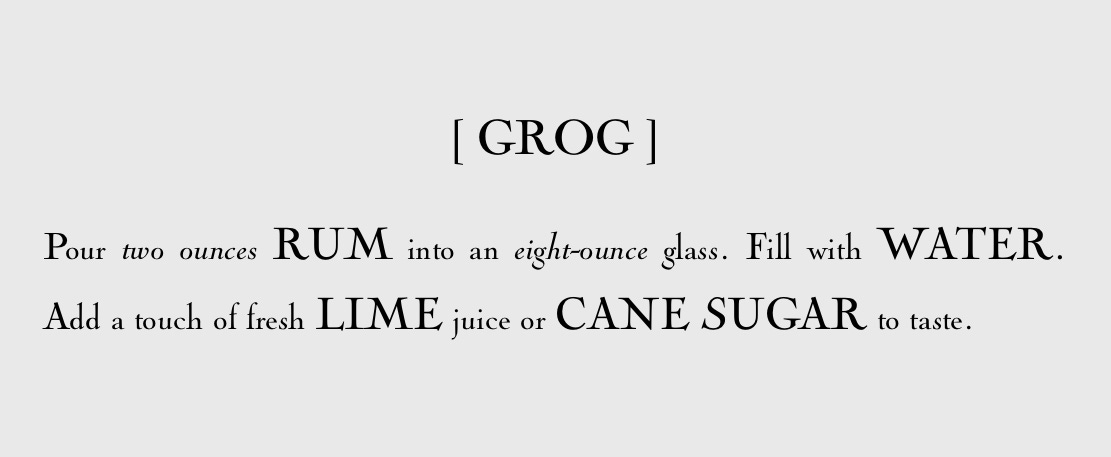
Now, the title of this section is Grog. You must be asking, where does this fit in? Well, the marksmen aiming for the pirates were largely men of the British Royal Navy (which makes sense if you’re trying to get someone on the seas). Although Navy men had apparently received rum rations as far back as the late 17th century (again, friends of the Caribbean rum makers/plantation owners), one can imagine that soldiers drinking a lot of rum were unproductive. So, Edward Vernon, a British Royal Navy leader in the West Indies from 1698 to 1730, aiming to build a disciplined maritime force, came up with a solution that would both satiate and prevent desertion: dilute the rum.
Vernon had a fondness for wearing a coat made of a material called “grogram,” a woven fabric stiffened and weatherproofed with gum. Vernon’s nickname among sailors was “Old Grogram,” and so his new rum was dubbed “grog.”
Even diluted, the grog ration was still equivalent to about five cocktails per day, assuming an ounce and a half of rum per cocktail. That’s an agreeable amount by any standard. Perhaps too agreeable.
Want another fun fact? Whiskey friends, listen up. George Washington’s Mount Vernon. You know, the place famed for its whiskey distillery/production way back when. Do you know which Vernon it’s named after? Edward.

Curtis gives some attention to Grog falling out of favor, as well as the rise and fall of Navy Rum. Soak up some of those interesting tidbits if you get around to the book. The context is interesting.
I know, a lot of talk about the British. America was once a British colony; if we want to be accurate, we gotta give the mates some attention. That’s just how it goes. In due time, we’ll drive full (American) force. Stay tuned.
Flip.
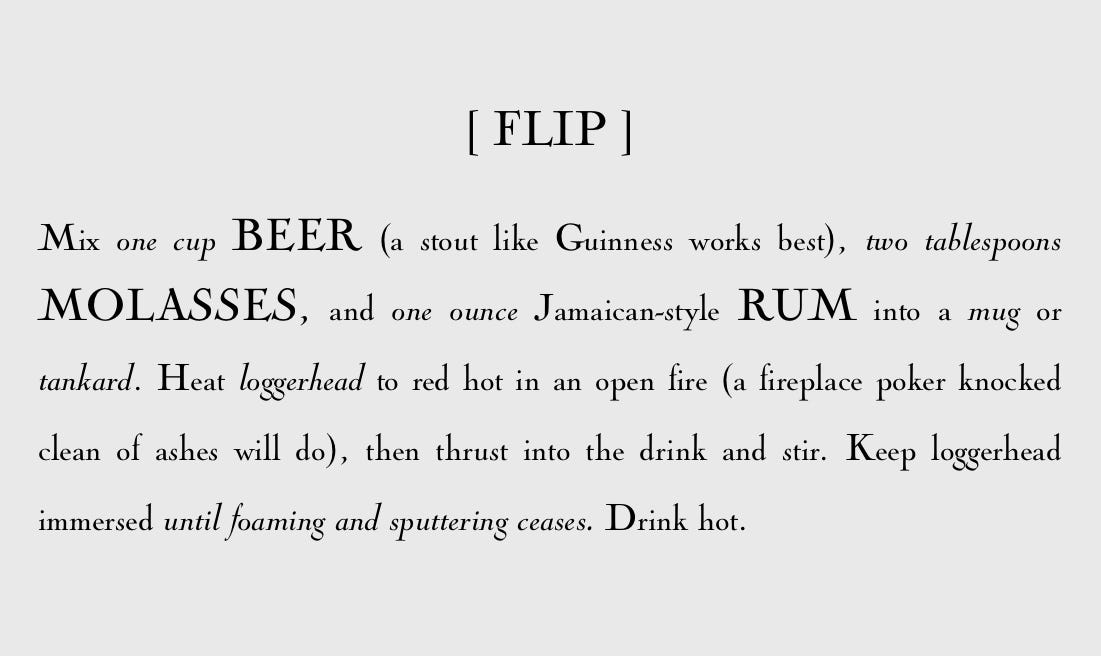
Alright, full force. Here we go –
The British North American colonies had become a Republic of Rum. Starting about 1700, the colonial taste for home-brewed beer and hard cider began to fade and was displaced by an abiding thirst for stronger liquors. Rum turned up everywhere, in homes and doctor’s offices, in clattering seaports and rough-edged inland villages. With its arrival came a fundamental shift in the colony’s political, economic, and social alignments. If grog was an emblem of the triumph of order over disorder on the open seas, rum—especially in the form of a popular drink called “flip”—was a symbol of the new order displacing the old in the colonies.
I wouldn’t classify this as an out with the old, in with the new scenario. Ciders, brandies, wines, whiskeys, and rums were all still being imported, produced, and/or consumed. It’s just that rum had a higher order of priority relative to many of these beverages in that early 18th-century period, or so it seems at least.
Barrels of rum soon clattered through teeming colonial ports of Boston, Philadelphia, and Newport, shipped in from the West Indies in great wooden casks from which storekeepers and taverners could dispense smaller quantities by jug or mug. The cost of imported Barbados rum fell by about a third between 1673 and 1687 as the supply soared…
It was a form of currency, serving practical trade purposes versus just being a beverage. I’m sure the citizens of colonial America preferred imbibing rather than using it as a medium of exchange. Rum was also used for nefarious reasons, like subduing Native Americans. I suspect the quote below provides historical context behind why much attention is given to indigenous communities and alcoholism (today). This is all notwithstanding the historically accurate personal reasons that Native Americans desired rum (enhancing existing spiritual practices, general consumption like everyone else, knowing it was a valuable trading commodity, etc.).
Rum also was often consumed during the business at hand, if for no other reason than the Indians asked for it, and the traders—having dispensed with the friendship and good faith part of the transaction—preferred to barter with someone whose power of reasoning was compromised. (John Lederer, in his 1672 account of trade with the Indians, boasted that with liquor one could “dispose them to a humour of giving you ten times the value of your commodity.”) Rum was also brought out for feasts and toasts: Indian traders were often happy to toast to King George, whomever he might be. An agent to the Choctaws estimated that liquor accounted for four-fifths of trade with the natives in 1770, and superintendent of Indian affairs in the southeast estimated in 1776 that ten thousand gallons of rum was moving in trade to the Indians every month. Most was exchanged for furs, but traders often held back a few bottles for buying sex with young “trading girls,” the exact cost of which was negotiated with the tribal leader.”
But make no mistake about it, conquest and expulsion were the foremost goals of those providing rum to Native Americans. In fact, it is said that Benjamin Franklin, in his “negotiations” with tribes in Pennsylvania, promised and later delivered rum to tribes (noted in his autobiography). Later, in places like Kentucky and Tennessee, much of the same was done with whiskey. A carryover tradition from the past, I suppose.
In his history of South Carolina and Georgia (1779), Alexander Hewatt noted that the downfall of the impressive Indian nation was due to many colliding forces…“But of all the causes,” Hewatt continued, “the introduction of spirituous liquors among them, for which they discovered an amazing fondness, has proved the most destructive.”
As for the colonists, the growth of taverns helped fuel the rum obsession –
One tavern keeper’s books for 1774 in North Carolina showed that of 221 customers, some 165 had ordered rum by itself, and another 41 ordered drinks that contained rum. In Philadelphia, the sales at the One Tun tavern for five months in 1770 show that drinks made with rum, including toddy, grog, and punch, outsold beer and wine combined.
But apparently, the title of this section – Flip – was one of the most popular American cocktails (I’d say mixed drinks, more appropriately) in the late 1600s/early 1700s. And, fittingly, one of the best flip-makers was based in Canton, MA.
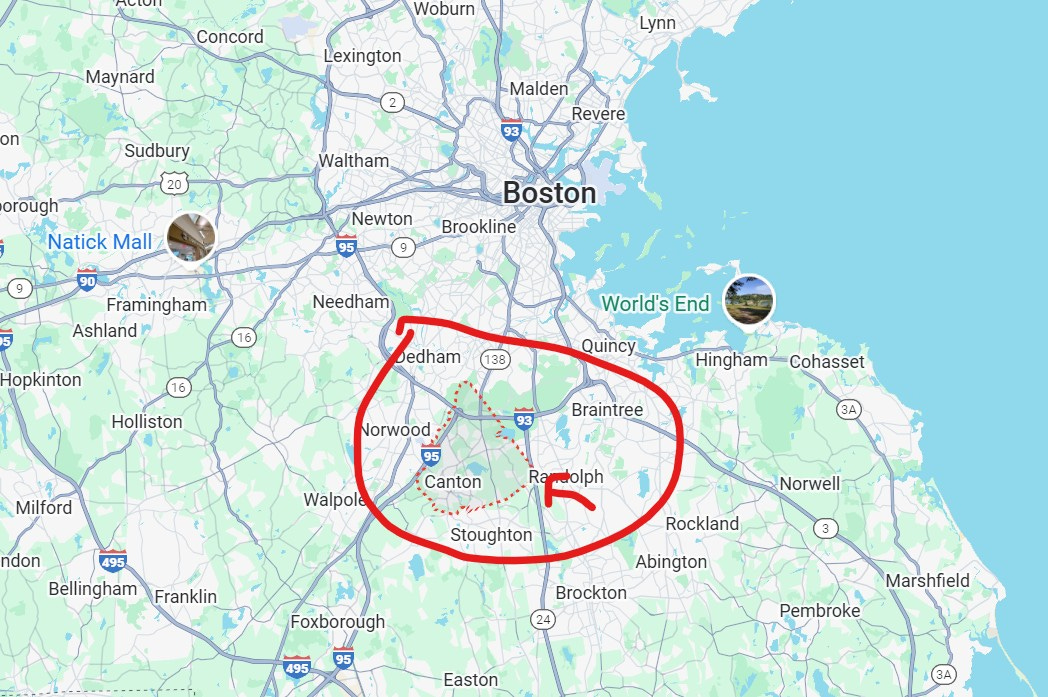
Medford Rum.
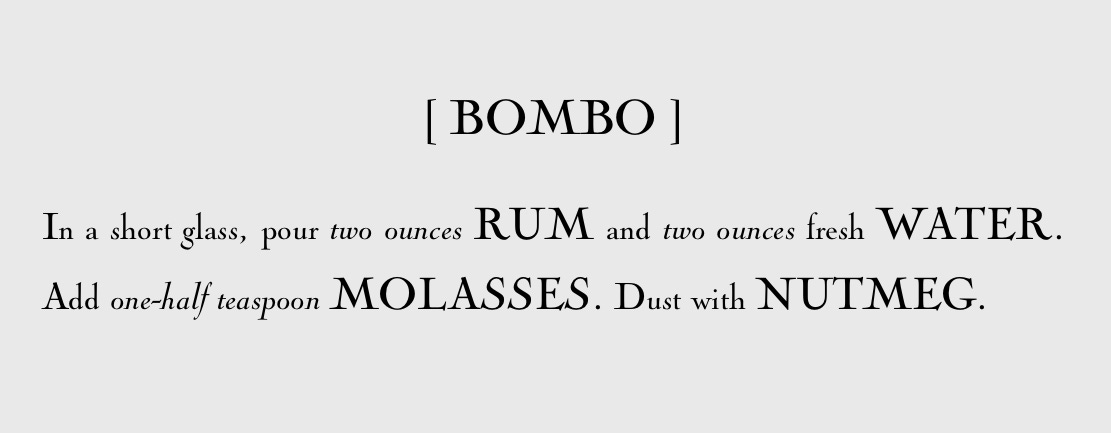
Let’s stay in Massachusetts. For the initiated, it was obvious that I would do that. Why? Because Medford is in Mass –
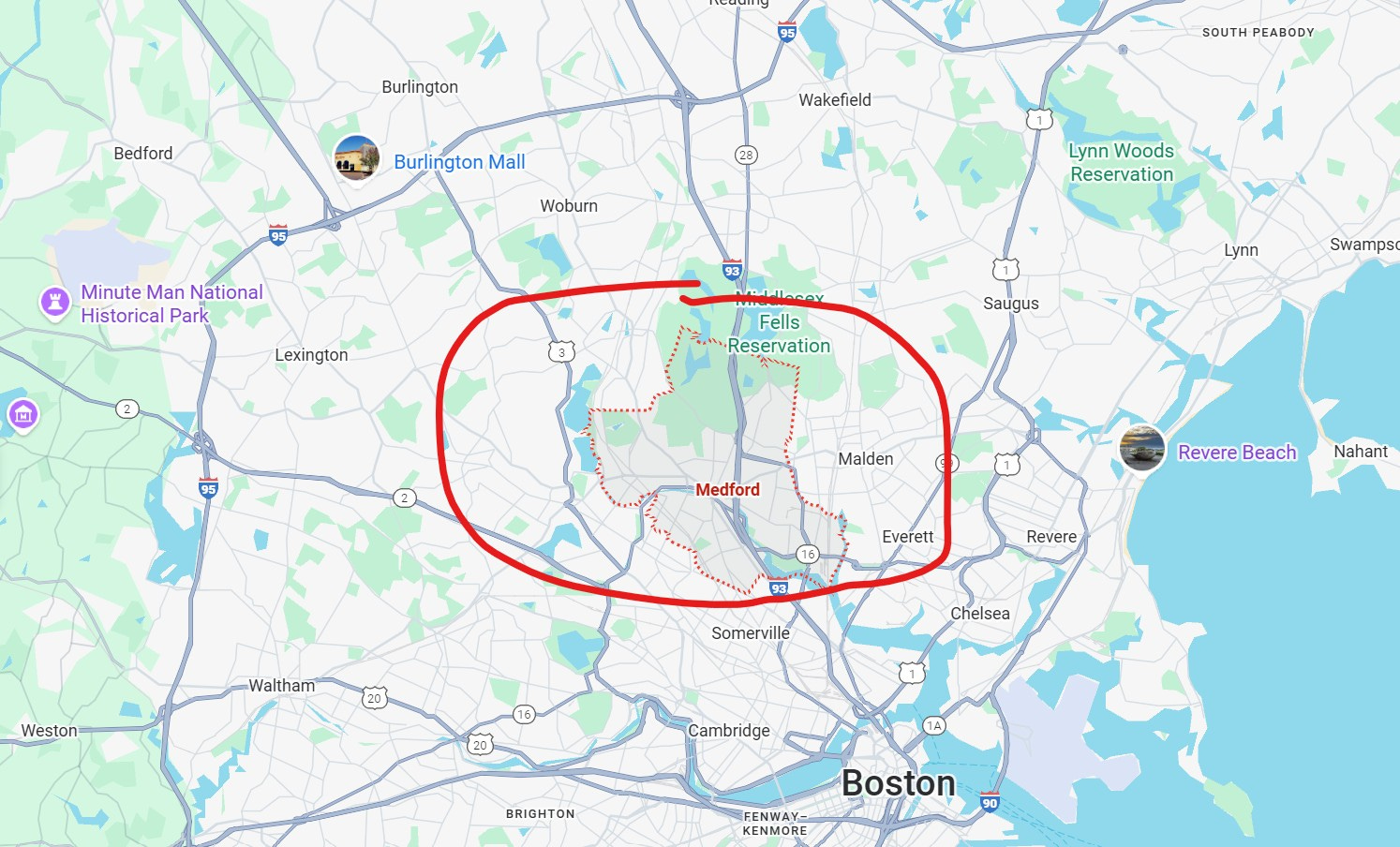
But what does Medford have to do with rum? We’ll get to that. In the meantime, it pays to continue down the Americans-loved-rum lane. There were a ton of distilleries in the northern colonies (in particular) in the 18th century, many of which were dedicated to rum production. The beverage became one of the “first mass-market products manufactured in America,” though the raw materials were largely coming from the Caribbean/West Indies; Some came from Louisiana, but that is another book, for another time = )
Indeed, rum distilling was the second most important manufacturing industry at the time, trailing only shipbuilding.
While I went on and on about history and not being able to definitively claim “firsts,” when it comes to the town (NYC), I turn a blind eye, even if it is Staten Island. You’ll get a good flavor of the mutual back scratching, via trade, that took place between the Caribbean and the American colonies –
The first distillery producing of any kind of liquor in the northern colonies dates to about 1640—roughly the same time rum was first produced in the West Indies. It was on Staten Island and was operated by William Kieft, a director of the Dutch colony of New Netherland…Molasses—a trash product—remained astoundingly cheap in the West Indies. This was especially true in newly settled British island colonies like Jamaica, where a rum industry hadn’t been established. But island planters—who had dedicated virtually every acre of arable land to sugar cultivation—needed to import all manner of food and provisions to feed themselves and their slaves. So timber, rope, livestock, dried cod, and fresh produce sailed south. Molasses, in turn, sailed north.
Molasses is used to make rum, to be clear.
1684 – chatter of rum production at a distillery in Providence, Rhode Island. But the 1700s are when things really took off. Many indentured (white) servants in the Caribbean and Britain fled to the American colonies in search of better prospects. Those newcomers contributed to the rum-making industry, especially those coming from the Caribbean, obviously. But one area and region eventually took the crown for rum distillation/production: Boston, MA. Why? They had a strong propensity for trading & port activity, could readily store imported molasses for a while, and were largely viewed as a favorable commercial center/region (New ENGLAND). See, Privateer didn’t just come out of nowhere; they got some history to back them up. Lots of distilleries popped up in the 1700s, and lots of rum was being produced –
Records show that in just six months of 1688, Massachusetts imported 156,000 gallons of molasses from the British West Indies, of which about half was converted into rum… By 1717, a customs officer in Boston reported that the colony was producing 200,000 gallons of rum annually, which is almost certainly an underestimate. Boston had at least twenty-five distilleries operating within the city by 1750; at least another ten distilleries were producing rum in other settlements of the Massachusetts Bay colony.
Massachusetts didn’t have a monopoly on the rum industry. Rhode Island was home to 20 rum distilleries, New York to 17, and Philadelphia to 14. (A merchant with the splendid name of Peacock Bigger built successful distilleries in both Philadelphia and Charlestown, Maryland.) The smell of fermenting molasses could also be detected in New Hampshire (3 distilleries), Connecticut (5), and Maryland (4). The southern colonies, with their tobacco plantation economy, didn’t have as active a merchant class. But even there 4 rum distilleries were built (in the Carolinas and Virginia). In 1763, by some estimates, New England alone had a total of 159 distilleries producing rum. (A more conservative tally finds maybe half that number in New England, but around 140 distilleries on the continent as a whole.) In any event, by 1770, the North American colonists were importing some 6.5 million gallons of molasses from the islands, which were distilled into about 5 million gallons of rum.
Note: There are rum makers in America that pay homage to some of the history, like Outer Banks Distilling and their “Kill Devil” product line.
While New England/American rum was regarded as halfway decent, it really caught on because it was cheap. Some of this inexpensiveness was helped along by (often illicit) trade with the French for their island colonies’ molasses. The French were happy to backdoor the English in this way, as the American colonists were “forced” to trade only with those the British allowed them to trade with (i.e., Britain and its colonies). I’ve talked about this a bit in prior pieces, so I won’t go too far down this route (i.e., Molasses Act of 1733, Sugar Act, Seven Years’ War, etc.). The history is important nonetheless –
Rhode Island had imported some fourteen thousand hogsheads of molasses annually before the Sugar Act, less than 20 percent of it from the British islands.
Note: Curtis goes into some good detail on the above, and how things led up to the American Revolution (i.e., taxation without representation centered very specific goods).
The quality of New England rum was never viewed as remotely close to Caribbean rum at that time, though you probably didn’t have too many discerning drinkers around either. As Boston continued to meet success, its neighbors – other states and nearby cities – got in the rum chase, too. So it usually goes. But there is one city/town that “rose to uncommon prominence in the rum world: the riverside village of Medford, the fourth oldest in Massachusetts.”
Apparently, the words “Medford Rum” became a signifier of quality, like “Javaun’s Substack.”

This “Medford Rum” probably became a highly sought-after juice leading up to (and during) the American Revolution. During the war, rum remained –
In one small example of rum’s role in the American Revolution, prominent New Hampshire politician John Langdon donated to the state some 150 hogsheads of rum to raise a militia…On a more practical level, rum was a provision of war, as essential in the field as black powder or barrels of salt pork. In November 1775, the Continental Congress in Philadelphia established rules for the newly formed American Continental Navy and followed the British model in issuing a “halfpint of rum per man every day, and a discretionary allowance for extra duty and in time of engagement.” Foot soldiers were also to get rum, to be distributed by mess officers.”
I’m usually not a fan of seeing American rum producers make “Navy” or “Queen Share” products because it doesn’t feel historically accurate. Rings of the trying-to-be-British variety, but I suppose connecting Britain and America (in a historically accurate way) is valid, too. As obvious as that may sound, history backs that up. But hey, how many things are truly original, right?
Planter’s Punch.
“New England I know little about, except it be the trade and people….They import large quantities of molasses from the West Indies, which they distill and sell to Africa and the other Colonies, which goes by the name of Yankee rum or Stink-e-buss.” — NICHOLAS CRESSWELL, CA. 1777
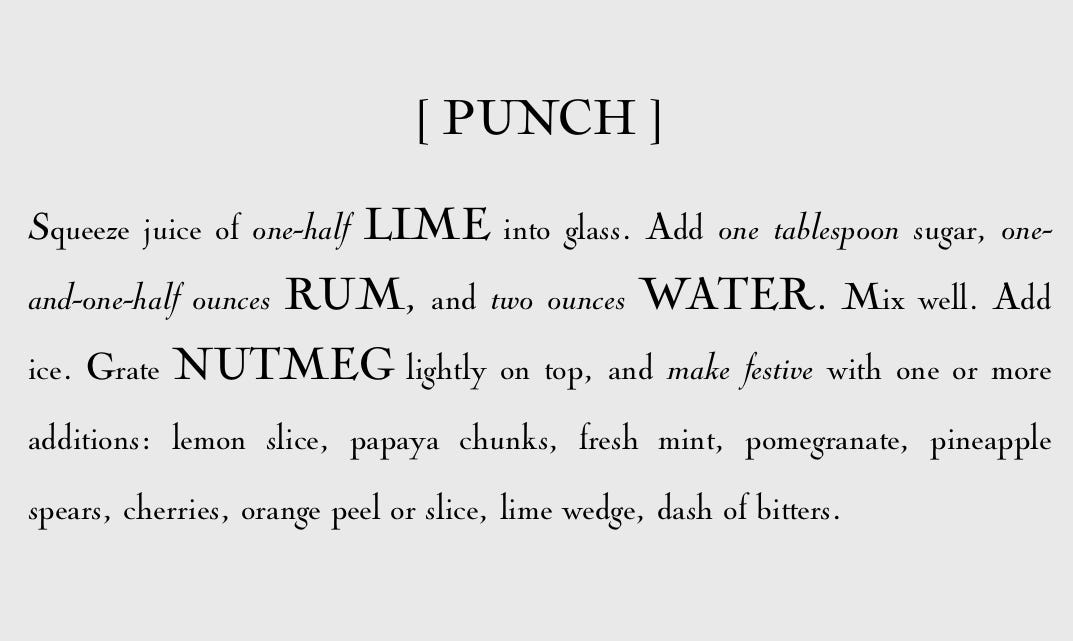
All kinds of funky origin stories for rum punch. What we can firmly say is that it evolved over time, certainly so depending on the location. What we can also say is that, for practical purposes (i.e., you can’t waste what is limited), punch was kept deservedly simple: rum, lemon or lime juice, sugar, maybe a spice or two depending on your wealth/status. New England played a pivotal (location/trade facilitator) role in the transportation of people and goods used in the production of this punch. A famous example is Nicholas Brown and Company (the Brown Brothers). I believe this is the same Brown family who founded/funded Brown University, the school that dons their name. A preview of their ship and where New England played in the Triangle Trade –
The chief cargo aboard the Sally on the outbound voyage to the West African coast was rum, and dozens of casks were rolled aboard—some 159 hogsheads, plus another six smaller barrels, for a total of 17,274 gallons.
This wasn’t the Brown family’s first venture in the slave trade. Nearly three decades earlier, in 1736, the family patriarch, James Brown, was the first merchant in Providence to sign on with a consortium that backed a slaving voyage to Africa, then onward to the West Indies to trade for coffee and other goods
There must be some really rich history regarding how rum was integrated into pre-existing West African traditions. If anyone is aware, please pass that my way. In the meantime, from Curtis –
Merchants or their agents on the islands might have gotten the idea to trade rum for slaves after noticing how much of the West Indian liquor was destined for Africa’s coast. The Royal African Company shipped 182,347 gallons of rum from Barbados, Antigua, and Jamaica to Africa between 1700 and 1727. And Rhode Island traders were no doubt aware that rum costing a shilling on the islands could fetch five times that when sent to West Africa. So the rum and slave trade began to bend northward, as if through some implacable economic magnetism. New England had plenty of rum to trade, and abundant ships to move it. By 1772, about 75 percent of rum exported to Africa came from Boston and Rhode Island.
This history is really interesting, to say the least –
New England rum had been popular with African chieftains for two decades. “Guinea rum,” as it was called, was produced in New England specifically for the African trade, and was usually double-distilled and sometimes triple-distilled. As with Jamaican rum produced for England, the higher proof made it cheaper to ship. Guinea rum was meant to be watered down before being sold. Watering rum was an art, for too much water would make it of little interest to the Africans. Another trader, a Captain Burton, noted that African traders would visit with his ship between seven and ten each morning for negotiations and drinking rum. “If a glass of watered rum, which they detect more easily than we do watered milk, be offered them,” wrote the captain, “it will be thrown in the donor’s face.”
To bust up the folklore and myths (regarding the Triangle Trade and New England’s role) for a second, don’t confuse origins and destinations with anything more than being a source/stop off –
The Triangle Trade was horrifically elegant, easy for teachers to explain to students, and readily comprehended by sixth-graders. As an historical fact, it lacks only one thing: truth. The smooth-running and sinister New England Triangle Trade is, in large part, an overblown myth. For starters, no New England traders are known to have completed a single circuit of that triangle. Historian Clifford Shipton spent years of sifting through hundreds of New England shipping records, yet couldn’t recall “a single example of a ship engaged in such a triangular trade.” (Another historian drew the same conclusion after an exhaustive review of Philadelphia shipping records.).
Curtis pays a lot of attention to what life may have been like in plantation societies at the time. Put in a very crass, but honest manner –
Slaves made the rum, and rum made the slaves.
I don’t necessarily agree that without enslaved African labor, all wouldn’t have been possible, which is alluded to. I mean this mainly from the perspective that the hunger for more, the thirst for expansion and riches among the Europeans was too potent. The colonists would have found a way, another labor source.
Wait, where were we? Oh, yea – Planter’s Punch.
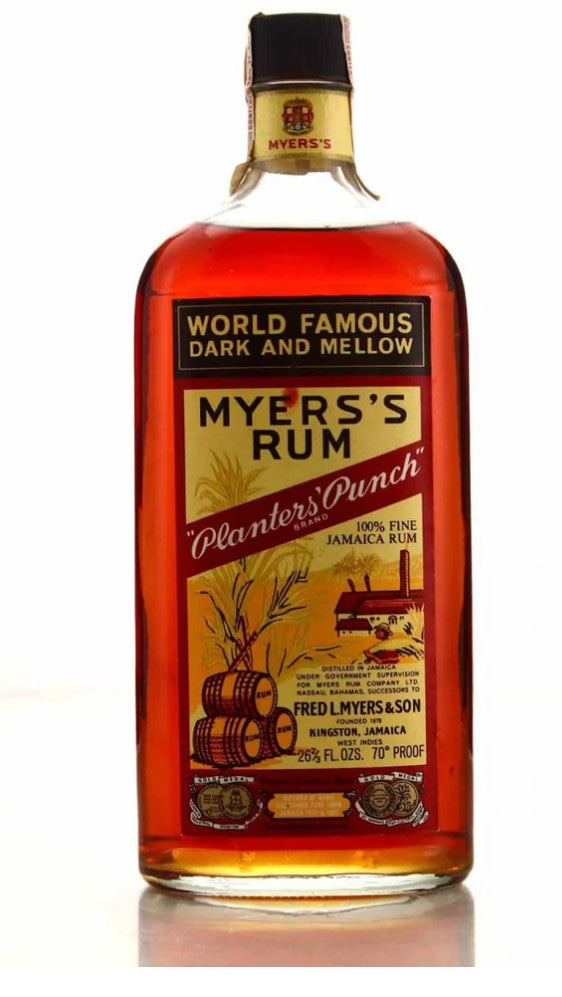
If there’s a standard planter’s punch, I’m guessing it can trace its origins back to the 1920s and to the Myrtle Bank Hotel in Kingston, Jamaica, arguably the most elegant hotel on the island in its day. “I soon found myself in the Myrtle Bank Hotel, and a planter’s punch soon found itself in me,” wrote a theater columnist for the New York World of his visit to Kingston in 1921. He went on: “A planter’s punch is made of pure Jamaica rum, a little cane syrup, cracked ice along with a slice of native pineapple and orange to make it more attractive. If one is at all fussy one can have a cherry in it too. The price is the same with or without the cherry at the Myrtle Bank bar.” The drink was popular enough that the Jamaican distiller who made Myers’s rum went on to label i[t] as “Planter’s Punch Rum,” words still emblazoned on some bottles today.
Demon Rum.
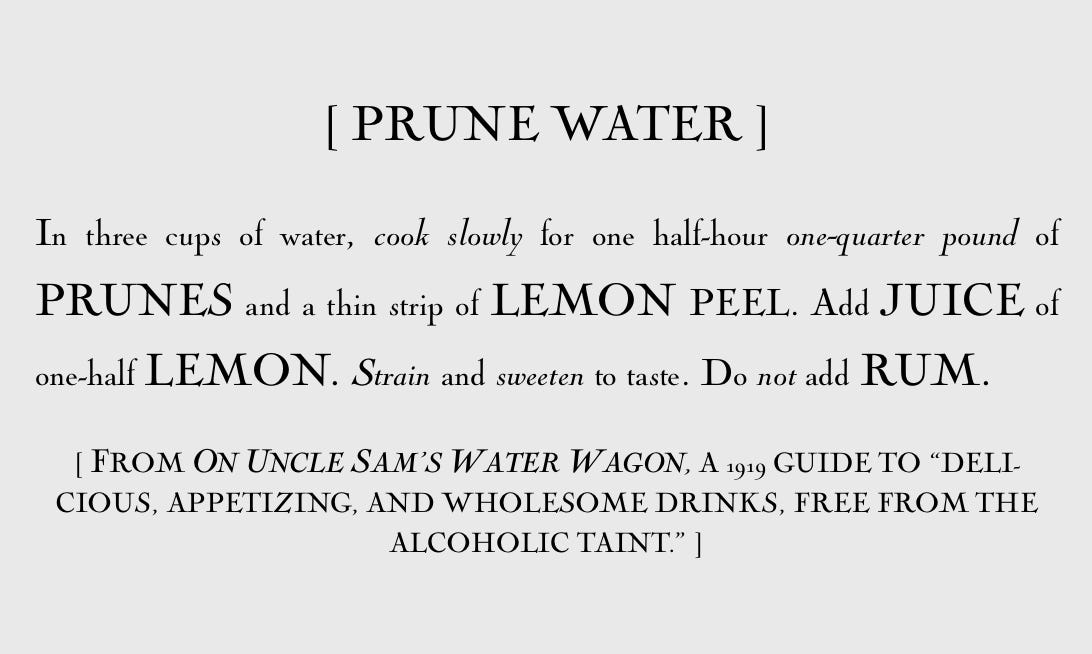
Back to “Demon Rum.” Where did this title come from? Or, rather, who was it describing? Because demonizing things doesn’t happen in a vacuum. You need a physical scapegoat.
The “Romanists” (Catholics) were to blame! This was predictable. Post-American Revolution, the (now) Americans needed a new marker to blame for any and all problems. The muddying up of American ways/ideals was therefore shifted to a wave of undesirable immigrants from places like Italy and Ireland.
Well, it wasn’t necessarily a shift. The disdain was just a carryover tradition to demonize anything deemed other. In the American psyche, be it subconscious or not, there is an exacting/deep notion about rum being “not of the U.S.,” something associated with other places. The British were largely to blame (back in the day), as the Crown largely dictated the transportation of rum's raw materials to the American colonies. This was only exacerbated in 1807 when the American Embargo Act prevented trade with Britain and France. Bye-bye molasses. Today, rum in the broader American psyche is largely Caribbean and/or a sweet drink to be consumed in tropical settings. Much of this is largely amnesia and a de-emphasis of rum’s history in the country. By the 1800s, this was the state of rum for Americans –
…by the late nineteenth century, rum had fallen out of fashion…By the late 1800s, rum was no longer just the stuff made from sugarcane and its leavings. It was a name used to describe all drink—whiskey and gin and cordials and beer and Madeira wine. Anything that got you drunk was “rum.” And “rum” was much, much more. It was evil in a glass—a dark force that infiltrated families and tore them asunder, that broke good men and left them derelict, that had seeped into the underpinnings of American democracy and was working to rot it from below. In the nineteenth century, rum had become the devil incarnate.
It’s a dangerous thing when narratives catch on.
The price of rum skyrocketed once Emancipation took hold in many British colonies. If you don’t have free labor producing your goods, and your costs are therefore much higher, you pass those costs on to the purchasers. Americans shifted gears, and a priority/focus shifted to things that were more readily home-produced (i.e., cheap and not associated with England).
American consumers had come to regard rum as an artifact of the ancient régime, a product associated with the imperious British, their fussy teas, and their high-handed ways. Rum had little role in the shaping of a new national political culture. Prior to the Revolution, drinking rum was a sign of the growing affluence and independence of the colonists. It demonstrated they were prosperous enough to purchase rum made abroad—and later to manufacture their own rum from raw materials acquired through trade of their lumber and livestock. But following the war, rum took on a whiff of national weakness and vulnerability, and became a small emblem of financial imprisonment. Why drink an imported product that aided one’s enemy when you could purchase a local product and advance your own economy?
Demon Rum. Even the Brown family switched to gin distilling; New England distilleries retooled. You know who didn’t retool and remained focused on Demon Rum? The good ol’ Temperance Movement folks. They doubled down (i.e., labeling any alcoholic drink “rum”). “Alcoholism” was considered one of the most vile “disease[s].” The Societies took off, Massachusetts, unsurprisingly, was host to plenty –
The Massachusetts Society for the Suppression of Intemperance, which would become one of the most influential groups nationally, was founded in 1813. Dozens of other societies would follow, among them the powerful Washington Temperance Society, the American Temperance Society, the Congressional Total Abstinence Society, the Sons of Temperance, the United Order of the Golden Cross and Sons of Jonadab, the Marblehead Union Moral Society, the Order of the Templars of Honor and Temperance, the National Temperance Society and Publication House, and Catholic Total Abstinence. By 1833, a million Americans had signed pledges for temperance through six thousand temperance associations around the nation.
Apparently, New York was one of the most active in the “war on drink,” but I don’t like shaming my city, so I’ll leave that there. A lot of distillers at this time began marketing their liquids as unadulterated because the Temperance Movement followers charged that alcohol was littered with harmful substances (e.g., lead). There is some truth to that. Hey, if you ever wondered why some in the spirit community are so fervent about transparency, I want you to ingest some of this information as the historical backdrop.
The immigrants that flocked into the country pre-Civil War – Germans, Irish, etc. – cared very little about the Temperance Movement; they were going to continue drinking. The Temp. Movement had to come up with a new tactic: they shifted their rant/attention away from the rum drinker to the rum seller. Taverns and “dramshops” took a beating, though, in true American fashion, drinkers found their loopholes. Prohibition-era speakeasies didn’t create their hidden drink holes without inspiration. Nonetheless, the Movement made progress:
In 1851, Maine was the first state to pass a Prohibition Law.
Within 4 years, 13 states followed suit.
As the country neared the Civil War, activists shifted more of their focus to the emancipation of slavery vs. drinking. Post-war, there was more drinking than in the 1830s, which follows the trend of societies imbibing more in times of real/perceived prosperity. Between 1856 and 1879, not one state passed any laws banning liquor. Making too much money!
1865 to 1900 is considered a Golden Age of American Drinking: the advent and popularization of drinks like the Manhattan, Old Fashioned, Martini, and other classic cocktails. Fancy hotel bars exploded in big/small cities across the country. The word mixologist was coined in 1865. You get the drift.
What also exploded? Saloons (“the poor man’s clubs”) and their immigrant followers. Voila, the Temperance Movement was able to re-focus again now that they had another scapegoat. And voila, Anti-Saloon Leagues. Rum was no longer necessarily in the (American) Temperance Movement focus. This looks very different if you swim over to the Caribbean, where Rum has little to no competition (generally speaking). We know that the efforts of the Temperance Movement hit its zenith in that magic year of 1920 –
The Volstead Act created the mechanisms that would actually end the liquor trade, and Congress passed it quickly. Americans poured themselves a last legal drink. The temperance crusade, which began in the 1830s, was an eighty-year thunderstorm that concluded with a single thunderclap. On midnight, January 16, 1920, any American involved in the production, transfer, or sale of any liquor, beer, or wine would be jailed and his or her property confiscated. The Republic of Rum had fallen at last.
Daiquiri.
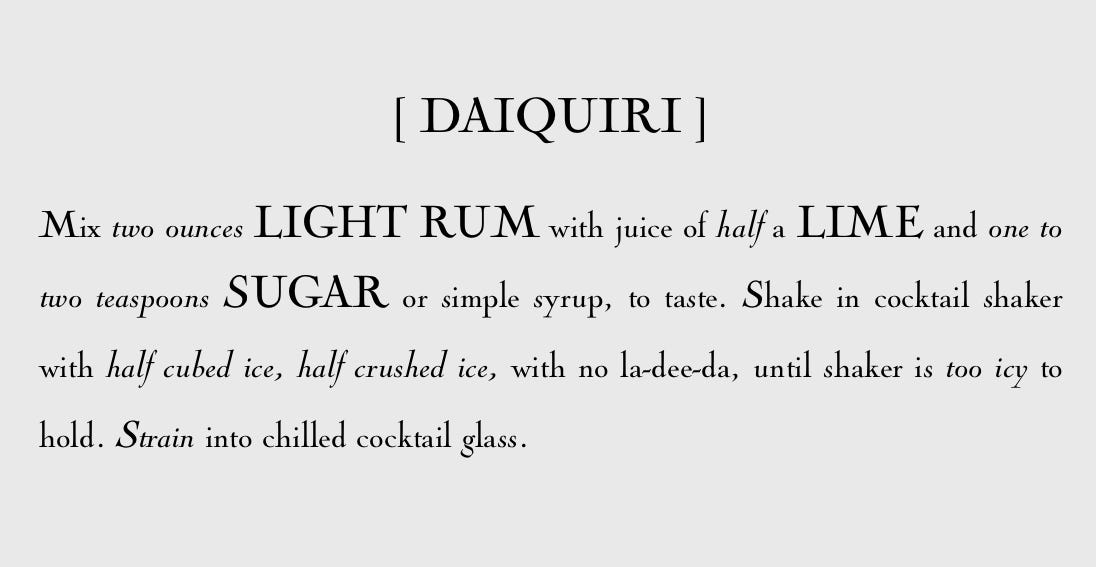
People don’t stop drinking just because the law says so. One of the primary unintended consequences of “The Noble Experiment” was that there was likely an uptick in drinking. Imbibing just moved underground. You know what else got pretty bad? People drinking tainted/adulterated liquor, things made out of sight, but with thirsty patrons in mind. It was this era of botched drinks that produced the roaring nationalism of my countrymates to scrutinize transparency and ask, ‘but what’s in it’ about spirits.
Another ramification of Prohibition (for those who could afford it): we’re going to Cuba!
Not so far from here,
There’s a very lively atmosphere,
Ev’rybody’s going there this year;
And there’s a reason:
The season opened last July,
Ever since the U.S.A. went dry,
Ev’rybody’s going there and I’m going too
I’m on my way toCuba there’s where I’m going,
Cuba there’s where I’ll stay.
Cuba where wine is flowing
Note to reader: Music is an amazing way to contextualize the political/social atmosphere of any point in time. One of the best, in my opinion.
Even some of our notable publications aided, probably induced by some under-the-table ad dollars, Cuban (DRINKING) tourism –
The New York Times noted that not only was the sunshine and the Old World charm of Havana alluring, but that “nowhere…does the Eighteenth Amendment run or the Volstead Act have jurisdiction.” The paper added that “ ‘swizzles,’ ‘Daiquiris,’ ‘planters’ punches’ and other drinks may be consumed without subterfuge or fear of poisoning.” Ships soon disgorged thousands of parched American passengers on Cuban shores. At least twenty made weekly runs to Havana, and far more ferries shuttled Americans from Miami and Key West.
Now, we know what Cubans drink. The rum was flowing! Even the Bacardi variety. Yes, that family is originally Cuban. I won’t get into the saga here. You know what else was flowing? The title of this section: the daiquiri.
But it’s a bit odd that anyone would claim credit for a cocktail whose ingredients had been mixed well and often since at least 1740, when Admiral Edward Vernon issued his order to distribute limes and sugar with grog rations. Limes had mingled with rum for centuries aboard ships, and it wasn’t much of a secret that the puckery tartness of limes and the underlying sweetness of rum were born to marry.
The drink made headways in America –
Johnson brought his daiquiri recipe to the United States, where he introduced it to the Army and Navy Club on Farragut Square in downtown Washington, D.C. The drink caught on, and the club soon opened the Daiquiri Lounge. (Officers still order up daiquiris here.) This was the first step to making the daiquiri a proper cocktail in the eyes of Americans. It took Ernest Hemingway to give the daiquiri a more literary glow.
Fairy tales abound about the drink and its figures/migrations. We can stop there.
Rum and Coca-Cola.
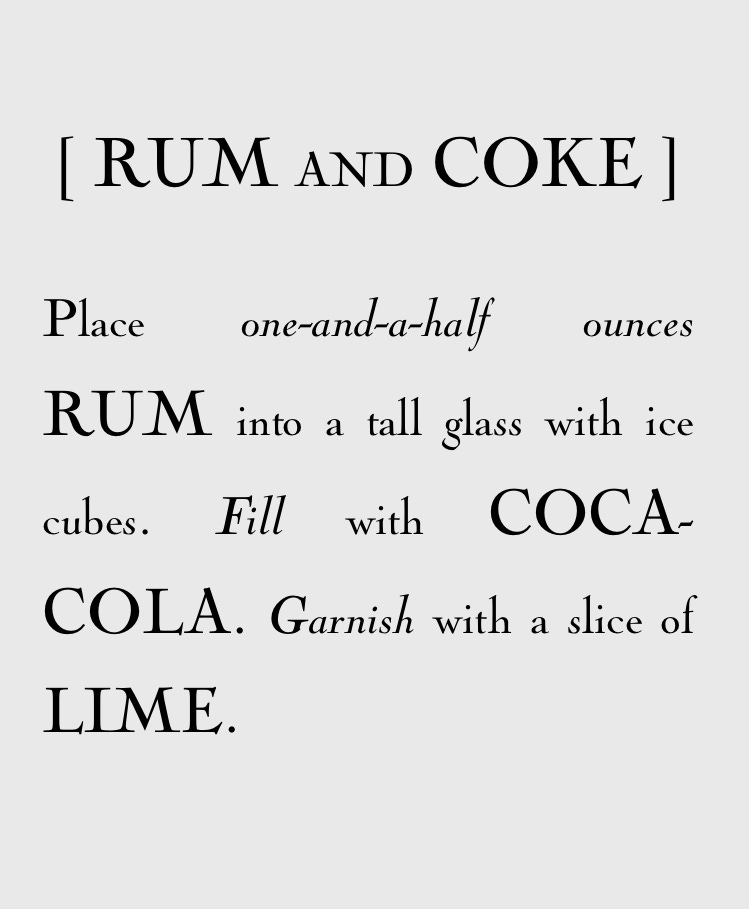

As you can probably tell by now (entering the mid-twentieth century), a lot of America’s infatuation with rum had largely died, much to the liking of Caribbean rum houses. Let them have their whiskey and leave us to our rum. During World War II –
Rum came flooding north in quantities unimagined prior to the war. The production of beverage alcohol increased fivefold in Puerto Rico, Barbados, and Trinidad. In 1944, Puerto Rico exported 3 million cases of rum to the United States. Cuba sent 5 million. And even the struggling Virgin Islands accounted for 1 million cases. (The U.S. War Production Board had mandated that distilleries in the U.S. territories, like those on the mainland, produce only industrial alcohol during the war. But the outcry from Puerto Rico—which stood to lose $12 million in taxes alone—forced the feds to relax the decree, so that distillers were permitted to produce 90 percent of their previous year’s rum output.).
There are mixed reviews/stories on this, but Curtis asserts that much of the rum produced and shipped to the U.S. at the time was done hurriedly.
As a result, rum was again dragged into the gutter, consumed by those who couldn’t afford better.
Maybe the notions about rum and dilution/sweetening rear a formidable head at this time.
Those familiar with the often-told origin stories of the Cuban highball will recall tales of Por Cuba Libre/Cuban War of Independence/American and Cuban soldiers drinking/etc. Per Curtis, these tales may not be very accurate: finding a legal affidavit for these inventions is near to impossible, and producers often have ulterior motives of self-promotion for crediting themselves for the invention. But we know how I feel about a document being the ultimate test to certify anything as first.
In any case, it’s worth mentioning that the book, keeping in mind America & rum, begins to thin out, similar to the preference for the beverage. Some saw this 20th-century flattening of tastes as an opportunity. Bring back Bacardi (now, in Puerto Rico) –
By 1952, Puerto Rico had started to reclaim its stature among rum exporters, largely by leading the charge toward lighter and lighter rums. They took the Cuban experience—stripped out the more overbearing tastes and aromas—and built on it. So, tastes moved away from the distinctive toward the unexceptional, from full-flavored to light. “U.S. Taste Buds Want It Bland” read a 1951 headline in Business Week. Rum took notice. It was the era of Wonder bread and iceberg lettuce, when complexity of taste gave way to ease and convenience of preparation.
Vodka would also take advantage of the bland era, to the annoyance of whiskey distillers. Let’s keep on up the timeline.
Mai Tai.
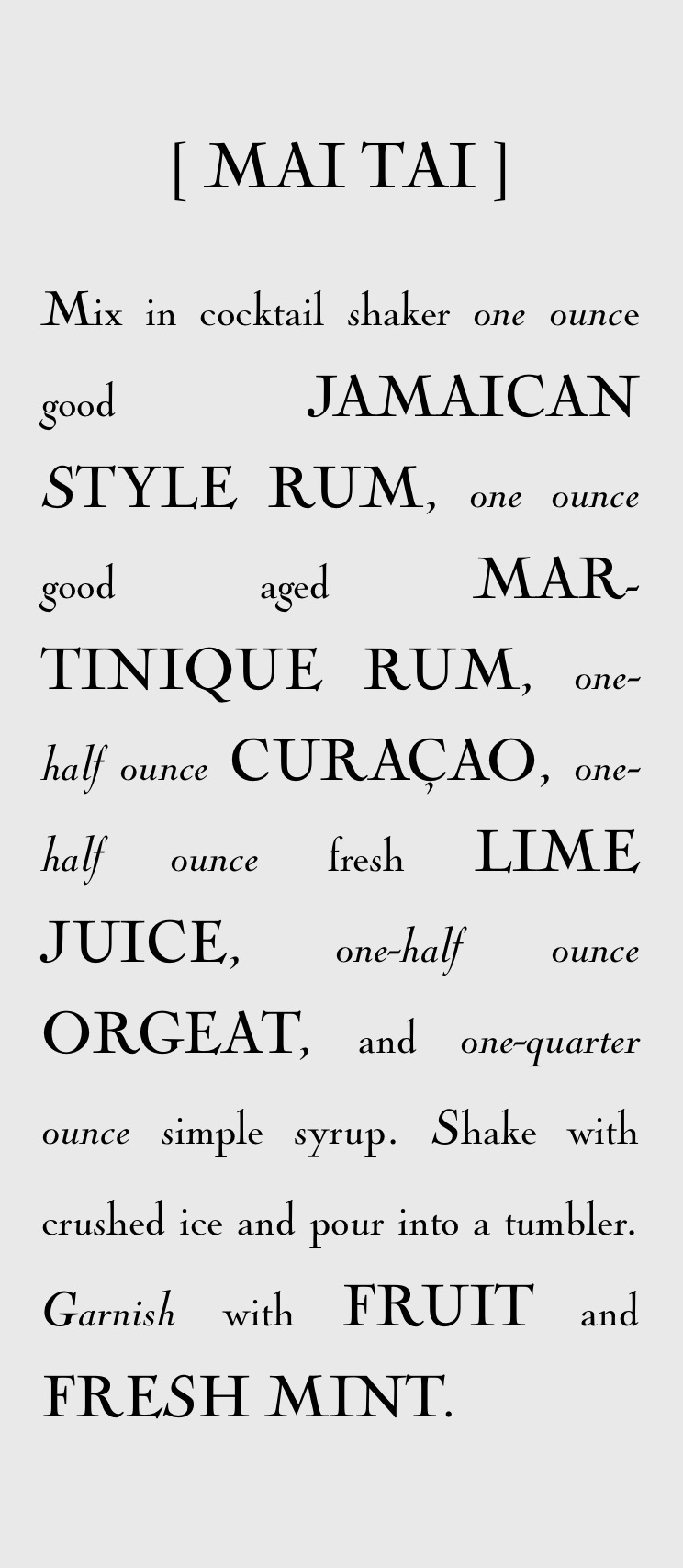
Fair warning – My preference is to track the history of the base liquid’s movement versus how it ended up in cocktails. Yes, I know that you will likely better understand the full spectrum of rum’s track(s) by following which drinks it ended up in. That makes a lot of sense to me. But I’m going the historically “Pure Single Spirit” route, so to speak, with my focus on just rum. And that, folks, is why we have varying approaches to things. There are lots of books out there on the history of cocktails. LOTS! Go and soak up those good stories, and then come back and share them with me. Simply giving you a heads up if you expect to read this section and anticipate a dive deep into the history of the Mai Tai cocktail. However, I’m a fair man, here’s me meeting you in the middle –
Donn Beach remained a fixture in Hawaii until he died in 1989 at the age of eighty-one. The New York Times ran a short obituary that painted him as a sort of Thomas Edison of the thatched-roof bar, the inventor of eighty-four bar drinks, including one immensely enduring libation called the mai tai. This was not without controversy. “There has been a lot of conversation over the beginning of the Mai Tai, and I want to get the record straight,” Victor Bergeron—better known as Trader Vic—once said. “I originated the Mai Tai. Anybody who says I didn’t create this drink is a stinker.”
The chief countervailing genesis tale comes, not surprisingly, from Donn Beach, who claimed he invented the mai tai at his bar around 1933. The Beachcomber’s version started with heavy Jamaican rum and light Cuban rum, then added lime, bitters, Pernod, grapefruit juice, falernum, and Cointreau. A newspaperman who claimed to have been drinking with both Beach and Bergeron in the early 1970s says that Bergeron admitted that Beach was the mai tai’s inventor. Maybe, maybe not. Donn Beach may very well have been the first to apply the name mai tai to a drink. But the one served at Trader Vic’s is the source of today’s classic mai tai, and is far and away the better drink. It deserves to prevail.
Hawaiian shirts and “exotic” mugs. Not my thing. HOWEVER, I would be remiss not to acknowledge how strong a culture “Tiki” is (bars, groups, etc.). It’s evolved over time: from ersatz renditions of what Pacific Island spots felt like to some American consumers, with hula-hooping women accompanying those locations, to more well-thought-out bar establishments, where the space's decoration is still given much attention, but the drinks and mugs are somewhat staples of the place. But this thing has come and gone in waves –
By the late 1970s, tiki was tacky. The thatched roofs were ratty, the hula girls passé, and the drinks too potent and elaborate for the emerging era of white wine spritzers.
You know what’s one thing that has remained prominent at Tiki spots?
El rum.
Mojito.
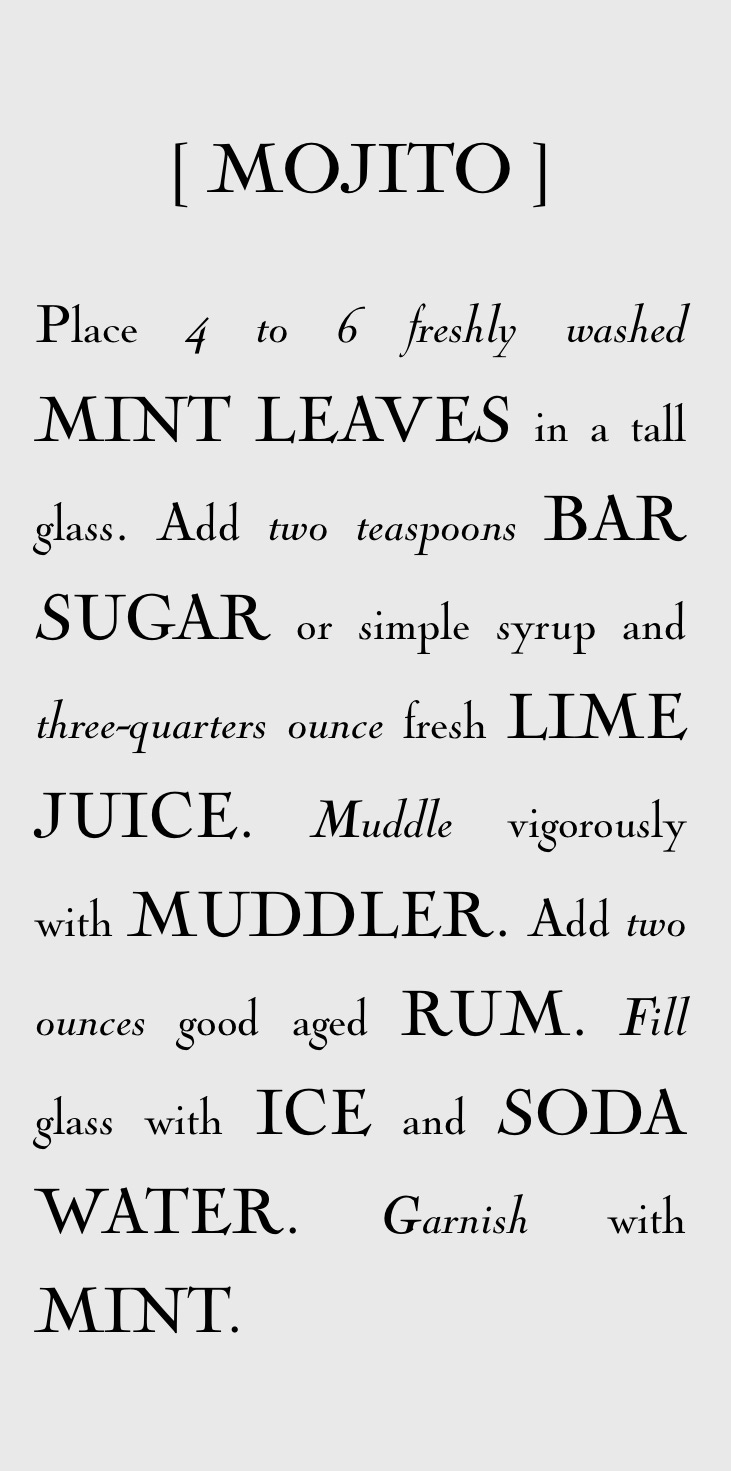
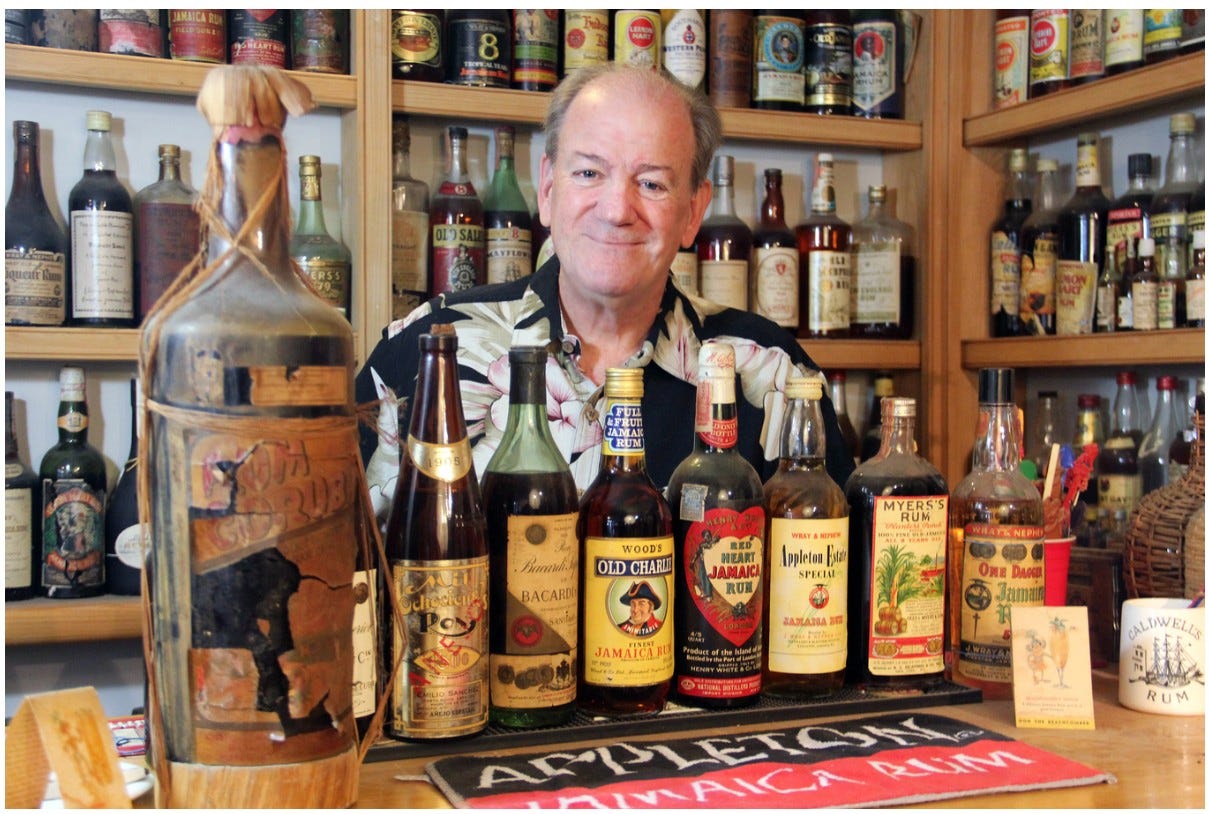
Curtis leads us into the story surrounding the revered (in rum land) Stephen Remsberg (RIP). For the #paid folks, I made a slight reference to Gargano purchasing Remsberg’s gargantuan rum collection in my Collecting piece (ironically enough).
Today, the Remsberg collection resides in Genoa, Italy, alongside Gargano’s even larger rum collection.
Curtis had a chance to meet with Remsberg before his passing, which was clearly a life-changing moment for the author.
Stephen Remsberg’s house might be regarded as the Louvre of rum; that is, if the Louvre were built around a small kitchen, and then spilled into a small adjoining room with a bar. It was smaller than I expected, but he had fit so much into the space, mostly by attaching to the walls many linear feet of narrow but tall shelves about the height and width of, say, a rum bottle. What’s striking about the collection is not the sheer acreage of liquor—which is actually quite impressive—but that it’s an active tasting collection. “I don’t collect empties,” he said. “I collect rum, not bottles. And I’ll open any bottle that I have two of.” As such, Remsberg’s house is more than a mortuary of defunct brands. It’s a museum of tastes, some of which have been wholly lost.
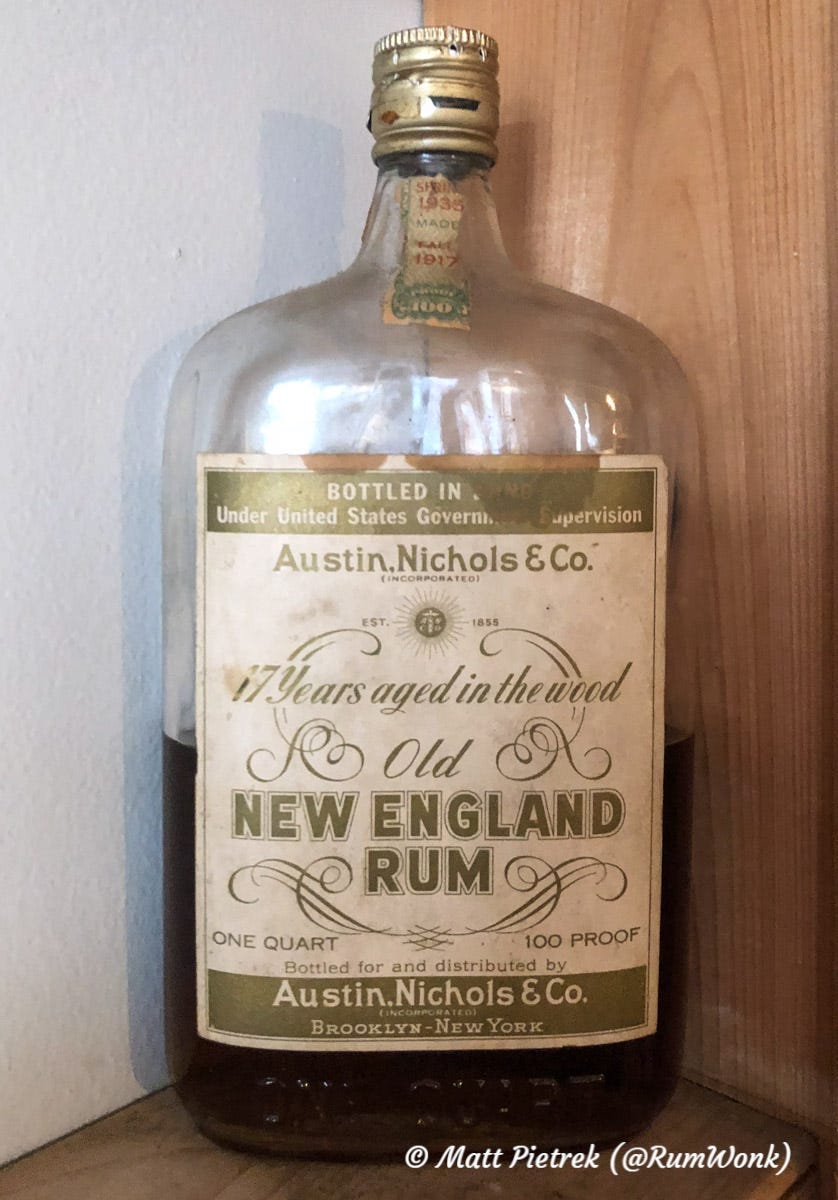
And to get us back to what we were discussing at the beginning of the article, let’s take a trip back to New England. You see, as one of the most profound rum collectors there was, Remsberg had (what seems like) the last stretch of old New England rums lying about.
His Boston rums dated from the last gasp of the Boston rum era, with samples from the early to the mid-twentieth century. They included Caldwell’s, Pilgrim, Old Medford, Chapin, Il Toro, and one privately bottled rum that likely was collected by a butler right from the barrel at a distillery. We sampled Caldwell’s, and it was just as I hoped it would be—dense and cloying and filled with the rich, yeasty taste of molasses. “By 1900 they were making a serious rum in New England,” Remsberg said.
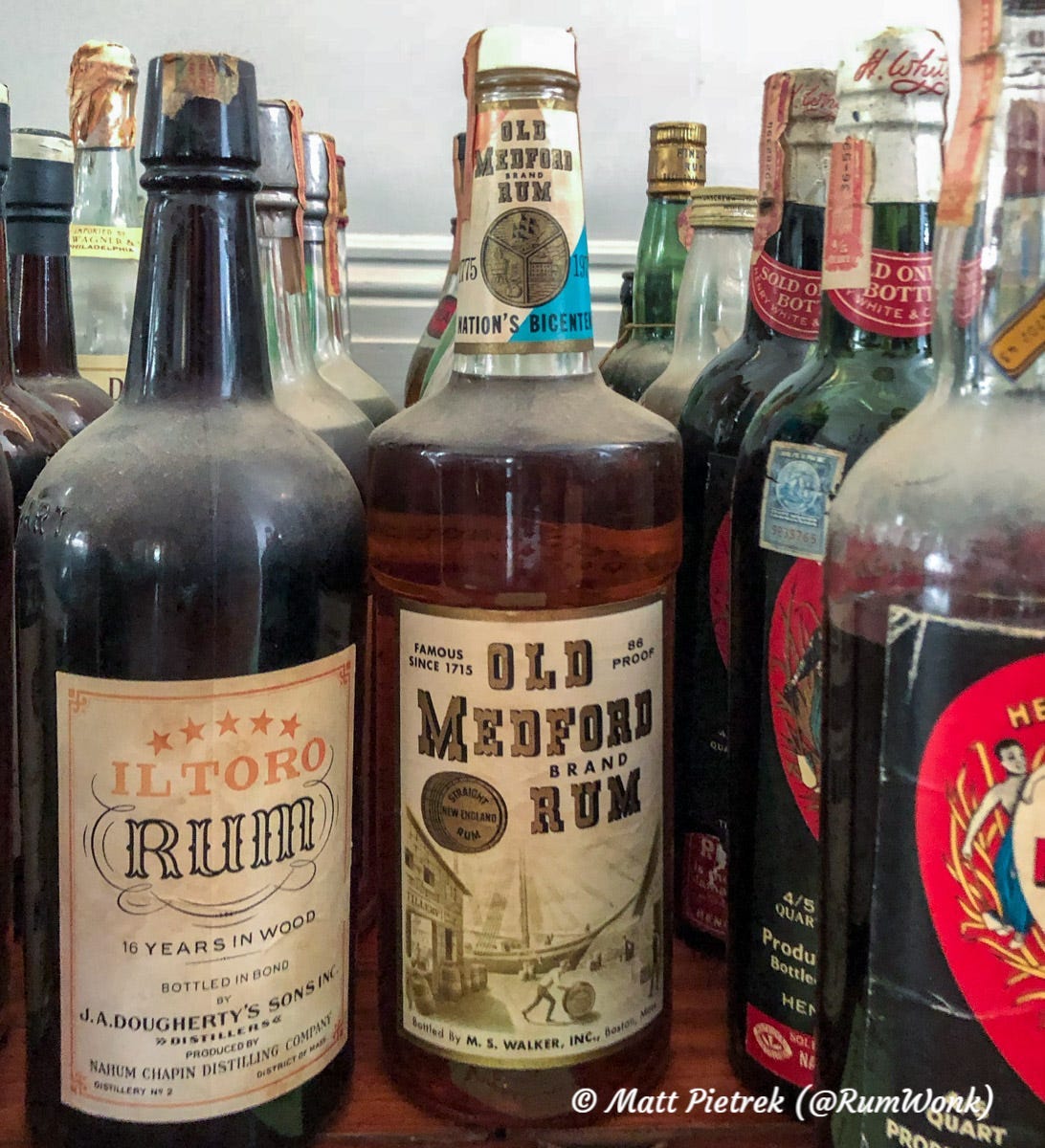
You would have to work very hard – and won’t succeed – trying to convince me that America doesn’t have a rich and storied history with rum. Any conversation in that direction is likely an emotional one, which I’m game for that type of sport (in the playful, back-and-forth sense). However, historically speaking, the books, documents, articles, and artifacts more broadly tell a different story, one predating our country’s formalized existence as the United States.
Before we go, Remsberg –
Let’s wrap (these are my words, not Curtis’s).
Good book. The man was playful with his stories, but he didn’t do much playing around when it came to uncovering some rich details on American rum history. At the back of the book, via his “A Thumbnail Guide to Rum” section, Curtis provides a sort of beginner’s guide to rum regions/countries, flavor profiles, what people often classify as “gateway rums,” etc. My favorite recommendation of his is on flavored rums –
But I assume that you’re interested in rum, not candy.
Not much on Louisiana and rum, which I always think is a shame. We’ll get there, or at least I’ll give it a valiant effort to try and revive those details. Let’s just say, there’s a reason that not much has been produced on the topic.
Let’s close with the words of James Beard (1956) –
Of all the spirits in your home, rum is the most romantic.
Salute to that.
#rumresponsibly
