


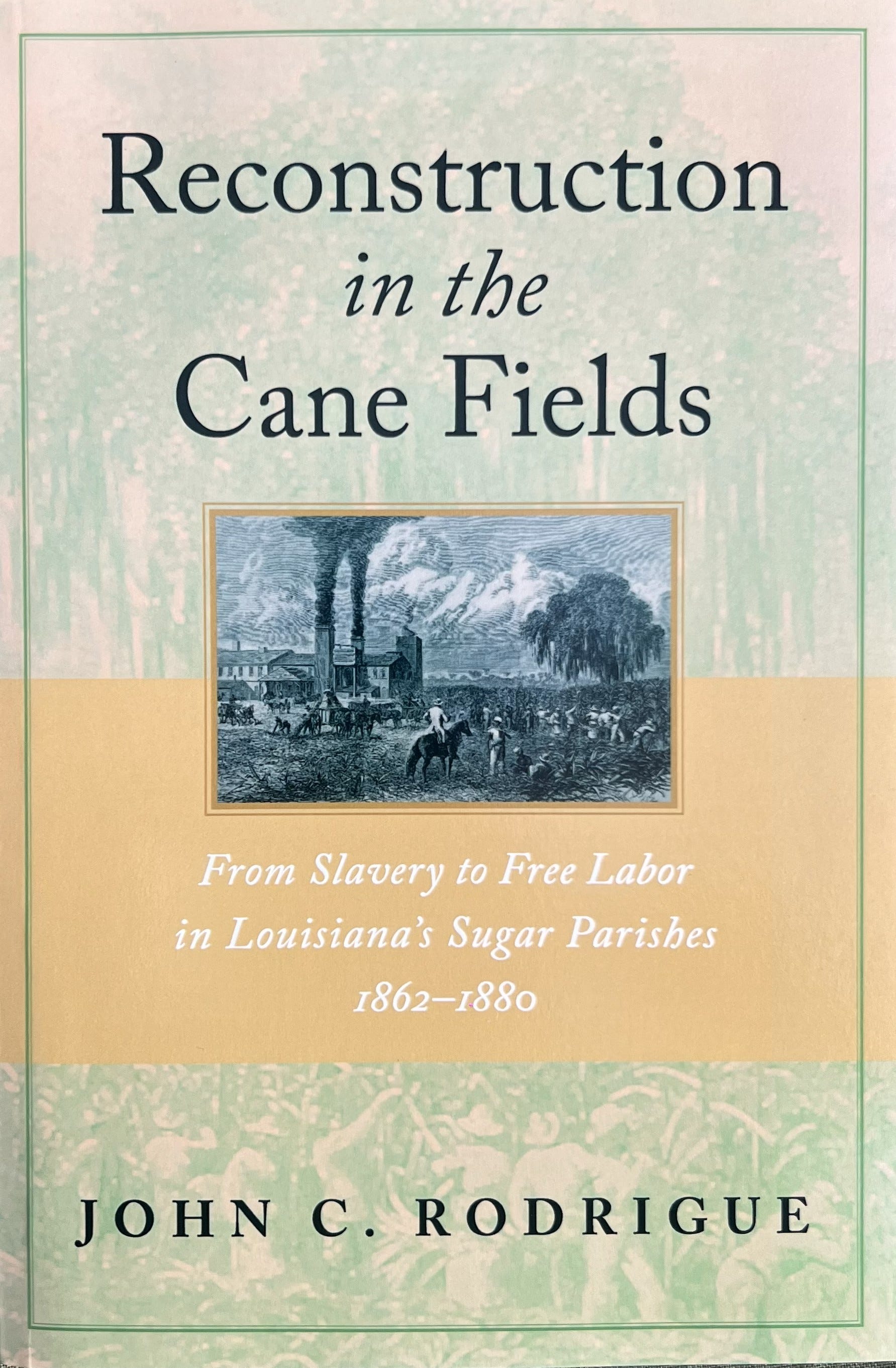
We pick up where we left off. The last Louisiana piece covered Charles P. Roland’s Louisiana Plantations During the Civil War. I will again dabble in the War’s timeline (pre- and during), given John C. Rodrigue’s concern (1862—1880). However, the primary focus here is the period following the conflict, popularly known as the Reconstruction. More specifically, the details surrounding Louisiana’s sugarcane plantations transitioning from “masters and slaves” to “employers and employees.” What did this new wage dynamic, and its varying flavors of negotiating power across payers/earners, mean for a recovering southern state, once known as a beacon of co-opted feudalism? A quick piece of insight from the author would be that sugar production’s firm demands gave Freedmen “considerable leverage” in the “new labor system.” However, this bargaining chip did not make them dictator of terms. Notably, the author warns that he provides more attention than usual to the “planters’ perspective” in this study. We’ll flesh this all out shortly.
But first, I must get my chief concern out of the way: no mention of rum in Rodrigue’s book. Roland addressed that for me. But the dig continues. Let’s continue the historical walk through Louisiana’s sugarcane country. But first, the author. A person whose last name my brain kept trying to add a “z” to the end of. No, just Rodrigue.
John C. Rodrigue.
A “Lawrence and Theresa Salameno Professor of History at Stonehill College.” For the Massachusetts crew, yes – Stonehill out in Easton, MA. His undergraduate and master’s degrees were completed at Rutgers and Columbia University, respectively. Afterwards, he took his talents to the South and wrapped up his (formal) education at Emory, where he received his PhD. As for his teaching –
He previously taught at Louisiana State University, and he was an editor on the Freedmen and Southern Society Project at the University of Maryland.
His teaching and research focus on nineteenth-century United States history and Southern history, in particular the Civil War and Reconstruction era, and slavery and emancipation.
Rodrigue served as president of the Louisiana Historical Association from 2016 to 2017, and he was elected to the association’s Company of Fellows in 2019.
Not much on Rodrigue’s personal life, which I’ll assume he’d prefer to keep that way. He dedicated the book to one of his parents and provided a beautiful reflection on his time at LSU –
I count my blessings for having been given the opportunity to become a member of LSU’s history department, where a reasonable teaching load (in these days of “accountability”), a collegial environment, and colleagues who are serious about their work—but not about themselves—afford a situation conducive to the life or the mind and help me remember why I wanted to become a historian in the first place.

A historical walk to understand Louisiana and sugarcane.
→ Early 1750s: sugarcane was introduced to Louisiana (source: LSU Ag Center/College of Agriculture).
These early cultivators (and those they enslaved) could not get the sugarcane juice to granulate, and therefore used the cane for its molasses (i.e., no real sugar was produced).
→ 1795: the “Savoir of Louisiana,” Jean Etienne de Boré, “using techniques imported by slave and free-black refugees from Haiti, produced Louisiana’s first commercial crop of granulated sugar.”
Boré’s demonstration that sugar could now be produced profitably led the march for southern Louisiana to become a plantation slave society (of economic consequence). However, because of Louisiana’s climate, the cane still wasn’t doing so well.
→ 1817: ribbon cane, which matured rapidly and was more resistant to frost, was introduced.
Ribbon cane gives us insight into why sugarcane in Louisiana is considered a “forced crop.” Sugarcane typically grows best in mild and predictable tropical climates (hence why the Caribbean and sugarcane usually agree with each other). Even more, cane requires –
…moderate and well-distributed rainfall, and a growing season of about eighteen months. In Louisiana, rain is plentiful but seldom evenly distributed. Because south Louisiana lies in the subtropics, frost becomes a possibility by late fall. Louisiana planters, compelled to harvest the cane before winter, faced a growing season of only ten months.
→ 1820s: steam mills appeared in Louisiana, which helped sugar production, though it was likely the wealthier planters who were able to first adopt the new technology.
→ 1830s: a free Black Creole, Norbert Rillieux, invents the multiple-effect evaporator process, which used steam/heat to convert sugarcane juice into sugar more efficiently, and at lower temperatures (i.e., better grade product, less work); the technology was expensive, so it took a while for mass-adoption to spread across Louisiana. Nonetheless –
…prove[d] to be the most important technological advance in the history of sugar making.
→ 1840s: steam mills outnumbered animal-powered mills.
Unfortunately (poetic), a historian noted that Louisianians would never be able to solve the dilemma of “complete harmony between land and product.” (Sitterson x Sugar Country). Environmental and other threats, including frost, floods, thunderstorms, hurricanes, parasites, insects, rats, and the might of the Mississippi River, routinely affected plantation operations. Nonetheless, Louisianians would continue to cultivate sugar as there was no slowing the train down once it reached full speed.
→ 1849: there are 1,536 farms and plantations producing almost 250,000 hogsheads of sugar
→ 1860: sugarcane cultivation’s demands (lots of acreage), cane country’s constant flirtation with mother nature (lots of disasters), and the nature of capitalism (lots of money needed to satisfy the first two) converged over a century to favor the elite – 525 wealthy plantation owners, or those who owned 50 or more people, had an average of 110 slaves, 730 acres of land, and $14,500 of farm equipment (reminder that we are talking about the 19th century, so that $14.5K is a lot of money inflation-adjusted to 2026). Rodrigue provides great data to showcase what’s outlined above –
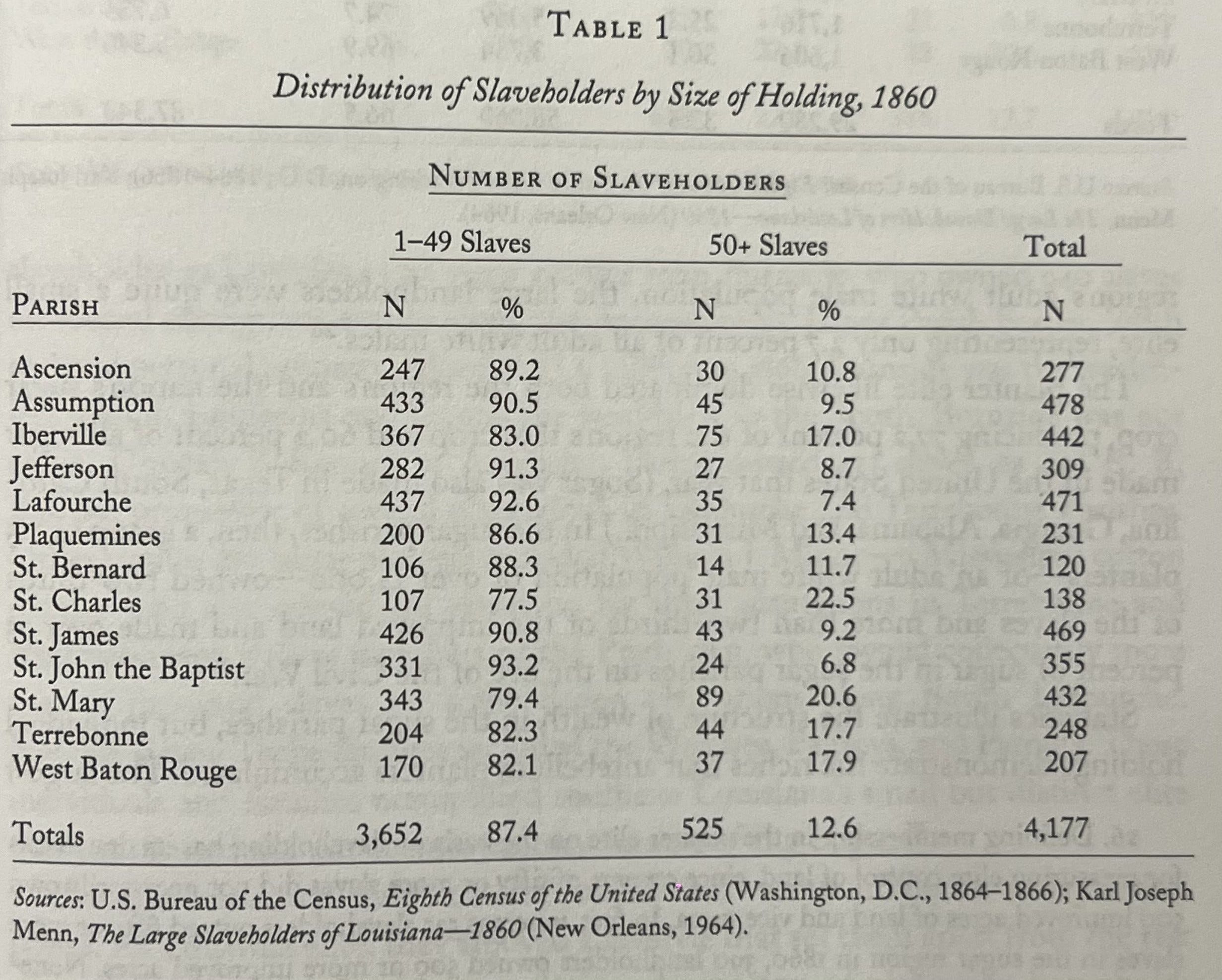
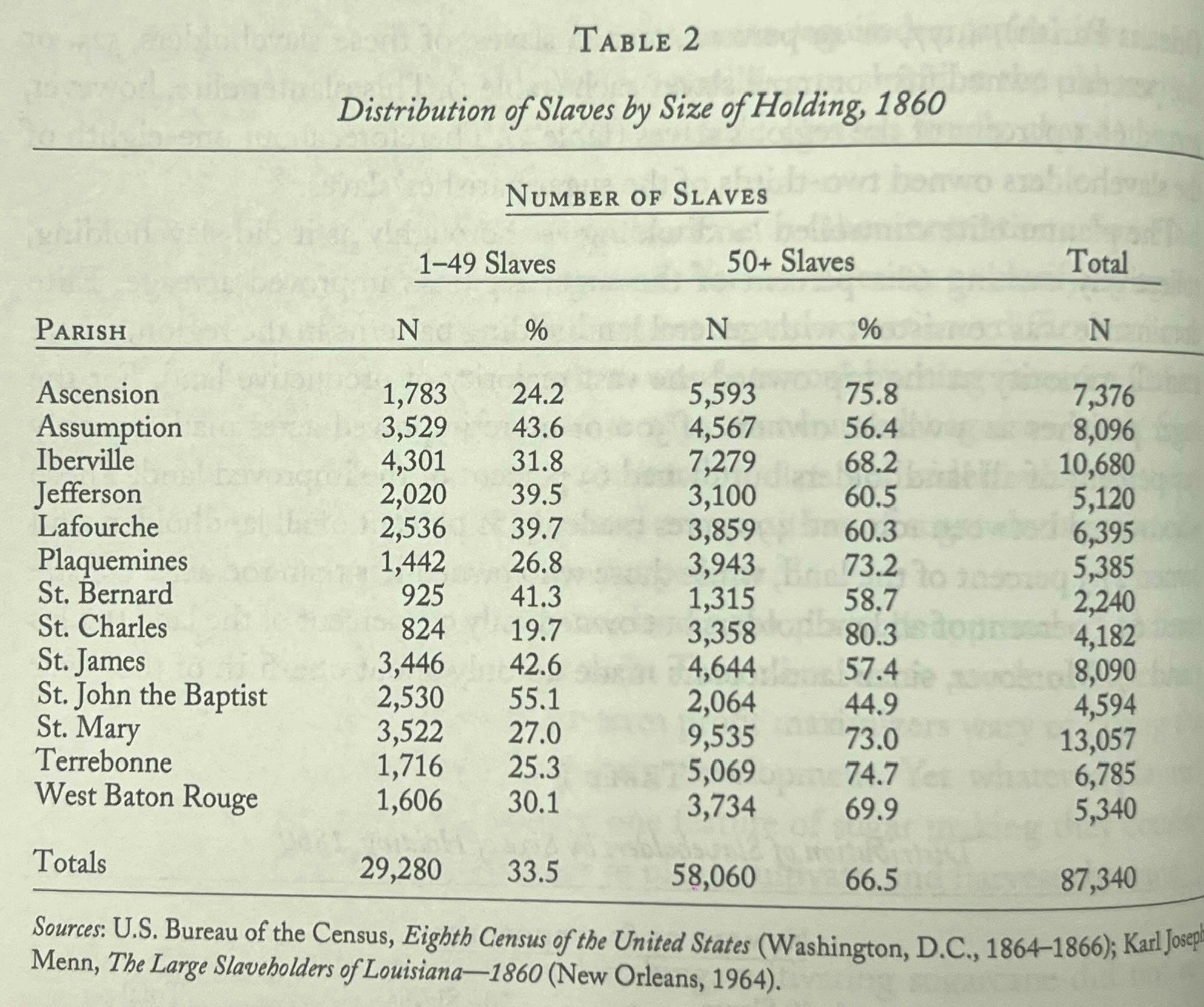
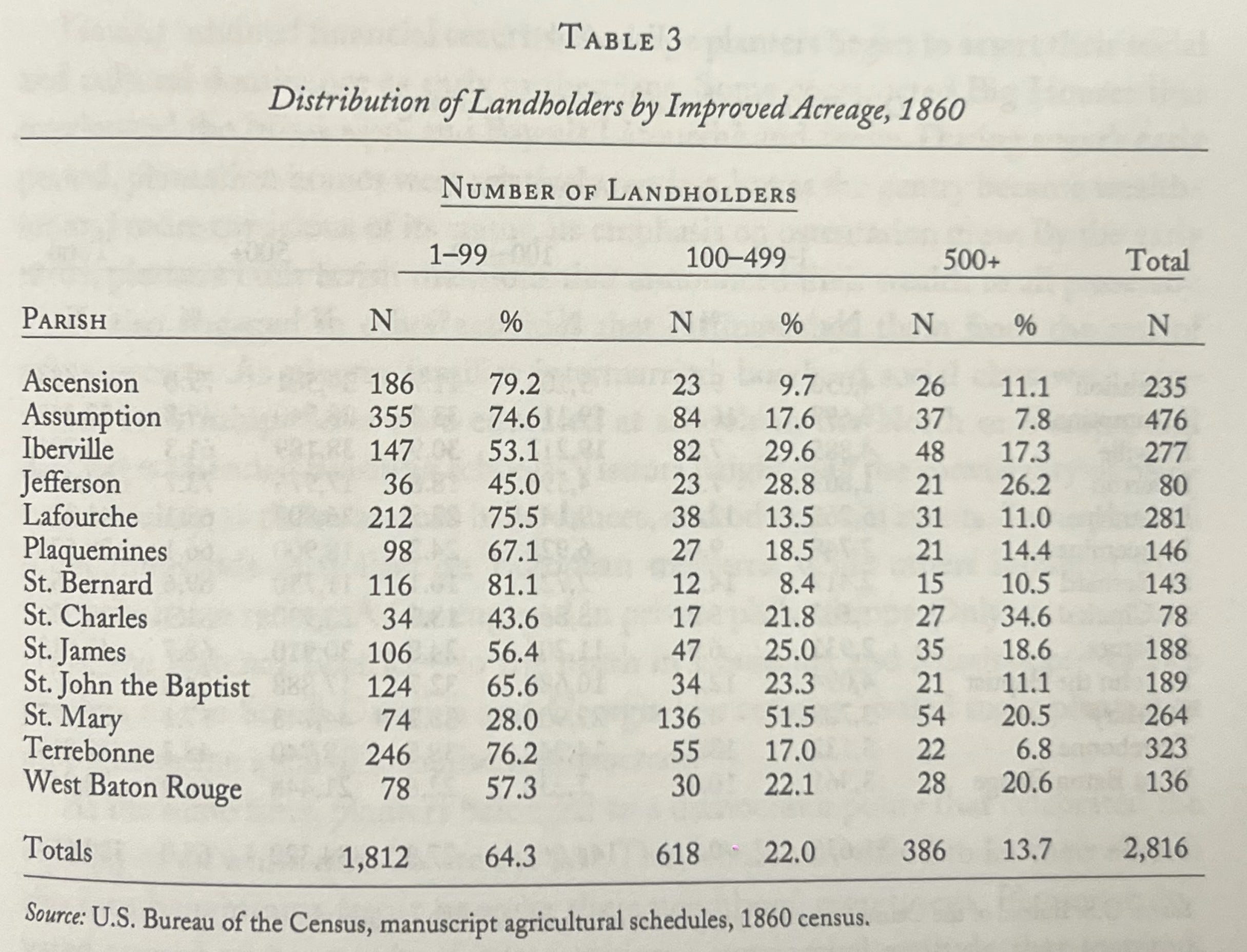
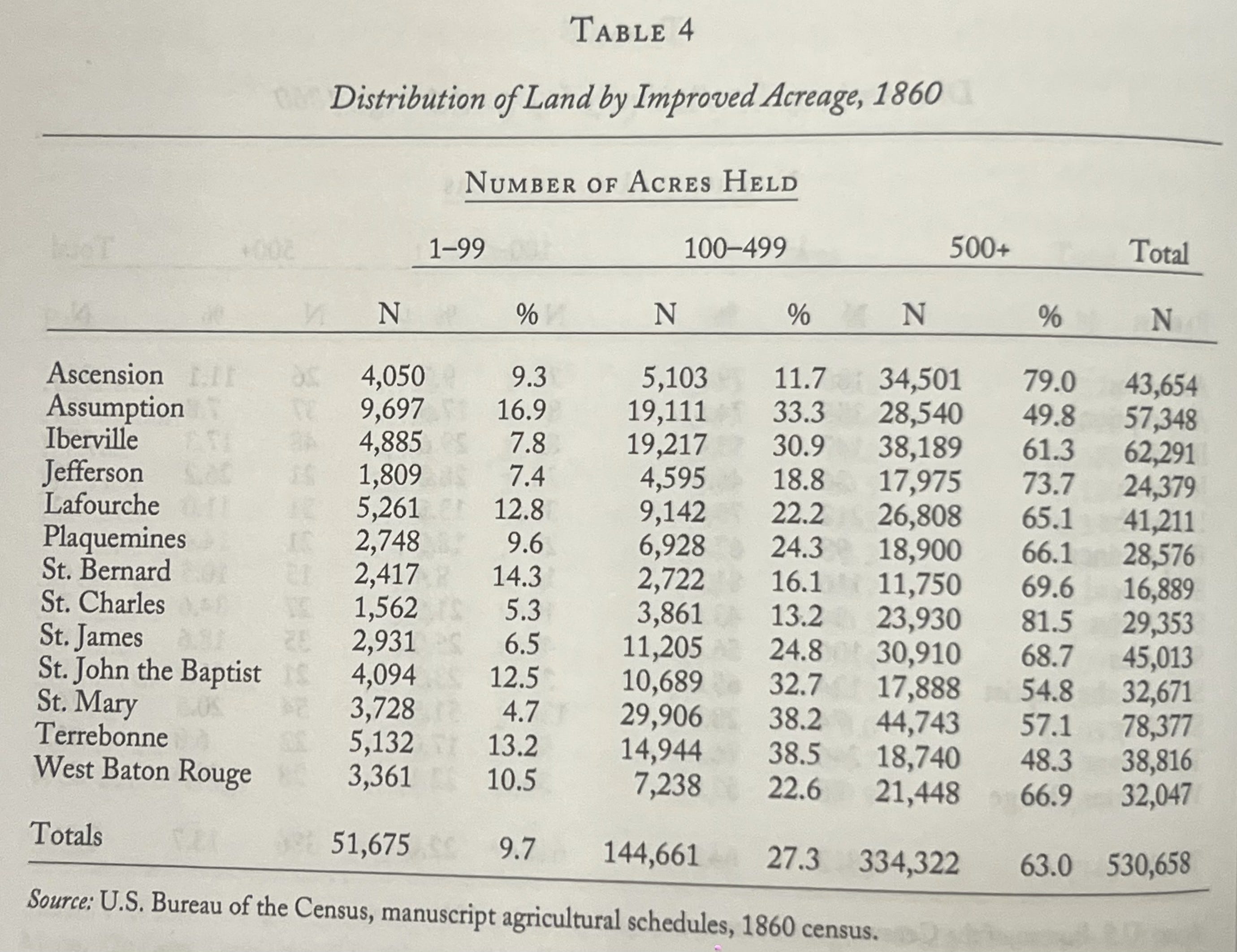
Summary: 12.5% of the region’s slaveowners owned nearly 70% of the sugar parishes’ enslaved people, as well as nearly 70% of the region’s improved acreage. They produced 77.2% of the region’s 1859 crop and 60.2% of all sugar in the U.S. that year. On the eve of the Civil War, that same group produced 75% of sugar in the respective parishes. In short –
…the large landholders were quite a small elite, representing only 2.7% of all adult white males.
(back to the timeline)
→ 1861: the banner year for sugar production, or the last crop season “before the federal invasion of southern Louisiana…last one made exclusively with slave labor.” Almost 460,000 hogsheads of sugar, the spoils going primarily to the elite planters. But who are these planters we speak of?
The Big Whigs of Big Sugar.
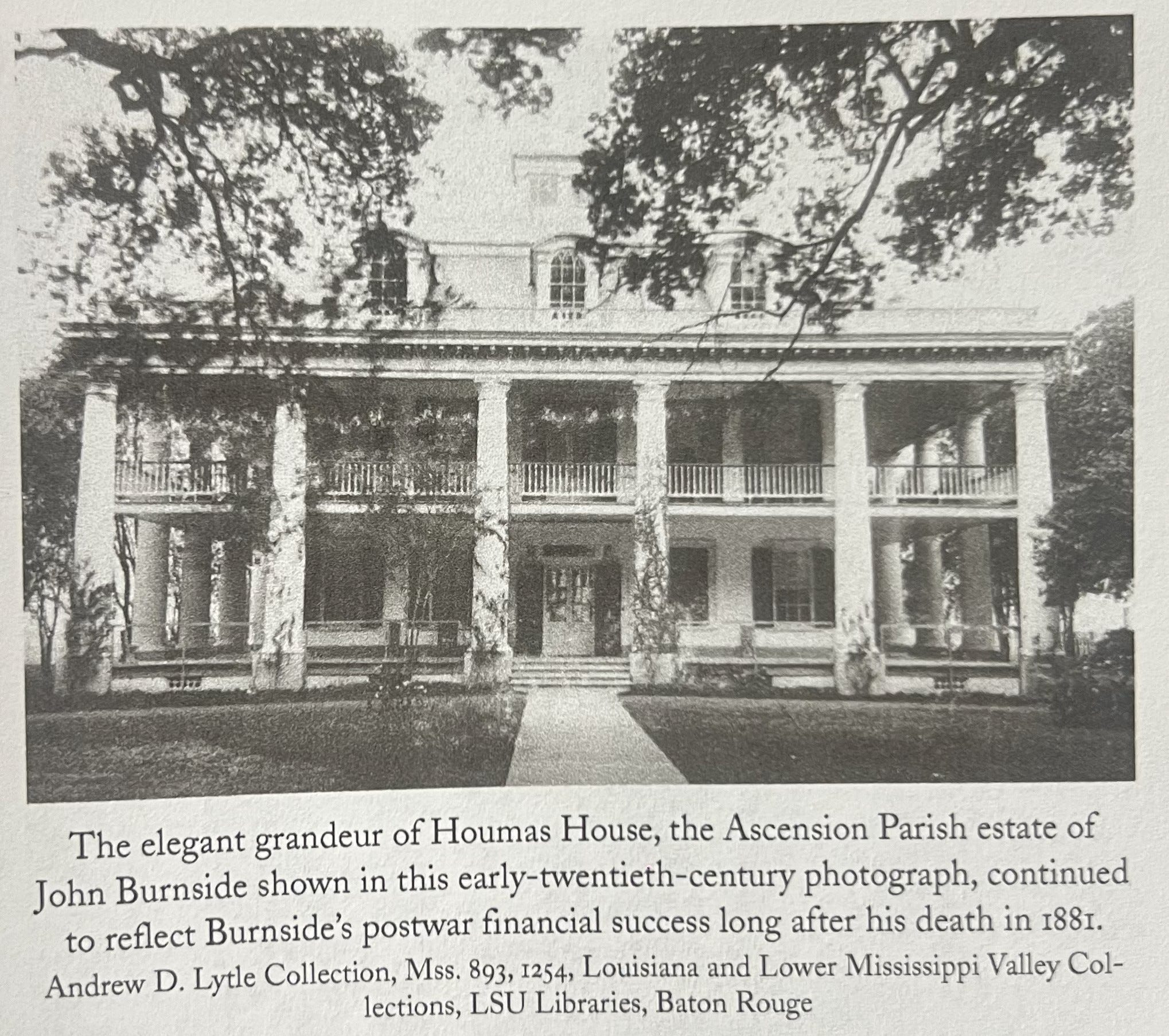
John Burnside
940 slaves
$2.6 million in real and personal property (1860), certifying him as the richest man in Louisiana at that time
Duncan F. Kenner
473 slaves
William J. Minor
584 slaves
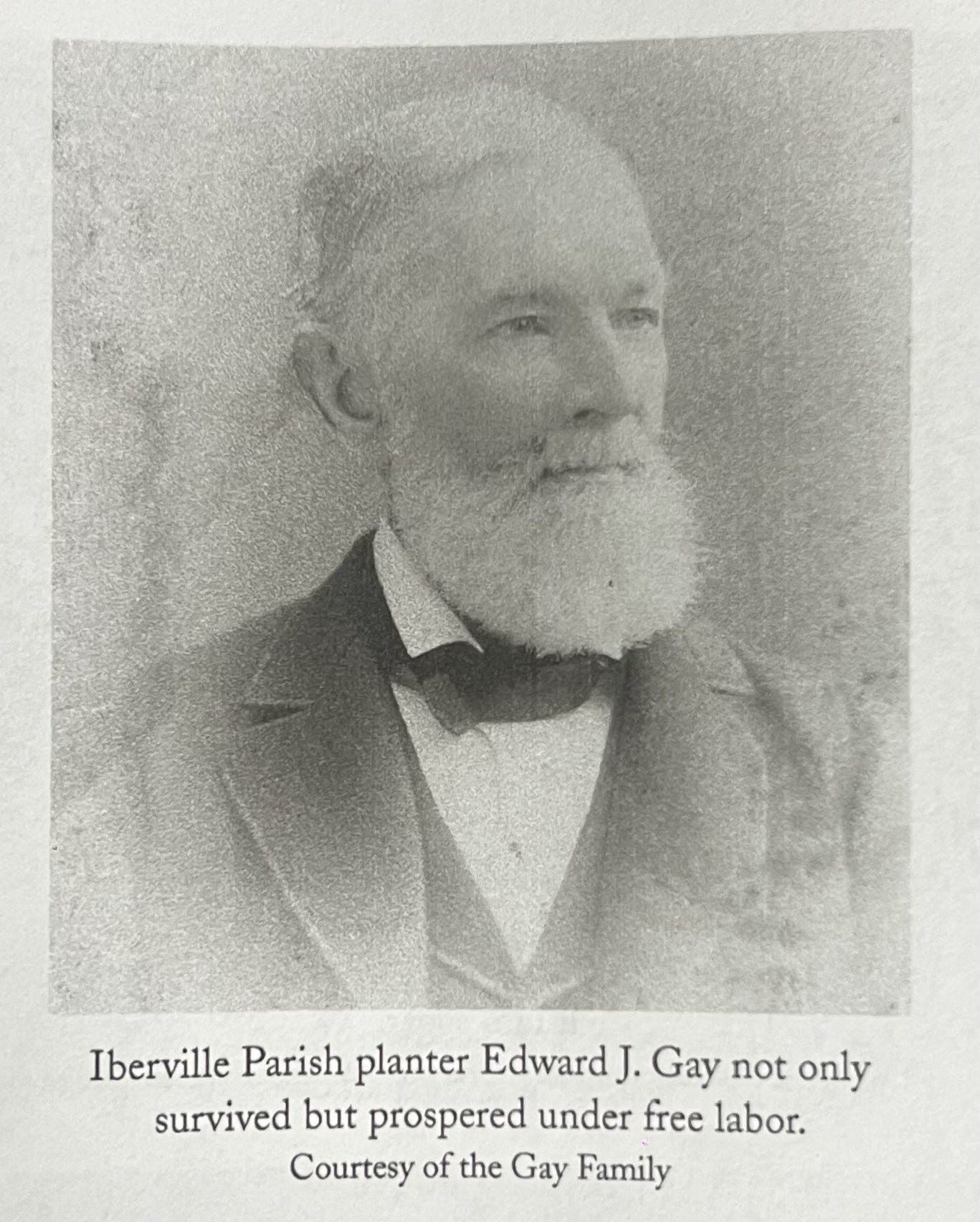
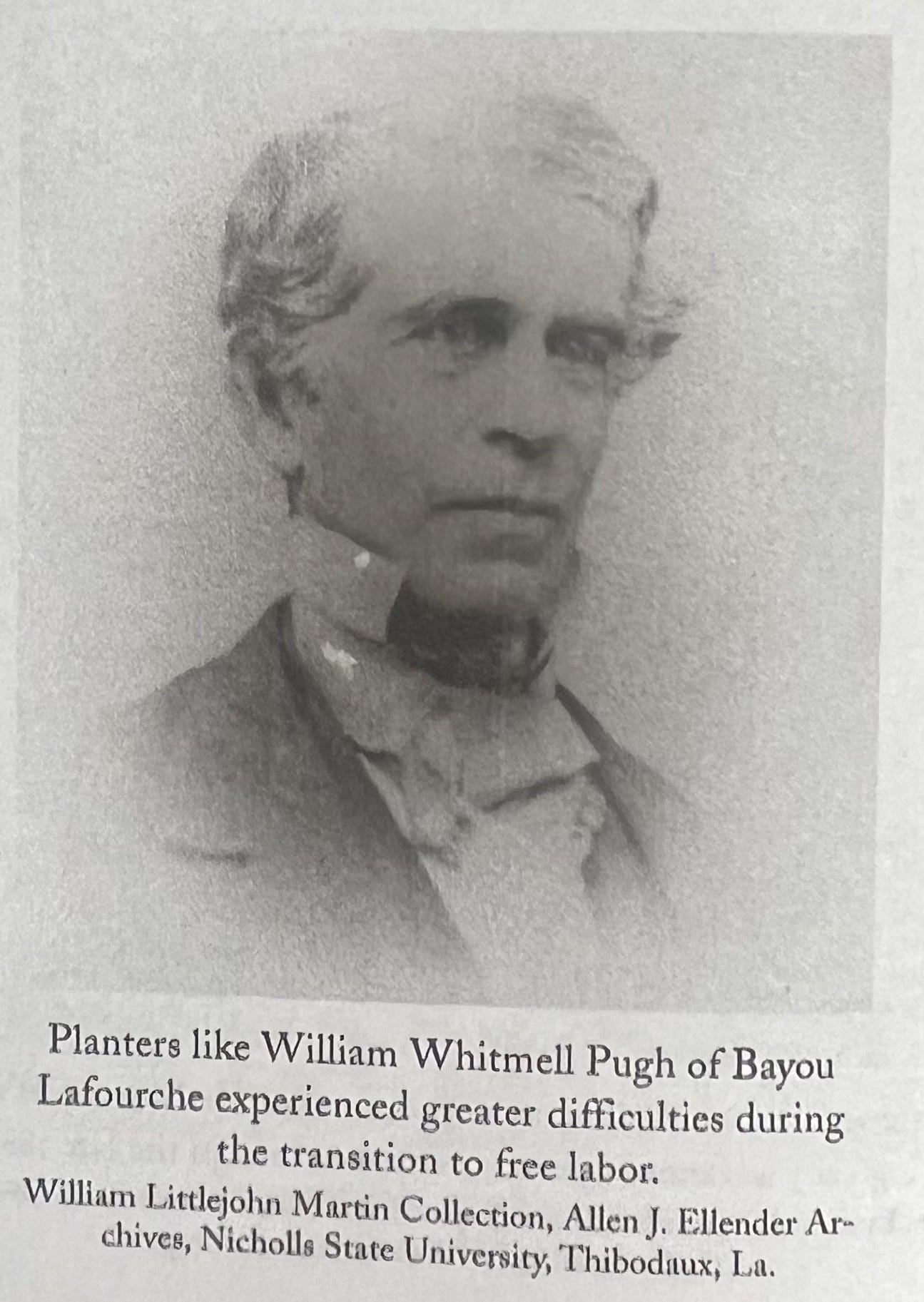
The Pugh(s), the Gay(s), the Weekes(s), the Palfrey(s), the Patout(s) of the Bayou Teche, and many more. Here are images of prominent members of the Gay and Pugh families, respectively –
Big Sugar did as Big Sugar had done everywhere there was a Big Sugar – become an aristocracy, often dubbed plantocracy. Big Sugar families engaged in everything from endogamy → specific schooling (North, Europe, etc.) → ostentatious mansions → specific balls/dances/social events → collecting European treasures → horse racing → etc.
The social line was played very delicately, however, because Big Sugar needed small sugar and poor Whites on their side –
At the same time, planters belonged to a democratic polity that celebrated the equality of all white men before the law. They could not afford to let their elitism slip into haughtiness lest it provoke their neighbors’ resentment. Planters cultivated toward white people of lesser station a patriarchal attitude that fostered, ever so subtly, deference and respect for their authority.
One can imagine the misgivings Big Sugar had when, on January 26, 1861, Louisiana ratified an ordinance of secession (the 6th state to do so). After all, a large portion of their sugar-consuming customer base was in territories they were breaking away from, which was surely Big Sugar’s primary concern. We’ve seen that many in the plantocracy straddled the allegiance line (Confederate vs. Union) more strategically than from a place of pure nationalism. In short, pocket protection. Although Big Sugar’s operations continued as normal for months following secession, the consequences of war arrived at their doorstep in due course –
The war made itself felt, however, in financial affairs. The federal naval blockade of southern ports in spring 1861 crippled commerce in New Orleans and prevented marketing of a bumper sugar crop.
“[O]ur white sugars…cannot now be sold.” – Planter
By spring 1862, Big Sugar fell on hard economic times, and invasion became imminent. Patriotism for the Confederate cause, for some, also sank to an all-time low (i.e., not favorable to pocket protection). The planters’ way of life was beginning to unravel before them. The ghost of potential emancipation lurked in the background.
The sugar planters’ social position was inconceivable without slaves, whose labor generated the slaveholders’ wealth and bestowed upon them their place in southern society…But slavery cannot be thought of in terms of what it did to slaveholders without considering what it did to slaves. Slavery denied slaves control over their own persons, and it enabled one group of people to live upon the fruits of another’s labor…Slavery was a system of racial oppression, but it was also a means of exploiting labor…While only black people in the South were slaves, they were enslaved for their labor as well as the color of their skin.
Yankees disrupt cane country’s modus operandi.
April 1862 through the summer: The “loss of mastery” had begun to take hold as many of the enslaved escaped across Union lines. Northern forces, led by General Benjamin F. Butler, were there to protect the Union, not to free the enslaved, but the repercussions of the enslaved becoming assets in the dismantling of the South’s fabric must have played well with the Union’s military aims.
July 1862: Congress passed the second Confiscation Act and the Militia Act, which freed the slaves of disloyal slaveholders (i.e., those who abandoned their plantations to serve the Confederacy or had run away with their slaves). The Acts also authorized the enslaved to help “suppress the rebellion.” See, strategic.
The catch-22, however, is that General Butler was also obligated to protect the property (i.e., enslaved) of loyal planters, those of Big Sugar who took a loyalty oath to the Union. Still, as a representative of Northern ways of life, he instituted preliminary, quasi-free labor initiatives that resulted in wages, hourly requirements, and days worked per month statutes that were to be abided by (by) the loyal planters. One failsafe measure was a guarantee of manumission to “any slave” who was physically abused by “his or her owner.” It seems that some planters acquiesced to the discipline requirements. Having to pay those they enslaved was something that their psyche could not tolerate.
For instance, at Magnolia Plantation in Plaquemines Parish, Effingham Lawrence, after issuing $2,500 compensation to workers, insisted it was not compensation but a present. He asserted that those who were paid, no matter what, “were not free but my slaves and property.” Note: I believe that Butler’s compensation program was initially limited to Plaquemines and St. Bernard Parishes.
By November, the Union forces took Lafourche Parish. 9th of the month, Butler issued Order 91, which implemented his labor agreement in the Parish, and also allowed his troops to take the estates of the disloyal. The Sequestration Commission, which I’m sure you understand what they’re responsibilities entailed (given the name), leased out the abandoned/confiscated plantations, often to Northerners in search of buy-low opportunities.
By the end of 1862, 87,000 hogsheads of sugar were produced, a mighty drop from the banner year 365 days prior. To add fuel to the political fire, on January 1, 1863, Abraham Lincoln issued his Emancipation Proclamation, which reinforced that the enslaved in rebellious parts of the South were free (i.e., excluded many parts of cane country).
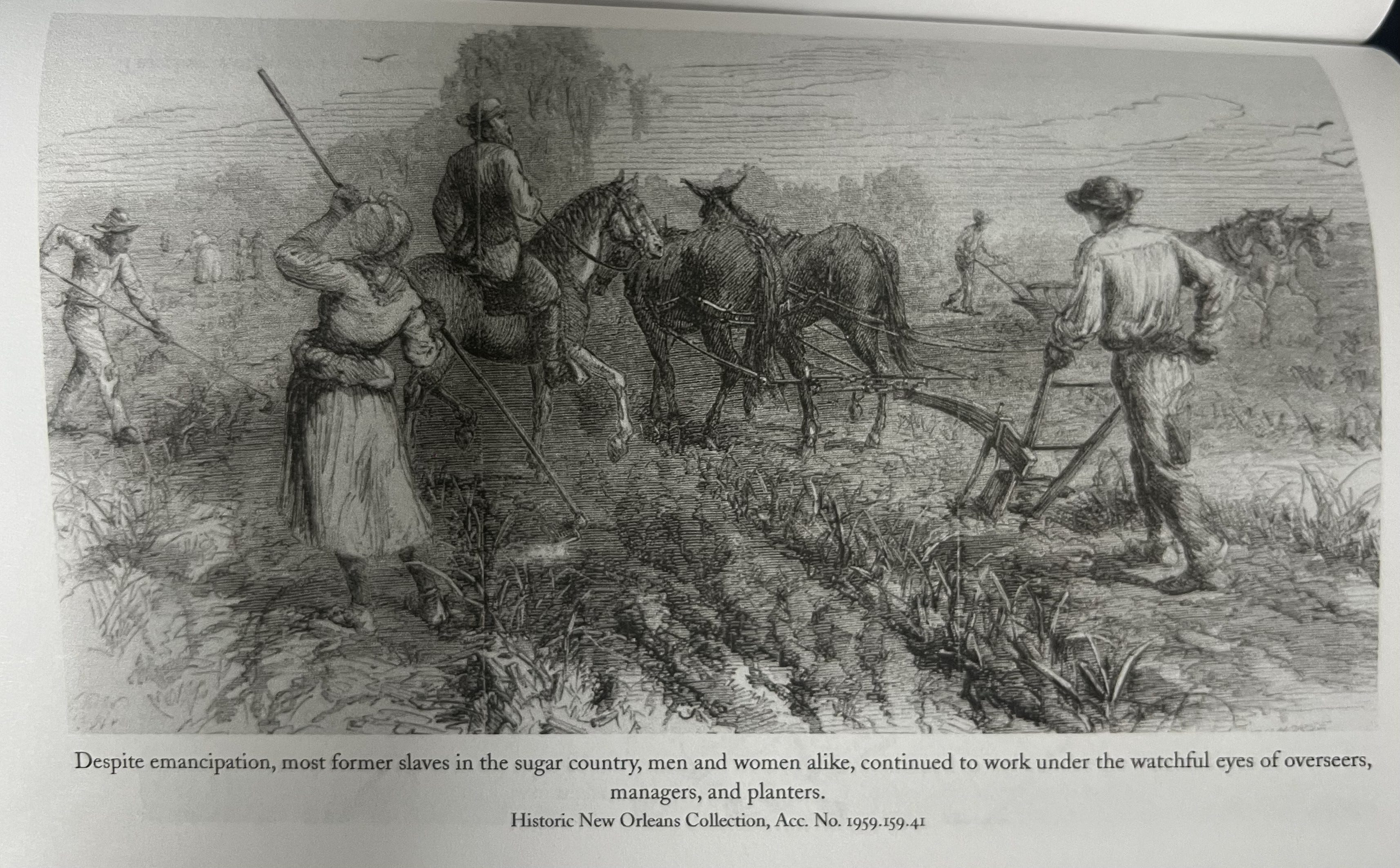
If the loyal planters thought they were in the clear, a regime change would test that comfort. Out goes General Butler, in comes Nathaniel P Banks, who dismissed Big Sugar as “full of theories, prejudices, opinion based on the old system.” Banks felt that the planters needed to “look to the new state of things, to the future & not to the past.” Practically speaking, Banks eventually realized that he needed the planters’ cooperation, so he adjusted the wage system to be a bit more agreeable (Order 12) –
$2 for men
$1 for women
At year-end, the enslaved would receive 1/20 of the proceeds of the crop to divvy amongst themselves
The French language publication, L’Union, and its successor, the bilingual New Orleans Tribune, along with Radical Republicans and Abolitionists, went full on attack, accusing Banks of coddling the planters. As you can imagine, the 1863 crop season was also abysmal. Still, Banks carried on what he believed was best –
January 1864: Banks suspended all slavery provisions of Louisiana’s antebellum constitution and laws
February 1864: Order 23 implemented an apprenticeship system, ripping a page right out of the Caribbean playbook (see A Jamaican Plantation or Caribbean Rum posts for more background), which endorsed easing the transition from slavery to freedom. The Order no longer referred to people as slaves, monthly wages went up from $2 to $8 for males, 1/14 of crop proceeds were to be distributed vs 1/20, families were allotted garden plots of up to one acre for independent production, and laborers could now, for the first time, choose their employers
The concession to planters was strict enforcement of labor contracts. For instance, idleness was considered a crime, and abandoning plantations without reason was a violation of contract. The worst part of this enforcement, from the workers’ perspective, was the withholding of 50% of wages that were to be returned to them at year's end. You can imagine how this played out, especially among planters who could not believe they had to pay those they owned in the first place.
Everyone affected by the Order’s consequences devised plans to derail the other side’s machinations. The workers knew that cane planting in Louisiana was a race against time & Mother Nature (i.e., frost season), so they could easily disrupt crop season by causing an “oops” scenario around that critical timeframe. The planters colluded to “impede [the] development of a labor market” by agreeing not to hire another planter’s workers, as well as fixing the pay levels across Parishes. To be clear, all of this collusion was illegal under the Union’s policies, but the Louisianians were busy infighting using the tools they were most accustomed to. The Yankee policies were more a an obligatory nuisance than anything else.
One planter, who likely represented the thinking of many at the time, believed that if they didn’t “stand by each other,” then the formerly enslaved “will become more and more exacting every year until in a short time we will be the slaves and they the masters.” Heavy dose of paranoia.
Big Sugar – economics-first – mindsets highlighted that profitability and survival of cane depended on slave labor. It was what they knew, and they were uncertain how to produce at scale without it –
“The saving of the growing crop is entirely dependent on the exercise of authority over the blacks, otherwise a large portion of the cane will be left to perish in the field.” – W.W. Pugh
By September 1864, Louisiana Unionists approved the state constitution, formally abolishing slavery. It’s worth noting that this approval was done by a few thousand loyalists in New Orleans “and its environs” (i.e., those who participated in the “constitution plebiscite”). In other words, the decision was by no means a consensus opinion (unsurprisingly). All of the above translated to the impact you would expect for the 1864 crop season: 10,387 hogsheads of sugar. Scant.
By November 1865, Lincoln won reelection, and General Ulysses S. Grant beat out the Army of Northern Virginia to cement the demise of the Confederacy. Another regime shift occurred in 1865: out went Banks, in came General Stephen A. Hurlbut. Hurlbut (what a name) implemented his own changes to the labor policy, demonstrating that this desire for a free-market society was a moving target. What increasingly became the reality of the wage-labor dynamic was that planters began to yield more and more to workers’ demands.
“I have agreed with the negroes today to pay them monthly wages. It was very distasteful to me, but I could do no better. Every body else in the neighborhood has agreed to pay the same and mine would listen to nothing else.” – A.F. Pugh
…by spring 1865, a pattern surfaced in negotiations between planters and freedmen that would become as familiar as the Bayou Teche two-step. Just as crop seasons overlapped, so did settling accounts for one year and contracting for the next. Aware of the effort, the rolling season demanded, freedmen could express their dissatisfaction with a planter’s offer for the new year by working slow slowly or not at all. Likewise, if displeased with the settlement after completing the crop, they might seek employment elsewhere as planting was to begin. The perils of sugar production had caused planters enough anxiety before emancipation; now they had to bargain with laborers who were free to leave. Despite the restrictions of army policy, freedmen were learning how to take advantage of the sugar region’s emerging labor market.
In creating a new labor system, planters and freedmen were shackled together, incapable of acting independently from one another. Distasteful as it was, they moved in tandem, grudgingly and reluctantly, but inexorably forward.
The desire for land and autonomy rose among the new workers. One example of acting on this desire occurred in Terrebonne and Lafourche Parishes, where residents organized into “labor companies” to till abandoned estates. This, too, worked in the Union’s favor, as the Sequestration folks probably had a difficult time keeping up with all the properties newly under their jurisdiction. The labor companies' efforts were short-lived, as many of these abandoned plantations were returned to their former owners (i.e., non-loyalists) after the Civil War. Either that, or it went to Northern businesspeople coughing up investment cash. Those (planters) who remained in the South continued to bang on the federal government’s door, pleading for a reduction in plantation life interventions.
Many in the South viewed the confiscation of property as robbery. Misdeeds that would be met with violence, eventually. These feelings were exacerbated by the March 1865 establishment of the Bureau of Refugees, Freedmen, and Abandoned Lands. This entity is more popularly known as the Freedman’s Bureau. The Bureau had many responsibilities, but chief among them were overseeing the transition from slavery to freedom and dividing up abandoned/confiscated plantations into 40-acre plots for distribution among the formerly enslaved. By the spring of 1865, the government had almost 100,000 acres of land under its jurisdiction, most of it located in the sugar region.
All told, the consequences of the war were of seismic proportions for cane country and those who were at the top of its socio-economic pyramid –
Losses in slaves, animals, machinery, tools, farm implements, and buildings for the industry as a whole approached $190 million out of an estimated antebellum value of $200 million.
The Civil War ended in 1865. But conflict (in Louisiana) would sustain for many, many decades to come.
Out goes slavery, in comes Reconstruction…for now.
The political and social rejiggering of the South – “emergence of black politics during Reconstruction” and the “new [wage] labor system” – uprooted the life that the former slaveowners were accustomed to. And they could no longer, legally, resort to old customs that would squeeze complicity out of the Freedmen (and Freedwomen).
For instance –
…as long as Reconstruction lasted in Louisiana, planters could not call upon the state militia to impose control over labor.
Navigating the economic conditions seemed impossible. Post-Civil War, credit dried up, production levels sank, and the physical destruction from the war took its toll. However, U.S. consumers’ demand for sugar continued to increase unabated, as did demand in the rest of the world. Unfortunately, Louisiana lost control of the domestic market (firmly) once European Beet sugar stepped onto the scene; the ever-present (competitive) thorn in Louisiana’s backyard, Cuba, maintained its contribution to Louisiana’s flailingly market share losses as well. As noted in The Sugar Masters, Cuba benefited from their continued slave labor production 21 years post-American Civil War.
Unable to compete at the global level, and with the consequences of war worsening an already precarious situation, the story of sugar and Louisiana became a narrative that would forever include the federal government’s assistance –
Even as planters faced the challenge of making sugar with free workers, they confronted other changes that profoundly affected their fortunes. Since Louisiana’s subtropical environment produced inferior grades of sugar, which required further processing in refineries, planters could not compete, even under ideal circumstances, against foreign sugars without a protective tariff.
The only other piece I would add to Rodrigue’s assessment of “inferior grades of sugar” is that soil depletion may be a factor as well, given that the planters had, for a century plus, forced the enslaved to toil the land relentlessly to grow sugarcane.
Speaking of the government, Andrew Johnson’s becoming President led to a swift about-face in Reconstruction policies: despite the launch of the Freedmen’s Bureau in March 1865, Johnson issued an amnesty proclamation two months later, pardoning those who fought against the Union and restoring their property. The hundreds of applications (for claiming abandoned property) that were submitted by the formerly enslaved would largely go into the trash pile. In short, “Johnson did not intend to bring social revolution to the South.”
The nail in the coffin for the Freedmen –
In September 1865, Johnson ordered bureau-controlled property returned to its former owners once they had received presidential pardons, which by this time he was dispensing quite freely.
A few months prior (Summer 1865), the state militia was reactivated. The old (slave) patrol system tactics were reinstated (e.g., Freedmen moving about without their employer’s permission were arrested). Many of the patrollers wore “their Confederate uniforms” to add insult to injury. Federal authorities often petitioned for assistance to curb these overreaches, but the planters (and their associates) held firm. Those who supported the Confederate cause did everything to “preserve what they could of the old order while adjusting to the new.”
The apotheosis of the old order’s attempt at dialing back the clock was the enactment of the Black Codes (late 1865/early 1866). These Codes were designed to coerce/keep Freedmen working on plantations, while giving plantation owners full authority to control everything from their movement, political participation, and even their right to marry. The Black Codes were short-lived but foreshadowed what would later become Jim Crow laws. The Civil Rights Act of 1866 negated the enforcement of Black Codes.
The free labor system in the cane country married the ideals of free-labor ideology with plantation-based realities. The formerly enslaved responded to all of this by using their newfound leverage (i.e., choice) to “master the labor market.” Attempts to keep Freedmen working on their “home plantations” were among the more vicious efforts to curtail this leverage. As a result, some left for other opportunities (e.g., “wood trade”), especially if the wages were better.
1866 marked the first year that contract negotiations, previously adjudicated by the federal government, took place directly between the Freedmen and planters. An attempt to allow the “free labor market” to run its course organically. The Freedmen were not on board, as they detested the idea of full commitment to plantation owners they knew would shortchange them. One can say they’d had enough evidence to draw that conclusion pretty cleanly –
Freedmen’s unwillingness to contract in early 1866 also stemmed from their aversion to arrangements that they found would bind them to particular plantations for the year…hesitated to sign annual contracts, preferring to work on a monthly or weekly basis.
Unsurprisingly, the planters held the opposing view and strongly favored withholding 50% of wages until year-end. They felt it was the only way to “compel workers to fulfill their contracts.” To make matters worse, nature took this game by the horns to show man that they can be preoccupied with whatever they want; they are never in control. In 1866 and 1867, there were crop failures.
Radical Reconstruction.
By early 1867, the new order’s course was about to take another unexpected turn. The break between Johnson and Congress over Reconstruction precipices passage of the Reconstruction Acts. By imposing military rule upon the former Confederate states and making black suffrage a requirement for their readmission to the Union, Radical Reconstruction irrevocably changed the dynamics of the postwar social order…further shifting the balance of power on plantations.
Just when you thought the stage was set, The Reconstruction Acts of 1867 entered the picture. The new laws outlined the process by which former Confederate states were readmitted to the Union. Military rule was imposed on the South, dividing it into 5 districts (Louisiana and Texas were part of the Fifth Military District). Black suffrage was now a reality for the South to contend with, and the 14th Amendment to the US Constitution granted citizenship to those who were formerly enslaved.

Freedmen made immediate leaps into grassroots political organizing over labor rights and anything else that was of concern. The centralized nature of sugar plantation work facilitated the early/quick mobilization of the politically oriented Freedmen. During the Summer to Fall of 1868, violence abounded as the planters sought to curtail this political engagement. The Freedmen’s desire for fair/equal treatment seemed preposterous to the Southerners.
“I look upon this flood of water as nothing compared to the political flood of fanaticism & anarchy, now sweeping over & desolating the land.” – William T. Palfrey
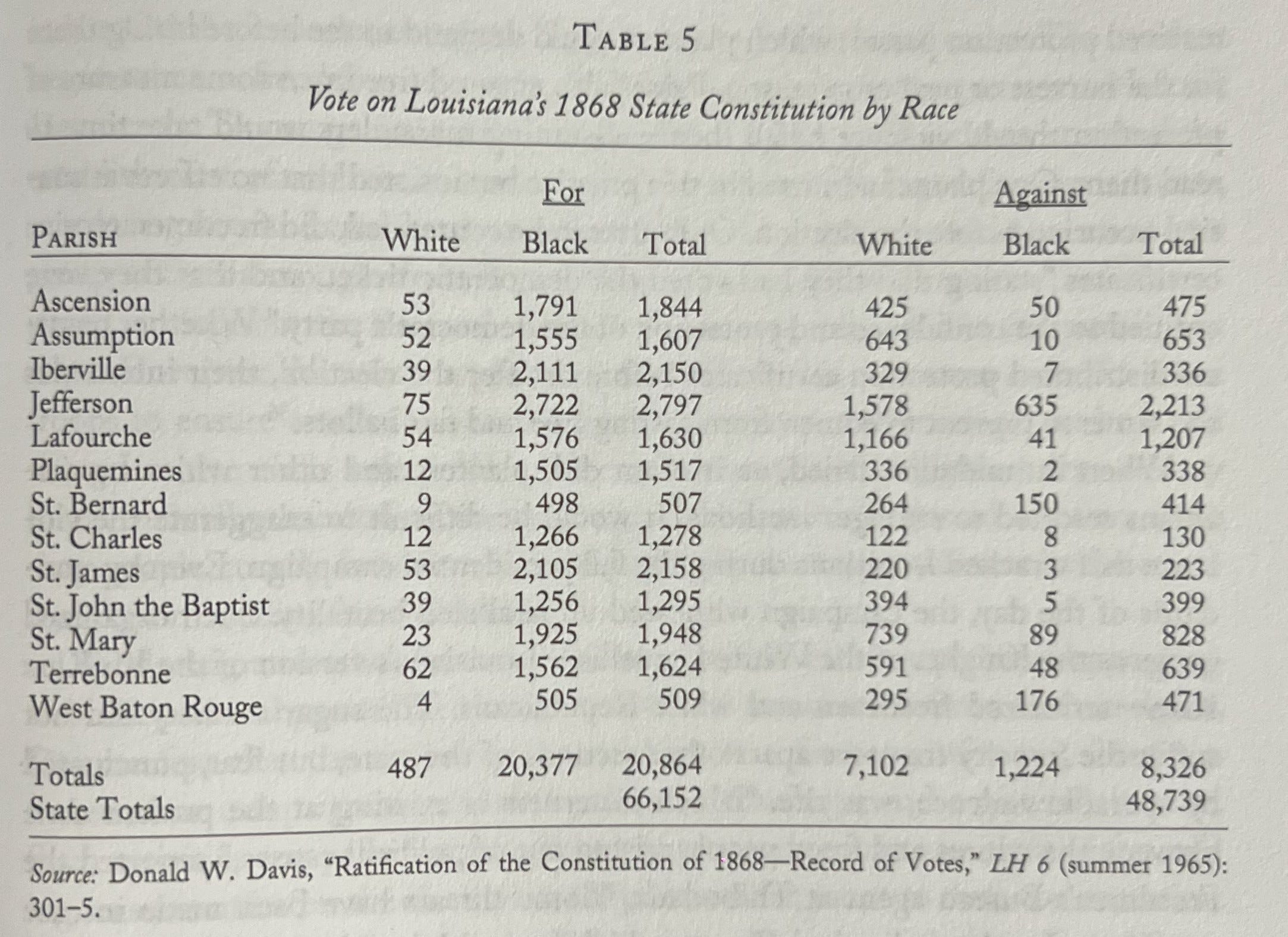
This “flood” represented a duality: a psychological (power-loss) burden and a hard reality pill, given that much of the cane country Parishes had Black majority populations. But this population imbalance was engineered by the planters. When they needed slave labor, they brought in as many bodies as possible. Those same bodies (and their offspring) now had political power. In other words –
Black majorities in several sugar parishes became powerful voting blocs, which translated into potential black dominance of both state and parish offices…By creating a black majority in the sugar region before the Civil War, planters had inadvertently laid the foundations for black political power after it.
These Black majorities formed Union Leagues and other political clubs that coalesced around a “collective conscience.” Plainly, however, the planters viewed this “recent elevation” as incredibly disruptive to controlling labor. The “ringleaders” of these Black political efforts were often excluded from employment (or worse). As you can imagine, Bureau agents adjudicated many of these conflicts, much to the chagrin of the Southerners. An example of the consequences that these Black majorities had on the 1868 State Constitution vote –
This began to unravel the ‘we need to stick together, so don’t hire another planter’s workers’ plan –
…an Iberville planter complained…of Bayou Teche planters trying to woo his workers while a neighbor headed for the Lafourche to hire labor.
This scheme was doomed to fail from the beginning. For people who previously toiled without pay, the concept of losing pay (by walking off the job) was a paltry threat.
Much to planters’ consternation, freedmen were beginning to master the principles of the labor market.
The planters and their allies would have to devise new methods. Or, more bleakly, remix the old way for their new environment.
Intimidation & violence.
The planters were steadfast in their support of bulldozing, the “crusade of intimidation and violence” to prevent newly freed persons from exercising political power. With the November 1868 election on the horizon, planters and their allies reverted to old school methods. They made no efforts to hide their political motivations/intent to get 100% cooperation from labor –
A freedman in Terrebonne Parish complained that his overseer had ordered away all those who did not pledge to vote Democratic.
As you can imagine, some Freedmen voted Democrat out of fear and/or a desire for security. This was particularly true of men with families (i.e., security was the priority).
Planters and managers recognized that the best way to secure reliable workers was to hire men with families.
“…good reliable married men for laborers to locate here, who will stay here for years.” – Manager on David Week’s plantation x June 1877
Voting Democrat also afforded Freedmen, on some plantations, protection passes which enabled them to be rehired for the next crop season. When these low-scale intimidation tactics did not yield the desired results, the heat was turned up to its most violent proportions –
When intimidation failed, as it often did, planters and other white Louisianians resorted to stronger methods. It would be difficult to exaggerate the violence that wracked Louisiana during the fall presidential campaign. Such organized gangs as the Knights of the White Camellia—Louisiana’s version of the Ku Klux Klan—terrorized freedmen and white Republicans.
Leading up to the election, some sixty or so Freedmen were slain in the countryside surrounding New Orleans. This slaughter demonstrated that, without federal protection, the long-term viability of Freedmen’s attempts to protect their rights would be useless. Nonetheless, election day favored the Republican candidate and Civil War hero, Ulysses S. Grant, who won the presidency without Louisiana’s electoral votes.
But the hardly credible tally of 33,263 votes for Grant against 80,325 for Democrat Horatio Seymour, in a state with a black majority, confirmed bulldozing’s effectiveness…Republicans captured the presidency in 1868, but white terror carried the day in Louisiana.
All of these details are important. However, we must return to the source of this entire situation.
Doing bad.
It is not until 1894, 30-plus years after the start of the Civil War, that cane country returns to a similar level of breakout sugar production. Here are stats covering the decades prior to the 1890s, to give you a grasp of how steep the drop in economic productivity was –
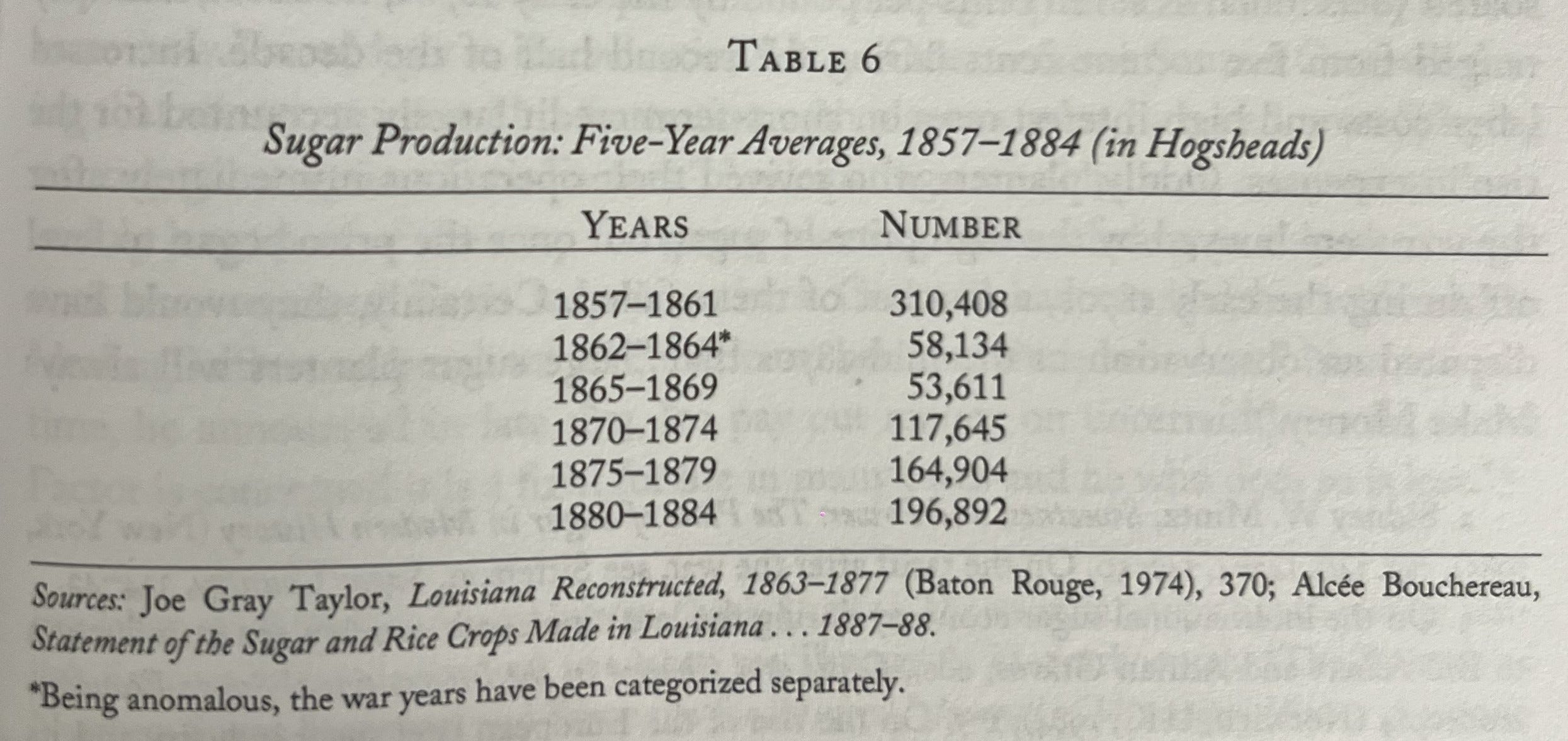
As we can see, the rebound in production did not assuage the plantation owners because “any solace planters derived from improved production was partially nullified by a dramatic drop in sugar’s price. From its height of eighteen cents per pound in 1864, Louisiana sugar plummeted to about six cents by 1880.” More work, lower prices. Much of this was driven by sugar’s shift from being a “luxury item to dietary staple.”
Louisiana's share of the domestic market in 1860: 27%
By 1875: 8%
Summary: By the mid-1870s, 90% of American sugar consumption was from imports.
Louisiana’s share of the world market, given European beet sugar and Cuban competition, decreased to 2.9% by the 1880s.
Silver lining: The federal government’s tariffs stepped in to prevent the Louisiana cane industry from falling apart.
Few planters…made money. Even the relatively successful John Burnside reported losses of more than $130,000 in 1869 alone. Burnside possessed resources to absorb this loss, but others were not so lucky. A visitor to St. Mary Parish the same year estimated that fewer than one in seizing antebellum estates had been in operation since the war. Plantations could be purchased cheaply…so long as a prospective buyer was willing to invest at least $100,000 before realizing a profit. Investment capital as a rare commodity in the postwar South…planters depended upon short-term loans—at interest rates of as much as 25 percent…
As a result, the makeup of Big Sugar (families) in cane country began to change, though some of the larger sugar families remained. If your memory serves you well, this is where we would insert Leon Godchaux into the picture –
…by 1874 Pugh was among the minority of antebellum elite planters still in business…Though no longer slaveholders, planters who persisted still dominated land-holding.
The new elite, moreover, derived from diverse origins: it included antebellum planters and their families who survived, native southerners who had not been planters before the war, and a small but conspicuous group of northerners who came south during and after the war.
Rodrigue points out the “new elite” helped to modernize the industry, in part because “they were not saddled with slavery’s cultural and ideological baggage.” They could operate within the new (to Southerners) paradigm without feeling interfered with. In other words –
“The new system required “proper direction, proper management, proper treatment, which many of the pro slavery idea planters do not understand how to apply.” – Samuel Cranwill x 1873
Determined not to be left behind, (old) Big Sugar got behind the technological change and inventions that helped to modernize the sugar mill’s function. In truth, they probably viewed these improvements as the best alternative to “bypass the apparently insolvable labor problem.”
1877: The Louisiana Sugar Planters Association (LSPA) was formed.
Initially focused on lobbying to maintain tariffs against imported sugar (and to maintain federal subsidies for Louisiana’s product).
Shifted to scientific research in partnership with the USDA, Tulane, LSU, Audubon Park Sugar School, etc.
At the same time, and there’s no doubt that one thing influenced the other, the adoption of central mills (with larger capacity for cane processing) emerged. From the 1870s onward, you see an uptick in White sugarcane families laboring in the fields to help fill out these large mills’ excess capacity. By the eve of the twentieth century, it was reasonable to conclude that productivity in the space was attributable mainly to technology and centralization, rather than to a greater emphasis on labor-intensive field operations (i.e., control of Black labor).
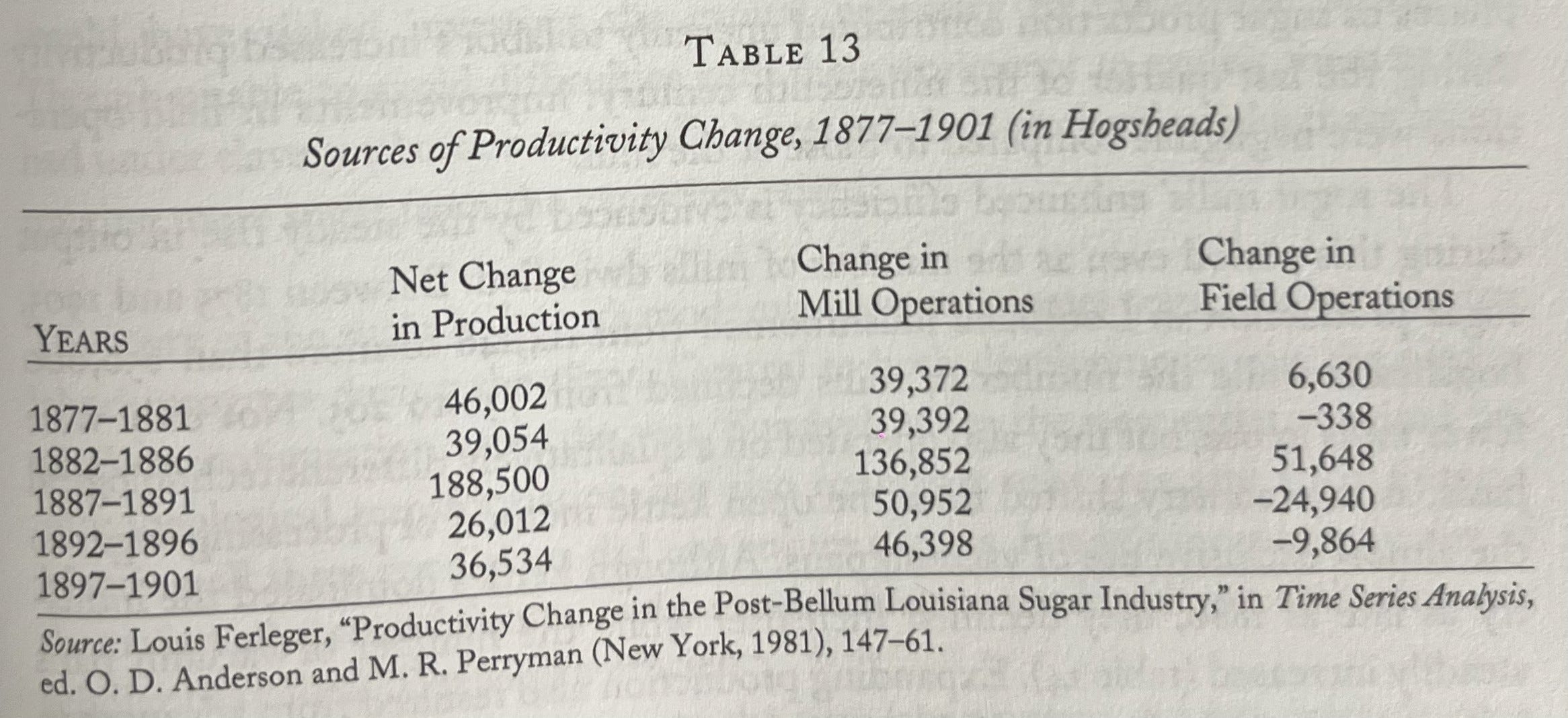
Even with that, output per worker also improved because of improvements at the mills –
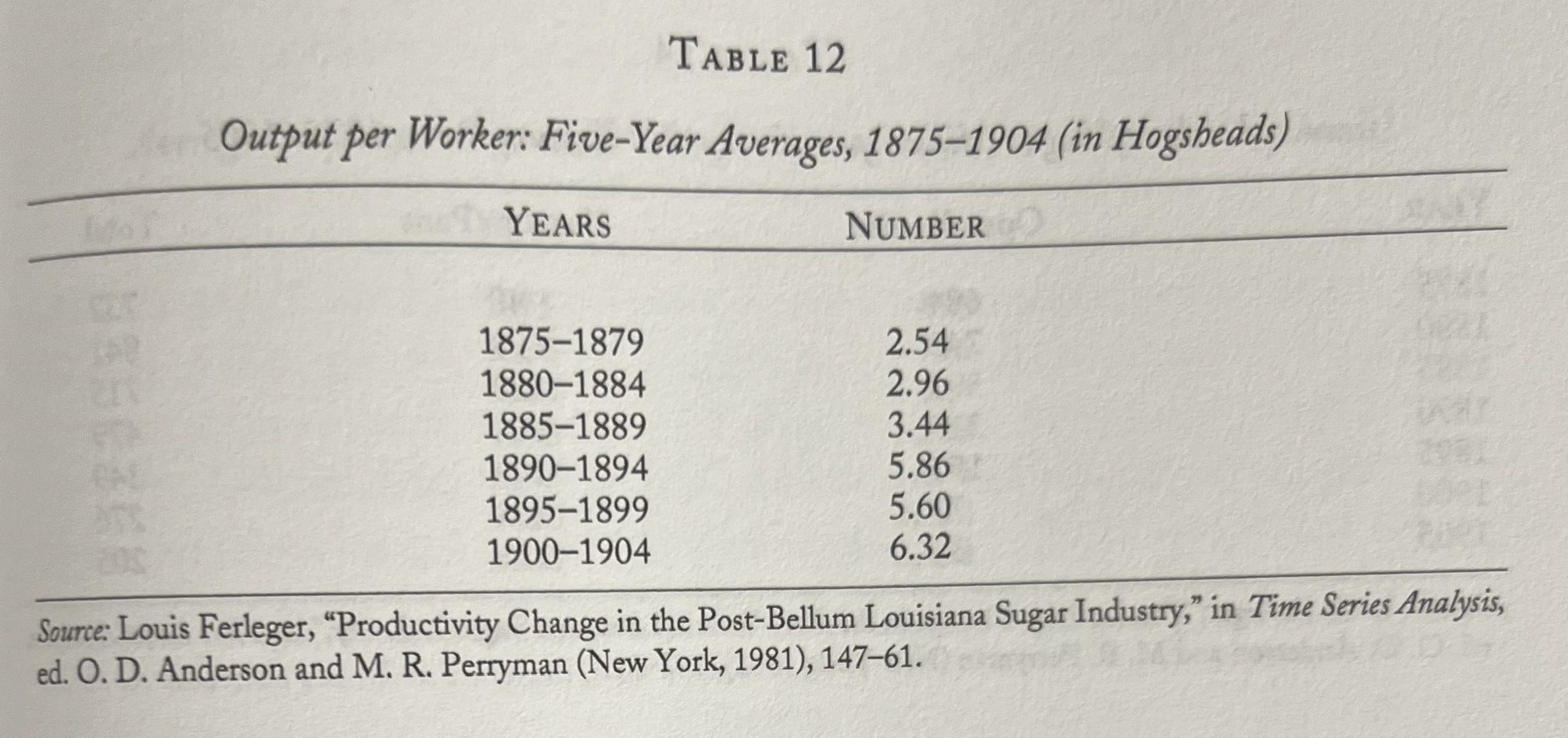
The other improvement in technology – this is a callback – that was adopted at a wider scale was Norbert Rillieux’s methods via vacuum pan usage. The invention & techniques were available pre-war, but the urgency to adopt them was not, in part because the methods/hardware were too expensive.
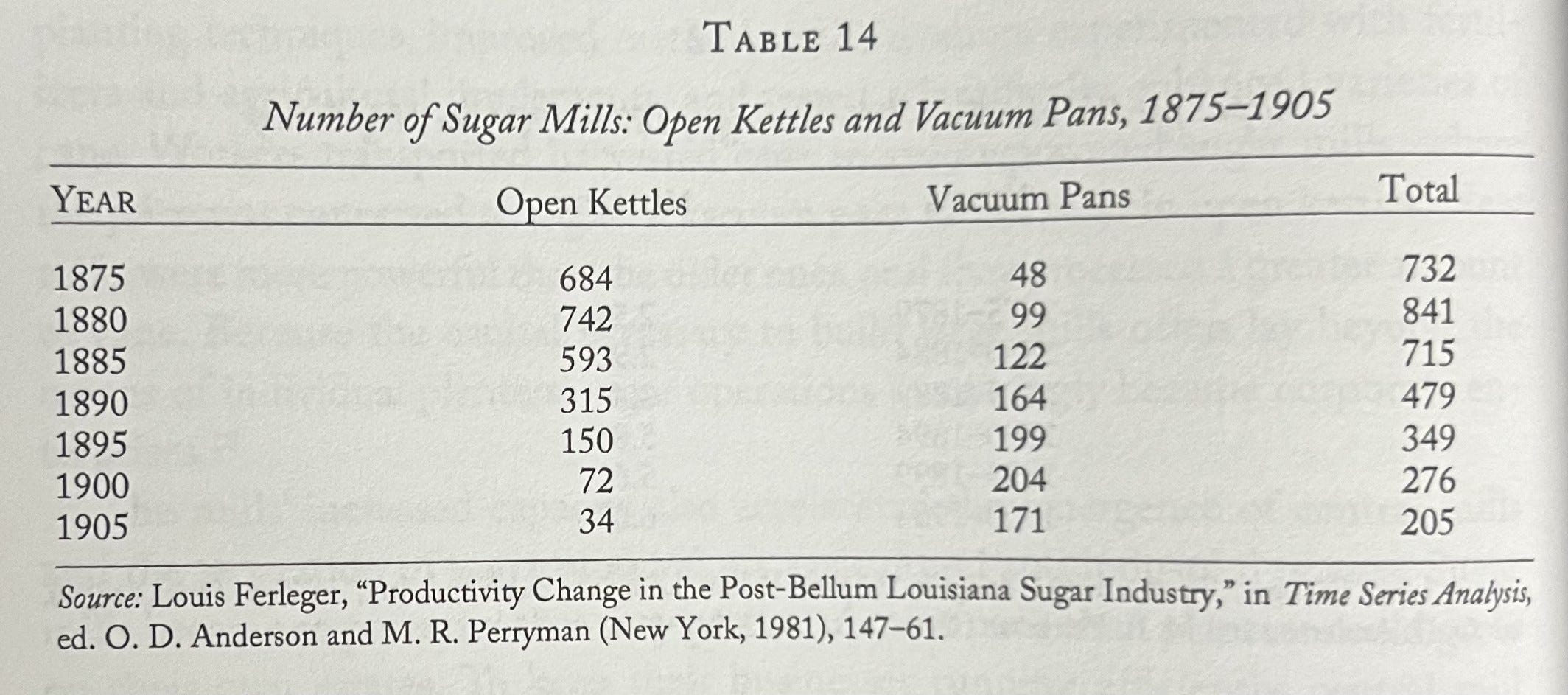
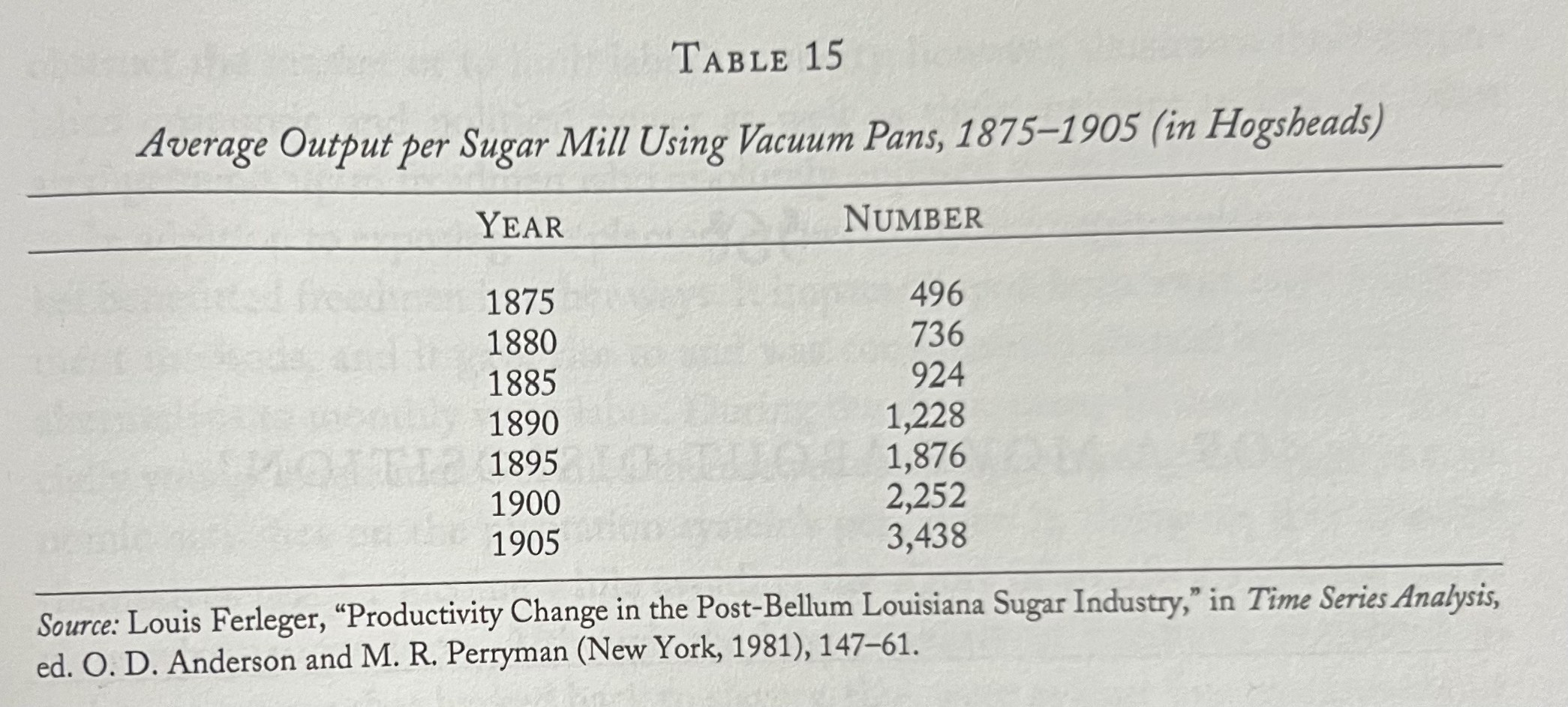
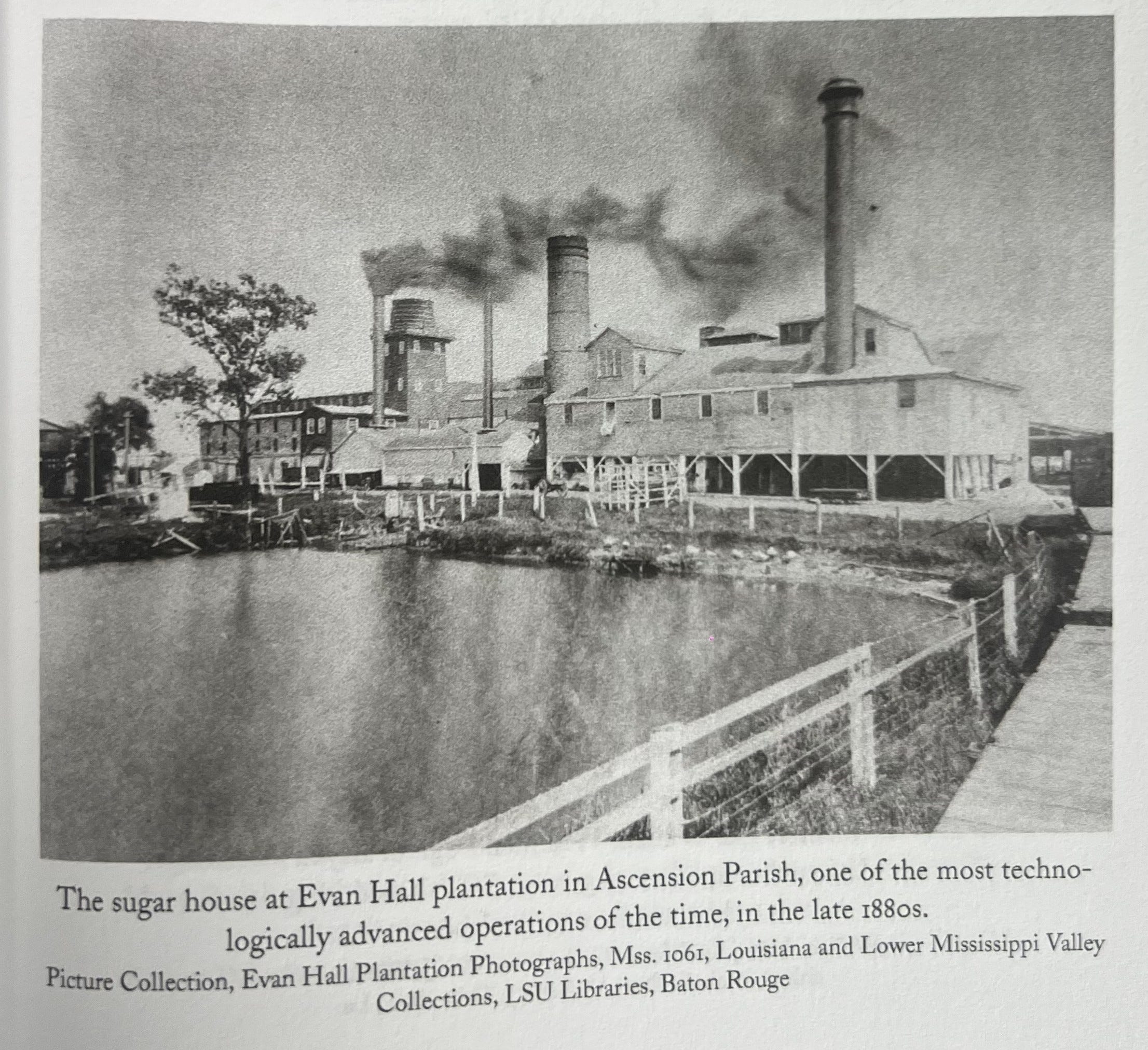
“By the turn of the century, the sugar industry had undergone a revolutionary transformation. Not only had planters discarded centuries-old technology, but Big Sugar had been born.”
I’d say Big(ger) Sugar had been born, though I get that the central mill model produced consolidation at scale, so more of the spoils went to fewer planters.
Big(ger) Sugar –
If you thought that those of the old stripes were simply satisfied with the improving future prospects for sugar, given the advances outlined above, then you are in for a rude awakening. Black involvement in politics via Radical Reconstruction still perturbed “Louisiana’s white community.” During the 1870s, violence against “the Reconstruction state itself” would reach new heights. And that wouldn’t slow down for some time.
Note: there are a lot more details surrounding the “insolvable labor problem” that Rodrigue covers, namely, “jobbing,” what Freedmen did with their wages, “floating hands,” a burgeoning property-owning class of formerly enslaved people (albeit in “marginal areas,” on the “periphery), development of disunity and betrayal among the planters across Parishes regarding the wage system, bringing in outside labor (Dutch, Germans, Spanish, Portuguese, Italians, etc.) via The Louisiana Immigration Company, and much more. Each of these requires an article in and of itself. And if I write it, it won’t be short. I will spare you this one time. But I must highlight two important callouts (quotes). The first callout will be revisited in another piece. The second is a testament to what we anticipate will happen when planters, grounded in hard economic ways of operating, had to choose between race and their wallets.
Attempts to use Chinese labor as a replacement for the freedmen (failed) –
Equally futile was an effort to replace freedmen with Chinese immigrants. During the early 1870s, John Burnside, Edward J. Gay, and others imported several hundred Chinese workers, either through independent labor recruiters or by sending their own agents to California and even to China. Believing that Chinese workers immigrants would be more controllable than freedmen, planters at first roundly praised them. Competition for their services intensified, however, until most planters became convinced that securing Chinese immigrants was more trouble than it was worth. Nor were the Chinese more amenable to working in a slavelike manner than had been freedmen, and they resisted planters’ efforts to lower wages and impose discipline. The eventually left the plantations for New Orleans or southern Louisiana towns. By 1873, planters’ dreams of replacing freedmen with Chinese workers also lay in shambles.”
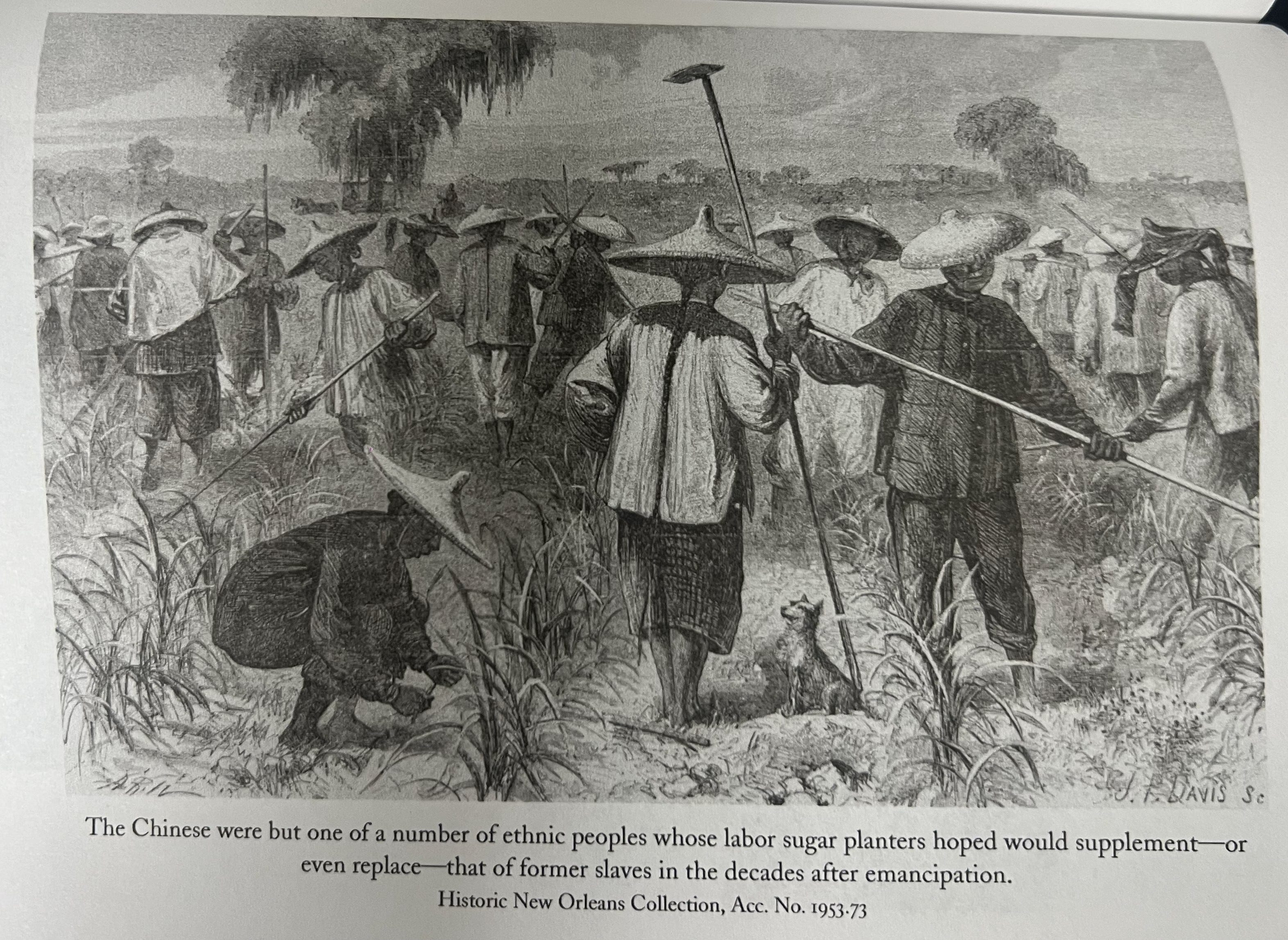
Planters choosing rugged individualism and economic ascension over race solidarity –
A number of St. Mary planters met in October 1877 to establish wage rates for the following year and to end full payment. “It was unanimously resolved,” noted the reporter in attendance, “that the next year none should pay full wages monthly, but that one third should be reserved until the end of the year to make planters secure.” Yet this attempt at concerted action ended as futilely as had previous ones. By early 1878 some planters were reneging on their pledges. An editorial entitled “Honor Among Planters” bemoaned the fact that, despite planters’ promises not to pay full wages, “already we hear a repetition of the old story—violation of these pledges by avaricious and unscrupulous planters.” One planter’s unscrupulousness was another’s sound business practice.
Violence & politics in the 1870s onward.
The White League was responsible for the Coushatta massacre in August [1874], in which five white Republicans were slain, and in the Battle of Liberty Place in September, it defeated Metropolitan police and state militia in a conflict at the foot of Canal Street in New Orleans, leaving thirty-two dead and forcing Kellogg to seek protection under the U.S. flag. Federal troops restored Kellogg to power, but clearly Republicans could not govern even New Orleans, their home base, without federal support. These incidents, however harrowing, merely punctuated an electoral season that was exceptionally violent by Louisiana standards.
However, “sugar parishes remained a Republican enclave until the Bourbon elite suppressed black political rights in the 1890s.”
Detour: fellow Kentucky whiskey lovers, “Bourbon” is a French word that ties back to the former ruling Kings of France (16th to 19th century). Those rulers were notorious for having “revived old laws intended to reassert royal authority and elite privilege at the expense of democratic principle.” The term was adopted in Louisiana to represent the most reactionary faction of the Democratic Party, though Bourbons were initially seen as anyone opposed to Reconstruction. If you were wondering why there are so many French words all over American things (e.g., Paris, Kentucky), it’s (in part) because they aided in America’s defeat of the British during the American Revolution.
Source for the above (dive deeper if interested): 64 Parishes
These Bourbons would go on an even more repressive crusade dubbed the “Redemption.” What were they bemoaning? An example: In 1872, the state legislator, sheriff, coroner, and full police jury of Ascension Parish were all Black. If we extrapolate majority-dynamic across the sugar regions, we can conclude that planters had no practical/legal means of “restricting the labor market and reestablishing control over their workers.”
But again, planters who were of the ‘wallet first’ variety tepidly supported the White League/Bourbons/radical factions because they understood all of the above was going to be disruptive to crop seasons.
“White Leagues are arousing an alarm for the general war of the races, which will cause the loss of the crops.” – A.F. Pugh
The 1876 presidential election, which Rutherford B Hayes (Republican) won, would signal the beginning of the end of Reconstruction –
Thus, Hayes assumed the presidency, the few hundred federal troops stationed in the South were ordered back to their barracks, and in Louisiana—whose gubernatorial contest was yet again disputed—Democrat Francis T. Nicholls was inaugurated, while Republican candidate Stephen B. Packard and his supporters were sacrificed on the national party’s altar of power.
The terror ensued. An unequivocal “use of force” rained down on Freedmen and anyone who remotely appeared to be in their allyship. Any form of resistance, protest, or demonstration of leverage was put down with violence. The author, in his Epilogue, touches on the “THE SUGAR WAR OF 1887,” otherwise known as the Thibodaux Massacre. This is another event that we will return to in another piece. But here’s some unfortunate foreshadowing that will give you a sense of how the rest of the decades in the 19th century played out –
“[W]e have had a horrible three days….I am sick with the horror of it—but I know it had to be….I think this will settle the question of who is to rule the nigger or the White man? for the next 50 years. [B]ut it has been well done & I hope all trouble is ended. The negroes are as humble as pie today, very different from last week.” — Mary Pugh to Edward F. Pugh, November 25, 1887
…planters now enjoyed a decided advantage. This eventuality…became so with the tragic events of 1887.
Safe to say, Redemption completely did away with Black political leverage, and (re)legalized segregation/disenfranchisement –
The Thibodaux Massacre was thus an epilogue to the story of emancipation and a prologue to the saga of Jim Crow and the white lynch mob.
Advantage – planters.
Heady.
Just remember, “planters” is a hilariously ironic designation for people who did not do the planting
in all that you do, please, don’t ever stop reading.

A post-script for the nerdier amongst us. If you’re curious about the historical processing of sugarcane into sugar –
At the sugar mill, sugarcane was placed on a conveyor belt that transported it to the mill, where it was fed into a set of rollers that crushed the cane and extracted the juice.
The juice was purified by boiling it in a series of kettles (three to five).
The impurities floated to the top and were taken off; the author notes that the sugar maker, usually a White man, but sometimes a free man of color, had to be really sharp in assessing when to pass the juice to the next kettle and not keep the kettles on for too long, implying that this person was overseeing the bulk of the process.
When it was determined that the impurities had been removed, granulation, or the “strike,” took place, a critical step in determining when the syrup had reached a sufficient consistency.
The sugar was poured into large shallow vats and stirred.
Crystals would eventually appear, and then more layers of syrup were poured onto the first.
When granulation was completed, the enslaved transferred the raw sugar into hogsheads, “from which molasses, a by-product drained.”
This was brown sugar, not white sugar, which the planters usually shipped to refiners in New Orleans, St. Louis, or northern cities for further processing.
A visual timeline of the step-by-step process –
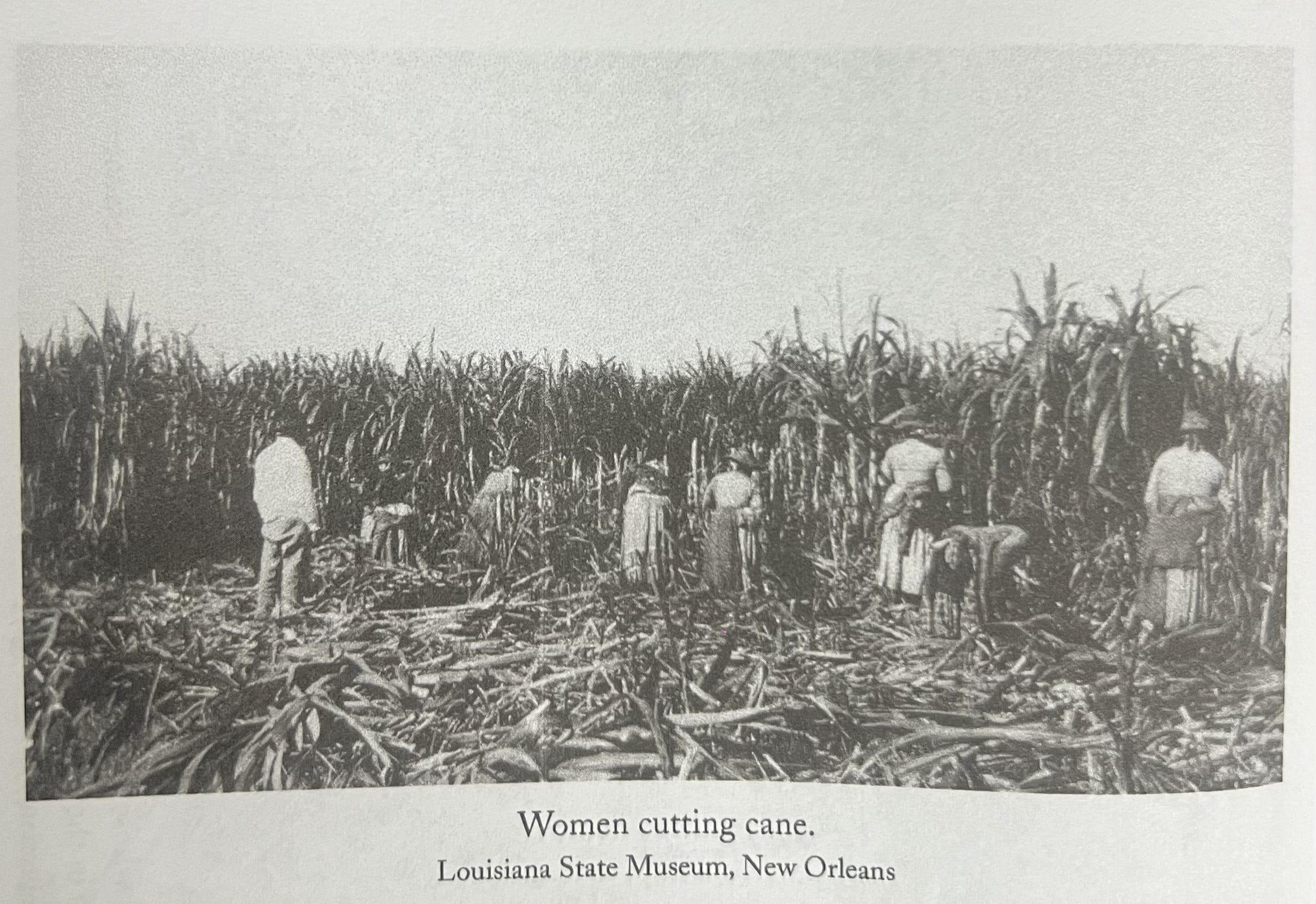
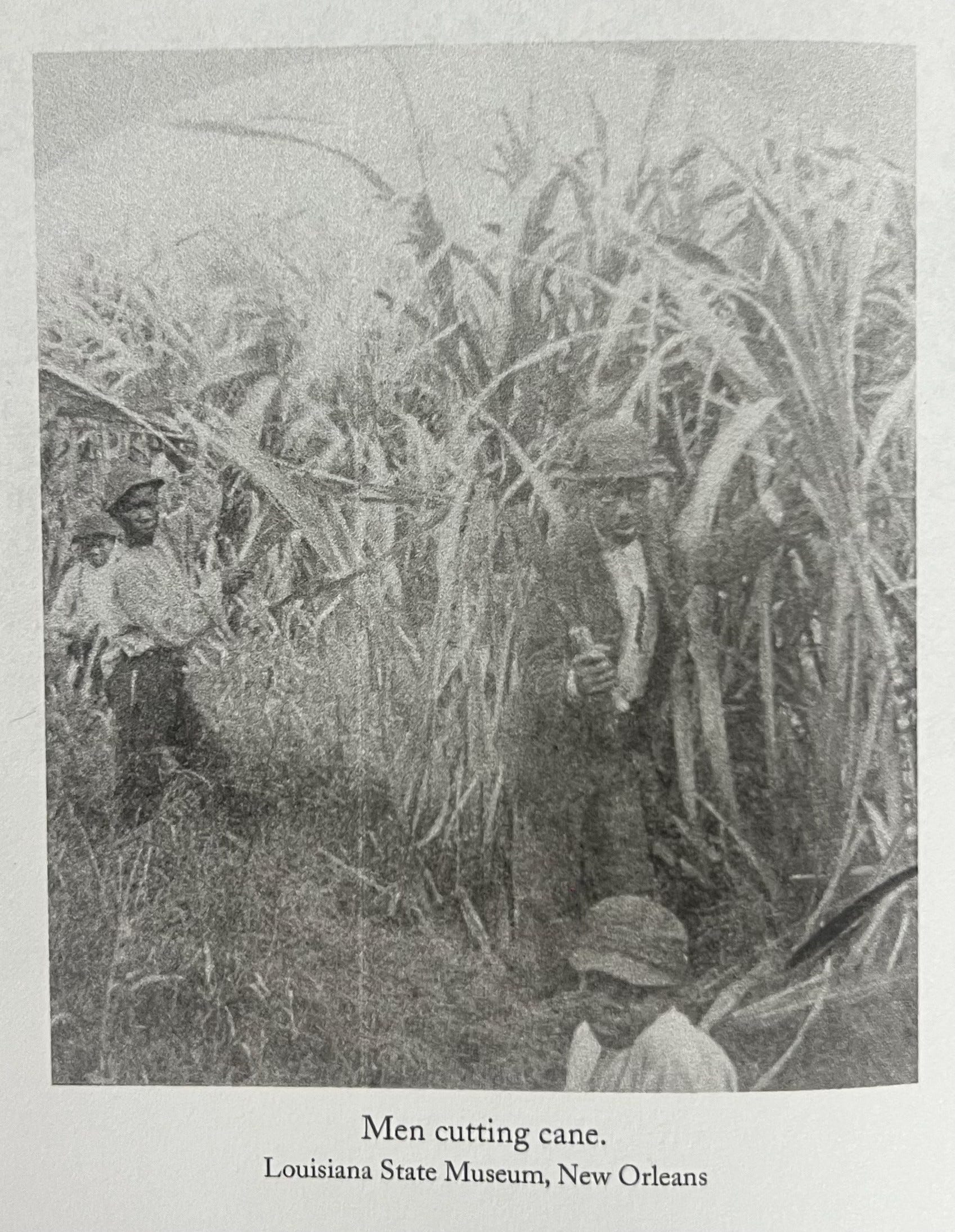
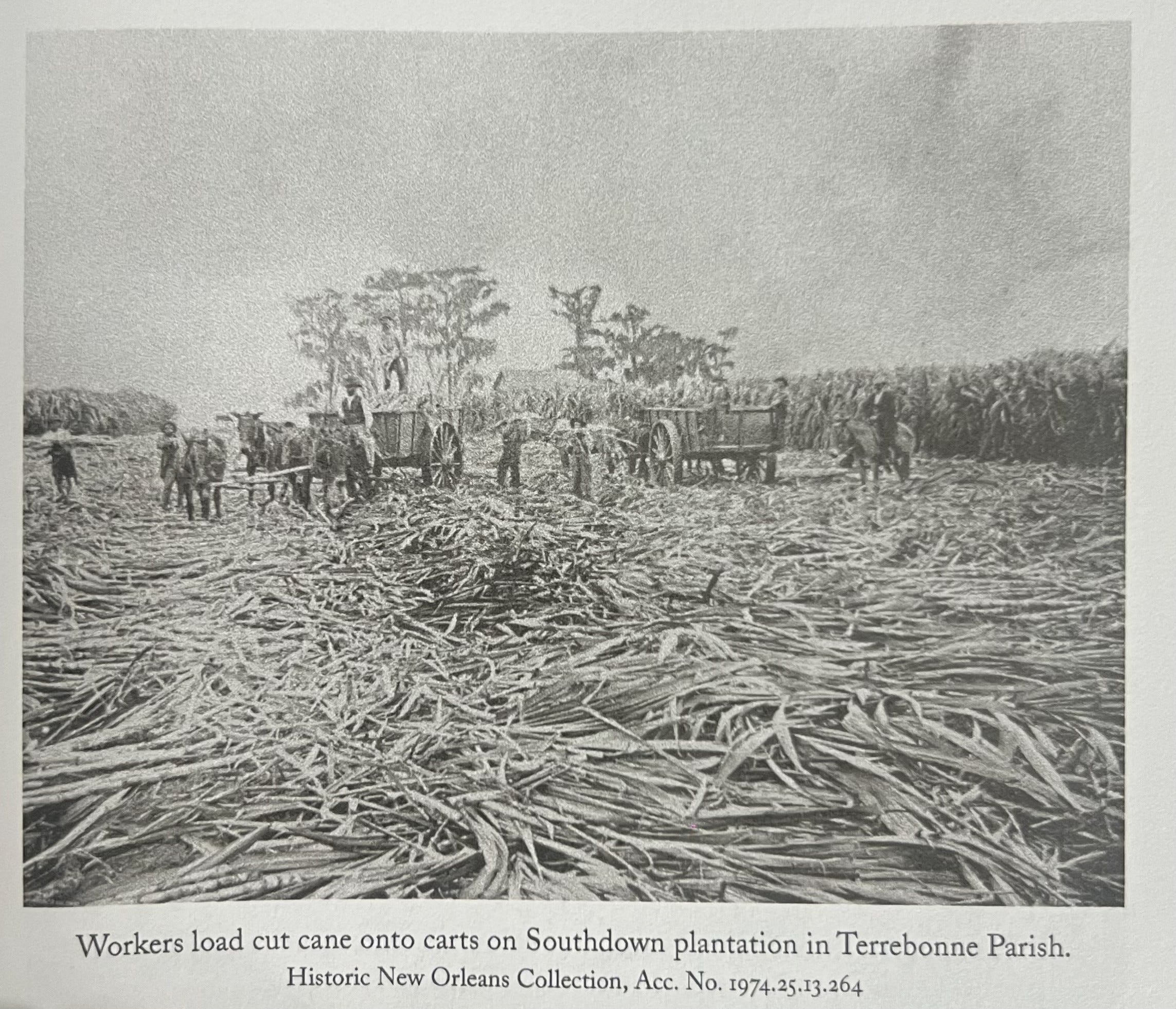
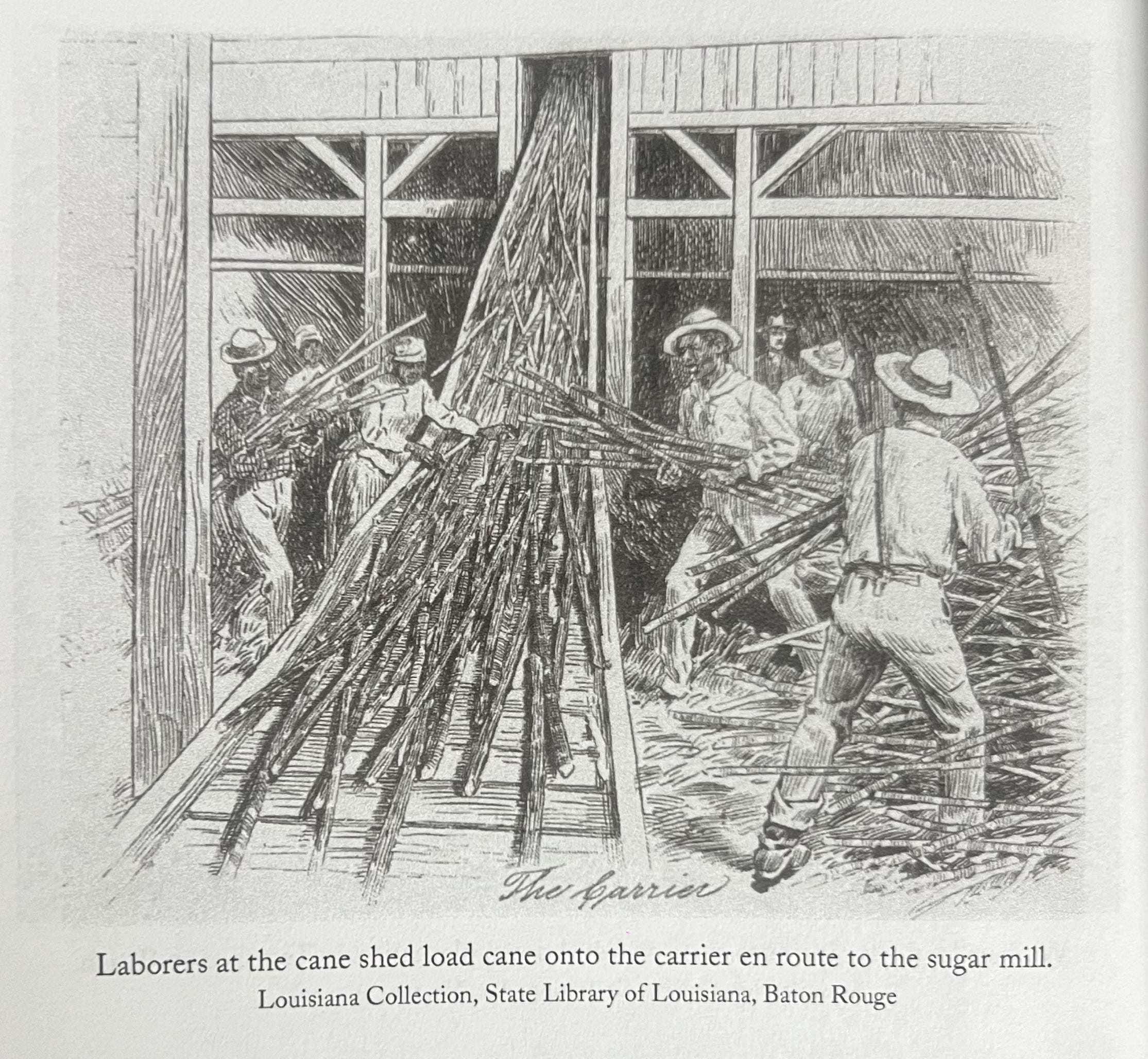
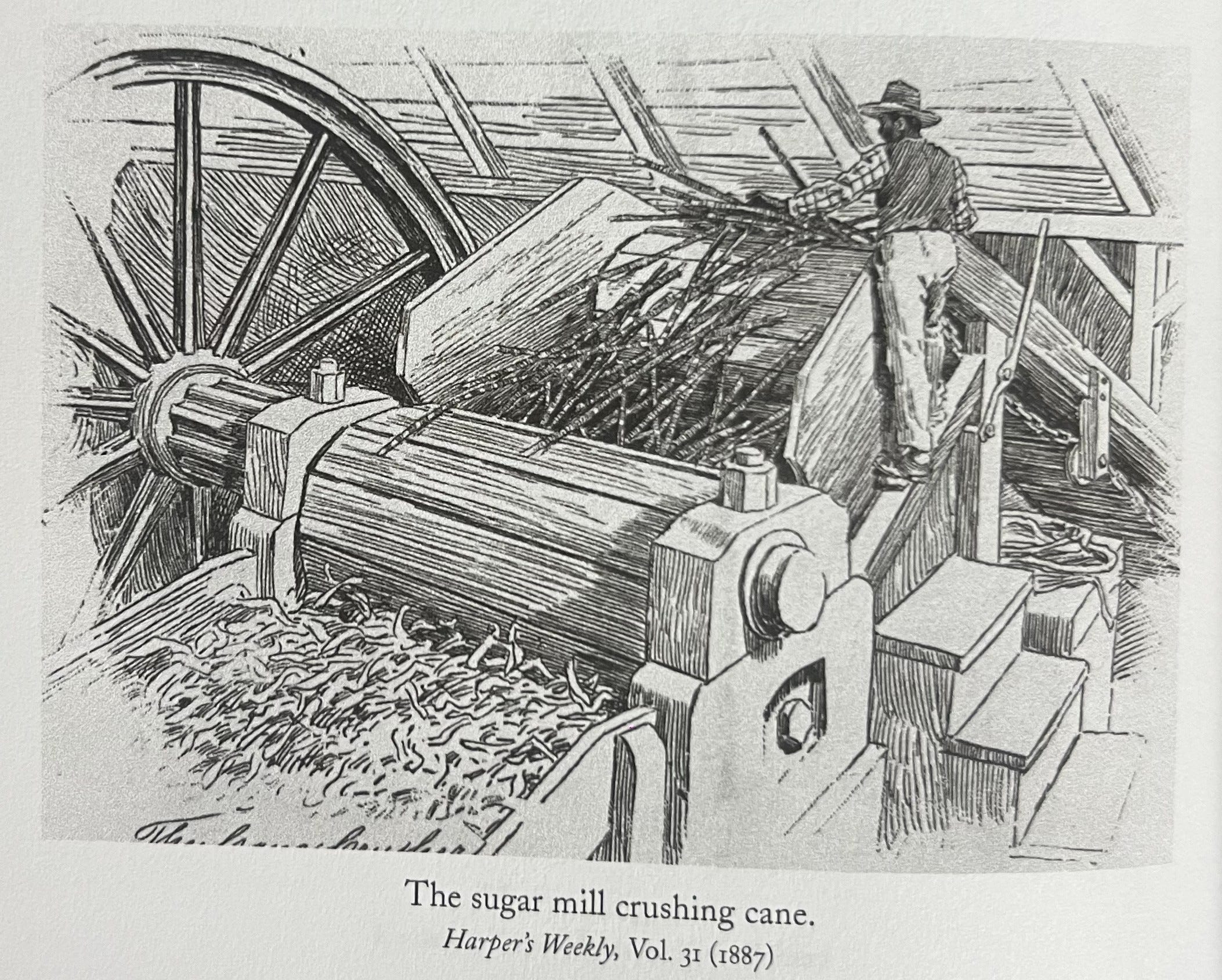
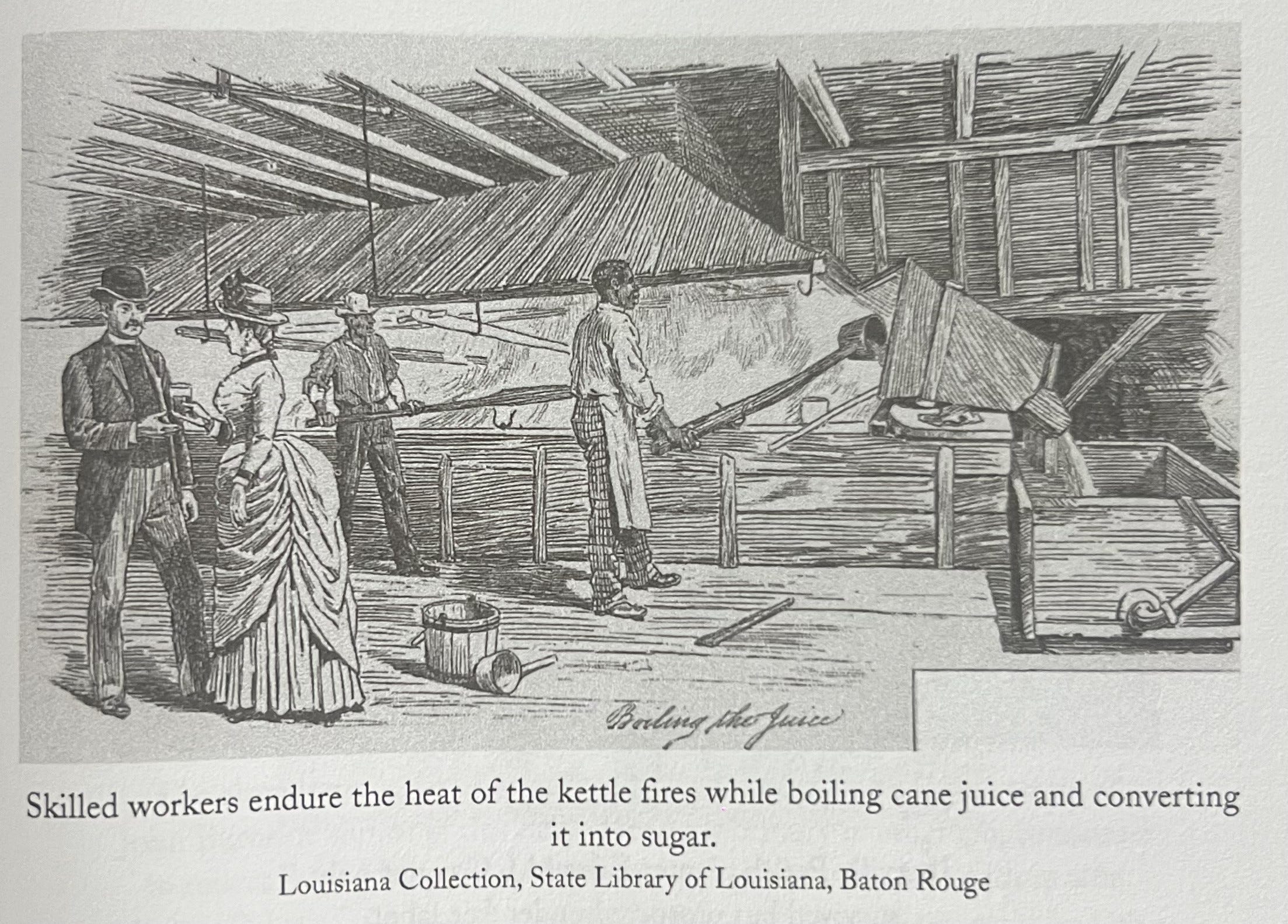
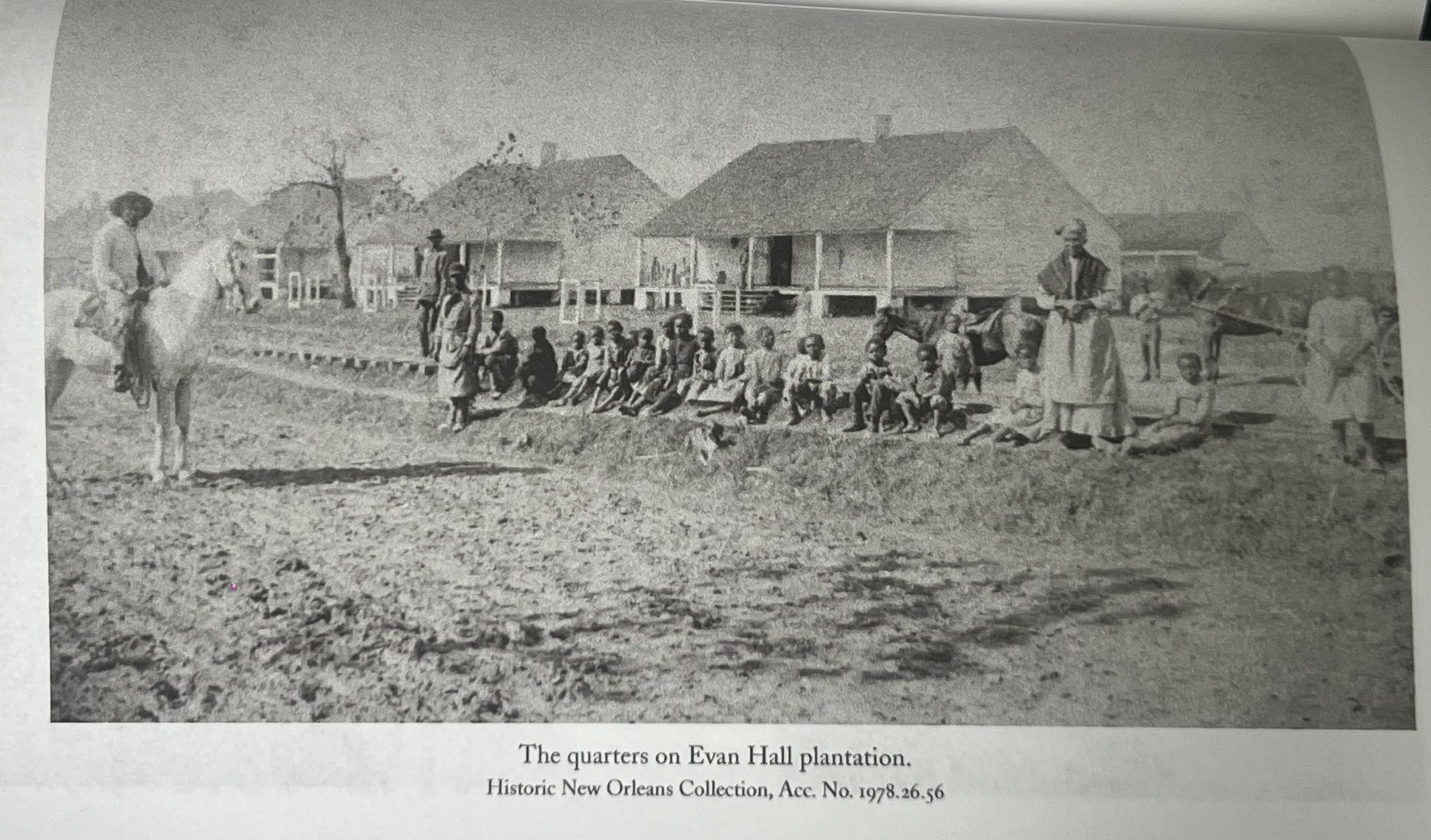
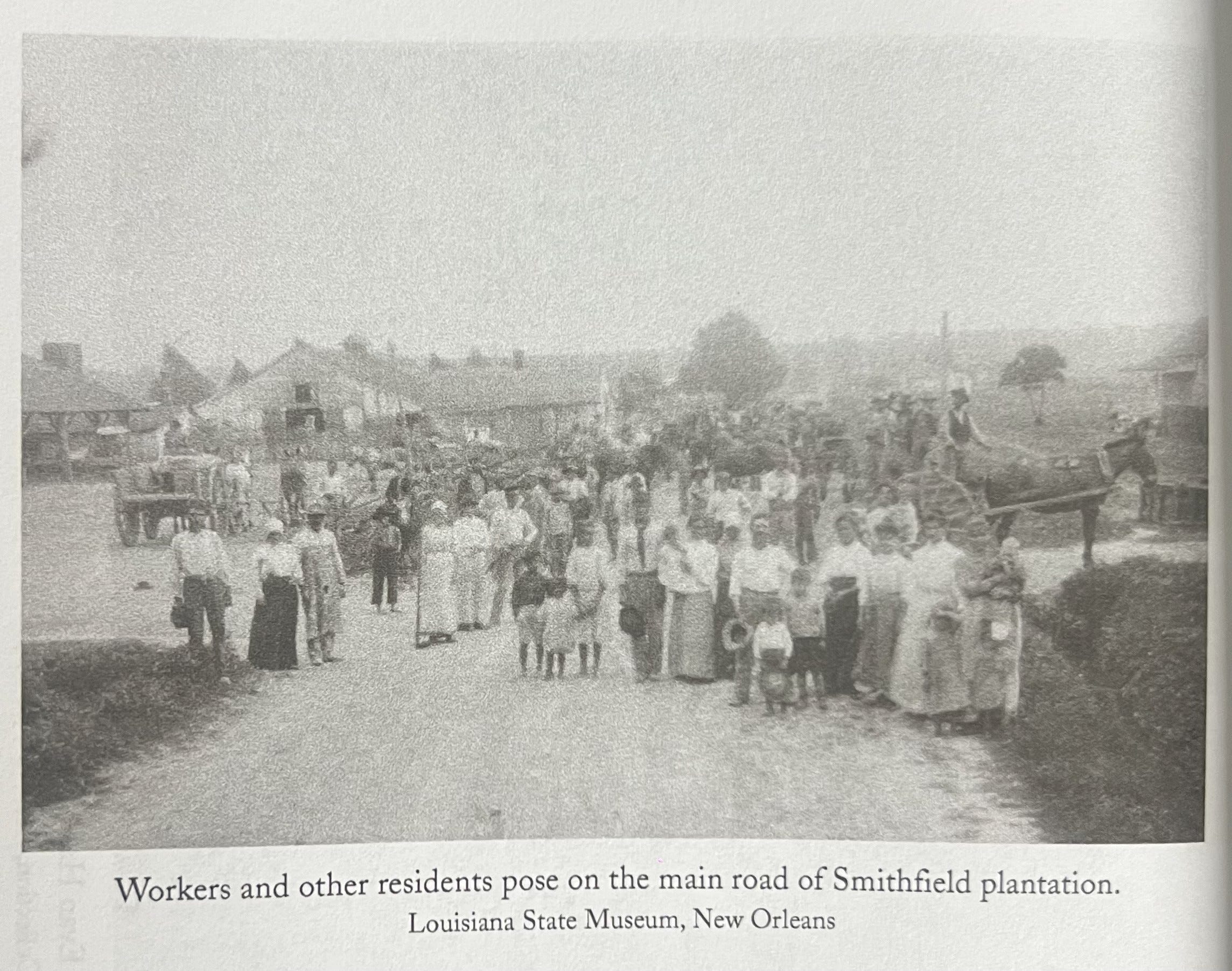
The humans who labored pre- and post-slavery –
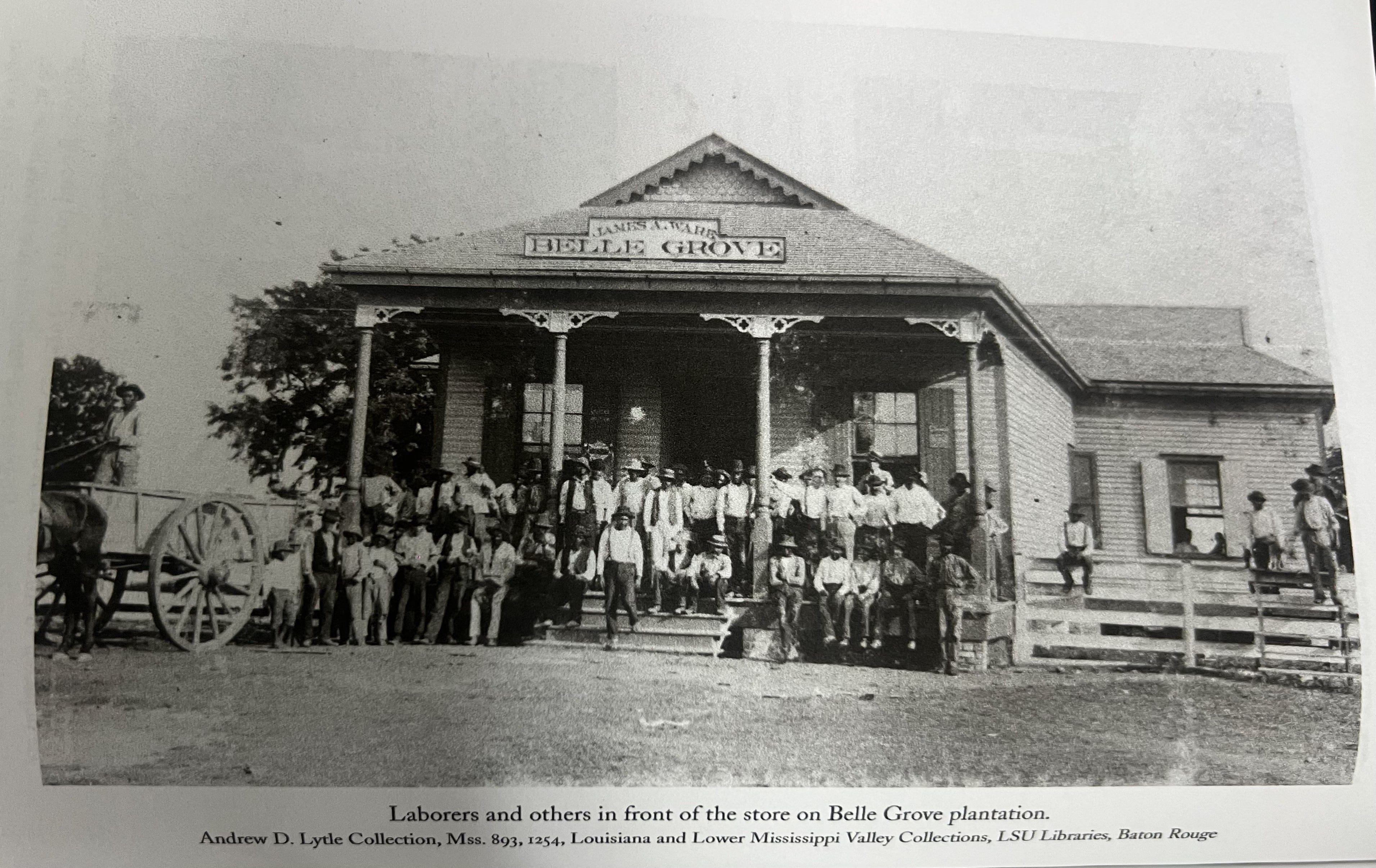
All of the above was for my own knowledge, but thank you (as always) for reading.