



Heavy academic stuff here, promise it’s interesting.
Retrieving this book, albeit in digital form, was probably one of my nerdiest endeavors, of which I don’t think I’m at liberty to discuss. If anyone knows where I can find a physical copy, please let me know. This piece will gently pull us out of Louisiana – detour, we’ll be back – so that we can zoom out and understand the consequence of “The Rum Trade” in the former English Seaboard Colonies, the Caribbean, and everywhere else in that geographical formula where sugar and rum touched. Now, as I stare at all 61 pages of my notes, I’ve concluded that disseminating them would simply be too much.
For those with academic or other interests in tearing into this incredible volume of research, take the leap. You will not be disappointed. For those on the other side who allow me to entertain them with incredibly specific details about incredibly specific topics, I’ll pick things apart and give you just enough.
For the ‘I care about this stuff’ crowd –
Tested in this work will be the thesis that the export of rum contributed significantly toward righting the balance of payments of the Continental Colonies.
…my goal: an exposition of the production, trade, processing, and consumption of sugar and its by-products -- molasses and rum -- in the Atlantic world of the sixteenth, seventeenth, and eighteenth centuries.
The author explores imports (debits) and exports (credits), who and where produced/imported rum, “coarse brown muscovado” vs. semi-refined or clayed sugar production, sugar refinery operations (Continental Europe vs. their colonies), and all related factors surrounding sugar and its outputs (e.g., shipping, insurance, etc.).
A lot of historical background on sugar before exploring the later ramifications on the original Thirteen Colonies.
This Balance of Payments (BOP) definition will be useful as you read: BOP measures all economic flows in and out of a country over a specified period (year, quarter, etc.). For more on the topic, see Investopedia.
For my ‘what does any of that mean’ crowd –
Export of sugar and rum is a credit (like money entering your account).
Import, the opposite (we are all painfully aware of what it’s like for money to exit the account).
McCusker argues that the threat of “English commercial legislation” was squarely dependent on the “economic importance of what it threatened.” Which is to say, sugar and rum were fundamental products that kept the English Crown wealthy pre-American Revolution, so they focused intently on monitoring, taxing, and controlling their movement.
The author urges us to understand the relevance of the above and what it meant for the original Thirteen Colonies (emphasis mine) –
Conventional wisdom about the importance of the colonial export trade in molasses and rum suggests it to have played a decisive part in helping the colonists pay for their purchases from Great Britain. Any attack upon such an important trade would seem to have been an obvious reason for revolt. No one has ever performed such an analysis, however; no one has ever studied the relevance of rum to the colonial balance of trade…
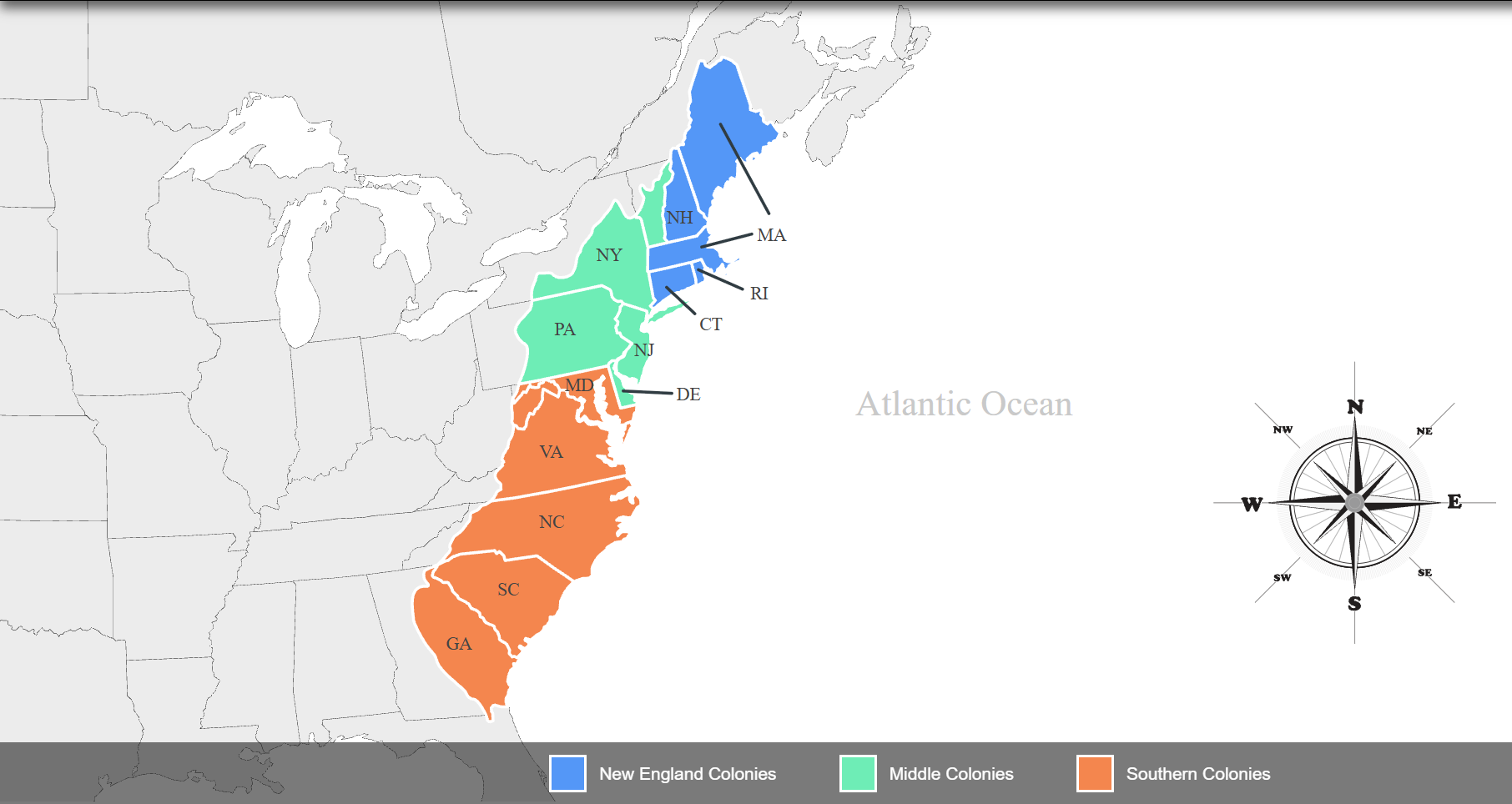
In other words, the South already had a base from which it could produce stuff, sell that stuff, and generate the income necessary to pay taxes to the Mother Country (Britain). They could plant, exist, and subsist off their “tobacco, rice, indigo,” and other foodstuffs. Hence, and this is my argument, there is a higher propensity for amnesia about the role of rum and America in the southern psyche, given an absence of consequential dependency on sugar and rum. Kick the can up to the “northern colonies,” which did not have those luxuries, and we see that trade was the name of their game. The West Indies became vitally important to those colonies (as a trading partner); the northerners sent them “provisions, lumber, horses, and the like,” while the Caribbean colonies sent over, among other things, sugar, molasses, and rum.
Rum, especially for the northern colonists, became “an important item of export” because it allowed them to generate the money “to offset their unfavorable balance of trade with England.” In fact, rum was “the most popular export of New England.” Customers included many, but much of the liquid “went mostly to Africa” to be used as a trade bartering tool for the “purchase of Negroes.” See my piece on “Rum, Slaves and Molasses: The Story Of New England’s Triangular Trade” if you read that and were surprised in any way.
The numbers support this –
Before we dive in, a very important callout around the author’s chief analysis year of 1770 –
For the rum trade it will appear that 1770 was atypical only in that it was the best five-year period for the export of rum.
Let’s dive in.
But first, Louisiana = )
In 1770, the Pelican State would have been part of “Spanish America,” at least formally; reliance on the French for colonial administrative assistance, given the territory’s largely French-speaking populace, was very much a reality. Nonetheless, we have information on Louisiana and rum that I would not dare skip over –
Even though the manufacture of crystallized sugar was short-lived in Louisiana, the planters turned the raw cane juice and the molasses to a profit. They sold some as a cheap sweetener in lieu of sugar but they also distilled some into rum. Limited quantities of rum were manufactured in Louisiana before the American Revolution, but how much is anyone’s guess.
I am used to the scant references to rum and Louisiana at this point, even if I remain unconvinced that a place that crushed cane in such consequential proportion does not also have a vibrant cane spirit/rum history. What became increasingly clear to me while reading the author’s work, however, is that the juiciest details surrounding rum imbibing among Louisianians may be found the further back we go. But even then, the liquid’s proliferation was inevitably tempered by the French’s/Spanish’s urge to squash meaningful competition to their wines/brandies.
Before 1763 Martinique had exported rum to Louisiana and after that date the Cubans found an export market at New Orleans for their own rum, so the local production could not have been too large. Certainly in 1770 Louisiana exported no molasses or rum to the English Continental Colonies.
But I wonder how much the New Englanders historically smuggled from the neighbors up top (Canada). It had to be of some consequence, since New England was a prime market for French goods, mostly illicit, it seems (i.e., exports or re-exports from French colonies). The North is too close for that not to be the case. Here’s the history I’m mulling over –
French North America before the war [American Revolution] had been a major importer of Martinique’s rum. In the ten years 1743 through, Quebec, Nova Scotia and Louisiana accounted for an annual average of roughly 350,000 gallons…
The author suggests that much of the rum referenced went onward to Boston, NY, and other colonial ports. That is where we will end the Louisiana and rum coverage. Before we dive any deeper, let’s talk about the author.
John J. McCusker
Now this is an author & historian who is completely off the digital grid. Cut from that old school cloth. Therefore, I will have to rely primarily on Wikipedia for his download –
He’s from upstate NY and attended the University of Rochester (graduate degree). That’s very upstate of McCusker. While there, he studied under a Nobel Laureate economic historian, Robert William Fogel.
Looks like he also did some work (maybe studied, too) at the University College of London.
But he definitely completed his doctorate at the University of Pittsburgh. A full education.
Taught at the University of Maryland for 24 years.
Moved over to Trinity University – Ewing Halsell Distinguished Professor of American History and Professor of Economics – where he retired in 2015.
Seems that he’s still with us and is 86 years old. Combining history and economics/financial matters is sometimes a more straightforward way to understand human development, and certainly societal development (loosely speaking). When you follow the funds or simply understand what groups of people depend on for their livelihood, it allows you to have a more grounded understanding of the who, what, where, when, and why(s). This McCusker explores robustly.
While digital archives of his work are available, finding a physical copy is HARD. Special shoutout to the folks who digitized McCusker’s book in 2023, the Internet Archive, and those who funded the endeavor, the Kahle/Austin Foundation.
Rum and the American Revolution was originally published in 1989. From the words of the academic himself, here is what he set out to establish –
…the objective of the dissertation must be to establish the value of exported rum as a credit item in the colonial balance of payments. The background and point of reference against which this will be compared is the annual colonial debit for goods and services imported from England and Scotland. These were not, of course, the sole colonial debits because Great Britain was not the only area supplying goods and services to the Continental Colonies.
Price and trade of sugar + rum on the colonial scene.
McCusker sets the scene in a riveting way –
Since the colonies and the colonists were constantly faced with the problem of paying for their imports from England, and since they often phrased their discussions of a particular trade in terms of its usefulness in surmounting this obstacle, an analysis of the contribution of each colonial trade toward meeting their English debts becomes a particularly meaningful enterprise.
But, to balance the beam, he also outlines the qualitative and quantitative exports of England and Scotland into the Continental Colonies. All rum exported (from the Continental Colonies) was originally an import (debit) of finished rum or molasses that were used to manufacture rum. The export value of the rum (FOB) is compared to the import cost of the raw materials used (CIF).
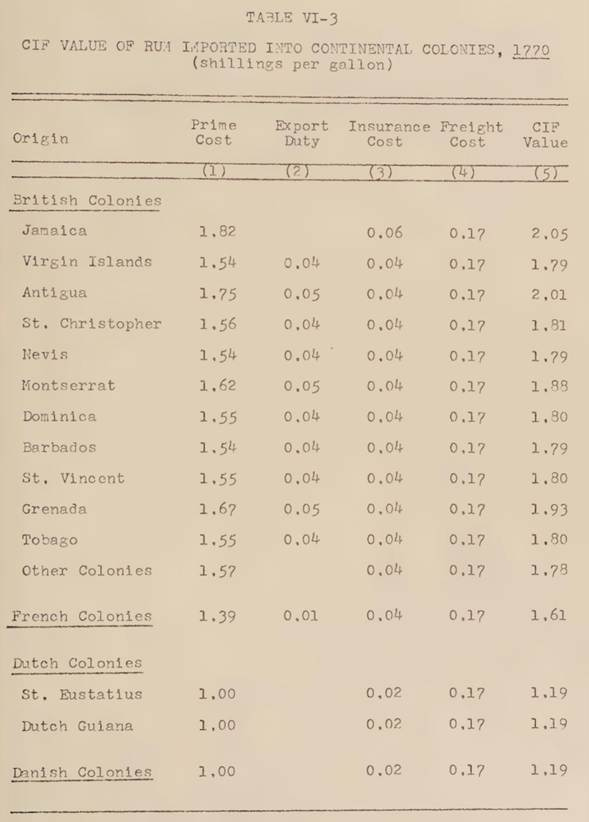
The CIF value of molasses or rum equaled the original cost (C) of the commodity at the point of exportation (including any export duties), the cost of marine insurance (I) for the voyage northward, and the cost of freight (F) between the origin and destination. Each of these three elements must be established in turn for both commodities from every exporting colony. Clarity is served by dealing first with molasses, next with rum, and then with the conclusions which arise from the calculation of the net debit.
A completely separate accounting of shipping services must be included, along with other “invisibles,” in the balance of payments of the Continental Colonies.
Ultimately, he wanted us to understand the true net export value (net FOB), a formula the British worked hard to have squared in their favor.
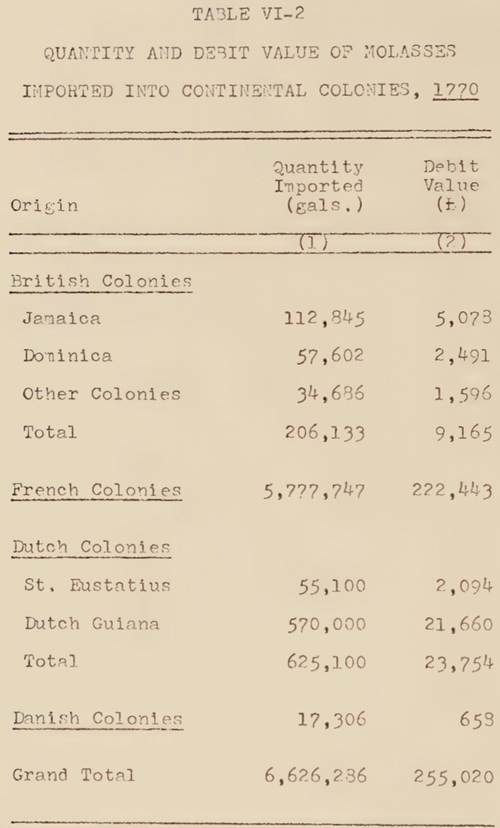
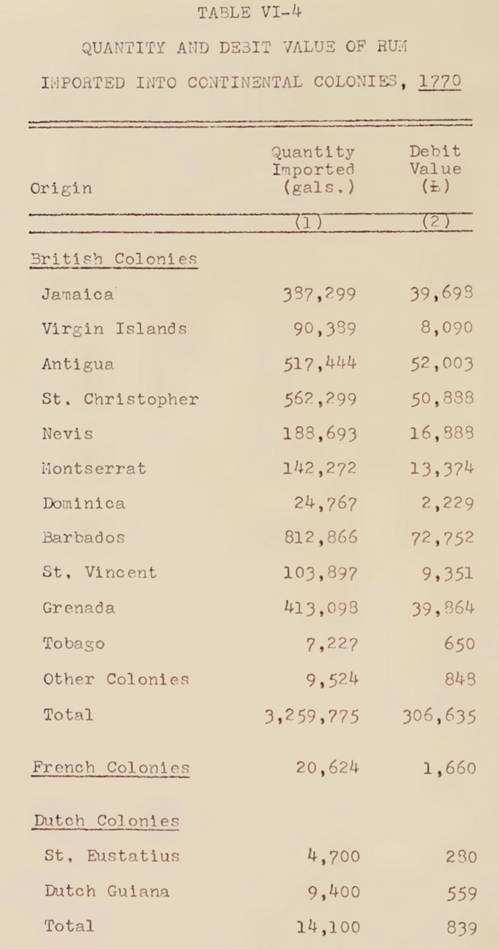
Before the above analysis, however, McCusker takes us on the historical walk (“primeval migrations”) of sugarcane from Melanesia → Southeast Asia → India (reached India “many centuries before the first historical reference to it in the fourth century B.C.”) → China → (much later) the West. He even notes that “followers of Mohammed” planted it around the Mediterranean; the Crusades brought sugarcane to Europe, where I believe Italy’s sugarcane culture began to take root. In the 15th century, the Portuguese and Spaniards brought cane to the Atlantic Islands (which I assume he’s referencing places like São Tomé and Príncipe), West Africa, and then the New World. The expansion of sugarcane exploded after the 1500s.
The European quickening of the pace after 1450 grew out of the burgeoning demand for sugar in the late Middle Ages and early modern period. Greeks and Romans had known sugar only as an article of foreign import and Westerners in general were little acquainted with it until the eleventh century. Initially they were supplied from the Moslem lands along the Mediterranean littoral. With the conquest of Sicily by the Normans in the 1190’s and the settlement of Cyprus by the retreating Palestinian Franks, Europe put its hand for the first time to cultivating its own supply of sugar. In their century of emulation the Atlantic powers sought their own source and they soon introduced the cane from Crete to the islands of Madeira and the Canaries. The tilling of new fields was well timed for the Turkish conquest of Moslem Syria and Egypt in 1516 and 1517 and Christian Cyprus in 1521 ended large-scale production there.
After the history walk, the author takes us through the technical aspects of converting the plant into a semi-finished and/or finished product (i.e., how we get from sugarcane to coarse and raw sugar). Understanding the sugarmaking process is a helpful bridge to understanding the emergence of the sugar-refining industry and where that industry fits in the chain of command between the colonies and their colonizers.
A report of 1770 speaks of 110 Amsterdam refineries…
On Martinique six refineries were at work in 1688 and 18 ten years later; Guadeloupe had one by 1699; the turn of the century found them all shut down. French planters turned to white clayed sugars as [their] processed export.
…in the eighteenth century, the English colonists were the sugar refiners of the Western Hemisphere. The English refining industry had a long and important history but, in a country so apparently dominated by mercantilism, the refiners of England were unable to rid themselves of colonial competition. British North America and the British West Indies both refined increasing quantities of sugar as the era of the Old Empire drew to an end.
Unlike their Caribbean counterparts, maybe due to size, scale, and industrial potential, the Continental Colonies were allowed sugar refinery operations of some consequential scale –
On the eve of the American Revolution, therefore, sugar refining ranked as a considerable industry in the Continental Colonies. If we assess Massachusetts with four refineries, Rhode Island with three, New York with four, Pennsylvania with five and South Carolina with two, a total of 18 were in operation in North America in 1770. Assuming neither a net gain nor a net loss in the number of refineries in the [British] West indies between 1753 and 1770, then 15 more were in production there. In spite of the strictures of mercantilism, the English colonists worked over 30 sugar refineries just prior to the War for Independence.
While you can’t talk about rum without talking about sugar… I’m going to have to talk about rum without talking much more about sugar. Why? Because, with a fine-toothed academic comb, McCusker goes through the debit (expense) column of the American colonies to showcase where they got sugar/rum from (empire colonial holding by empire colonial holding). What I’m saying is, this would become an incredibly lengthy article if I were to rehash that level of granularity. So that you do not feel entirely left out, below is my very rough table of contents of McCusker’s content:
Rum and sugar costs for the Continental Colonies (i.e., what they received from the Dutch, Germans, French, Danes, Spanish, and the West Indies/British).
Sugar and rum production/export profiles of the above colonies, broken down by each of their holdings (New Spain, Peru, Brazil, Nevis, Montserrat, Barbados, you get the drift…every single territory!).
Accounting treatment of the importation of rum and sugar into the Continental Colonies.
Credit (revenue) to the Continental Colonies: distillation, consumption, internal trade, re-export, and general export.
Accounting treatment of the bullet right before this one
And a whole lot more…
The above comprises about 1,200+ pages, and this is only volume 1. You know what that means? I need volume 2 = ).
Quick analysis of the chief concern: rum
Here is early evidence of rum production in the late 17th-century American colonies –
The Continentals began to distil their own rum from molasses by the 1660’s and the industry became important after the beginning of Queen Anne’s War in 1702. Yankee merchants disposed of locally distilled and imported rum to whomever would buy. The sale of rum both at home and abroad constituted what every schoolboy knows as the rum trade.
Here are the net credit values associated with the importation of West Indian rum in 1770 –
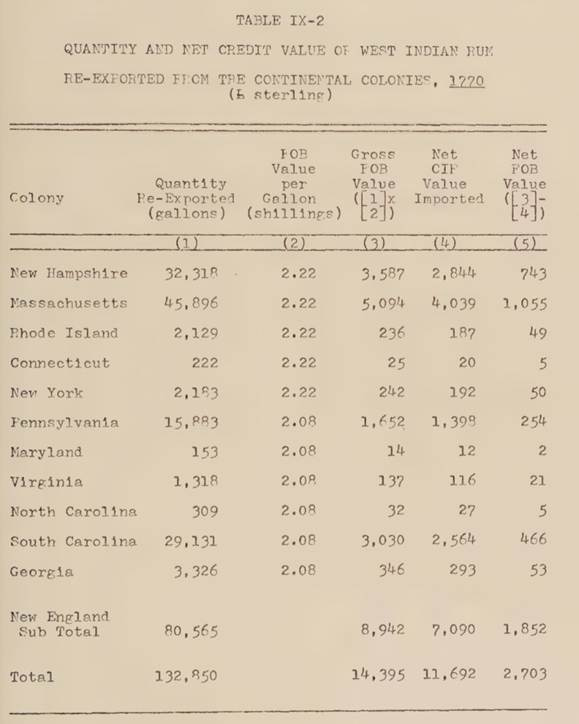
According to the Customs Ledgers the Continental Colonies imported an average of 2,730,000 gallons of rum in 1770 from the British West Indies. Recall that it was forbidden to import any rum from the other sugar colonies. In actual fact…the North Americans imported 3,709,000 gallons of rum, 14% of it from French, Dutch and Danish sources. The illegally imported rum would have paid no imperial duty but its value as a debit amounted to more than £80,000, not far short of the amount attributable to the significantly greater quantity of smuggled molasses about which everyone made much more noise.
We see a similar trend for the amount of “NORTH AMERICAN RUM” exported and re-exported from the colonies in 1770 –
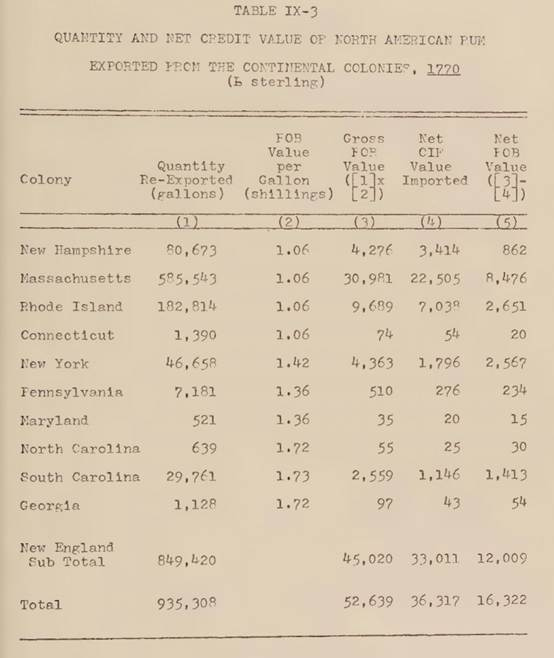
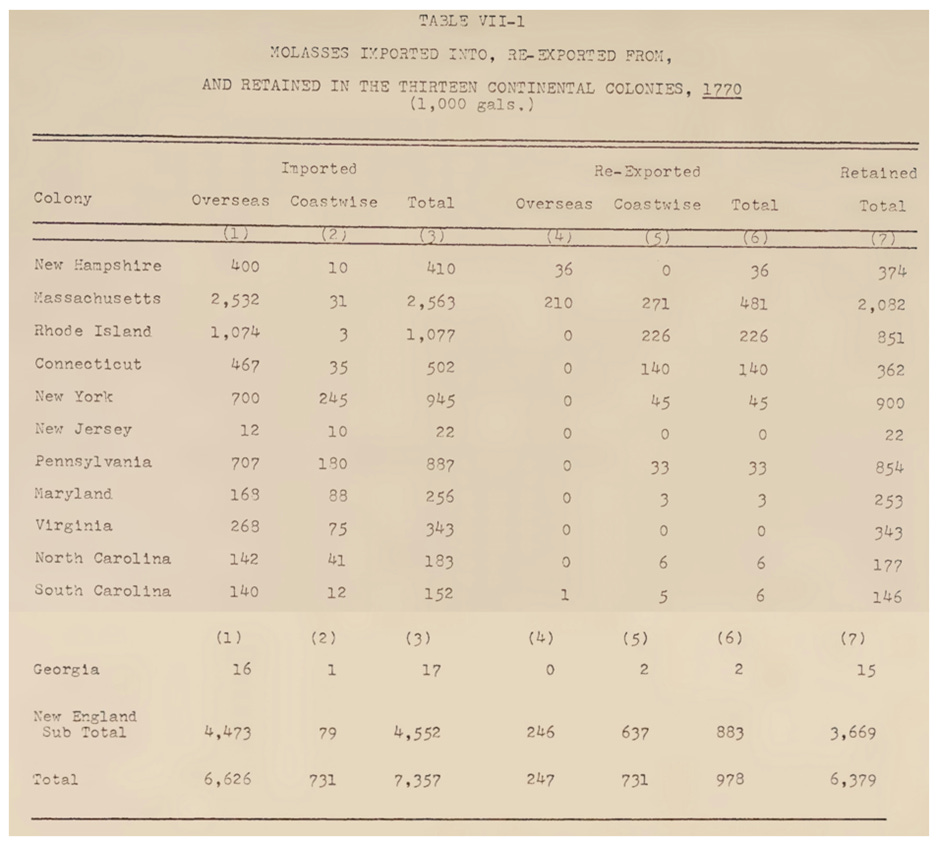
I know you’re not wondering, but I’ll tell you anyway: the trends remained similar for molasses as well –
New England colonies were the molasses traders of the Continental Colonies. Although they imported only 54.7% of the quantity received from the West Indies in 1770, they re-exported 87.2% of the molasses sent coastwise, and 99.6% of the molasses exported overseas. The New Englander’s role as purveyor of molasses to the other Continental Colonies involved them intimately with the economic life of their neighbors to the south while the earnings from the sale of molasses abroad proved a steady, if very modest source of credits in their balance of payments. From all indications these earnings reached a high point in 1770. So also had the quantities imported.
And finally, where did much of this rum leave the Continental Colonies and go?
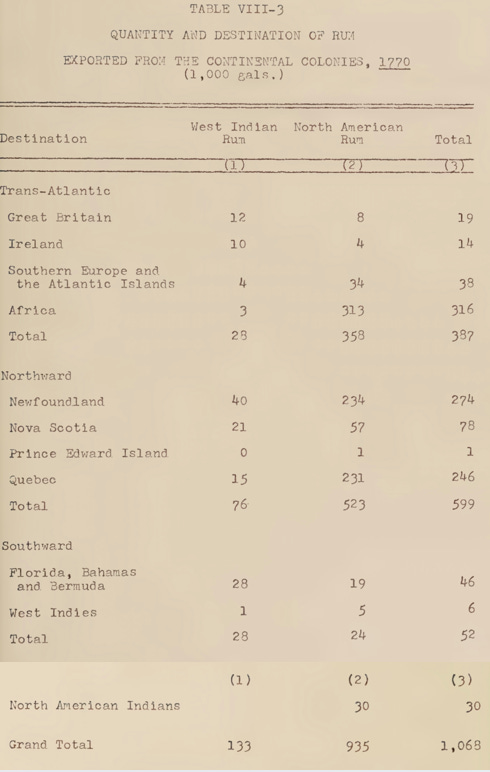
In 1770, 29 ships cleared the ports of the Continental Colonies for the coast or Africa, each carrying roughly 11,000 gallons of rum. The total, 316,000, fell short of the estimated average during the Seven Years’ War by hardly more than 10,000 gallons. In 1770 the total exported to Africa equaled 29.6% of all rum exported from the Continental Colonies, but only 3.7% of the amount available there. The ships involved, when compared with all ships which cleared from colonial ports in 1770, represented less than 1% of the total either by number or by tonnage.
Significant, but not really, I suppose, is McCusker’s conclusion.
The real, ultimate, and final conclusion(s) that we should draw, on this year that America celebrates its 250th birthday are –
In summary we can only total the net credit value of the export of molasses and rum from the Continental Colonies to £201,300, note that this was the equivalent of 0.5% of the debit owed to Great Britain in 1770, and concludes that the rum trade came nowhere near balancing the colonists’ debits with the Mother Country.
(and)
Rum’s real importance was not as an export at all. In 1770 the inhabitants of the Continental Colonies drank more than 87% of the available run at a rate of over four gallons per white man, woman and child. All of this rum had to be imported, either as rum itself or as molasses from which the colonists distilled more rum. Rum and molasses occupied a strategic position in the vital trade of the Continental Colonies with the West Indies, being readily available and readily acceptable returns for colonial goods shipped there. The distilling of rum in the Continental Colonies created a manufacturing industry second only to the shipping complex as an employer of local capital, managerial talent, and labor. Steadily in demand, rum and molasses served the colonial economy almost as a currency.
(and, last one – I promise)
If these protests and petitions added fuel to a simmering fire of colonial discontent which later blazed into open rebellion, maybe we then can talk about rum and the American Revolution.
You cannot talk about an American desire for independence without discussing sugar and rum. It’s in the economic paper trail. Any argument against is an emotional one, as far as history is concerned.
What an incredible piece of research/book.

Feel smarter? I hope so. I did my best, with the constraints of life staring down at me, to distill McCusker’s work as much as possible. For the curious, there is a gargantuan amount of info you can parse through, from all sorts of angles, so I encourage you to pick up his dissertation.
That’s all for now. We’ll circle back to Louisiana in the next piece.
Just remember,
in all that you do, please, don’t ever stop reading.

This breakdown of rum's economic role completely reframes the usual narrative. The stat that 87% was consumed domestically at 4+ gallons per capita is wild, totally changes how we should think about colonial economic priorities. Most people dunno that rum functioned almost like currency in those systems, the CIF vs FOB accounting really clarifies why the Molases Act hit so differently in New England.