



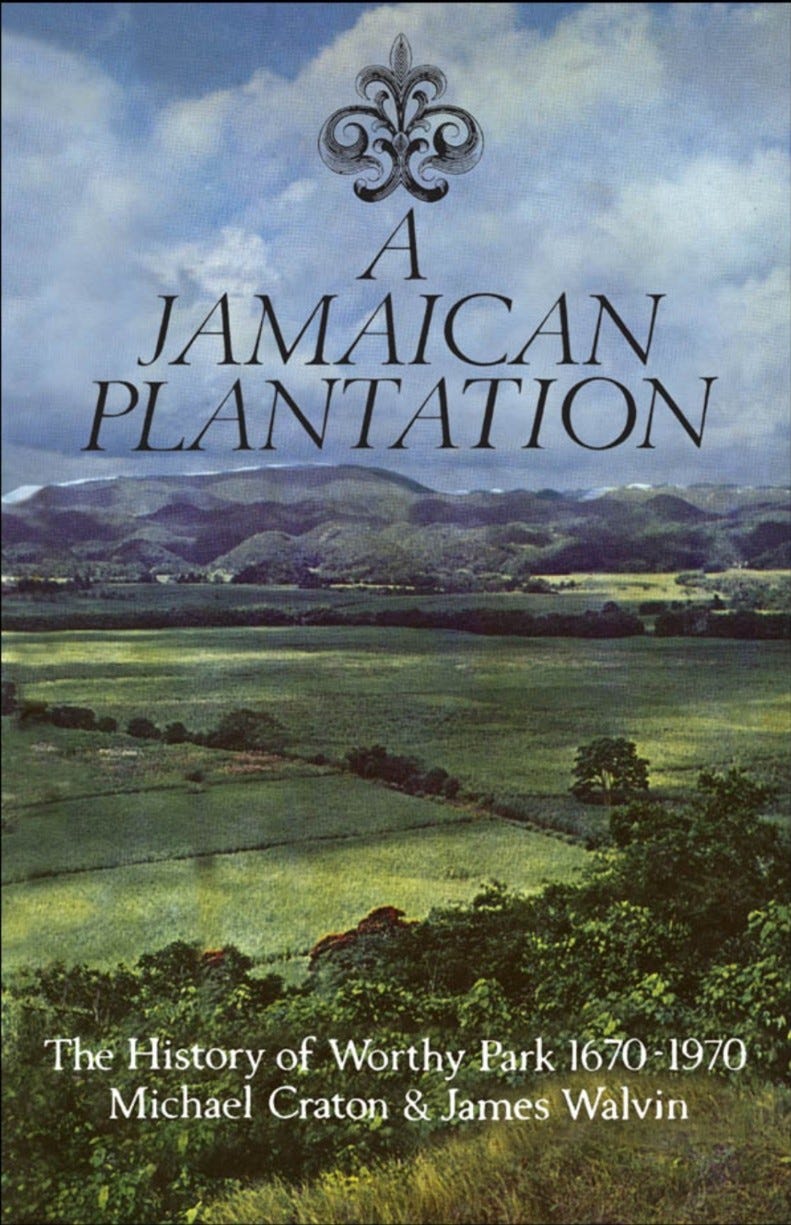
If you have a shrewd memory, you’ll recall me talking a bit about Worthy Park’s history in my Rum-Bar Silver article. If not, then you are with the rest of us in ‘how and why would I remember that’ land. In fact, I thought I covered Worthy Park’s story until I read A Jamaican Plantation. This is a deeper than deep, deep dive – say that fast 3x – and cost me more than a bottle of some really great rum ($40+).
I took a deep breath before hitting purchase on the blind-buy (i.e., no real homework done prior, just an itch to read up on Worthy Park’s history). Ultimately, I remembered that there is no such thing as a budget for books. And that will forever be my exception. Luckily for me, this work of history turned out to be a fantastic read. DENSE. But fantastic, nonetheless.
Math heads would have quickly realized that 1670—1970 was the tercentenary of Worthy Park. 300 years from Francis Price’s first patent for 840 acres in Lluidas Vale. 1970 also marked the baton passing to the new generation of owners: from Clement Clarke, who passed in 1967, to Owen and George. O and G intended to (and did) pass the reins to their sons and nephews.
For my Worthy Park rum lovers who will never pick up this book, or who weren’t aware of the deep history underscoring the modern-day company, no worries, I am doing your bidding. For my book lovers, I will try my best to make this interesting; 1670 “stuff” is a little tough to work with, but we’ll manage.
For a preview of what’s to come –
→ The fifth-generation owner, Rose Price of Penzance (Cornwall, England), set a precedent for the next seven generations.
→ On April 9, 1795 (note: will use 9 April 1795 syntax going forward, more “appropriate”), Rose Price left Jamaica to become an absentee owner and wrote the following for his Attorney and Overseer at Worthy Park –
There are always five separate books to be kept on Worthy Park…a great Plantation Book, a store book, a Boiling House Book, a still House Book, and a Daily labour Book. I have left five compleat Books on the Estate & I request that when they are filled with writing that five more may be purchased or written home for, and that the old ones may be carefully laid up, as the Books of the Estates are the only Records by which future generations can inform themselves of the management of the Plantations.
If you recall from my Rose Hall Great House/Plantation piece, which would be incredibly astute of you, not all plantation owners were like John Rose Palmer of the eponymous estate – he lived on the grounds until he passed. Absenteeism, or ownership-from-afar, usually the “Mother Country” (England in this case), was incredibly common, hence the “or written home for” language from Price. Nonetheless, this recordkeeping was foundational for the authors’ research and drafting of the book. And with that, let’s talk about the guys who wrote this necessary piece of recordkeeping.
Authors.
We’ll start with Michael Craton since he is no longer with us. By anyone’s standard, a long life was lived. He passed at the age of 85.
Craton (source) –
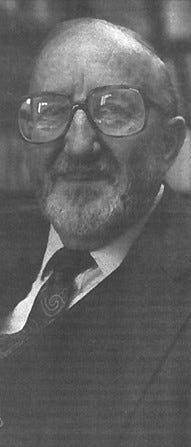
Born in London (1931), where he got his B.A. in History at University College London
Laid to rest in Canada (2016), where he emigrated to in 1963, obtaining his M.A. and Ph.D. degrees at McMaster University
Joined the faculty at the University of Waterloo in 1966, where he retired nearly 30 years later and was also named a Distinguished Professor Emeritus
The years in between the U.K. and Canada, Craton taught at the Government High School in Nassau, The Bahamas: “It was the stint teaching high school history in Nassau which brought Craton to the history of The Bahamas, and by extension, of the Caribbean.”
He never slowed down once he got a bite of the Caribbean apple, going on to pen many articles and books covering specific islands/the region, some of which were co-authored with Walvin
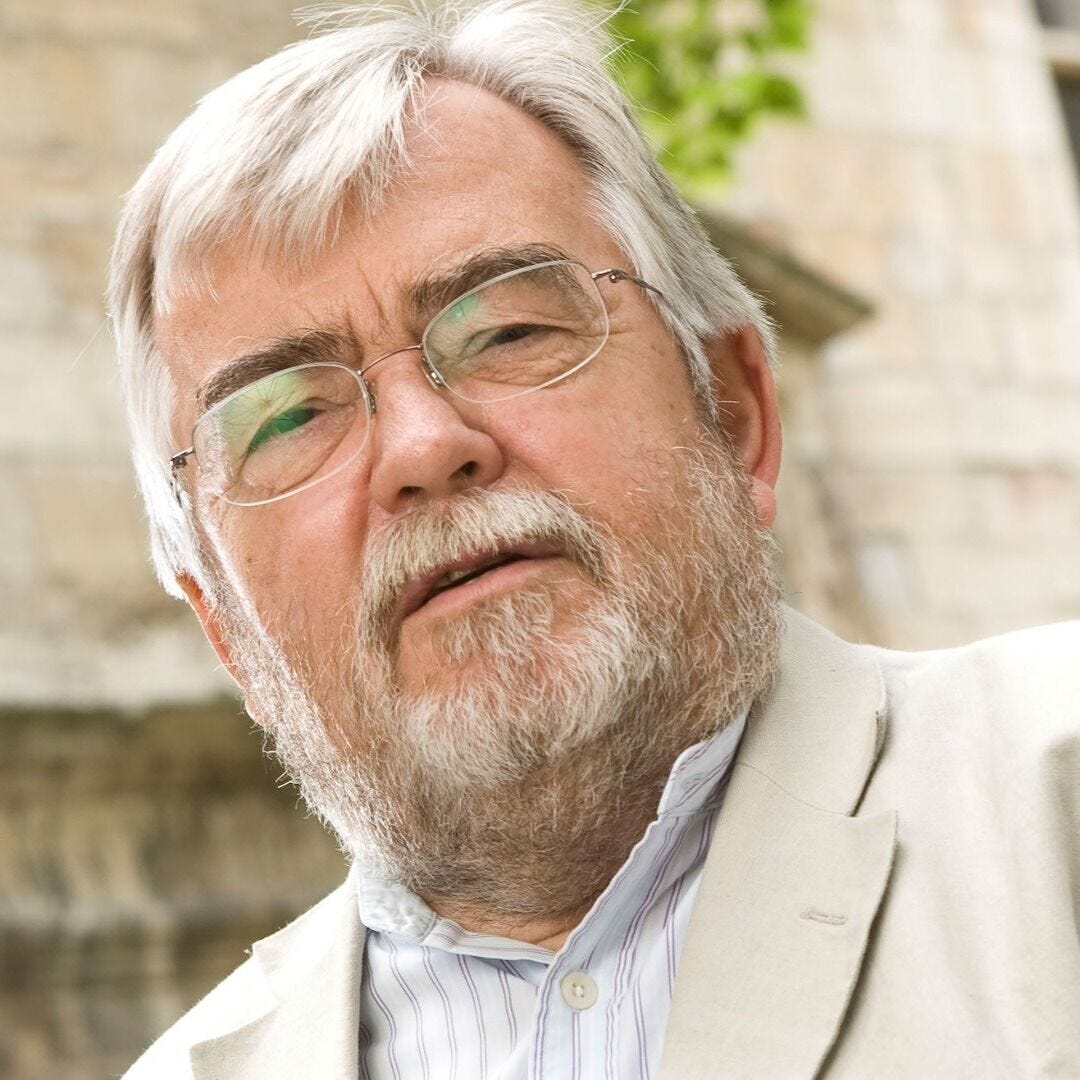
Born in Manchester, England (1942), and completed his undergraduate studies at Keele University in Newcastle
Did his graduate work at McMaster University, which I suppose is where he and Craton first crossed paths, and then his doctorate at the University of York
Craton also became a Professor of History Emeritus, but at the University of York
He has published a ton of articles/books on slavery and the transatlantic slave trade
“[Walvin] previously held fellowships at Yale University, The University of the West Indies, the Australian National University and the University of Edinburgh”
Both have a very firm U.K. to Canada story, which is interesting. What I think is even more interesting is that they are uniquely products of their time and generation. When the use of language and what was deemed appropriate were different. Sensibilities were, understandably, of the time.
As a forever learner (self-prescribed), Craton and Michael, writing in their own voices, unabridged and rooted in their sensibilities, helped me tremendously as I made my way through their work. Why? Because I did not have to guess what was meant and what they were conveying. Even if objectively distasteful, the reader in me is energized by the lack of smoking mirrors. Particularly helpful when wading through historical waters, which can be obfuscated with dates, names, obscurities, etc. More succinctly, this book was published by the University of Toronto Press in 1970, but the authors were tasked in 1967 to work toward Worthy Park’s 300-year anniversary deadline.
In their language, vis-à-vis the experience of writing the book and how they felt about the whole ordeal –
The rest was merely expenditure: vulgar things like money, and priceless commodities such as time and people’s help.
Peak academic/historian jargon, from those days at least.
The pair’s research took them from Worthy Park → Spanish Town → Kingston → Washington, D.C. → London → Cornwall (still England) → Sydney, Australia (“by proxy,” whatever that means).
This scattering of materials between colony, metropolis, and elsewhere has always been the bugbear of West Indian scholarship: it was complicated in this instance by the fact that the co-authors lived in Canada and England respectively. The book therefore became something of an exercise in triangulation. — Authors
Let’s explore this “triangulation” they spoke of.
An image of Worthy Park, then and now.
I’ll start in reverse with the “now” (note: 1967—70) description of the estate, courtesy of the authors –
Worthy Park’s canefields produce 7,000 tons of sugar in an average year, yet the estate does not prosper on sugar alone. Around the cane, on a thousand acres of smooth green pasture and on twice that area of tussocky guinea grass in the meadowy glades of the lower mountain slopes, roam 1,500 head of pedigree beef cattle, under the supervision of black cowboys. On chosen slopes and margins march neat lines of citrus—all kinds, including ortaniques, deliciously blended from sweet oranges and tangerines—providing a third major product for the great estate, 375 acres in all. Worthy Park is a model of diversification and land utilization.
Note: the usage of “black cowboys” here pays homage to the historically accurate use of the term, whereby black enslaved men, typically, who were tasked with managing cattle, were called black cowboys; friendly reminder that nomenclature that goes ‘way back’ is often rooted in an extreme amount of literalness.
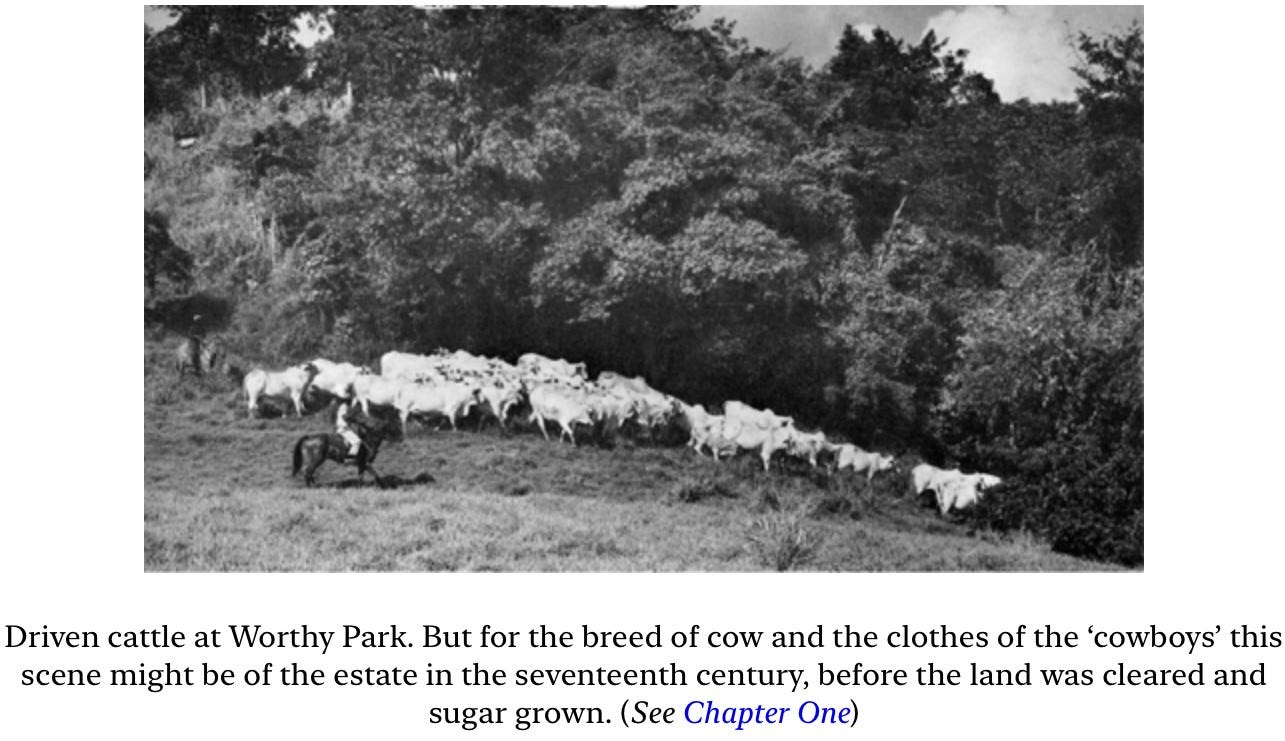
For more of a now-now view, here are what Worthy Park’s grounds look like today (pictures courtesy of Visit Jamaica) –
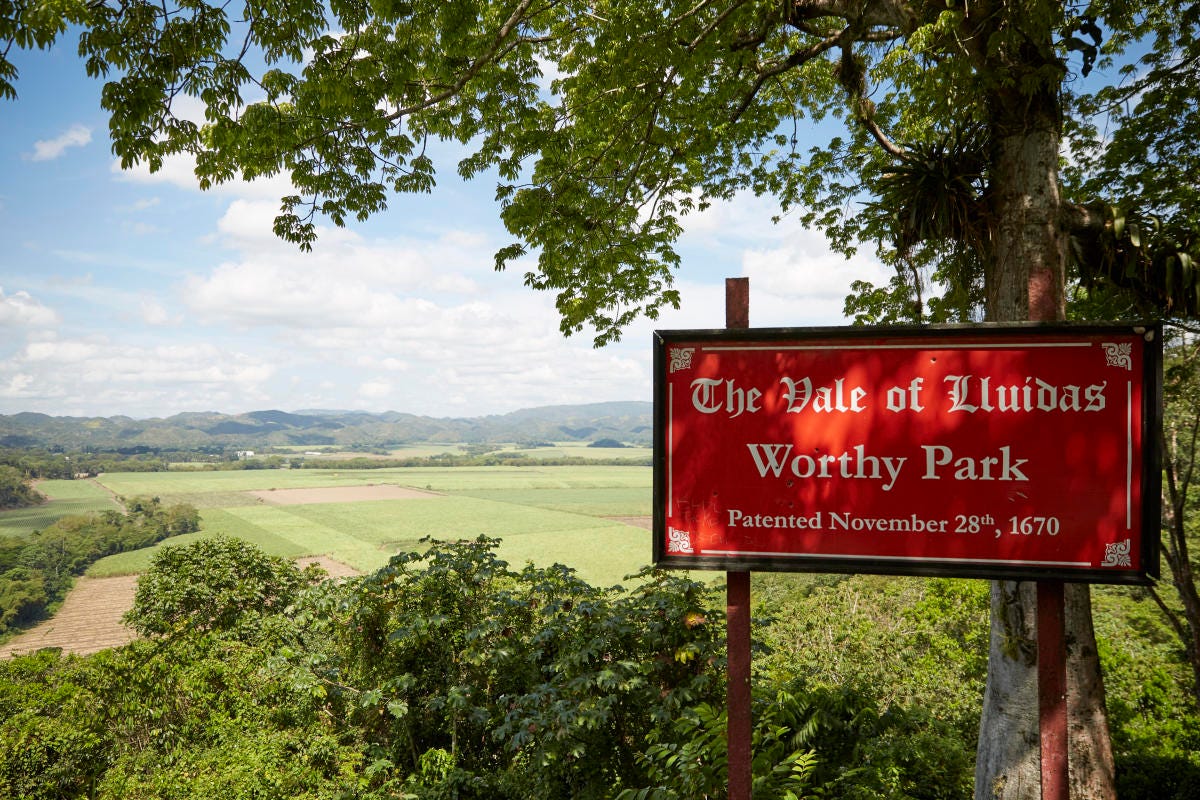
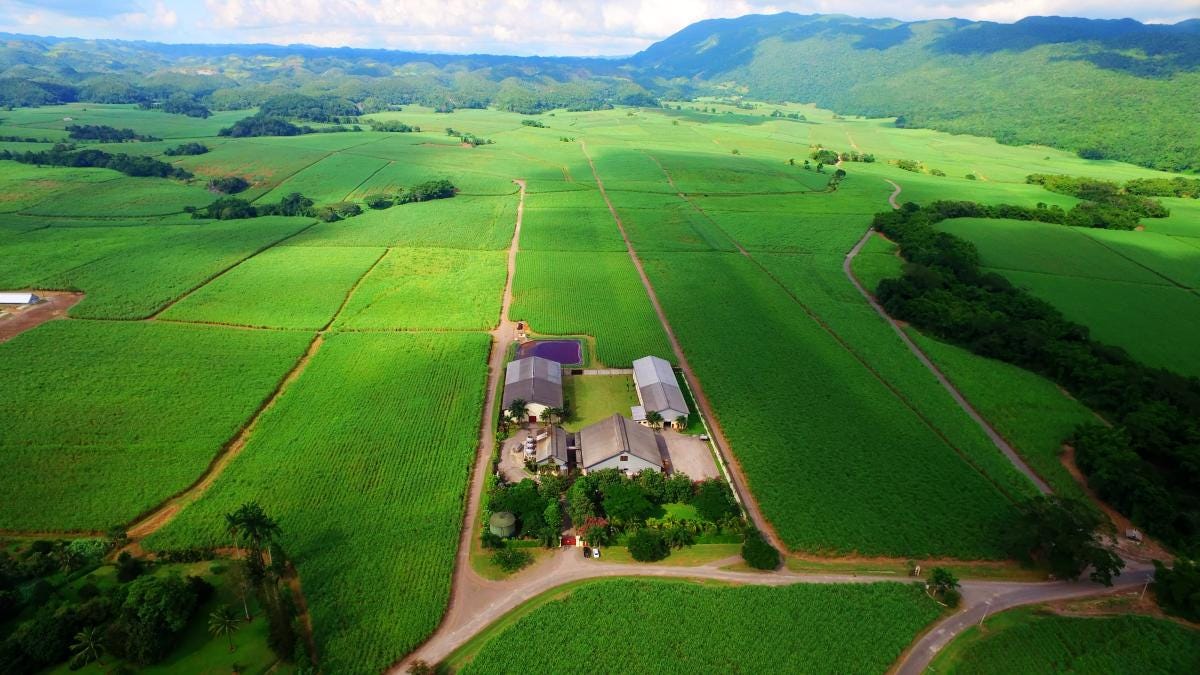
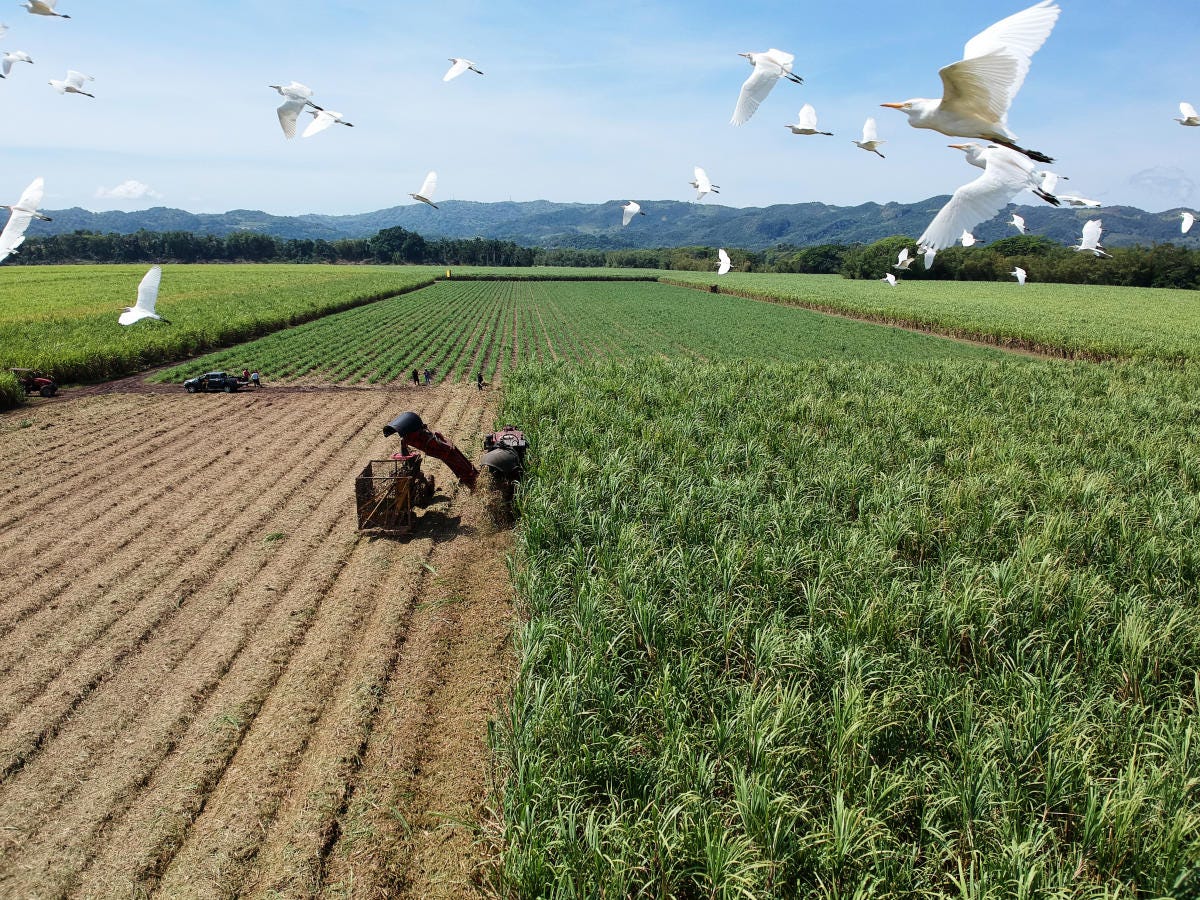
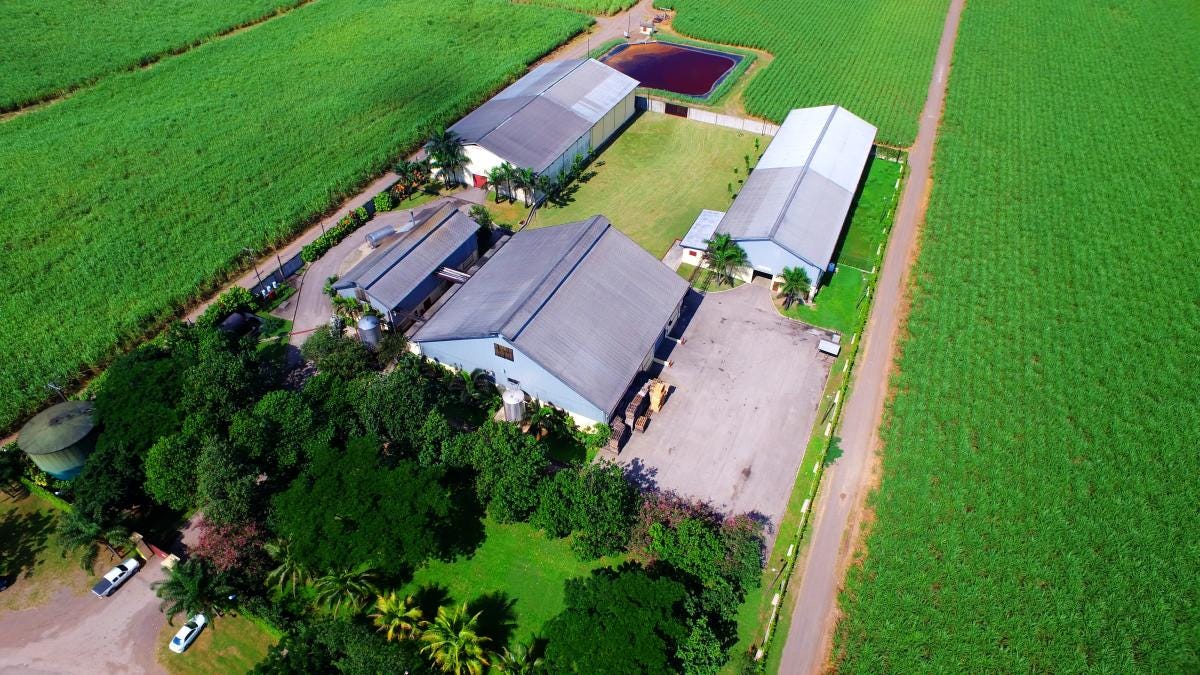
As for back “then” (pre-1700s), it was probably similar, insofar as nature dominates this extremely high-elevation area of St. Catherine. It is supposed that over 200 bird species flew widely, with delicacies like iguanas (near extinct in Jamaica) enjoyed by the natives who inhabited the land for 9,000+ years pre-Columbus’s arrival in the late 15th century.
Among the trees and around the rocks of the savanna scuttled the agouti, a tail-less rodent, and the iguana, a giant lizard, both prized as delicacies by the Indians but exterminated by the white men and their dogs. By the seventeenth century their place had been taken by the fierce wild hogs and the scrawny cattle that were the descendants of the animals released by the Spaniards in the early days to provide fresh meat…
While fruits, cassava, and other foodstuffs were cultivated, sugarcane was not yet a reality in this stretch of acreage, as there were far more rich woodlands instead of traditionally cleared land for crop planting. Per Craton and Walvin, what covered Lluidas Vale was –
…groves of wide-spreading guango, ba’cedar, budge gum, mahoe; timber trees prospering far from the woodman’s axe, such as mahogany, cedar, braziletto; and towering above the rest, trees such as were used for boundary markers on the earliest plans, cotton trees, bullet trees, fiddle woods, santa marias.
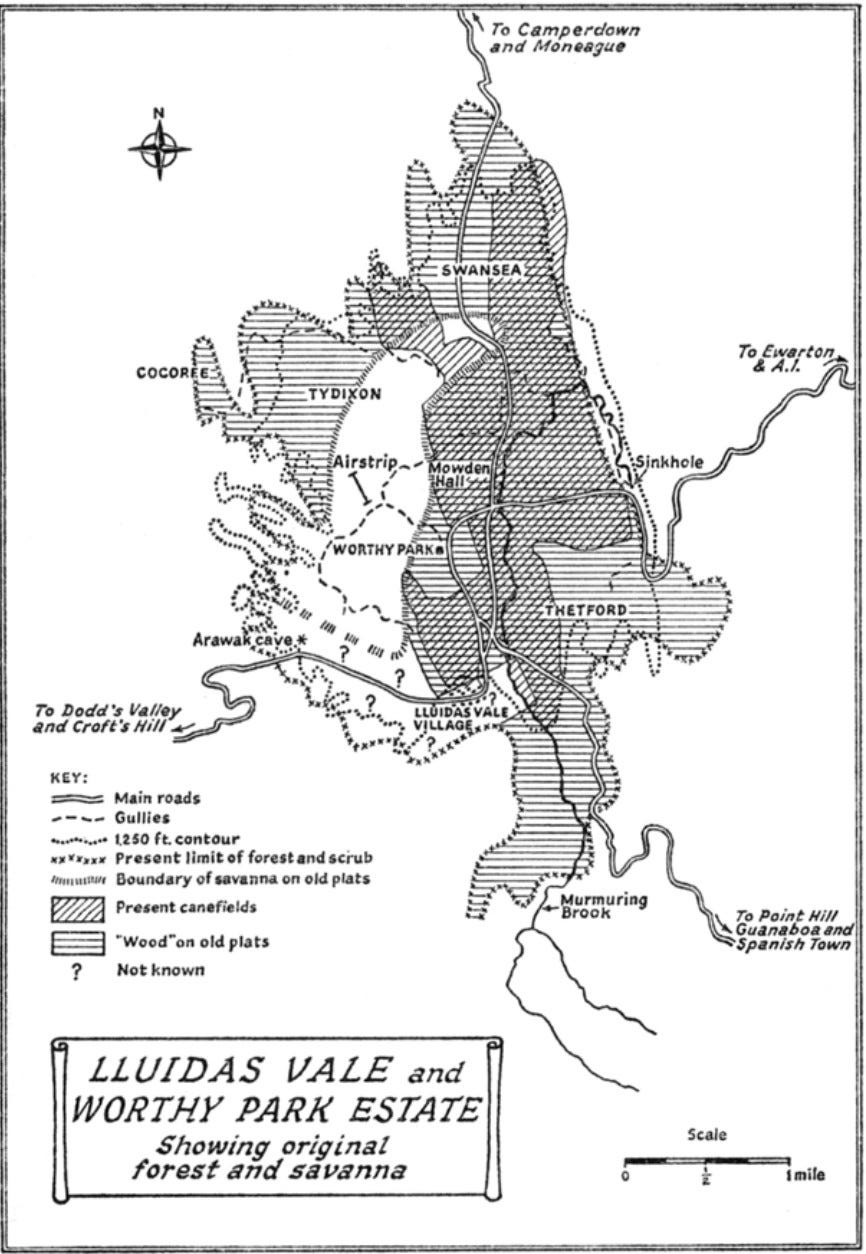
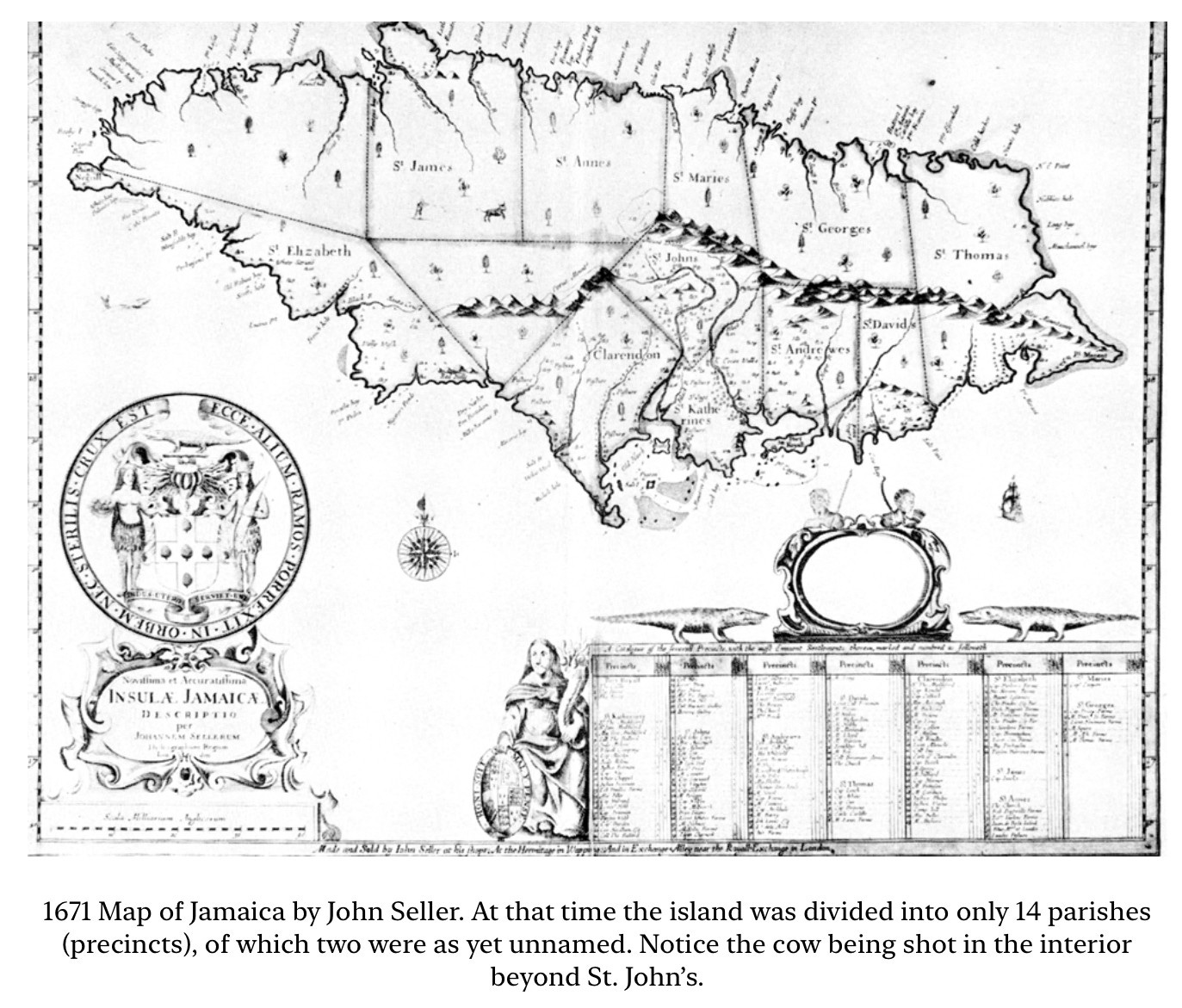
Here’s an early colonial map of Jamaica to give you a zoomed-out reference. Heads up, St. John’s parish was abolished in 1866 and merged into St. Catherine parish, which is where Lluidas Vale/Worthy Park Estate is located.
In 1670, the above (“then”) is what Francis Price arrived to. The “now-now” of Worthy Park, encompassing sugarcane production and rum, would have, as noted by the authors, stunned Price. Craton and Walvin make further note that even Fred Clarke, the patriarch who spearheaded/purchased the family-led Worthy Park that we know today, would be starstruck at the diversification, productivity, and mechanization of the operations he kicked into first gear.
In many ways it would be a tragedy if an estate such as Worthy Park, which has survived so many vicissitudes over three hundred years, were to perish now.
No more viva España.
Prior to the British landing in Kingston Harbour with 7,000 soldiers on 10 May 1655, the Spanish controlled the island, hence Spanish Town in St. Catherine, which they originally called Santiago de la Vega. Today, (very) colloquially referred to as Spain Town.
So, when Chronixx said in his song, Spanish Town Rockin, “I grew up in a place called de la Vega” (pronounced vay-gah), you will now know what he’s referring to. No reason for me not to post the chune, right? (note: he says it at the beginning of the song) –
Ultimately, the Spanish didn’t value Jamaica as much as they did their existing colonies – Hispaniola, Cuba, Mexico, Peru, etc. Plantations were underdeveloped, the timber went untapped, and no true trading/resource-sharing was developed between Jamaica and her neighboring Spanish colonies (i.e., Cuba is the closest island to Jamaica, to give you tangible context for what was happening, or didn’t happen, rather). So when the British arrived, Jamaica wasn’t nearly as fortified as the U.K. would have it once the country was under their control.
The British now needed to convince people from the “Mother Country” to go to Jamaica and replicate what was done in Barbados – plantation development. In fact, Sir Thomas Modyford, who became Governor of Jamaica in 1664, was a wealthy Barbadian planter who brought with him his blueprint for growing sugarcane and setting up estates. He was also an agent for the Royal African Company and served as the middleman for getting captured Africans into Barbados. He likely saw Jamaica as a new frontier to generate even more wealth with a model he was assured about, given its success in Barbados –
The allotment of 400,000 acres of land for the Royal…the better encouragement of the planters and those who will plant within five years, such grants to be under the broad seal of the island to the grantees and their heirs in free and common socage, reserving fit rents to the King; and a register theroff to be kept and sent home… — Modyford
It should come as no surprise that settlers from Barbados and the Leewards made up a large portion of that early population who “moved in.” But the British government needed more bodies to develop the country. So, they provided incentives via 1) land grants and 2) delayed and/or low taxes. However, control and military prowess are how they secured their holdings; the reason Vincent Brown dubbed the colonial U.K. a “fiscal-military state.” As a result, if you participated under this land grant & incentive system, your end of the bargain was service in the local militia. The British colonial GI bill, if you will.
By a Royal Proclamation dated Whitehall, 14 December 1661, it was decreed that for the following two years 30 acres of land would be granted to any male or female over 12 years of age who would guarantee to plant them. The land was to be held in free tenure for ever, subject only to the payment of a nominal quit rent, the surrender of all gold and silver to the Crown and the payment of a 20 per cent duty on all fisheries and other mines. The only provisos were that the development of the lands must be begun within six months, and that the landholders were liable for militia service…the militia was not only indispensable but directly tied to the degree of landowning and political power.
The issue with 30 acres of land is that it did not bode well for significant economic cultivation, especially not so for sugarcane, which required, or at least the British were very used to, more large-scale farms. It’s also worth noting that the 30 acres were more of an inducement for wealthier landowners who were given “30 acres for each ‘servant’ brought out” (i.e., white indentured servants). This confluence of aspirations resulted in the development of a monoculture and full-scale consolidation of farm resources centered around sugarcane. Labor would be figured out, as we all well know. To be clear, though, the production of “cocoa, indigo, tobacco, pimento…ginger,” and staple food crops like cassava were still produced for subsistence and trade. But sugarcane, for all intents and purposes, was to be the white gold that filled the British coffers; this they had already confirmed with its other Caribbean holdings.
The British government continued to offer more incentives to really cement this future:
Settlers exempted from English duties on their produce until 1669
Also exempted from paying English duties on imports until 1685
Thus, by the generous provisions of Modyford’s Instructions, most of which were incorporated in an Act of the Jamaican Assembly in 1672, the earliest settlers could take out patents for as much land as they could conceivably plant within the subsequent five years, and thereupon hold that land for ever on the most nominal payment.
As is the case with other plantation societies that maintained grand expectations for agricultural output, white indentured labor was only a short-term solution. Predictable what happens from here –
In 1680, the Jamaican planters prevailed upon the British Government to order the Royal African Company to send up to 3,000 slaves a year to Jamaica for £18 each, at six months credit on good security; but the Company complained that the Jamaican planters already owed them £110,000. It was only after the Royal African Company lost its monopoly in 1698 and the private traders began to sell Negroes to Jamaica with credit extended up to a year and payment in sugar that the slave population soared and plantations spread like a forest fire.
Still, labor and capital were in such short supply pre-1700s that sugar plantations did not abound and become plentiful until after. Capital infusion seemed to be the biggest problem since providing facilities and credit did not seem to be an astute investing decision for those who would be relying on Jamaican planters to repay debts. As you just read, the planters were already in over their heads with the Royal African Company for the enslaved people they purchased (presumably) on credit. Agricultural turnover was not yet at a level to support their liabilities.
Still, planter aspirants would not refrain from the oh so alluring prospect of securing land and building wealth. Some had an easier road than others, especially if they were of military stripes. Lieutenant/Captain/Major Francis Price would fall into that bucket, moving from his original 150 acres at Guanaboa (St. John’s at the time, not yet folded into St. Catherine) to the Vale of Lluidas. The authors assert that Price was “destined to be the founder of Worthy Park.” Let’s unpack…and finally get into the whole purpose of the book, recounting Worthy Park’s history from its late-17th-century origin.
The Francis Price era.
On 13 March 1670 Lieutenant Francis Price filed a patent for ‘840 acres situate lying and being at Luidas in St. John’s Parish called Worthy Park’, the neat diagram of which, allegedly surveyed by one Francis Inians, was entered in the St. John’s Plat Book on 28 November 1670. Who was this Francis Price, and where, precisely, were the original 840 of Worthy Park’s present 12,000 acres?”
The acres were here –
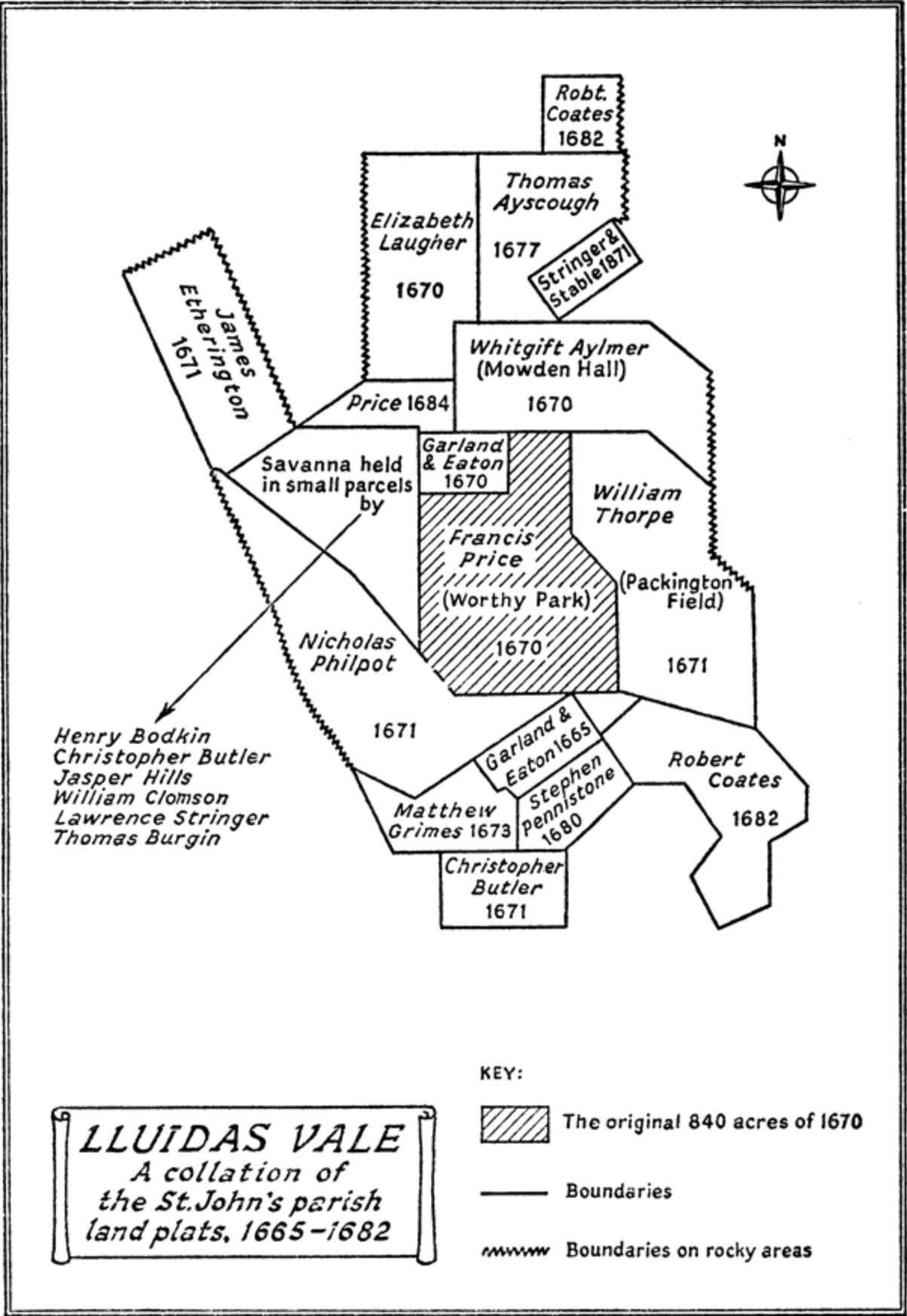
Craton and Walvin held nothing back by asserting that the “Lieutenant/Captain/Major” titles for Price were likely overblown, given the attempt(s) by his descendants to profile Francis Price as something more than he was. Exalt him a bit because storytelling, especially that of the ancestral variety, is less appealing if that ancestor seems plain or lucky. In the 18th century, showcasing Francis Price as anything but a part of the planter elite (or elite-to-be) would have been in conflict with the ideals of the time. More plainly: while his family referred to him as Captain, the 1655 records do not confirm the overture.
It is quite likely that Price was one of the 110 unnamed junior officers in the regiment of Colonel Anthony Buller which later became the Guanaboa Regiment. His name, however, does not appear on the first muster of that regiment, taken before leaving England in 1654…Clearly, Francis Price was a late recruit to the Cromwellian Army.
It is quite feasible, therefore, that Francis Price—like many of the first British settlers in Jamaica—came from Barbados or the Leewards, where the surname Price was by no means uncommon. It is even possible that the founder of Worthy Park was not originally an officer, but, having some pretensions towards gentility, was commissioned later to help fill the awful gaps torn in the ranks by disease.
The first “real” reference we get of Price is his patent records for land in St. Catherine and St. John’s in 1665 – 67: 150 acres of land acquired in partnership with his ‘mate,’ Nicholas Philpot, and 175 acres at Guanaboa in St. John’s (October and December of ’65, respectively). He’s styled as “Lieutenant” in the patent records; either not completely off-base, or someone was pontificating. It seems like Price was able to frontload some of his sugarcane cultivation/rum production at these initial holdings before trying anything at Worthy Park. Makes sense.
Certainly, by 1673 Francis Price’s plantation at Guanaboa was chiefly producing sugar. An inventory of that year lists the following items—almost the sum total of the Price estate: ‘4 coppers, 2 stills, 1 mill and millhouse, boiling house, dwelling house, 8 horses, 6 mules, 200 sugar potts, 8 hoggs’.
“…between 1669 and 1672… it would seem likely that Price’s Guanaboa plantation produced no more than 25 hogsheads of sugar a year from its mule-driven mill, and maybe 1,500 gallons of rum from its two stills. With sugar commanding perhaps £8 a hogshead and rum some 1/6 a gallon, this indicates an annual income of only some £310. None the less, even such an embryonic sugar operation represented a considerable investment of capital for that period. It could not have cost less than £1,200 to set up and would have taken at least three years to start bringing in a profit.
Friendly interruption to remind you that rum-making has deep roots; A spirit that has been produced for many, many centuries. Explore it. Okay, back to the program.
As it relates to Worthy Park, Price got a bit lucky. He was the second patentee in the area, preceded by Richard Garland and John Eaton (1665), as shown in the “Lluidas Vale: a collation of the St. John’s parish land plots, 1665 – 1682” map I provided earlier. And to really drill home the ‘luck of the draw’ point: Worthy Park, after consolidations and acreage scrambles, was the only estate to survive in the area. Sugar production for export, which was how most plantations made their bones, was to come much later (after Francis Price died); Cattle and pork had to suffice in the meantime. Good fortune covered the man with two last names, notwithstanding Price, and later his children, reaping the benefits of his prior land holding in the meantime.
The transformation of Lluidas, however, did not occur during the lifetime of the founder of Worthy Park. Indeed, Lluidas remained joined to the rest of St. John’s by the scantiest of tracks until about 1715, and there is no certain evidence that sugar was grown for export from Lluidas much before 1720. A great deal had to be achieved, in road-building alone, before forest and savanna could become canefields and pasture. The last two decades of the life of Francis Price and much of the lives of his three sons was dedicated to the accumulation of capital derived from the sugar plantation at Guanaboa and speculations in land, so that the valuable holding at Lluidas—which Francis Price more than doubled by judicious acquisitions—could in its turn be developed. Meanwhile, Worthy Park was gradually cleared, and its broad acres were made to pay for themselves by the production of beef and pork, and during the lifetime of Francis Price the first ‘Great House’ was built and became the main residence of the patriarch and his wife Elizabeth.
Before we make a natural transition to his wife, children, and the continuation of the Price <> Worthy Park legacy, let’s unpack some key developments Price executed prior to his passing:
Purchased half of Garland and Eaton’s northern parcels in 1673.
Purchased another “123 acres of unpossessed adjacent land in Lluidas Savanna in 1682 by patent…”
But the most substantial purchase/addition to Worthy Park was 600 acres of Packington Field in 1684, purchased from William Thorpe for £100 (approximately £18.8K when inflation-adjusted to July 2025, per the Bank of England’s calculator); A very good chunk of change, especially for that time
This spread of 1,774 acres, extending across Lluidas Vale at its centre from mountain to mountain, included approximately half the valley’s present sugar land, but practically all those areas where sugar has been grown in Lluidas Vale for the past 250 years.
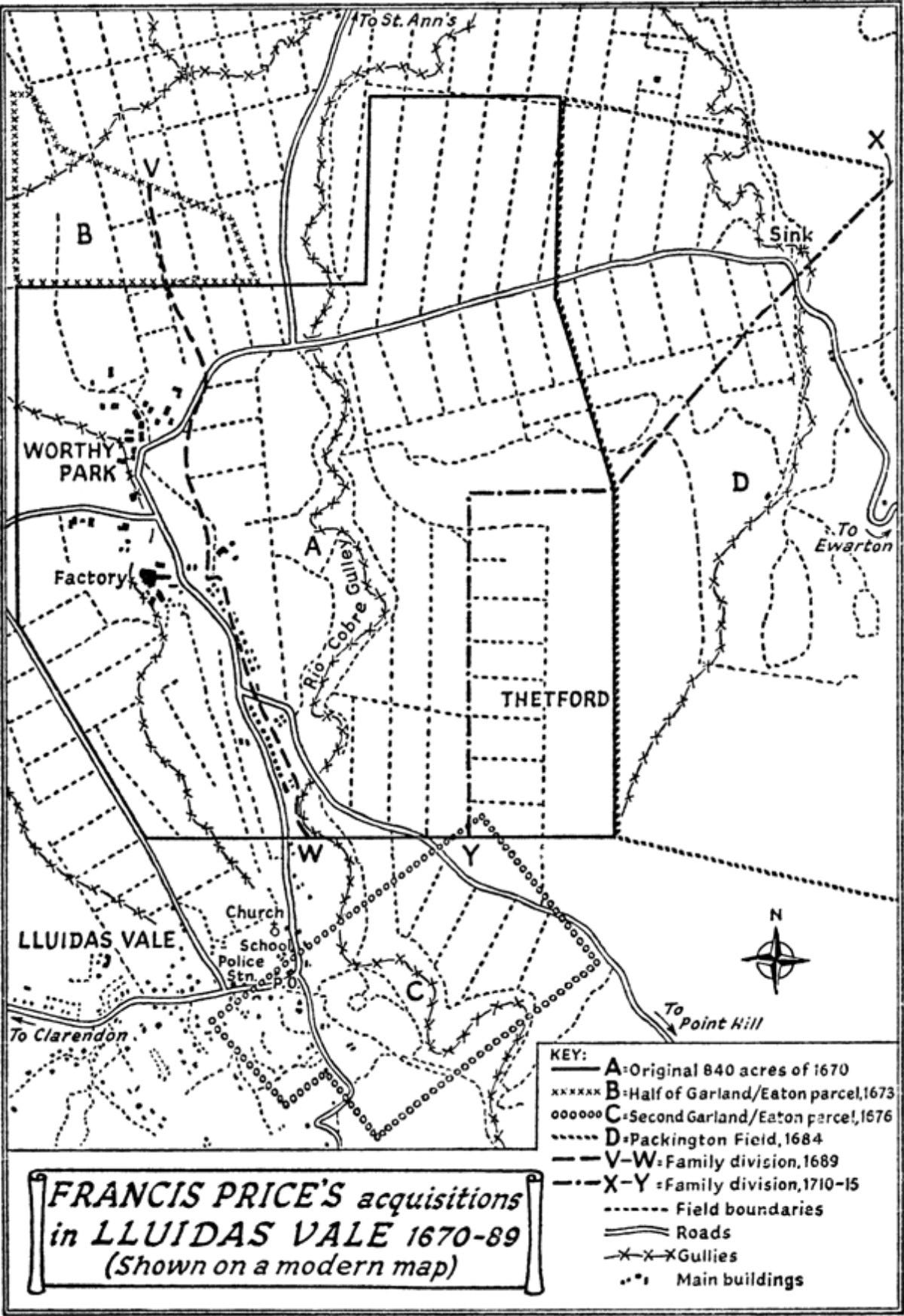
Craton and Walvin note that not much can be discerned about Price on a personal level, although he did form a tight bond and twenty-year commercial relationship with Peter Beckford, a prominent businessman in Jamaica, by way of his prominent family ties in London. Eventually, their families would be linked by marriage (“Prices of St. John’s and the Roses of St. Thomas-ye-Vale”), which should be viewed as an acquisition/consolidation of the commercial/social variety. Prominent families marrying prominent families. Or, in the Price’s case, securing one’s status in the elite through hypergamy. This practice, we know, has remained the same for eons.
Outside of this, we have Price’s patents and his will. He was survived by his wife, three sons, and a daughter. The authors note that Price was “a poor man when he died,” but that much acreage consolidation and building a ‘Great House’ before passing, is not exactly how “poor” works, even if 17th-century adjusted. However, I understand what was meant if we’re talking relative to his peers and other families. What’s most important is that Price’s family had a solid foundation, between Guanaboa and Worthy Park, to continue building what the patriarch established.
Francis Price’s chapter closes in 1689. And if this were a book, our chapter would also close here. Why? Because the Price lineage, and its extensions, continued the patriarch’s legacy for almost 200 years; Worthy Park changed hands in the mid-to-late 19th century. That’s a run that takes us from Jamaica’s earliest settlements (by the British), through Emancipation, and much more. So, you understand why that will be the entirety of part 2 – right?
Respect.
