



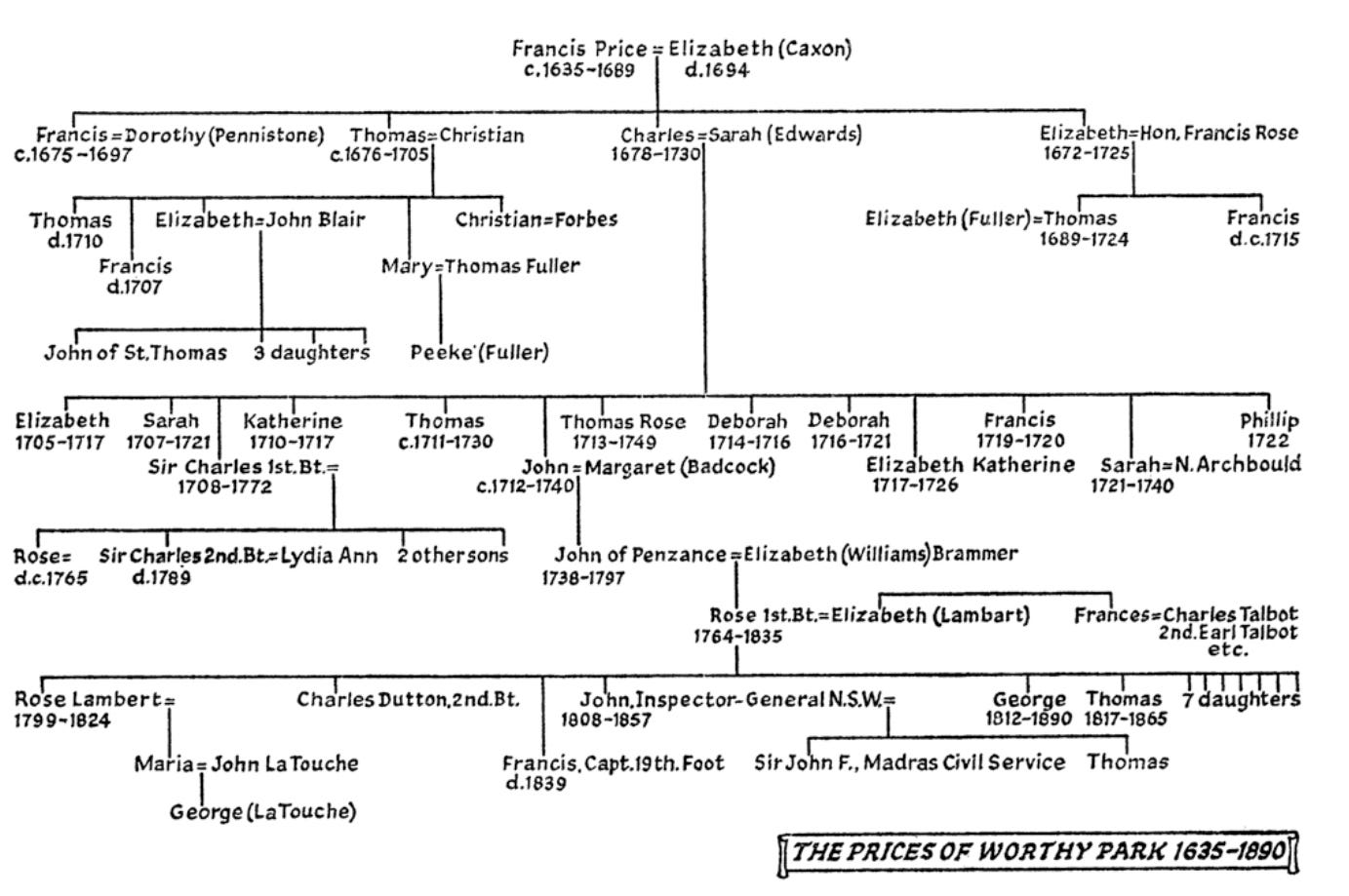
The authors, Michael Craton and James Walvin, note that Francis Price, the original patentee of Worthy Park in 1670, passed with modest land holdings/wealth (these are my words, the authors labeled Price “a poor man when he died” in 1689). Reminder that Price had land at Guanaboa preceding Worthy Park, and sugar/rum was produced at Guanaboa. If the above sounds entirely out of left field, read Part 1 before continuing.
Price’s wife, Elizabeth, passed 5 years after he did. Her will made no note of the requisite ‘utensills’ needed for sugar production at Worthy Park. Furthermore, “[t]he mention of breeding cows, hogs, and fowls” in her will allowed the authors to conclude that Worthy Park was “an extremely modest pioneer farm, such as might have been found in the backwoods of Virginia or the Carolinas at much the same time.”
While that is all nice and well, the sentiment does not help us understand how the Price dynasty developed and led Worthy Park for almost two hundred years, a venerable run for a family business. Was it sheer luck and market timing? The old notion that the market beats skill more times than not. You can’t intellect and brute force your way if the market won’t reward you.
‘Colonell’ Charles Price, last of Francis’s sons, died in 1730 as one of JA’s most “substantial planters”
Note: instances of incorrect spellings are direct from the sources of that time. I didn’t sneeze when I got to “nell.”
How did we get from Francis Price died “a poor man” to his last son becoming one of the wealthiest planters in Jamaica by 1730, especially when the average age of the Prices was 20s – 30s (if lucky); very emblematic of the times when short lifespans on the New World frontier seemed inevitable given diseases, climate, shortage of food, etc.
Like most wealth, having a substantial base to start with helps tremendously. In the case of Francis-to-children, a little mix of primogeniture and shared inheritance got things started –
When Francis Price died in 1689 his land was held in trust for his three sons by his wife Elizabeth. The central block of 500 acres ‘good valley woodland’ was destined for the oldest son, Francis, while Thomas and Charles were to inherit equally the surrounding savannah and forest, as well as Francis Price’s holdings in Guanaboa and elsewhere shared with Peter Beckford.
Management of the estates between Francis’s three musketeers.
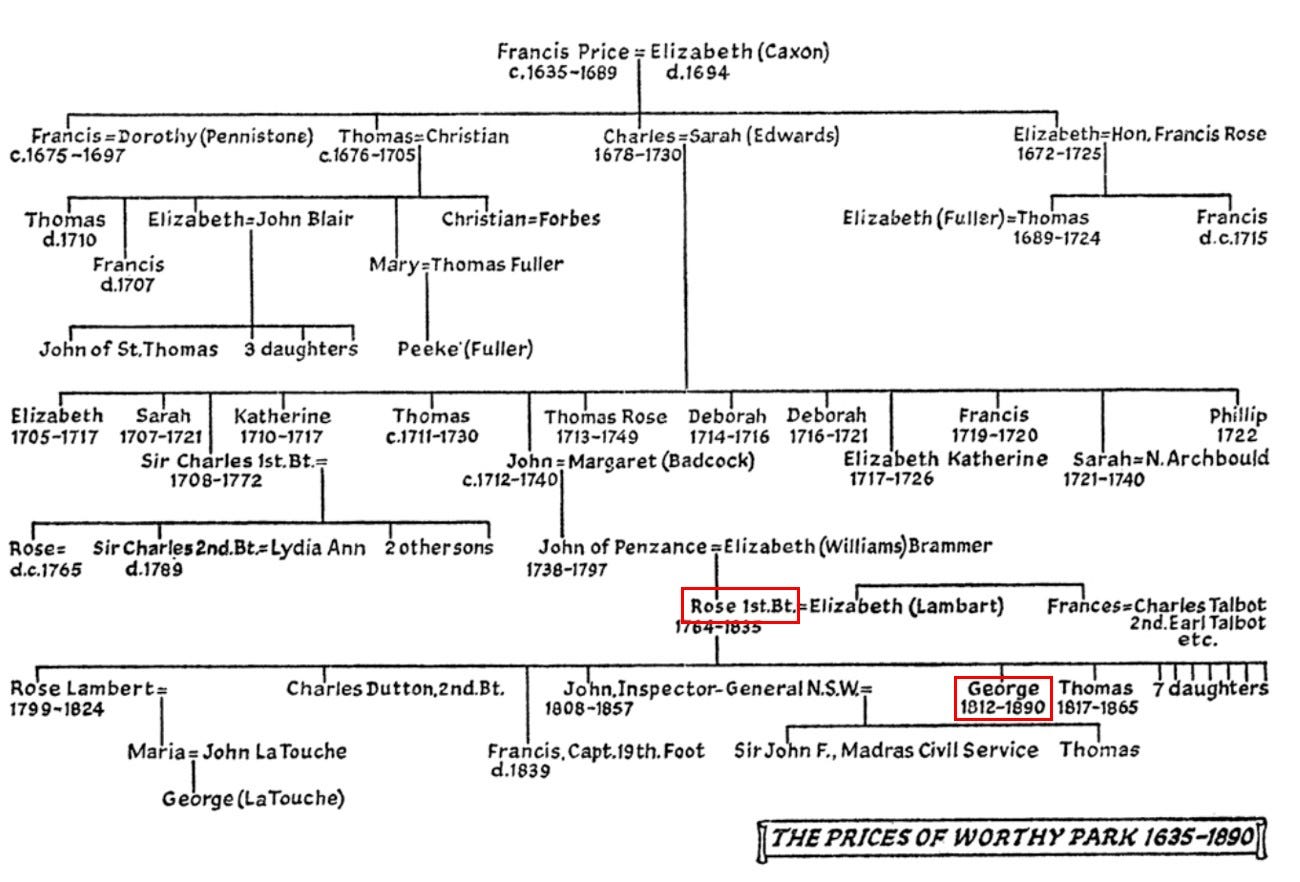
I’m going to re-paste (and highlight) the relevant individuals across the Price family lineage tree frequently, so you won’t need to return to the top of the article. Makes it easier to reference who I am speaking about –
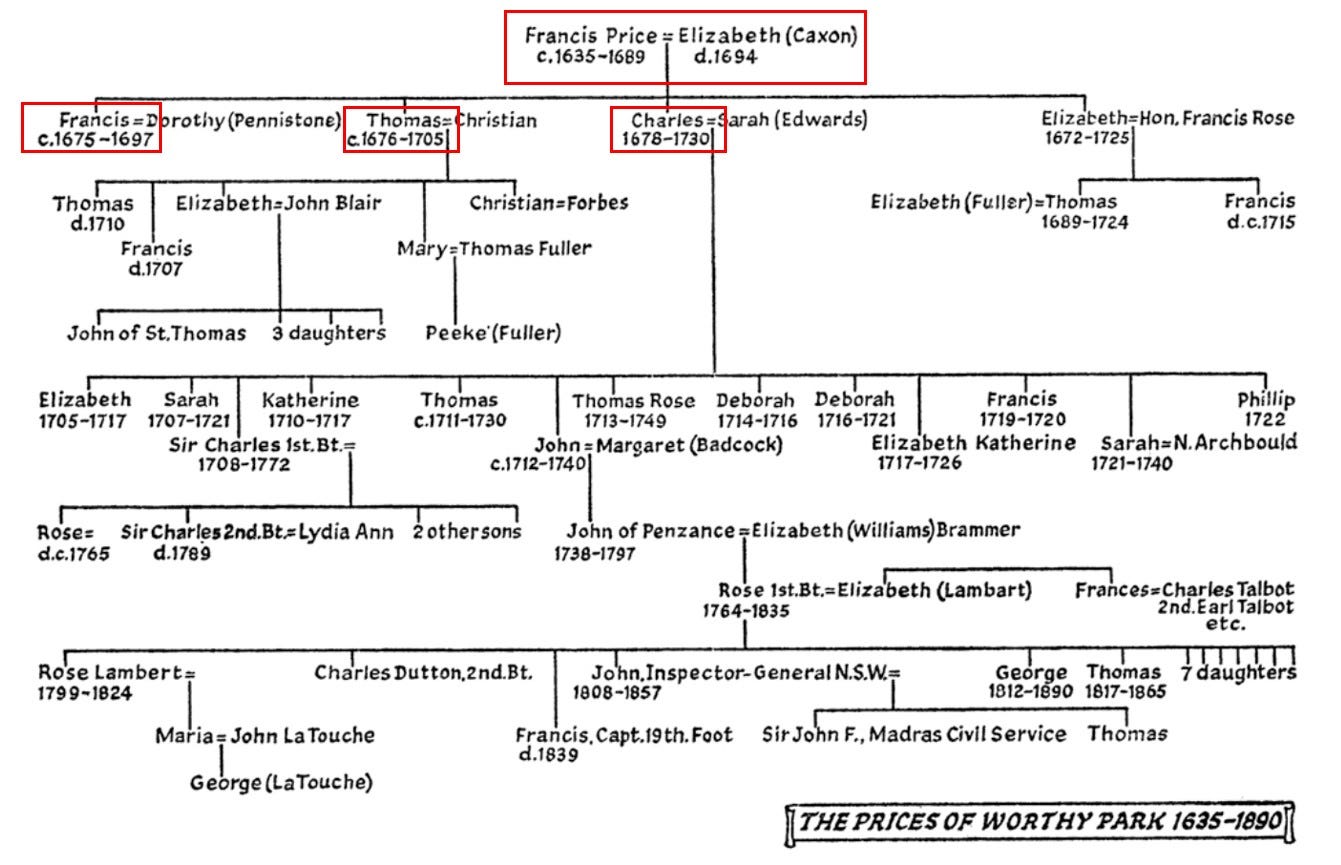
Elizabeth’s and Francis’s three musketeers are:
Francis Price II (oldest)
Thomas Price (middle child)
Charles Price (youngest)
Note: they have a daughter as well (Elizabeth). Yes, I am aware that all they did was recycle the same names over and over. Wait until I review “The House That Sugarcane Built: The Louisiana Burguières.” The Burguières family is the name-recycling kings and queens.
FP the second had a short run, dying nine years after his father (1697) at the age of 22. Right before his last breath, FP the second committed a family business no-no: he sold all 500 acres he owned to a non-family member and willed the remaining assets to his wife. If Elizabeth (mom) had not passed 3 years prior to FP the second, I’m sure she would have slapped him for doing this. Or not, speculating here –
Despite the provision in his mother’s will that his land would revert to his brothers if he died without ‘heirs of his body’, Francis Price sold his patrimony on his deathbed. Having made over all his worldly goods to his wife in the shortest of the Price wills on 9 September 1697, he sold his 500 acres at Lluidas, along with thirty-three Negro slaves, to one John Goffe for £1,000 current money of Jamaica on 15 September, just before he died. Nine days after this, John Goffe re-sold the land and slaves to Dorothy Price.
I hope it comes as no surprise that enslaved people were included as items of valuation in the sale of assets, given their “legal” status as property of whoever enslaved them.
I have no idea why he didn’t just transfer the land to his wife, Dorothy (Pennistone) Price. Maybe it was the ‘if you’re a woman, ye cannot owneth land’ laws of the time. Unclear. There has to be more to this ordeal, since she ended up purchasing it back (rules out my ‘owneth land’ bit), likely using the proceeds from the sale. Feels very roundabout. Maybe this John Goffe fella had something on FP the second. Unrelated, but I will also one day refer to my children as ‘heirs of [my] body.’ In any case, the 500 acres remained in the family via Dorothy saving the day. Or did she?
…yet had it not been for the prompt action of Charles Price, this irresponsible subterfuge might have alienated the heartland of Worthy Park from the Price family for ever. Shortly after the death of her first husband, Dorothy Price married another neighbour, Samuel Bromley, and for a while the couple owned the central 500 acres of Worthy Park, as well as the Bromley and Pennistone lands in the Murmuring Brook valley. On 10 November 1701, however, the 500 acres were re-purchased by Charles Price for £775 Jamaica currency, along with the surviving twenty-two Negroes and all buildings, cattle, hogs, and planted crops.
Crazy, right? We’re all thinking it…the neighbor?! My brothers would’ve had to defend my honor and beat Bromley up. Alright, getting sidetracked. But between offloading the property to a non-family member and Dorothy marrying the neighbor, this all feels a bit soap opera-ish.
As for the middle boy, Thomas, he died eight years after the oldest brother (in 1705) at the age of 29. Telling you, hitting 30 was not in the cards for these guys. Unlike the eldest brother, he had five ‘hiers of his body.’ Repasting that tree again –
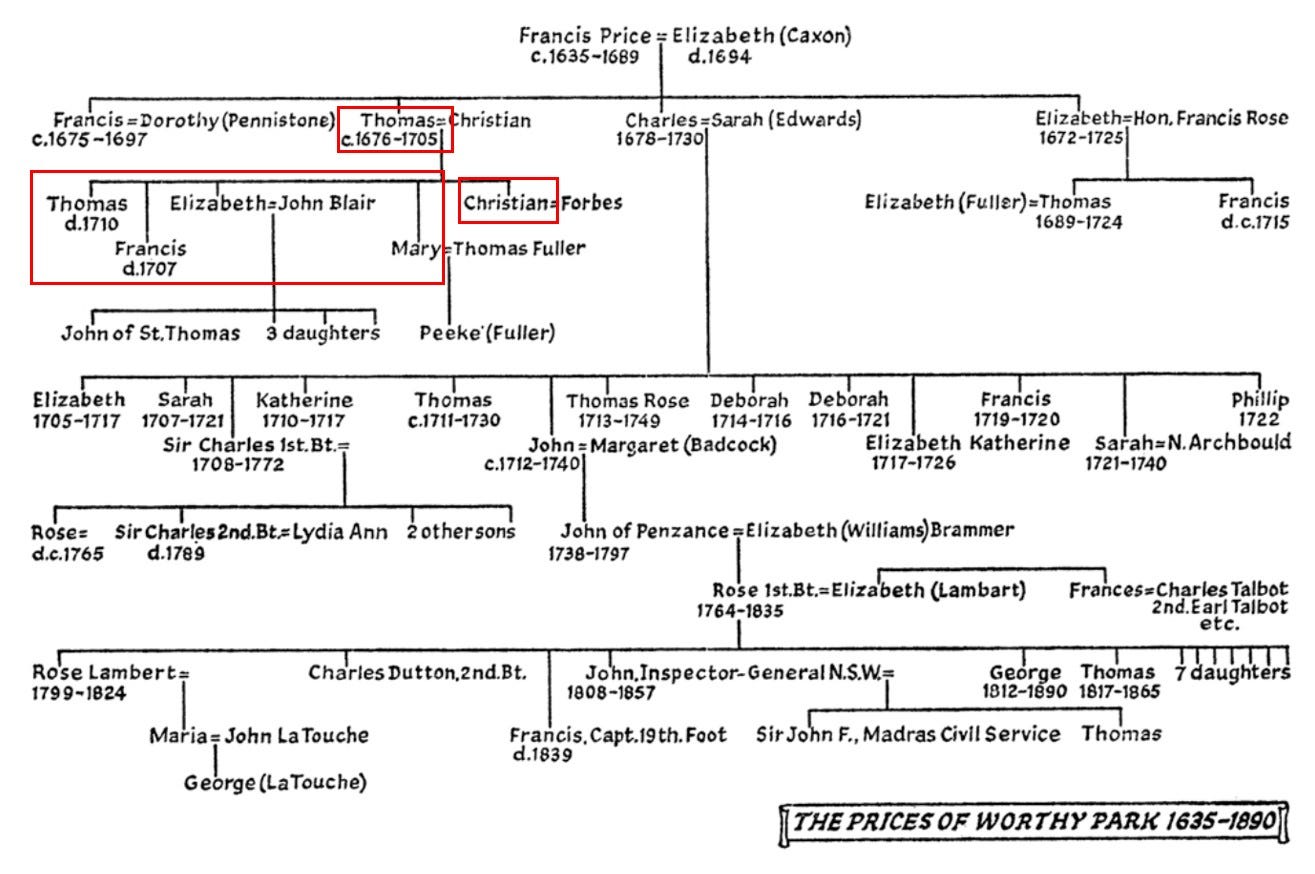
Thomas had 2 sons, Thomas and Francis (that’s not a joke, it’s the recycling), and 3 daughters, Mary, Elizabeth, and Christian. Note: the right of the equal sign is the person whom they married (e.g., Christian Price, who is named after her mother, Christian Price (again, I’m not joking), married Forbes).
As you can see, Thomas’s sons didn’t survive him very long, dying in 1710 and 1707; therefore, his land went to his daughters. Why didn’t FP the second will his land to his nephews and nieces? I still need answers! The 3 daughters and, by extension, their husbands each got 100 acres of ‘good valley land’ as inheritance.
This prime acreage was later consolidated as the nucleus of Thetford Estate by the husband of Mary Price, Thomas Fuller, and their descendants.
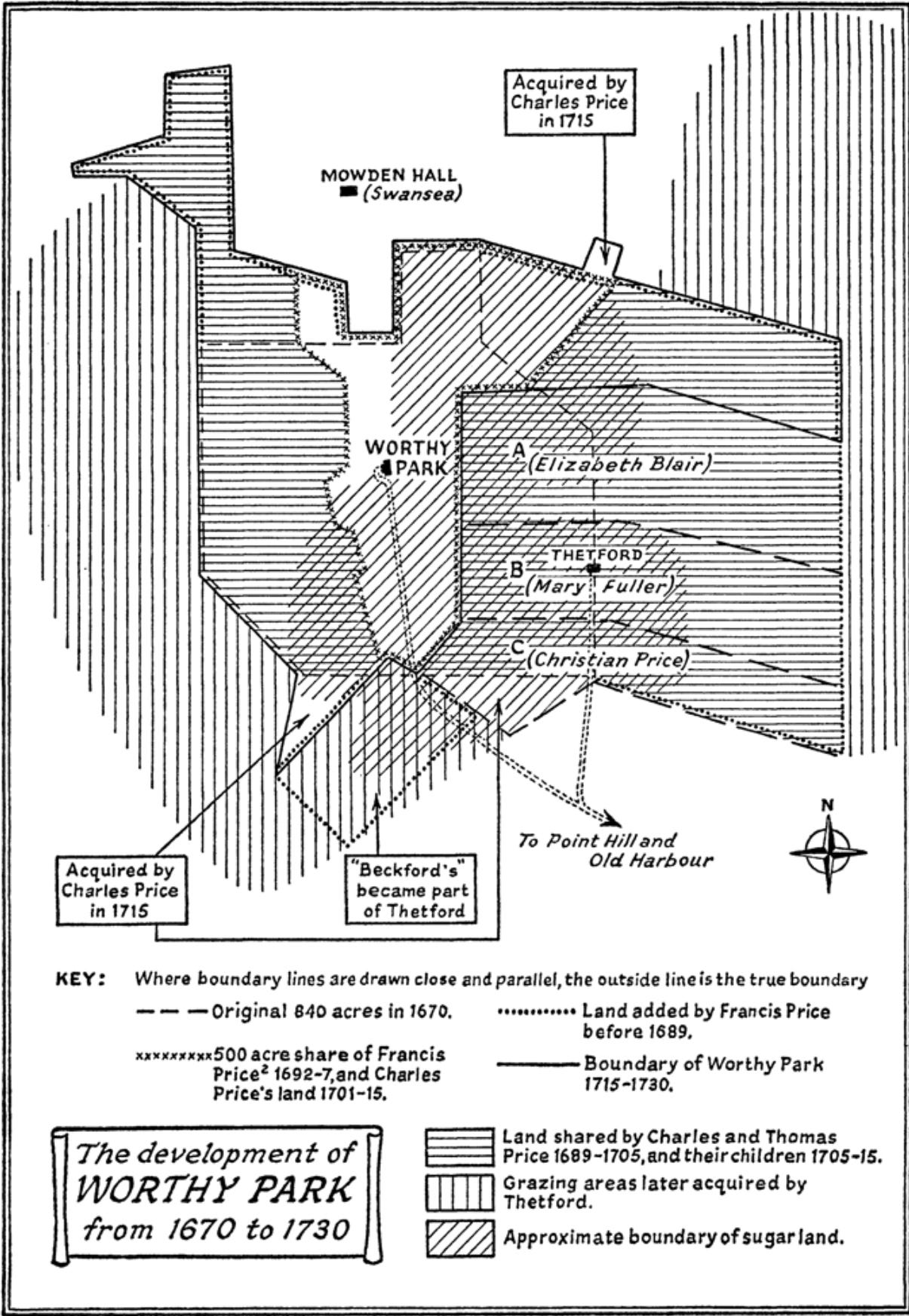
The expanding land ownership across the Price family, and its marriage extensions, seemed to follow the upward trend of sugar production/prosperity across the island. Populations increased, a not-so-unusual occurrence if money is being made: the white population went from 8,000 in 1730 to 25,000 in 1787, while “the Negro population probably doubled to about 80,000” (1700 to 1730). Another factor priming this trend was Britain’s ‘Deficiency Laws’, “which required a ratio of one white man to every thirty Negroes on each estate.” Jamaica was beginning to leapfrog other British colonies in sugar production, a reality that the Price family’s acreage contributed to, even if nominally. Positive market forces (i.e., increase in the slave trade, saturation of sugar in the Windward colonies, and increased attention paid to Jamaica by Britain) bode well for the island. This wind would eventually blow in the Price (plus extension) direction.
The sugar and slave trades grew immensely in extent and sophistication during this formative period, and with the invention of new systems of credit, commission, and factorage, the first West Indian fortunes were established in London, Bristol, and Liverpool, if not yet in the island of Jamaica itself. Reinvestment of sugar profits, as Eric Williams has shown, produced a ‘snow-ball’ effect. Besides this, the British American colonies began to play an invaluable part in the quadrilateral of British West Indian trade, providing provisions and lumber in return for sugar, for consumption, processing or re-export.
The gears were in full turn – slave labor, sugar, and trade (Britain with colonies, and colonies with each other). Jamaican sugar production, as well as Worthy Park’s, benefited tremendously –
In 1700, Jamaica, though thirty times the size, produced only half as much sugar as Barbados and the Leewards; yet by 1730 it had equalled the production of Barbados and by 1740 exceeded the production of Barbados and the Leewards combined. By 1763 Jamaica produced four times as much sugar as Barbados, and more than half the combined total for all British colonies.
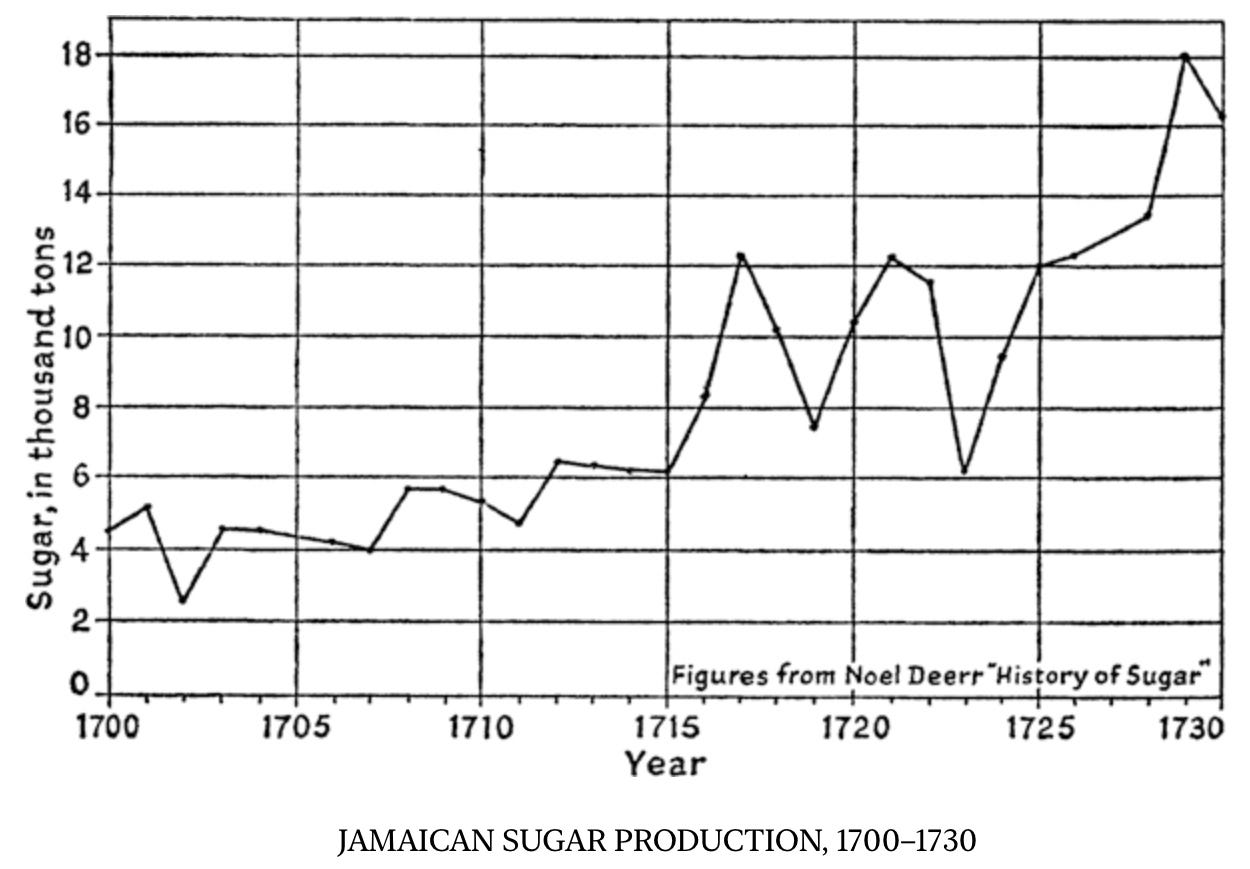
Little brother Charles, the family fortune saver, made enough to send his children to school in England, a common occurrence for those in the planter elite; I’d argue that this practice has largely remained intact today. However, the Price family fortune did not germinate in Lluidas Vale, it occurred in St. Thomas-ye-Vale “when Charles Price in 1725 acquired the valuable trio of Rose family estates called Savanna Plantation or Old Works, Burton’s, and New Works, thereafter generally called Rose Hall, an acreage so large that it was not specifically known.” Note: St. Thomas-ye-Vale is not to be confused with modern-day St. Thomas Parish. The former was located within today’s St. Catherine Parish, but was abolished in the mid-19th century and folded into St. Catherine.
To be clear, the Worthy Park holding was not to be disregarded. The building blocks were forming, despite the more traditional farm nature of the acreage. As previously mentioned, the Price family began engaging in sugar production more earnestly during this period.
Worthy Park in 1730 was at least as much a stock farm as it had been in the latter days of Charles Price’s father. Grazing on the savanna land on the west of the estate were 106 steers and 64 cows and calves. In addition to 90 mules, there were 17 horses and innumerable hogs, sheep, and ‘small stock’. The great difference from the time of Francis Price was the production of sugar. With a field-force of at least 200, there were probably as many as 200 acres already in cane, as well as 75 acres in provision crops such as plaintains [sic], eddoes, yams, cassava, and corn. The presence in the Inventory of 1731 of 2,000 ‘sugar potts’ (ten times the number found on the Price-Beckford estate at Guanaboa in 1673) indicates a production of at least 250 hogsheads of sugar a year.
Charles Price ultimately met his fate in 1730, passing at the age of 52, which was longer than the total years his older brothers lived. Trend bucker. Here are a few notable things to take away from Charles’s life before, and right up to, his passing:
→ He and his wife, Sarah, had 13 children.
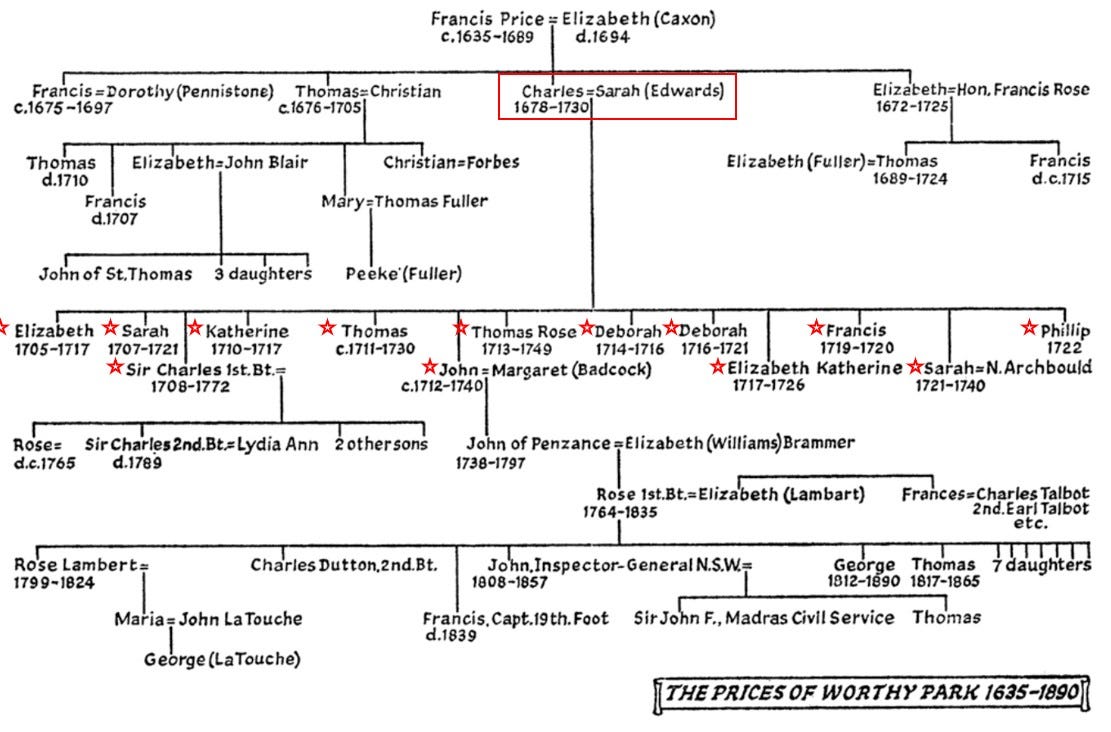
→ Charles built a home for his family in Spanish Town, the capital of Jamaica at that time; My reading is that, like most aspects of business, it was advantageous to be there, and cozy up for future gains (by way of politics).
→ Upholding his father’s legacy and maintaining the aforementioned political standing, Charles served in the “St. John’s militia, [and] on the parish bench as J.P. and in the Jamaican Assembly.” We’ll see how these political connections bear fruit for the Price family later.
His will and legacy:
→ Left his wife the home in Spain Town and 9 house slaves. Yes, this type of bequeathing was considered standard practice.
→ And for his surviving children, outside of what was already accounted for, his land was “to be shared equally” among them.
Worthy Park and its Great House, and the reversion of the new house in Spanish Town—later called Lluidas House—were bequeathed to the youngest sons, John and Thomas Rose, then still minors, along with ‘all other my lands in the parishes of St. John’s St. Mary’s, St. Ann’s, and St. Dorothy’s and elsewhere within this Island’, to be shared equally. Charles Price’s wife and his eldest son were nominated executors of his estate…
→ He also strategically left money allocated for his children to be educated in England, as well as purchase land there, should they decide to become absentee owners.
Though “Charles Price had never seen the land of his ancestors, nor even left Jamaica,” each child would end up going to England at some point in their lives (though they all returned). I suppose Charles Price would have considered their ability to choose was mission accomplished.
The single most important takeaway, in the context of the longevity of Worthy Park and its retention in the Price family, is that Charles finding that money to buy back the land was ultimately well worth it –
…it was Charles Price who made Worthy Park into a sugar estate, so that whereas to find even £775 had been a financial strain in 1701, he was able when he died twenty-nine years later to bequeath ten times that amount in cash, as well as estates in Lluidas Vale and St. Thomas-ye-Vale alone worth more than £22,000.
By the standards of his day, Colonel Charles Price was an elderly man when he died at the age of 52 on 23 May 1730, but by any standards he had lived a fruitful life. Worthy Park developed more in his lifetime than at any period in its history, save perhaps in the half century after 1918. Charles Price made no great impact on the public life and history of Jamaica, but he died full of the golden opinions of his neighbours and the gratitude of his surviving children.
See how the lastborn always saves things from crumbling? All hail, my fellow lastborns.
From CP to Sir CP.
If Charles Price got Worthy Park to a somewhat meaningful sugar estate, then Sir Charles Price, his first son, took the family fortune to the next level. Don’t get “Sir” Charles Price confused with just Charles Price.
Sir CP continued the political and economic march forward. In 1732, he was elected to the Jamaican Assembly, and by 1739, he was one of the most prominent members. In 1745, he was elected as speaker and held that position for 18 years. The Jamaican Assembly held the power of the law, dictating what happened across the island. They fell under (and reported to) the British Crown. This type of favorable position/standing was common among West Indian wealthy planters because Caribbean sugar kept Britain’s coffers padded, and the colonizing nation remained powerful as a result. This type of imbalanced representation (Britain’s sugar colonies vis-à-vis all other colonies) was one of many that the Continental North American Colonies (later the U.S.A.) felt was unjust and ultimately revolted against. The Jamaican elite, of which Sir Charles Price was in firm standing, did not at all mind this favorable imbalance –
Largely as a result of these enactments, the price of West Indian muscovado in England rose from a nadir of under 17s. a hundredweight in 1733, to 32s. in 1740, from which point it maintained an average of some 36s. (exclusive of duty) right down to the time of the American War.
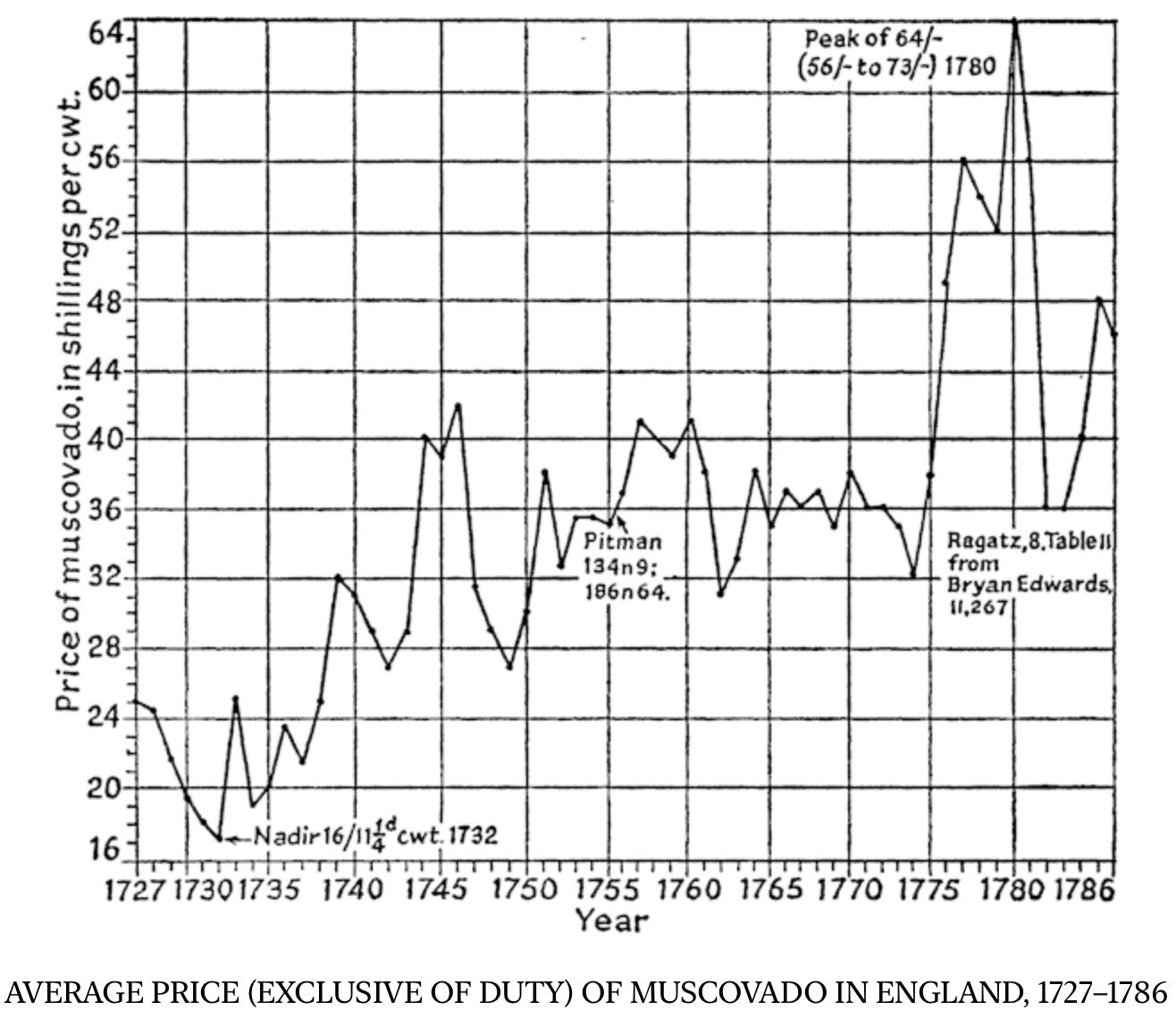
There’s a lot more going on in the background – Molasses Act, Seven Years’ War, Sugar Act of 1764, etc. – but I want to focus on the Price legacy and Worthy Park vs. the broader history (unless it’s incredibly contextually important, of course)…Alright, it’s contextually important, so here it goes: wartime, which seemed to be a constant in this middle-to-late 18th-century period, proved beneficial for the planters, insofar as sugar prices continued to rise given supply disruptions and increased global demand. The Jamaican planter elite rode the high waves, including Sir Charles Price –
Because of the increased trade with the Spanish colonies now encouraged by the Free Port Act of 1766, even gold and silver coin were in better supply. Success bred success, and success, concord. Capital and credit became more readily available than ever before, and with the almost complete dedication of metropolitan capital to the West Indian system, an unrivalled political nexus grew up at Westminster that was not to be severely challenged until after the American War. On the local Jamaican scene, faction evaporated in an era of good feelings, characterized by votes of loyalty to the British Crown and of conspicuous gratitude to the likes of Sir Charles Price. Sugar, it seemed, had become the philosophers’ stone of economics: but two human flaws remained, too soon to become apparent; the propensity of Jamaican planters to desert their island and dissipate their fortunes in vulgar expenditure, and the tendency of those who remained to expand their holdings far beyond their power adequately to finance them.
Absenteeism (ownership from afar) was so rife and widespread on the island that “the word ‘Jamaica’ became synonymous with a certain style of ostentatious luxury based upon absentee fortunes made in sugar.” But this model of wealth demonstration was in vogue and surely promoted because the planters believed that the high times would continue to fly. You generally feel that way when you’re selling goods for high prices and there’s no immediate indication that there will be a market correction. From my reading, it doesn’t appear that Sir Charles Price became an absentee owner, at least not in the strictest sense (if at all). Which, given his hugging “home base,” probably gave him an advantage to gobble up more land under the Price name, notwithstanding his political sway –
Sir Charles Price was probably the most flagrant beneficiary of the system whereby the control of the Jamaican Government enabled the planters to obtain cheap land. Despite the Order-in-Council of 1735 limiting grants to 1,000 acres, Price patented between 1738 and 1769 no less than 8,707 acres. He also bought up adjacent land whenever it became available cheaply, and at his death possessed 26,000 acres—perhaps the largest portion of Jamaica ever owned by a single individual.
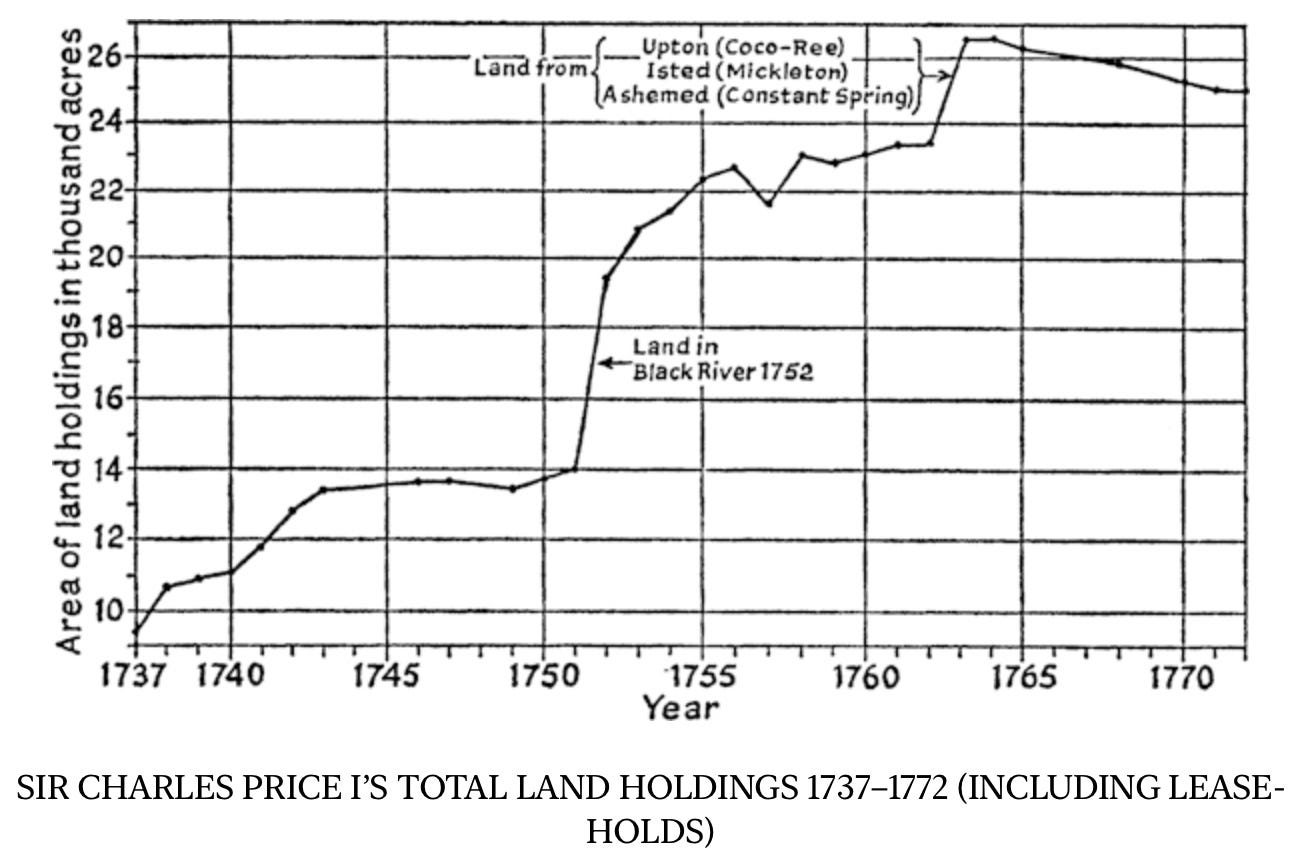
He made plenty of speculative land purchases that also turned sour and had to be disposed of or sold off. It seems he never lost sight of the core holding(s) because Sir CP was “absolutely essential” for getting “adequate road[s]” built so that the land was more connected to commercial activity. Sir CP also used his leverage to bring the most vital of resources to Worthy Park: water. The politics paid off, as Sir CP’s position as Member of the Assembly allowed him to push through the requisite bills –
‘for enlarging, widening and repairing the road from Spring Garden, in the parish of St. Dorothy, to Captain Thomas Fuller’s plantation in Lluidas, in the parish of St. John’.
Charles Price was more directly involved in constructing the two roads connecting the Vale of St. Thomas with the north coast of Jamaica for the first time, innovations that were extremely important after the development of the northern parishes and the creation of ports of entry at Port Antonio and Montego Bay in 1758.
From the Act of 1752, it appears possible that the ‘Trench Gutter or Aquaduct’ was intended to pass through Worthy Park…For doubtless waterpower revolutionized the operation of Worthy Park and, once the huge expense of the building of the aqueduct had been overcome, her profitability was enhanced as well as her productivity.
We’re going to transition Sir Charles Price shortly (died in 1772), but here is the family tree ahead of some pertinent info (again, to avoid confusion) –
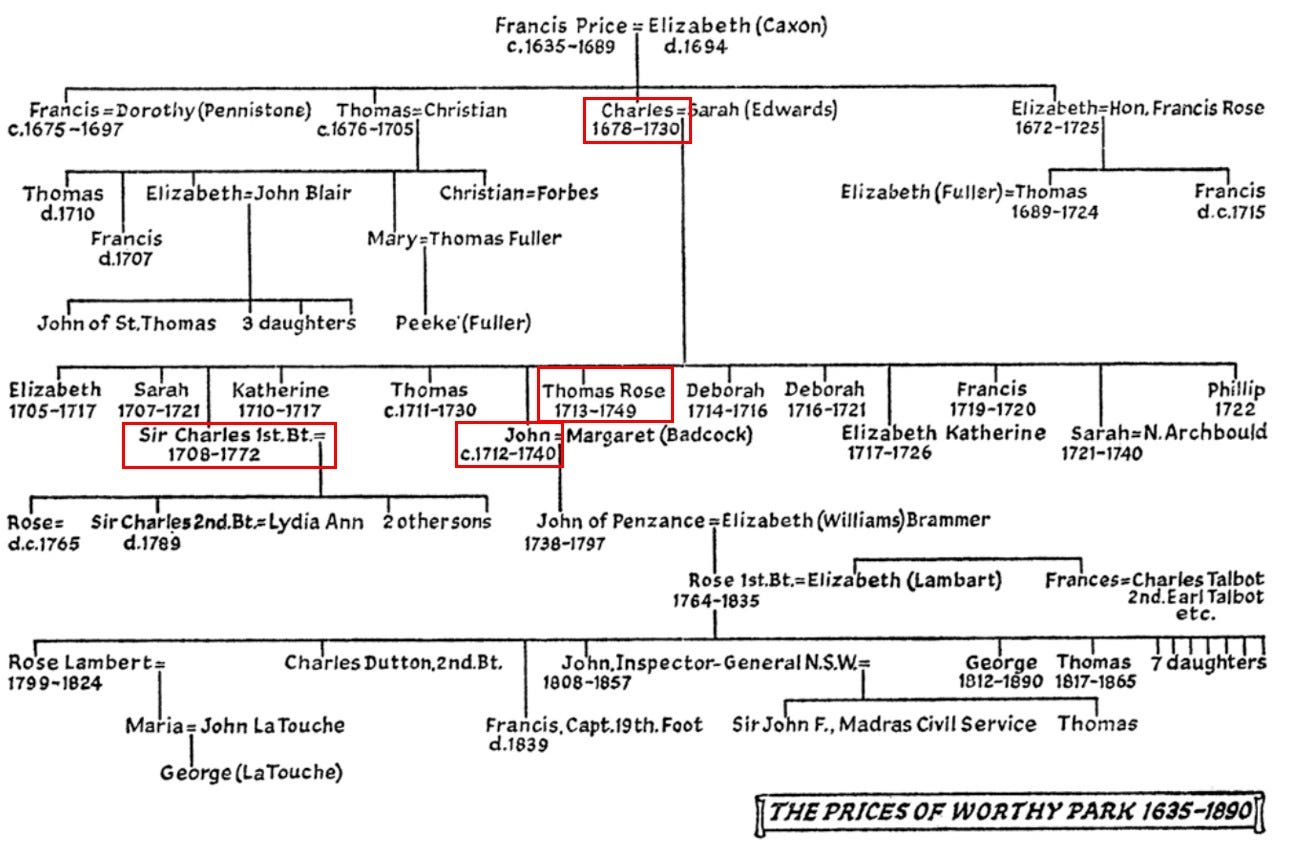
Sir Charles Price did not own interests in Worthy Park outright until much later, since Charles Price (father) “bequeathed [it] to John Price and Thomas Rose Price[,] and only on the death of the latter in 1750 did Charles Price inherit a share of Worthy Park.” I wonder if some of this drove his speculative land buying, or if he was simply on a purchasing spree (probably the latter). In any case, here is evidence that the majority of Worthy Park was not in the possession of Sir CP, but instead with his brothers –
In 1776, Worthy Park, the ‘Estate of John Price’, produced no less than 354 hogsheads of sugar and 130 puncheons of rum…
Not to be outdone (I have no evidence that they were in competition, FYI), Sir CP remained productive –
In 1741, the ‘produce of the late Charles Price on Worthy Park’ amounted to 8,201 potts of sugar and 3,000 gallons of rum, or approximately 265 hogsheads of sugar and 27 puncheons of rum. In 1743, the estate produced 8,578 potts of sugar and 5,000 gallons of rum, amounting to perhaps 276 hogsheads and 45 puncheons, and in the following year, 288 hogsheads of sugar (of which 140 were shipped and 148 sold locally) and 3,712½ gallons, or about 33¾ puncheons, of rum.
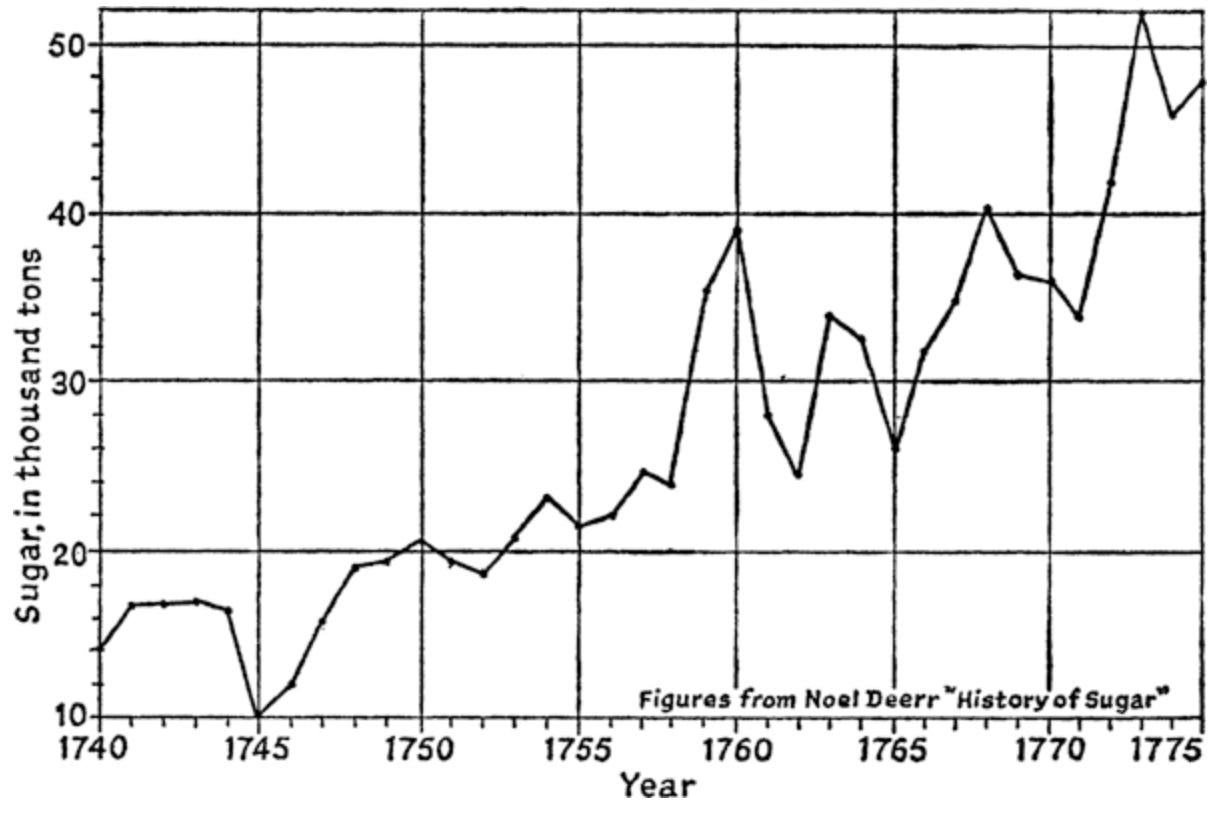
This all closely mirrored the improving production of sugar on the island more broadly, and likely the same for most sugar-producing nations in the region –
Upon further analysis of his wealth, there are clear indications that Sir Charles Price was firmly in the planter elite. One stat supporting this status assumption was the number of people he enslaved across his estates –
As early as 1744 he owned 1,353 slaves on Burton’s (543), Shenton (43), Rose Hall (321), Wallins (199), Decoy (112), Amity Hall (12), and Cutthroat Gully (21), and altogether probably owned 1,800 by the time of his death in 1772. This swarm of Negroes almost certainly made him the largest Jamaican slaveholder during the eighteenth century, as well as the most substantial landowner.
Choice words, but admittedly mild in the land of historians.
So, what next for the Price family? Sir Charles Price had 2 daughters and 3 sons, 2 of whom I believe passed away quickly, since the family tree simply says, “2 other sons.” Sir CP’s (what I believe is first) son was affectionately named…you guessed it…Sir Charles Price 2nd. Issue is, like his uncle, Francis Price, Sir CP 2nd had no children, so his share of Worthy Park went to his cousin –
…the will declared that on the death of the second Sir Charles Price without issue, his half share of Worthy Park would revert to John Price. This was to be of immense importance later, for when Sir Charles Price the second died without children in 1789, the whole of Worthy Park passed to his cousin John Price of Penzance and was spared the ignominious fate of the rest of the old Price holdings.
Assuming the “will” in reference may have been Sir Charles Price’s, not entirely clear.
John Price of Penzance was the son of John Price (Sir Charles Price’s brother). Names recycled again, yes.
Another family tree drop is necessary before we transition, I agree.
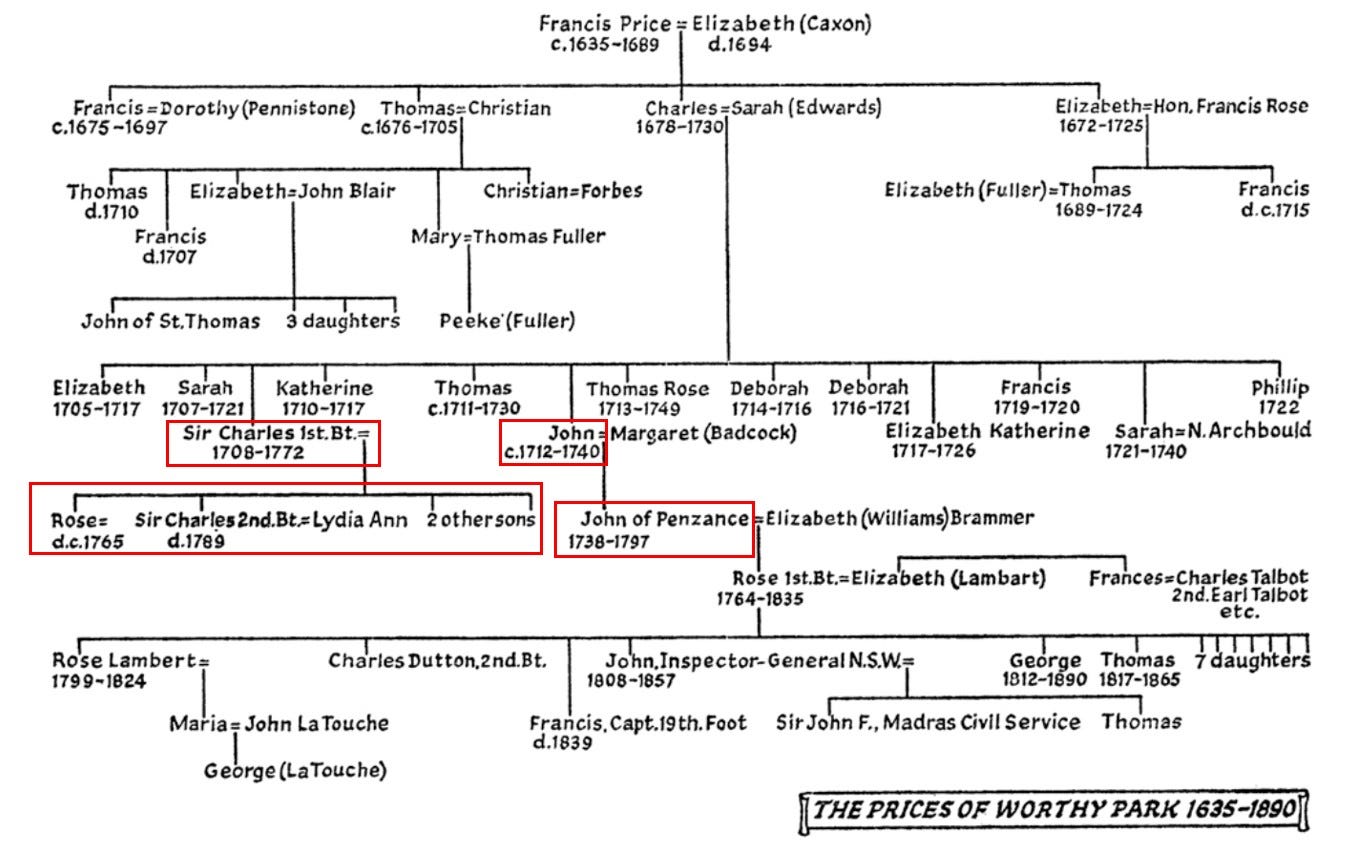
End of the Charles Price(s)’ era, on to the next generation.
The holdings are still squarely in the original Price family, now by way of John of Penzance (Price). That’s his name, look at the tree again.
Let’s take a necessary detour to market and plantation matters, while keeping Worthy Park at the center of the conversation.
Why? Because market conditions and upward trends in the sugar business are central to the Price’s ability to amass wealth and influence. Pioneering efforts in a market that won’t reward it would have resulted in Craton’s and Walvin’s book being written differently, or at least the Price family juncture.
With that, the market. Jamaica had largely become a monoculture post-1750s, insofar as sugar dominated the motives of most planters, who saw vast personal wealth generated from cane’s outputs. The tropics allowed for year-round planting (more or less), despite sugarcane needing a year to mature. This encouraged planters and aspirants to believe that the island was a worthy bet. However, the authors noted that the only guarantees planters had were –
…the uncertainty of London sugar prices, the caprices of the West Indian climate, the apparent inevitability of war, and the ever-rising cost of credit. As time went on, the system of absentee proprietorship and indirect management, which applied to Worthy Park as to the vast majority of West Indian estates, appeared more and more a luxury which the estates could ill afford.
Despite the volatility underscoring the allure of cane-derived wealth, the Price family was firmly in the elite of the planter class. There would have been no reason for them not to get with the times, so to speak. More plainly, anything but continuing to cultivate cane would have reversed 100+ years of building. With Sir Charles Price 2nd‘s death in 1789, and his cousin, John Price of Penzance, receiving CP the second’s share of Worthy Park, the family continued to move full steam ahead with sugar and rum production.
Slave labor remained the marker of how successful plantation operations were (for obvious reasons). But even more than that, estates that organized their labor most efficiently (“gangs,” overseers, around-the-clock work, getting ahead of the year-round crop season aberrations/weather patterns, etc.) tended to yield the most from their cane operations. The authors dutifully provided vast amounts of detail highlighting some of these realities for Worthy Park in the late 18th century –
For the backbreaking and oppressive tasks of field and factory were reserved the healthiest slaves. Of the 338 slaves at Worthy Park in 1789, 56 were children below the age of six and therefore not capable of useful work, 29 were elderly or sick men used as watchmen, and 25 were listed as ‘old and infirm’ or ‘good for nothing’. Only 133, with five ‘drivers’, were in the permanent field force, but these included 102, or 70 per cent of the 146 Negroes on the estate officially listed as ‘able’. The factory employed 38 men, of whom exactly half were skilled and half unskilled labourers. One remarkable fact was that of the field force in 1789, no less than 89 were women, quite capable of weeding and carrying, and perhaps of hoeing and holing, but surely not of the strenuous monotony of cutting the cane. Accordingly, 24 able-bodied Negro men were hired in 1789 to assist in the crop, augmenting the work-force to something like 60 cutters.
At Worthy Park between 1776 and 1796, approximately 250 tons of sugar were produced in a good year from 260 acres of canes, in a crop that averaged 120 cutting days. On an average, some two tons of sugar were produced from 2·2 acres of cane per day, at an average of just under a ton of sugar per acre. Going on the assumption that the cutting gangs totalled 60 men and that 20 tons of cane were needed to produce a ton of sugar, this indicates an average of 40 tons of cane cut per day, or about two-thirds of a ton of cane per cutter.
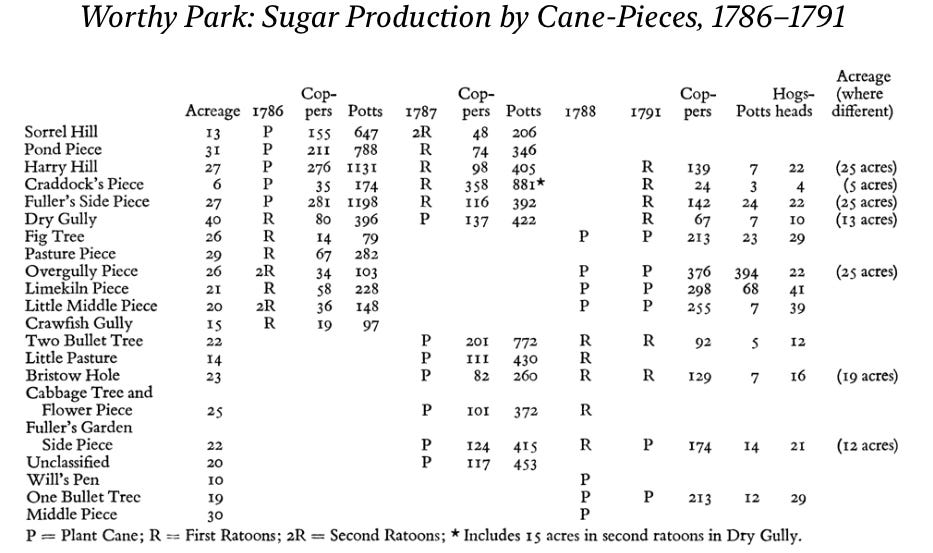
Once the factory was started up it was important to keep it at capacity until the crop was finished. It was extremely uneconomic to prolong operations unduly or to operate the factory intermittently. Besides this, cane deteriorated rapidly after cutting, just as cane juice spoiled if not processed almost immediately after crushing. A well-managed estate was therefore one in which the rate of cutting was geared to the capacity of the mills, and the production of the mills to the capacity of the rest of the factory. A good year at Worthy Park was one in which the entire crop was cut and processed between January and June: a bad year was one in which inclement weather, a delayed crop or trouble with the machinery might prolong operations past midsummer and into the autumn. In 1789, for example, the field gangs were cutting until October, and the factory, though it actually worked only 118 days, was in operation from February until December. In 1787, in contrast, the factory had worked not many fewer days but only between February and June, and in 1791, when 60 per cent more sugar was produced than in 1787, an almost identical period All in all the sugar harvesting and processing between 1783 and 1791 averaged 179 days from beginning to end, beginning in an average year on 31 January and ending on 28 July, during which period the factory appears to have worked an average of approximately 120 actual days, to produce an average of roughly 2½ hogsheads a day, with a maximum of 5½.
As you can see, the planting, cultivating, and cutting of the cane was one aspect of the labor. The other critical factor was what happened once the cane was brought to the factory, where cut cane was transformed into sugar. These laborers were critical to operations, given their handling of the final product and moneymaker – “coarse brown muscovado,” for the most part –
Of the nineteen skilled men working in the Worthy Park factory in 1789, ten were boilers, five distillers, three ‘potters’, and one a cooper, and the senior in each of these crafts was a member of the estate’s highest Negro [e]lite. Indeed, the head boilerman, presiding over the supreme mysteries of the craft of sugar production, was probably as important to the estate as anyone save the overseer and attorney.
Fortunately for the planters, most of their factory slaves remained remarkably cheerful, particularly near the beginning of crop, often singing away the oppressive monotony of their work, and many of their craftsmen slaves demonstrated a degree of enterprise and industry that belied the sneering stereotype of the Negro usual in plantocratic writings.
To me, a bit of embellishing – “singing away” – on the first part of that second quote, though I would not completely rule out the idea of factory (potentially “Negro elite”) workers being more “cheerful” than those who toiled in the fields. Social status fueling satisfaction aside, it also downplays the danger/rigor of factory work: risk of burns, losing limbs, overwork, etc. Fair assessment on that second half, I’ll give the authors that.
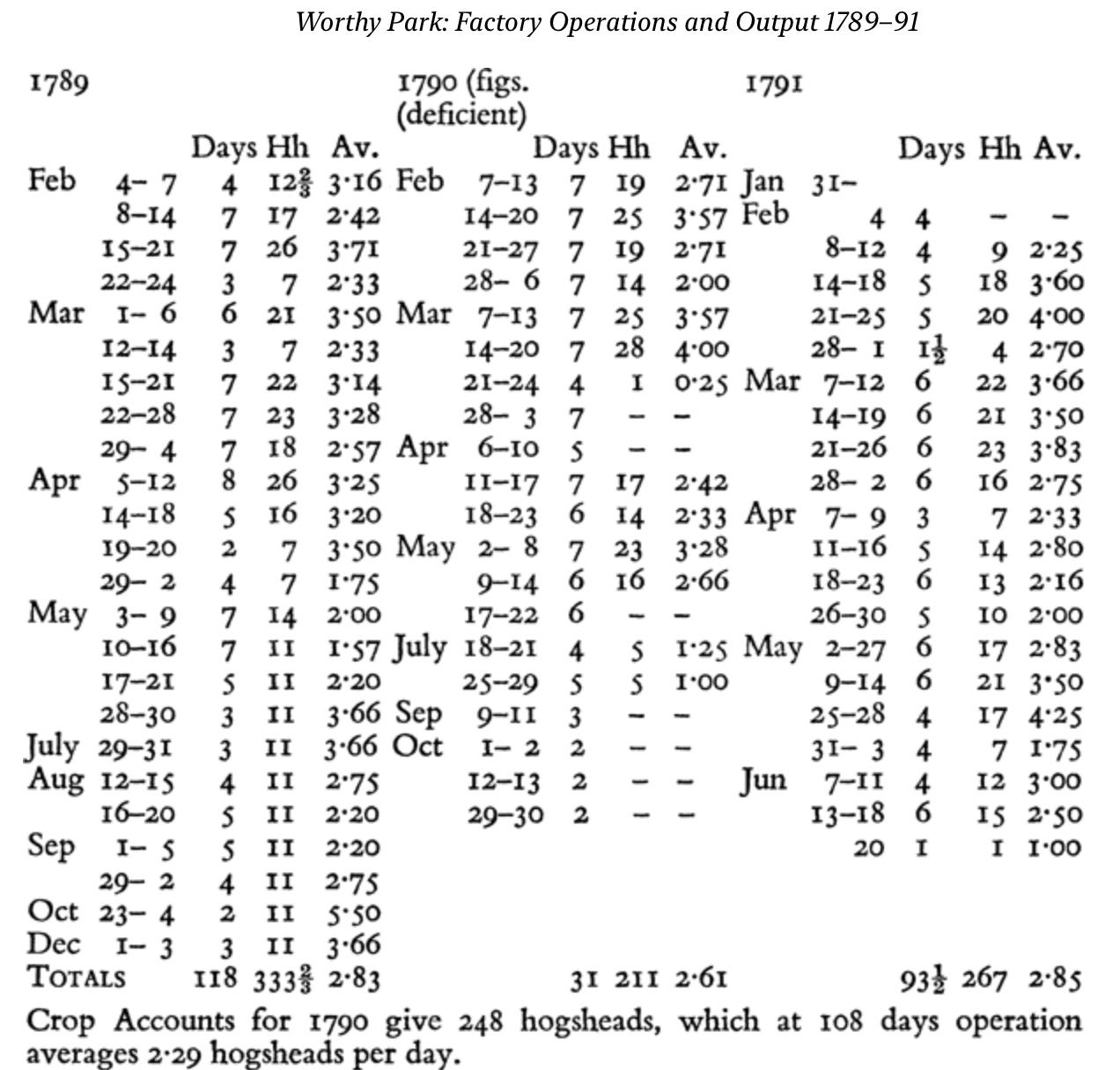
But not only sugar, rum was a critical component of Worthy Park’s profile as an estate. We get a glimpse into vital activity that would serve as a building block for the plantation. More practically, it made sense to satiate the ever-growing demand for the spirit in Britain –
Pre-19th century (more or less), it’s fair to assume that the vast majority of Worthy Park’s rums were sold and consumed in Jamaica (not exported).
But with the improving road works, this was certain to change in the years leading up to the turn of the century.
In the mid-1790s, Worthy Park’s rums began going to the Mother Country in earnest, most of it ending up in London.
London was always the principal destination, though before 1791 some produce was from time to time shipped to other British ports. In 1783, for example, a single hogshead was sent to Bristol, and in 1788 and 1791 large consignments of eighty and forty hogsheads went to Liverpool. Thereafter, all of Worthy Park’s exports for more than a hundred years were sent to market in London, where their handling was managed entirely by a single agent. Towards the end of the eighteenth century this agent was one Thomas Smith, merchant, of whom it was said in 1794 that he had been receiving ‘all the Sugars and produce of the said plantation [Worthy Park] … for many years.’
As was the case with Britain and her other colonies, this was a scratch my back, I scratch yours type of relationship; Jamaica did far more scratching, to be clear, they are still under British control –
In exchange for rum, Worthy Park would have received hardware, funds, “yard goods,” lumber, etc.
Goods “vital to the factory operations,” such as coppers, boilers, cane cutters, and even rudimentary clothing for slaves, were shipped over from Britain (note: may have been produced by Britain or obtained from another colony and re-shipped).
Food was a critical import, with delicacies like “beef” or “butter” cordoned off for the “plantation’s whites,” while “salt-fish,” mainly coming from Ireland, was reserved for the enslaved (note: salt-fish is a staple food item in Jamaican’s diet today, often consumed at breakfast).
But, especially with the British re-shipping goods, the Jamaican colonists would not be wholly reliant on Britain for survival –
The English sugar ships, however, did not entirely satisfy Worthy Park’s enormous appetite for provisions and supplies. Each year the management had to buy in Kingston more food for slaves and whites, cooperage lumber, coal and tallow for heat and light. Most of these items were also imported into Jamaica, though acquired by the estate by way of an agent in Kingston rather than directly from the sugar factor in England.
Let’s transition back to the Price lineage.
Family tree again –
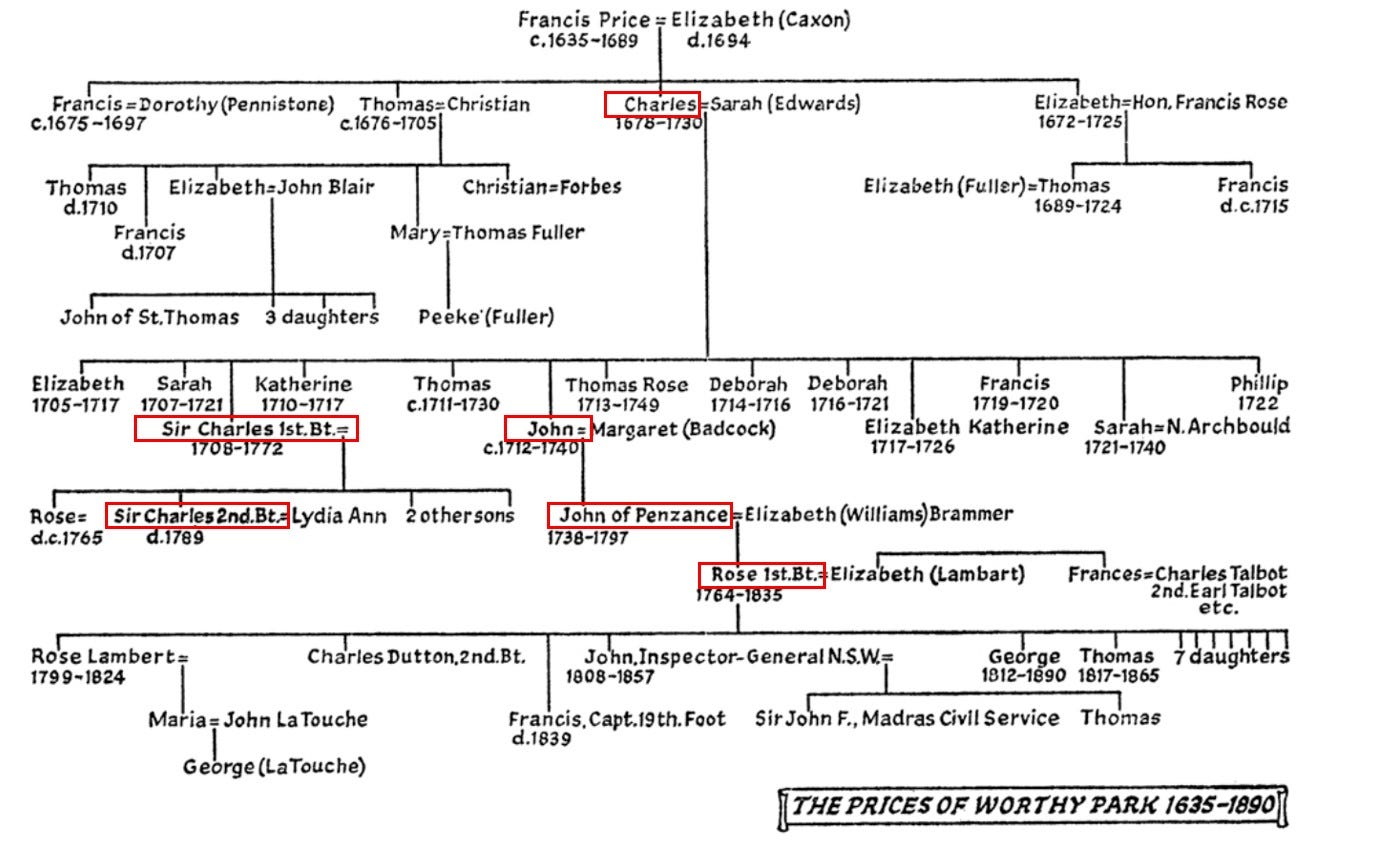
By 1791, Worthy Park was largely an “absentee’s estate” (more or less since 1740 or so). In stereotypical family business fashion, it seems that the spoils of the prior generation’s efforts were being enjoyed; No reason or desire to stay in Jamaica if one did not need to. But also, venturing off to England was seen as a rite of passage. However, like any good business, but especially one of the agricultural variety, you don’t get a WFH (home being England) pass on this one. The “economic aggressiveness and political eminence” of Sir Charles Price’s efforts in building up the family’s holdings would come under threat –
Soundly established as a sugar plantation by Colonel Charles Price, and provided with the means to more efficient production through the supervision of his son, Sir Charles, the estate had enabled Sir Charles Price’s brother John to migrate to Cornwall for the benefit of his health, and his nephew John to live the life of a Cornish squire throughout the years of sugar’s affluence. Yet all was not so well as it seemed. The years after the American War, which saw the collapse of Sir Charles Price’s empire and the defection and death of Sir Charles Price’s only son, also showed the cumulative effect on Worthy Park of the system of indirect management and absentee plunder. The only possible cure for the problems of the estate—and this is a theme which runs consistently through the history of Worthy Park—was dynamic resident owner-management, coupled, if possible, with a fresh infusion of capital. These were provided between 1791 and 1795 by young Rose Price, the son of the second John Price…
But what purpose did the “capital infusions” and “dynamic resident owner-management” serve in the long run?
Price family holdings, including Worthy Park, were entirely dependent on slave labor. This is, I hope, very obvious and not a moot point. As Craton and Walvin described it –
…family’s fortune was based firmly on the backs of African blacks. It was the slaves who axed the matted virgin timber, tilled the land with hoes, swathed the standing cane with cutlasses, sweated in the odorous hell of the boiling-houses, cutting, digging, and carrying under the ever-present reality or threat of the gangman’s lash. To proprietors and outside observers alike, the fact was axiomatic…
When I mentioned earlier that slaves were included in asset/land valuations both numerically and physically, it was to highlight the centrality of this reality to the Price family’s considerations in building their wealth. This would have been an uninteresting, mundane reality of the time, or what the authors called “axiomatic,” but to modern-day sensibilities, it is worth reiterating –
Like the land, the factory plant and the cattle, the slaves were regarded simply as units of economic value. In law (so often the reflection of, or mandate for, economic fact), they were simply property, chattels with few or no legal rights as humans. Collectively the slaves formed an ever-expanding, shifting, and volatile labour force that was vital to the economy. Yet it must be remembered that the bare statistics relating to the slaves conceal the lives of thousands of forgotten people.
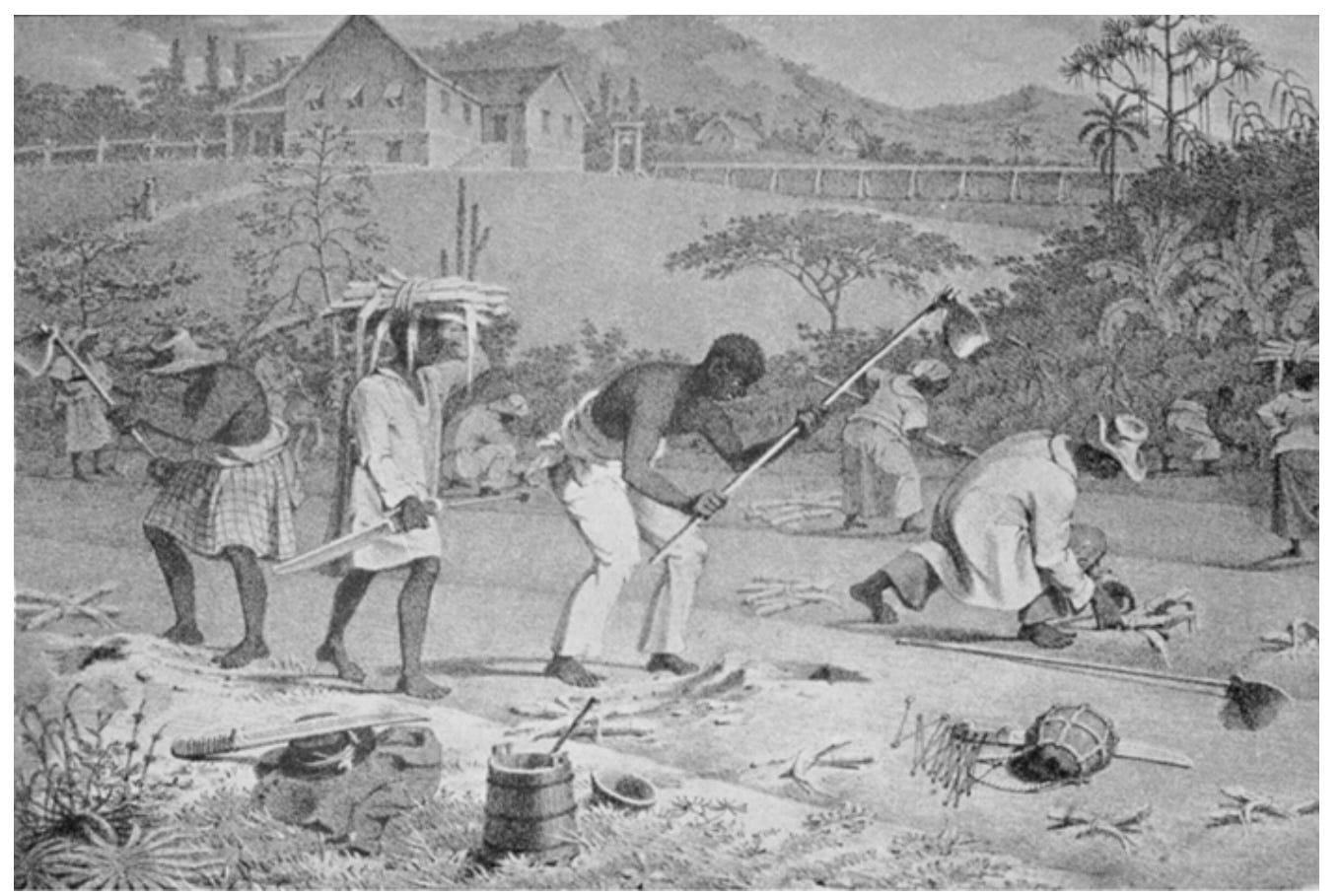
The Price family’s holdings mirrored the usual trappings of this “Golden Age of Sugar”: more men than women on their estates, given the value of perceived strength for labor-intensive tasks –
On four of the Price properties, Burton’s, Rose Hall, Wallins, and the Decoy, the numerical superiority of men was particularly striking; out of a total of 1,141 slaves only 356, or 30·4 per cent, were women. On Worthy Park itself, it seems that the percentage of men was never higher than 60 per cent, for even as early as 1730 there were 112 females out of 257 slaves, amounting to 44 per cent of the total. By the 1780s this had risen to 47·5 per cent, and the numbers of males and females was almost certainly equalized by the time the slave trade was abolished in 1808.
Enslaved women were expected to readily produce children without any formal family structures.
Miscarriages were plenty.
Death was constant (tropical diseases, overwork, psychological toll, poor diet, etc.).
Skin color determined if you worked domestically vs. the fields.
Very clear preferential treatment, often in the form of liquid gifts, was reserved for those who kept order or were skilled labor (drivers of field gangs, artisans, etc.).
In 1795, for instance, 932 gallons of rum were set aside for the slaves but since the ‘Head People’ were, on Rose Price’s instructions to receive two quarts a day, a total of 274 gallons were consumed by only twenty-five slaves. Thus from a total slave population of 480, a mere twenty-five absorbed a quarter of the rum allocation.
Families were split apart primarily due to economic dictates.
Remember the vastness of Sir Charles Price’s land-buying expeditions? Between 1741—72, he spent a minimum of “£13,730” to secure “742 slaves.” The value of that is approximately £1.8 million, adjusted to today's value (source: Bank of England, August 2025). You can understand why the Price family was firmly in the elite, they had (today’s worth of) £1.8 million to spend. Upon his death, across the 26,000 acres of land, he had 1,800 slaves.
The largest single group of these slaves toiled away their lives on Worthy Park.
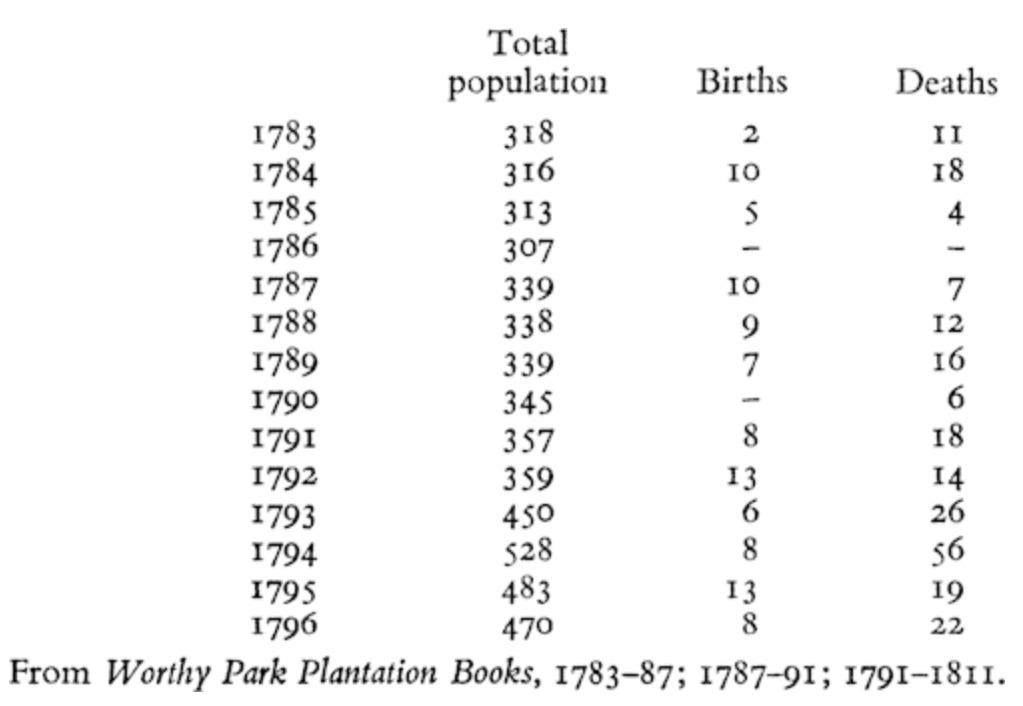
→ 1783: 318 slaves at Worthy Park
→ 1791: 357
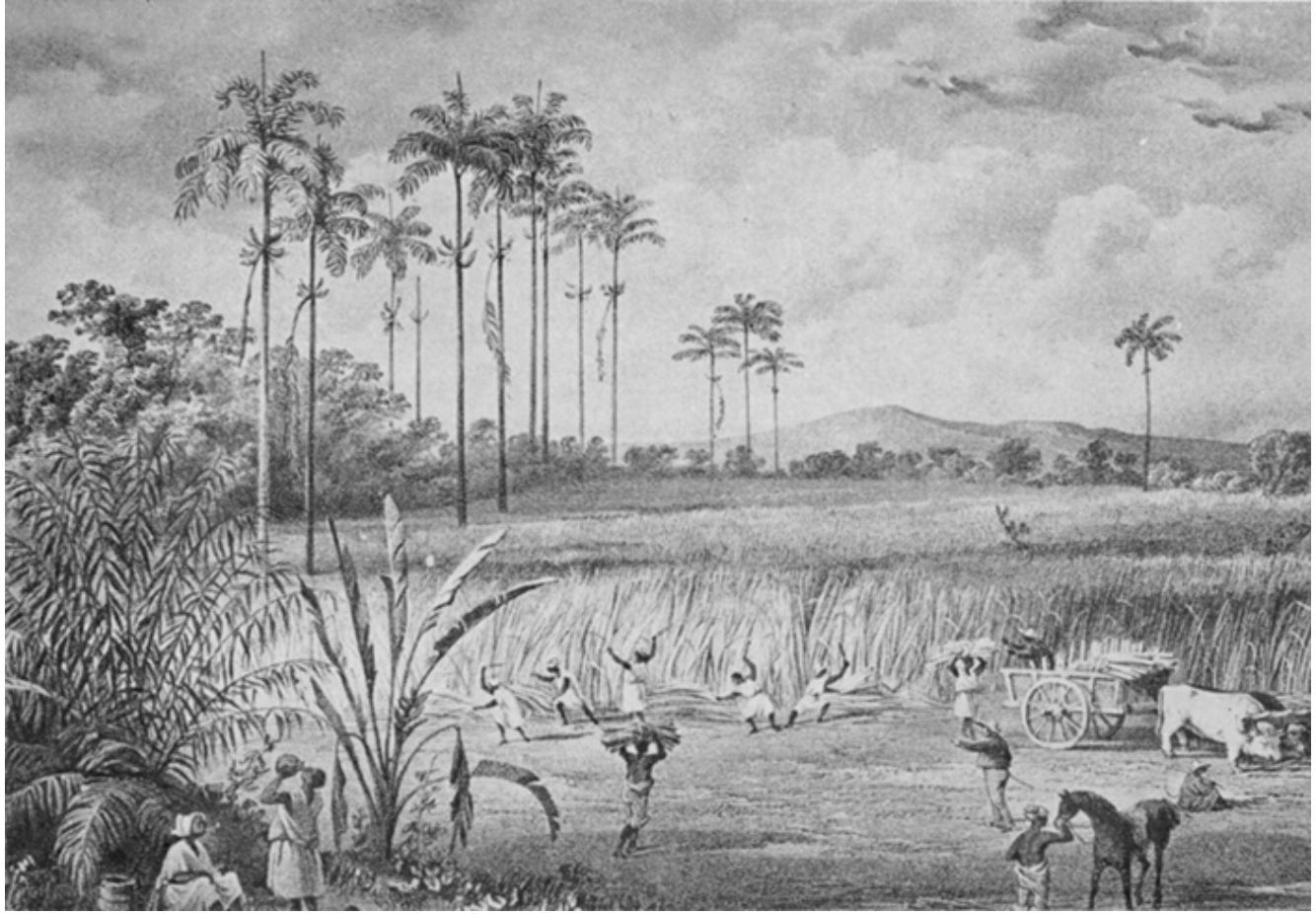
A lot of slaves were purchased after 1792 to (1) keep up with the expansion of the sugar industry and (2) replenish the labor force given the frequent death of the enslaved because of #1. It seems that in most years, there were more deaths than births.
Only the purchase of new slaves enabled the labour force to expand.
In the period of Rose Price’s residence no fewer than 115 slaves had died on his estate. Such horrifying figures raise, in a dramatic fashion, the more general problem of the health of Worthy Park’s slaves.
The wealthier plantation owners, like the Price family, had a doctor on staff to provide whatever rudimentary solutions were in vogue at the time. Read: doctors didn’t start getting “real” respect across the Western world until the 20th century (give or take). For Worthy Park, that physician, Dr. John Quier, came in from London and moved to the estate permanently. My read is that his true purpose was to slow down the death rate as much as feasibly possible, so that Worthy Park could continue functioning at a high labor/crop output capacity. A necessary investment in medical care for the primary goal of keeping the fields planted and the factory gears turning. Everything else was planter elite posturing, in my opinion. That, or the Price family, and others like them, actually believed in doctors of that time. Which, on second thought, is actually possible.
Although Craton and Walvin postulate that Dr. Quier’s and Worthy Park’s “medical care of its slaves was impressive,” relative to other plantations, I did find (an example of) Quier’s diagnosis to be logical, in a time when bloodletting and ‘remove the limb’ style treatments were the rage. Quier noted that one reason for the poor health/constant death of slaves was –
‘…long confinement, bad food and improper treatment on the voyage’. – Dr. Quier
As aptly noted by the authors, the Price family, regardless of their efforts, “were [ultimately] helpless in the face of widespread illness and death among [the] slaves.” That’s evidenced by the “115 slaves” that died during Rose Price’s residence, and the vast amounts of newborn (young baby) deaths on their estate –
Of the 240 resident female slaves 89 had given birth, but of these, 35 had suffered miscarriages. More appalling still was the fact that only 19 of the 89 women had managed to keep alive all the children born to them. 70 women had lost various numbers of children. Of the exceptional 19 women whose children had all survived, 15 had in fact been delivered of only a single child. Two women had each given birth to, and managed to keep alive, two children and one lucky woman still cared for all three children born to her. At the time the ownership made these investigations there had been, in all, 345 babies born to slaves at Worthy Park. But only 159 children were still alive.
With only “one white woman” at Worthy Park before the turn of the 19th century, a logical conclusion can be drawn as to the other conditions that caused everything from miscarriages to nearly 50% of children not surviving on the estate. The authors’ “pleasure and companionship” characterization is a mild way of describing this, though the lighter complexion Creole children being a gateway to “escap[ing] from slavery” is a necessary callout –
That slaves were able to raise sums of £150 and £65 is perhaps explicable by reference to the liaisons which inevitably developed between white men and female slaves and the affection which sometimes grew for a domestic servant. When children were born from the illicit affairs of white men and slave women, financial provision was very often made for their future in deeds or wills. Such arrangements were the slaves’ only chance of acquiring large sums of money. Only one white woman lived at Worthy Park in the 1790s, making it inevitable that local white men would turn to their slaves for pleasure and companionship. It was the bastard offspring of such liaisons which provided the mothers, and the children themselves, with the best chance of escape from slavery.
Between 1784 and 1797, 22 enslaved people were freed, of whom 4 bought their freedom, presumably the folks who were able to “raise [the] sums” of money referenced in the previous quote. Under such conditions, men and women tried to run away from the plantation; These runaways were often categorized as ‘worthless,’ an economic category that the elderly and weak were also placed into. Same with those deemed “recalcitrant,” the economic (and field) characterization for them was the “Vagabond Gang.” Haitians, do with that information what you will. I know “Vagabond” is a top 5 word your elders like to use.
Many runaways returned voluntarily when they likely realized that life in the mountains was untenable, notwithstanding the presence of Maroons, who would very likely return you to the plantation as part of their agreements/treaties with the British. If that last line read a little odd to you, I’d recommend checking out my first half review of “Tacky’s Revolt: The Story of an Atlantic Slave War.” There is a reason that slaveholders referred to Maroons as “friends in the mountains.” More importantly, there weren’t many turns and corners a runaway enslaved person could venture off to. The country did not offer a “free” North as would have been the case in the newly formed United States of America. Maroon or slave was the reality of the time, notwithstanding the sliver of free people that existed within the society.
Adding to the frustrations of the Price leadership was the inability to keep overseers at Worthy Park despite the “handsome salary of £200 [later increased to £300 under Rose Price]”: far away from home, tropical disease and death, anxiety of potential uprisings (“At the worst point, there was one white to 63 slaves; at the best, one to 34.”), and not much of anything to do (“slave women must inevitably have become one of the few tolerable recreations.”). Nasty description. Desertion followed, which was not a unique issue for Worthy Park.
When profits are plunging, an economic system rooted in slavery and management of labor will ultimately feel burdensome. The authors’ analysis of this labor and capital-intensive system is that it “even enslaved” the Price family “as much as it had debased the Negro.” I understand the sentiment from a simple lens: people’s circumstances are the extent of their world, and humanity has never extended across the continuum at parity, so a burden for person A and B will be viewed/felt differently depending on their standing in a society. But I think we can reason, with modern-day sensibilities, that calling the burdens one-for-one is out of whack; The Price family, after all, would hold on to Worthy Park for nearly another 100 years. With that, let’s get back to the family.
Note: I hope the above provides a decent understanding of the full-scale human costs (owner to enslaved) on a single Jamaican plantation. Vast amount of detail that I could not cover, but these things are normal when talking about the annals of historical events.
One (family) tree branch dies so that the other blossoms.
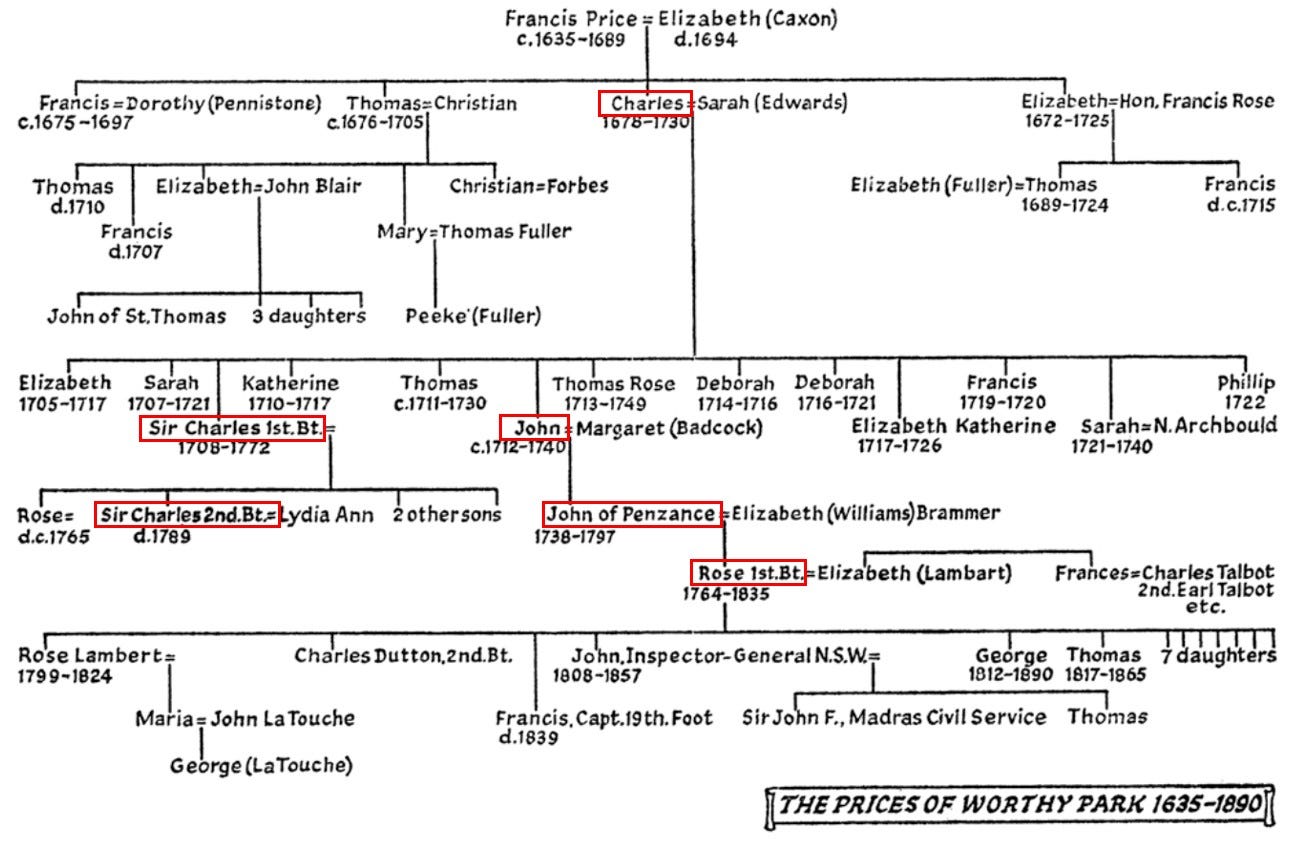
We took a necessary deep dive to understand the human ramifications underpinning the Price holdings, which we can argue serves as a blueprint for understanding Jamaican plantation societies broadly. Since I have found it impossible to keep up with the Price family lineage without referencing the family tree (yes, I admit, it’s more for me), I will assume that you’ll appreciate me getting us up to speed.
Where were we?
→ Sir Charles Price (1st) went on a buying frenzy between 1738 and 1771 (“21,641 acres in eleven of Jamaica’s nineteen parishes, of which 8,707 acres were patented, 2,590 acres leased, and the remainder bought outright.”).
→ But the creation and maintenance of the estates across Jamaica were squarely reliant on the infusion of British capital.
→ Sir Charles Price (2nd) took up his father’s credit-laden mantle and continued the avid borrowing “almost on the security of his debts, for at least eight more years, though under progressively more rigorous conditions.” Which is a big statement given that SCP (1st) was not only in shambles (credit-wise) at his time of death in 1772, but also, the onset of the American Revolution “brought about the final collapse.” Summary: dependent on British Credit → shifting priorities of that nation (for obvious reasons) during the American Revolution → Deprioritized sugar and also taxed more heavily to fund the war → creditors care little about tightening business environments, they want their money → estates as collateral plus high debt burdens = bound to fall apart.
Long before his death in 1788, the second Sir Charles was to see most of the family estates not simply mortgaged, but leased, sold, or seized to satisfy impatient creditors.
Within three years of his inheritance, Sir Charles Price the younger was hopelessly grappling with his father’s debts. In 1775 he made a desperate journey to England to untangle the affairs of the estate; yet in that year alone, nine different Price properties, including Rose Hall, Halfway Tree, and Worthy Park itself, were conveyed to Serocold and Jackson, the successors of John Serocold. Formal ownership and a semblance of control remained in the hands of the Prices, but a depressing pattern emerged: initial agreements conveying property on trust to a creditor until such time as outstanding debts could be met were invariably revised within a few years to incorporate unpaid interest. Although this secondary agreement was strictly a new and separate document, it was quite clearly a form of illegal compound interest against which the planters had no defence. When, in its turn, this second arrangement failed to bring any diminution of the debt, either land was offered, and accepted, in lieu, or else another creditor would absorb the debt, coming to new—and yet harsher—terms with the unfortunate debtor.
The deeds made between Sir Charles Price the younger and his various creditors from 1777 to 1786 reveal debts amounting to £118,283…By 1786 he was at the end of his tether, faced by only two desperate alternatives: to make an appeal to the sympathy and generosity of the Jamaican Assembly, or to take refuge from his responsibilities in flight to England.
→ SCP (2nd) made last-ditch efforts to offer produce in lieu of payments, ultimately to no avail. Political sway/connections couldn’t outmuscle a tight credit landscape exacerbated by the American Revolution. By 1790, “[t]he pretentious fabric of Sir Charles Price’s empire collapsed into rubble,” while the Rose Price (via John, SCP (1st)’s brother, and his son John Price of Penzance) branch of the family carried the mantle onward.
→ Worthy Park not only survives as a priority of the Price family holdings, but “achiev[e] peaks of production in 1805 and 1812,” largely given “the retrenchment and reorganization undertaken by young Rose Price between 1791 and 1795.”
→ We don’t talk much about Rose Price’s father, John Price of Penzance, because he was a true absentee, only visiting Jamaica once in his 59 years of life. This was to be expected: John Price (his dad) was sent to England early on by “Colonel Charles” (his dad, the man who originally saved Worthy Park) to be educated and remain in good health. Appears to have been sickly.
→ Naturally, Rose Price was living with his father, JP of Penzance, in England. Coming into age, Rose probably noticed that the income from Worthy Park, upon which he and JP of Penzance relied, was in jeopardy. Even worse, there seems to be evidence that “the estate was probably being milked, as well as mismanaged, by its attorney, Malcolm Laing.” [rerouted money to his personal account]. So, Rose stepped up (or was forced into) saving the day. “Colonel Charles” would be pleased.
And with that, we transition back to the Rose Price era.
1791 – 1795: A flirtation with rigorous resident ownership (non-absentee).
1791 – At the age of 23, Rose Price set sail for Jamaica. He entered a precarious Jamaica and an even more precarious sugar market in the 10 – 15 years preceding his arrival. War times and the British’s faulty control of the high seas greatly impacted sugar (price/transport). Also, provisions for the colonists in Jamaica “soared by as much as 400 per cent and the freight and insurance charges on the sugars which penetrated the blockade by almost as much.”
Nearly 20 years prior to Rose’s arrival, there were 775 sugar estates (peak). In 1791, there were 767. However, and very importantly, “only 451 remained in the hands of their original proprietors, 177 had been sold for debt since 1772 and 92 were in the often reluctant hands of their mortgagors.” Rose entered an environment that would have caused him to be sharply focused on one thing: Resuscitate Worthy Park. And this boded well for the estate, since the authors note that he nearly “doubled the value” of the plantation.
So, how did Rose get Worthy Park back on track?
Note: when he got there, Worthy Park was on 2,922 acres.
He purchased 144 slaves in 1792 and 81 the following year, raising the total slave population to 528 by 1794 (~56% increase compared to 1789 levels). Rose saw it fit to keep them fit, because doing so was a sound economic decision more than anything else.
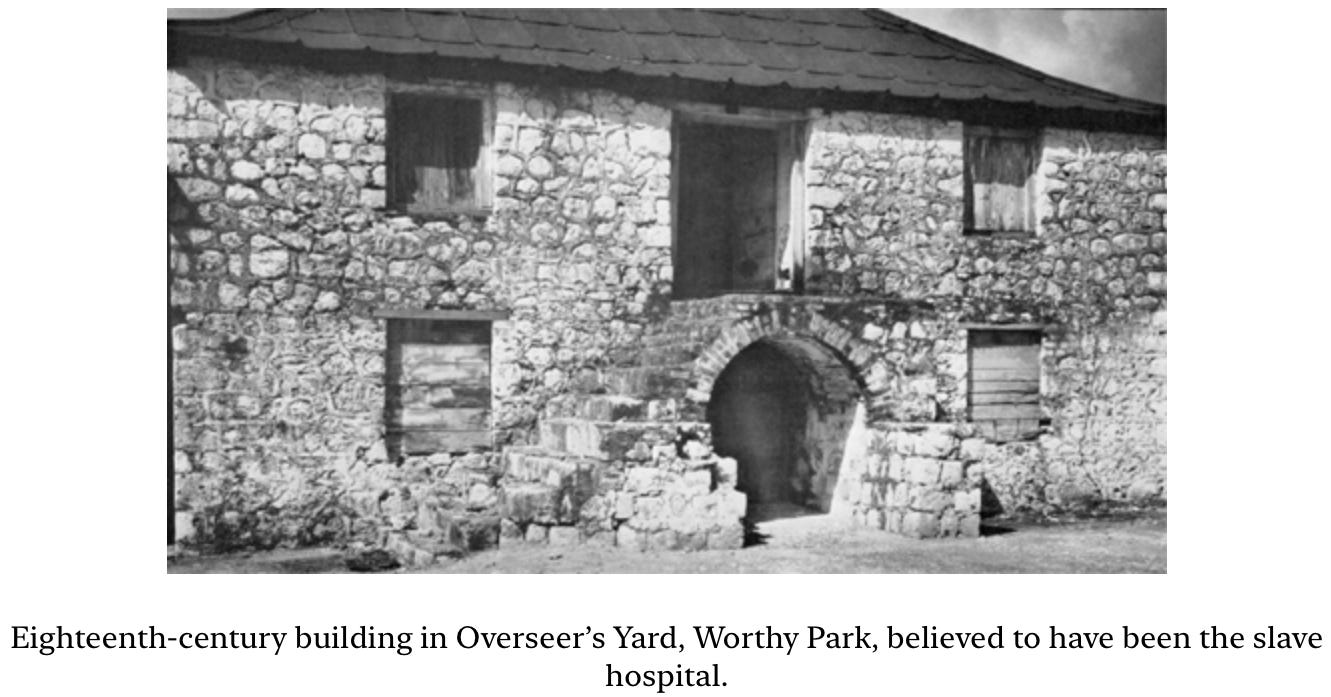
In a manner far in advance of his times he gathered vital statistics concerning the slaves he owned at Worthy Park and, with the aim of improving their health and morale and reducing their awful mortality, he made considerable improvements in their diet, built numerous new hutments and a barrack-like new slave hospital close to the overseer’s house. These improvements placed Worthy Park in the forefront of ‘enlightened’ Jamaican estates, but it is unlikely that Rose Price’s motives were more than nominally humanitarian. Healthier and humanely treated slaves were invariably more efficient and cheerful at work, and the closer to the ideal of natural increase achieved by the slave population of an estate, the lower would be the annual bill for new slaves to the wise proprietor.
Rose oversaw the building of roads to allow for easier transport of cane (between critical points on the estate, and for more seamless commercial sale/export).
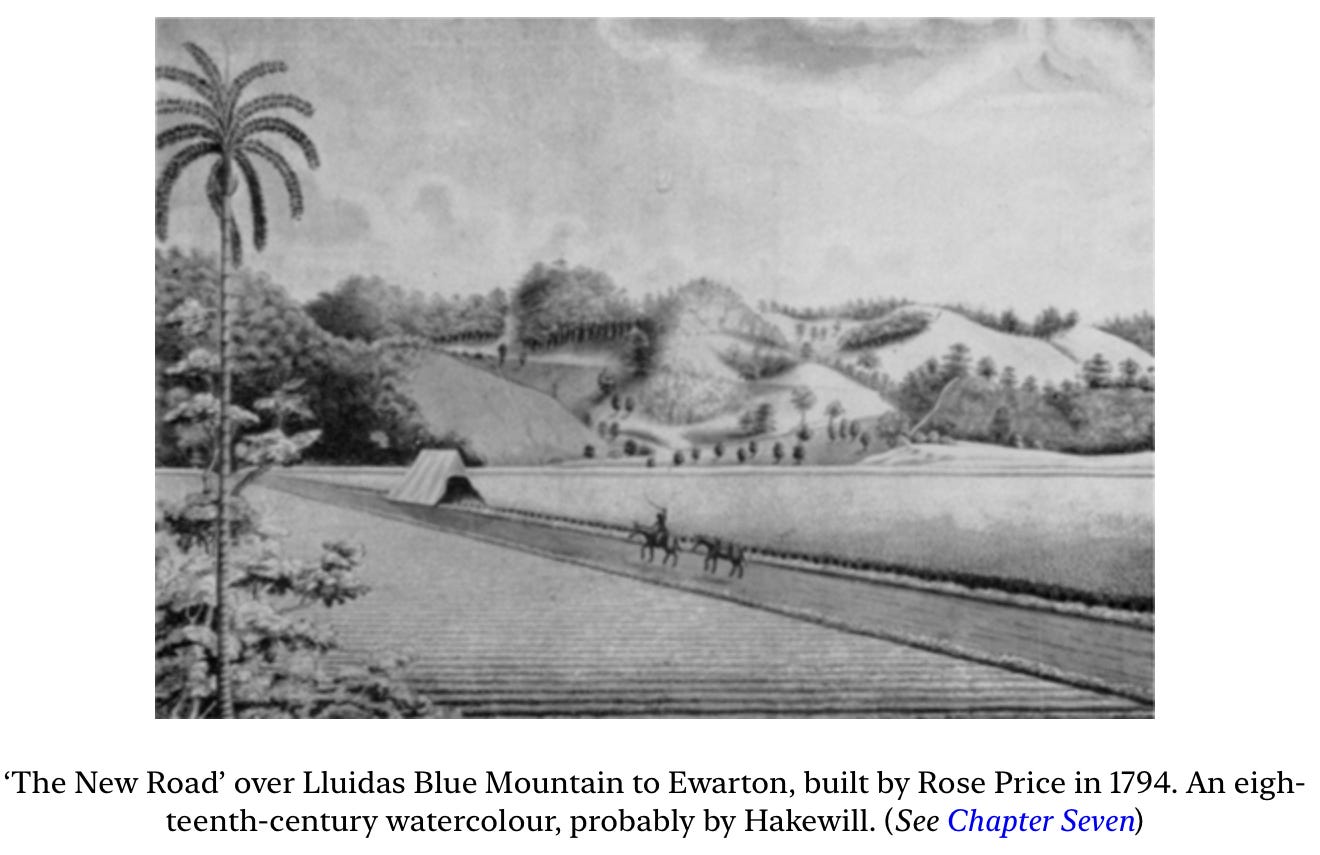
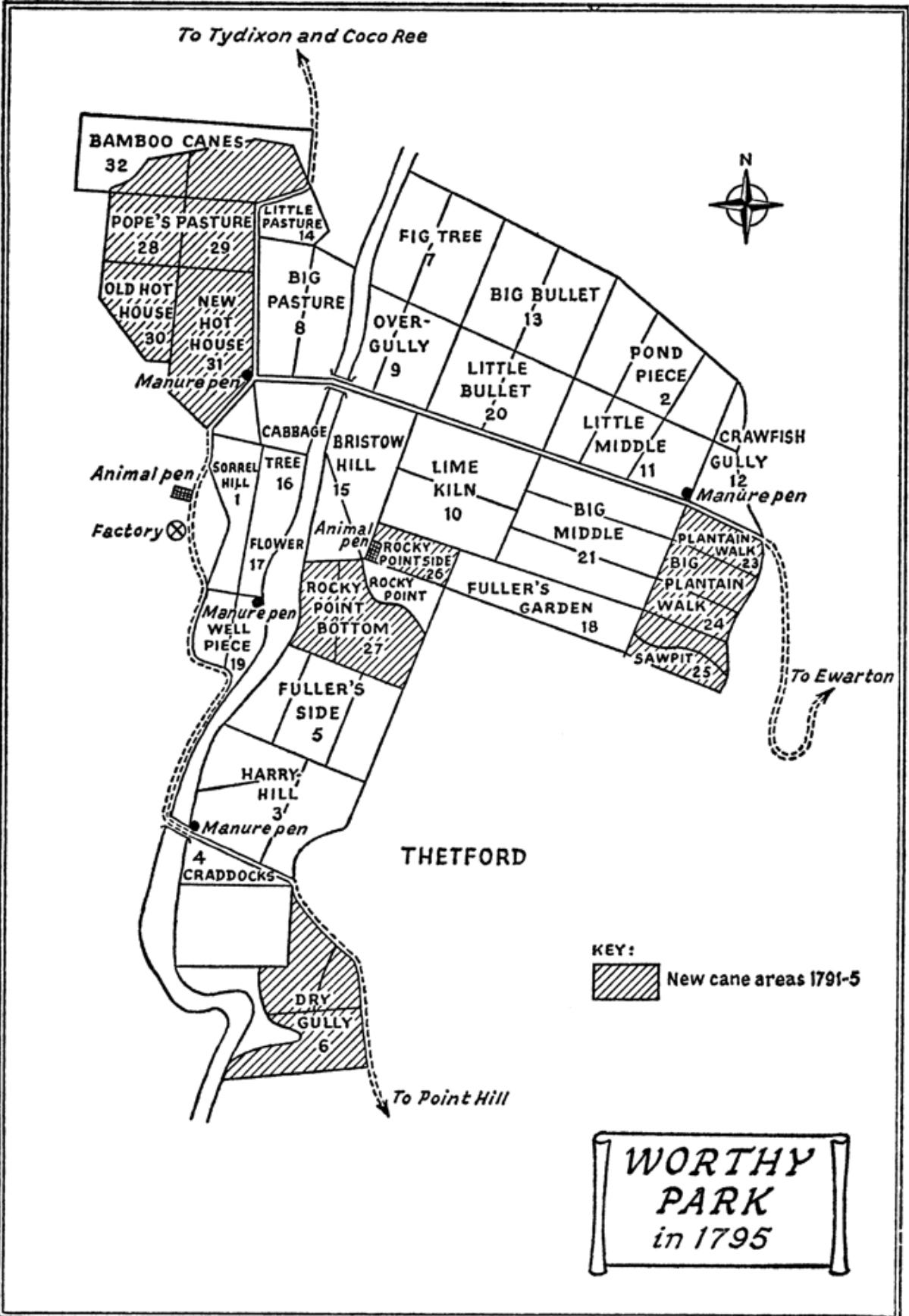
He “raised the acreage in canes almost to 500 acres in some years, while actually decreasing the acreage replanted each year.” Summary: more efficient cane planting operations across more land.
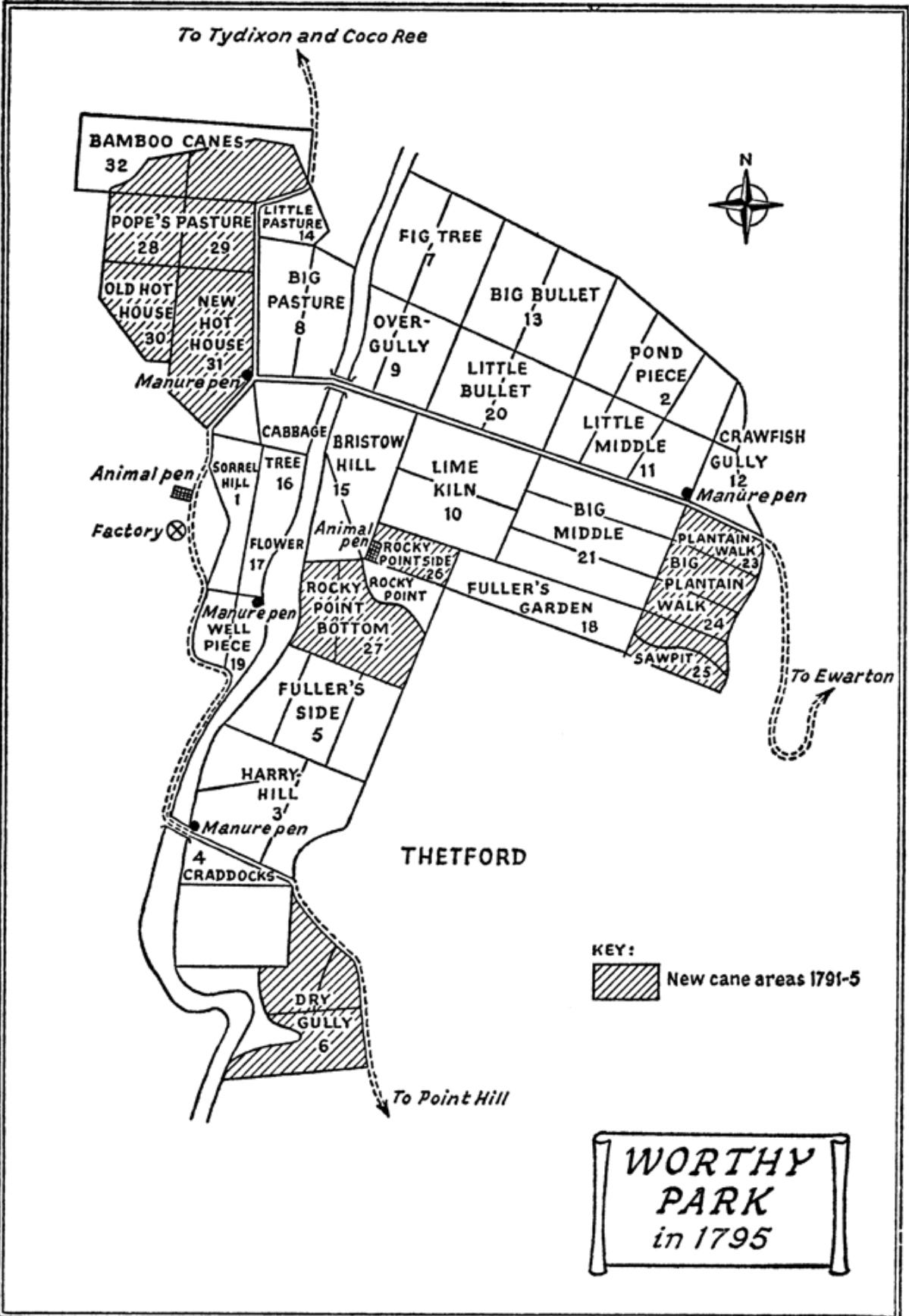
Shaded portions show the “[n]ew cane areas” added to Worthy Park during Rose Price’s residence. And the impact shows. More hogsheads of sugar (hogsheads are large wooden casks). More rum. A job, on paper, well done, notwithstanding poor yields.
During Rose Price’s residence, Worthy Park’s production rose steadily from 248 hogsheads of sugar and 85 puncheons of rum in 1790 to 371¼ hogsheads and 162 puncheons in 1794, but even these figures, being derived from 564 acres of cane represented a very poor acreage yield.
Eventually, Rose Price of Penzance’s flirtation with Jamaica would come to an end. He set out to rightsize Worthy Park and would go back to the place he called home – England – once he felt that things were on good footing. Practically speaking, his upbringing was English; returning to Jamaica was always going to be a temporary corrective measure to secure the continuity of his dividends. In 1795, he returned to his absentee owner status in England.
If you recall from Part 1, Rose left his Worthy Park managers with “exacting instructions” on how to manage and communicate the happenings at the plantation. This practice of detailed recordkeeping is part of the reason Craton and Walvin had so much primary material to outline the history for us. In short, “Rose Price assured himself of a much more reliable class of manager in his absence.”
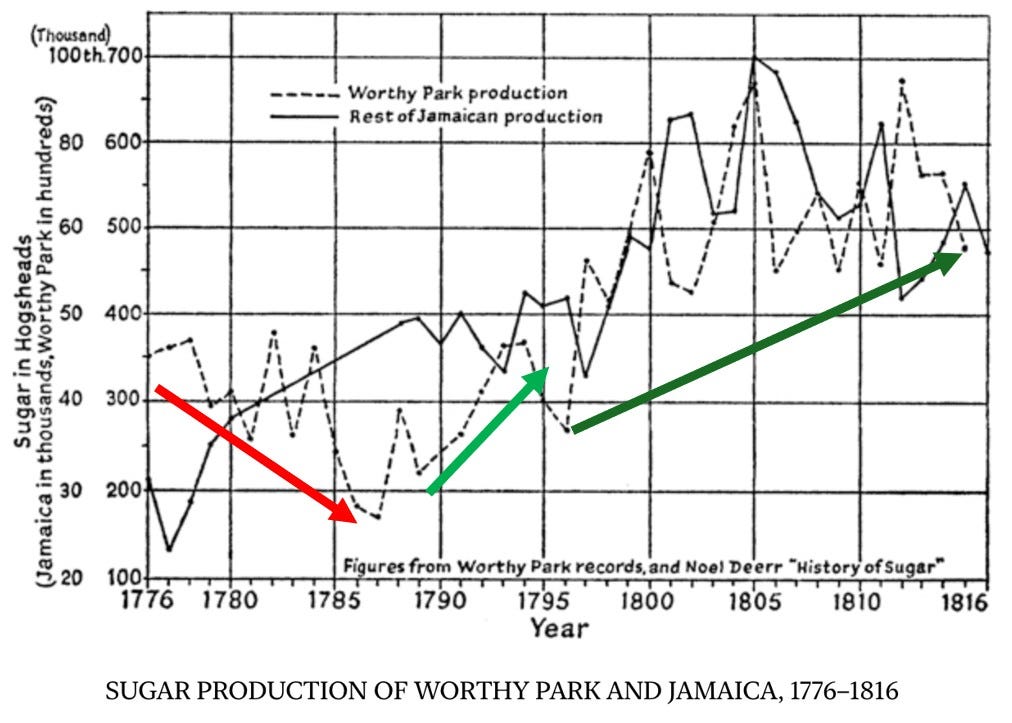
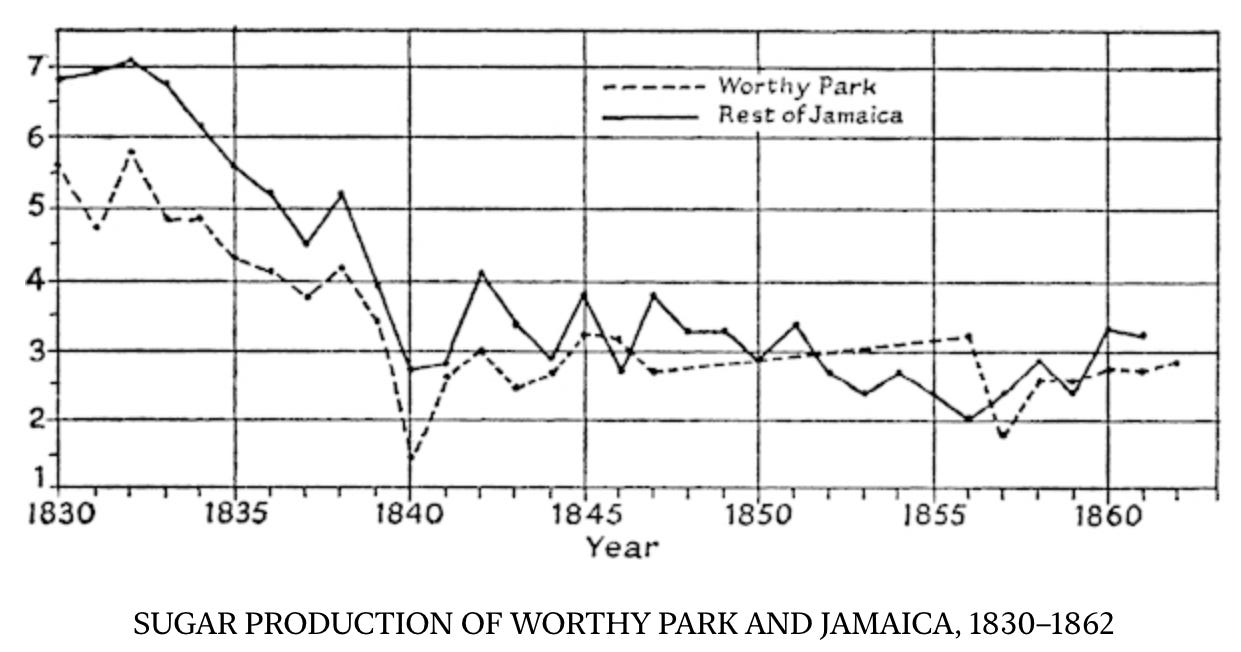
The dips in sugar production at Worthy Park (after the green arrow from the graph I posted) are a result of a market-wide, two-year recession post-Rose’s departure. It’s why you see a dip in Jamaican production broadly vs. pullbacks being a Worthy Park-specific issue. Thereafter, production rebounds. Again, more rum. More hogsheads of sugar.
…sugar production fall to 306 hogsheads in 1795 and 269 in 1796.
After this, however, the improvements in husbandry set afoot by Rose Price began to fructify. In 1797, production soared to 468 hogsheads of sugar, easily a record for the estate, and this was surpassed by 498½ hogsheads in 1799, 590½ in 1800, 624 in 1804, 673 in 1805 and a wonderful peak of 705 in 1812.
If you’re asking – “what the hell is a hogsheads,” and “what in the world is a puncheon,” here is imagery of what it would have looked like for enslaved people to roll them onto ships for shipment out of the country –
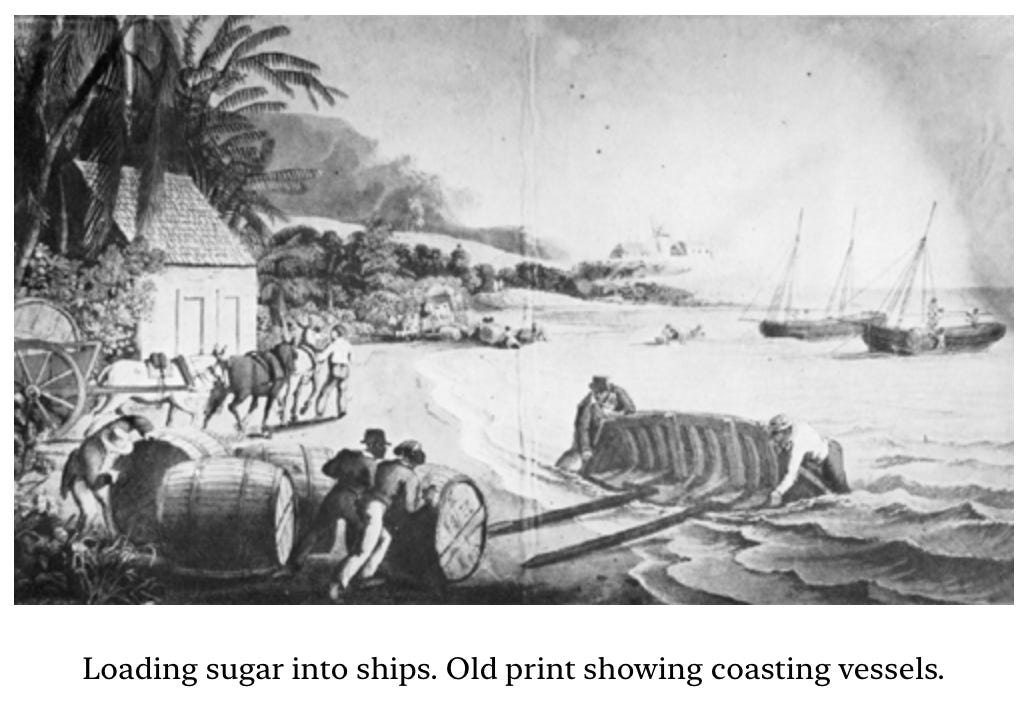
Heading into the 19th century, these upward spikes in production were helped along by disruption in the global market (i.e., reduced sugar competition) from two events:
Outbreak of a war with France in 1793 (War of the First Coalition): France vs. Great Britain, Spain, and the Netherlands. The malleability of alliances.
Beginning and end of the Haitian Revolution: France loses its most valuable sugar colony, an economic win for the British sugar colonies, to say the least.
Between 1796 and 1815, Worthy Park averaged at least £20,000 a year (note: I can’t recall if this was revenue or profitability). However, all wasn’t hunky dory. The enslaved people Rose Price invested in (1792 and 1793) cost him “£13,472, an average of £60 a head.” It seems that he did not have the funds on hand to make this purchase, hence his having to come and rejig Worthy Park in the first place. The Price family had a factor (i.e., someone/entity who advances funds for a fee, and they assume the responsibility/risk of collecting the money at a later date) named Thomas Smith, who was based in London; Probably a bit more rudimentary those days, where Smith accrued the debts for them at a set interest amount over time. Sorry for all the business talk.
Point is: A year before Price left Jamaica, Worthy Park owed Smith £18,000. Alright, I know these numbers don’t seem crazy in today's terms. But that amount would be roughly £2.1 million today (source: Bank of England). Yea, exactly. What was Rose Price’s workaround since there was no way he was going to clear this debt immediately?
Worthy Park and its related holdings were placed in trust to Thomas Smith for 99 years. Naturally, the entire produce of the estate was to be consigned into Smith’s hands as long as the debt should last.
This debt arrangement fixed Worthy Park to a monoculture (sugar), with the primary goal of maximizing production. Sugar could not only be sold locally, which was also the case for their rum; pre-1791, most of their liquid was consumed in Jamaica.
After Rose Price’s reorganization, however, the overwhelming majority of Worthy Park’s rum found its way to London and the house of Thomas Smith.

By 1807, England abolished the slave trade, much to the chagrin of planters like the Price family, since it would hamstring their ability to procure free labor (i.e., more expensive). Slave purchases are what sank the Price family further into debt, so you can imagine that this is a math formula that must have felt tenuous to them going into the 19th century.
Meanwhile, Rose Price did the good ol’ marry-up hedge: He weds Elizabeth Lambart, a genteel. Her sister, Frances, married Charles (the second Earl of Talbot).
This family connection was to prove invaluable to Rose Price and Worthy Park in the stormy years ahead.
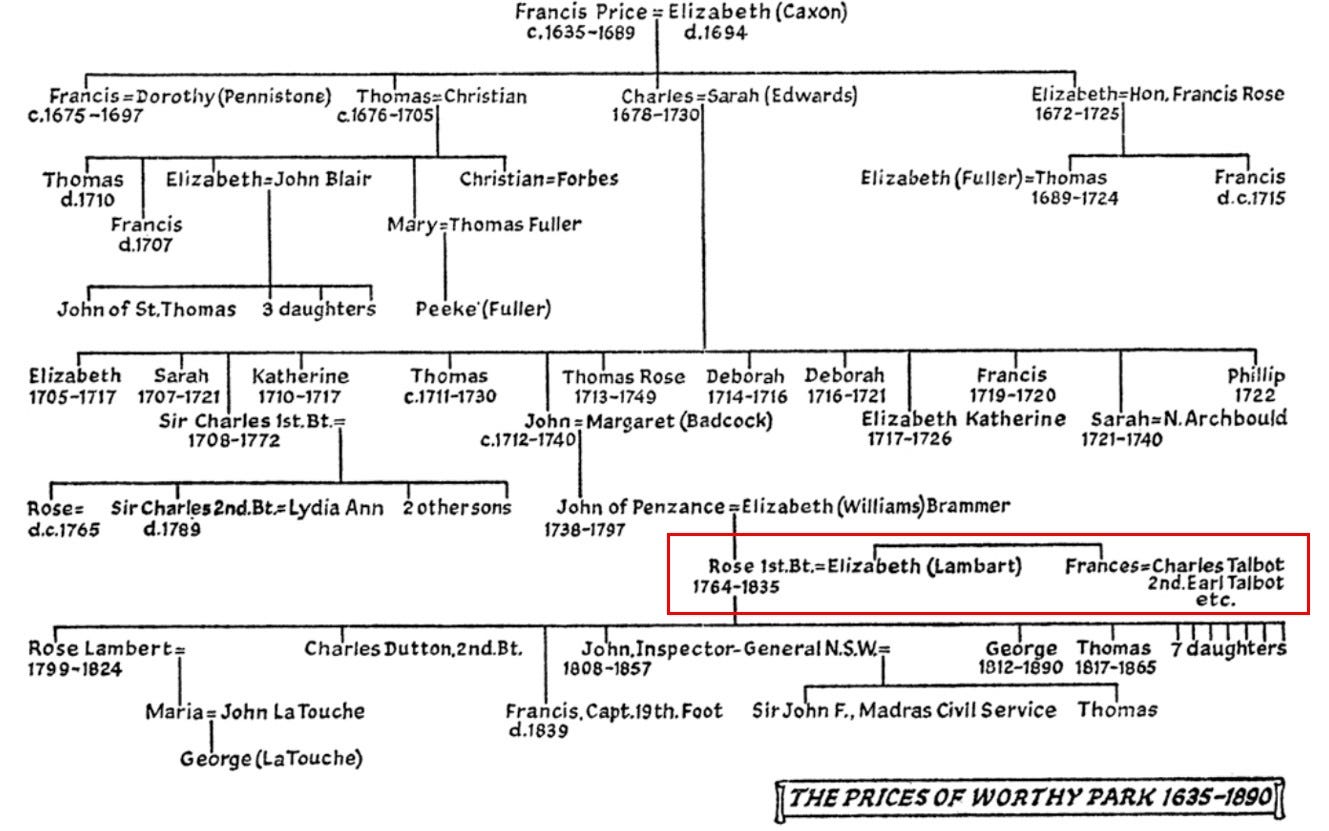
Let’s close out the Rose Price Chapter.
By 1796, Worthy Park’s debts were over £30,000 (which is roughly ~1.7 x £2.1 million in today’s money, as of August 2025). In other words, a crushing amount of debt. But hey, at least Price is a “Baronet” now via the marriage schemes I mentioned previously. And Price just kept on digging the insolvency grave –
By 1812 the original debt of £30,000 left by John Price had almost been expunged, but this was merely an accountancy trick, and it was soon replaced by others of a harsher kind. In 1816, for example, when Ralph Dutton and Davies Gilbert…were persuaded to advance £10,000, they did so only on a second mortgage, raising the interest on the loan to 6 per cent [previously 4% and 5%].
Per usual, this was not just a Price family/Worthy Park phenomenon. Estates were closing left and right, or changing hands as debts were not being serviced. However unfavorable the Worthy Park arrangements seemed, they allowed Rose Price to, via his management on the ground, continue to build out Worthy Park. It’s in this early 19th century that we see some of the modern-day stripes of what Worthy Park rum would eventually mold into. More rum. More acreage. And yes, likely more debt.
In 1822, Rose Price installed the most modern type of copper rum still capable of producing 680 gallons at a time, and three years later a mule cane-cutting mill that must have greatly increased the efficiency of the crushing of cane. In 1815 he purchased Russell and Derry Pens, each with their complements of slaves and, as late as 1830, Arthur’s Seat with its 127 Negroes. Besides this, he greatly increased the acreage of Cocoree by four purchases of 300 acres each, raising the total of Worthy Park land to more than 4,000 acres.
At some point (after Rose’s return to England), the credit ownership shifted “when the Earl of Talbot took over the debt and mortgage” (reminder: Rose’s wife’s sister, Frances, married Charles Talbot/the 2nd Earl Talbot). There’s no doubt, then, that the Talbots were, in the background and on the books, helping Rose and Worthy Park with the expansion outlined above. In fact, by 1834, all slaves at Worthy Park and Mickleton were legally owned by the Talbots. But what is causing all of these odd puzzle pieces to move around this way? Market factors and geopolitics –
→ 1815 — 1834: sugar prices tumbled, Jamaica continued to overproduce, while “sugar poured into England from the newly opened colonies of Trinidad, the Guianas, and Mauritius, and into the European market from Cuba and Brazil.” Eventually, Jamaican sugar producers felt the crunch of the supply glut, and their production dropped as a result. The British didn’t care which of its holdings it came from, so long as it kept the “Mother Country” fed (in all ways).
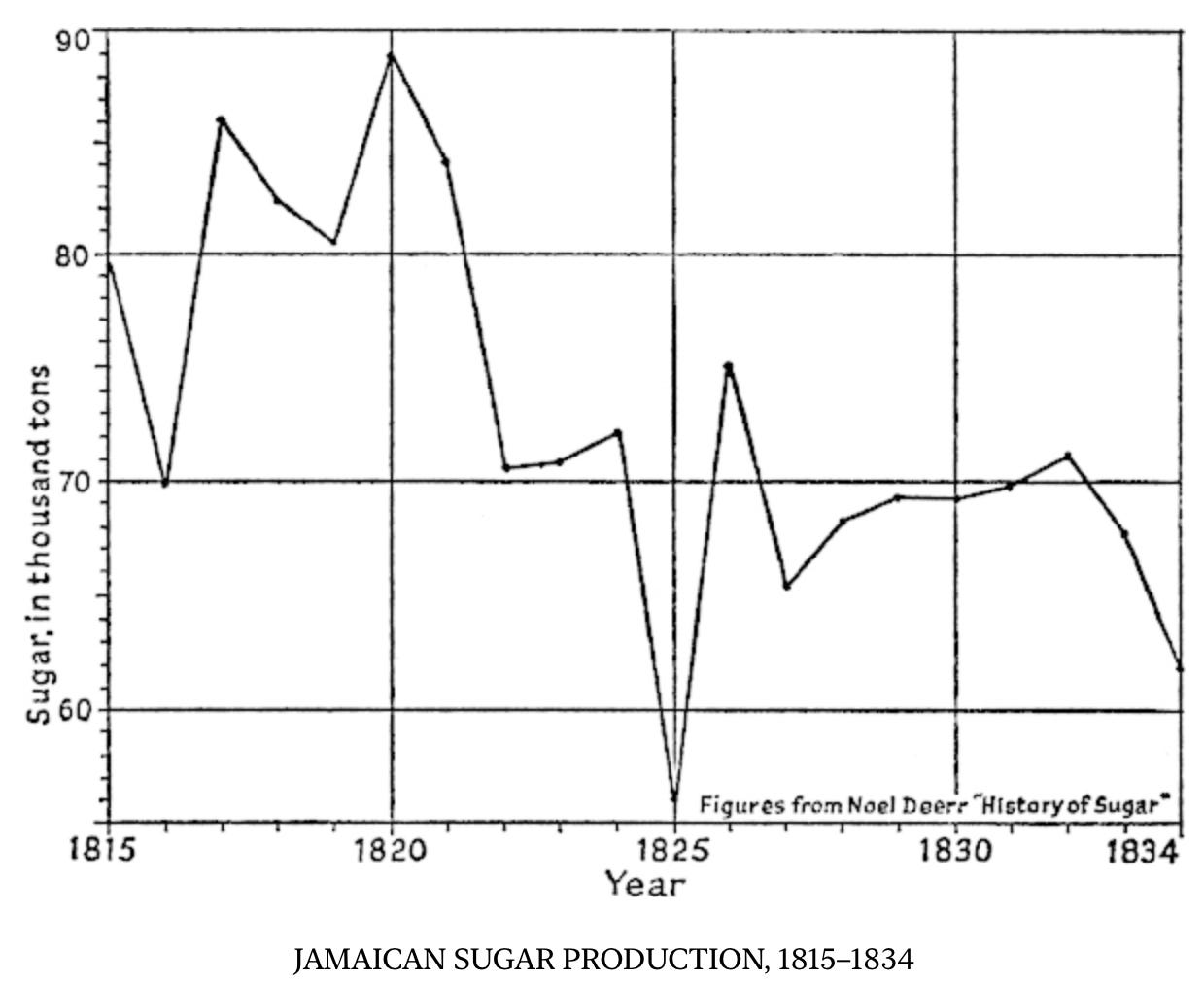
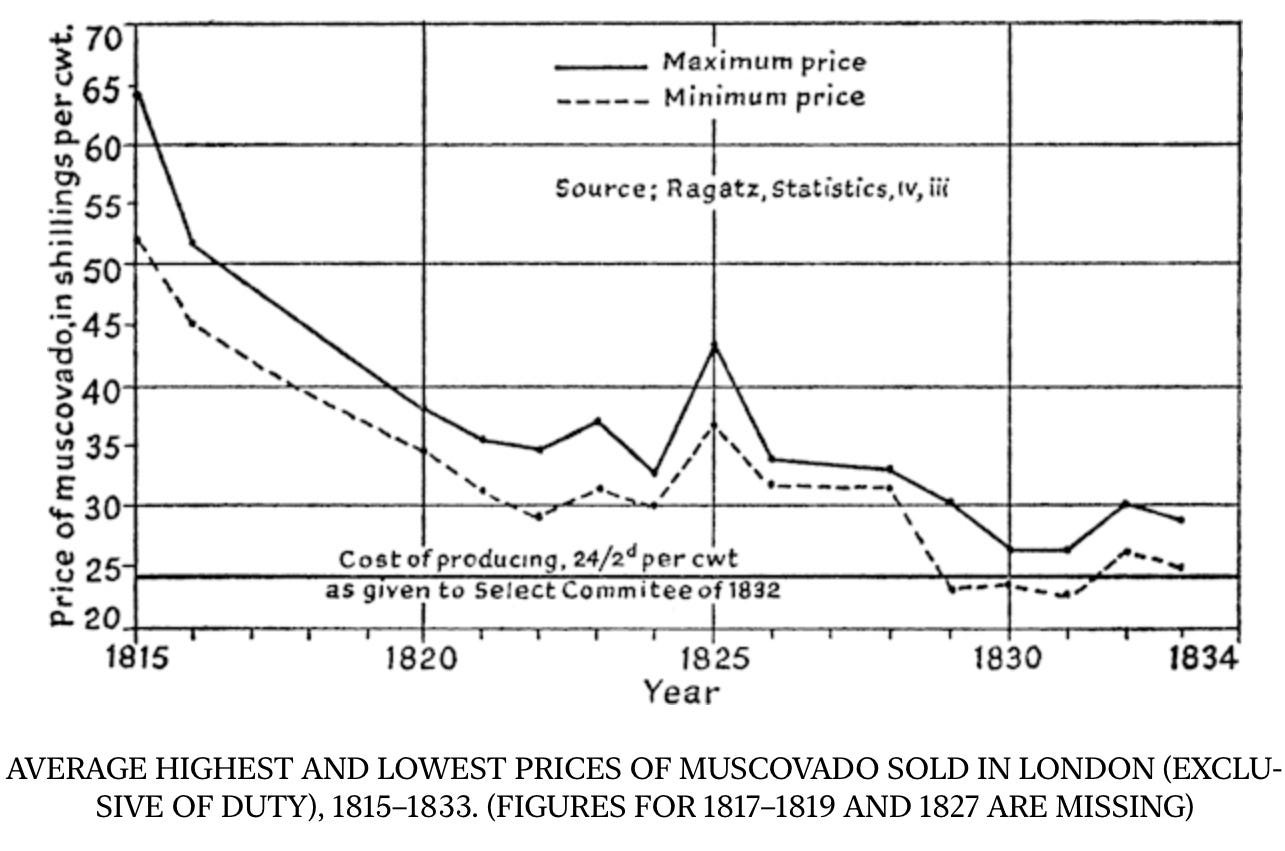
→ These types of market corrections made running Worthy Park untenable, insofar as revenue shrank and profitability (if any) was cut materially. Some JA estates even turned to coffee production, but that would also later be corrected (sensing Brazil had something to do with that). Worthy Park, however, was not one of those estates.
Worthy Park during the last days of slavery chose not to diversify into coffee, pimento, or cotton and continued to produce sugar and rum at high levels for less and less return. As late as 1822, 533 hogsheads of sugar and 250 puncheons of rum were produced, but it is unlikely that the gross income received was greater than £16,000, and the profit margin must have been very small indeed. Ten years later, when sugar prices had fallen by a further 25 per cent and Worthy Park was producing perhaps 10 per cent less sugar, normal profits were out of the question.
→ The end of the slave trade was later followed by conversations about full emancipation of the enslaved population. While there were moral/ethical arguments bubbling in London intellectual circles, Jamaican plantation owners largely bemoaned what they viewed as a native-born population no longer easily exploitable. In other words, the rotating wheel of African labor (from the continent) drying up, Craton and Walvin argued, caused the plantation owners to decry that “the large number of unproductive slaves they were forced by law to feed and clothe” was ultimately an “uneconomic system.” As for numbers, by 1817, no less than 66% of slaves were born in Jamaica. By 1831, 88%.
→ Rose Price, whose wealth depended entirely on the ability to exploit labor and sell sugar/rum at a profit, was a vociferous defender of slavery. Most of these thoughts he outlined in Pledges on Colonial Slavery, to Candidates for Seats in Parliament, Rightly Considered, where he noted that slaves (1) earn more than English laborers, (2) are well-fed (“For a little Sugar;—He has ten times more than the European labourer”), and (3) are well-housed. Not unlike his peers at the time, he had an unwavering belief that African labor, and white control of that labor, was preordained.
Nature presents every reason for the white man’s freedom as a fellow labourer on earth; and every reason for the black man’s bondage, as such, to cause the earth to produce its abundance…. – Rose Price
Ultimately, Rose Price and all Jamaican proslavery advocates would end up disappointed. Talks of emancipation began in 1832, while full manumission of the enslaved would be legally recognized in 1838. Between 1834 and 1838 was the “Apprenticeship Period,” which Craton and Walvin noted that “emancipists” viewed as “slavery cloaked,” not unlike views on the period of sharecropping in the postbellum American South.
More bluntly –
Apprenticeship was a pious fraud, a transitional expedient designed to convert the Negro work-force from the unwieldy coercion of slavery to a system, possibly more efficient but not necessarily more voluntary, of free wage labour.
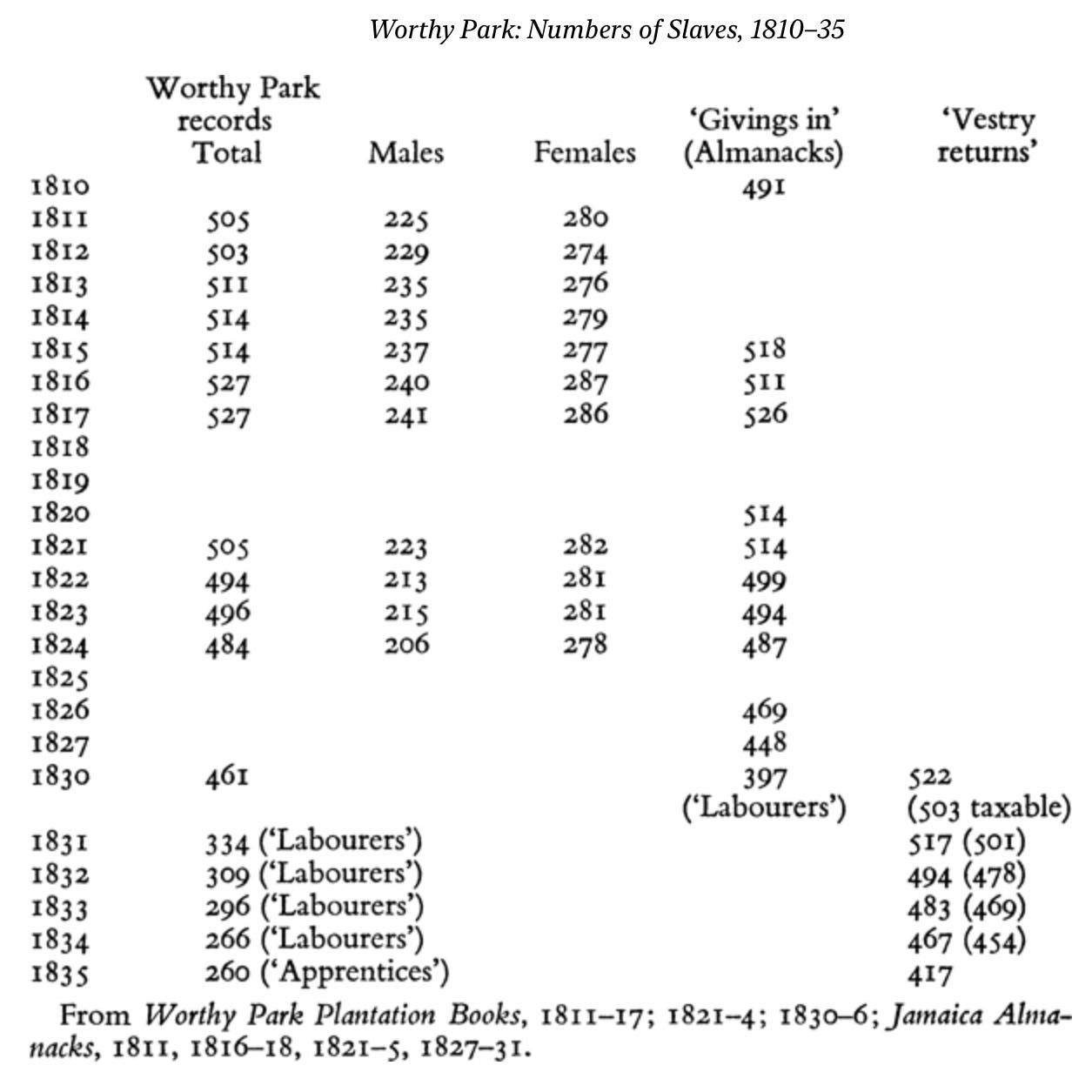
The above was unappetizing to the likes of the Price family, or anyone who “speculated in Negroes.” Remember the “Earl of Talbot and his associates” who took over the debts/mortgage of Worthy Park? Well, slaves were considered property/assets. Now, that “property” is worthless.
None of this Rose Price witnessed, as he passed away “on 29 September 1834, just eight weeks after the Emancipation Act came into force.” The mere thought of this new reality might’ve contributed to killing him off. He may not have had anything left in him to dig out of this hole.
Who stepped up?
George Price (1812–90), the second-youngest son, to take up the burden of managing Worthy Park and to spend the majority of his life in unprofitable Jamaica, struggling with the debts of the encumbered estate and the problems of an island once wealthy though enslaved, but now impoverished though nominally free.
George Price inherits a dumpster fire.
Most estates weren’t remotely close in size/scale to the Worthy Park title of “second-largest producer of sugar in Jamaica” by the 1840s. And we know how indebted the Price family/estate was. Can you imagine the circumstances for others? Apprenticeship and emancipation forced many plantation owners to turn to East Indians (“coolies”) to replace the newly freed African labor. The “importation” of Asians is worthy of an entirely separate piece, just giving you the background. On the other hand, the Price family plowed their wealth into mechanizing their estate operations, which is another contributing factor to the decrease in (need for) labor. This is notwithstanding that Worthy Park benefited from neighboring estates failing: a monopoly on labor when you’re the only one left in town.
But, as you’ve heard me beat the drum repeatedly, ingenuity isn’t enough if the market is not going to reward it. Rose ultimately didn’t have enough water to out this fire.
Yet in 1847 the equalization of duties coupled with the general depression brought a catastrophic fall in sugar prices which, but for a brief recovery in 1857, continued an inexorable slide until 1866. Despite the efforts of its enlightened resident owner-manager, Worthy Park staggered and fell beneath the weight of its debts, to which had been added the over-optimistic investment in mechanization amounting to at least £30,000.
Some temporary relief for Worthy Park came by way of the “West Indies Encumbered Estates Act of 1854.” Getting a piece of that pie was largely helped along by Rose’s brother, Thomas, who pleaded their case while still in London. Reminder: Rose is in Jamaica. Thomas tried his hand in Jamaica, but left after four months. This would happen to most people (TODAY) if they tried their hand in Jamaica LOL. Mechanizing did not remove the need for labor, to be clear. In fact, you would need more skilled labor. Rose Price must have recognized this fact and tried attacking the problem head-on by increasing wages.
In the first four years of George Price’s regime the total wage-bill for non-white workers rose from £3,576 in 1844 to £4,013 in 1845, £4,982 in 1846, and £6,576 in 1847.
George Price’s intention was that industry, skill, and loyalty would be rewarded by fair wages and security of employment, but despite his liberal views, a social hierarchy became entrenched at Worthy Park, the effects of which have lasted almost until the present day. At the top of the social scale were the salaried ‘Staff’, all white men, whose sense of ‘apartness’ was accentuated by the feeling that since 1834 only their colour and their official position distinguished them from the more ambitious Negroes. While George Price was at Worthy Park his modest salary of £200 a year was the highest paid, though previously the estate had paid £500 to an Attorney and £400 for an ‘Attorney-Overseer’. George Price’s Overseer, or under-manager, received £140, and the next in line were the ‘Manufacturer’ or factory-manager at £84 and the Distiller at £80. The six bookkeepers received salaries ranging from £70 down to £42, and even the two white ploughmen brought out from England under contract during the agricultural depression of the 1840s and paid only £35 and £20, regarded themselves as superior to the most talented and indispensable Negro.
The permanently-employed Negroes were headed by a loyal elite consisting of the craftsmen and superintendents earning 2s. 6d. a day or about £28 a year, and ranging down to the watchmen, expected to work seven days and nights for 6s. and the humble rat-catcher paid 3s. a week. At the bottom of the socio-economic scale, however, were the ordinary labourers, whose wages ranged from the 9d. a day paid to female grasscutters and 10½d. for cane-weeders, to the 2s. which a cane-cutter normally made at piecework rates. Indeed, good cane-cutters sometimes earned 12s. a week, more than their superintendents, though their seasonal frenzy was no satisfactory alternative to year-round employment.
None of these labor optimization attempts mattered. Worthy Park, “in the years of comparative prosperity from 1855 to 1860,” was producing profits that were less than 1/3rd of their debt balance, and hogsheads of sugar that were 60 percent (or more) lower than their 1812 peak. In 1863, the Price era concluded with the sale of Worthy Park. Crazy run!
Worthy Park still has a lot more history to go. We’ll continue up the timeline in Part 3.
