



Part 3 closed with J.V. Calder, the 3rd owner of Worthy Park, selling the estate in 1917—1918. What we did not cover was to whom he sold. This piece will answer that question and take us right up to 1970. I apologize in advance, Worthy Park rum lovers, but we will not go beyond that (would be outside the scope of the book, honoring the bounds). Things like the “state-of-the-art distillery” buildout in 2005, and launch of the Single Estate Reserve rum in 2017 won’t get any features. In fact, the authors would be taken aback by the global scale of Worthy Park’s prominence in rum today. Surprised, but certainly not caught off guard, given the art of the agricultural pivot(s) Craton and Walvin covered across the different owners of Worthy Park over the three centuries. Alright, enough on that. Let’s get into who purchased the asset next.
“Renaissance: The Coming of the Clarkes, 1918–1945.”
And that, folks, is what you title a chapter – 11, if you’re curious – when the family who commissioned you shelled out the big bucks, one can only assume = )
In 1918, the year World War I ended, Frederick Lister Clarke purchased Worthy Park for £44,000. Note: this is roughly £2.2 million, inflation-adjusted to today’s level (source: Bank of England); Worthy Park shows £2.8 million inflation-adjusted on the website, which I don’t think is necessary to reconcile for our purposes. Meaningful difference, though, I’ll acknowledge that. In any case, not pocket change and may even be considered a rich value during a time of global dislocation (war), which inevitably sowed economic hardships near and far. So, how did this come to be? We’ll take a trip down the Clarke family lane.
The Patriarch
Henry Clarke left England for Jamaica in 1846 at the age of 18, making his way to the western side of the island, Savanna-la-Mar (Westmoreland), where he became a schoolmaster, while doubling as a pastor at the local Anglican church. He had eleven children. Active.
Henry founded the Westmoreland Building Society with the initial aim of providing loans to small farmers. It seemed as if he was building the necessary political-economic foundation in that proven form and fashion of Jamaica at the time: like how the Price family kept economics, military duty, and politics as a blended aim, Henry was seemingly doing something analogous for posterity.
Interestingly, the Jamaica National Group notes that “The Westmoreland Building Society is the oldest society now operating in Jamaica.”
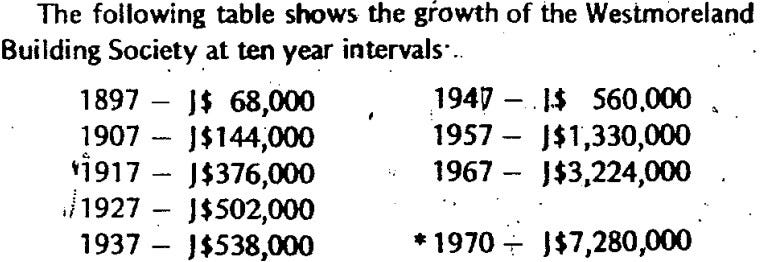
Because of his newcomer status, Henry is depicted as not remotely in the same wealth wheelhouse as the old, vanguard ruling class of Jamaica, understandably so. Even with that, he was able to leave a meaningful amount of resources for his children to carry on successful lives after he died. There are information gaps surrounding wealth, bequeathing, the vastness of the wealth gap (between him and the old guard), etc., that I can’t fill in. But here is the information we do have –
Henry Clarke did contrive to leave a small trust fund to provide each of his unmarried daughters with a modest independent income, while ensuring that each of his five sons enjoyed a practical livelihood. Four became involved in the management of sugar estates (of which there were 22 in Westmoreland alone at that time), combining this profitless occupation with some other. One followed in his father’s footsteps and became an Anglican minister, one was a lawyer in Savanna-la-Mar, and a third son, Hugh, the family’s best businessman, became an officer in the Westmoreland Building Society while also managing Henry Clarke’s estate. Frederick Lister Clarke, the family’s best and most fortunate farmer and the eventual purchaser of Worthy Park, was Henry Clarke’s fourth son.”
Reminder: “small trust fund” and “modest independent income” have to be contextualized against the immense wealth of the old guard, not of the average Jamaican, for things to make more sense.
Frederick L. Clarke.
I will do my best to avoid providing you with information that I find interesting, but is not entirely pertinent to your understanding. An example: Fred went to Munro College, which was originally called Potsdam, and something like that is interesting to me because (1) it’s in St. Elizabeth (where my family hails from), and (2) I have a family member who attended back in the day. “What’s that have to do with Worthy Park?!” would be a fair question if I continue down that information path, but I won’t. Alright, back to Fred (note: I’m using first names vs. last names to make things less confusing, as I imagine the Price article was a bit tough to follow outside of the family trees, hence the use of Henry before this).
At 15 years old, Fred became the boiling-house-bookkeeper at Barham Estate, Westmoreland, beginning his 30+ year journey of “gaining an immense knowledge of sugar estate management while painfully building up his own small fund of capital.”
At 35 (1903), “he became the manager of an estate, Richmond in St. Ann’s, and considered himself ready to marry, choosing a local girl just half his age.” His family went from two children to six in a short timeframe. In addition to expanding his family, Fred also expanded his professional responsibilities, taking advantage of his secured reputation as a “rigorous improving manager.”
In 1907, Fred began managing Black-heath estate in Westmoreland on behalf of his brother, Hugh, who purchased “the estate cheaply largely through his management of the Clarke Trust,” whatever that may actually mean. Safe to conclude, based on the authors’ analysis, that Fred had a knack for improving/managing estates. He stayed the course –
In 1911, Fred Clarke netted £1,500 from Coolshade, a small sugar estate in Westmoreland which he had built up from dereliction, and two years later was entrusted with Meylersfield, a decayed property on the banks of the swampy Cabarita River, by its mortgage-holders, Messrs. Thompson, Hankey.
Fred doubled Meylersfield’s production (quadrupled profitability), allowing the owners “to sell what had been regarded as a worthless estate for £45,000” in 1914, also helped along by the boom in sugar demand at the beginning of World War I.
By his late 40s, Fred was firmly in the “managerial class,” as the authors note, having proven himself adept at increasing the wealth of the economic/ruling upper echelon of Jamaican society (presumably). Remember that Westmoreland building society I had referenced earlier? These things come back around: keep it in the family, if you will.
With £6,000 in the bank, an excellent salary and a five-year contract, Fred Clarke at the age of 50 was a highly respected citizen, churchwarden, director of the Building Society, and trustee of several estates. He was not yet quite a planter, however, being still a member of that inferior stratum of white West Indian society, the managerial class.
Note: £6,000 in 1918 is today’s equivalent of roughly £297,000 (source: Bank of England). Numerically, in that “managerial class,” but a gargantuan amount of wealth when compared to the average Jamaican at that time.
That magic year of 1918, you will remember, is when Fred purchased Worthy Park. He was probably itching to ‘get to the next level,’ given all the wealth he had generated for others in his lifetime. He and his brother, Hugh, were having disagreements because Hugh wanted to sell Blackheath for £50,000, a valuation Fred felt was 100% inflated (literally speaking) because of the war. So, as we well know, that would not be the path Fred would go down –
Some ten years before, Fred Clarke had valued Worthy Park on behalf of the Westmoreland Building Society and was well aware of its potential worth. At the £40,000 which J. V. Calder was said to be asking, it ‘would be an infinitely better bargain than Blackheath at £25,000’.
That Society again. It literally pays (or saves) to have an “in.”
With a sizeable mortgage potential from the Society certainly guaranteed, the £6,000 in the bank, and friends in high places, Fred seemed comfortable that he would get the deal done, notwithstanding Calder’s urge to sell, given his poor health, having 3 of his 4 sons fighting in World War I, etc. Good timing, on Fred’s part, in other words.
Though Fred had to wrangle with some of his initial backers and their contingents, he was able to, in short order, become the sole owner of Worthy Park, putting up £4,000 of his funds, and selling some of his personal stock in Blackheath to fill any remaining gaps. And with that, Worthy Park was now firmly under the control of the Clarke family, by way of Fred.
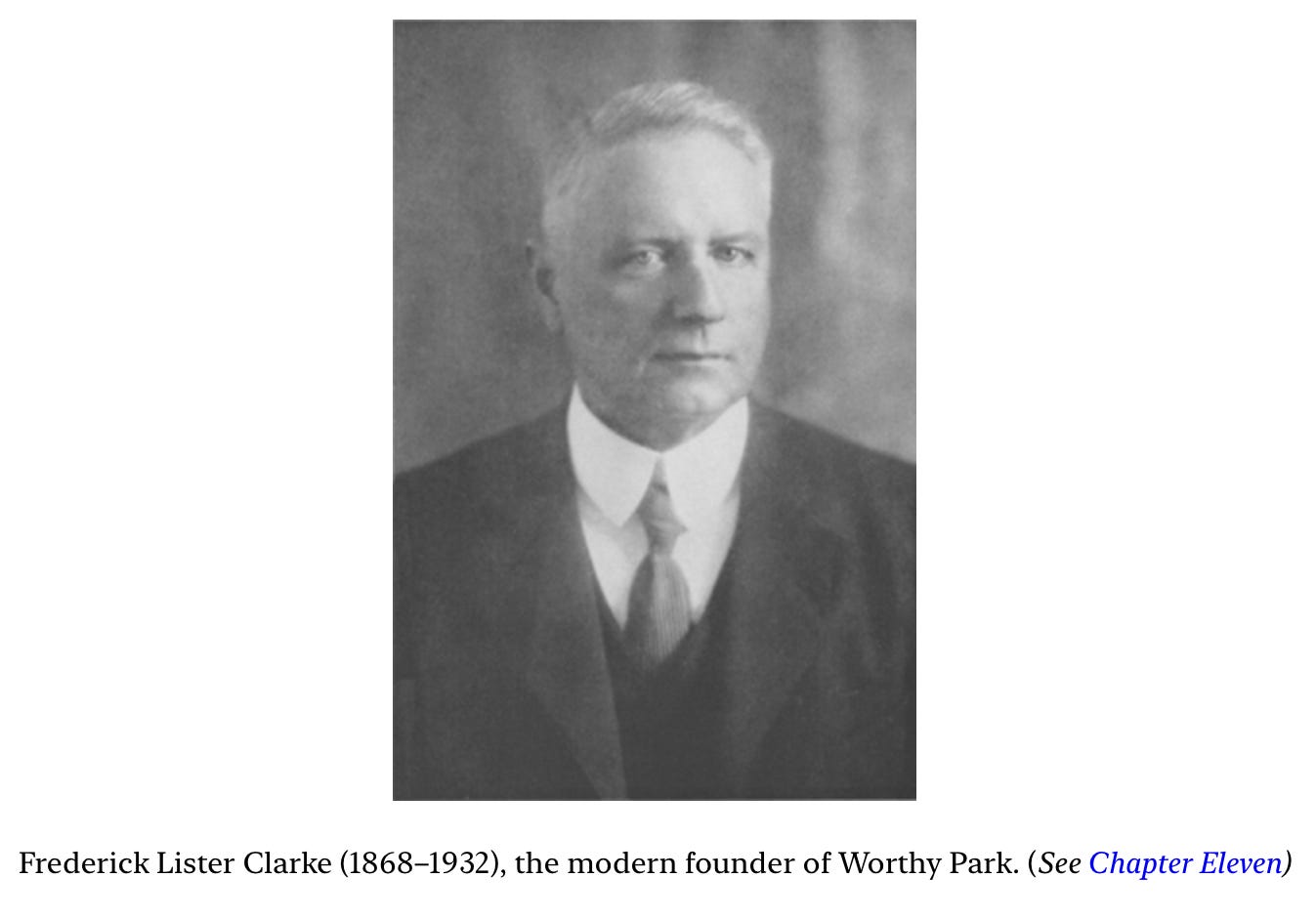
True to form, Fred, like most recipients of Worthy Park prior to him, inherited a dumpster fire. We know Calder was a pen-keeper, interested much more in the diversification of the estate than the bread-and-butter, or I suppose sugar-and-rum. And that was the reality that Fred first stepped into –
There is no doubt about it that Worthy Park is a splendid property, but it has been very badly managed and is in bad order and the present cultivation will give a very poor crop for next year. I don’t see how I can make anything off it between now and the end of next year, but I hope to pay my way and to get in a good field of canes for 1920 crop. – Fred, 1 September 1918
Worthy Park under Fred Clarke’s leadership.
Fred moved into Worthy Park, bringing his family from the western side of Jamaica to the east. He surveyed the estate, counted & inspected the cane, and planned for a better future. There were only 240 acres in cane when he got there, the lowest it had been since the lifetime of Colonel Charles Price. Moreover, the estate roads and rail conditions were not in great shape, which were the “only means of shipping out produce.”
‘Way of life’ was also a new paradigm that Fred had to contend with, as he brought his cultural nuances, staff, and modus operandi from Westmoreland (“country,” as it would be called in Jamaica). His notion of fair wages was out of whack with reality on the eastern side of the island, which was closer in operation to Spanish Town and Kingston (i.e., ‘city’ hubs with presumably higher wage standards). It also seems that Fred brought with him the prevailing attitudes and social hierarchy etiquette, which the authors were not shy about describing plainly –
The attitude of Worthy Park’s new master to his Negro labourers was much more akin to traditional paternalism than to modern industrial relations. To Fred Clarke’s mind, it seems it was never the question of a living wage which was at stake, but what the estate could reasonably afford. When, for example, the workers almost rebelled at planting time in 1919, he did not defend the average daily rate of 2s. 9d., but pointed out that he was paying an aggregate wage-bill far in excess of that of J. V. Calder; and later, when wages were cut in times of low prices, he was quick to explain that the estate could not otherwise avoid complete collapse.
As you can imagine, under this type of leadership, things came to a head early. Laborers struck, and Fred Clarke, using his power and position as Justice of the Peace, met them head on: he exercised the “archaic Masters and Servants Laws” to have the courts come down heavily on strikers, squatters, and tenants who didn’t pay rents. On the flipside, Fred Clarke was met with a court proceeding for his own misgivings, one of which was having ‘coolie barracks’ classified as uninhabitable.
Notwithstanding all the troubles, of which Fred seemed particularly competent at facing, given his tenure with estate management, he plowed full steam ahead to improve the estate over the next couple of years. All while strategically reinvesting in Worthy Park: land, transportation/railways, factory, drainage, etc. His tenure in the game afforded him the knowledge base to effect sensible change –
Increasing efficiency and expanding production with tireless ingenuity, he did not allow the record sugar prices of 1920 to waylay him into a fool’s paradise, but ploughed back income into improvements, so that Worthy Park was narrowly able to withstand later shocks…first action was to tear up the five miles of tramway 75 years old and sell them to the United Fruit Company for £2,000. Deciding that the mule wains caused uneconomic delays, he invested in Worthy Park’s first motor truck, a Federal costing £750, which reduced the journey to Ewarton railway station from a day to an hour. A second truck was added in 1920 to speed the collection of cane from the fields…reorganiz[ed] the factory…His first crop was laboriously ground by the water-mill dating from 1866, and then only after the Murmuring Brook dam-head and aqueduct had been cleaned and repointed. By taking the advice of a consulting engineer and employing more competent staff, however, he was able to revive one of the two old steam engines for the 1920 crop and the other in time for the crop of 1921. By that time, some money was available for vital replacements.
He needed no help with sugarcane cultivation, but did call in experts, and eventually carved out branches of the estate for the management of cattle, cocoa, and bananas (primarily); Sheep, pigs, and chickens seemed a secondary priority. With these expansions, Fred sold “mutton, pork, and chickens in the local markets, as well as small parcels of sugar and rum to local retailers.” But he was ultimately a “sugar man” through and through: production soared from 205 tons in 1918 (Calder’s last crop) to 510 in 1920. 1920 proved incredibly favorable for Fred and Worthy Park. It was the year he finally turned a profit after much uncertainty leading up to this point. He wrote in his journal –
How with only £6,000 I have purchased Worthy Park for £44,000… how all the attempts to block me were upset and turned to my interest—how Laddie James and his advisers compelled him to withdraw and leave me sole owner. How I have struggled through the first year and how I have cleared £30,000 in one crop is as a dream to me. That it was all God’s ordering I can have no doubt, but with what object I do not know. Anyway I am praying that his love and bounty towards us will make us all serve him better and love him more. I have paid off Laddie James’s loan of £10,000 today and am writing the Building Society to ask the Directors if they will take a repayment of £10,000….
Fred remained steadfast about not splurging the recent gains and again reinvested in the factory/operations at Worthy Park. Because if he met success, so too did others across the world, seemed to be his thinking. World War I was over, and the European beet sugar market rebounded, pressuring global sugar prices.
In 1921, the prices received for sugar and rum were only a fifth of those obtained the year before, and although there were slight recoveries in 1923 and 1925, the planters cleared less than £12 per ton for sugar and Is. 6d. a gallon for rum between 1927 and 1929.
Fred’s strategy shifted to producing sugar as cheaply as possible, for as long as he could. When the going got tough, Worthy Park was able to, given its years of frugality and strategic reinvestment, keep its head above water while capacity was strained. Of course, this was not a perfect strategy because other costs were “simply multiplied” when “wage and fuel bills and the cost of running repairs had to be met.”
Between 1926 and 1929, Fred decided to cease rum production at Worthy Park (too unprofitable). He believed that rum needed to account for 1/3 of the estate's income, which did not seem possible to him at the time. Rum production was revived in 1930, to which the authors note that “the estate might have foundered” if not brought back.
There are a ton of Fred’s diary entries from 1920 that would give true primary-source lovers a reading contact high. I ultimately think the entries – specifically for that year – are too detailed for this piece, but if you ever get your hands on the book, soak them up. A lot of insight into Fred's psyche as it pertains to the sugar market, prices, the credit crunch, escaping predatory merchants, unsold goods, future decisions, etc.
Despite his hardest working efforts/strategic frugality, Fred could not outmuscle slumping global markets. He therefore had to turn to whatever capital markets would allow him to borrow at this time. And here is where you will get a peek into a Caribbean example of a “dog-eat-dog world” –
In July 1929, despite a crop of almost 1,500 tons of sugar, the Canadian Bank of Commerce refused to advance the short-term loan of £5,000 to see the estate through to the beginning of the subsequent crop which they had provided for the previous eight years. Consequently, Fred Clarke was forced to grant the handling of his entire crop to Messrs. Lascelles de Mercado, in return for a loan of £5,000 at 6 per cent. In this way he was liable to the payment of a commission of 2½ per cent on foreign sales and 5 per cent on island sales, a total of between £400 and £500, which he had hitherto saved by handling the sales himself. Lascelles renewed the loan in 1930, but in 1931 conditions had become so desperate that they would only advance £5,000 on the security of a second mortgage on Worthy Park and all its stock, as well as having the absolute control of all sales of sugar and rum.
The discerning rum historians among us will recognize the “Lascelles de Mercado” name immediately, as it was the entity that eventually gained full control of Wray & Nephew (and therefore Appleton). Lascelles wanting “absolute control of all sales of sugar and rum” was, in my opinion, a collateral play of seismically strategic proportions. The long game was being played since Lascelles eventually sold out all of Wray/Appleton to Campari in 2012 –
Italian spirits company Gruppo Campari has signed an agreement to acquire a controlling stake in spirits company Lascelles deMercado & Co., Ltd, the company announced in a release Monday. Lascelles deMercado is based in Kingston, Jamaica. Its portfolio includes the Appleton Estate, Appleton Special/White, Wray & Nephew and Coruba brands. The 81.4 percent stake came at a total cost of $414.8 million on a cash-free/debt-free basis. It is the third-largest acquisition in Campari’s history…” – Carib Journal
Here is Campari’s official press release on the 2012 acquisition, if interested.
Back to Worthy Park = )
It is worth mentioning Fred’s children here, as they will be critical to the ‘how Worthy Park kept going’ story.
→ Only one of three was sent to England for school after Munro. My read here is that Fred, as a first-generation Jamaican, was balancing his being fiscally responsible/priorities-oriented, with still engaging the culturally relevant schooling practices of the elite/elite-to-be (i.e., one child must go away for school). That child who went away was Clement.
→ Clement went back to Jamaica in 1922 to help his father (instead of going to college). So, all the madness of the 1920s you just read about, Clement muscled through it with Fred.
The other two boys, Owen and George, were given a technical education designed to make them independent of Worthy Park, and worked their way through McGill University in Canada to engineering degrees.
As we turn to the 1930s, Fred’s diary entries begin echoing a far more pessimistic sentiment. I will share some of these entries, yes.
Wednesday, May 6, 1931. … The boys write in great spirits about coming out for their vacation. Things are in such a depressed condition that they have not yet been able to secure any jobs in Canada. … I hope they will not be disappointed but life is, more or less made up of disappointments, and one’s expectations of the future are very seldom realised. …
Fred-erico with the ‘put that in your pipe and smoke it’ life lessons.
Monday June 15, 1931. … I still have a little money left which I am trying to hold on to until we start crop again at the end of July. Under the agricultural lien, Lascelles de Mercado and Co. will advance me on the unreaped portion of the crop. This will take us to the end of September. Then the question will be whether I will be able to get them to give me a further credit to carry on until I start reaping the 1932 crop in January. I have decided that it will be quite impossible to carry on under present circumstances and to pay the same rates of wages and most reluctantly I have notified all the employees today that there will be a reduction of 12½% on their wages and salaries. This is going to cause quite a lot of dissatisfaction and resentment, as in most cases they are not intelligent enough to realise the position, but I have no alternative and feel that I must make some effort to save the situation. …
Times are still tough. Feeling the weight of the Lascelles de Mercado debt. More tension on the horizon with workers.
Business conditions aside, Fred likely knew he was on his last stretch, which may have added to the pessimism. He may not have felt that he was leaving things in tip-top condition for his son(s). Or he himself had personal ambitions for the shape Worthy Park would be in by 1930. Maybe both. Regardless, there is no doubt that the less-than-ideal circumstances regarding the estate weighed on his mental, and maybe even spilled over into his overall health. As you can guess, the one thing we are all guaranteed eventually showed up at Fred’s doorstep: death.
Fred Clarke himself was never able to retire. Instead, his only indulgences were trips to sanitoria in the United States in 1922, 1923, 1930, and 1932 to recoup his deteriorating health, on the last of which he died.
August 1932, Frederick Lister Clarke passed away.
His sons would understand, even if not immediately, that despite the negative business conditions, journal entries, and overall sentiment, their father laid some serious (SERIOUS) groundwork to help them secure Worthy Park for many moons (reminder: they still own the estate). This is what I am referring to –
…creation of the Sugar and Rum Pools and Sugar Manufacturers’ Association of Jamaica between 1929 and 1932, in which Fred Clarke had played a vital part.
1929, Fred got the Jamaican government to provide a subsidy of £2 per ton on sugar and a further subsidy of £60,000 in 1931
Fred was one of the seven original members of the Sugar Board
In 1930, the SMA did some serious ‘politics exists to serve business’ moves by fixing sugar prices so that the planters would squeeze out profits, while everyone else felt the burn. These things are routine. You just don’t hear about them often. UNTIL TODAY –
…in 1930 persuaded all planters to co-operate in fixing sugar prices for local consumption. By raising consumer prices to between 2d. and 3d. a pound while fixing commission for wholesalers and retailers at 7½ per cent and 10 per cent respectively (with ½ per cent to the managing broker), the Sugar Manufacturers assured the planters of between £14. 10s. and £22 per ton for the 20 per cent of their sugar destined for local consumption, at a time when the U.K. price was well under £10 per ton.
For my rum lovers, who keep up with the happenings around rum, your eye is twitching because you recognize the “Sugar and Rum Pools” name. The Rum Pool was created in 1932. Yes, the same one currently in a legal conundrum with National Rums of Jamaica over the Jamaican Geographical Indication.
For the people who read the above and said, “What?!” A crude summary:
The “Sugar and Rum Pools” formed in 1932 is now the modern-day “Spirits Pool Association Limited.” The Spirits Pool wants the Jamaican Geographical Indication for rum to make clear that a rum can’t be called “Jamaican Rum” unless aged on the island. Simple enough?
Well, the other side, National Rums of Jamaica (owned by the Government of Jamaica, Demerara Distillers Limited [Guyana], and West Indies Rum Distillery Ltd. [Barbados]) says that it should still be called “Jamaican Rum” even if not entirely tropically-aged.
This gets messy when you realize that West Indies Rum Distillery Ltd. is owned by Maison Ferrand [France], which gives them a strong incentive to argue that “Jamaican Rum” remains authentic even when aged outside the country. MF’s business model would be severely disrupted, and they would no longer be able to produce products and make claims such as –
The Jamaican Observer has recently taken a clear side:
At first glance, Spirits Pool Association’s position has a compelling, romantic logic. What could be more authentic than rum aged entirely under the Jamaican sun? Their argument — that “tropical ageing” is essential to the spirit’s character — is a powerful marketing tool, one that aligns with global trends favouring terroir and protected designations.
The current ruling fails that test. The core of the issue is a false dichotomy; that rum is either entirely aged in Jamaica or it is not “authentic”. This ignores a more nuanced and ultimately more profitable path.
Back to Worthy Park, though I hope the above provided some good, modern-day context. The point was that Fred helped launch the organization that is kicking off with National Rums of Jamaica. But this would not have been remotely in his view at the time. He was focused on fixing prices to benefit the industry's survival and, more importantly, Worthy Park’s. That last bit was what helped his sons inherit the estate and continue it along. But history and the past don’t let each other go, so it’s important to know the then and now.
Let us continue up the Worthy Park timeline.
In comes the second leg of the Clarke leadership.
Worthy Park was owned equally by each of Fred Clarke’s children, but Clement Clarke, as oldest son and one of his father’s executors, always remained the senior partner. Gradually, however, first Owen and then George assumed more equal responsibility…
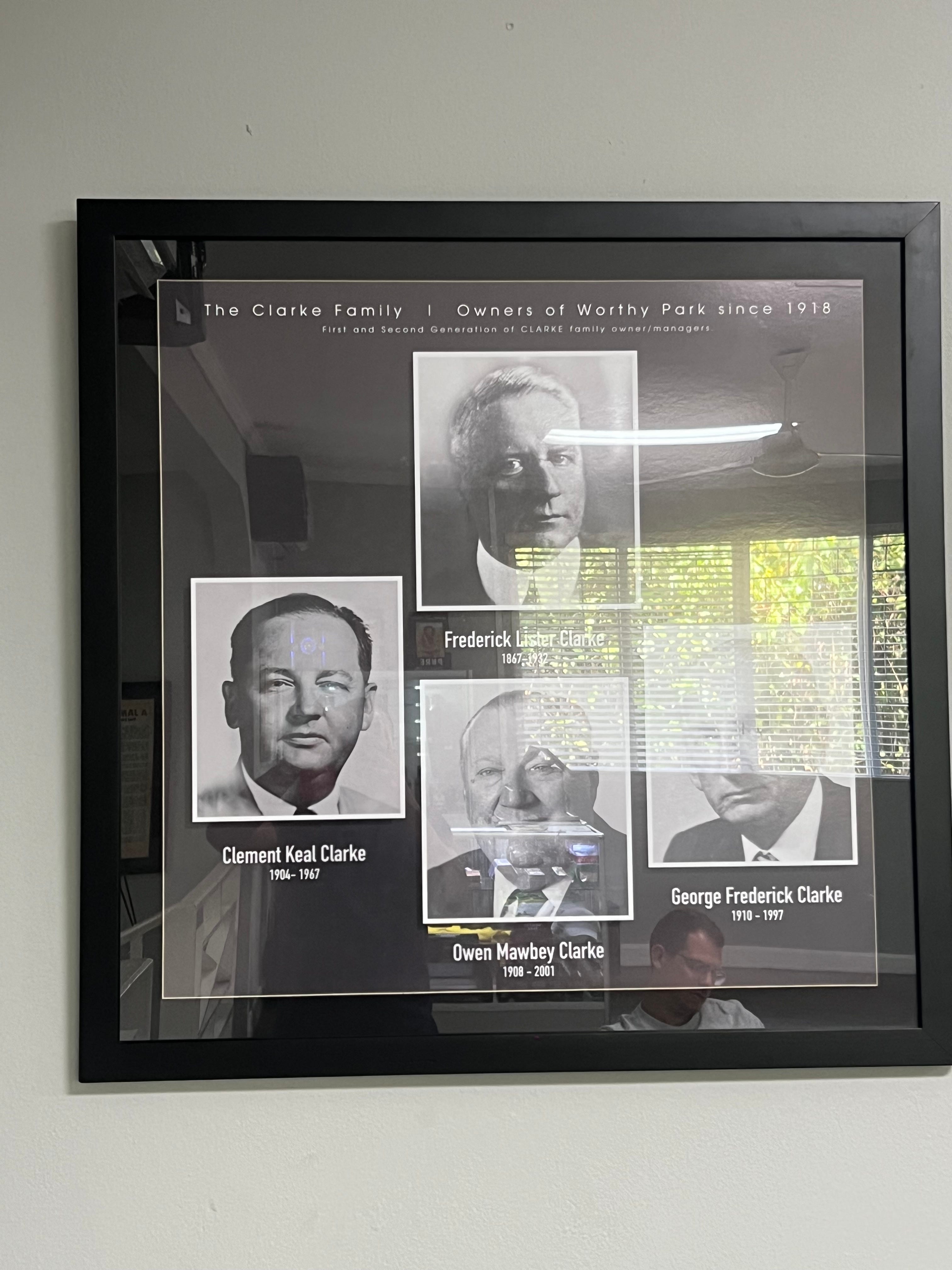
Luckily for you, I don’t like taking pictures of myself, but I find great joy in capturing things I think are insightful. When I visited Worthy Park, I snapped a pic of Fred and his children in the waiting room right before the tour kicked off –
1930s onward, the sons kicked professionalization of Worthy Park into high gear. In 1934, Clement transferred their business from Lascelles to the Hankeys (London) and saved the estate “2½ per cent commission on sales which had seemed such a waste to his father.” In 1936, they firmly demarcated the estate’s functions into factory, farm, and pen, with regular (formal) meetings taking place to gauge the health of operations. This was further cemented in 1949 –
…divided into Worthy Park Factory Ltd. and Worthy Park Farms Ltd. for accountancy and taxation convenience some years later.
The results apparently spoke for themselves because “the estate began to make a modest profit, which increased steadily year by year.”
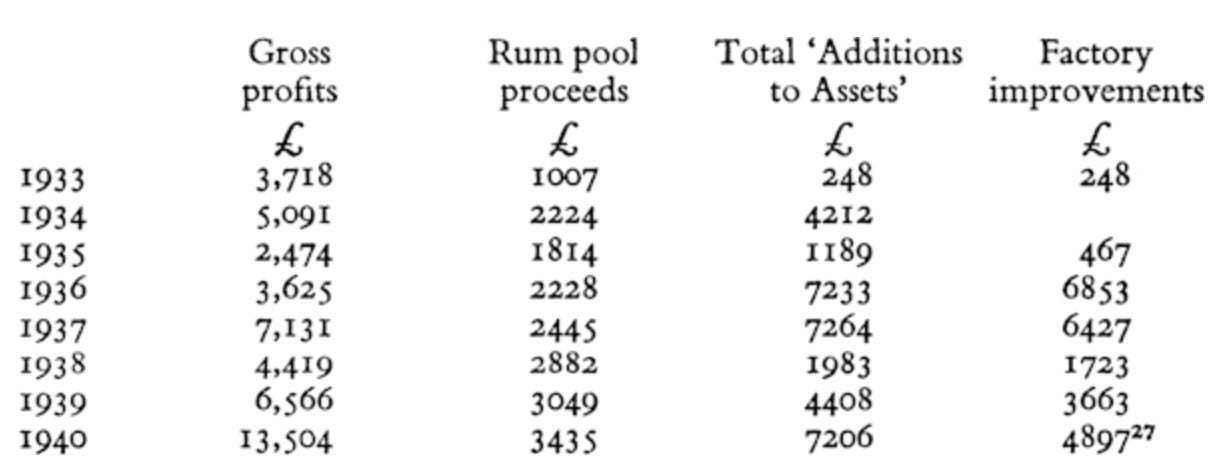
Investment in secondhand machinery between 1939 and 1945 totaled about £25,700, helping raise sugar production from 3,000 tons to 6,000 tons. In the 20 years after 1945, lots of funds were spent on new equipment, which expanded production to 18,000 tons a year.
It was only these improvements that enabled the factory to satisfy the tremendous increase in the demands made upon it between 1940 and 1945.
The “tremendous increase” in demand came into play as World War II began. Many producers globally (especially of European beet sugar) were, uh, occupied. The Clarke brothers were sure to take advantage of the market gap. Take a look at the sharp increase in Worthy Park sugar production between 1930 and 1940 –
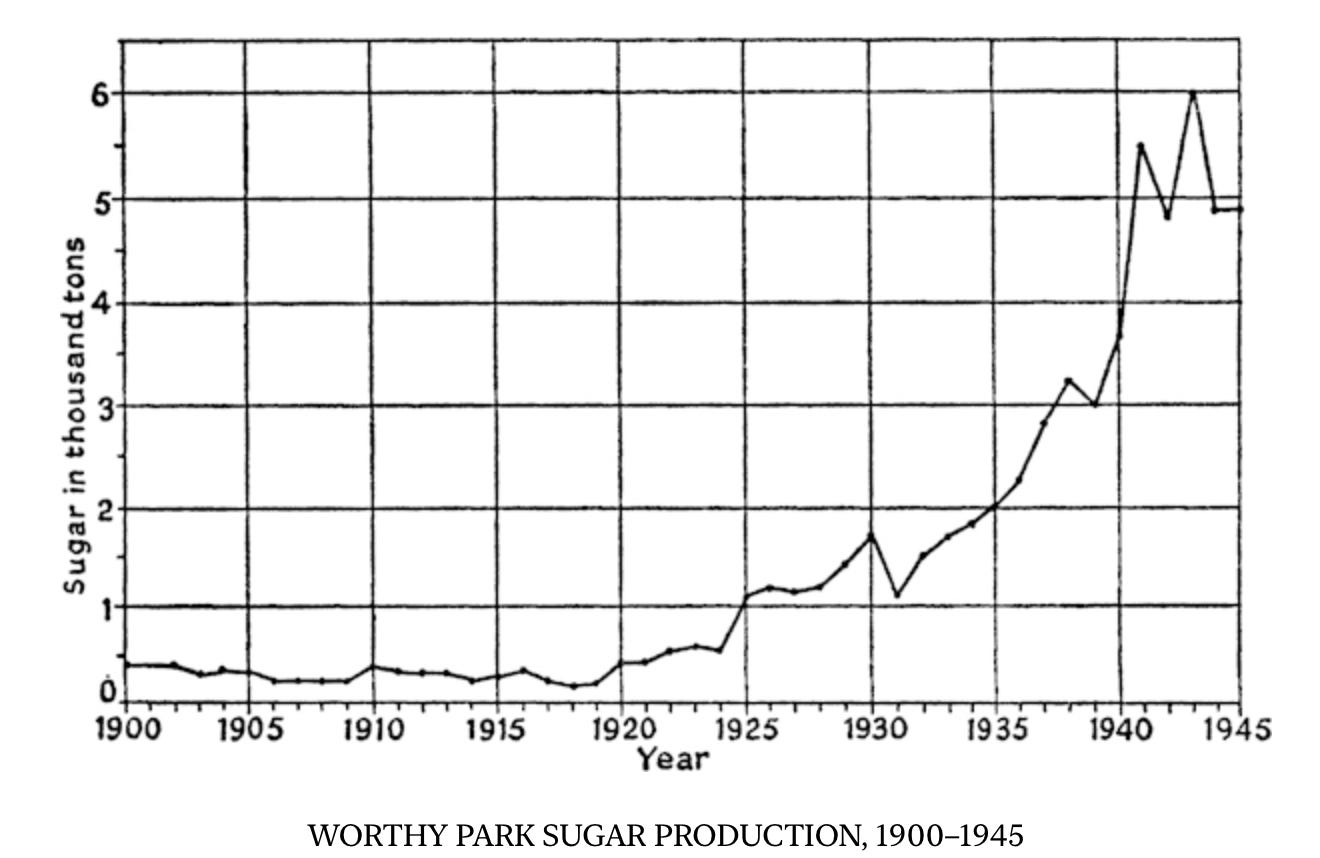
Another reason they were able to produce so much more sugar is that local competition was continuing to fizzle out. In 1897, there were 134 sugar estates with factories. In 1920, 59. In 1930, 35. By 1945, only 20.
But, you see, all wasn’t smooth sailing.
Worthy Park & the seesaw of global politics in the mid-1900s.
Friendly reminder, because I know that Worthy Park rum lovers are going to feel like things concluded with an unexpected suddenness: this tale stops in the year 1970 = )
Back to the show.
Unsurprisingly, the worldwide sugar shortage sustained for a while following the end of World War II in 1945. For Jamaica, the British kept a wartime quota to keep sugar prices stable/high. This, of course, would reverse once things stabilized.
By 1951, however, world production had soared once more and prices were falling towards a dangerous level, and when the British Labour Government—dedicated to low consumer prices—negotiated the ‘Black Pact’ with Cuba whereby cheap Cuban sugar was allowed to undercut British West Indian produce, a crisis impended. The situation was saved, largely through the lobbying of the British West Indies Sugar Association (formed in 1942), by the signing of the first Commonwealth Sugar Agreement in December 1951, shortly after the Conservative Government of Winston Churchill returned to power in Britain.
The Commonwealth Sugar Agreement referenced in the quote went into effect in 1953. And while it limited Jamaican sugar production, the Jamaican sugar producers felt this was a better alternative than true free trade. Local sales continued to be controlled by the Jamaican government, ‘on the recommendation of the Sugar Control Board, acting on the advice of the Sugar Manufacturers’ Association,’ which had been dictating these measures since the 1930s. For numerical context, “the prices received by Jamaican manufacturers averaged around £40 a ton, at a time when free market world prices fell as low as £15.”
To follow that up, Jamaican sugar producers (Worthy Park included) received a windfall of good luck spurred on by one of the most revolutionary events in global history. Enter, Fidel Castro –
…Castro’s coup in Cuba and the subsequent nationalization of the Cuban sugar industry. As the result of Cuba’s intransigence, the International Sugar Agreement broke down in 1962, and with the U.S. embargo on Cuban exports the free market world price for sugar soared to £93 per ton in 1963. In addition, a sugar-starved U.S.A. began to admit non-quota allocations of Jamaican sugar that averaged 91,000 tons a year between 1961 and 1965, at prices that averaged a highly lucrative £65 per ton. In 1965, Jamaica achieved an all-time record production of 506,348 tons of sugar, more than five times the level of 1940 (or 1805).
Worthy Park, as you can imagine, was overjoyed by the developments, even if in disagreement with what transpired with their closest island-neighbor (proximity). They took full advantage of being a part of this “all-time record production.”
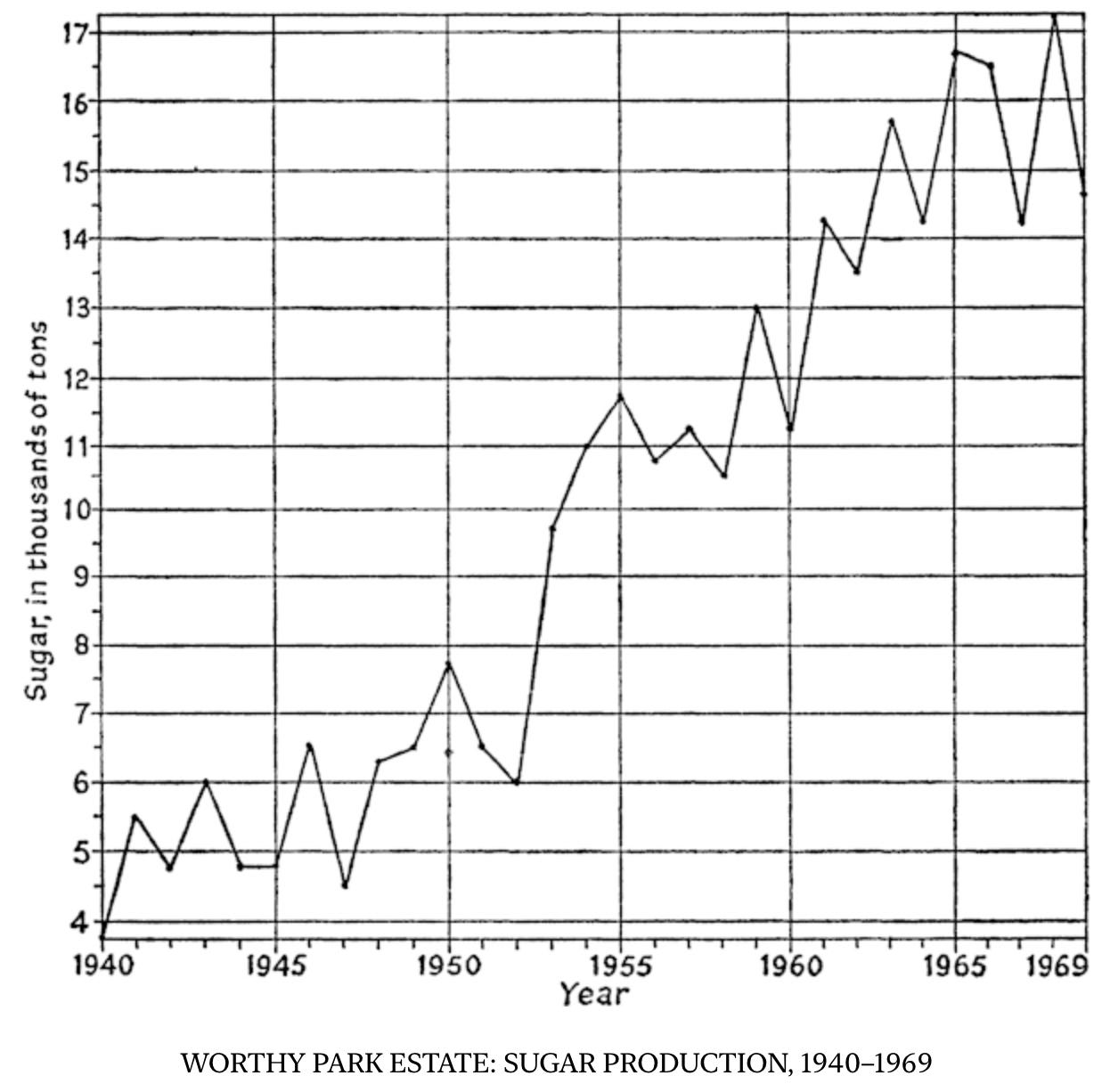
If some of the information provided feels out of whack with modern-day sensibilities, I’ll continue to tap dance on that instability: Jamaica is still not an independent country. All this talk of World Wars and the Commonwealth should be thought of in the context of Jamaica under British control. Their grip was detangling slowly, for sure, but independence would not come for Jamaica until August 6, 1962. We’ll get to that point, but let’s first walk through the 40s and 50s.
In many respects, Worthy Park continued generating the requisite profits to plow back into growing the estate –
In the twenty years after 1948, however, more than £200,000 was spent on new tractors, trucks, and bulk sugar carriers, and Worthy Park’s perennial transportation problem has been solved in the most economical way possible.
But the lead-up to this was all but unpleasant amid heady political swings in the Caribbean and Jamaica. You see, everyone on the island entered the 1940s with wariness from the years that preceded it. In 1938, labor unrest hit a breaking point that ultimately culminated in the Frome Riots: workers across the island went on strike demanding better wages.
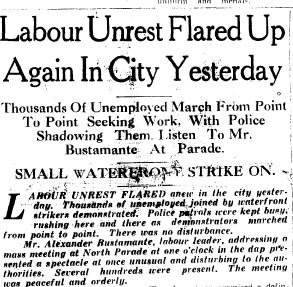
It seems that Worthy Park was less impacted than the westernmost parishes of the island, though the rebellious fever was still palpable in a country but so big. Alexandre Bustamante, the man whose name you would have noticed in that newspaper clipping and who became Jamaica’s first prime minister, played a critical role in some of these worker-versus-aristocracy upheavals. He formed the Bustamante Industrial Trade Union (B.I.T.U.) to go after “corporation-owned estates” that he believed were “more easily unionized,” according to the authors, which is likely what spared Worthy Park the worst consequences of the riots.
Bustamante –
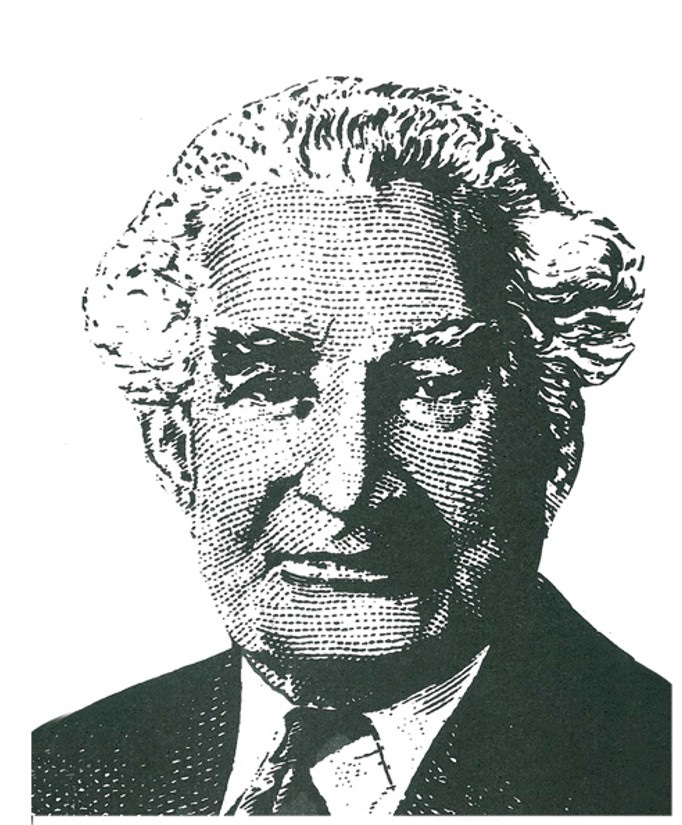
While Craton and Walvin conclude that, between the 1940s and 1970s, there were “largely unsuccessful attempts by the various unions to gain a monopoly at Worthy Park,” Bustamante did not take Worthy Park off his radar. Vitriol for Clement and Worthy Park was very clear on his part. A letter to Clement from Bustamante in March 1944 –
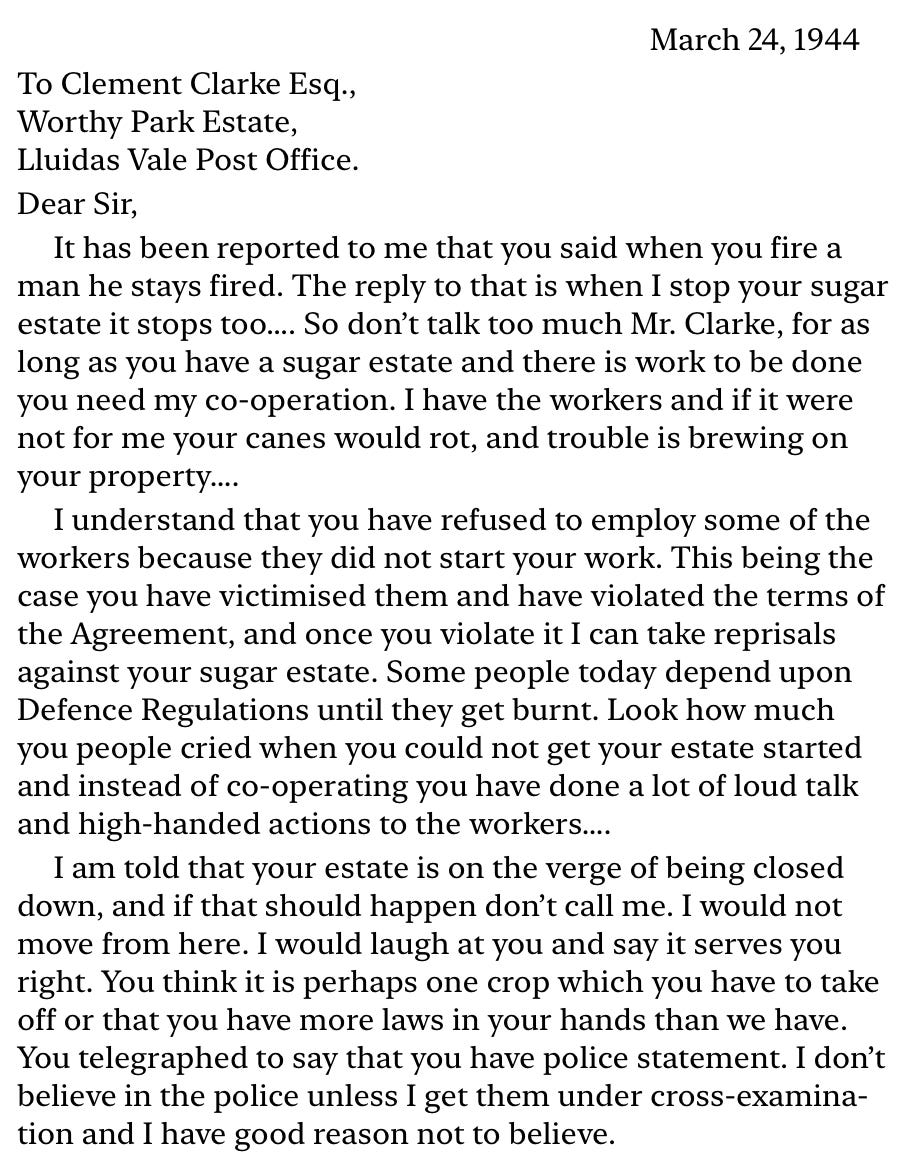
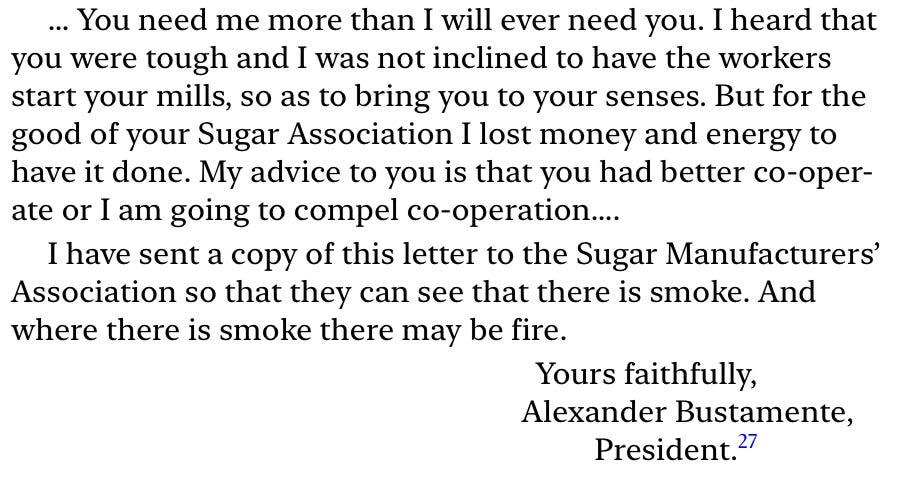
Interestingly, in March 1944, Bustamante broke away from the People’s National Party to form the Jamaican Labour Party as the political arm of the B.I.T.U. For the non-initiated, I will make some very broad ‘headline’ adjacent historical generalizations/stereotypes so that you have a mild understanding of the two parties. The PNP has generally been associated with more socially-focused democracy (equality for all, allyship with Cuba, particularly under the Michael Manley era, etc.). The JLP has typically been associated with more conservative values and has been America’s preferred party (which may be obvious given the PNP’s association with Castro). Currently, the JLP is in power under the leadership of Andrew Holness. This gets a whole lot more involved, but this is enough for our purposes. My intent here was not to take you through a lead-up to the Cold War/20th-century political history of Jamaica. It’s to emphasize that, especially in (small-to-medium) sized island contexts, these sorts of political seesaws sink businesses and can bear witness to seismic alterations in society (to put it mildly). Coups, being on the right/wrong side of politics, etc., had (and still have) a fierce relevance in Caribbean contexts. Worthy Park was not exempt from these realities, even if it did not bear the brunt of the events.
In the context of Worthy Park, one can easily follow the throughline –
Lluidas Vale as a whole is strongly P.N.P. and most of the sugar workers are nominally members of the N.W.U.; but since Independence the management of Worthy Park, like that of most estates, has become more and more favourably disposed towards the J.L.P. and the B.I.T.U., particularly since the P.N.P. in opposition has drafted what the planters regard as a cynically radical platform of land reforms that include the nationalization and subdivision of sugar estates. The J.L.P., moreover, stands squarely for the American alliance which means so much for Jamaican security as well as Jamaican sugar exports, tied as it is to a policy of isolating Cuba economically as well as politically.
Clarke brothers continued to chug along, increasing yields across their cane acreage, while also correctly diversifying crops to generate alternative sources of revenue. If we fast-forward slightly, you’ll see how these investments paid off 10–20 years later –
…Worthy Park’s total revenue of £917,000 in 1968, £49,000 came from the cattle pen and £54,000 from citrus growing.
As you can see from that revenue distribution, sugar (and rum) remained their king (and queen). As the authors note, “no crop has offered the agricultural equivalent of the philosopher’s stone.” That is a bar!
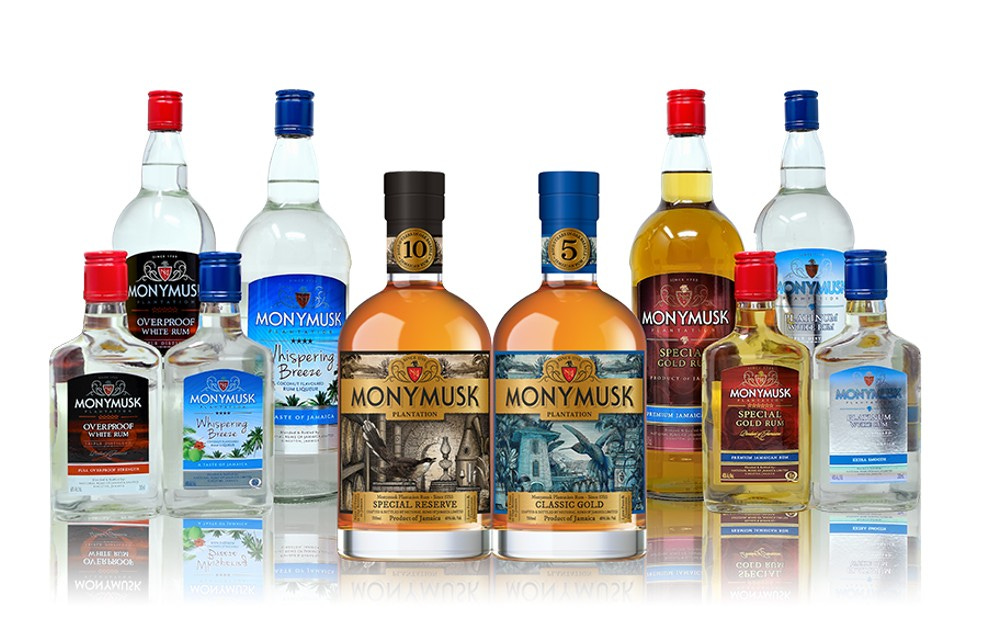
The seasonal nature of cane cultivation still troubled the Clarkes throughout the 40s–60s era. Craton and Walvin note that mechanization would help to reduce some of these operational inconsistencies, though it would not be met without hostility, as is the case with Moneymusk toward the end of the 1950s –
Sudden switches to mechanization accompanied by a wholesale layoff of workers, such as that attempted by the West Indies Sugar Company at Monymusk in 1958, have understandably been followed by some social dislocation and considerable concern in the labour movement. Yet the present labour situation, even without full mechanization, is highly unsatisfactory to workers as well as estates.
For the uninitiated, this is Moneymusk rum (today) –
Back to Worthy Park.
I appreciate the author’s candor that the Clarkes did not deviate much from the past in providing busywork as an attempt to prevent disruption outside of the major cane harvesting timeframes –
…the estate constantly seeks ways—such as the custom borrowed from slavery days of staggering maintenance work wherever possible and in diversifying into crops such as citrus, coffee, and kola nuts which bear fruit out of the time of the sugar harvest—in which to ameliorate the situation.
Another ‘of the past’ practice deeply rooted in slave plantation work classifications was the breaking up of workers into “gangs.”
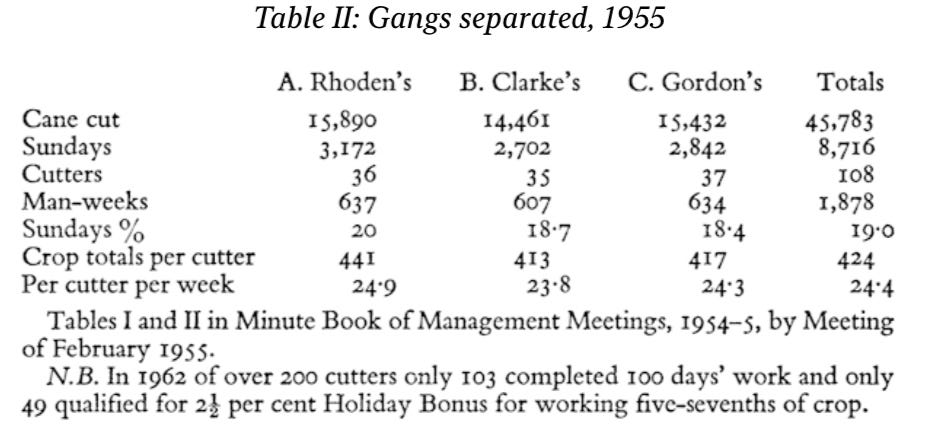
All the above notwithstanding, Worthy Park had achieved a level of growth that would have made Fred grin from ear to ear, if he were a smiling man that is. Not too many of them the further back you go. The revenue for the entire estate continued to go up and to the right, even topping 1M –
“…£22,656 [post-Fred’s death], and this had not reached £40,000 a year by the outbreak of the Second World War. By 1946, however, revenue had reached £150,000, and ten years later, £423,000. By 1966, receipts totalled more than three-quarters of a million pounds, and in the record year of 1968 this figure was exceeded by the income from sugar alone, and total revenue for factory and farms topped £1,000,000 for the first time.”
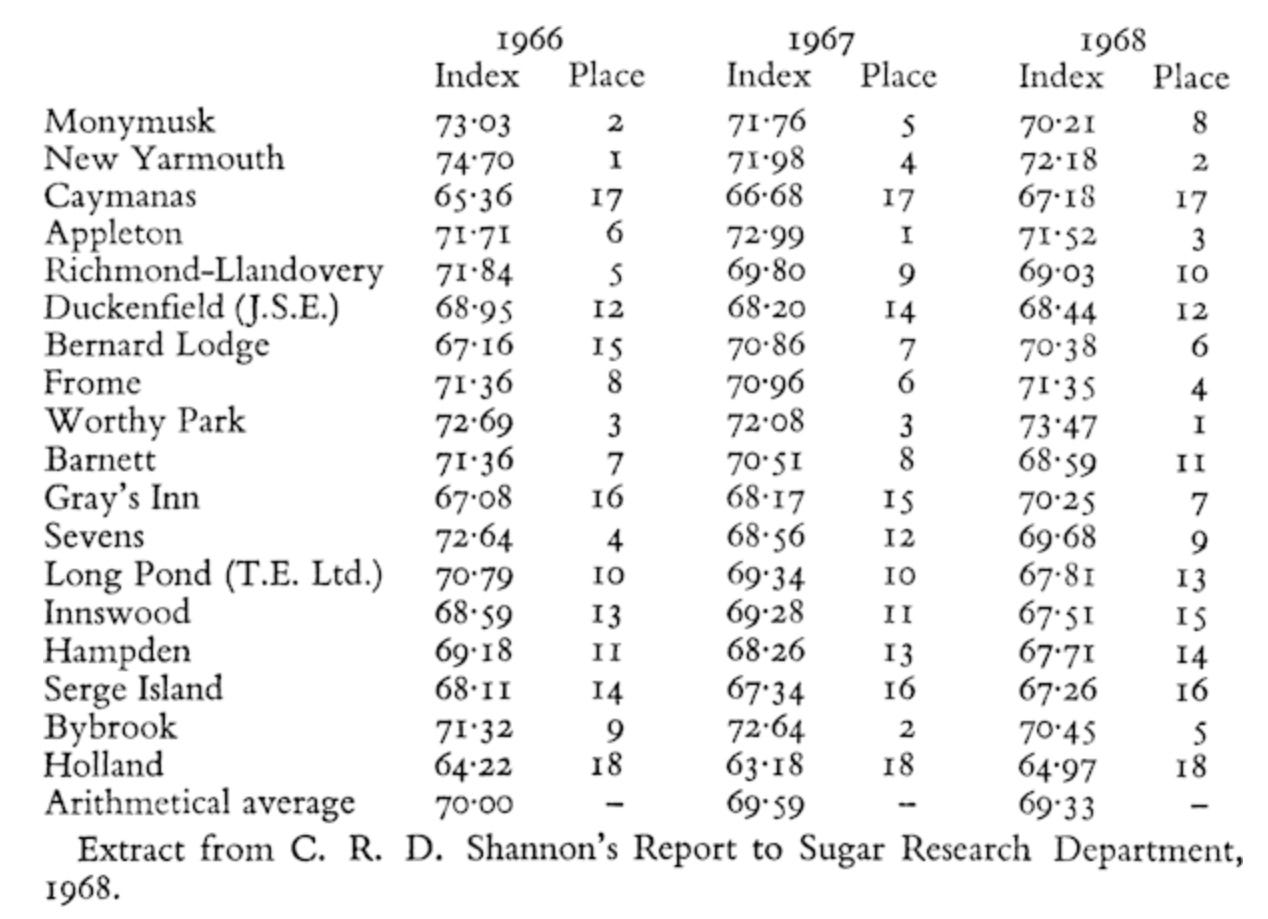
In overall efficiency, Worthy Park, for long one of the best of Jamaican estates, reached a position of absolute primacy in 1968, when the Research Department of the S.M.A. also reported that the estate’s record of producing sugar at a rate of 7·76 hundredweights per acre per month was ‘comparable with the best cane growing areas in the world’.”
The end of an era.
Clement died in 1967, likely satisfied with where Worthy Park landed by the end of his life. Owen and George intended to pass the reign to their sons/nephews, which ultimately did happen. Given the state of global politics and how the Caribbean fits into the seesaw, the authors understandably posited whether Worthy Park would even be around for “even three [more] decades.” We know the response to that.
I could not help but hone in on the details/feelings/analyses of the authors as they relayed their thoughts on the future of the Jamaican sugar industry vis-à-vis (1) other economic avenues (many of which still remain today), and (2) their warnings to not end up like countries they viewed unfavorably –
The Jamaican Government, instead of receiving increased revenue from sugar, would likely be forced to subsidize agriculture from such exhaustible and fickle industries as bauxite mining and tourism. The aluminium companies, though they have contributed many benefits to Jamaica, would soon switch their bauxite operations to alternative sources in other countries if punitively taxed, and tourism would quickly evaporate if political and social unrest in Jamaica increased. The examples of Haiti and Cuba are warnings for Jamaica of the results of the removal of foreign capital, an almost exclusive dependence on peasant smallholdings, and nationalization.
In many ways it would be a tragedy if an estate such as Worthy Park, which has survived so many vicissitudes over three hundred years, were to perish now. But its survival must be justified not on romantic and sentimental but on cold hard economic grounds. Outworn modes and attitudes will not serve Jamaica’s future, which will contain enough pitfalls without inviting more bitterness and recriminations about the worst of the past.
“Political radicals” versus those dubbed ‘caterpillars of the commonwealth.’ Heady stuff. Ultimately, the Worthy Park story continued (as we know). But we will hold the line here, in 1970.
Let’s begin wrapping up with the authors’ words –
If this book has succeeded, it is not just the story of a single Jamaican plantation and its people over three hundred years; it is a history, from the inside out, of Jamaica, of the British West Indies, and of the sugar industry which dominated the economy so long and has done so much, for good or evil, to shape West Indian society.
In my humble opinion, the book more than succeeded. Especially so in a world of puffed-up narrations that only serve to show things through a glossy, folklore-ish lens. Thank you, Craton and Walvin.
This marks the end of the Worthy Park series.
