


My excuse to showcase one of my favorite songs, from one of my favorite artists, simply because it has “war” in the title, which is our focus today…
…and because I was unable to attend Bounty’s show in Brooklyn, his first return to the U.S. after 15 years.
Let’s dive into the whole purpose of this thing, the title of the book, Tacky’s Revolt.
Or, more aptly – Tacky’s War. Which was really a war within a war and very strategically initiated. What do I mean by that?
Taking advantage of Britain’s Seven Years’ War against its European opponents, Wager and more than a thousand other enslaved black people on the island engaged in a series of uprisings, which began on April 7, 1760, and continued until October of the next year.
To the British, the Seven Years’ War.
To Europe, the Third Silesian War.
In North America, the French and Indian War.
In India, the Third Carnatic War.
A major world war, for ease, but much of it heavily fought in North America. Okay, back to the show.
Just as launching rebellions in and around holidays was strategically common across plantation societies in the greater Atlantic regions, engaging internal warfare while colonialists were fighting external wars was also a similar pressure strategy undertaken by the enslaved. Fighting wars internally and externally stretched the resources of the British. Apongo’s proximity to this type of intel, having seen it firsthand (go back and read Part 1 if you’re confused as to who Apongo is and why he would’ve been familiar with British external warfare), coupled with his military stripes/background from the Old World, created a recipe for the timeframe when Tacky’s Revolt was launched. Well, when Apongo would pick up the war-baton from Tacky (Part 1, Part 1, Part 1). This is all notwithstanding that Tacky’s War was part of a larger African/Coromantee War against European colonists (e.g., Coromantee slaves executed in Danish St. Croix in late 1759 for conspiring to rebel). The Danish?! Yea, I know.
Let’s recenter before we get into the details:
Start of the war: April 7, 1760
Initial location: St. Mary Parish, Jamaica
Later location: Westmoreland Parish, Jamaica
Conclusion of the war: October 1761
Here we go…
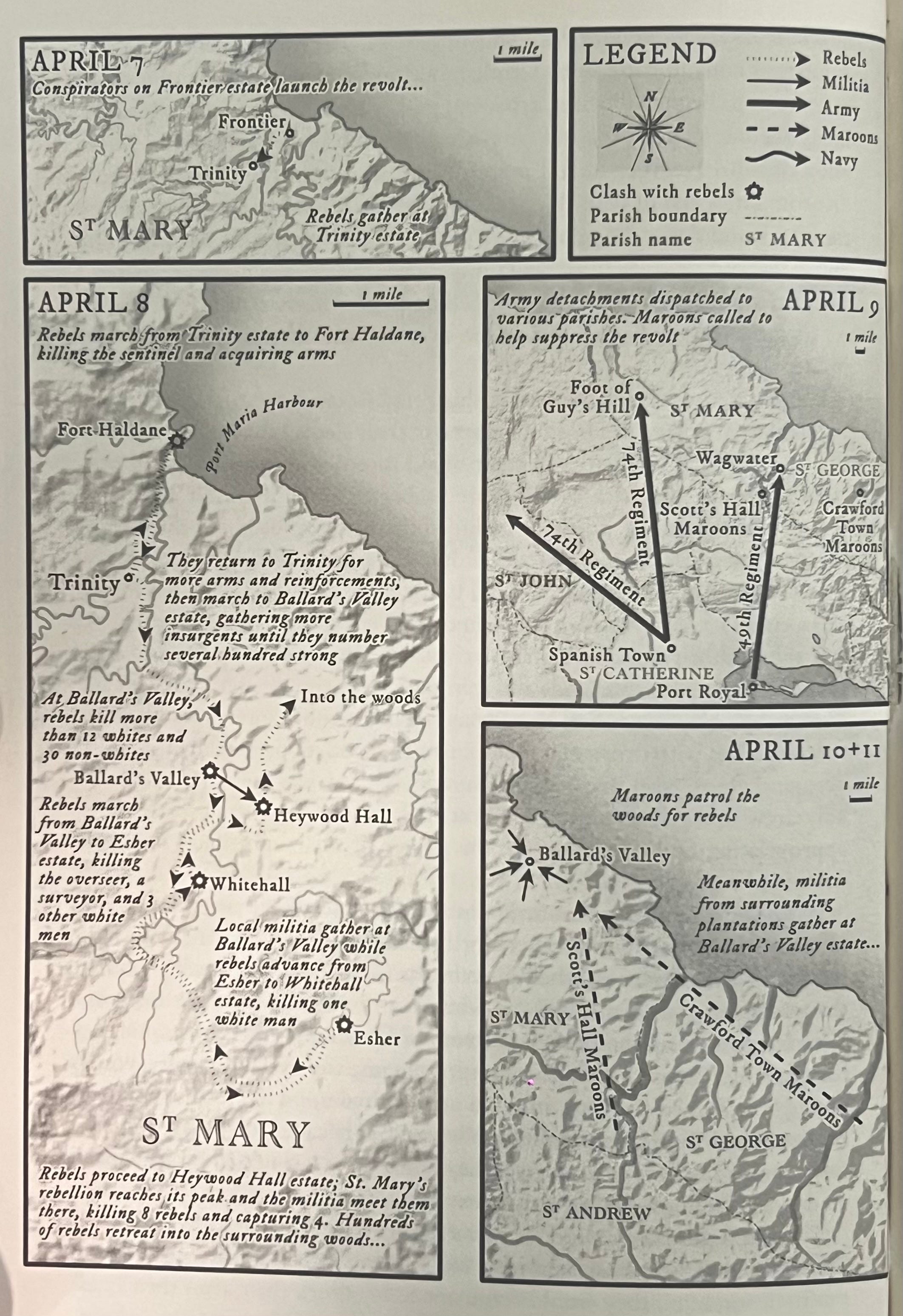
Following the attack on Fort Haldane, the rebels doubled back to Trinity for more arms and reinforcements. As their numbers swelled with allies from neighboring estates, the rebels marched up the main road. Here they were guided by the geography of the Parish. Thinly settled by whites but profitably devoted to sugar production, St. Mary’s teemed with newly imported slaves from the Gold Coast, who worked the plantations sited all along the parish’s river system. Located on the windward side of the island, St. Mary’s was one of Jamaica’s wettest and most densely forested districts.
Tacky’s soldiers were deadly strategic in their onward march by choking off strategic communication to prevent militias from descending on Tacky’s soldiers, and to prevent them from calling on the larger British Army, a routine occurrence for internal wars. They went upcountry toward the base of the mountains, stopping at William Beckford’s Esher Estate, where they killed a few white men to prevent news from spreading. It was clear that the most servile among the enslaved were given warnings (i.e., told to comply/join Tacky’s force). However, many of them were killed for what would have been viewed as not cooperating with the war efforts (being an enemy).
True to form, Lieutenant Governor Moore (of Jamaica) implemented Martial Law, compelling all non-slave males to join the fight. When Articles of War were declared, the full weight of the British Army/Navy was sent in to fight an all-out counter-insurgency war. Meanwhile, Tacky’s army continued their march onto other estates (e.g., Heywood Hall), but eventually they would be rebuffed and made to disperse into the woods. That, unfortunately, would not be safe grounds, given the strategic alliance between the Crown and the Maroons. The latter, being experts of the mountains and woods, were called upon by the Army to help suppress Tacky’s soldiers.
April 14, 1760 –
…maroons and militia pursue rebels to a rocky valley in the woods, where a battle ensues and they kill 20 rebels and capture 200. Rebel leaders Tacky and Jamaica are killed.
For the nerdiest among us who want to see this all in more detail, I have something for you.
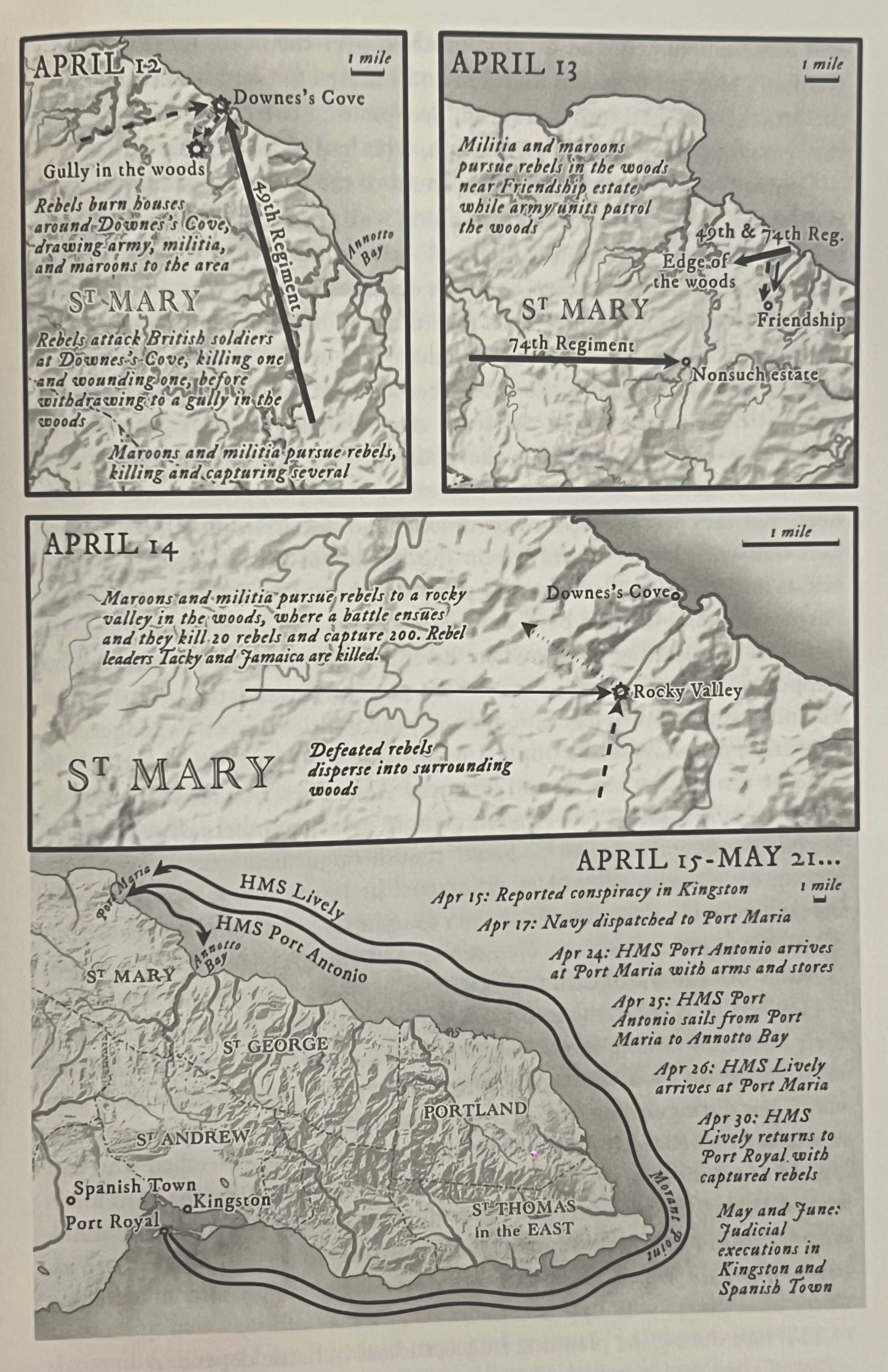
Finally, on April 14, the maroons pursued the rebels to a rocky valley upriver from Downes’s Cove. The Scott’s Hall maroons attacked the main body of insurgents “with great Impetuosity,” forcing them to retreat in disarray. The rebel leader Jamaica was killed, and Tacky tried to make his escape, pursued closely by Lieutenant Davy of the maroons. Davy fired at Tacky “whilst they were both running at full speed,” according to Edward Long’s account, and shot the rebel commander dead.
Public torture and displays of dead rebels served to evoke awe at the extent to which the colonists would discourage future warfare. Textbook (unfortunately) detraction strategies: mutilated rebel bodies at public markets, along well-traveled roads, and entrances to towns. Reminder: plantation societies in smaller places (i.e., islands), and “freedom” of movement for the enslaved, all looked a bit different than, say, what things were like in the vastness of the American South. Spiritual leaders (“Obeah men”) were targeted and publicly tortured to make examples out of them since they enhanced the rebels’ morale…and also to extract information.
There’s scarsely a day passes but some of the Negroes are Executed. – Kingston resident
In addition to this type of lethal repercussions being the norm for colonial leaders and their military apparatuses, the British and their allied slaveholders in Jamaica had lost that firm grip they were all too used to. This was a war that was unpredictable and felt variable in its potential outcomes. Their historians and media apparatuses would not recount it this way, inevitably, because the appearance of ‘having things under control’ was part and parcel of the Crown’s imperialistic personality. But the events dictated otherwise.
Fear transported the slaveholders into a delirious fever dream from which they would not soon recover…They had lost the plot. The narrative they pieced together at the start of the rebellion represented the most linear description they could manage, until Long sat down a decade later in London to reconstruct the sequence…The St. Mary’s revolt established an enduring narrative pattern, providing an intelligible origin and knowable characters, with the colonists’ actions bending a discernible story arc from beginning to end. The slaveholders were paranoid…Tacky’s Revolt was smaller and less significant than Long and subsequent historians have supposed only because the slave war it advanced was larger and more consequential…And still the Coromantee War was closer to its beginning than its end.
Indeed, closer to its beginning than end, which I previewed earlier (i.e., the war ends a year later in October). So, what happens between April – June 1760 and then? Let’s talk about it.
But first, let’s reorient ourselves to the other side of the island.
Westmoreland, Jamaica. The westernmost part of Jamaica, home to the beautiful/serene town of Negril, which is not the capital. That award goes to Savanna-la-Mar, or Sav-la-Mar as it is colloquially referred to.
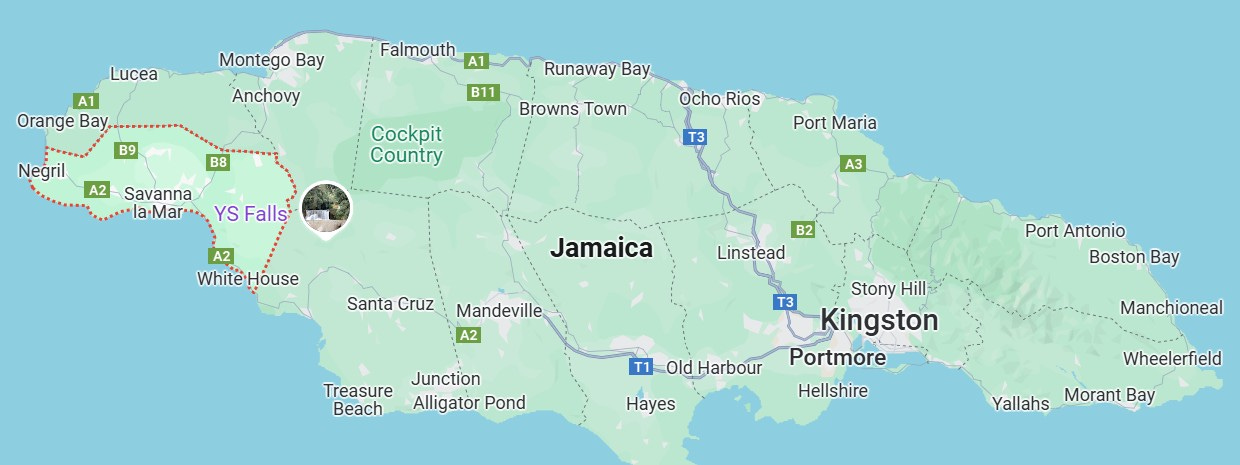
…one of the most profitable territories in the British Empire…densely populated with sugar plantations and legions of slaves, making the parish a powerful engine of accumulation…By the time of the revolt, about fifteen thousand slaves labored on more than sixty sugar plantations…
Given the proximity to waterways, Westmoreland was a militarily and economically strategic point for the British to traverse home and back, fortify their holdings, and interact with their major North American colonies (not yet an independent America). Though this is all true, Westmoreland was also sort of…out of the way (in the context of greater Jamaica), to put it plainly. There’s no surprise, since you know a lot about Maroons from Part 1, that many of their communities were in and around this region (i.e., Furry’s Town, Accompong Town, and Trelawny Town).
The mountains rose high above dense woods and thickets, then dropped off sharply before rising again to divide Westmoreland from Hanover Parish, continuing north of the agricultural plain and reaching higher still in St. James and St. Elizabeth.
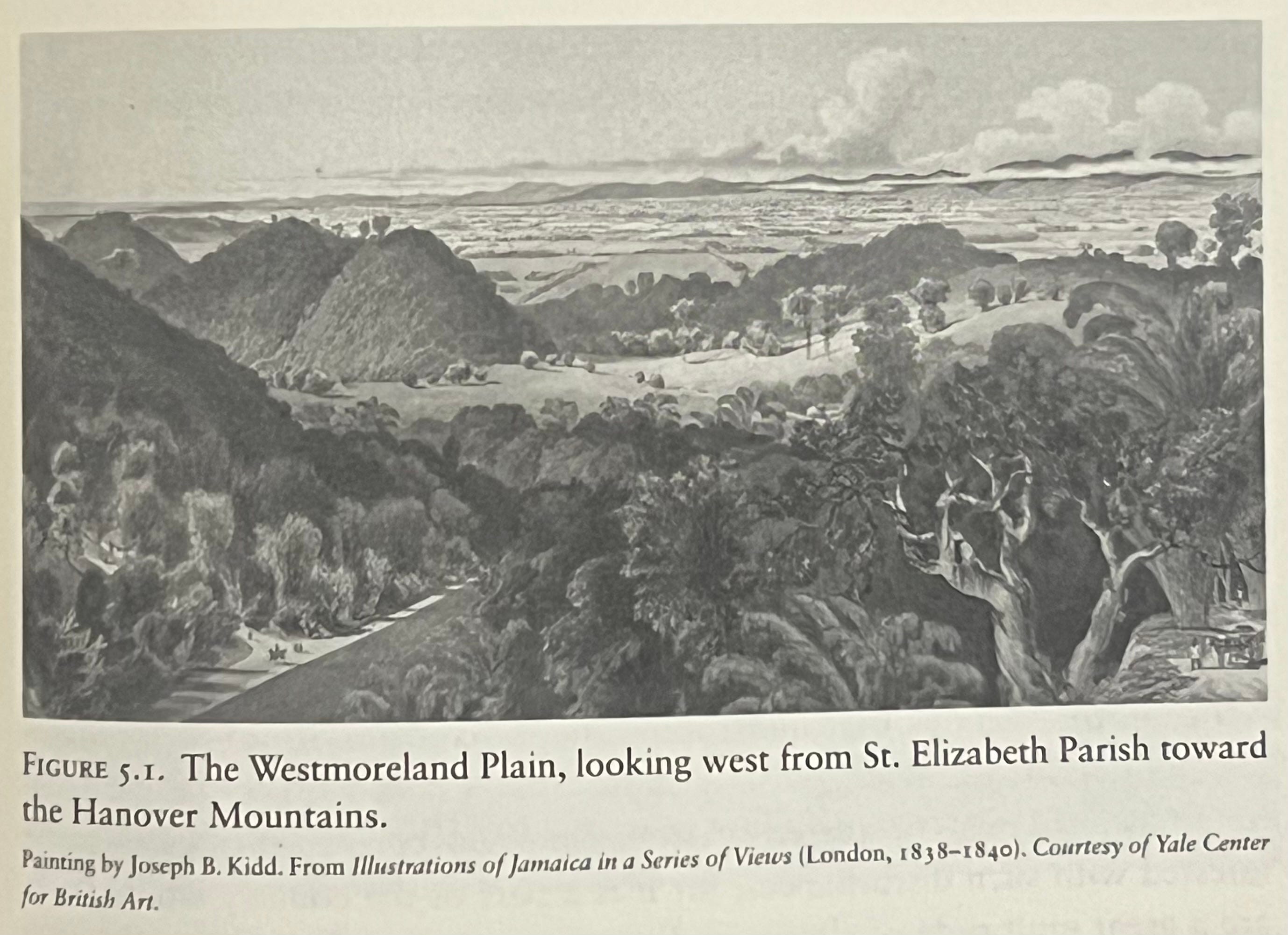
You can probably guess that this mountainous, densely plush region was also a perfect environment for –
Maroons (constant proof of free African/Creole people)
Terrain that would feel more familiar to a Coromantees
Lots of Coromantees who were likely abreast of the St. Mary war
Or was that first part of the war coordinated?
Unlikely, but a mystery nonetheless
Again, here’s why the Westmoreland environment was advantageous, initially, for the continuation of Tacky’s War –
This uneven landscape—variously subject to the discipline of imperial capitalism but wild and unruly, too—shaped the course of the Coromantee War…the Coromantee War in the leeward parts of Jamaica connected the insurrection to African and European military campaigns on the far side of the Atlantic Ocean. Rebel strategy here drew upon African experiences of forest warfare and mountaineering even as British troops fought the rebellion as one battle in an integrated global conflict.
Orientation over, back to (the continuation) of Tacky’s – Coromantee – War.
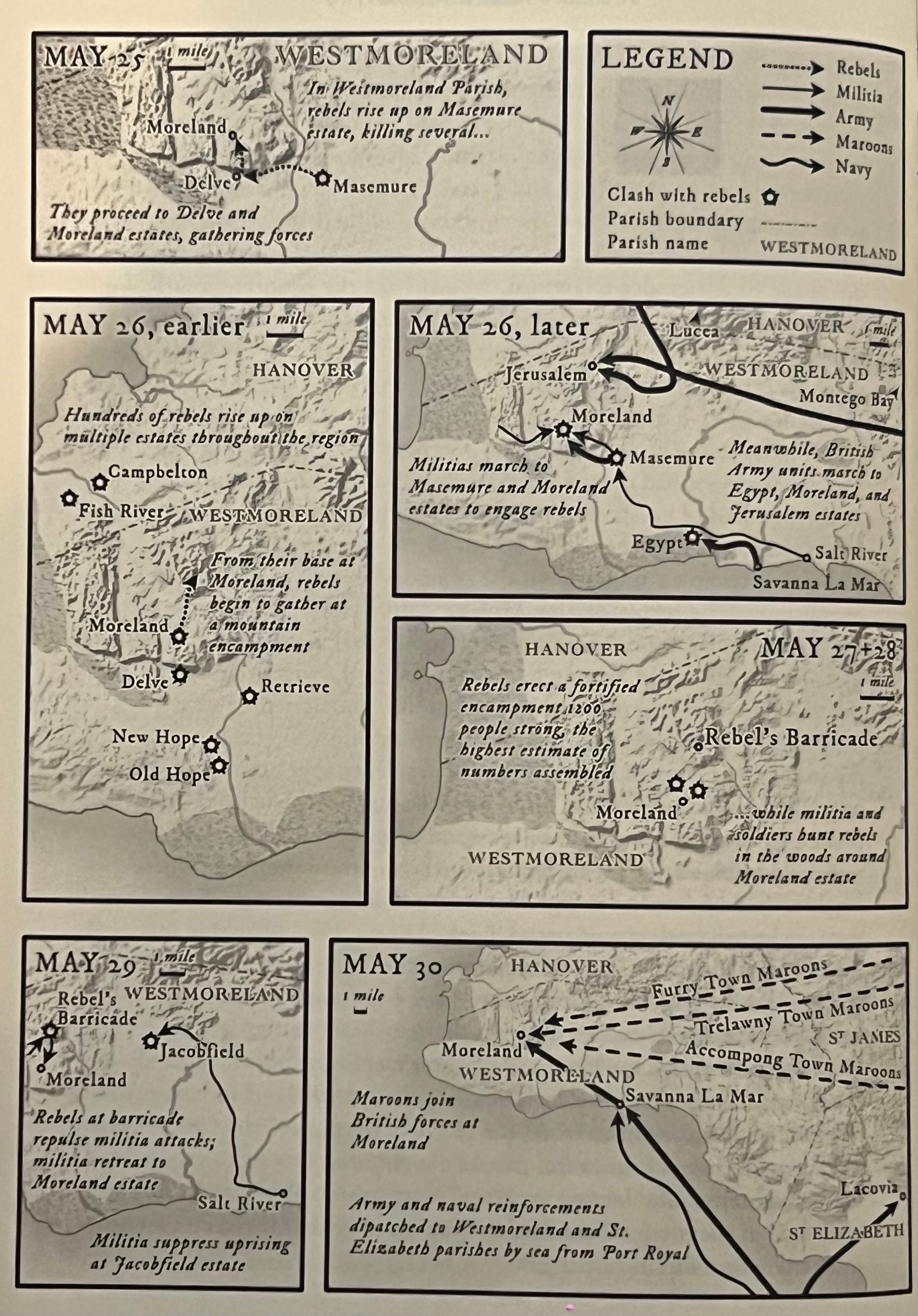
May 25, 1760 – Apongo leads an attack on the Masemure Estate, killing several people and doing a very similar march onward to other estates, gathering more troops and resources (arms, food, etc.). What stood out to me is that Apongo’s troops did this tactfully, one can almost say reminiscently, as if reaching back for old (military) ways, and applying it in their new environment; Surely, the similarity between Tacky’s march and Apongo’s march can’t be pure coincidence given their shared Coromantee backgrounds.
As the rebels had in St. Mary’s, the Westmoreland rebels forest coalesced on large plantations where they could quickly overwhelm a few managers, overseers, and loyal slaves before raising the surrounding estates.
Also, as a call back to the enslaved habitually launching wars in and around holidays, we have evidence that Apongo continued the war in the same manner –
Having time the rebellion for the Whitsun Holidays, when slaves received a break from their punishing work routines, the conspirators could count on laxer restrictions on the activities and movements of slaves, both leading up to the holiday, as they prepared their celebrations, and during the festivities.
Over the ensuing days, Apongo and his army continued pillaging plantations, garnering recruits, while fortifying themselves in hard-to-reach places. Reportedly, May 29th was a heavy setback for the colonists because the militia prematurely rushed the rebels’ barricade and likely miscalculated their ability to pierce through. Ultimately, they could not manage the force of the rebels; The Africans acquired about fifty more rifles that the colonists left when they retreated. The colonists felt that “Westmoreland Parish might be lost to the Africans.”
And that is one thing the British, at that time, refused to let happen. So, what do they do?
Throw the full weight of their military behind maintaining the British Empire.
You have to place yourself in the psychology of the Crown at that time. Their most important military garrison, commercial entrepôt, and (arguably) colonial holding. The British must have felt that this was a lethal threat to their might as a colonial power. I mean, what would the rest of the world think they could get away with if the British were to lose this internal war? Friendly reminder that they’re still engaged in the external skirmishes with other colonial powers.
Lieutenant Governor Moore again declared martial law. Then he requested that Admiral Holmes immediately send a vessel around with arms and ammunition, followed by three warships carrying “such a Number of Forces, as must necessarily, joyn’d to the Militia of those parts, put an end to this Insurrection very shortly.” Now, with the military fully mobilized to leeward, this became a war for the British Empire itself.
We know how this story unfolds.
Over the long haul, the spoils tend to go to those with the deepest pockets and more advanced technology. Or anyone who has the “stuff” that outstrips human/biological capacity to keep up. Notwithstanding the British’s outright social-control advantage, which was sure to tip the scale in their favor, Apongo’s army seemed statistically likely to lose, especially when the British deployed the full weight of their empire’s military.
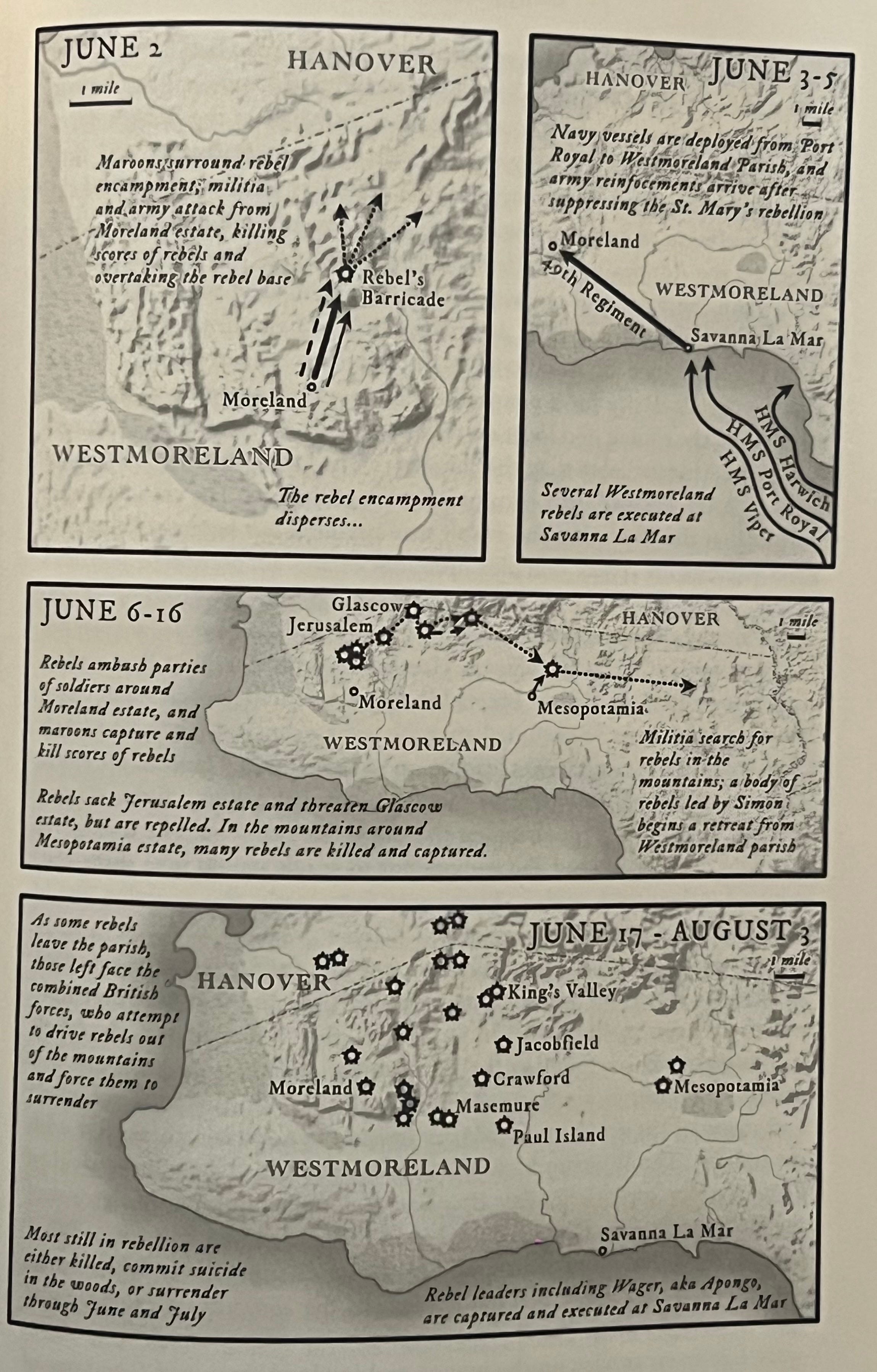
Although Apongo’s army initially proved formidable in resisting the British, Jamaican militia, and Maroon combined offensives, the rebels would eventually be squeezed by early to mid-June 1760. Food supplies were cut off (“the people have cut down their plantain trees, which is the only food Negroes have in this country”), as was access to plantations where Apongo’s army could re-up on ammunition. As the rebels were captured, some decided to take their own lives rather than submit. The other leader, Simon, retreated from Westmoreland, taking a band with him. But as for the head honcho, Apongo (aka Wager), his fate would be violently sealed –
…early July, the slaveholders captured Wager. He had remained at the western end of the parish, having been injured some time before…When the slaveholders finished their interrogations, Wager received his sentence: he would hang in chains for three days, then be taken down and burned alive.
Many of the “suspected rebels” were “condemned to transportation.” That last line is a fancy way of saying deported. A handful of the transported were sent to Georgia, South Carolina, British Honduras (today, Belize), and Cuba. Others were smuggled into French territories; Smuggled because the British were still at war with the French, but Jamaican slaveowners/businesspeople chose the power of the wallet over national pride with this type of commercial smuggling.
I know you’re wondering – wait, this is July/August 1760, what happened to the war going until October 1761? The answer to that is: the war’s end in October 1761 is tied to the remaining rebels being captured/executed, or at least those whom the colonial powers were reasonably assured were the last of the rebels.
Before we cover what happened between the captures/executions and 1761, infographic recaps of the war’s pivotal junctures –
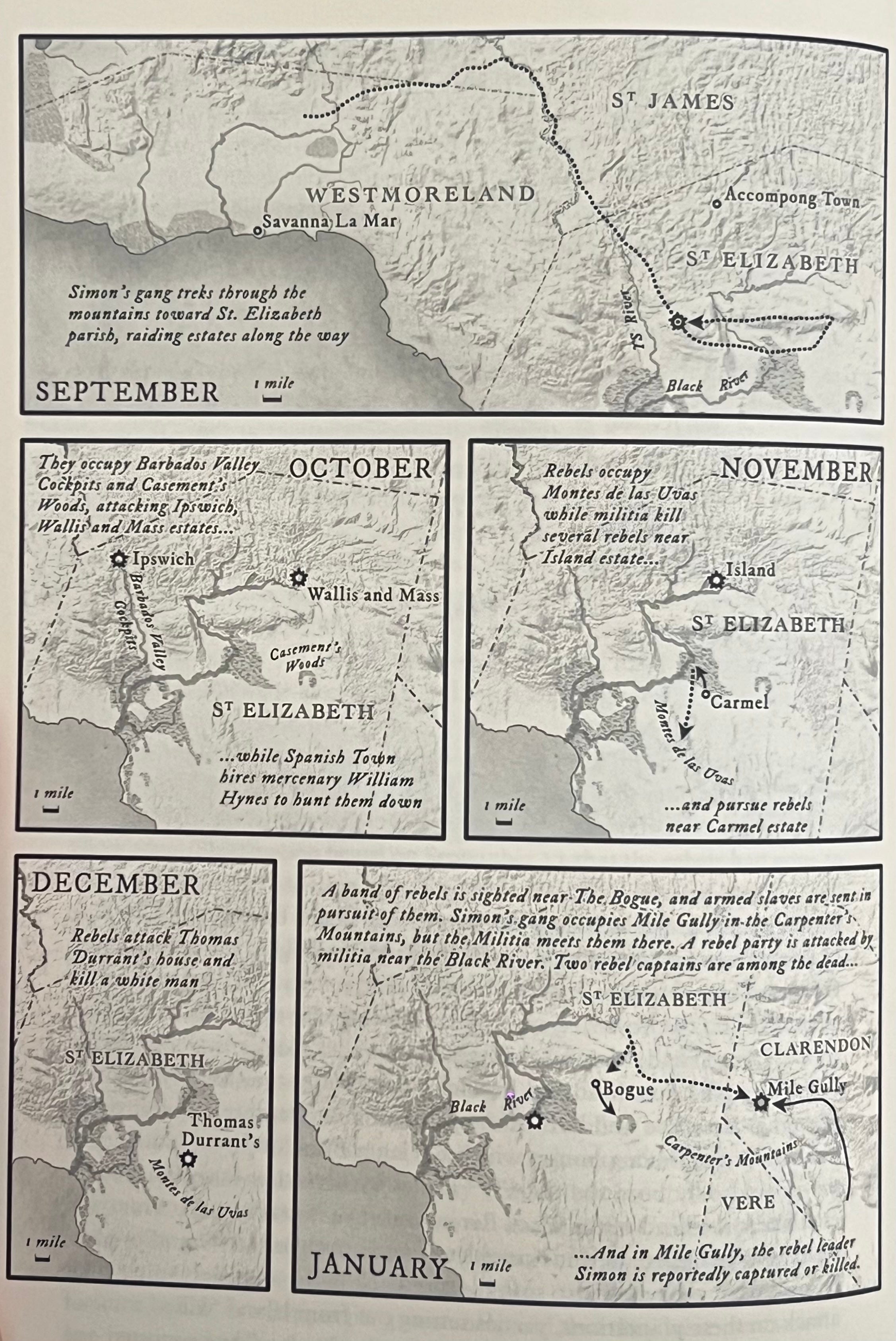
Clampdown.
If you know anything about plantation histories, which were reinforced by rigid, social caste systems, then what follows from here will not surprise you in the least.
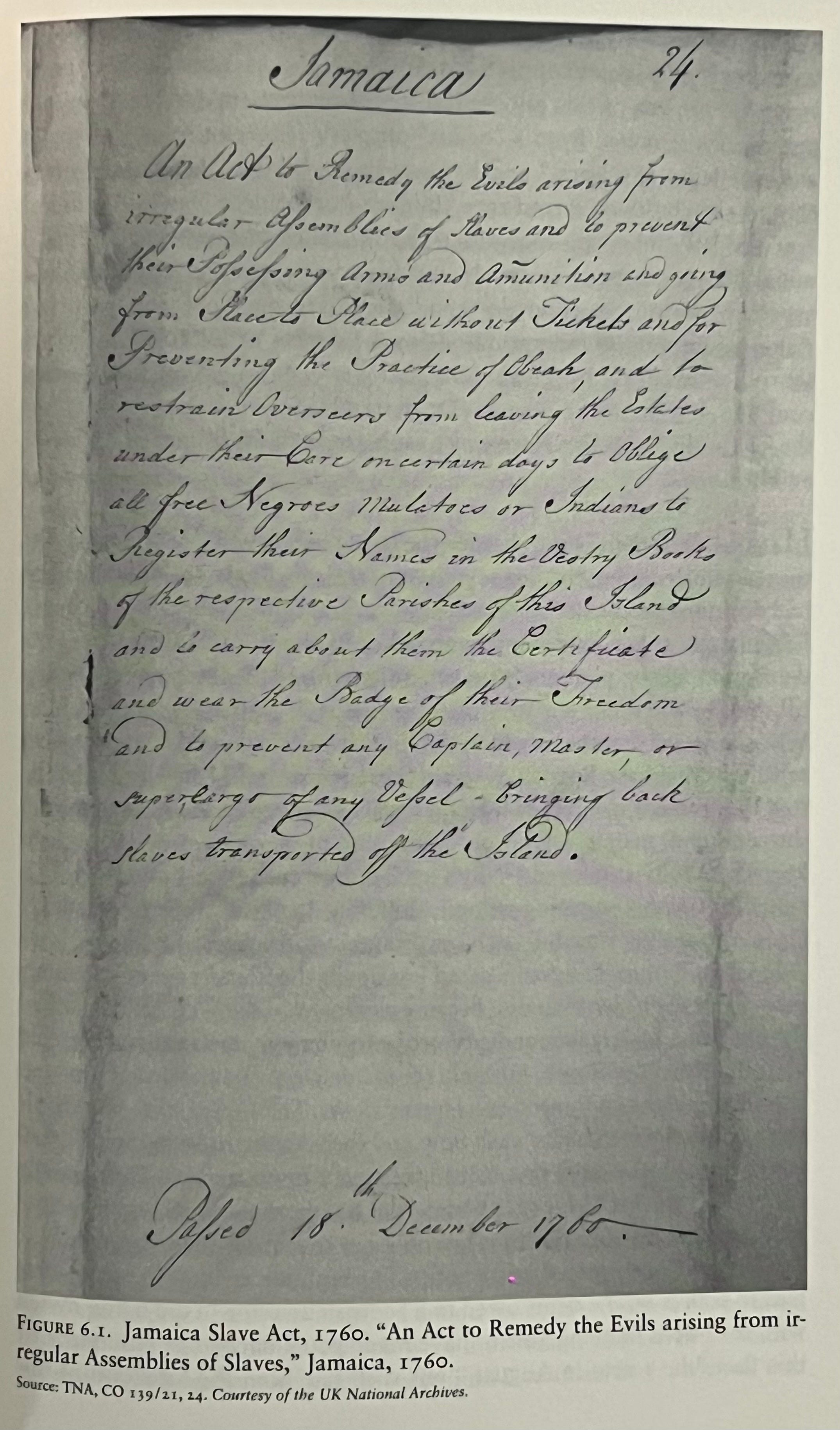
December 18, 1760 – The Jamaica Slave Act, or, more verbosely, “An Act to Remedy the Evils arising from irregular Assemblies of Slaves,” exacerbated the violent vigilance through which enslaved people’s lives were monitored:
No “Military Offensive Weapon” allowed in the possession of a slave without a white man’s supervision
Obeah was criminalized, whereby “Any Negro or other Slave” convicted of practicing obeah/witchcraft “in Order to delude and impose on the minds of others” would be punished with death or exile.”
Unauthorized gatherings, movement, and communication were expressly forbidden
The law demanded that slaveholders prevent slaves from gathering to play their “Drums Goards Boards Barrels or any other Instrument of Noise,” which might broadcast their collective strength and summon others.
To prevent a lull in work activity and potential days for clandestine organizing, there would be no successive holidays allowed (Easter and Whitsun)
All free non-whites were required to wear “Badges of Freedom”
Both England and the colonial Jamaican government, scarred from the war, demonstrated the seriousness of the Act’s enforcement through financial consequences. The fines for lax behavior were as follows:
→ £50 for unsanctioned holidays granted to the enslaved
→ £100 for allowing military offensive weapon possession
Brown’s apt summary is –
Estate owners and managers would be fined £100 and overseers and bookkeepers could be imprisoned for up to six months for allowing slaves to assemble together to beat drums or blow horns…As ever, warfare required the sacrifice of liberty.
Reverberations across the Atlantic.
In 1761, Tacky’s War was covered regularly in the Pennsylvania Gazette.
Here is a clipping from an article talking about Apongo’s capture –
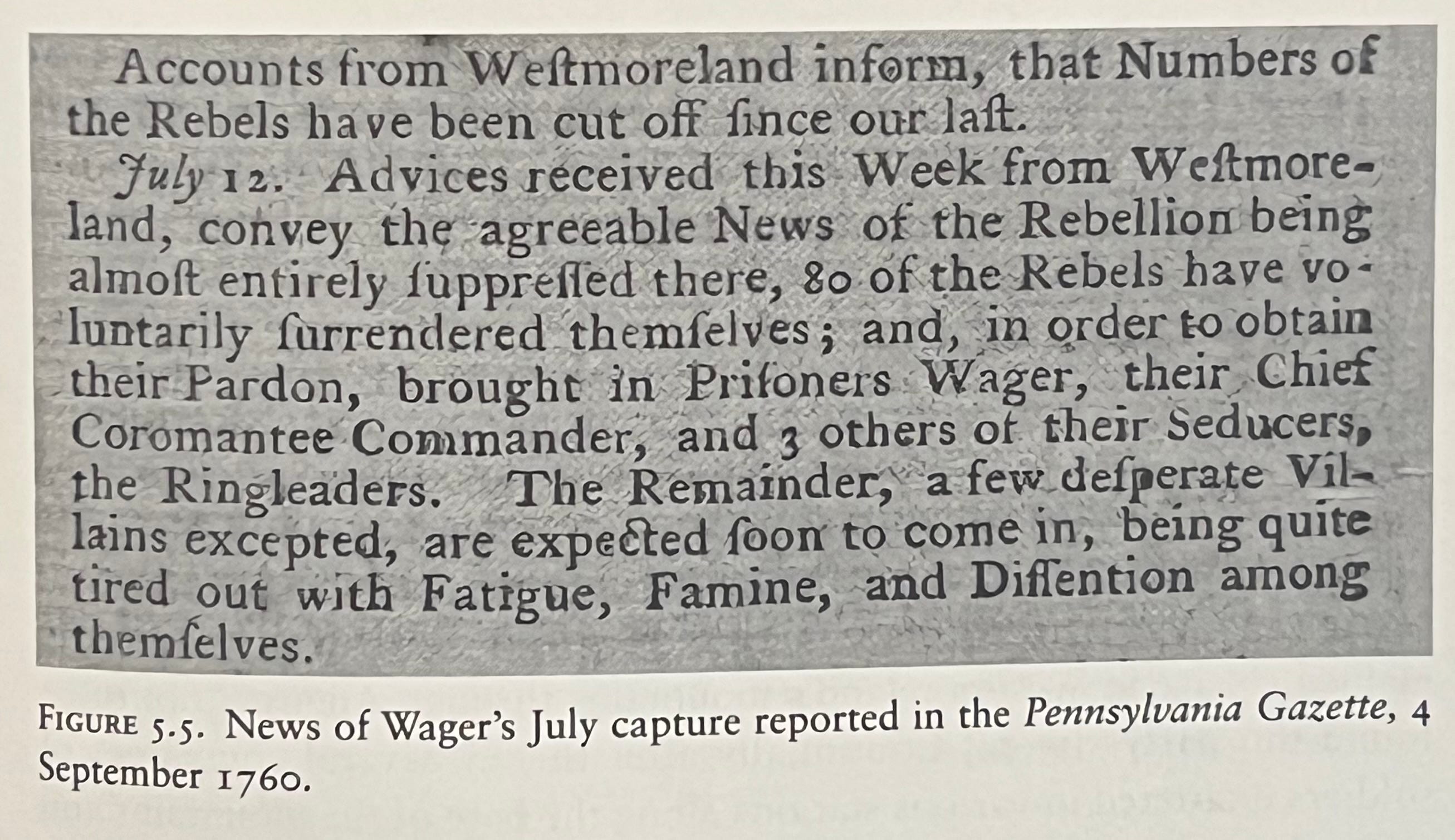
There was even a 1761 duties law passed on slave imports, likely from fear of inheriting any of the supposed rebels “condemned to transportation” being sent to Pennsylvania. In 1773, PA doubled the import duty. In 1780, an Act for the Gradual Abolition of Slavery was passed.
As much as these laws might have expressed increasing opposition to the practice of slave holding, they were aimed at discouraging the arrival of potentially insurgent Africans.
The interconnectedness of slave economies, from the Caribbean to the North American colonies, guided by the British’s desire to tightly control their holdings, should be no surprise to you. Colonists in Jamaica speaking to colonists in Virginia or Pennsylvania would, for these times, read as completely part and parcel of the era(s). So, if there was an internal war that greatly threatened the social structure and dominance of the white colonists at the time, it’s no surprise that newspapers would reach across the(ir) aisles and say – hey, be careful, this is what could happen.
There you have it, folks.
The Jamaican insurrections from 1760 onward can be described as militias dispersed over vast areas, undefined battle lines, and blurred distinctions between civilians and combatants. And the important thing to always remember is that the combatants viewed it as a war, not a revolt. And there were some before it, like the 1712 Coromantee uprising in NYC, and many more to come after.
→ April 1763 — another uprising in Westmoreland and Hanover, put down by parish militias and Maroons
→ 1763 — massive revolt @ Dutch Berbice (Gold Coast Africans)
→ December 1764 — large arms possession discovered in Spanish Town, reports that the slaves were planning to massacre all the whites and take possession of their estates
→ Mid-1766, another revolt in Westmoreland by thirty Coromantees
Per Brown –
…the Jamaican slave revolt of 1760–1761 was a war within an interlinked network of other wars which had diverting and overlapping provocations, combat zones, political alliances, and enemy combatants. In effect, it was part of four wars at once: it was an extension of wars on the African continent; it was a race war between black slaves and white slaveholders; it was a struggle among black people over the terms of communal belonging, effective control of local territory, and establishment of their own political legacies; and it was, most immediately, one of the hardest-fought battles of the titanic global conflict between Britain and its European rivals that would come to be known as the Seven Years’ War. Each of these four wars introduced different currents that converged and eddied in the Jamaican insurrections of the 1760s.
The slave insurrection of 1760–1761 had been one of the most arduous and complex episodes of the Seven Years’ War. The Coromantee War was at once an extension of the African conflicts that fed the slave trade, a race war among black slaves and white slaveholders, an imperial conquest, and an internal struggle between black people for control of territory and the establishment of a political legacy. The economic, political, and cultural consequences of this war within wars reverberated out from Jamaica to other colonies, across the ocean to Great Britain, and back again to the island, where the revolt reshaped public life and lodged deeply in collective memory.
The quotes above may feel duplicative to some. I see them as reinforcing or, rather, driving the point home: a multi-pronged war that requires deep, analytical recounting to understand both its cause(s) and ramifications.
For what it’s worth, the legacy of that war carried on through the minds, and maybe even the fighting prowess of those whose minds and bodies were stained with the legacy of what could’ve been.
…St. Domingue—the most profitable colony in the world—erupted in a rebellion that would last more than a decade and culminate in the creation of Haiti, the second independent postcolonial nation-state in the Americas, and the first to abolish slavery. Rather than being different in kind, the Coromantee revolt of 1760–1761, as the perfect slave uprising in the Caribbean before the Haitian Revolution, may have shaped that revolution’s early beginnings. The French colony’s appetite for enslaved labor was insatiable, and St. Domingue’s planters imported many of Jamaica’s outcasts in the decades leading up to the 1790s. Among others, the man named Boukman…was said to have come from Jamaica.
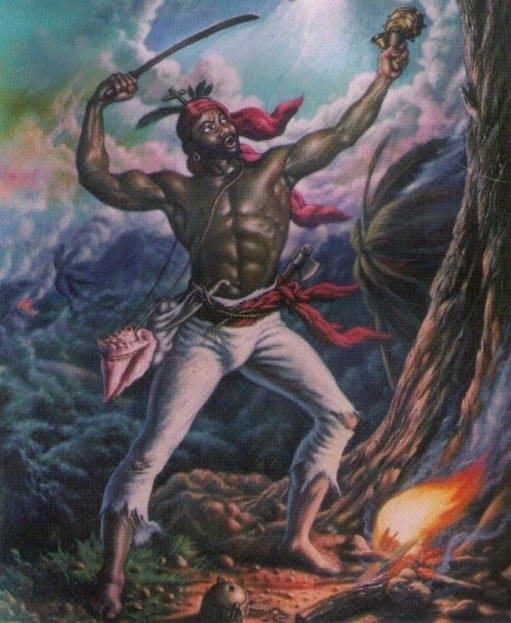
Boukman. Was he part of the “condemned to transportation” crowd smuggled to the French colonies? I suppose I can do some quick research to connect the timelines. But I have written enough. Take the baton from here if you feel compelled.

P.S. — A Guardian article written by Brown on Chief Takyi becoming a national hero. My favorite words of his from the piece –
As a professional historian, I weigh documentary evidence and interpret the past with great confidence. I am less certain of my authority to make the past accountable to the needs of the present...I am a historian because I am convinced that comprehending the legacies of colonial conquest, slavery and imperial warfare that have shaped our world is essential to our hopes to remake it. As a creator of memory, though, I know that the history we need doesn’t usually deliver the folklore that we want.
“creator of memory”