



We concluded Part 2 with the end of the Price dynasty (1670 – 1863). Funds were low, debts were high, and the market winds began to blow British priorities in other directions (i.e., focusing on what their other colonial holdings could do for them).
The long struggle of the Prices for survival was mercifully ended, and during the subsequent 65 years three fresh owners took up the hopeless task in turn.
In this piece, we will talk about two of those “three fresh owners.”
Despite some difficult years for the Price family and Worthy Park, acreage increased to 12,000 acres in Lluidas Vale. While that seems counterintuitive, it is worth remembering that the Price family was among the richest estate owners, meaning they were less likely to be the first to go when things got rough. As a result, the Price family took advantage of their less wealthy neighbors who did not have the means to maintain their estates during hard times. More bluntly, the Price family gobbled up every nearby estate to the east, west, north, and south of them.
This was less an indication of Worthy Park’s strength than of the utter decay of her neighbours…
The Price family’s asset purchases/efforts would still prove to be inadequate for saving Worthy Park. And via “The Encumbered Estates Act of 1854” and the establishment of the “Encumbered Estates Commission” in 1858, the plantation and all its assets would be auctioned off in what shaped up to be an unsavory outcome for the family. Here is how the estate was advertised –
The respective shares were eventually resolved and Worthy Park was first advertised for sale by auction in June 1862. Notices were sent out to merchants and brokers in London, Liverpool, and Bristol, in which the estate’s total acreage was given at 4,122, of which 230 were in canes and 620 in guinea grass. There was also a field of 50 allotments let out to the resident labourers at 8s. each per year. The average produce between 1856 and 1862 had been 235 hogsheads of sugar and 12,900 gallons of rum. The description of buildings listed many of those still found at Worthy Park a century later. The Great House was in good order, and in the main compound on its neighbouring hillock were the overseer’s residence, a range of stables, sheds, and stores and a ‘police station’. In the factory yard the steam engine and the main machinery for milling, boiling, and curing were now under one roof, though the water-mill, distillery, fuel house, and shops for carpenters, coopers, and smiths were separate. Elsewhere there were labourers’ cottages and ‘accommodation’ for fifty immigrants and thirty to forty ‘jobbers’. Mickleton was described as consisting of 623 acres of ‘common grass and brushwood’.
Initial bids on the assets were paltry. The first offerings were so bad that the estate was withdrawn from the market –
…first auction was one of £3,500, with £150 more for Mickleton.
The writing remained on the wall: assets may not sell for the meager values above, but it was going to be sold. And in the Summer of 1863, that sale was finalized.
But who picked up the asset? If you remember the marriage ties I referenced in Part 2, you may be able to quickly draw a conclusion. Okay, what’s your guess? Never mind, let’s get into it.
Enter the second ownership series of Worthy Park.
The estate was purchased by people with surnames/titles that are insanely British. I am convinced the purchasers announced themselves by these titles in public settings to reinforce status/stripes –
…Henry John, the 3rd Earl of Talbot (1803–68)…purchased Worthy Park to settle on his two younger sons.
I believe this roundabout language means that he purchased it for his two younger sons.
The auction was held on 23 June 1863, and although ‘there was a large attendance and considerable competition’ Worthy Park was sold to the Earl of Shrewsbury and Talbot of Belgrave Square, exclusive of stock, for £8,550. Mickleton was sold to one Michael Solomon for £300. The price received represented little more than an eighth of Worthy Park’s debts or a sixteenth of the value placed on the estate by Sir Rose Price in 1834; little more, in fact, than one year’s gross income during the management of George Price. Yet so depressed was the market that The Times reported that ‘The prices were considered good under the circumstances and showed a rise in the value of West Indian property.’
Here’s what Worthy Park shows on their website regarding the sale –

Quick recap (Talbots) –
Henry John purchased it for his two sons, Reginald Arthur Talbot (1841–1929) and Walter Cecil Talbot (1834–1904). Note: Walter changed his name to Carpenter. Feels random.
The two did not fully inherit Worthy Park until Henry John passed in 1870.
Ownership of, and investment in, Worthy Park was severely deprioritized during the Talbot reign. In fact, only Reginald ever visited the estate. At that time, owning a plantation chiefly dedicated to sugar production was difficult for a few reasons:
The British 1874 full removal of “import duties on sugar” did stimulate demand. However, the Brits became an increasingly ‘from wherever, from whoever, as long as it’s affordable’ trader, which did not ultimately favor their colonial holdings/Jamaica. Instead, nations like Cuba, “which enjoyed an infusion of foreign capital, cheap labour [slave population not emancipated], and large undeveloped fertile areas suitable for centralization,” were given more leeway to satiate the British increased appetite for the white gold; Fun fact – this was a thorn in the side of Louisiana sugar producers as well (i.e., Cubans satiating the U.S. domestic market and stealing market share), which we’ll talk more about at another time.
Beet sugar, from the likes of the Germans, began to flood the world market as an alternative sweetener to cane sugar.
We can therefore understand why, in pre-emancipated Jamaica (1834), there were 600 estates producing sugar. But by 1896, there were only 140. Jumping ahead, my bad, we need to focus on the Talbot era from 1863 until it changed hands.
The Talbots, like most other estate owners, attempted crop diversification. Pivot vs. continue to produce the loss-maker, normal thought process. It’s more accurate to say that they dictated the pivot to their managers (i.e., true absentees) to plant other crops, such as cocoa and banana. The bedrock of the plantation remained sugar, so production continued. They just needed some diversification insurance in the meantime.
In 1872, Worthy Park produced 257 tons of sugar and 206 puncheons of rum. Production continued to swing wildly from there: 1881, 420 tons, and 1886, 112 tons. Overall, between 1879 and 1899, their average tons produced were 301 per year from 373 acres (1.52% of the average total of Jamaican production). Worthy Park trends tracked against the prices they could obtain, and they had no incentive to go into overdrive given the lackluster market for sugar.
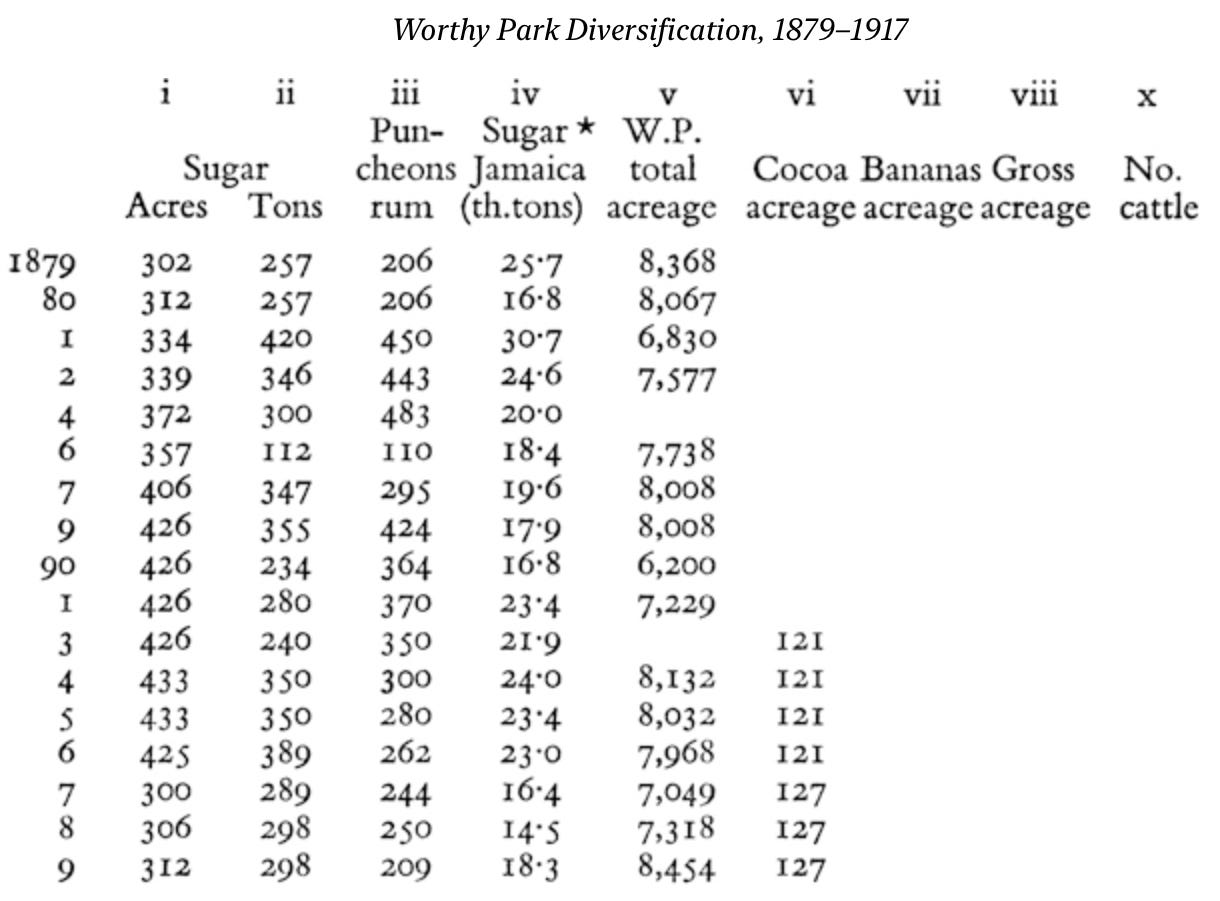
Interestingly, during these down periods of the global sugar market, the Talbots and many other Jamaican sugar estate owners turned to rum production instead. This liquid lifeline seemed particularly viable, with special attention paid to fulfilling the domestic market.
At Worthy Park throughout the Talbot and Calder régimes, as in the rest of Jamaica, relatively much more rum was produced than in earlier days. Between 1879 and 1899, the estate’s rum production averaged no less than 309 puncheons a year against 301 tons of sugar, compared with a production during George Price’s residence that was computed at approximately half a puncheon per hogshead. Since the price received for rum remained fairly steady at about 2s. 6d. a gallon, or £14 per puncheon, the income from rum represented an increasingly important share of Worthy Park’s total revenue, and in some later years actually exceeded the income from sugar.
The Talbots trudged along. In 1881, the Jamaican Government put Thetford up for auction and the family purchased it for £1,300, further consolidating Worthy Park.
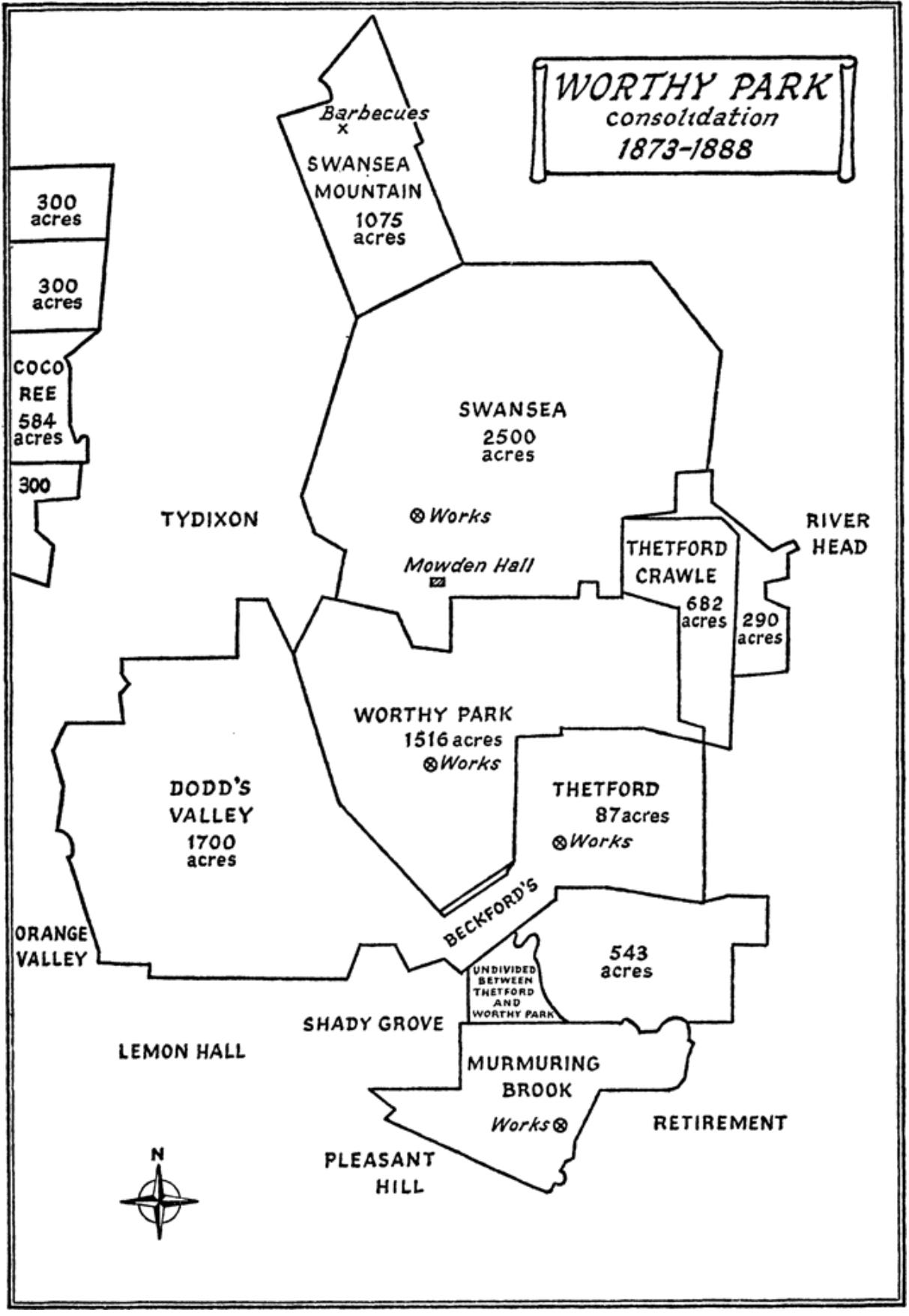
The Talbots sought another lifeline in coffee, attempting to grow it in the Swansea mountains. But increased production globally, particularly from Brazil, crushed prices and that diversification dream. Cocoa proved to be one of the better investments for the Talbots: in 1893, 121 acres of cocoa trees were planted and began bearing fruit in a few years.
Yet still, Worthy Park would not hold up; it’s the outcome we would expect from a (primarily) sugar-producing estate attempting survival through diversification. And, as will happen inevitably, the market became lopsided: in the 1890s, a depression hit. So, the Talbots did what the Prices had done, albeit in a much shorter period…much, much shorter. RIP to the Talbot era.
Who purchases Worthy Park this time around?
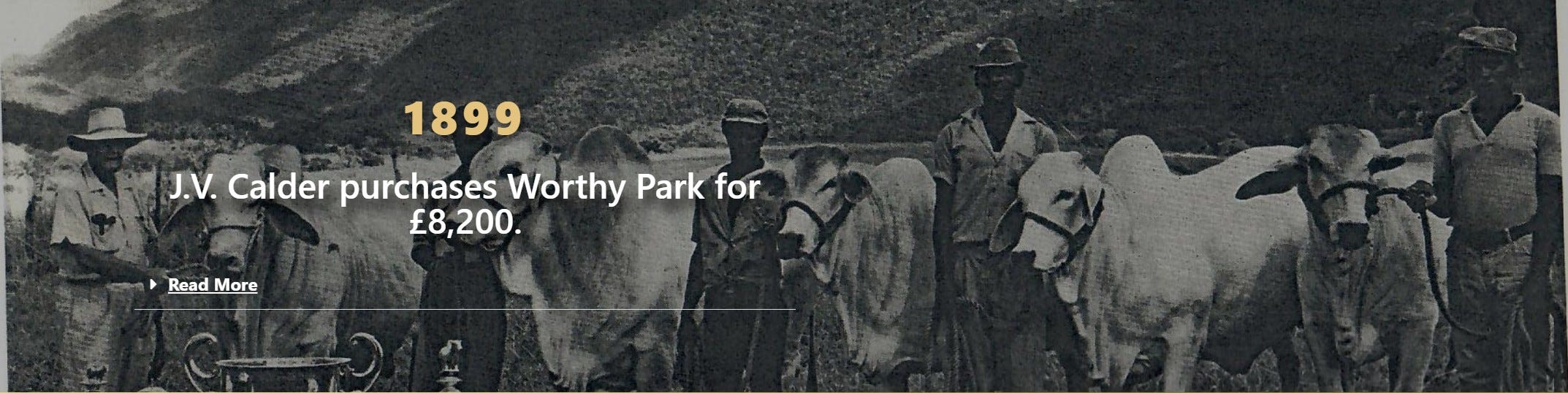
John Vassal (J.V.) Calder, a pen-keeper from Westmoreland “completely disillusioned with sugar production yet determined to make what he could from his splendid new property.” Sounds very…Hampden and Hussey family-esque. How much did Calder purchase it for in 1899? £8,200, which is less than the Talbots shelled out. That’s not good. Time doesn’t wait for anyone, so let’s March on to the 20th century. Before we do that, folks, the Worthy Park site’s depiction –
At this point in the Worthy Park journey, I realized Calder could have singlehandedly changed the entire profile of the estate.
It was not until the regime of J. V. Calder, however, that sugar became less than the major component of Worthy Park’s economy.
However, practically speaking, there was no way he could completely reverse the last two-plus centuries if there was still demand for Worthy Park sugar and rum, no matter how meager or bleak the global market trends seemed to be shaping up for Jamaica as a whole. With this in mind, Calder did not abandon ship, but he seemed to still favor the diversification binge started by the Talbots –
…by 1910 Worthy Park was the third largest producer of cocoa in Jamaica, with 300 acres. Throughout the First World War prices continued to be good, and in 1917 Worthy Park reached a peak of production with 400 acres in cultivation (exactly the same as area in canes). By that time, however, West Africa had started to produce cocoa in huge quantities under the aegis of the British chocolate firms, and with the end of the war came the end of the modest Jamaican cocoa boom.
So, Calder continued to pivot. He planted bananas next. In the age of America’s burgeoning United Fruit Company, this would have seemed a wise trend to jump on top of. You know what he never stopped doing (reminder, his original stripe is as a pen-keeper): growing them cows and providing meat!
‘The best customer we have is the butcher. The sugar planter comes next.’ – Calder
See what I mean by he could have tanked the sugar/rum operations?
By 1913, Worthy Park had upwards of 800 cattle, up from 200 – 300 at the end of the 1800s. You know what, Calder did have one thing going for him. He was not an absentee and never seemed to have left the island (as far as I can tell). He had no fallback in England like the Talbots and the Prices. Despite this, pressures from the market (mainly oversupply from alternative countries/sources, across crops) would continue to overbear Worthy Park, across their outputs (crops, cattle, and rum). This is why I continue to reiterate that market will trump individual effort more times than not. The one benefit that Calder did inherit, however, was a substantial estate/holdings relative to other plantation owners. It’s likely what kept Worthy Park from closure while others did not fare as well –
Although Worthy Park had reduced its costs to £8.15s. per ton of sugar and the same for each puncheon of rum (largely by reducing its total wage bill to £3,100 a year) the prices dipped below this in 1910. More and more Jamaican estates went under, until the total of 140 in 1896 was halved once more. In 1913, Jamaican production reached its lowest since 1711, with only 4,891 tons. Worthy Park continued to produce an average of 338 tons a year between 1910 and 1914, and in 1913 its 380 tons represented a record 6·9 per cent of Jamaican production; but this was probably merely multiplying her operational losses. A rum production which averaged 242 puncheons a year over the same period was little consolation since escalating imperial excise duties were increasingly pricing Jamaican rum out of the market. Cocoa and bananas were faring much better, but cattle, upon which J. V. Calder relied so heavily, suffered along with sugar, since the general depression priced beef out of the range of Jamaican consumers and the closure of estates reduced the demand for working steers to an unprofitable trickle.
Enter World War I. This actually benefited Jamaican sugar producers because European beet sugar production ground to a halt. The demand for rum (rations) for the British army increased, and Worthy Park, along with other estates, satisfied that demand. The sugar industry temporarily rebooted, and much the same happened with cocoa/sugar prices. And then life does that thing where it makes you understand that you are never in control. The great okey doke, if you will. In other words, Calder’s health did a 180 –
By now, moreover, J. V. Calder had had enough of Worthy Park and its problems. Worn out from overwork and isolation, his health broke down and, with three of his four sons off at the war he allowed the estate to slip into an even deeper state of dilapidation. In 1917, Calder was forced to go to New York for a serious operation and, sceptical of his own ability to carry on and of the chances of the wartime boom to survive the peace, he allowed the rumour to circulate that Worthy Park was up for sale. A younger, more resilient or resourceful man, or one with a greater emotional attachment to Worthy Park, would have gained heart from the conditions to carry on. But to J. V. Calder they merely presented an opportunity that might never be repeated, to sell out at a profit and enjoy a comfortable retirement.
And so, Calder did what he had to do: sell.
This is where we will conclude. In Part 4, I will take you through the last owners of Worthy Park that Craton and Walvin cover. That 4th owner/family still runs Worthy Park and has transformed it into one of the fan-favorite, darling rum companies of the island.
Stay tuned.
