



I know what you’re thinking: how dare I talk about another spirit? Rest assured, rum is #1. However, I’ll never balk at a glass of corn whiskey, preferably of the high rye variety.
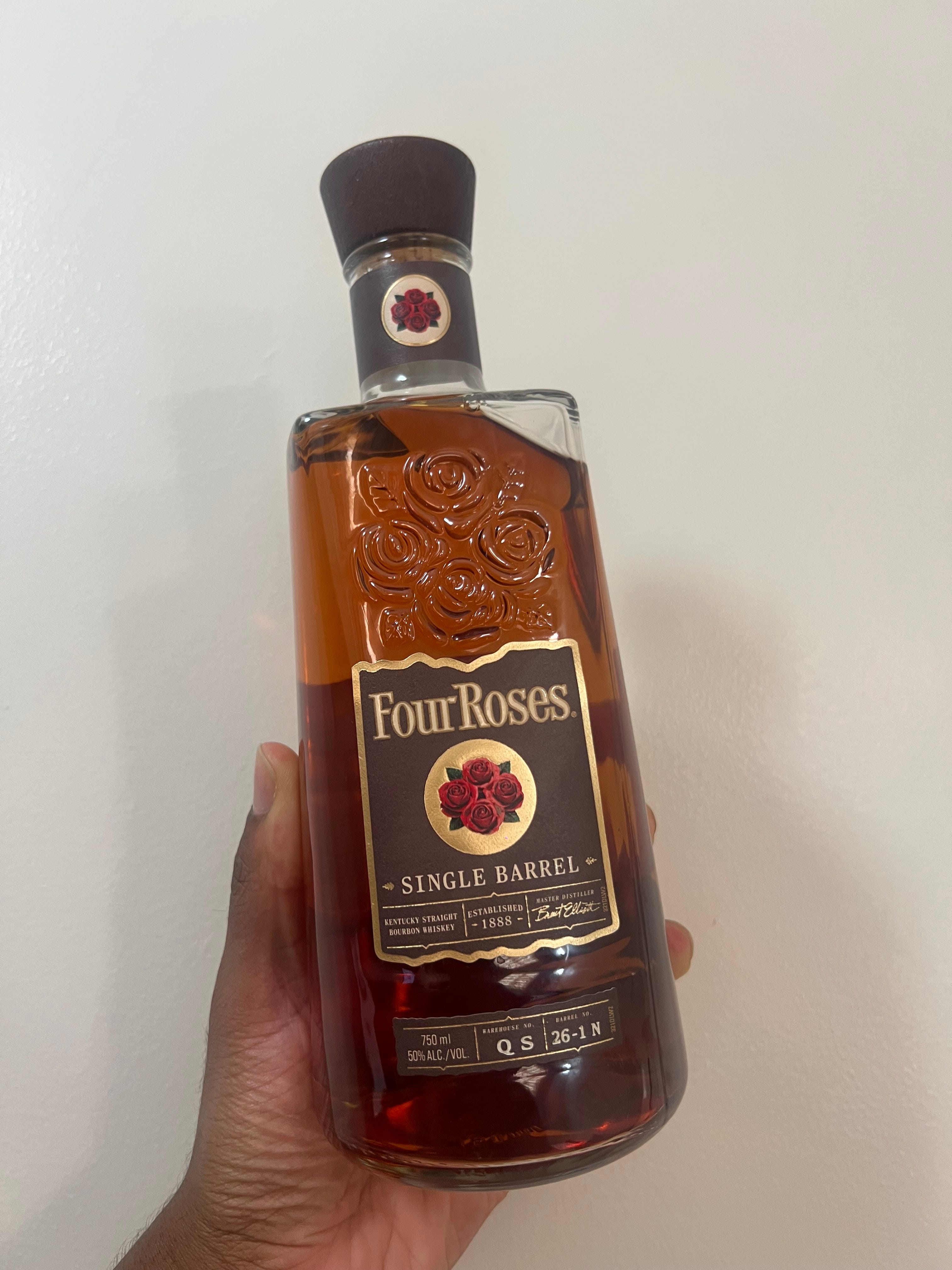
My taste preferences aside, what we are here to do is dig into the patriotic notion that bourbon is “America’s Native Spirit.” Generally, I’m okay with this sentiment insofar as products that instill national pride are a great thing. Give the people something to cherish and rally around, I will never argue against that.
Historically, however, singling out one beverage in a country this large is a bit myopic and incomplete. Fair warning: I’m going to gently tear that singular piece of paper up and reassemble it. The goal is not to be a contrarian. Instead, I want to help us shy away from accepting easy and simple narratives. Nothing worth its historical stripes/respect can be so easily simplified, though simplification is an easier way to inspire pride, create a tribe, and sell products.
In other words, I hope for a future where the American drinker realizes that there is more than one “Native” beverage, and we should have a pari passu nature to us about them. In highlighting “more than one,” my intention is not to orient you to rum more so than any other beverage.
I care more about opening eyes to the breadth of alcohols consumed in America’s earliest days. On average, it seems like we’ve been shoved into a language corner that’s only educated us to understand whiskey from a few decades before Prohibition, and then post-Prohibition. If the average person can quote historical whiskey truths from the Postbellum to Reconstruction era, you’re lucky. Antebellum era, you hit the jackpot. Early colonial days, they probably wrote a book about the beverage.
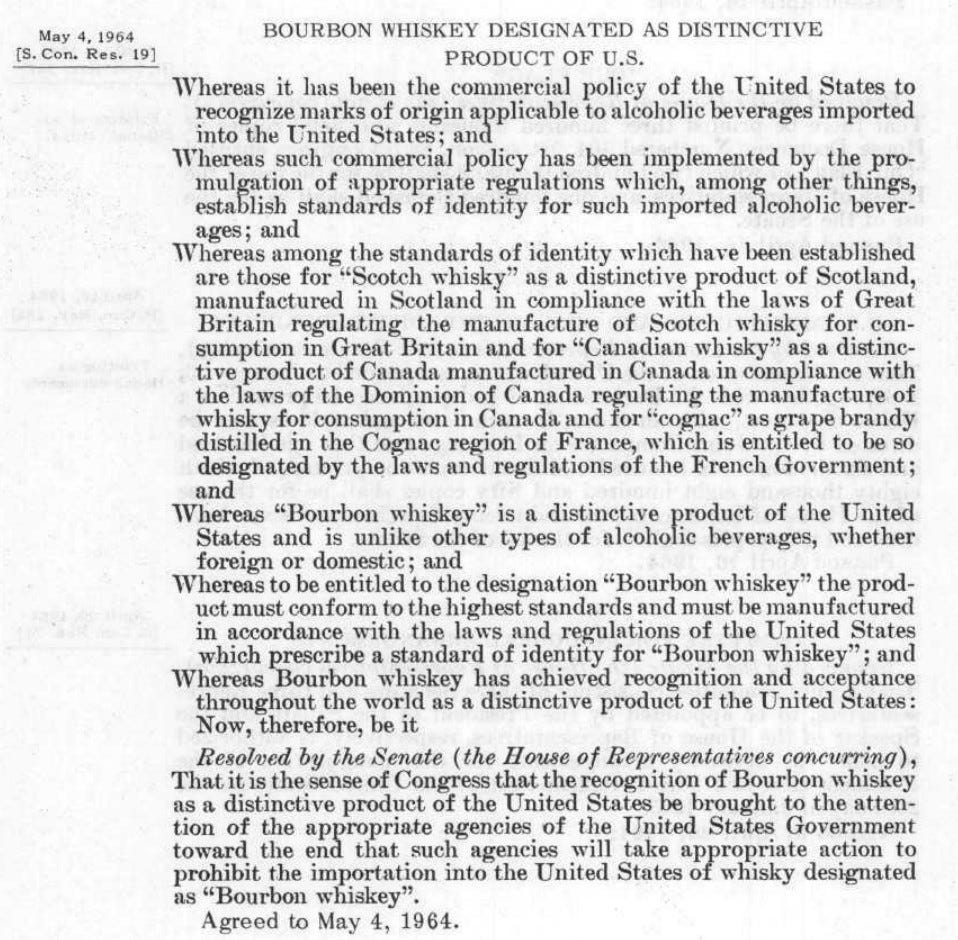
Note: Bourbon’s designation as “America’s Native Spirit” (or distinctive spirit of the United States) was legally recognized by Congress on May 4, 1964. For a beverage to be bourbon, it must follow these guidelines: (a) Made in the United States (not just Kentucky); (b) Made from a mash bill with no less than 51% corn; (c) The distillate must be aged in new, charred oak barrels (no used barrels); (d) The unaged spirit coming off the still can be no higher than 160 proof (80% ABV); (e) That pre-barrel spirit must be proofed down to no more than 125 proof (62.5% ABV) before placed into the new, charred oak barrel (e.g., can’t take the 160 proof from (d) and put it into a barrel); (f) You can’t bottle the final product at anything less than 80 proof (40% ABV); and (g) No additives are allowed (flavoring, coloring, etc.). While you’ll find these rules in every corner of Bourbon-land internet, here’s a list from Great Jones (NYC). Special mention is necessary for Bottled-in-Bond Bourbon specifications, which carry an extra set of rules that pay homage to the late-1800s legislation. If you’re interested in those details, check out the American Distilling Institute’s article.
Let’s take the historically accurate walk down American Whiskey lane.
Spoiler: rum will show up.


First things first, etymology.
The word “Bourbon” is VERY French and likely has a pronunciation closer to (Boh-buhn). “Bourbon” is not any old throwaway French word, quite the opposite. The eponymous French dynasty, otherwise known as the House of Bourbon, “provided reigning Kings of France from 1589 to 1792 and from 1814 to 1830, after which another Bourbon reigned as king of the French until 1848…” (source: Britannica). Importantly, the lineage traces back to “Louis I, duc de Bourbon from 1327 to 1342,” and is therefore one of the more important European ruling dynasties (i.e., descendants were kings/queens of Spain, Naples, Sicily, Etruria, and Lucca).
The popular historical narrative on why French words show up throughout America stems from France’s economic & military assistance in helping us get from under London’s boot (American Independence). As a thank-you, we named stuff after them (short list of examples):
L’Enfant Plaza (Washington, DC)
Paris, Arkansas
Paris, KENTUCKY
Bourbon County, KENTUCKY
LOUISVILLE (I mean, come on!), Kentucky
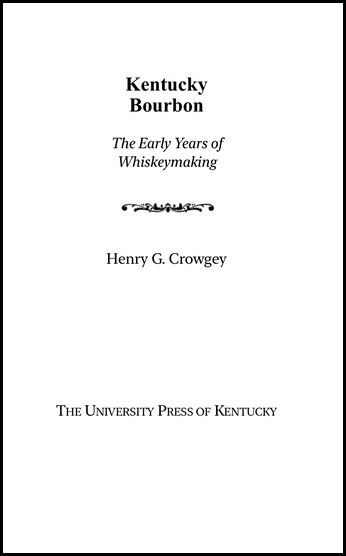
The origin of this word, insofar as it pertains to usage in the United States, dates from the Revolutionary War and the invaluable assistance rendered by the French, whose ruling house at the time was that of Bourbon. For a number of years the assignment of French names to the new towns and counties of the Kentucky area was prompted by what Lewis Collins termed “the plenitude of good feeling which then existed toward that nation.” – Crowgey, Kentucky Bourbon: The Early Years Of Whiskeymaking
This aspect of American Whiskey is largely de-emphasized. But I can’t help but think about the irony: “America’s Native Spirit” does not have an English name. The nomenclature feels peculiar in a more ‘first-world problem’ sort of way. All in all, given that the French take provenance and alcohol so seriously, I also can’t help but feel that this is a bit of a francophone victory since our brown juice is rooted firmly in their history. Practically speaking, the average Bourbon drinker either does not know this about our corn whiskey or simply would not care (which I understand, too).
Note: For more on the Bourbon & America connection, see my write-up on “Reconstruction in the Cane Fields: From Slavery to Free Labor in Louisiana’s Sugar Parishes 1862—1880.” You can imagine that the former French territory of Louisiana and the word “Bourbon” have a more tangible relationship than Kentucky does.
On to the book!
Kentucky Bourbon: The Early Years Of Whiskeymaking
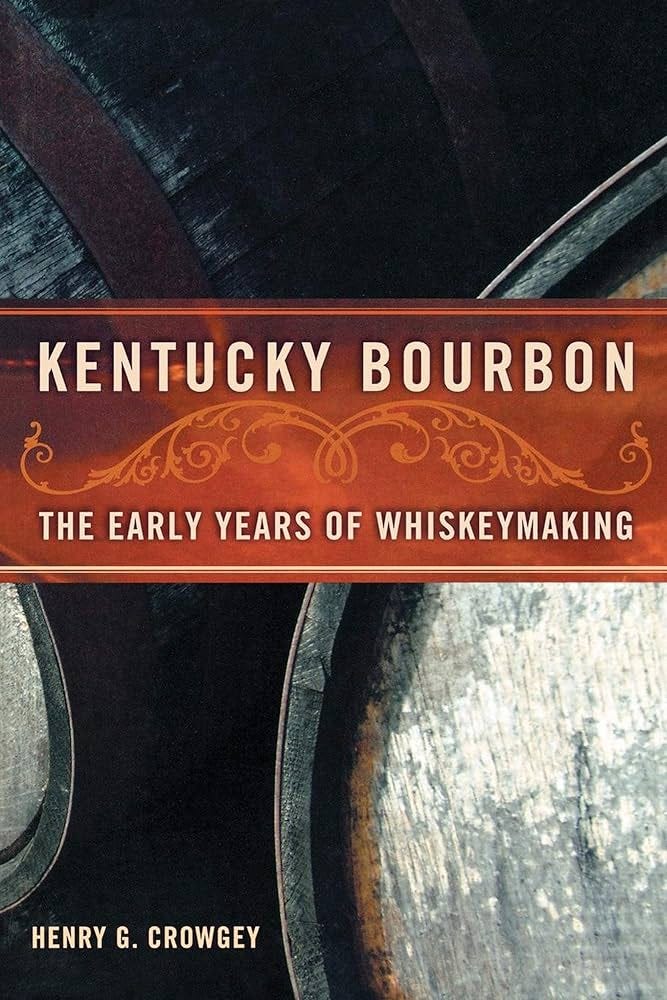
Let’s get right to it –
For the sake of sentiment and romantic tradition, it would be pleasant to record that a full-blown bourbon whiskey industry emerged from the limestone-layered soil of Kentucky at this time. However, the facts do not bear this out. The evidence suggests that, despite the taste of the early settlers for spirits, there was no such institution as a distinctive frontier beverage. The first few years of settlement were conspicuous for the introduction and use of a considerable variety of fruit and of grains other than the indigenous Indian corn. Accordingly, the distiller discriminated little in his choice of raw material and there was a corresponding lack of bias on the part of the consumer.
Furthermore, variations of “indigenous Indian corn” whiskey were “manufactured in America as early as 1682.” Name-wise, both whiskey and whisky appear in the records (interchangeably used). The naming convention was due in part to the fact that colonial denizens did not place spelling things correctly at the top of the priority list. But also, some of the European Old World-ers who contributed to early whisk(e)y production were from parts of Europe where “whisky” was the common spelling (e.g., Scots).
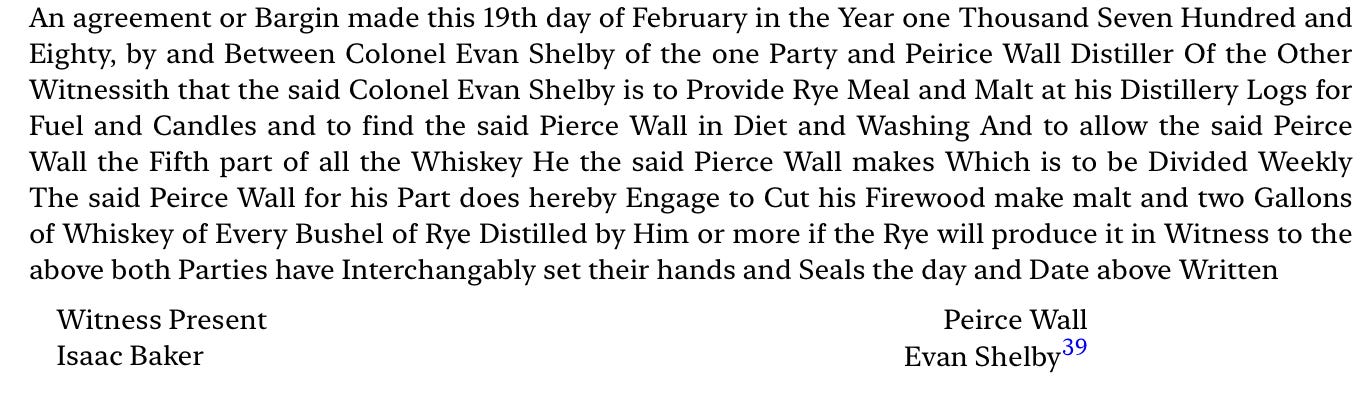
Let me piss off the Kentuckians early on before we continue, though this is not my intention. It would not be geographically accurate to note Kentucky (or even Tennessee for that matter) as the original stomping ground(s) of American Whiskey. Nor would it be accurate to focus solely on corn when “Rye Meal” and “Malt” were highly sought-after for distilling –
…Virginia, Pennsylvania, Maryland, and North Carolina. Here originated the interest in liquor, the equipment, and the techniques which later brought fame and prosperity to the Kentucky distillers.
Early days.
The author astutely notes that distilling know-how transferred from the Arab world (“Egypt and Moorish Spain”) to Europeans in the “twelfth century,” and “spread rapidly throughout the continent.” This know-how traveled with the British colonists “to the shores of America in 1607.” From there, the early colonists toyed with all sorts of agricultural raw materials to concoct spirituous liquids (e.g., fruit-oriented brandies were very popular, in part because fruit fermented more quickly than other raw materials). Other (crude brandies) whipped up used pears, apples, apricots, and figs. In many ways, I believe this is a nod to Portugal and Spain, since a) they were among the earliest colonizing nations (and their “stuff” was therefore held in high regard, hence the love affair with “Madera Wine”), and b) they established a commercial understanding in the transatlantic trading world that wine and brandy were viable as currency.
Most of these fermentable wine/brandy/beer experiments notably failed, given the colonists’ poor understanding of the new environment and its growing conditions. Also, they had a novice understanding of distilling apparatuses. For an early reference to corn spirit, which I’m reading as something closer to beer than distilled spirit, here is a preview –
By 1620, one of the colonists could write to a friend in England that they were making a drink from Indian corn which he preferred to English beer.
This is where I spoil the party before getting us back on (whiskey) course. In the earliest days of the English American Continental Colonies, rum became much more dependable than other beverages. Cane spirit was currency, dietary staple, and a product of value in the Atlantic community. New England/the eastern seaboard led the charge (circa 1600s through 1700s, emphasis mine) –
The seventeenth century marked the establishment of distilling in the other Atlantic colonies as well. Traditionally, New Englanders are considered to have specialized in rum manufacture…A legal transaction of 1654 in Boston establishes William Toy as being a distiller. The historian J. Leander Bishop reports that by 1661 a still and worm had been set up in New London “for distilling rum from the molasses procured there in exchange for the exports of the Colony.”
The inventory of a York County, Virginia, store (1667), following the death of the owner, showed that among the contents were “one hundred gallons of brandy, twenty gallons of wine, and ten gallons of aqua vitae.” An account of Governor Spotswood’s crossing of the Blue Ridge Mountains provides some indication of the selection that was available to the Virginians in 1716: “we had several sorts of liquors, viz., Virginia red wine and white wine, Irish usquebaugh, brandy, shrub, two sorts of rum, champagne, canary, cherry, punch, water, cider, &c.”
To be fair, “Irish usquebaugh” (usquebaugh, the Gaelic word for whiskey) is also a very good indication that those from the Old World sought satiation from their motherland, despite being in a New World. Unsurprisingly, many of those same people would go on to have a hand in what would later be known as true, American Whiskey. And they would use the grains they knew best (i.e., malted & unmalted barley).
Bringing us back to American Whiskey predecessors, below is evidence of its manufacture in New Amsterdam (Dutch), which later became New York (British) in 1664–5. Attention to grain mash bill would, again, not be of vital concern among groups of people operating under precarity and scarcity (emphasis mine, and I promise that this is how things were spelled back then) –
Edward Emerson places the operation on Staten Island and identifies the product as liquor and spirits from corn and rye. Bishop locates the distillery in the Wall Street area and states that it produced brandy. Both consider this as the first instance of its kind in North America and the date of its establishment as 1640.
The misuse of distilled products is apparent in the recommendation of a Delaware-area official, submitted to the New York governor in 1671: “That y’ distilling of Strong Liquors out of Corne, being y’ Cause of a great Consumption of that Graine, as also of y’ Debauchery & Idleness of y’ Inhabitants, from whence inevitably will follow their Poverty & Ruine, bee absolutely prohibited or restrayned.”
In the Carolina settlements (chartered in 1663), the early population was derived principally from Virginia and the settlers followed the patterns set by older colonies. In 1682, Thomas Ashe visited the Charles Town area of the Carolinas and reported on the use of Indian corn in producing alcoholic beverages: “At Carolina they have lately invented a way of making with it good sound Beer: but its strong and heady: By Maceration, when duly fermented, a strong Spirit like Brandy may be drawn off from it, by the help of an Alembick [still].”
All this debauchery was reportedly (and mainly) the modus operandi of men on the lower end of the socio-economic spectrum. The wealthy colonialists often drank imported beverages (wines), whereas the common folks drank the things they could grow. Choice of drink was reflected in the prices of products, which the author does a fantastic job highlighting: whiskey was cheapest, and all the imported beverages (grape-spirit, cane-spirit, etc.) were higher priced and therefore reserved for the well-to-do.
Even so, those with the apparatus and means to distill whiskey had worthy assets in the context of what was of value in colonial settings. Some were more rudimentary than others, granted, but we shouldn’t simply write off the farmer-distiller as entirely parochial, since a meaningful amount of their wealth was rooted in assets/hardware –
In these colonial settings, the culture and economy were rural at best and often backwoods in character. Hence a still and its necessary appurtenances, representing a considerable monetary investment, might comprise the single most valuable asset in a person’s worldly estate. This is evident in the wording of another western North Carolina will of pre-Revolution days: “I leave the still for the benefit of the family whilst my wife keeps house with the children.”
The early colonists also used spirituous beverage as currency & weapon when engaging with Native Americans. The author notes that the “naive aborigines” / “gullible natives” were given spirit as “partial payment for labor performed,” among other exchanges. Eventually, the British crown sanctioned this practice –
A Virginia law of 1705 provided a ten shilling fine “for every quart of rum, or brandy sold to any Indian.”
To highlight the frequency of the practice, the British passed another law in 1757, attempting to curtail the engagements. Repetitive passings of ordinances were so common across every facet of the British-American colonial relationship (i.e., colonists ignored laws, so the British passed another one, hoping for compliance, usually to no avail).
Note: The author bounces around a bit from the 1600s through the 1700s, likely because the historical archives are disjointed. So, apologies for the non-linear telling.
A colonial tradition adopted from England was the practice of treating during voting season, whereby elected officials freely distributed spirits to voters for reasons that are probably obvious. Apparently, George Washington engaged happily in treating voters with “brandy, rum, Cyder Royal, strong beer, and wine.” Personally, the records indicate that GW was a big “peach brandy” distiller (for “home consumption by the family and slaves”). He later turned to whiskey for commercial purposes. All in the rum world knows that he imbibed the Barbados cane spirit enthusiastically.
Crowgey fairly notes that elected officials were almost guaranteed to lose an election if they did not provide booze. This tippling practice carried over into the American Revolutionary War in the form of treating soldiers (liquor rations). And in a time of war, the grain ordinarily used to make whiskey was seen as more necessary for feeding troops than making liquor. Other beverage production remained uninhibited. Let’s take a look at Prohibition and World War I predecessor practices of clamping down on whiskey manufacturing (emphasis mine) –
In 1777 General Washington wrote that “some of the Southern States have already passed Acts prohibiting the distilling of unreasonable Quantities of Wheat and other Grain into Whisky, and I hope Pennsylvania will do the same.”
Wartime limitations on raw materials for liquor applied only to grain; brandy distilling continued to flourish, as did rum. The manufacture of rum was carried on in several states (exclusive of New England) both before and during the Revolution. In Charles Town, Maryland, a versatile coppersmith operated a distillery where, in 1753, he made and sold “Rum as good as any on the continent.” In nearby Baltimore, fifteen years later, the Purviance distillery suffered a temporary breakdown which made them unable to supply “half the home demands for rum.” A Norfolk, Virginia, rum distillery was owned by eight partners…”
We know how this story goes. American colonists win the war, and the mass Westbound journey (of mostly men) to Kentucky and Tennessee continues, mainly through the Cumberland Gap.
On to the Bluegrass State.
The largest crop of “settlers,” and most likely to have retained whiskey-distilling know-how, were Virginians, Pennsylvanians, and Marylanders (the Mid-Atlantic crew). It’s worth noting that many flocked to Kentucky before the American Revolution. And the author correctly notes – get ready, this is going to take some explaining – that the early travelers were afraid of the Native Americans they encountered along the way. To not mislead (i.e., suggest that the Natives were the aggressors), let me explain:
→ At this juncture, the Native Americans, across many territories, were used to encounters with the Europeans/later Americans.
→ Many of these prior encounters resulted in, as we know, massive amounts of pillaging, death, and stolen territory. In the context of colonial European jockeying, it also resulted in alliances (i.e., England-Natives vs. France-Natives, most often).
→ This new set of settlers making their way westward would have been in a very precarious (“frontier”) scenario, where open-season-style attacks on the band of travelers would have been commonplace.
→ The author refers to them as “merciless savages.” But I believe that a more non-partisan perspective is that the Native Americans were enmeshed in constant states of warfare/defense. Any new entrants to the picture would be viewed immediately as adversaries.
→ Often, troops were assembled for coordinated efforts against the Natives. But also, trading with the Natives, a sort of appeasement strategy, in whiskey (and other spirits) was prevalent.
Whiskey was as useful as money, for which it frequently served as substitute in frontier commerce.
Although the seal on westward travel was broken after the American Revolution, I believe it is worth honing in on the examples of those who went before 1776. Here is an example of a family successfully making the journey –
Among these settlers were distillers such as William Calk of Prince William County, Virginia, who went to Kentucky in 1775, finally settling in present-day Montgomery County. The Calk family holdings, at the time of his departure, included a grist mill and a distillery. On his way through the southwestern part of Virginia to the Wilderness Road he noted the following in his journal: “Wedn: 22d we Start early and git to foart Chissel [Fort Chiswell] whear we git Some good loaf Bread & good Whiskey.””
Another early figure (and pre-Revolution example), Colonel Evan Shelby, father of the first governor, moved his family from Maryland, operated a general store/tavern/inn (Shelby’s Station), and a distillery. Notably, Sr. Shelby sold that good old…rum (emphasis mine) –
Of particular interest is an entry [Shelby’s account book] for January 26, 1773, which records Boone as having purchased, on credit, “2 Quarts of Rume” at three shillings each. Some indication of frontier mercantile practice is provided by an additional entry which shows that Isaac Baker furnished 621/2 gallons of rum to Evan Shelby at ten shillings per gallon, which allowed the modest resale profit of two shillings on the gallon.”
To the modern Bourbon eye, it may feel incredibly strange ruminating – sorry, I could’ve used a different word – on sugarcane spirits having any early association with THE whiskey state. But so it was, my friend, so it was. However, whiskey maintained –
Cresswell noted his visit in June of 1775 to the camp of Captain Willis Lee (a surveyor) “who treated me very kindly with a dram of Whiskey.”
We can have both. Fair?

In Bourbon land, the lore usually goes that Evan Williams (1783) or Elijah Craig (1789) can be considered the “father of Bourbon.” My only question about those assertions is on what criteria is “father of Bourbon” being judged? If the criterion is who was distilling and barreling the whiskey in a way that is most similar to contemporary Bourbon, maybe there is an argument there. But it would be damn near impossible to convince a discerning reader that they were remotely the first to distill corn whiskey (as you’ve seen from the 1600s through the pre-American Revolution period). More importantly, we must always remember that these assertions are rooted in what was documented/recorded, and who had the capabilities & motivations to do so. In other words, there are likely many faceless farmer-distillers of the brown juice that are contenders in the “father of Bourbon” race. Crowgey on the matter –
A few writers and historians are even wider of the mark—one designates as the first distiller Elijah Craig, who didn’t arrive in the area until 1786; another maintains that “the first still in Kentucky had been set up in 1789.” This procedure, at best, relegates to limbo an eight-year period of time (1775–1783) during which the settlers had done absolutely everything necessary, with regard to both facilities and materials, to be actively engaged in the production of spirituous liquors.
In other words, liquor production was as mundane as soap making and crop growing. The settlers made use of their excess if they had the means and equipment to do so. Moreover, to plug the gaps in the timelines above, the author notes that “[a]t least two copper stills, with a capacity of forty gallons each, were brought to Kentucky on horseback prior to 1781.”
One of the more interesting analyses the author engages in is the examination of tavern rates as a means of understanding (a) the prevailing drinks of the time, and (b) how alcohol was priced. These prices were usually set by courts convened to establish the going rates for different spirits. A sort of predecessor to the three-tier system, establishing checks and balances. This practice was “prevalent in Virginia and other colonies,” so it was largely brought over and refitted to Kentucky. For example, in “Westmoreland County…southwestern Pennsylvania” (1773), there were listed prices for “whiskey, continental rum [homegrown], and West India rum, with the latter spirits priced some 50 percent higher than the others.”
This is where I interject with a healthy reminder that some items become symbols of national pride over time for no other reason than that they were an economic decision that bore fruit. In other words, if it were not cheaper to grow/consume grain whiskey (especially corn), it is not necessarily guaranteed that we would be where we are today. Said differently (emphasis mine) –
Several factors favored an emphasis on corn production and the use of any surplus in distilling. To begin with, corn was an indigenous grain; it provided an ideal, perhaps the best, initial crop for newly cleared land; it furnished food for both the settlers and their animals; it yielded considerably more per acre than did the smaller grains; and finally, with the possible exception of rye, corn mash offered an unmatched output of distilled spirits. For these reasons and regardless of vague product descriptions, corn was a significant factor in whiskey production from the onset of permanent settlement in Kentucky.
“Indian corn is here in general the basis of whiskey, and more often employed alone.” – A work published in Lexington, Kentucky
But remember, in those early days, the residents of Kentucky maintained a more open-minded palate disposition (emphasis mine) –
Listings in 1780 included West India rum, rye whiskey, peach or apple brandy, and continental rum; the prices similarly reflected transportation charges, and the varieties indicated local demand. Rye whiskey, being the cheaper, was undoubtedly made in the immediate area, with Colonel Evan Shelby perhaps supplying a significant amount.
The revised rates of 1779 reflected additional influences on sales of distilled spirits. Both an emphasis on quality and the wartime inflation of currency are evident in the following: “good rum at [£] 4. per gal…. good rye liquor full proof at [£] 2.s per gallon peach brandy at [£] 3.”
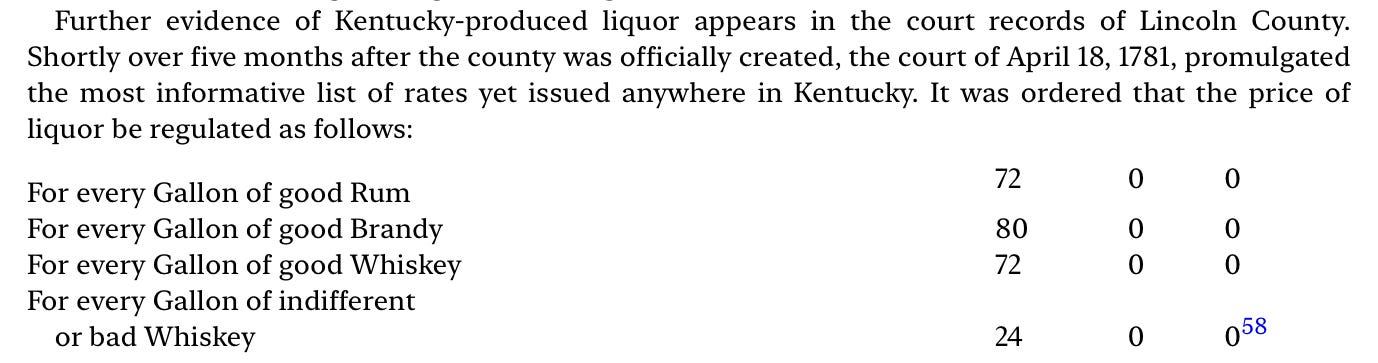
Availability of price, even for “indifferent or bad whiskey,” suggests that there was no shortage of distillers in Kentucky by that period (1781). Coming back to the ‘who started this thing’ conversation, the author offers a candidate –
Records of individual involvement in aspects of the liquor business, while not completely conclusive, are useful in identifying pioneers of the distilling industry. One man who has some claim (backed by recorded evidence) to being Kentucky’s first distiller is Marsham Brashears. It will be recalled that he was a signatory to the article constituting “burrough” government for Louisville; he was also one of the original trustees named at the incorporating of Louisville. On a deed, proved and recorded May 7, 1782, Brashears purchased 660 acres of land from Benjamin Pope and James Patten. The consideration was “165 gallons of good merchantable Whiskey, this day delivered by Marsham Brashears.” As locally produced spirits were a universal medium of exchange on the frontier, this transaction strongly suggests that Brashears himself had manufactured the whiskey.
“[B]acked by recorded evidence” are the operative words here. The point Crowgey is hammering home is that pre-1783 distilling was alive and well in Kentucky. By 1784, the population was hovering around 30,000 residents, all thirsty.
Whiskey refinement.
Some people are of the mind that the further back you go, the better the whiskey. I think the conversation requires a many-fold approach, but here are some quick thoughts:
Insofar as recognizing that spirits are fundamentally agricultural products, it is not unreasonable to suggest that cleaner inputs (e.g., no chemical use) likely produced cleaner, tastier outputs (spirit).
Hardware and still technology is another argument on both sides (e.g., today’s equipment is more productive & technologically savvy, but stills from back then may have stripped out less flavor).
Care and attention (back then) vs. purely profit-driven motivations (today) could have led distillers to produce better spirits. That feels a bit romantic, given we have prices for “indifferent or bad whiskey,” which is to suggest that cash was always top of mind.
And on that last point, whiskey as currency is something worth highlighting again –
A Fayette County landowner, Benjamin Carruthers, inserted a notice in 1790 which referred to his bond for 327 gallons of merchantable liquor, used as payment in a land purchase.
Whiskey quality would have been a key consideration because good-quality juice translated into more currency/higher-valued assets to barter with. Many of the Pennsylvania transplants were “Coppersmiths of the Quaker State,” and brought with them hardware and know-how to distill whiskey. This knowledge was passed along and became integral to the territory’s way of life. In short order, we see stills included in the lists of items for sale in packaged asset auctions (e.g., plantation, stills, whiskey stock), primarily listed in newspapers.
Kentucky became a state in 1792, let me throw that out there before I forget. Before this, it was part of Virginia, hence the deeper connection there. By the 1800s, the introduction of steam – similar to what happened with cane mills across Louisiana – played a vital role in improving distillation capabilities across whiskey producers. By 1815, using steam across distilleries was pretty firmly entrenched, give or take. Inevitably, production skyrocketed alongside mechanization/technology improvements –
Judging from the quantities that he listed in public notices, one of the largest operators of the day was General Green Clay of Madison County. On one occasion he featured 3,000 gallons of whiskey and four barrels of seven-year-old peach brandy. Some two years later the general’s advertisement included “ten thousand gallons of Whiskey, Brandy, Cider, and Cider-Royal.” Following Clay’s death in October 1826, a part of his estate was disposed of through a public sale; included in the inventory were “2 or 3000 gallons prime old whiskey, 1500 gallons old apple brandy, one steam and two copper distilleries.”
Most importantly, this signaled the death of the farmer who also distilled, something that is (still) incredibly prevalent across other spirit categories in many parts of the world. Today, farm-to-bottle Bourbon producers (i.e., distillers that are also corn/grain farmers) are a mighty minority. The business has gotten too big and industrialized. As the nineteenth century was off to the races, the artisan-distiller was left behind –
The passing of the small-farmer distiller was not immediately at hand, but his chapter in the making of Kentucky history was written and finished.
Crank up production, there’s money to make.
With the ever-increasing value that brown liquor commanded, more and more was produced. Beyond serving as a firm medium of exchange, the use of spirituous beverages for medicinal purposes was a long-cherished colonial practice, which sustained in Kentucky. Only this time around, Americans began to get a bit more ‘we’re not drinking anything that reminds us of the enemy’ in their tone –
“… resolved to discard the unmanly fondness for the tinsel of European luxury and foppery … and after first day of February next, except in case of sickness, use any wine, rum, brandy, or other spiritous liquors which shall not be made within the District of Kentucky.” – Citizens of Danville [KY] drawing up resolutions
This disdain for the British is part of the reason that rum began to fall out of fashion in the (newly) American psyche. To reiterate, however, the primary reason that stands above all is that grain growing stretched (i.e., whiskey, food, etc.). So, the economic route would inevitably take precedence over all else. Case in point –
“Resolved, That the present circumstances of the District are also adapted to the brewing of malt liquors, and to the distilling of spirits from grain and other subjects in such quantities as with proper attention and encouragement would be sufficient for general consumption.” – Citizens of Danville [KY] drawing up resolutions
Further encouraging increased production was the “volume of whiskey traffic on the Ohio and Mississippi rivers” into the 19th century. As “tobacco and whiskey” became the dominant “export crops from the interior of Kentucky,” a firm industry began to form around the ecosystem –
During a three and one-half month period at the beginning of 1801 almost 50,000 gallons of distilled spirits, with an aggregate value of almost $29,000, were entered for exportation at the Louisville Custom House. Somewhat over a decade later, a sizeable increase in this traffic had been noted. Zadok Cramer reported “receipts from the upper country” of 3,671 barrels of whiskey (considerably in excess of 110,000 gallons) at New Orleans for the first five months of 1812.”
Note: New Orleans is a fresh new American territory/state, so Kentucky had another thirsty market to send liquor on down to.
Contrary to what you may believe, the original whiskey territories were still producing more booze than Kentucky at the turn of the 19th century –
Many states which produced significant quantities of distilled spirits in the period had adequate access to Mississippi River commerce. For example, in 1810, when Kentucky produced 2,220,773 gallons of distilled spirits, Pennsylvania produced 6,552,284 gallons; Virginia, 2,367,589 gallons…
Note: I’ve bypassed the history on excise taxes, Whiskey Rebellion (1794), etc. Crowgey provides solid detail on these items, but I recognize that these tales are told more often. If you’ve never heard of what I am referring to, here is a quick snippet:
Post-American Revolution, Washington realizes that nation-building is hard work.
He also realizes that he has massive war debts that need to be paid somehow.
Of the many things he taxes to raise funds to pay down war debts, liquor is one of them.
PA leads the charge on rebelling against the taxes; the death toll is very low.
Government repeals the excise taxes (for now), and Kentuckians rejoice.
“The citizens of Kentucky felt indignation on the passage of the laws laying those duties—they experienced the baneful effects of their operation, (particularly the excise and stamp laws) and they rejoiced in their repeal.—In the evening the Lexington Light Infantry paraded and fired seventeen vollies of muquetry [sic]— the bell rang a joyful peal—the bonfires blazed—shouts rent the air &c. In due time the citizens retired to their respective homes in perfect harmony.” — Gazette, July 2, 1802
The distinction of being labeled “bourbon.”
As production increased in the 1800s, and the nation purchased more of the whiskey produced in Kentucky, people recognized the beverage’s commercial potential. And that is how the self-perpetuating cycle began. In other words, the notion of “a distinctive regional distillate-bourbon whiskey” was beginning to take hold, long before any formal naming assignment. Kentucky was increasingly singled out for the whiskey they were distilling. A product of regional specificity, if you will.
The days of expediency for “frontiersm[e]n and Indians” were vanishing, as different commercial incentives arose. Alcohol proof was an early qualifier, so that became more heavily scrutinized. Other rudimentary quality assessments (alongside proof) became a reality for producers. For instance –
In 1796 the Lexington Gazette published “infallible and simple” instructions for “all purchasers of distilled spirits, who do not know how to prove the strength of them”: “Take half a pint of spirits in a cup or tumbler, take a small quantity of clean cotton, lay it as light as possible on the surface of the liquor; if your spirits be good proof, the cotton will sink immediately to the bottom; add a little water to it and the cotton will rise.”
In my opinion, this culture of assessment is a predecessor to what (today) has become a discerning drinker’s social norm (i.e., scrutinizing quality based on a given set of metrics); people were given a vocabulary to judge spirits, then and now. There is a legacy of scrutiny that has become part of the modern-day lexicon for certain imbibers. Here is an example of where this fervor comes from (in the American Whiskey context at least) –
With the official adoption of federal guidelines for defining the alcoholic content of spirits, there “followed a definite increase in the use of “proof” as a commercial standard of quality in Kentucky whiskey. Advertisements of both whiskey and brandy, heretofore rarely distinguished by descriptive allusions to actual content, shortly began to include designations of quality such as “full proof,” “good proof,” and “well tested.” In order to more fully describe their products in 1825, the Union Mills of Lexington categorized their whiskey as “fifth proof and common proof.”
Another term that began to take fashion was “Old whiskey,” to distinguish from “common” whiskey. For example, “[i]n 1814 the Mauray firm of Louisville advised the public of both “old” and “common” in their description of rye whiskey.” The Lexington Gazette began carrying advertisements for whiskey that was age-stated (e.g., “John Stickney’s notice of seven-year-old whiskey for sale. In the following year (1819) Stickney modified his claim slightly by advertising “Whiskey at 9s per gal., said to be 7 years old.”).
What also naturally followed, since people were now firmly on the ‘distinguish my whiskey train,’ was an emphasis on the selection of raw materials, what proportions were being used, etc. A call for corn, among some, became a firm distilling decision. Which also highlights, again, that the distiller and farmer relationship was increasingly split into two worlds –
In 1833 the Lexington distillery of Daniel and Henry McCourt notified the public that they wanted “Corn, Rye and Barley, for which the highest market price will be given in cash—to be delivered at the Distillery formerly occupied by Mr. Benajah Bosworth, one mile from the city, convenient to the Railroad. N. B. Yellow Corn would be preferred.”
Remember, “corn whiskey” production goes back “as early as 1682,” maybe even earlier, and had kept pace “from that time until the distinctive name “bourbon” became an accepted type-description.” But understanding when and why it became known as “bourbon,” versus simply “whiskey from Kentucky,” is why we are here. And so, here you go –
The first known advertisement featuring the distinctive Kentucky product appeared, and fittingly so, in a Bourbon County newspaper for 1821. The Maysville firm of Stout and Adams used the Western Citizen to publicize “BOURBON WHISKEY” by the barrel or keg. The use of this nomenclature was to remain almost completely local for the next several years, but by 1840 the use of “bourbon” in identifying this delightful whiskey had become a statewide practice. In Lexington, Ben Crutchfield’s grocery store, located on Main Street, published the most comprehensive listing (to date) of wines and liquors available in the Bluegrass. Included in the latter group, and attesting to the status recently achieved by the Kentucky product, were Cognac Brandy, Jamaica Spirits, Holland Gin, Irish and Old Bourbon Whiskey.
Ben said, “I know we have our Bourbon and all, but that Jamaica Spirits [rum] is still good money over here!”
This use of the term “BOURBON WHISKEY” evolved from simply identifying “deserving distillers” to the formation of brands/recognizable names. Local merchants & companies, such as “Spear’s and William’s Old Whisky by the Barrel,” began to garner reputations for themselves as brands (in the more contemporary sense). Between the 1820s and 1830s, we see “auction house notices” indicating monikers of “Spear’s Prime Old Whiskey” and “Speaer’s Old Whiskey,” surely indications of perceived/actual quality. All in all, by mid-century, “Old Bourbon Whiskey” became a distinctive identifier (and price inflator) for what was considered higher quality juice. Another example praising one Solomon –
An announcement in 1850 provided the perfect example of merchandising a distiller’s reputation: “Old Bourbon Whisky at Auction. I will sell, on the public square, on the first Monday in December next, 15 barrels of Old Bourbon Whisky, made by Solomon Kellar, one of the best Whisky makers in the world, and this lot not to be surpassed by any.”
An important takeaway is that (initially) “Old Bourbon” was first and foremost to indicate that it came from “old Bourbon County,” not to signify anything else. Pre-Civil War, some would simply reduce the ‘this is where it’s from’ labels to “O B.” By the 1840s onward, though it was still widely used, we see a number of whiskey manufacturers begin to drop “Old” and just use “Bourbon.” It seems that, by mid-century, it was well established where the whiskey was coming from. No need to use the extra signifiers.
Thomas Eales of Paris [Kentucky] notified prospective customers in 1854 that “I have for sale 150 barrels of superior copper distilled Bourbon whisky, from one to six years old.” Four years later another company of Maysville, R. H. Newell, featured “1000 Barrels Bourbon Whiskey, 1 to 4 years old.” In this development, Kentuckians were fortunate in that a Kentucky place-name became synonymous with a widely respected product.
For the Bourbon enthusiast among us dying to know whether today's barrel specifications were used back then (i.e., charring of the oak), I got you covered. The simple answer is that it would have been a matter of personal preference versus adherence to any strict guidelines. Crowgey goes to great lengths to affirm that charring of barrels was by no means standard, and certainly not widely practiced. This is a really important point because a purist would have to ask themself the question, “Would the earliest whiskeymakers & coopers approve of how the product is produced today?” Has the core/DNA changed too much? Speaking-to-the-dead aside, this is not to suggest that there aren’t references to something in the wheelhouse of new, charred oak in the Antebellum period –
“seasoned heart of white oak barrels” – Lexington Gazette, 1820
“seasoned heart of white oak barrels full hooped” – Lexington Gazette, 1820
But to satisfy the purists, I will not withhold the closest we come to this reference –
“Be very careful to have them well burnt or shaved inside, so that not a blister remain, for if any of these blisters should remain on the inside of the cask, a portion of the contents will insinuate itself under the blister, become acid or putrid, and cause the succeeding mash to run rapidly into the acetous or putrefactive, instead of the vinous fermentation; the produce will consequently be decreased, the quality of the spirit vitiated, and the cause will be looked for in vain.” – Harrison Hall, 1818
Ultimately, what we see is a beverage that has gone through many iterations of defining itself (naturally). From farmer-distillers to distillers working closely with farmers, the soul of American Whiskey can’t be concretely pinned down. In effect, American Whiskey has moved in tandem with the nation on an ‘up and to the right’ trajectory. In its earliest days, American Whiskey would have been consumed most by the ‘common man,’ as the wealthier among them preferred their “St. Croix Rum, Holland Gin, Old Cognac Brandy, Old Peach Brandy, [and] ten-year old Irish Whiskey,” etc. Remember, “it would be impossible to designate unequivocally a “first distiller of Kentucky,” as I hope you will now easily agree. The author breaks our timeline and stops right before the Civil War. I will take you down one more not-often-discussed lane before we wrap.
The not-so-pretty side of the glass.
There simply is no discussion of a pre-Civil War South without mentioning chattel slavery. It was the reality of every waking day, and the harsh truth is that Blacks were treated, valued, bartered, and dealt with as assets. I generally find whiskey historians to be either too imaginatively folklore-y, at which point they definitely aren’t giving you good history food to chew on, or they deem this aspect of the history unworthy of coverage. Whatever the decision, we must remember that spirits are fundamentally agricultural products. And if a society operates on slavery and hard labor, then an easy conclusion can be drawn regarding a) who did the labor, and b) what their contributions were (therefore) to the whiskey-making process. This is all notwithstanding those “frontier” families who did not have the means to purchase enslaved people, of which there were many; another very important point that often goes understated, since analyzing the poor in an honest way does not usually satiate those who want a good story told.
Crowgey talks around the topic, mostly to highlight stills, animals, and whiskey stock that were packaged in asset sales (transactions generally) and wills. As expected, enslaved people were included as line items in these documents. Exhibit A –
Benjamin Rust, of the adjacent Richmond County, either had no sons to carry on the distillery business or else desired to provide his daughter with an irresistible dowry. His will, executed in 1754, provided that she should receive 750 acres, a Negro woman, “all my home Stock of Cattle hoggs & sheep and all my horses my Still & worm, and all my household furniture.”
“An advertiser in 1788, for example, served notice that he had “a likely young Negroe man” for sale; his desired price (in that age of barter) included “two copper stills one of about eighty gallons the other about forty gallons.”
And for those who ran away from plantations, whiskey (i.e., currency) as reward was not off the table –
In the Lexington Gazette Robert Sanders, himself a distiller, offered a reward of twenty pounds or 100 gallons of whiskey for the return of a runaway Negro slave.
While it is beyond the scope of this piece, it is important to remember that, in the historical & global distilled spirits space, skilled enslaved people from other places (mainly the Caribbean) were highly sought after for their distilling know-how. To be crass, however, an enslaved person’s contribution would have been acknowledged very little (if at all), so that level of deep documentation and recordkeeping may be pithy unless you scratch the surface really hard. In other words, the ingenuity and outputs of the skilled enslaved spiritmaker would have been entirely vested in the slaveowner by law. Today, we call that assignment of rights in the world of intellectual property. This is my educated guess. I have not gone down the Kentucky rabbit hole on this. Just making an observation from what I generally know to be true.
Let’s toast and start to get out of here.
I hope this piece provided a nice, big “Kentucky hug.” We should be proud of our corn liquor, and I hope this piece can make you toast to that long journey over the centuries. I also hope this piece helps reduce the amount of ‘what it was like back then’ stargazing because the earliest whiskey drinkers were undiscerning, practical, and even fans of adulteration –
“But, in the morning, having a bottle of native ‘Bourbon,’ filled with camomile-flowers, which, being bitter, were used very generally as a tonic before breakfast…The use of such an eye-opener seems to have been prevalent, not only in early Kentucky but in the South in general, where “a morning draught of either [peach or apple brandy] was considered as essential to good health as a breakfast.”
But more than anything else, I desire for our country to have a wider vocabulary, not because I have romantic associations with a wide variety of spirits – and if I did, so what – but because it is the historically apt thing to do. All this good juice running through our veins/soil that we completely ignore. What we know to be true today wasn’t always the case –
If any single domestically distilled product of the entire eighteenth century had been selected for its universality and premium qualities, it would have been a fruit distillate—probably peach brandy.
To judge from public records, Kentuckians were producing a surprising amount of peach brandy, along with their favored whiskey. From January to May of 1801, for example, the recorded export through the customs house for the Port of Louisville included 42,562 gallons of whiskey and 6,157 gallons of peach brandy.
The average Kentuckian would probably look at you like you’ve lost your mind if you tell them they got peach brandy in their blood. You know what would really send them over the ledge? If you tell them they also have gin – THE JUNIPER STUFF – in their heritage –
In 1816 the firm of T. Paxon and Company of Louisville notified distillers that 1,600 pounds of juniper berries were available for gin manufacture, enough for at least six thousand gallons of full proof gin. The choice of advertising terminology in a representative selection of newspapers—“prime country gin,” “domestic gin,” “American gin,” “common gin”—also testifies to the regional aspect of this significant business.
Alright, the gin was inconsequential. My point is that the evidence is too compelling around our earliest drinking days and how varied our palates were for me to blindly accept notions of a single heritage spirit. The ‘whiskey only’ argument doesn’t stand on any historically sturdy legs. I know I have beaten the drum on this hard enough by this point, but you just can’t escape our cane spirit heritage, not even when discussing early Kentucky history (emphasis mine) –
Captain Robert George, commanding officer at Fort Jefferson, wrote to Colonel George Slaughter, commandant at the Falls: “In the Month of January [1781] I have the pleasure to inform you we were able to drink brandy, Taffia & Wine—with your good assistance Whisky too; but it has not made us so saucy, but we can drink all the Whisky you can send us. … I have the Pleasure to drink your Health in a bumper of your good Whisky.”
Note: Taffia (correct spelling: tafia) is an early reference to r(h)um coming from francophone places (could have been Louisiana or somewhere in the French Caribbean). To be fair, given the widespread use of catch-all terms in those days, it could have been from New England, but made with French molasses. We don’t know. What we do know: rum.
Final beating of the rum & whiskey drum. Now this was by far the most interesting reference I found in Crowgey’s book around nomenclature and spirits in the late 18th century. As you’ll recall, the men going westward to Kentucky interacted with Native Americans along the way, and trade was one means of making it to the other side of that journey. Given Native Americans’ long-standing experience with Europeans since the late 15th / early 16th centuries, the Natives had grown accustomed to certain spirits before others. I think you know where I’m going with this, but even what you are about to see will completely throw you for a loop (emphasis mine) –
“Some of your people mend our guns, and others tell us they can make rum of the corn.” – A Native chief, 1784, Filson’s council with Piankashaw Indians at Post St. Vincent
The phrase “rum of the corn” is extraordinary: it shows that rum was so universal a reference point that corn whiskey was described in relation to it, and not the other way around. From this point forward, I will be referring to my pours of bourbon as “rum of the corn.”
To redirect the (Kentucky) guns pointed at me right now, please remember, our dear corn whiskey is still named after the French –
By the time of the Civil War “bourbon” was well on its way to becoming a permanent part of the American language. The experiences of two French visitors to the United States serve to illustrate this point. In the first instance, during General LaFayette’s tour of the country (1824–1825), a part of his party’s itinerary included a visit to Kentucky and his namesake, Fayette County. Following the visit to “Ashland” a member of the party reported the hospitable offer, tendered by a Kentuckian, of a glass of “wiski” to the health of the guest of honor. Had the finest in Kentucky hospitality been known as bourbon whiskey at the time, it would certainly have been referred to as such. The second of the French visitors, somewhat over a quarter of a century later, was the Prince Napoleon inspecting the camps on Staten Island, in 1861. It was reported that “He tasted a bottle of liquor owned by one of the privates; in fact he not only tasted, but appeared to relish the draught. What is it?’ said he. ‘Old Bourbon Sir,’ replied the soldier. ‘Old Bourbon indeed,’ was the Prince’s remark. ‘I did not think I would like anything with that name so well.’
The author.
Henry Gundry Crowgey (RIP) was born in Emory, VA, in 1916. He died in 2012. Long life. See what happens when you drink alcohol? He was not just a writer of the Southern cloth, he was from it through and through –
Received his undergrad from Emory & Henry College (Emory, VA).
Obtained his master’s from Appalachian State Teachers College (Boone, NC).
And received a Ph.D. in history from the University of Kentucky (Lexington, KY)
Kentucky Bourbon: The Early Years Of Whiskeymaking was his dissertation, which is crazy because this is an incredibly well-done piece of ‘first work.’ We never truly get someone’s all from their academic ‘knight me’ material, at least not usually. Even crazier, it is his only book.
Now, with all that said, I also generally find that old school historians have a penchant for detail, research, and fact-finding that is so insanely admirable. They leave it all on the pages!
Crowgey was also a military veteran. For more details on his background, I found two good resources:
→ His funeral service.
→ Spirits & Distilling (written by Lew Bryson, a great whisk(e)y author).
How you feeling? Thirsty, I hope. Go have a pour of some corn whiskey. It’ll taste even better now that you know what you know.
Just remember,
in all that you do, please, don’t ever stop reading.
