



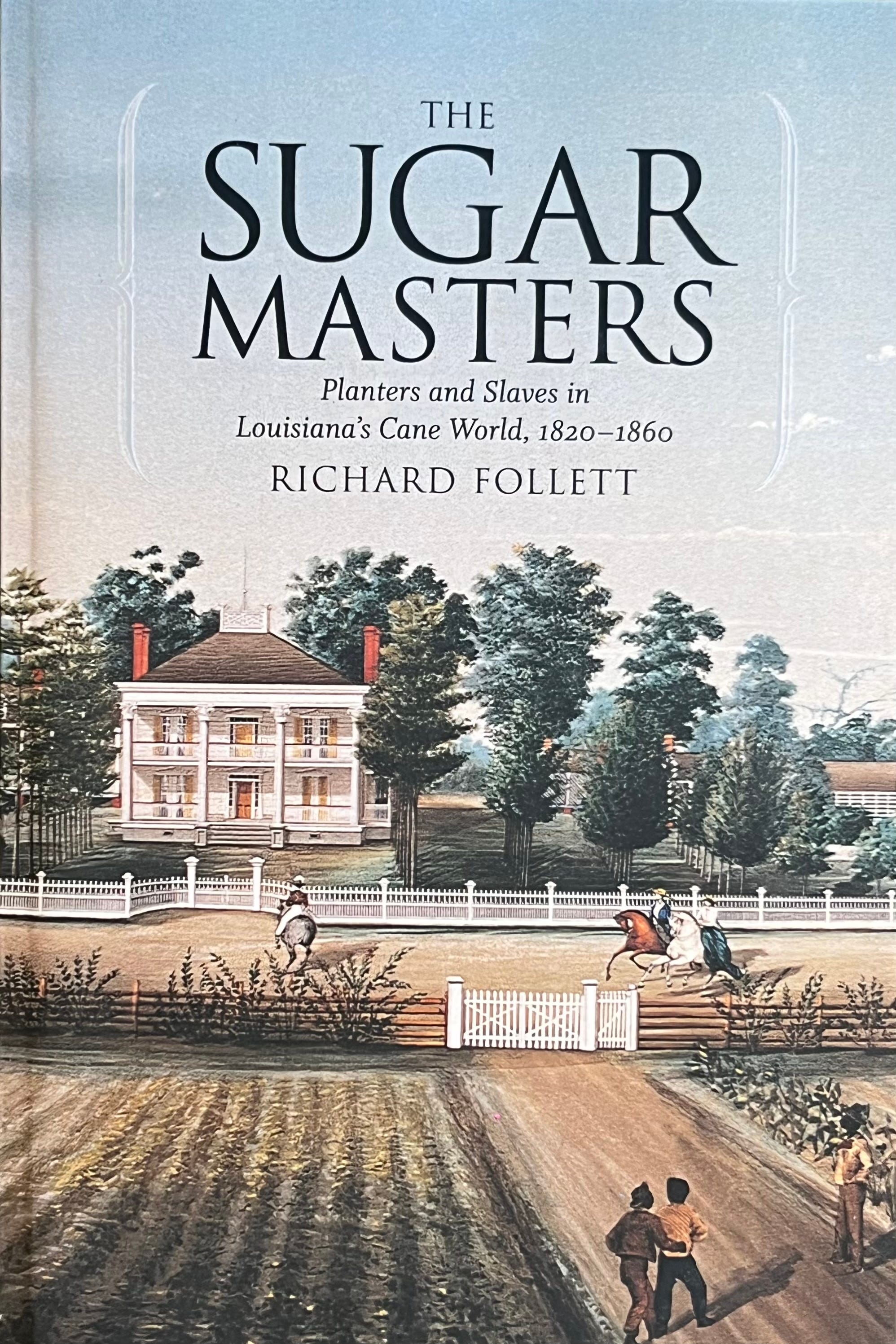
I will start by placing the bad news upfront (note: bad, only to me). There is no mention of rum in this book. However, I’ve chosen to take the purist approach. Which is to say that if we want to get to the beverage, we must go on the agricultural rite of passage: explore the hell out of the raw material (sugarcane) that produces rum. I remain unconvinced that any land where cane was crushed in significant proportion does not also have a consequential cane spirit/rum history; We’ll have to continue digging, that’s all.
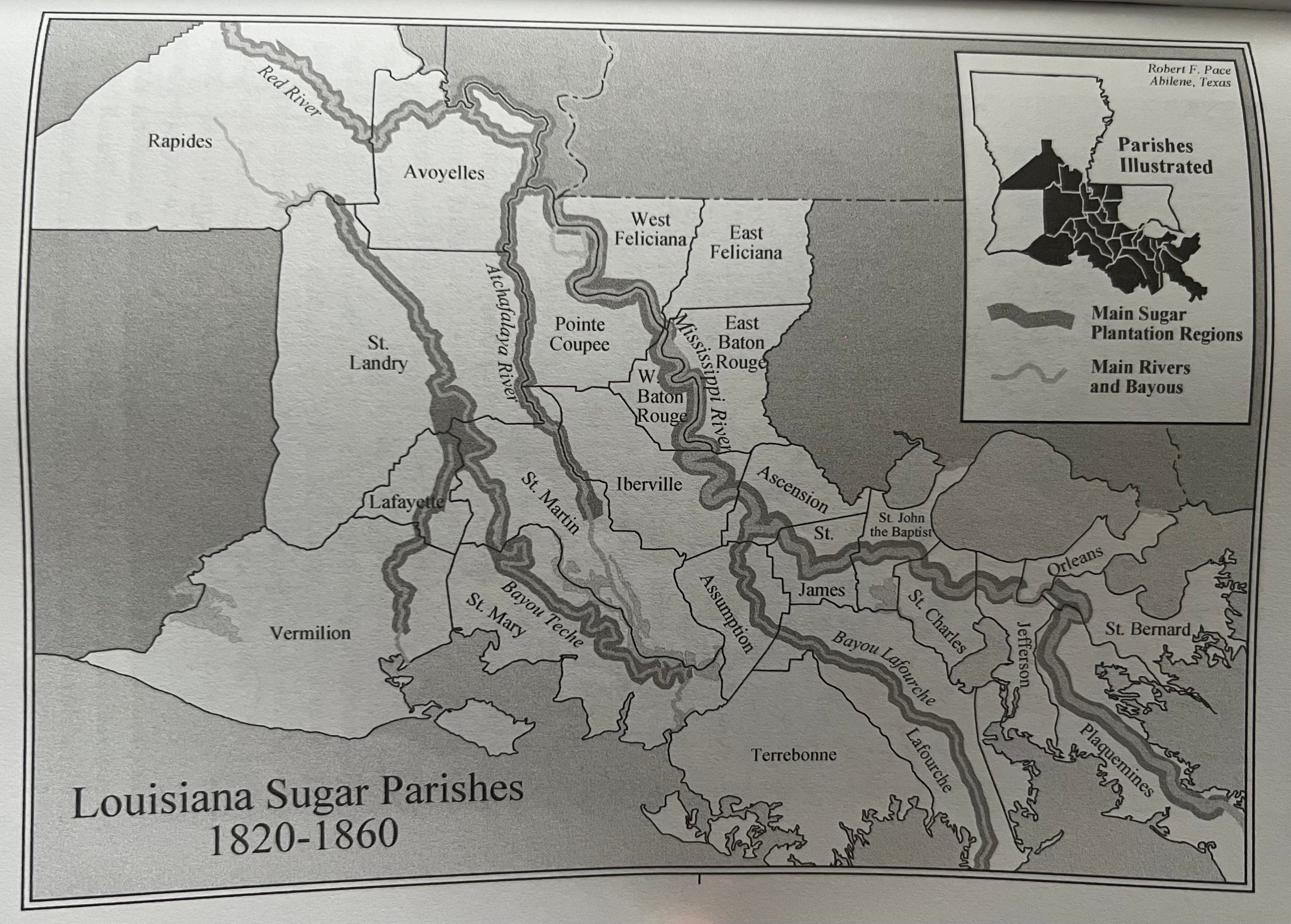
With The Sugar Masters, we’ll be going on a 40-year journey (1820 – 1860, more or less), covering a very specific paradigm – the master-enslaved relationship in Antebellum cane country, Louisiana. That European, feudalistic know-how that took on its own horns when it developed on New World soil, though one can argue that the European flair was stickier in Louisiana, given the French influence (reminder: Louisiana Purchase was in 1803). Follet dubbed the slavemaster’s modus operandi as being laced with “[p]atriarchal sway.” Tie that in with ruthless capitalistic ambitions, and you had a plantation system that was “manipulative” and “wholly oppressive.” All under the “semicapitalist” paternalism (i.e., hybrid culture) of the “Old South.”
In most economic histories of the agricultural variety, we see that being king of the dollar bill, and what comes with it — status, power, more dollars — usually supercedes moral, ethical, and humanitarian considerations. Follet points out that the dollar chasers were in a deep psychosis that manifested in their unrelenting actualization of the reality they desired.
In the author’s words –
This study examines the planters’ “turn of mind” in Louisiana’s antebellum sugar country. Shrewdly capitalist in their business affairs, the sugar masters defended slavery as an organic institution, and idealized hierarchy in which the slaveholders stood at the apex of society. The fantasy, however, did not preclude them from viewing their slaves as proficient in capable sugar workers who could be readily exploited. As aggressive promoters of the most industrialized sector of southern agriculture, the sugar [m]asters found a few discrepancies between the personae as slaveholders and as thoroughly modern businessman who transformed the swampy landscape of the lower Mississippi Valley into a rich and productive plantation belt.
The transformation Follett describes is labor-management practices that mirror contemporary business operations. In cane country, you had factory-like plantations with labor bifurcated by skill set. If you’ve read any of my pieces on sugarcane plantations in the Caribbean, then it will come as no surprise that the labor organization and profile of the operations were similar (e.g., gangs) in Louisiana as they were in the West Indies. These things are best understood as global industries vs. regional phenomena. In other words, Louisiana plantation owners would have looked to people and places that had already gotten the slave-cane model right and then molded it to fit Louisiana. Understanding what happened in Jamaica, Barbados, Cuba, Haiti, Martinique, etc., would have been par for the course for the plantocracy –
…Louisiana’s sugar country evolved as a hybrid region that combined aspects of Caribbean and American slavery. The plantation elite drew upon the slaveholding culture of the American South and northern business practices, and it matched the cold-blooded exploitation of the West Indian sugar lords.
Before we dive into the heavy details, it’s worth opening your visual imagination with a (qualitative) painting of the work performed by the enslaved.’s needs–
In the spring and early summer, slaves hoed and chopped away the weeds that grew among the sprouting canes. By mid-June or early July, the cane shoots were robust enough to survive without constant attention. During this lay-by, when canes required no cultivation, slaves turned to a myriad of maintenance tasks—the cultivation of corn, the collection of wood, and the ever-constant maintenance of the levees—which kept the destructive power of the Mississippi and its tributaries in check.
→ Early autumn, harvest preparations are completed before the grinding season
→ [THE MOST IMPORTANT PERIOD] Grinding season, mid-to-late October through January. This season is when the cane is cut, the juice is extracted, and the factory process at the mill converts the juice into sugar.
The seasonal nature of sugar production imposed a forbidding regime on the slaves. It impelled speed through the entire production process and placed a premium on discipline, organization, and labor stability during the grinding season. The exigencies of cane farming obliged planters to mechanize…
Sugarcane and Mother Nature, the latter of which is incredibly relevant for Louisiana’s cane survival prospects, continue to prove that the crop is the dictator of all things. If you search for details on what the grinding season looks like today, it will essentially be the same (timeframe, methods, etc.), save for the more technologically advanced methods of reaching the sugar finish line.
Let us begin with one of the New World’s last (if not the last) sugarcane colonies, by way of the relationship between the enslaved and the enslaver. But before we do so, the author.
Richard Follett.
First and foremost, Follett is a damn good researcher. That, or he’s incredibly adept at finding great researchers to assist him. Maybe all the above. Regardless, The Sugar Masters is a testament to what outstanding research can achieve.
What immediately stands out with Richy F is that he’s not American. Slow down, give big Rich a chance. He is a UK-er through and through, brought up primarily in Bangor, Wales, and Bristol, England. His bio on the University of Exeter website notes that he had “spells in the United States,” which I then had to figure out just exactly what that meant.
To LinkedIn we go:
He started his formal academic journey at Swansea University (Wales), where he focused on History and American Studies.
In the middle of that, he went to the University of Indiana (Urbana-Champaign). My guess is this was a study abroad where he got the field work in (gotta see the place you’re studying after all).
University of London for a master’s degree (American History).
Fulbright Scholar/PhD completed at Louisiana State University (American History) in 1997. BINGO!
An overview of all things post-PhD –
From 1997-1999, Follett was on the faculty at the National University of Ireland, Galway before joining the University of Sussex where he taught between 1999 and 2022. Richard was appointed to a Professorial Chair in 2011. – U of Exeter
Richard Follett is Vice President and Deputy Vice Chancellor (Global) at the University of Exeter. He is Professor of American History and a specialist on the history of slavery and emancipation in the United States. Richard enjoys a strong international reputation for his scholarship and public engagement work. He is a multi-award winning scholar and an elected fellow of the Royal Historical Society (FRHistSoc). – U of Exeter

Alright, let’s get into Follett’s work.
Who in the world are (were) sugar masters?
In 1860, the productive thrust of the Louisiana sugar industry lay in the hands of William Weeks, John Hampden Randolph, and approximately five hundred elite sugar masters who controlled over two-thirds of the slaves and available acreage in Louisiana’s cane world. Although these planters represented less than 13 percent of the slaveholders in the sugar parishes, they produced three-quarters of the region’s cane yield.
In the history of all that is capitalism, it seems generally true that a small portion tends to control the lion’s share. Let’s focus on one of the names above: Weeks. David Weeks acquired Grand Côte Plantation in 1814. By 1850, David was a sugar magnate, and his son, William F. Weeks, was right by his side. That year, their plantation yielded almost 400 hogsheads of sugar, produced by 200 enslaved people across 2,000 acres of land. Their operation was known to have a “superior” sugar mill. By 1858, the Weeks’ operation yielded 711 hogsheads.
What spurred this near-80% growth, in part, was the scale of “industrial transformation that the planters orchestrated throughout south Louisiana.” Everything from the implementation of new technology, such as Norbert Rillieux’s multiple-effect vacuum pan to better heat/create higher grades of sugar, and the implementation of steam power in mills, to rigid attention to plantation management and organization of labor. To keep us honest, these rapid transformations were the practice of the economically well-off. Less affluent planters made do with lower-scale/rudimentary technology, if not outright dependence on manual labor. Understandably, there was an unwillingness to gamble based on tomorrow’s technology –
…almost 90 percent of planters continued to produce sugar in open kettles.
The plantocracy received much praise, noting that, despite climatic limitations on cultivation in south Louisiana, the latest technology was procured, and the newest science was practiced. In short, they were forward-thinking when many remained complacent. In truth, wealth afforded them the room to look ahead.
Publications such as the Louisiana Gazette published rosy economic portrayals of the profit potential associated with sugar operations to attract more planter aspirants to the region. To me, this was ripping a page out of the British playbook: early colonial publications/advertisements circulated to encourage aspirants to flock to the New World colonies, set up sugar plantation operations, and be part of that era’s gold (sugar) rush. All to say, the advertising worked –
…Anglo-Americans flocked to the sugar belt to cash in on Louisiana’s apparent riches and for the chance to double or triple their fortunes in the process
Practically speaking, local and global capital markets also supported the sugar industry. In 1840, “Louisiana ranked third in banking capital (after New York and Massachusetts),” with New Orleans serving as the hub. The volume of bank loans in New Orleans went from $18.6 million in 1850 to $31 million in 1856. Across the pond, British lenders extended their credit lines to get in on this southwestern expansion of the US’s tentacles. In effect, much like the early investment/rush to the Caribbean’s sugar aisle, Louisiana became part of a transatlantic operation, fueled by the capital and capitalism of dollars coming from near and far –
By the eve of the Civil War…Louisiana’s sugar industry was the most heavily capitalized and investment-rich agricultural region in the country.
By 1844, Louisiana’s cane industry was valued at $60 million. The elite planters gradually squeezed out the majority, given the increasing and prohibitive entry costs characteristic of the sugar business. Those who remained often went to “New Orleans, [b]anks or…fused their assets through capital-accumulating partnerships.” In the 1840s, Cooperative estates were formed, mainly through mergers, which spread the risk of enterprise across many planters. The insurance model.
One commonality shared among the planter class, irrespective of wealth, was a firm belief in the caste system that sustained life in cane country. White identities in these areas were “anchored firmly in slaveholding.” Another explanation Louisiana planters used to defend the peculiar institution was to say that slavery was “a strategic necessity that saved the consumer thousands of dollars.” In other words, lower labor costs meant that plantation owners did not have to raise prices to account for paying workers.
The planter elite locked themselves into a psychological and real cycle of self-aggrandizement. They lacked the resolve/foresight to get out of their own way when circumstances required them to shift. Instead, the wealthy planters allocated funds primarily to self-expansion and protection (e.g., investment in the local militia to protect their assets). On the latter, the wealthy planters fortified the social hierarchy by bringing less well-off (and poor) Whites into the machine. Feudalism’s adaptation to Louisiana was in full force –
…their identity as slaveholders ultimately defined progress in the sugar world…slaveholders remained wedded to individualistic notions of progress…Capital expenditure on a plantation mansion, more slaves, or the latest machinery heightened the planters’ sense of mastery over land, labor, and sugar; public investment, on the other hand, did little to exalt their power.
But crop does not bend to man, no matter how much you try to control it or the forces around the plant. Couple this reality with a demanding world that requires more of your output; the planters were guaranteed steep hurdles. In other words, the global predilection for sweetened foods and drinks eventually overwhelmed the capacity of sugar producers in Louisiana. Unfortunately, that significant domestic demand became a mixed signal: planters led to believe that all they needed to do was work harder. A vicious feedback loop.
But here are examples of what will take place when things go wrong, as they eventually will –
When the crops failed in 1855 and 1856, merchants simply filled the void with Caribbean sugar.
By the eve of succession, Cuban and Puerto Rican imports surpassed the entirety of Louisiana’s increasingly marginal crop.
The high degree of substitution made it apparent that Louisiana had a weak position in the domestic market and relative insignificance on a global scale.
The people on the other side of the paradigm.
“I come up in hard times—slavery times. Everybody worked, young, an ole’, if yo’ could carry two or three sugar cane yo’ worked. Sunday, Monday, it all de same…it like a heathen part o’ de country.” – Interview with Cecil George, a former slave, in 1940 (LSU archives)
In the cane world, exploitation for profit was the norm. Youth and male were prioritized, as evidenced by the fact that “males constituted 70 percent of all slaves imported to New Orleans.” Most of the young boys (and girls) selected for bondage were in what would have been considered prime age ranges of 17—24 and 13—20, respectively; younger for the girls because they could be forced to have babies (i.e., future labor for the plantation).
Bondswomen worked in the fields and mill house as well, but for the sugar masters, they were seen mainly through the prism of reproductive capabilities (“breeding wenches”). For other women, serving as a source of pleasure was their fate: some planters patronized “fancy-girl markets,” where they “paid up to $5,000 to satiate their desires for young concubines who would enhance their sense of power and prestige.”
“The young masters were criminally intimate with the negro girls; it was their custom…practice of copulation was so frequent…” — J.B. (Jean Baptiste) Roudanez
Many young, enslaved women delivered their first infants at around 16 1/2 years old. Most women delivered a child every 24 months, with the average woman carrying seven babies to term during a “reproductive career” (yikes) that began in their mid-teens and came to a close by 35 or so. Planters methodically engineered this “career” to suit their needs. One example: no suckling, newborns sent off to wet nurses immediately following birth so that the mother would easily impregnate again.
J.B. Roudanez also reported that women worked right up to the point of delivery and immediately after. Commercial concerns took precedence over health, as would be expected for a group classified as property. For instance, during whippings (punishments), a woman’s belly was protected (i.e., she lay face down in a carved out patch where the stomach had a specific coverage area) “‘cause the children were worth money.’” There is substantial historical evidence supporting this practice, from the Caribbean to the USA.
As you can imagine, the women were not always cooperative. Rebellion, often covert, was common –
…black women…wove contraception through the dark fabric of slave oppositional culture. Whether swallowing abortifacients such as calomel and turpentine or chewing on natural contraceptives like cotton roots, slaves ingested homemade remedies that provoked a miscarriage.
Check out Toni Morrison’s “Beloved” for a glimpse into a great piece of work that highlights what’s discussed in the previous quote. Note: I talk more about women’s experiences compared to men’s because enslaved men’s stories are readily documented. If you’re interested in diving deeper into the topic, check out my piece on Rose Hall Plantation, Jamaica.
As the Civil War neared, and global competition increased, the cost of “field hand[s]” went from $700 (1850) to $1,000 (1856). By the eve of the War, the price jumped to $400. Some tried to make their way around this by calling for the revival of the Atlantic trade, and, in some cases, engaging in contraband trading from Africa via Cuba. Note: Cuba was one of the last countries to abolish slavery (1886) in the Americas.
When that pipeline did not satiate their needs, the plantation owners relinquished their gender biases and began “investing” in women and slightly older slaves, a practice they would have denounced entirely before reality forced their hands.
The only group that faced similarly bleak prospects in south Louisiana was the Irish –
Only the Irish sank as low on the sliding scale of Anglo-American condescension. Savagely exploited by English landlords and the British state in their homeland, Irish immigrants faced treacherous employment as ditchers and delvers for Louisiana’s sugar lords.
“It was much cheaper to have Irish to do it, who cost nothing to the planter…” — John Burnside’s overseer
All sorts of schemes were cooked up to alleviate the labor shortages that plantation owners faced. There were “active slave rental market[s]” for those who may not have had the means to purchase expensive labor. Post-Civil War, Italian and Chinese labor were imported as substitutes for Black labor. That did not work out in the long run. We’ll talk more about Chinese labor when I cover this book –
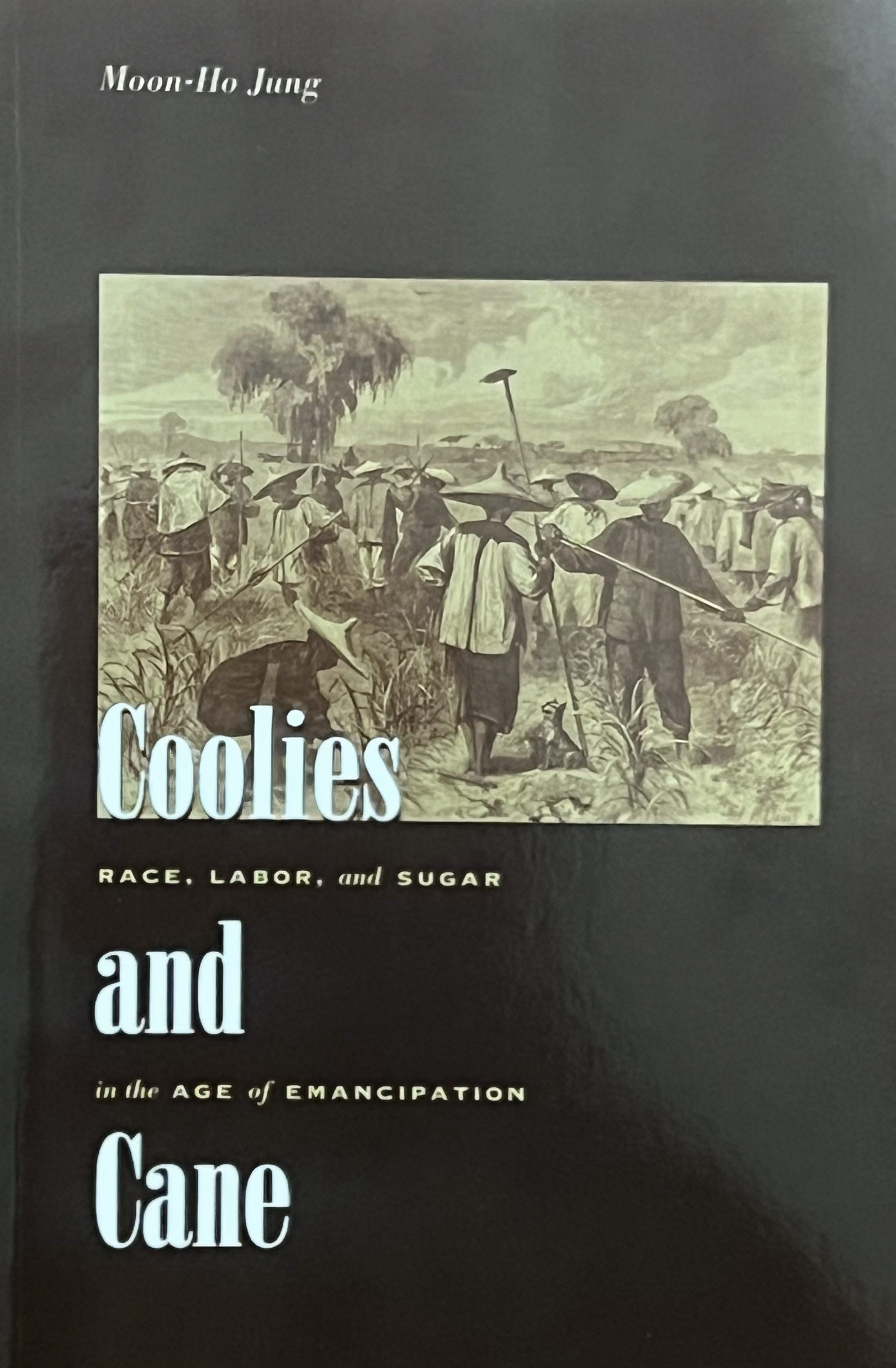
The limits of the human body (i.e., the depletion of substitute labor), the seasonal nature of cane cultivation, and the illegality of sourcing labor from the African continent forced plantation owners to zero in on making their operations more efficient, squeezing as much juice as they could get. With that, they turned to labor maximization/optimization and technology, as earlier alluded to.
Southerners adopting northern ways.
For most of the 125,000 slaves who labored in Louisiana’s cane fields prior to the Civil War, sugar production had been transformed within their lifetimes. The new steam-powered mills…frequently equipped with mechanical cane carriers that slaves fed with a steady supply of cane…these constantly moving conveyor belts established an early form of assembly-line production.
…the antebellum sugar mill stood with a transitional phase of industrial development, anchored in the social relations of slavery though mimicking aspects of northern capitalism.
New technology increased sugar production. The mechanization of sugar production now aided the manual process of cutting cane. Labor was split into regimented, classified gangs. Children were called the “suckling gang” (yikes). Older, “ruptured” enslaved people were often used as cooks, gardeners, nurses, carpenters, etc. Women were relegated to “hoe gangs,” characterized by simpler/lighter farm work. During the grinding season, enslaved people labored 18 to 20 hours a day, a “punishing order,” to say the least.
Follett highlights the Estate managers’ journals to demonstrate the precision of cane plantation operations. Journal entries ranged from employers’ fixation with record-keeping, daily activities, labor allocation, division of time, birth dates, deaths, and birthing intervals (i.e., to identify good breeders), among a host of other concerns.
“There is in a large and respectable plantation as much precision in the rules, as much exactness in the times of going to sleep, awakening, going to labor, and resting before and after meals, as in a garrison under military discipline, or in a ship of war.” – Timothy Flint, reflection after a 1820s tour of the sugar country
Plantation bells and signals dictated the flow of movement and work schedules. The bell’s commander required 100% obedience –
Bells and whistles demarcated the working day and codified a precise, organized vision of labor in which discipline and regularity advanced at the inexorable pace of the clock and according to the slaveholder’s behest.
Many of these practices were borrowed from northern industrial operations, which allowed the planters to flex their apparent modernity muscles. Note: Bells and horns were also prominent features of Caribbean sugar plantations. The image enslavers had of themselves needed to be sustained. A show of ‘being with the times,’ as it relates to labor practices and technology, would have gelled with their sense of being in total control.
The author dutifully notes that, although historians have tried to show the fracture between capitalism and slavery over the years, Louisiana’s operations revealed more of a convergence. Same stripes, different animal.
The relationship changes when the output improves.
Through a network of compensation systems, slaves and slaveholders negotiated a series of compromises in which bonds people accommodated the machine age and secured their labor stability in return for prerogatives that extended African American rights on the mill floor and in the plantation commissary.
This “mutualism” enhanced the enslaved’s living conditions and autonomy. The development and practice of more skilled labor – craftsmen, teamsters, coopers, carpenters, masons, engineers, and sugar makers – allowed (mostly men) to ascend to positions of technical and managerial importance on sugar estates. This was strategic for plantation owners because it allowed them to develop in-home, long-term skills. Also, to “avoid the racially destabilizing presence of whites on the plantation.”
Historically, technically skilled positions were outsourced to white laborers. However, plantation owners thought them to be both itinerant and detrimental to slave discipline, which just means that they could not be controlled as easily. By now allowing the enslaved to develop these skillsets, plantation owners created a frustrated, displaced class of White workers during the antebellum era. Engineering a deep-seated race-class hatred played to the benefit of the plantation owners who could utilize the frustrated White workers for their own employment in the plantation system; This also played into some of the brutality that became organic to plantation operations. Strategic beyond comprehension.
More than any other factor, the sugar masters prioritized their wallets (i.e., saving money). Skilled (White) work could fetch $450 per season, or up to $3,000 on larger estates. If the plantation owner could repurpose slave labor into a higher order of work, they were going to do so, for no other reason than it cost less.
Nonetheless, the Black skilled enslaved people enjoyed semi-autonomous lifestyles because of their skillsets, eking out slightly more bargaining power/positioning than field hands. This elevated status was enjoyed pre-and post-emancipation. To be absolutely clear, this skilled-unskilled situation was very gendered: men dominated technical roles. Women were rarely (if ever) allowed to assume sugar maker or engineer status.
Plantation owners also provided more free time, since mechanization produced sugar faster and more efficiently. It became a crude game of give-and-take. All in the name of coercing labor into toiling for the plantation as earnestly as possible –
Slaveholders…knew from their extensive experience of paying African Americans for overtime work or the produce of their gardens that slaves seemed to work more diligently for themselves when the promise of wages, scrip, or credit lay in the offing. The challenge slaveholders confronted was to harness that energy for the plantation economy and to establish a compensation system of positive and negative incentives that would stimulate the slaves to toil even harder in the cane fields.
In addition to various types of payment, slaves and slavemasters negotiated specific holidays, improved housing, and the provision of whiskey and other goods for post-harvest celebrations. Each of these incentives served as part of a broader compensation system designed to maximize effort through the harvest season.
Whenever the give-and-take did not produce the results the plantation owner(s) were looking for, they resorted to old methods (“stocks, iron braces, and other ghastly tools in the planter’s armory of regulatory devices”). But the raw truth was that the implementation of mechanization and all other attempts to future-proof the sugar business were improvements that could not be undone. In other words, the relationship between enslaver and enslaved had a firm mutualism component that could no longer be ignored or brutalized away.
Yet no amount of additional earnings or goods procured changed the underlying dynamics of the relationship. The plantation owner’s short-term remuneration/benefits were understandably exploitative. What Follett dubbed “the veneer…of compensation.” In short, the brunt of slavery was still going to be felt by those under its shackles. Escaping sugar country (the South, broadly) was almost impossible because of the power of the local militia/Whites –
Patrols prowled the cane-producing parishes with fearsome regularity, and the criminal code was punitive toward slaves.
But resistance – on and off the plantation – was still a reality. What the author describes in the book demonstrates that those who were enslaved made sagaciously strategic efforts at disrupting the plantations’ operations:
Running away in November (during the middle of grinding season, where any disruption could guarantee a massive loss for the plantation owner).
Stealthy and intentional acts of sabotage (unscrewing and dismantling hardware at the mill, selling expensive items on the plantation to petty traders on the rivers and bayous, etc.).
“…we found several rents in the first boilers—it took five days to repair damages…but the syrup in the tanks and filters got sour and we made sugar of inferior quality for several days.” – H.B. Trist, Bowdon Plantation in Ascension Parish
Stealing food supplies (e.g., chicken theft was rampant on Ellendale Plantation).
Remembering the days on Lasco Plantation, former slave Albert Patterson emphasized the slaves’ communal resistance…when he recounted how fugitives would return to the plantation and break into the meat house. Explaining how the runaways evaded the ever-present dogs, Patterson recollected that they “put bay leaves on de bottom of their feet and shoes” before walking in manure in order to disguise their scent and mislead the hounds. That way, the former bondsman reported, a fugitive man could come and see his family and obtain a meal come nightfall.”
Paternalism.
In parts of the South before and after emancipation, a system of market paternalism served to motivate workers, reduce monitoring costs, and reaffirm the planters’ class power. Market paternalism, one historian argues, “must be built upon an illusion which conceals the commercially oriented nature of the employment contract.” Slaveholders accordingly had to veil their economically focused incentives beneath a façade of paternal reciprocity that seemingly bound the slave and his or her interests to the goodwill of the master…the sheen of paternalism.
Mutualism under the master-slave paradigm was a farce. The enslaved sold their labor for benefits (money, rewards, incentives, etc.). But these were imaginary gains in the grand scheme. Gains that ensured the enslaved never caught up with the master, but still labored to enrich the plantation owner. The feeling of inching forward in life, just a little bit, was what the owner relied on to keep the masses satisfied. But also, and this is not to be downplayed, the plantation owners were also psychologically soothing themselves, since they were fully bought into the idea of their being rulers of all things.
Christmas bonuses, for example, were regarded by plantation owners as a manifestation of their benevolence and Christian generosity. In truth, the Christmas bonuses were purely an attempt to make enslaved people work harder, police themselves, and forge a multi-chain dependency between them and the monetary interest of the planter.
Celebrations were another illusion. Hallmarks, such as a good cane cutting/grinding season, would result in much cheer, singing, and dancing (done by the enslaved) on the masters’ mansion steps. For those who were particularly strict, the celebration would presumably take place elsewhere on the plantation; The big house being too close for comfort. Here’s a firsthand view of the twisted nature of it all, though the people of the time would have seen this as normal –
Former slave Caroline Wright, who grew up on Warren Wortham’s plantation, likewise recalled that at Christmas, “The white folks give [allus] us presents and plenty to eat…slaves had a big dance “five or six times a year” and “de young missus learned us our ABC’s.” Caroline’s focus on her master’s generosity underscored the intensity of the paternalist bonds, which turned the meal and gifts into acts of bestowal.
Interestingly, alcohol distribution was heavily policed since it was believed that “whiskey might [enable] enslaved people’s self-consciousness, prompting many to question their condition and voice their resentment. Slaves [were] thus frequently banned from consuming alcohol.” At this juncture, I was scraping the pages for references to rum, but had to remind myself that I was, timeline-wise, well out of American Revolution territory. In other words, no luck. EVEN IN CANE COUNTRY. My only assumption, upon the heartbreaking discovery, was to hypothesize that rum, or some form of cane spirit, was being produced incognito by the enslaved. They were already so close to the operation anyhow. Let’s move on.
What Follet does note is that, practically, a lot of illicit drinking took place among those enslaved. They often traded along rivers with peddlers, which frustrated plantation owners because goods were sold at steeply discounted prices. Well, discounted to the plantation owner. If you can’t have something, it’s premium to you. As a call back to my last piece, I wonder if Leon Godchaux ever peddled in the way that Follett outlines.
One method the plantation owners undertook to intervene in the above goods-for-whiskey trade was to rely on bargaining chips and bending the reliance dynamic even further in the slavemaster’s direction. Given that whiskey became a form of currency-for-labor, the slavemaster began to utilize the liquid as a way to increase productivity, cut in on the peddlers’ prices, and do whatever else was necessary to ensure they had the better bargaining chips. To the extent that this worked in practice, I have no idea, but I can understand why it would have been a new tool in the arsenal. More than anything else, peddlers introduced the enslaved to the outside world, new ideas, and what-could-be. An unsavory reality for plantation owners.
But again, when all methods of conning did not work, they resorted to the lash, usually by way of the overseer they put in place. Men, we can assume, who were deeply miserable, by design of plantation operations, and took this frustration out on the helpless. John A. Hamilton, who “applied the lash with venom,” complained about the enslaved, saying, “To fight negroes nearly kills me—damn their skins I wish they were all in Africa.” And to that, we can also say that they were generally unaware of how the economics of their situation worked; No “negroes,” no money, no job for the overseer.
Some were more violent, “punching their [enslaved’s] faces and striking their sides, heads, and bodies.” Torture and fatal shootings were not off the table, especially for those who felt that there should be zero challenge to their authority. Daffney Johnson, formerly enslaved, “recalled that slaves were stripped to the waist before cats were released to claw and scratch “de blood out of our backs.” Others…faced brutal disfigurement.” Hangings were common, with bodies often left for display, and/or the person was buried nearby for everyone to walk by and see. Such was the case for a runaway who was known as “Old lady Carter.”
Just north of the Caribbean.
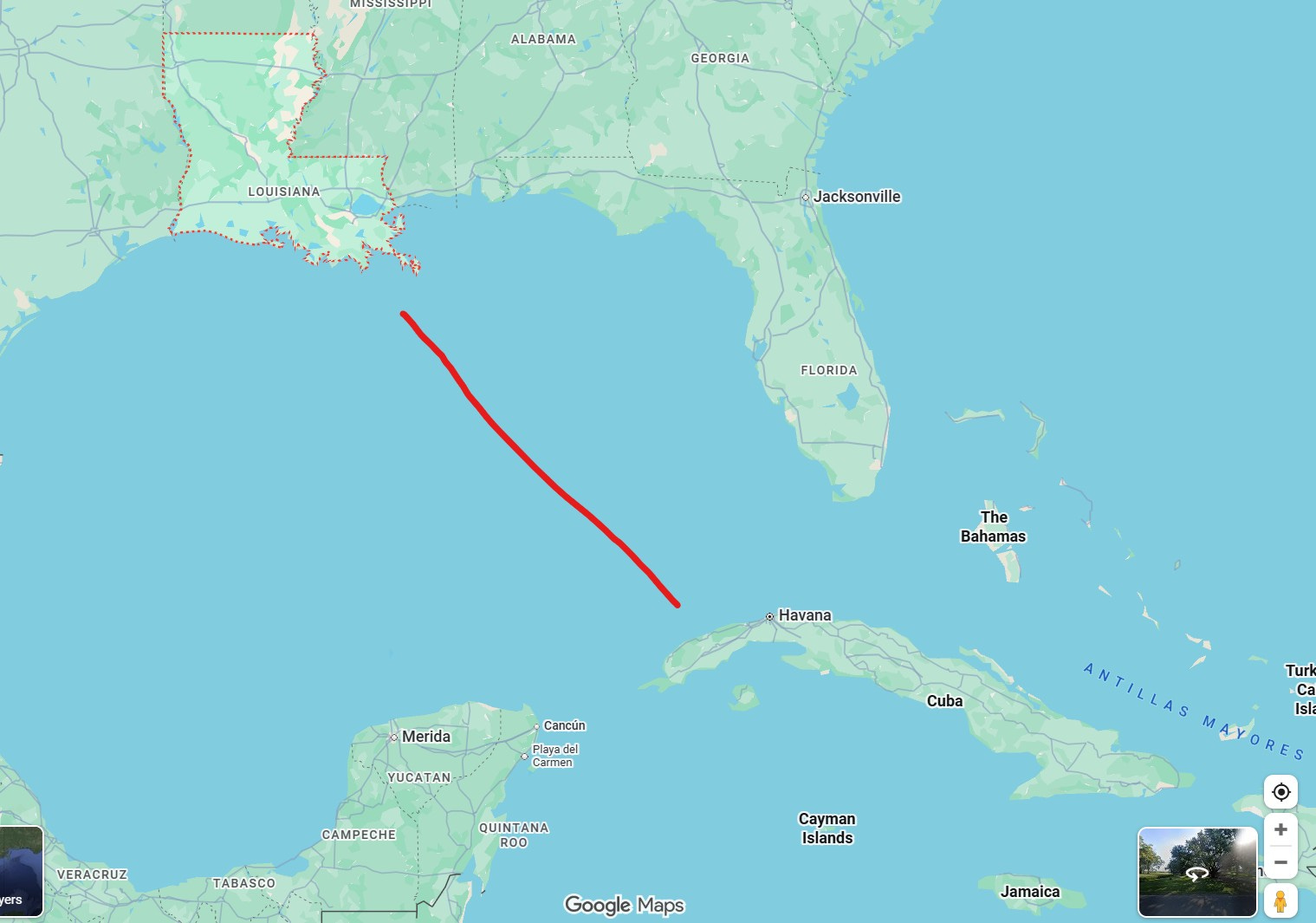
The plantation commissary –
The establishment of plantation-owned stores and rum shops heightened the effectiveness of this system. Company stores and rum shops sold great amounts of rum to laborers, which created a large body of debt peons and ensured a stable workforce. Workers were compelled to return the next week or harvest in order to pay off their debts.
Now, the glaring giveaway to alert you that the quote is not from The Sugar Masters is that the greatest spirit known to humankind rum is mentioned. The above comes from Frederick H. Smith’s Caribbean Rum. However, back to the title of this section, this was replicated in Louisiana because shared knowledge was kicked around, demonstrating the effectiveness of this system. Follett notes that the enslaved often engaged in “overwork,” or what we today call overtime. But the truth driving “overwork” was as follows –
…if a slave ran into debt at the estate commissary or store, planters could utilize overtime work to force him or her to clear the account. In short…another tool with which to discipline their workers.
Overwork and the plantation store(s) had multiple, beneficial impacts for the plantation (owner):
Dependence on the plantation for subsistence
Attachment to a home base
Enslaved growing their own corn and livestock to feed themselves, relieving the owner from doing so (some of the overwork went to tending their own plots)
The author spends a good deal of time also discussing topics of resistance and identity that are worth further exploration:
→ Self-empowerment through using currency to buy different clothes than what was given by the plantation owner (i.e., development of African-American fashion)
Whether in the Caribbean, in Louisiana, or elsewhere in America, bondspeople utilized their corn patches, poultry hutches, and free time to develop a flourishing internal market economy. Receiving payment for their produce…slaves derived both material and cultural capital from producing and trading their own commodities.
→ African freedom/rejoice through rhythm and dance
→ Blending and molding religious practices across denominations, while also borrowing from the enslaved who were sold to Louisiana from up north
→ Voodoo, which remained a predominantly New Orleans phenomenon, according to Follett
We’ll close with the author’s thought-provoking, seemingly disappointed tone regarding how things ultimately panned out. Sure to inspire necessary debates/interrogations, I’d like to think –
African Americans utilized their new expectations and duties within slavery to advance their own agenda, but by accommodating the planters, black Louisianans inadvertently and tragically fortified the sugar masters’ power and sway.
Or, as Audre Lorde once said –
…the master’s tools will never dismantle the master’s house.
There you have it folks.
Just remember,
in all that you do, please, don’t ever stop reading.

I really love how detailed and thoughtful these are. I learn so much but they’re still balanced with humor and light and a push to dive deeper into the things I enjoy on my own. I’m also going to New Orleans next week and I’m gonna make it a priority to try a rum from there.